Ch. 16 Therapy and Treatments
 Studied by 0 people
 Call Kai
 Learn
Learn Practice Test
 Spaced Repetition
 Match
Match Flashcards
 Knowt Play
1/32

There's no tags or description
Looks like no tags are added yet.
Name | Mastery | Learn | Test | Matching | Spaced | Call with Kai |
|---|
No analytics yet
Send a link to your students to track their progress
33 Terms
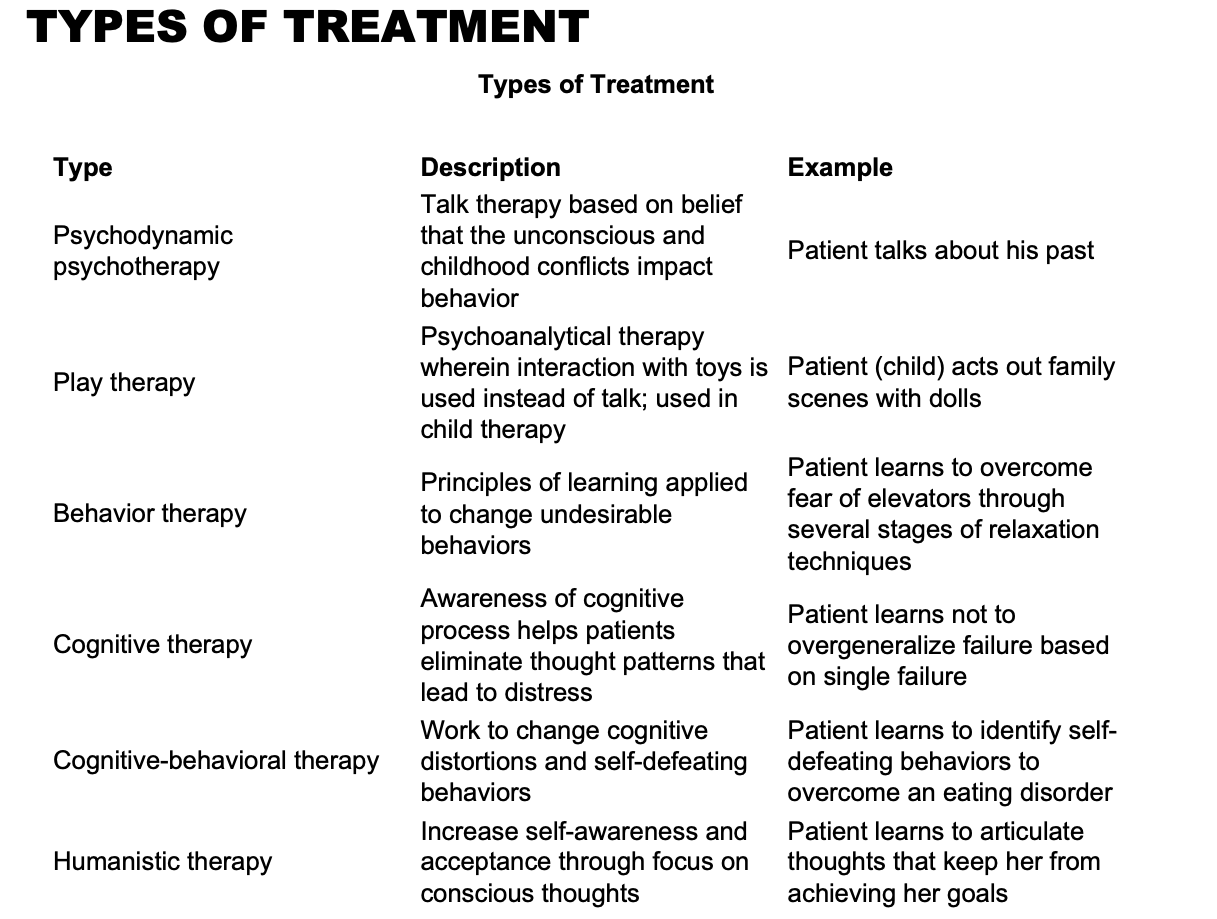
TYPES OF TREATMENT
Psychotherapy
Behavior Therapy
Cognitive Therapy
Cognitive-Behavioral Therapy
Humanistic Therapy
PSYCHOANALYSIS Techniques
the first form of psychotherapy created by Sigmund Freud.
It focuses on uncovering hidden, unconscious feelings, usually from childhood, that influence current behavior.
Main Techniques
Free Association
The patient relaxes and says anything that comes to mind, without filtering.
The idea: unconscious thoughts and feelings will “slip out.”
Dream Analysis
therapist interprets the hidden meaning (latent) behind the patient’s dreams because Freud believed dreams reveal unconscious desires or fears.
Example:
A patient dreams of being chased → the therapist might interpret this as the patient avoiding a stressful issue in real life.
Resistance
When the patient tries to block or avoid painful or unacceptable thoughts during therapy.
Freud believed resistance showed the therapy was getting close to important unconscious material.
Example:
A patient keeps changing the subject whenever childhood issues are mentioned.
Transference
The patient transfers feelings they had toward important people in their life (parents, partners, etc.) onto the therapist.
Example:
A patient begins treating the therapist like their father—feeling anger or seeking approval—allowing them to work through unresolved emotions.
Free association
psychoanalytic technique
where the patient relaxes and says whatever comes to mind, without filtering or censoring their thoughts.
Freud believed this helps uncover unconscious feelings, memories, and conflicts.
Example:
A therapist says:
“Just say anything that comes to your mind.”
The patient responds:
“I see a blue room… reminds me of school… my mom yelled at me… I feel nervous…”
Even if the thoughts seem random, the therapist uses them to discover deeper emotional issues.
Dream analysis
psychoanalytic technique
where the therapist interprets the hidden, unconscious meaning behind a patient’s dreams. (Latent)
Freud believed dreams reveal desires, fears, and conflicts that the person may not be aware of while awake.
Example:
A patient dreams they are falling.It seeks to uncover unconscious desires and fears.
The therapist might interpret this as the patient feeling out of control in their real life (such as school, relationships, or stress).
The dream gives clues about emotions the patient may not openly recognize.
Resistance
patient unconsciously blocks or avoids talking about painful, uncomfortable, or threatening thoughts during psychoanalytic therapy.
Freud believed resistance happens because the ego tries to protect the person from upsetting unconscious material.
Resistance appears during free association, when the patient avoids certain topics or suddenly goes blank.
It signals that the therapy is getting close to important unconscious conflicts.
Example:
The therapist asks about the patient’s childhood.
The patient suddenly:changes the subject,
laughs it off,
“forgets,”
becomes silent,
or gets irritated.
These behaviors show resistance—the mind is trying to avoid painful memories.
Transference
when a patient projects or transfers feelings they have toward important people in their life (like a parent, partner, or sibling) onto the therapist during psychoanalytic therapy.
Freud believed this helps reveal unresolved childhood conflicts and emotional patterns.
Feelings transferred can be positive (affection, admiration) or negative (anger, resentment).
It occurs naturally as the patient opens up during therapy.
Therapists use transference to understand the patient’s deeper emotional issues.
Example:
A patient begins treating the therapist like their father, showing the same anger, fear, or desire for approval they feel toward their real father.
This helps the therapist understand unresolved family conflicts that influence the patient’s current behavior.
Behavior Therapy
is a type of psychotherapy that uses principles of learning (classical conditioning + operant conditioning) to change unwanted or unhealthy behaviors.
It focuses on current behavior, not past experiences.
The idea:
If a behavior is learned, it can be unlearned and replaced with a healthier one.
1. Classical Conditioning Techniques
These help people change behaviors by creating new associations.
a. Counterconditioning
Learning a new response to replace an undesired one.
Includes aversive conditioning and exposure therapy.
b. Aversive Conditioning
Uses an unpleasant stimulus to stop an undesirable behavior.
Example: Using Antabuse (substance that causes negative side effects such as vomiting when combined with alcohol) to make alcohol cause nausea.
c. Exposure Therapy
Gradually exposing someone to what they fear so they get used to it.
Used for phobias and anxiety.
Counterconditioning
behavior therapy technique where a person learns a new, healthier response to a stimulus that used to cause an unwanted or unhealthy response.
You replace a bad reaction with a good or neutral reaction.
Counterconditioning includes:
Aversive conditioning
Exposure therapy
Examples
Fear of Dogs → Relaxation Instead of Fear
A person scared of dogs practices deep breathing while being gradually exposed to calm, friendly dogs.
Eventually the fear response is replaced with calmness.
Treating Alcohol Addiction (Aversive Conditioning)
A person takes Antabuse, which causes nausea when alcohol is consumed.
The pleasant feeling of drinking is replaced with discomfort.
Bedwetting Alarm
A child learns to wake up when feeling a full bladder because the alarm goes off when bedwetting starts.
The old response (urinating in sleep) is replaced with waking up
Aversive conditioning
a type of counterconditioning where an unpleasant stimulus is paired with an unwanted behavior to help a person stopthat behavior.
The goal:
Make the unwanted behavior feel unpleasant so the person avoids it.
Examples
Treating Alcohol Addiction with Antabuse
A person takes Antabuse, a medication that causes:
nausea
vomiting
headache
increased heart rate
when alcohol is consumed.
Eventually, drinking becomes associated with feeling sick, not pleasure.
Nail-Biting
A bitter-tasting nail polish is applied.
The unpleasant taste becomes linked to nail-biting, so the person stops.
Smoking
A therapist pairs smoking with a foul odor or discomfort, making cigarettes less appealing.
Exposure therapy
a behavior therapy technique where a person is gradually and repeatedly exposed to the object or situation that causes fear or anxiety, so they eventually become less afraid and more comfortable with it.
Examples
Fear of Elevators
A therapist helps a client by:
Thinking about an elevator
Standing near an elevator
Pressing the button
Riding one floor
Eventually riding calmly to higher floors
Over time, the anxiety decreases.
Example 2: Fear of Spiders
A person with arachnophobia is gradually exposed to spiders in a controlled setting while learning to relax.
Systematic desensitization
a type of exposure therapy where a person learns to stay relaxed while facing gradually increasing levels of a feared object or situation.
The idea:
You cannot be relaxed and afraid at the same time.
So if you learn to stay calm during the fear, the fear response weakens and eventually disappears.Example 1: Fear of Elevators
A person practices deep breathing while imagining pressing an elevator button.
Once they can stay calm, they move on to riding one floor, then several floors.
Over time, the fear fades.
Example 2: Fear of Spiders
A client first looks at pictures of spiders while relaxed → then watches videos → then sees a real spider from far away → eventually holds a small spider.
Each step is paired with calm breathing.
Example 3: Fear of Flying
The client visualizes walking into an airport while relaxed → then sitting in a plane seat → then watching takeoff videos → eventually taking a short flight.
COGNITIVE THERAPY
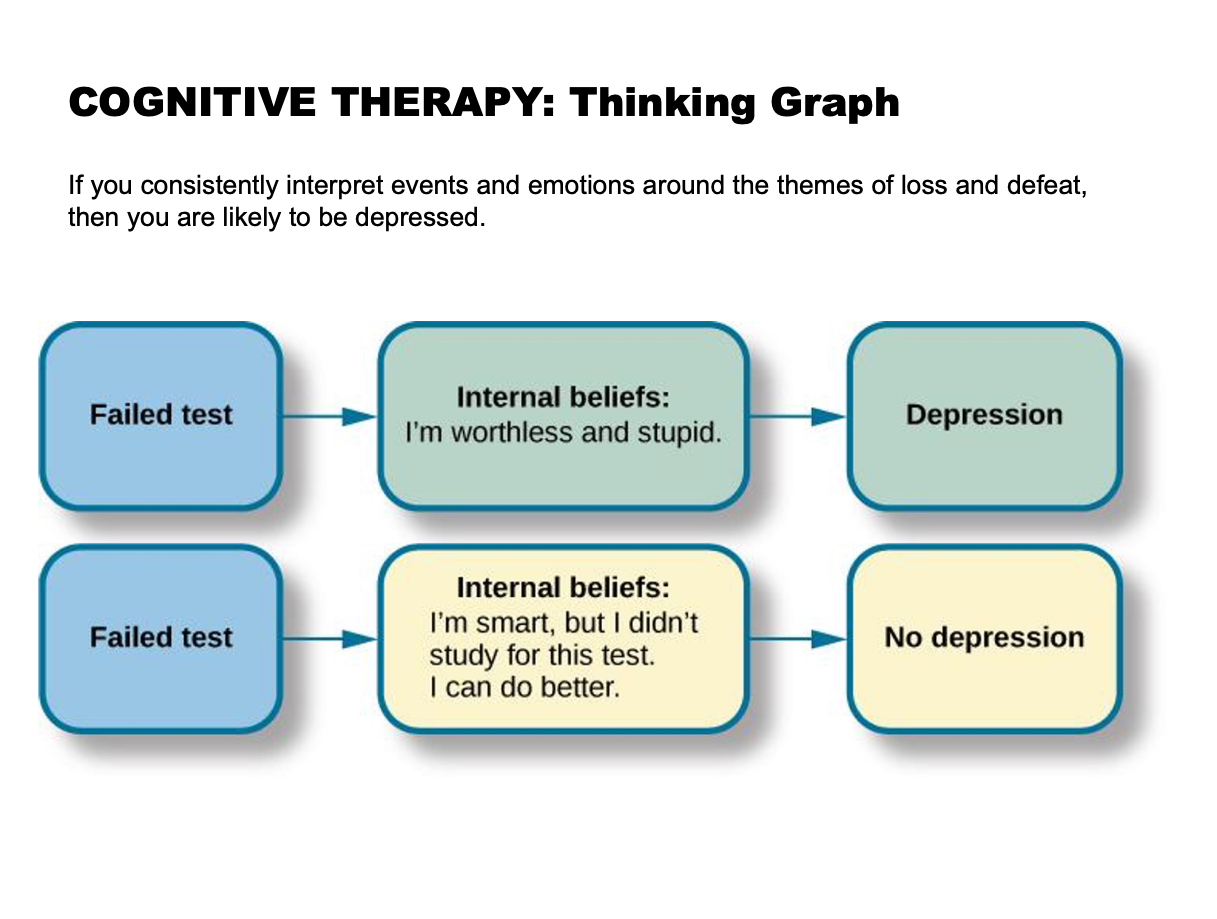
How you think determines how you feel and act
a type of psychotherapy that focuses on how a person’s thoughts lead to their feelings and behaviors.
The goal is to help people identify and change distorted or irrational thinking patterns that create distress.
Encourages clients to find more logical ways of interpreting situations and positive ways of thinking.
Cognitive Distortions
1. Overgeneralizing
Taking a small situation and making it huge.
Example: “I got one question wrong → I’m terrible at school.”2. Polarized / Black-and-White Thinking
Seeing things as all good or all bad.
Example: “I am either perfect, or a failure.”3. Jumping to Conclusions
Assuming people think negatively about you without evidence.
Example: A friend doesn’t answer → “They must be mad at me.”4. Mind Reading
Overgeneralizing
a cognitive distortion
taking a small situation and making it huge
It leads to negative emotions like hopelessness, anxiety, or depression.
where a person takes one negative event and assumes it will always happen or applies it to everything in their life.
Example 1: School
You miss one question on a quiz and think:
“I’m terrible at this class. I’ll never understand anything.”
→ One small mistake becomes a global conclusion.
Example 2: Social
You invite one friend to hang out and they can’t go.
You think:
“No one ever wants to spend time with me.”
→ A single event becomes “everybody” and “always.”
Example 3: Work or Daily Tasks
You burn dinner and think:
“I mess up everything I try.”
→ One cooking mistake becomes a statement about your whole lif
Polarized (“black & white”) thinking
cognitive distortion
where a person sees things in extreme, all-or-nothing terms, with no middle ground or gray area.
Seeing things as all good or all bad.
Example: “I am either perfect, or a failure.”
Example 1: Schoolwork
“I didn’t get an A on the test, so I’m a complete failure.”
→ There is no room for “good enough” or improvement.
Example 2: Relationships
“If my friend doesn’t agree with me, she must hate me.”
→ Differences are seen as rejection.
Example 3: Personal Standards
“I made one mistake at work. I can’t do anything right.”
→ One slip = total incompetence.
Example 4: Self-Worth
“I didn’t reach my goal perfectly, so I’m worthless.”
→ Worth is measured only by extremes.
Jumping to conclusions
cognitive distortion
assuming that people are thinking negatively about you or reacting negatively to you, without evidence.
Mind reading → assuming you know what someone else thinks
Example 1: Text Message
Someone doesn’t respond right away.
You think:
“They’re ignoring me. I must have done something wrong.”
→ No evidence, just assumption.Example 2: School/Work
You make a small mistake and think:
“I’m probably going to get fired.”
→ Automatically assuming the worst.Example 3: Social Situation
You walk past a group of people who laugh.
You think:
“They’re laughing at me.”
→ Assuming their behavior is about you.Example 4: New Experience
You think:
“I’ve never tried this before. I know I’ll fail.”
→ Predicting failure without trying.
Mind Reading
cognitive distortion
where a person assumes they know what someone else is thinking, usually assuming it’s negative, even though there is no real evidence.
It is a form of jumping to conclusions
Example 1: Texting
Your friend doesn’t reply right away.
You think:
“She must be upset with me.”
→ No evidence—just assuming her thoughts.Example 2: School / Class
You answer a question wrong and think:
“Everyone thinks I’m stupid.”
→ Believing you can read everyone’s minds.Example 3: Social Situation
Someone looks serious while you are talking.
You assume:
“He probably thinks what I'm saying is boring.”
→ You treat your guess as fact.Example 3: Social Situation
Someone looks serious while you are talking.
You assume:
“He probably thinks what I'm saying is boring.”
→ You treat your guess as fact.
COGNITIVE-BEHAVIORAL THERAPY
form of psychotherapy that helps people change negative thinking patterns (cognitive) and change unhealthy behaviors (behavioral) at the same time.
focuses more on present issues rather than on a patient’s past.
Uses the ABC model to reveal cognitive distortions
Action – “triggering” event.
Belief about the event (what are the negative beliefs)
Im stupid, I may also give up, all other students do better than me
Challenge the distortions (beliefs) …Consequences
should, must, need to —> change it to “I hope that… but if not, everything is still okay.”
HUMANISTIC THERAPY
Client-centered therapy
a type of psychotherapy that focuses on helping people become more self-aware, self-accepting, and able to reach their full potential.
It emphasizes conscious thoughts, personal growth, and the client’s ability to take charge of their life.
Non-directive therapy – therapist does not give advice or provide interpretations but helps client identify conflicts and understand feelings
Techniques:
Active listening – therapist acknowledges, restates, and clarifies what the client
expresses.
Unconditional positive regard – therapist does not judge clients and simply accepts
them for who they are.
Genuineness, empathy, and acceptance towards clients – Rogers felt that
therapists should demonstrate these because it helps the client become more accepting
of themselves, which results in personal growth.
Goal:
Help the client become more accepting of themselves → leading to personal growth and healthier functioning.
BIOMEDICAL THERAPIES
Psychotropic medications – medications used to treat psychological disorders.
Treat the symptoms of psychological disorders but do not cure the disorder.
Antipsychotics – treat positive psychotic symptoms such as hallucinations, delusions, and paranoia by blocking dopamine.
Atypical antipsychotics – treat the negative symptoms of schizophrenia such as withdrawal and apathy, by targeting both dopamine and serotonin receptors.
Antipsychotics and atypical antipsychotics both treat schizophrenia and other types of severe thought disorders.
Anti-depressants – alter levels of serotonin and norepinephrine.
Depression and anxiety.
Anti-anxiety agents – depress central nervous system activation.
Anxiety, OCD, PTSD, panic disorder and social phobia.
Mood stabilizers – treat episodes of mania as well as depression (Bipolar disorder).
Stimulants – improve ability to focus on a task and maintain attention (ADHD).
Electroconvulsive therapy – induces seizures to help alleviate severe depression.
Transcranial magnetic stimulation – magnetic fields stimulate nerve cells to improve depression symptom.
Psychotropic medications
medications used to treat psychological disorders.
treat the symptoms of psychological disorders but do not cure the disorder.
Antipsychotics
treat positive psychotic symptoms such as hallucinations, delusions, and paranoia by blocking dopamine.
Atypical antipsychotics
treat the negative symptoms of schizophrenia such as withdrawal and apathy, by targeting both dopamine and serotonin receptors.
Anti-depressant
alter levels of serotonin and norepinephrine.
Depression and anxiety.
Anti-anxiety agent
depress central nervous system activation.
Anxiety, OCD, PTSD, panic disorder and social phobia.
Mood stabilizers
treat episodes of mania as well as depression (Bipolar disorder).
Stimulants
improve ability to focus on a task and maintain attention (ADHD).
Electroconvulsive therapy
induces seizures to help alleviate severe depression.
Transcranial magnetic stimulation
magnetic fields stimulate nerve cells to improve depression symptom.
Individual Therapy
In an individual therapy session, a client works one-on-one with a trained therapist.
to discuss problems, develop coping strategies, and work toward mental and emotional well-being.
Group Therapy
In group therapy, several clients meet with a trained therapist to discuss a common issue such as divorce, grief, an eating disorder, substance abuse, or anger management.
Can help decrease shame and isolation.
helps people be accountable
learn social etiquette
Clients may have concerns about confidentiality or feel uncomfortable sharing problems with strangers.
Family Therapy
Aims to enhance growth of each family member as well as that of the family as a whole.
The goal is to improve communication, solve problems, and help family members understand each other better.
Couples Therapy
Therapist helps people work on difficulties in their relationship - aims to help them resolve problems and implement strategies that will lead to a healthier and happier relationship.
E.g. how to listen, how to argue, and how to express feelings.
Primarily uses cognitive-behavioral therapy
ADDICTION
chronic (long-lasting) condition in which a person cannot stop using a substance or engaging in a behavior, even when it causes serious problems in their life.
People with addiction feel strong cravings, lose control, and continue the behavior despite harmful physical, emotional, or social consequences.
Key Features of Addiction
1. Loss of Control
The person tries to cut back or stop but can’t.
2. Cravings
Strong urges or desires to use the substance or do the behavior.
3. Tolerance
Needing more of the substance to feel the same effect.
4. Withdrawal Symptoms
Feeling sick, anxious, moody, or uncomfortable when the substance is not used.
5. Continued Use Despite Harm
The person keeps using even though it harms their health, relationships, work, or school.
 Note
Note  Flashcards (34)