Psyc 100: Ch 8: Memory + Research Skills
 Call Kai
 Learn
Learn Practice Test
 Spaced Repetition
 Match
Match Flashcards
 Knowt Play
1/58

Earn XP
Description and Tags
SFU PSYC 100 Spring 2026
Name | Mastery | Learn | Test | Matching | Spaced | Call with Kai |
|---|
No analytics yet
Send a link to your students to track their progress
59 Terms
What are the key variables in the following study?
The Relationship Between Sleep Duration and Academic Concentration in University Students
Researchers examined whether sleep duration influences students’ concentration during lectures. University students reported how many hours they slept the night before attending class. Participants then completed a computerized attention task designed to measure academic concentration. A total of N = 214 participants took part in the study. Results showed a positive association between sleep duration and concentration, meaning students who slept longer performed better on the attention task.
The Relationship Between Sleep Duration and Academic Concentration in University Students
Researchers examined whether sleep duration influences students’ concentration during lectures. University students reported how many hours they slept the night before attending class. Participants then completed a computerized attention task designed to measure academic concentration. A total of N = 214 participants took part in the study. Results showed a positive association between sleep duration and concentration, meaning students who slept longer performed better on the attention task.
How many participants were included in the study?
The Relationship Between Social Media Use and Sleep Quality in Adolescents
This study investigated whether time spent on social media affects sleep quality among teenagers. Adolescents reported their daily social media usage and completed a sleep questionnaire assessing sleep duration and restfulness. The study included N = 480 participants from several high schools. Results revealed a negative association between social media use and sleep quality.
The Relationship Between Social Media Use and Sleep Quality in Adolescents
This study investigated whether time spent on social media affects sleep quality among teenagers. Adolescents reported their daily social media usage and completed a sleep questionnaire assessing sleep duration and restfulness. The study included N = 480 participants from several high schools. Results revealed a negative association between social media use and sleep quality.
What was the main finding of the study?
Physical Exercise and Stress Reduction in Adults
Researchers examined whether regular physical exercise reduces stress levels in adults. Participants reported how frequently they exercised each week and completed a standardized stress questionnaire. The study included N = 150 participants recruited from community fitness centers. Results indicated a negative association between exercise frequency and stress levels.
Physical Exercise and Stress Reduction in Adults
Researchers examined whether regular physical exercise reduces stress levels in adults. Participants reported how frequently they exercised each week and completed a standardized stress questionnaire. The study included N = 150 participants recruited from community fitness centers. Results indicated a negative association between exercise frequency and stress levels.
(meaning indiviuals who exercised more reported lower stress)
What type of relationship did the study find?
Study Time and Exam Performance in Undergraduate Students
This study explored whether the amount of time students spend studying predicts their exam performance. Undergraduate students reported the number of hours they studied during the week before an exam. Researchers then compared study time with final exam scores. A total of N = 365 participants were included in the analysis. Results showed a positive association between study time and exam performance.
Study Time and Exam Performance in Undergraduate Students
This study explored whether the amount of time students spend studying predicts their exam performance. Undergraduate students reported the number of hours they studied during the week before an exam. Researchers then compared study time with final exam scores. A total of N = 365 participants were included in the analysis. Results showed a positive association between study time and exam performance.
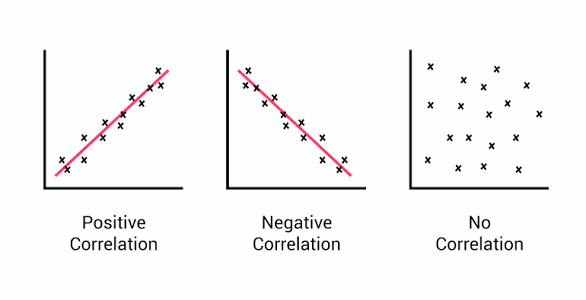
Define what negative and postive means, along with no association (assoication=correlation)
Postive: when on variable increases the other also increases
ex. study time goes up so does exam score (theoretically)
Negative: when one variable increases the other decreases
ex. social media use increases then sleep quality decreases
No association means the 2 variables are not related so changes in 1 variable do not predict the other
ex. checking tides on west canada as no relation to the wind patterns on mars as these 2 things do not influence eachother and do not change together in any predictable way.
What is memory?
Memory is recalling past events and past learning by means of encoding, storage and retrieval
memory is the ability to store information and recall it later
It involves 3 processes
How many processes are there of memory and define each.
Encoding is getting information into memory in the first place
Ex. listening to a lecture, reading a textbook watching someone perform a skill all of which has you brain converting infromation into a form it can store
Ex. hearing a phone number and mentally process it
Storage retaining memories for future use
Keeping information in memory over time, so after the information is encoded the brain holds onto it
It can be stored for seconds minutes or even years
Ex. you remember your childhood address because that information has been stored in your memory
Retrieval is recapturing memories when we need them
Accessing information we stored earlier so this happens when we remember something
Ex. answering a name, recalling directions, answering a test question
OVERALL you are bringing stored information back into awareness
What are the 2 theories of how memory works? (no defenition)
Information-Processing Model
The Parallel Distributed-Processing Model
What is the first theory of how memory works?
Information-Processing Model, is the theory that information passes through 3 memory stores during encoding, storage and retrievals.
Sees memory as working like a step by step system, similar to how computer process information, so information goes through 3 stages, encoding, storage and retrieval
Steps:
Sensory Memory: The immediate, initial recording of sensory information (iconic for visual, echoic for auditory).
Attention: A filter that selects relevant information to move from sensory memory to working memory
Short-Term/Working Memory: A limited capacity, temporary workspace where information is actively processed and manipulated. (happens only if we pay attention if not then the thing is lost) (holds information for 30seconds with a capcity of 5-9 items which is longer lasting then sensory memory)
Long-Term Memory: The relatively permanent and limitless repository for storing information. (happens if we encode the information, so if we are paying attention long enough) (information is stored in long term memory essenitalyl forver)
Encoding: The process of transforming information from working memory into long-term memory.
Retrieval: Accessing information from long-term memory to bring it back to awareness
What are sensory memories and the types
Sensory memories are the earliest, fleeting stage of memory that briefly stores raw, highly detailed information from the senses. There are 2 types:
Ionic Memory, what we see
Echoic Memory, what we hear
PURPOSE is to help sensory information
What is the second theory of how memory works?
The Parallel Distributed-Processing Model, is the theory that information is represented in the brain as a pattern of activation across entire neural networks
memories are stored in a network of associations throughout our brain
This model says memroy is not sotred in one place but rather different parts of memory are stored in different brain areas and when you remember something you brain activates all those parts together
Compare and contrast the 2 theories on how memory works
Information-Processing Model
sees memory working in step by step stages while
Parrallel distributed-Processing Model
sees memory as stored across n etowrks of neurons that active togehter in the brain
What are the 2 ways to encode something?
Automatic processing, is when you remember something without much conscious awareness or effort
Often used for remembering matters of time space and frequency
Ex. we can remmeber path from front door to bedroom, remembering where things are in relation to us
Effortful processing, is when you remember something with careful attention and conscious effort
Used for a lot of other stuff we want to remember
Ex. trying to remember stuff from lecture, studying for a class, remembering someones name, or phone number
Attention vs awareness
To encode anything into memory using either effortful or automatic processing requires us paying attention to it
But we are only aware of it during effortful processing
Whats sensory memory
Memory involving detailed, brief sensory images or sounds retained for a brief period of time
Ex. a photograph viewed fora. brief moment, a brief glance at a passing car, random letters examined for less than a second ( sperling test of sensory memory)
what is working memory
a short term memory store for information you are thinking about right now including:
recalled memories, ex phone numbers or what you are reading
what is rehersal
consciously repeating information to ensure it is encoded
What is long term memory
all of the information we have gathered that is available for use, such as acquired skills, people we know, and past feelings
What is spaced practice effect
Learning is better when study sessions are spread out over time rather than crammed all at once.
it facilitates moving working memories into long-term memory by rehearsing over time
What are the types of encoding and how many are there?
(content based)
Phonological, is encoding based on sound
Visual, is encoding based on how the information looked
People with amazing visual encoding skills have eidetic (photographic) memory
Semantic, is encoding based on the meaning of information
whats the term when someone has amazing visual encoding skills?
Eidetic (photographic) memory
What are the best methods of effortful encoding and how many are there?
Understand, we remember things better when we can understand what it means
whereas Rote memorization has limited effectiveness
Elaborate, the more we can elaborate or expand on the meaning and make the information personally relevant, the better we remember it
Using mnemonic devices is a tehcnique used to increase meaningfulness of information to make it more memorable
Ex. SOH/CAH/TOA, Every Good Boy Deserves Fudge
Use Chunking which means to group bits of information together
Ex. remembering phone numbers
Use Schemas is when you organize new information according to the categories created by the previous experience and learning
If you have been in 1 university class you have a decent schema that will guide how you behave in a new different class
Using the PQRST Method,
Preview: skim it first, identify key themes
Question: turn each subsection into a question that you’ll answer as you read
Read: try to answer the questions you posed yourself
Self-Recitation: ask and answer questions aloud to yourself
Test: practice recalling information from what you read
What is the term for just memorizing a defneition without knowing how it relates to anything else, and how is its effectiveness?
Rote Memorization
Has limited effectiveness
What are the storage limits of the working memory
around 30 seconds, where the memory is pasted onto long term or lost
What is memory span
the max number of items that can be recalled in the correct order
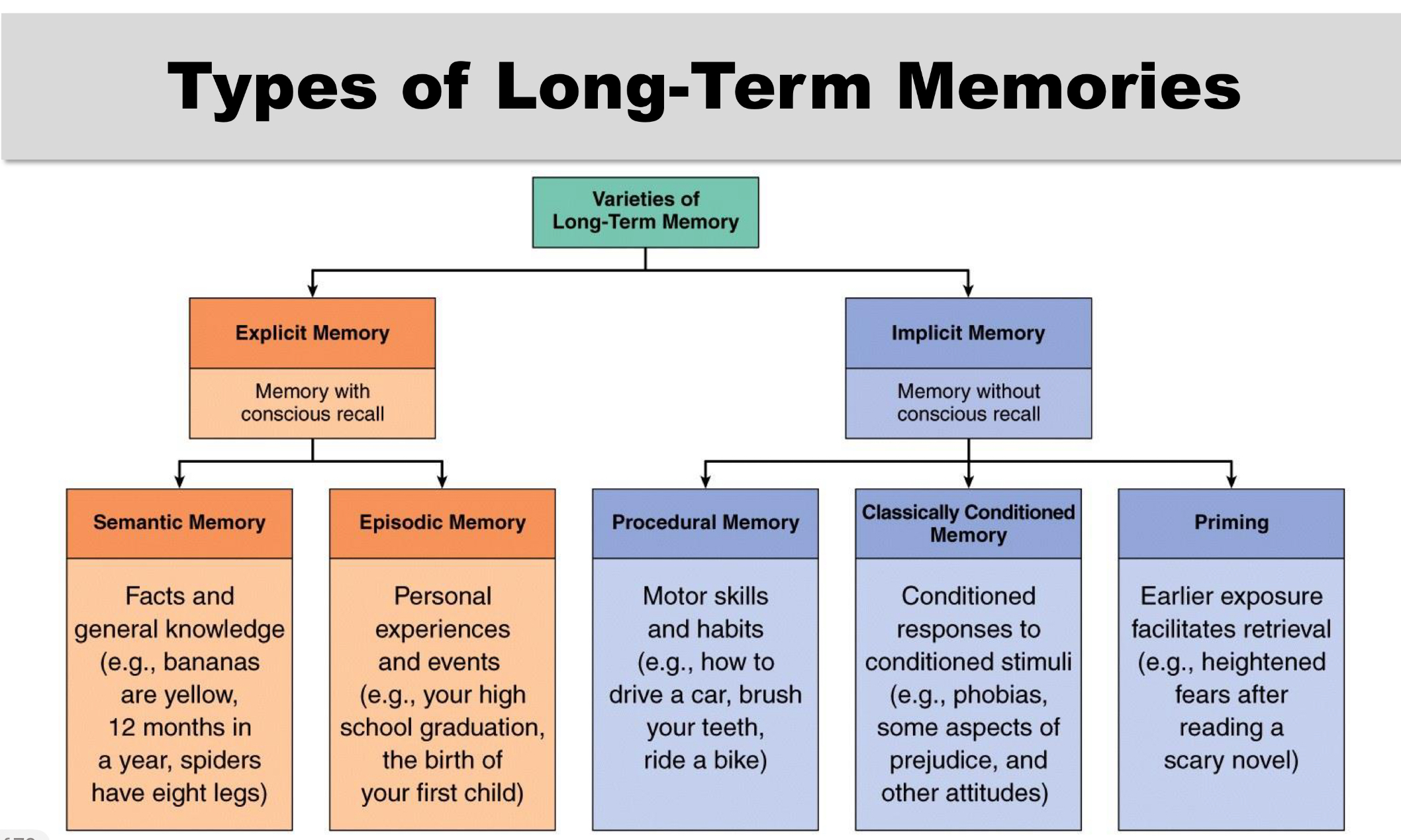
What are the types of long term memories and how many are there?
Explicit memory, memory that a person can consciously bring to mind
Ex. home address or date of birth
There are 2 types
Implicit Memory, is memory that a person is not conciously aware of such as learned motor behaviours, skills and habits
ex. riding a bike
There are 3 types
What are the types of explicit memories?
Semantic, is memory of general knowledge of the world
Episodic is memory of personal events or episodes from ones life
What are the types of implicit memory?
Procedural memory, is motor skills and habits
Classically conditioned memory, is condiitoned responses like fear disgust excitement etc
Priming is exposure to something in your enviornment that makes a memory more accessible
ex. seeing an ad, can activate certian ideas or feelings without you realziing it which can influence your choices or behavior later.
if u saw a coke ad, later at a restuarant you may choose to have coca cola more quickly or be more likely to choose it even if you dont remmeber the ad
What are the types and sub types of long term memories
How are long term memories organized?
not fully understood
but regarless, of precise organization the pieces of information stored in long term memory are linked to eachother forming a vast network of interwoven associations
How do we retrive memories
mentally we search the brain for stored information and if its located then it is brought back into working memory
What is the serial position effect
Is the tendency to remember the first and last items in a list better than the items in the middle
There are 2 parts
Primacy Effect, the more likely to remmeber things heard first
bc the first items have more time to be rehearsed and encoded
Recency effect, the more likely to remember things heard most recently
happens when asked soon after learning
What helps retrieval?
Retrieval cues, are words sights or other stimuli that remind us of the information we need to retrieve from our memory
Priming, is one piece of information that helps us retrieve other related memories
Context effects, we can remember things better where we first learn them
Encoding specificity principle, the orginal context (location or situation), modd or state in which we learn materials is loaded with retrieval cues, which leads to memories of the orginal event
OVERALL contexts can prime certain memories
Why are recognition tasks easier than recall
Because of Priming
think of MCQs on exams, the response options are priming your memory
What is state dependent memory?
You remember things better when you are in the same state of mind you were in when you first learned it
(similar to context dependent memory but different)
What are flashbulb memories
Detailed memories of an emotionally significant event or of the circumstances surronding the moment we learned about the event
9/11
IMPORTANT TO REMMEBER THAT, these memoreis and not necessarily more acurate than any other memory but certainly they are more vivid
each time you recall a memory you reconstruct it rather than replaying it exactly so overtime people may add details forget parts mix in later information so the memory becomes less accurate even if it still feels vivid
What is forgetting
the inability to recall information that was previously encoded into memory
this may be due to failure of attention or lack of retrieval cues
What are 3 possible reasons for retrieval failure?
Decay theory
Interference theory
motivated forgetting
What is decay theory
are memories that fade over time if they are not used or reheasred
What is the forgetting curve
We forget a great deal very rapidly but the forgetting levels off and the amount of information we retain stabilizes
What is interference theory?
it’s the theory that says forgetting happens because ither memories interfere with the memory you are trying to recall
There are 2 types
Retroactive interference is learning of new information that disrupts access to previously recalled information (NEW INFO INTERFERES OLD INTO, EX. AFTER LEARNING A NEW PHON ENUMBER YOU FORGET OLD ONE)
Proactive interference is competing information that is learned before the forgotten material, preventing its subsequent recall (OLD INFORMATION INTERFERES WITH NEW INFO. EX. YOU TYPE OLD PASSWORD WHEN TRYING TO REMEMBER NEW ONE)
What is motivated forgetting
Forgetting that occurs because the brain actively is pushing away unpleasant or stresssfull memories
ex. someone forgetting detains of tramatic experience
What is repression?
Repression is the process in which we unconsciously prevent some traumatic event from entering our awareness so that we do not have to experience the anxiety or blows to our self concept that the memories would bring
What are the factors that contribute to memory distortions
Source of misattributions, which is when remmebering information but not the source which may lead to us remembering information from an unreliable source as true
Imagination, memories can be distored with false information that comes from within from our imagination
when our brain sees a gap we are eagar to fill it with information that makes sense/ feels good
Misinformation is the exposure to new information, particularly misinformation which can also lead to the distortion or the manufacture of false memories
misinformation that we pay attention to has just as much opportunity to be encoded as any other information we pay attention to
true or false Hypnosis can cause people to distort or manufacture memories rather than rediscover real ones.
True.
Ex. the satanic panic of the 80s-90s. where some therapists used hypnosis and ‘recovered memory therapy‘, patients were encouraged to recall suppresed childhood memories and mayn people reported ritual abuse that later turned out to have little evidence
talk about eyewitness testimony relaiblity
Eyewitness testimony can be unreliable because memories can be distorted by suggestion and reconstruction.
ex ronald cotton
Is there a specific memory region
No.
but the preforntal cortex is particularly important for working memeory and the hippocampus is important for the transfer of memories into long term memory.
Whats memory consolidation?
the processes by which memories are stabilize in the brain
What is potentiation
the synchronous networks of cells firing together
What is long term potentiation (LTP)
A phenomenon where repeated stimulation of certain nerve cells in the brain greatly increase the likihood that the cells will respond strongly to future stimulation
What is infantile amnesia
inability to remember events from early childhood usally before 4 years of age, we only have memories of faces places and skills but not memeories of life
the hippocampus develops slowly
most early episodic memories are emotional
What is prosepective memory?
the ability to remeber content in the future
remembering to do an action in the future
this can decline with age starting in our 20’s
What is retrospective memory
The ability to remmber content from the past
this can decline with age starting in our 20’s
What is amnestic disorders?
organic disorders in whcih memory loss is the primary symptom
What is anterograde amnesia
you cant form new memores
ex. hi. im tome … hi. im tom”
old memories are ok but cant form new memories
What is retrograde amnesia
you cant remember thigns before amnesia inducing events
ex. who am i
Old memories are lost but new memories are ok
What is dementia
severe memory problems combined with losses in at least one other cognitive functions such as abstract thinking or language
What is alzheimers disease and how does it realte to dementia
alzheimers disease is the most common form of dementia
What are plaque and tangles of alzheimers disease?
Plaque are clumps of protein that build up between brain cells
Tangles are twisted fibers of protein taht form inside neurons
both are thought to damage neurons in the brain of alzhemiers patients but are absent in the healthy brain

