GERIATRIC STUDY GUIDE
0.0(0)
 Studied by 7 people
 Call Kai
 Learn
Learn Practice Test
 Spaced Repetition
 Match
Match Flashcards
 Knowt Play
Card Sorting
1/100

Earn XP
Description and Tags
Last updated 9:46 PM on 12/14/22
Name | Mastery | Learn | Test | Matching | Spaced | Call with Kai |
|---|
No analytics yet
Send a link to your students to track their progress
101 Terms
1
New cards
Infancy
Trust versus Mistrust
2
New cards
Toddler
Autonomy versus Shame and Doubt
3
New cards
Preschool
Initiative versus Guilt
4
New cards
School Age
Industry versus Inferiority
5
New cards
Adolescent
Identity versus Role Confusion
6
New cards
Young Adult
Intimacy versus Isolation
7
New cards
Middle Adult
Generativity versus Stagnation
8
New cards
Older Adult
Self Actualization/Integrity versus Despair
9
New cards
Young old
65 to 74
10
New cards
Middle Old
75 to 84
11
New cards
Old-Old
85 and above
12
New cards
Centenarian
100 and older
13
New cards
Gerontology
A study of the growing process of aging of normal, healthy and functioning individuals.
14
New cards
Gerone
A term given to people who are old but can gracefully function as a useful citizen in the home and in the community.
15
New cards
Geriatrics
A term given to people who are old or who behave old and signify's care given to old sick people.
16
New cards
Aging
A slow process of growth towards maturity of mind, body, spirit and comprises a series of changes that occur in all living organism.
17
New cards
Gerontological Nursing (Gerontology)
A specialty in nursing pertaining to the care of older adults in their normal development process.
18
New cards
Where the word geriatrics came from and what it means
From greek word "geras" (old age) "iatrics" (medicine)
19
New cards
What is Aging?
Aging is a continuous process from birth to death, which covers physical, social, psychological, and spiritual changes.
20
New cards
Theory
1. A cluster of conclusions in search of a premise
2. An explanation that makes sense to us of some phenomenon
2. An explanation that makes sense to us of some phenomenon
21
New cards
Biological/Physical Theory
1. Stochastic Theory
2. Non-stochastic theory (pre-determine theory)
2. Non-stochastic theory (pre-determine theory)
22
New cards
Stochastic Theory
Propose that chance error and the accumulation of damage over time cause aging
23
New cards
non-stochastic theory
View aging as certain predetermined, timed phenomena
24
New cards
Error theory
Aging as a result of an accumulation of errors in the synthesis of cellular DNA and RNA
Ex. Visible sign is the gray hair
Ex. Visible sign is the gray hair
25
New cards
Wear and Tear
Cell errors are the result of "wearing out" over time because of continued use and trauma; one of the earliest theory of aging
Ex. Shoulder pain of pitcher and knee of a run
Ex. Shoulder pain of pitcher and knee of a run
26
New cards
Cross-link Theory
Explains aging in terms of the accumulation of errors by cross-linking or stiffening of protein in the cell
Proteins link with glucose and other sugars in the presence of oxygen and become stiff and thick
Proteins link with glucose and other sugars in the presence of oxygen and become stiff and thick
27
New cards
Psychological Theory
Explains aging in terms of mental processes, emotions, attitudes and motivations characterized by life stage transition
28
New cards
Human Needs
Five basic needs motivate behavior in a life long process:
Individualism, Stages of Personality, Life Course/Life span, Selective Optimization
Individualism, Stages of Personality, Life Course/Life span, Selective Optimization
29
New cards
Individualism
Personality consist of an ego, collective unconscious that views life from a personal and external perspective. Older adults search for meaning and adapt to functional and social issues
30
New cards
Stages of Personality
Personality develops in eight sequential stages with corresponding life developmental task.
The eight tasks, Integrity versus despair characterized by evaluating life's accomplishments, struggles includes letting go, accepting care, detachment and physical and mental decline
The eight tasks, Integrity versus despair characterized by evaluating life's accomplishments, struggles includes letting go, accepting care, detachment and physical and mental decline
31
New cards
Life course/ Life Span
Life Stages are predictable and structured by roles, relationship, values, development and goals.
Persons adapt to changing roles and relationship.
Age group norms and characteristics are an important part of the life course
Persons adapt to changing roles and relationship.
Age group norms and characteristics are an important part of the life course
32
New cards
Selective optimization
Individuals cope with aging losses through activity/ role selection, optimization and compensation. Critical life points are morbidity, mortality, and quality of life.
Selective optimization with compensation facilitates successful aging
Selective optimization with compensation facilitates successful aging
33
New cards
Theories of Aging according to Letty Kuan
Retirement and Role Discontinuities
Determinants of Fruitful Aging
Prepared retirement
Health Status
Income
Family Constellation
Self-Preparation
Retirement Role Discontinuities (Aging Process) leads to change of Life meets determinants resulting in Outcome of fruitful retirement and aging.
Determinants of Fruitful Aging
Prepared retirement
Health Status
Income
Family Constellation
Self-Preparation
Retirement Role Discontinuities (Aging Process) leads to change of Life meets determinants resulting in Outcome of fruitful retirement and aging.
34
New cards
Sociological Theories
Refers to the changing roles, relationship, status and generational cohort impact the older adult's ability to adapt.
35
New cards
Activity
Remaining occupied and involved is necessary to a satisfying late life
36
New cards
Disengagement
Gradual withdrawal from society and relationships serves to maintain social equilibrium and promote internal reflection
37
New cards
Subculture
The elderly prefer to segregate from society in aging subculture sharing loss of status and societal negativity regarding the aged. Health and mobility are key determinants of social status.
38
New cards
Continuity
Personality influence roles and life' satisfaction and remains consistent throughout life. Past coping patterns recur as older adults adjust to physical , financial and social decline and contemplate death. Identifying with one's age group finding a residence compatible with ones limitations
39
New cards
Age stratification
Society is stratified by age group which is the basis for acquiring resources, roles, status and deference from others
40
New cards
Person Environment Fit
Function is affected by ego strength, mobility, health and cognition sensory perception and the environment. Competency changes once ability to adapt to new environment demands
41
New cards
Gerotranscendence
Elderly transform from a materialistic/ rational perspective toward oneness with the universe.
42
New cards
Programmed theory (non-stochastic theory )
1.) changes of aging to a process that is thought to be predetermined or ' programmed ' at the cellular level.
2.) this means that each cell has a natural life expectancy.
3.) as more cells stop or cease to replicate the signs of aging appear and ultimately the person "dies" at a predetermined age.
2.) this means that each cell has a natural life expectancy.
3.) as more cells stop or cease to replicate the signs of aging appear and ultimately the person "dies" at a predetermined age.
43
New cards
Free Radical theory
among the most understood and accepted theory
> it is believed that cellular errors are the result of random damage from molecules in the cells, called free radicals.
> it is believed that cellular errors are the result of random damage from molecules in the cells, called free radicals.
44
New cards
free radicals
are natural by product of cellular activity
> with aging the damage cause by free radicals occur faster than the cells repair as a result there will be cell death.
Based on the aging process is based on the hypothesis that with increasing age, mutations of the mitochondrial DNA will accumulate and will at least lead to a loss of function with subsequent acceleration of cell death. Even if this theory is widely accepted, the reactive-oxygen-species-induced mutations of mitochondrial DNA, the accumulation of mitochondrial DNA and the role of antioxidants are not fully understood
> with aging the damage cause by free radicals occur faster than the cells repair as a result there will be cell death.
Based on the aging process is based on the hypothesis that with increasing age, mutations of the mitochondrial DNA will accumulate and will at least lead to a loss of function with subsequent acceleration of cell death. Even if this theory is widely accepted, the reactive-oxygen-species-induced mutations of mitochondrial DNA, the accumulation of mitochondrial DNA and the role of antioxidants are not fully understood
45
New cards
Neuroendocrine -Immunologic theory
changes in the integrated neuroendocrine and immune system.
> programmed deaths of the immune cells from damage caused by the increase of free radicals as aging progresses.
> programmed deaths of the immune cells from damage caused by the increase of free radicals as aging progresses.
46
New cards
Nutrition theory
is the most logical theory to qualify long life
>one essential factor that promotes longevity is good nutrition.
> good nutrition is also the body's defense against disease.
> tissue cells, nerves, muscles and bones that are appropriately nourished with the proper nutrition all throughout the developmental stages maintain the structure and function of the body and its optimum activity.
>one essential factor that promotes longevity is good nutrition.
> good nutrition is also the body's defense against disease.
> tissue cells, nerves, muscles and bones that are appropriately nourished with the proper nutrition all throughout the developmental stages maintain the structure and function of the body and its optimum activity.
47
New cards
Transition theory
shows the role of shifting or change of one situation to another on the aging process
> there are too many transition in one’s life and there is no adequate preparation that accompany that shifting of role or situation become a threat to the security of the individual and this will hasten aging
> there are too many transition in one’s life and there is no adequate preparation that accompany that shifting of role or situation become a threat to the security of the individual and this will hasten aging
48
New cards
Evidenced based Practice
nursing follows a systematic approach that uses existing research for clinical decision making.
> best practice are evidenced based and are built on the expertise of the nurse.
49
New cards
Standard
reflect the level and expectations of care that are desired and serve as a model against which practice can be judged
> these serve to both guide and evaluate nursing plans.
> these serve to both guide and evaluate nursing plans.
50
New cards
Holistic gerontological care
incorporates knowledge and skills from a variety of disciplines to address the physical, mental, social, and spiritual health of an individuals.
51
New cards
Principles
are those given facts or widely accepted theories that guide nursing action.
As professional nurses are responsible for using these principles as the foundation of nursing practice.
As professional nurses are responsible for using these principles as the foundation of nursing practice.
52
New cards
Comprehensive Geriatric Assessment
A multidimensional, multidisciplinary diagnostic instrument designed to collect data on the medical, psychosocial and functional capabilities and limitations of elderly patients.
(As soon as we are able to assess and identify the limitations and capabilities, that’s the moment we can act upon or do the nursing assessment. How can I help my client?)
(As soon as we are able to assess and identify the limitations and capabilities, that’s the moment we can act upon or do the nursing assessment. How can I help my client?)
53
New cards
Importance of geriatric assessment
1. practitioners/ nurses use the information generated to develop treatment and long term follow up plans.
2. arrange primary care and rehabilitative services
3. organize and facilitate process of case management
4. determine long term care
5. make the best use of health care resources
2. arrange primary care and rehabilitative services
3. organize and facilitate process of case management
4. determine long term care
5. make the best use of health care resources
54
New cards
Prevalent problems faced by the elder patient " FIVE I's of Geriatrics"
1. intellectual impairment
2. immobility
3. instability
4. incontinence
5. iatrogenic disorders
2. immobility
3. instability
4. incontinence
5. iatrogenic disorders
55
New cards
Assessment tools
1. physical health
2. motor capacity
3. manual ability
4. self care ability
5. instrumental abilities
6. cognitive functioning
7. social function
2. motor capacity
3. manual ability
4. self care ability
5. instrumental abilities
6. cognitive functioning
7. social function
56
New cards
Three approaches used for collecting assessment data
Self report format, Report by proxy, Observation
57
New cards
Self report format
questions are either ask directly or the person is expected to respond to written questions about his or her health status
58
New cards
Report by proxy
obtained indirectly, that is the nurse asks another person, such as a staff nurse, aide, spouse, or child to report their observation
59
New cards
observation
the nurse collects and records the data, she or he has measured and observed the persons health status using objective parameter
60
New cards
Activities of Daily Living (ADL)
Patient's capacity for daily living.
D - Dressing
E - Eating
A - Ambulating (Walking)
T - Toileting
H - Hygiene
D - Dressing
E - Eating
A - Ambulating (Walking)
T - Toileting
H - Hygiene
61
New cards
Instrumental Activities of Daily Living
S - Shopping
H - Housekeeping
A - Accounting
F - Food Preparation
T - Transportation
H - Housekeeping
A - Accounting
F - Food Preparation
T - Transportation
62
New cards
FANCAPES
A model for a comprehensive yet prioritized assessment that is especially useful for the frail elders:
F = Fluids
A = Aeration
N = Nutrition
C = Communication
A = Activity
P = Pain
E = Elimination
S = Socialization and social skills
F = Fluids
A = Aeration
N = Nutrition
C = Communication
A = Activity
P = Pain
E = Elimination
S = Socialization and social skills
63
New cards
Frailty
A stage of age related physiologic vulnerability from impaired homeostatic reserved and reduced capacity of the organism to withstand stress
= both physical and mental decline leads to an increased risk for morbidity and mortality
= both physical and mental decline leads to an increased risk for morbidity and mortality
64
New cards
Chronic Illness
Conditions that last a year or more and require ongoing medical attention or limit activities of daily living.
65
New cards
Chronic Illness Nursing Perspective
Irreversible presence, accumulation or latency or disease state or impairments that involve the total human environment for
a. Supportive care
b. Self-care
c. Maintenance of function
d. Prevention of further disability
a. Supportive care
b. Self-care
c. Maintenance of function
d. Prevention of further disability
66
New cards
Categories of Chronic Illness (Nonfatal)
Conditions such as osteoarthritis, vision problem, these contribute to disability and increased health cost but most individual can live with them for many years.
67
New cards
Serious eventually fatal chronic illness
Lead to death ex cancer, organ failure, heart failure, stroke
68
New cards
Frailty
A condition in which the body has little reserve left and any disturbance can cause multiple health conditions and cost
69
New cards
Therapeutic
Nurse-Client Interaction/Nurse-client Relationship
70
New cards
Therapeutic Communication Techniques
Responsible, Assertive, and Caring Interactions in Practice.
71
New cards
THERAPEUTIC RELATIONSHIPS
Primary mode of implementing interventions in psychiatric nursing
Phases
Orientation
Working
Termination
Phases
Orientation
Working
Termination
72
New cards
EFFECTIVE NURSE BEHAVIOR
Active listening
Focus on client
Self-awareness
Professional caring
Genuine
Interest
Acceptance
Focus on client
Self-awareness
Professional caring
Genuine
Interest
Acceptance
73
New cards
INEFFECTIVE NURSE BEHAVIOR
Excessive self-disclosure
Anxiety
Distracting nonverbal mannerisms of behavior
Excessive talking
Asking multiple questions
Rushing the interaction process
Anxiety
Distracting nonverbal mannerisms of behavior
Excessive talking
Asking multiple questions
Rushing the interaction process
74
New cards
Generalist
provide care according to
various models
> nursing experiences with elders across the
continuum of care
> nursing care in acute care setting or nursing
care in
a. retirement home
b. nutrition center
c. home care agency
d. adult day health program
e. senior housing
f. rehabilitation center
various models
> nursing experiences with elders across the
continuum of care
> nursing care in acute care setting or nursing
care in
a. retirement home
b. nutrition center
c. home care agency
d. adult day health program
e. senior housing
f. rehabilitation center
75
New cards
specialist
expertise in planning and
evaluating care
> advanced preparation of masters level
evaluating care
> advanced preparation of masters level
76
New cards
advanced clinical expertise
Acute care
Comprises 60 percent of medical – surgical patients
Chronic illness and injury
Community and home base care
Adult day health program
b. primary health clinic
c. retirement communities
d. independent senior housing
Comprises 60 percent of medical – surgical patients
Chronic illness and injury
Community and home base care
Adult day health program
b. primary health clinic
c. retirement communities
d. independent senior housing
77
New cards
Long term care
comprises variety of health, social and personal care that is provided in caring for chronic illness, functional and
cognitive deficits
cognitive deficits
78
New cards
BOUNDARIES
General principles of boundaries in professional relationships
Special issues in mental health
Client’s perception of nurse’s actions
Setting for the interaction
Use of touch
Special issues in mental health
Client’s perception of nurse’s actions
Setting for the interaction
Use of touch
79
New cards
ISSUES
Confidentiality
Privacy and dignity
Student concerns
What if no one will talk to me?
What if I say the wrong thing?
What if I can’t think of anything to say?
How can I ask personal questions without prying?
Privacy and dignity
Student concerns
What if no one will talk to me?
What if I say the wrong thing?
What if I can’t think of anything to say?
How can I ask personal questions without prying?
80
New cards
Therapeutic Communications
1. Purposes and Goals
2. Expressing feelings
3. Clarifying problems
4. Addressing client concerns
5. Resolving problems
6. Role playing alternatives
2. Expressing feelings
3. Clarifying problems
4. Addressing client concerns
5. Resolving problems
6. Role playing alternatives
81
New cards
Verbal Skills & Behavior
1. Specific clear messages
2. Therapeutic communication techniques
3. Finding and responding to cues
4. Open-ended vs. close- ended questions
5. Directive vs. nondirective interaction
2. Therapeutic communication techniques
3. Finding and responding to cues
4. Open-ended vs. close- ended questions
5. Directive vs. nondirective interaction
82
New cards
Nonverbal Skills and Behavior
Distance
Posture
Eye contact
Facial expression
Tone and volume of voice
Use of touch
Involvement in activity
Posture
Eye contact
Facial expression
Tone and volume of voice
Use of touch
Involvement in activity
83
New cards
Medication History
1. Nurses should take particular care in identifying all drugs the patient is currently taking
2. The record should obtain a list of all currently prescribed medications
- Including indication, dosage, schedule, and duration, all over the counter
- preparations, previously prescribed medications with the duration of use, date of discontinuation and reasons of withdrawal
3. Specific notes regarding drug allergies and reactions
2. The record should obtain a list of all currently prescribed medications
- Including indication, dosage, schedule, and duration, all over the counter
- preparations, previously prescribed medications with the duration of use, date of discontinuation and reasons of withdrawal
3. Specific notes regarding drug allergies and reactions
84
New cards
Medical History
1. immunization history (tetanus, influenza, pneumococcal vaccine )
2. listing of previous illnesses and diagnosis
3. any previous operations or hospitalization
4. any blood transfusion
5. complete obstetric and gynecologic history for female patients
2. listing of previous illnesses and diagnosis
3. any previous operations or hospitalization
4. any blood transfusion
5. complete obstetric and gynecologic history for female patients
85
New cards
Personal and Social History
1. detailed description of alcohol use, tobacco, use and caffeine intake.
2. patients sleep pattern and use of medication
3. questions about frequency and ease of falling asleep , quality of sleep, snoring, napping and degree of daytime somnolence should be ask.
2. patients sleep pattern and use of medication
3. questions about frequency and ease of falling asleep , quality of sleep, snoring, napping and degree of daytime somnolence should be ask.
86
New cards
Dietary Assessment
The US National Screening Initiative develop a public awareness checklist that allows patients and caregivers to rate their nutritional health.
Recommendations for interventions are based on the score.
Recommendations for interventions are based on the score.
87
New cards
Nutrition
1. What is the type and amount of food consumed?
2. Does the person have the ability to bite, chew, and swallow?
2. Does the person have the ability to bite, chew, and swallow?
88
New cards
Aeration
1. is the person's oxygen exchange adequate for full respiratory functioning?
2. Is supplemental oxygen required, is it possible for the person to obtain it?
3. What is the respiratory rate and depth at rest and during activity, talking, walking and exercise and while performing activities of daily living.
2. Is supplemental oxygen required, is it possible for the person to obtain it?
3. What is the respiratory rate and depth at rest and during activity, talking, walking and exercise and while performing activities of daily living.
89
New cards
Mini-cog
it is used as a tool that could establish cognitive status more quickly without equipment needed
90
New cards
Components
3 item recall, give 3 items, ask to repeat, divert and recall
91
New cards
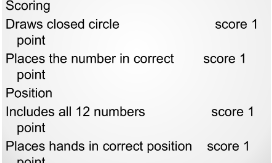
Clock drawing test
which has been used since 1992, is a screening tool that helps identify those with cognitive impairment and that is used as a measure of severity.
Instruction: On a piece of blank paper ask the elders to draw circle
Ask the elders to place the numbers 1-12 inside the circle as for a clock
Ask the elders to place the hands at 3:45
Instruction: On a piece of blank paper ask the elders to draw circle
Ask the elders to place the numbers 1-12 inside the circle as for a clock
Ask the elders to place the hands at 3:45
92
New cards
Mini- mental state examination
the tool that is most used, a 30 item instrument that is used to screen for cognitive deficiencies and is one of the factors in the determination of a diagnosis of dementia or delirium
93
New cards
instrumental activities of daily living
1. telephone
2. traveling
3. shopping
4. preparing meals
5. housework
6. medication
7. money
2. traveling
3. shopping
4. preparing meals
5. housework
6. medication
7. money
94
New cards
Mental Status Assessment
As persons enter their 80’s and 90’s their risk for impaired cognitive abilities increases, increase rate of illnesses such as Alzheimer’s .
The gerontological nurse must be aware of the basic tools that are used in the assessment of mental status especially cognitive abilities and mood.
The gerontological nurse must be aware of the basic tools that are used in the assessment of mental status especially cognitive abilities and mood.
95
New cards
Environmental History
1. Understanding of the living arrangement
2. Safety measure
3. Home evaluation which includes lighting, flooring, furniture locations and air conditioning
4. Kitchen, bathroom and stairway should be evaluated for safety, common sites for falls and injuries
2. Safety measure
3. Home evaluation which includes lighting, flooring, furniture locations and air conditioning
4. Kitchen, bathroom and stairway should be evaluated for safety, common sites for falls and injuries
96
New cards
Assessment for Depression
Patients should be asked about signs and symptoms related to their emotional condition
Scoring scale, one point for each of these answers. Cut –off score (0-5) normal above 5 suggest depression
Scoring scale, one point for each of these answers. Cut –off score (0-5) normal above 5 suggest depression
97
New cards
Sexual History
Sexuality may be an important aspect of many geriatric patient including the oldest old.
Sexual history helps health practitioners evaluate medical, psychological and educational needs of the elder patient
Sexual history helps health practitioners evaluate medical, psychological and educational needs of the elder patient
98
New cards
Physical Examination
A. Vital sign- carefully and completely
Body temperature- oral and axillary
Pulse- pulse rhythms, pulse pressure
Blood pressure
Respiratory rate
Pain
B. General Appearance
Height
Weight
Skin inspection
C. HEENT Examination
Eyes- test visual acuity
Ears- use of an otoscope to detect cerumen
Hearing- simple test of hearing acuity such as rubbing two fingers or placing a ticking watch near the ear can be useful.
Body temperature- oral and axillary
Pulse- pulse rhythms, pulse pressure
Blood pressure
Respiratory rate
Pain
B. General Appearance
Height
Weight
Skin inspection
C. HEENT Examination
Eyes- test visual acuity
Ears- use of an otoscope to detect cerumen
Hearing- simple test of hearing acuity such as rubbing two fingers or placing a ticking watch near the ear can be useful.
99
New cards
mini-mental state examination
the tool that is most used, a 30 item instrument that is used to screen for cognitive deficiencies and is one of the factors in the determination of a diagnosis of dementia or delirium.
>it tests orientation, short term memory, attention, calculation ability, language and construction.
>written test, administered to persons who are able to see and write.
>it tests orientation, short term memory, attention, calculation ability, language and construction.
>written test, administered to persons who are able to see and write.
100
New cards
Cardiovascular System
a. hypertension
b. coronary artery disease
b. coronary artery disease
 Note
Note  Flashcards (22)