Chapter 17 - pt 1
 Studied by 0 people
 Call Kai
 Learn
Learn Practice Test
 Spaced Repetition
 Match
Match Flashcards
 Knowt Play
1/15

There's no tags or description
Looks like no tags are added yet.
Name | Mastery | Learn | Test | Matching | Spaced | Call with Kai |
|---|
No analytics yet
Send a link to your students to track their progress
16 Terms
Hormone
Chemical messengers secreted by endocrine glands
transported in the blood
influence the activity of their target tissues effectors
Target tissue
are specific cells, tissues, or organs that have unique receptors for particular hormones, acting like locks that only specific hormone "keys" can fit, triggering responses like metabolism changes in the liver/muscle (insulin) or calcium regulation (PTH on bone/kidneys).
Difference between endocrine and exocrine
Endocrine
They don’t have ducts
Hormones are secreted into the blood
Exocrine
They have ducts
Chemical produced by the gland
Compare the nervous system with the endocrine system
Both are communication systems
Similarities
Shared brain structures
Hypothalamus-regulates nervous system function (body temperature) and endocrine function (pituitary gland)
Shared chemical messengers
Norepinephrine- secreted by neurons and the adrenal medulla (endocrine gland)
Shared regulatory processes
Work together to regulate body processes
Shared signaling pathways
Neurotransmitters and hormones can affect target cells
Contrast the nervous system with the endocrine system
Mode of transport
Nervous: directly signals to target cell by action potential and neurotransmitters
Endocrine: transmits signals in the bloodstream throughout the body
Speed of response
Nervous: responds faster (milliseconds)
Endocrine: responds slower (seconds)
Duration of response
Nervous: short response
Endocrine: longer lasting
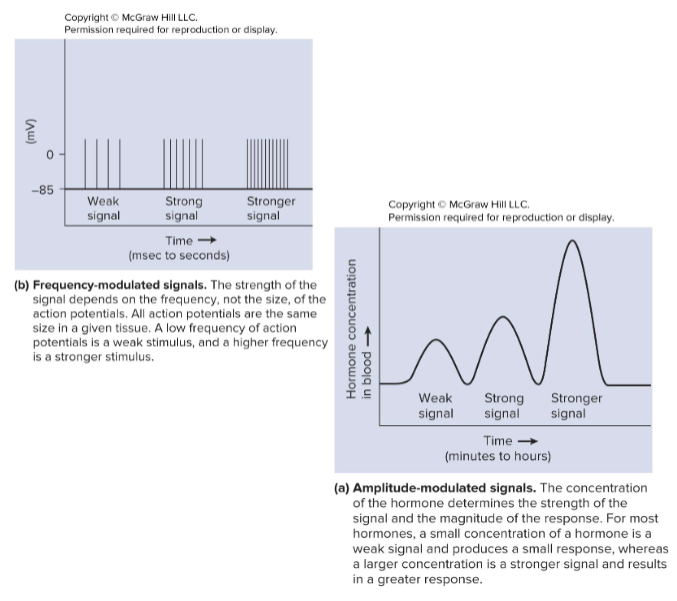
Modulation of signal intensity
Nervous: frequency modulated signals- depends on how often a signal is sent during a certain period of time
Endocrine: amplitude modulated signals- amount of signal (hormone concentration) produced
Define the four major categories of physical processes regulated by the endocrine system
Growth and development
Metabolism
Blood composition
Reproduction
Describe the four classes of chemical messengers
Autocrine
secreted by cells in a local area; affects the activity of the same cell from which it was secreted
Paracrine
produced by manny tissues and secreted into extracellular fluid; has a localized effect on nearby tissues
Neurotransmitter
produced by neurons; secreted into synaptic cleft by presynaptic nerve terminal; travels short distances; affect postsynaptic cells
Endocrine
secreted into the blood by specialized cells travels some distance to target tissues; results in coordinated regulation of cell function; called hormones
List and describe the three stimulatory on hormone secretion and give examples of each
Humoral stimuli
fluids in the body
molecule in the bloodstream directly stimulates hormone release
molecules bond to receptors on the hormone secreting cell
Glucose, Ca2+, Na+
Neural stimuli
neurotransmitter stimulate the hormone producing cell
neurotransmitters can also be inhibitory
some neurons are secreted
input from the sympathetic division of the autonomic nervous system on the adrenal medulla
Hormonal stimuli
hormones stimulate the secretion of other hormones
includes neuropeptides
neurotransmitters released into the blood supply
releasing hormones released by hypothalamus
some hormones prevent secretion
inhibiting hormones released by the hypothalamus
negative feedback mechanisms (thyroid hormone)
Ex: tropic hormones-secreted by the anterior pituitary gland
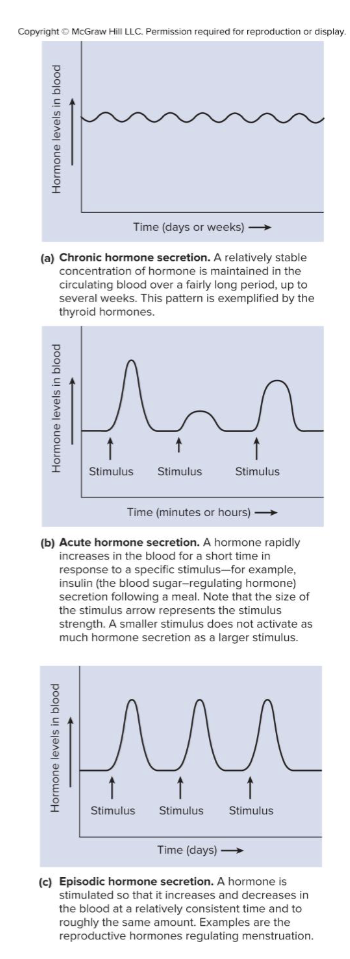
Describe the three main patterns of hormone secretion
Chronic
results in relatively constant blood levels of the hormone
thyroid hormone
Acute
hormones concentration changes suddenly and irregularly
levels differ with each stimulus
epinephrine release in response to stress or physical exercise
Episodic
hormone is secreted at fairly predictable intervals and concentrations
reproductive hormones
List and describe the two classes of hormones
Lipid-soluble hormones
Hydrophobic
Ex: steroids (all cholesterol based), testosterone, aldosterone
Water-soluble hormones
Hydrophilic
Proteins
thyroid stimulating hormone, growth hormone
Peptides
insulin, thyrotropin releasing hormone
Binding proteins
Help to protect hormones (small hormones) from hydrolytic enzymes in the blood
increase the half life of the hormone
Increase water solubility of hormone (lipid soluble hormones)
Reversible binding
can act as a reservoir of hormone
Bound hormone
Hormone that is attached to the binding protein
hormones bind specific binding proteins
Free hormone
Hormone detached from the binding protein
some hormones are “always free” and some are “sometimes free”
Effect of binding proteins on circulating hormone levels
Increase water solubility of hormone (lipid-soluble hormones)
Reversible binding
can act as a reservoir of hormone
Explain the influence of the chemical nature of a hormone on its transport in the blood, its removal from circulation, and its life span
In the blood
Two mechanisms
Negative feedback mechanism
regulates the levels of most hormones
hormone inhibits its grown secretion (self-limiting)
Positive feedback mechanism
hormone stimulates its own secretion
Removal from circulation
Hormones are destroyed in circulation by enzymes at their target cells
Limits the length of hormone activity
Breakdown products are excreted in urine or bile
Elimination of lipid-soluble hormones
conjugation-allows for lipid soluble hormones to be broken down
specific enzymes in the liver attach water soluble to the hormone
prevents the hormone from reentering bloodstream
excreted by kidneys (urine) and liver (bile)
Elimination of water soluble hormones
broken dow by hydrolytic enzymes (proteases) in the bloodstream and kidney eliminates breakdown products
target cells degrade them and may recycle the amino acids
Hormone half-life
Amount of time it takes for 50% of circulating hormone to be removed from circulation and excreted
Larger, more complex hormones are more stable
Smaller, simpler hormones are less stable
Describe the major mechanisms that maintain blood hormone levels
Attached carbohydrates (glycoproteins)
Modified terminal end to protect from protease activity
Binding proteins
 Note
Note  Flashcards (40)