Thunderstorms & Severe Weather Block III
 Call Kai
 Learn
Learn Practice Test
 Spaced Repetition
 Match
Match Flashcards
 Knowt Play
1/22

Name | Mastery | Learn | Test | Matching | Spaced | Call with Kai |
|---|
No analytics yet
Send a link to your students to track their progress
23 Terms
Tornadoes Ch. 12
↓
Tornado Definition
• Rapidly rotating column of air that blows around a small area of intense low pressure with a circulation that reaches the ground
• Circulation present either as a funnel-shaped cloud or as a swirling cloud of dust and debris
• Most have wind speeds of less than 135 mph but can exceed 250 mph
• A funnel cloud is a tornado whose circulation has not reached the ground
Tornado Rotation
• Almost all __ rotate counter-clockwise around their central core of low pressure
• a few have been observed to rotate clockwise but they are rare
Tornado Diameter
• Common diameter is 300ft to 2,000ft
— Some have been measured less than 20ft
— Still others have been larger than a mile
Tornado Average Lifespan
The average path/time is a few minutes and about 4 miles
Tornado Lifecycle
Dust-whirl
Mature Stag
Shrinking
Decay Stage
Dust-whirl Stage
• 1st
• Swirling upward from the surface marks the tornado’s circulation on the ground and a short funnel often extends down from the thunderstorm
Mature
• 2nd
• Normally is most severe as the funnel reaches its greatest width and is almost vertical
Shrinking
• 3rd
• During this stage the funnel shrinks and tilts
• damage swath narrows at the surface
Decay
• 4th
• Tornado shapes like a rope
• Shape typically greatly distorts
Where/When tornados are most likely
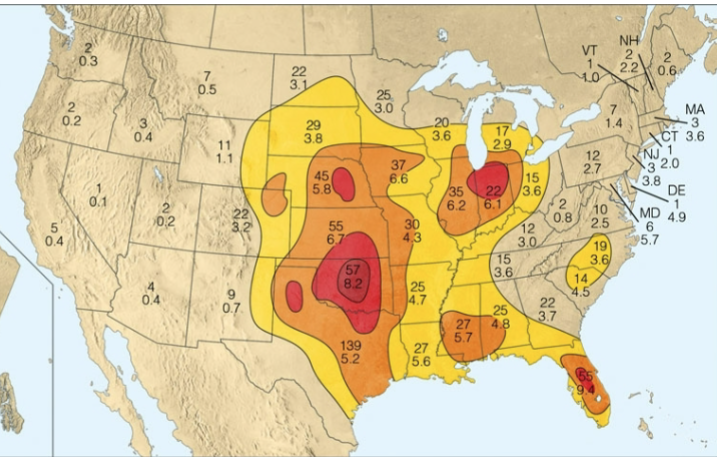
• US experience most tornados (averages more than 1,000 annually)
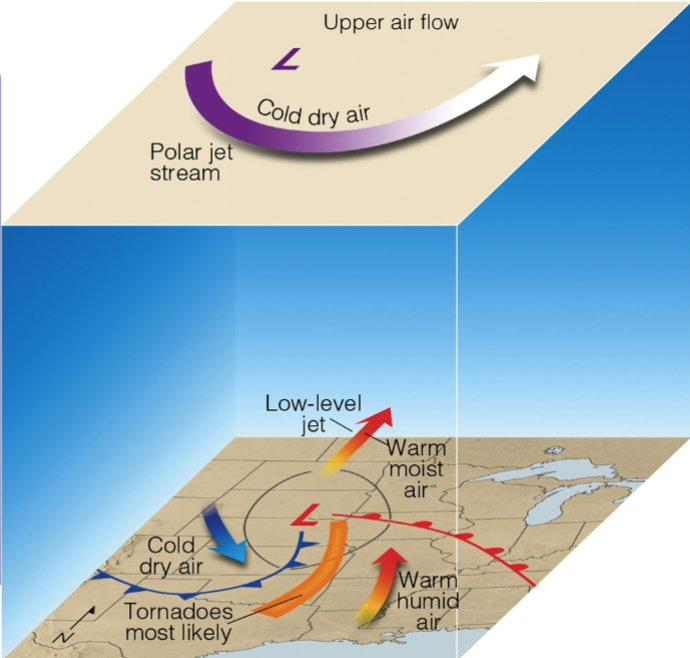
• Tornado Alley of the Central Plains (warm, humid surface; cold dry air aloft)
— most susceptible because it has the right conditions for severe T-storms
• Dixie Alley is the tornado max that stretches across Alabama and Mississippi
• Highest spring, lowest winter
Winter’s Role
• Southern Gulf States
• Polar-front jet is above the region
• Contrasts between warm and cold air masses is the greatest
Spring’s Role
• Humid Gulf air surges north
• Contrasting air masses and the jet stream also move north
• Tornadoes become more prevalent from the Southern Atlantic States west into the Great Plains
Summer’s Role
• Contrast between air masses lessens
• Jet Stream is near the Canadian border
• Tornado activity tends to be concentrated from the Northern Plains eastward to New York State
Tornado Frequency Info
• About 70% of all __ happen between March-July
• May has the greatest number of __ with an average 6 per day
• Most Violent __ are in April when vertical wind shear tends to be present as well as horizontal and vertical temperature and moisture contrasts are the greatest
• Most frequent between 4pm to 6pm
• Least frequent before sunrise
(Have occurred at all times of the day and night)
Perfect conditions for tornados
• Conditionally unstable atmosphere with strong vertical shear for supercell development
• Wind speeds increase with height and change direction
Where the strongest winds of a tornado are
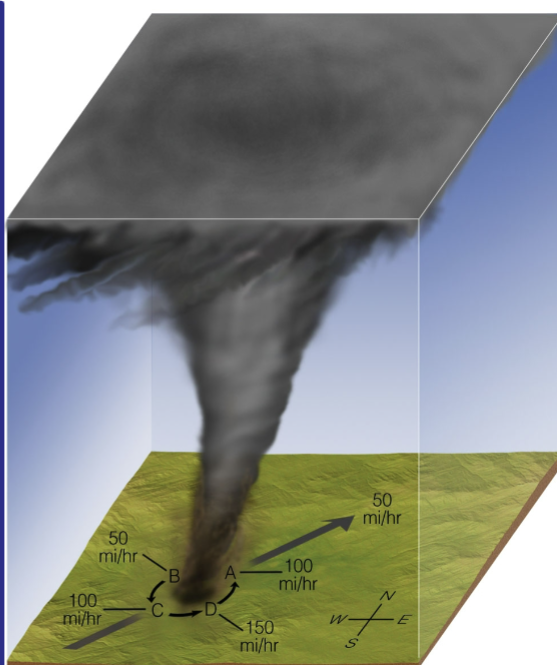
• If facing a __ the strongest winds will be on the left side
• A __ approaching from the SW heading NE
— If it is going 50 mph with a 100 mph rotational speed
— The forward speed will add 50 mph to the SE side (position D)
— Subtract 50 mph from the NW side (B)
• Most destruction = SE