Gen Psych Midterm 2
 Studied by 0 people
 Call Kai
 Learn
Learn Practice Test
 Spaced Repetition
 Match
Match Flashcards
 Knowt Play
1/155

There's no tags or description
Looks like no tags are added yet.
Name | Mastery | Learn | Test | Matching | Spaced | Call with Kai |
|---|
No analytics yet
Send a link to your students to track their progress
156 Terms
Learning
based on experience/producing permanent changes in an organism
conditioning
linking an experience (when I do this) with a response (will do that)
learning by association
linking events that've occurred in a sequence
classical conditioning
neutral stimulus produces response after being paired with a stimulus that'd naturally produce a response
What was Pavlov's dog experiment?
neutral stimulus (walking through door) induced natural response (dog salivating at mouth as they expect him to be holding steak in his hand)
unconditioned stimulus (US)
something that causes reaction with no training
- bringing steak
unconditioned response (UR)
natural response
- dog drooling when it expects steak
neutral stimulus
stimulus with no association to a particular response
- ex: bell ringing
conditioned stimulus (CS)
originally neutral stimulus that'l become associated with the unconditioned stimulus (US)
- bell ringing [wouldn't naturally make dog drool, but with US, UR becomes CR]
conditioned response (CR)
the learned response to a previously neutral (but now conditioned) stimulus (CS)
What are the five steps of classical conditioning?
1. acquisition
2. generalization
3. discrimination
4. extinction
5. spontaneous recovery
what is the acquisition in classical conditioning?
organism learns to associate stimuli with one another (acquisition of the CR [drooling] after the CS [ringing bell] has been paired for the US [meat] for so long)
What is generalization in classical conditioning?
tendency once a response has been conditioned, stimuli similar to the CS will elicit similar responses
- due to brain being pattern detectors and working on efficiency for survival ("false alarms")
What is discrimination in classical conditioning?
making distinctions of what'll elicit CR - distinguishing between CS and stimuli that doesn't signal US
What is extinction in classical conditioning?
when CS not paired with US for a long period of time, there's a gradual elimination of the CR
What is spontaneous recovery in classical conditioning?
tendency of a learned behavior to recover from extinction after a rest period
- depends on the strength of the CR (spontaneous recovery not as high as it was before, but still present)
What was Watson's idea of behaviorism?
trajectory of someone's life is nurture instead of nature (can turn anyone into any career regardless of talents, abilities, penchants, race, etc.)
Little Albert Story with Watson's Behaviorism
- conditioned rat phobia in Little Albert by having a loud noise occur whenever Albert interacts with white rat
- tainted experiment as we don't know about Albert's developmental delays, etc.
Skinner box
- utilized shaping by giving small rewards as they're closer and closer to a certain direction/behavior in a small box
operant conditioning
when a behavior is modified through positive and negative reinforcement
- "if you do this, I'll do that"
Thorndike's Law of Effect
if organism does something and sees it has an effect, they're more likely to do it
- ex: squirrel/rat in box, given treats if they found ways out of the puzzle box
Intermittent Reinforcement schedules
not having to give a reward every time someone does an action -> can be scheduled to affect the number of responses
- beneficial as resists extinctions
Continuous Reinforcement
reinforcing the desired response every time it occurs
- ex: soda machine
Fixed Ratio Reinforcement Schedule
- reinforcement after every nth behavior
- ex: garment workers (paid x for every x made)
Fixed Interval Reinforcement Schedule
- reinforcement for behavior after a fixed time
- ex: cramming for finals, Tuesday discount prices, phone time after every 20 min study block
Variable Ratio Reinforcement Schedule
- after a random number of behaviors (may come after 3rd time, 5th time, 10th, time, etc.)
- ex: slot machines
Variable Interval Reinforcement Schedule
- reinforcement after random amount of time, unpredictably often
- ex: checking your email
What requires the least amount of training and gives the highest responses?
Fixed ratio and variable ratio
- having it not based on a certain amount of time
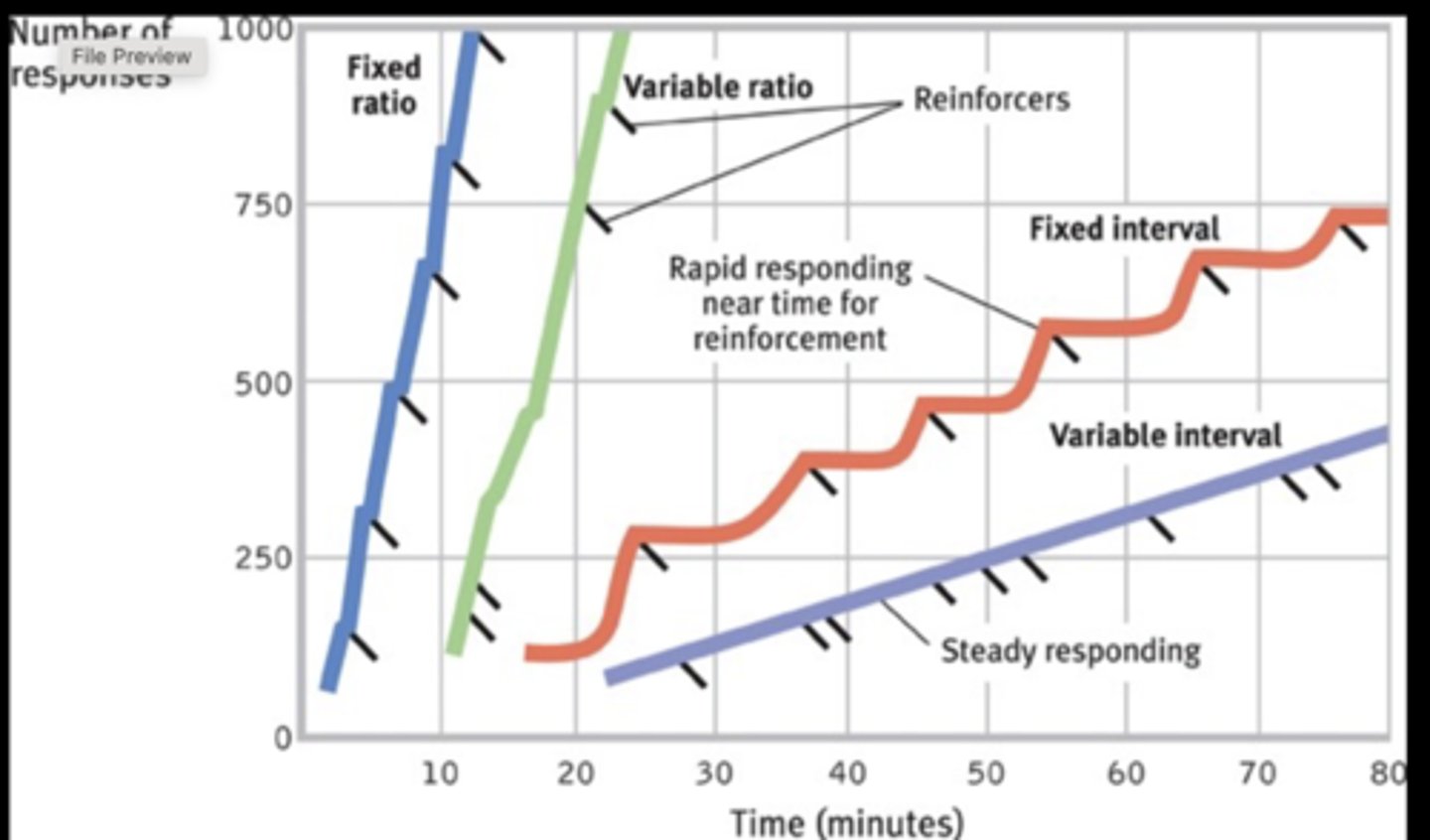
When would you want to use fixed/variable interval schedules?
fixed interval: has high rate of responding near the reinforcement time, variable interval just has steady responding overall
Reinforcement
makes a desired behavior more likely ("good job at not barking!")
Punishment
makes an undesired behavior less likely ("stop barking!")
Positive
giving
Negative
taking away
Positive reinforcement
giving something good (giving dog bacon when they stop barking, cash incentive for doing well-child visits)
Negative reinforcement
taking away something bad (stop blowing loud horn when dog stops barking)
Positive punishment
giving something bad (spraying dog in face when they bark, prisons giving hell)
Negative punishment
taking away something good (taking away dog's favorite toy when they bark, prisons taking away freedom)
Why are biological constrains raising limitations about conditioning?
- ex: having bad experience with hummus, will always have a disdain for hummus - didn't need periods of training/conditioning, CS was the US
- acquisition occurring after only a single trial
observational learning + what type of process is this?
children acquires language of acquisition (behaviors) by just observing adults around them
- learning by watching others
- more implicit/passive process than "active"
- works for anger as well (seeing aggressive acts to a doll -> kids will mirror that, hence why against violent video games)
why is memory not like a file cabinet?
1. memory isn't a "fixed space", has unlimited space
2. stuff we put in might be different when we take it out
3. might not always be able to find what we're looking for
what is memory?
learning (encoding) that has persisted over time
- information that has been stored (retention) and can be retrieved (recall)
what is the purpose of recognition?
- less active recall process (ex: using MCQ)
- compared to FRQ where it's active recall (must produce an answer)
What are the three stages of the Model of Memory?
1. sensory memory
2. short-term/working memory
3. long-term memory
What is sensory memory?
experience storage - holds sensory information for a few seconds or less
- if doesn't reach conscious detection, will be stored without awareness
What are the two ways sensory memory can come in?
1. iconic - store of visual information, is face-decaying (ex: seeing faces in a busy store - if no awareness, won't remember)
2. echoic - store of auditory information, also fast-decaying
What is short-term/working memory?
experiences that make it to your awareness
- holds non-sensory information for more than a few seconds, but less than a minute
- ex: hearing a phone number and reciting it
- working memory tries to actively maintain infomration
What are three ways your working memory can try to maintain information in storage?
1. rehearsal - repeating something over to keep it active short-term
2. chunking - putting things in meaningful categories to organize information
3. mnemonics - keeping story alive in mind by having it represent something you want to remember
How many numbers can we maintain in our working memory?
seven - hence why phone numbers are 7 numbers
What are the two types of long-term/stored memories?
1. explicit - declarative memories, facts/experiences, what you learn in school
2. implicit memories - procedural, "automatic" after learning
What are the two divisions of explicit memories?
Can be semantic (hard facts/concepts - names) or episodic (experiences)
How are explicit memories stored?
effortful processing - need flash cards/techniques
Where are explicit memories stored?
hippocampus (and frontal lobe for attention/awareness)
- will link with other brain regions (ex: verbal memory [skills from conversations] from temporal lobe/hippocampus, visual memories from occipital lobe/hippocampus)
How are implicit memories stored?
via automatic processing - just by doing it allows you to learn/remember how to do it
- may also have unconscious learning/priming, SNS stored in implicit memory (without our knowledge of it being there)
Where are implicit memories stored?
cerebellum and basal ganglia
Why is memory susceptible to construction errors?
people are suggestible and variable
- ex: using different words to ask how fast cars collided vs smashed vs bumped vs contacted
- memory being retrieved is a reconstruction process
Misinformation effects
when misleading information corrupts Noe's memory of an event + repeated imagining of a false event can create false memories of that event
What is interference? Proactive vs Retroactive interference
makes us forget certain information
- proactive interference: things you learn FIRST interferes with your ability to remember things you learn next
- retroactive interference: things you learn NEWLY interfere with remembering what you learned first
Positioning effects on forgetting/the serial position effect
1. primary - people remember name of first/second people they greeted
2. recency - only remembering last few people greeted
- deals with position of where something is in a series
- prone to in witness testimony (putting best witness first/last)
Amnesia and 2 types of it
forgetting, caused by injury/infection/events
1. retrograde amnesia: inability to remember what happened BEFORE amnesia event
2. anterograde amnesia: inability to remember what happened AFTER amnesia event
Alzheimer's Disease (what it is and why it happens)?
progressive degenerative brain disorder causing profound memory loss
- type of dementia
- chances increase to 50% once 85+ years old
- will continually get worse once its hit
- lesions called by amyloid plaques and tangled clusters of neurons/fibers -> brain atrophy
How can we predict Alzheimer's disease
- running tests (based on what test you run, may catch it at varying stages)
- proactive semantic (list of word) interferences - looking at serial position
How might priming affect our memory when asked to recognize a list of words?
- if words are similar to the ones that were given (like encompassing "cupcake" and "cake" into "sweets"), can be primed to remember/misremember different words
Clock Drawing Task
tool to screen dementia to test for degraded semantic memory (declarative/fact memory)
- person with Alzheimer's may not know which numbers go where, how to draw hands, etc.
- like frontotemporal lobe dementia with Wernicke's, inability to understand numbers and such
mental representation
self-generated perception
- ex: asked what cupcake is, will generate image in our head
problem solving
applying reasoning to knowledge to solve problems (ex: math word problems)
decision-making
applying value to solutions to make choices
- something a computer won't be able to do
- varies by person, day, situation, etc.
prototype theory
comparing objects to best/most typical member of category
expected utility (EU) formula
EU(A) = P(A) * v(A)
expected utility = probability * value
rational choice theory
predicts what you should do, but generally won't use as we don't want to calculate EU 24/7
heuristics + what is its opposite?
mental shortcuts to guide decision-making
- fastest, not always right
- opposite: algorithm (equation/experiment of our options - slow, but most accurate)
What do prediction heuristics tell us about?
heuristic to quickly make a prediction about outcome of something
- ex: in Monty Hall problem, heuristics overtake as brains not wired to do probability easy
Gambler's Fallacy
prediction heuristic
- false judgment that probability of event in random sequence depends on preceding event (ex: winning streak, hot-hand fallacy)
Availability bias
mental shortcut where things more readily available (in memory) judged to occur more frequently - ex: seeing harrowing things in news, lives, physically) + underestimating amount of death from asthma/water as that's not seen often
Representativeness Bias
mental shortcut about making probability judgment by comparing an object/event to prototype of object/event
- ignores base rate * probability
EX: seeing a professor loving jazz and saxophone, what are chances hes a biology professor or a jazz professor? (jazz professor, but statistically, more likely to be bio as there's so many bio professors)
- involves conjunction fallacy
conjunction fallacy
thinking because you have more information about something, you're more likely to make correct judgement
- people thinking two events more likely to occur together than individual events (ex: women being a bank teller and feminist than just a bank teller)
what do valuation heuristics measure?
which is better?
framing effects
people give different answers to same problem depending on how framed
- ex: 80% fatty beef vs 20% lean beef
sunk cost fallacy
people make decisions about current situations based on what they've previously invested in a situation
- trying to avoid losses, will choose what's framed as a gain
- ex: in movie you hate, but you already paid for ticket -> "losing time", want to leave. "losing money" -> want to stay
mental set
constraints based on how we frame
- mental sets are tendencies to approach problem in one particular way (usually what's been successful in the past)
social brain hypothesis
brains evolved for our own survival, but also socially coordinated survival
- thinking is for survival and social in groups
Language
system for communicating using signals that'll convey meaning, combined by grammar rooms
- facilitates social coordination, strengthens social bonds, information acquisition
semantics
relationship between symbols and what they refer to
- ex: semantic principle: spelling w-a-t-e-r doesn't mean anything until you know water is the cool liquid you're touching
syntax
combination of semantic units (words with meaning) in an order that makes sense to us
- need semantics with syntax and syntax with semantics
Phonemes
building block of language
- smallest units of sound that are "speech sounds"
- don't mean anything on their own
- ex: Cats = cuh-at-ses
Morphemes
building block of language
- smallest units of language (cats = cat-s)
- both generally meaningful
What are the two categories of language? What areas do they utilize?
1. receptive language (develops before expressive) - able to understand what's said to you
- uses Wernicke's area in the temporal lobe
2. expressive/productive language - production of language, sounds/words
- uses Broca's area in the frontal lobe
What is the timeline of receptive language developing?
4 months: infants differentiate between speech sounds (ex: Da in English and nDa in Hindi)
7 months: babies segmenting spoken sounds into individual words (ball, milk)
12 months: babies understand approx 50 words
- not talking, but receptive language
12-15 months: babies acquire one new word every other day (hella rate of growth)
16-23 months: 1-2 new words/day (hella)
What is the timeline of expressive language developing?
2 months: cooing
6 months: babbling
10-12 months: gesturing and asking for joint attention (if caregiver looking at something, babies ask "what's that")
12 months: first words!
18-24 months: word combination (two-word/telegraphic speech)
age 3+: vocab increasing dramatically, fast-mapping (connecting words together, grammar rules, conversational)
Are kids being conditioned when they're learning different words?
no - they're making errors they've never heard before ("bird flewed")
- good they don't need to be conditioned because it'd be slow and inefficient
Is learning language innate? What supports?
- language acquisition device (LAD) [not a brain structure, but genetically-determined brain organization] - theoretical notion that language skills are etched into structure of human brain
- biologically programmed to learn language
Evidence of nativism (theory that language learning/etc. is learned, not conditioned)
- babies are "world citizens" and understand different languages of the world while adults more "culture-bound", only understand native language
- most language functions housed in left hemisphere -> is materialized
- brains can distinguish between languages so young
Is there a sensitive period of language development?
- Genie, kept in closet till 13, couldn't learn to speak till later -> couldn't develop language ability beyond "toddler-level"
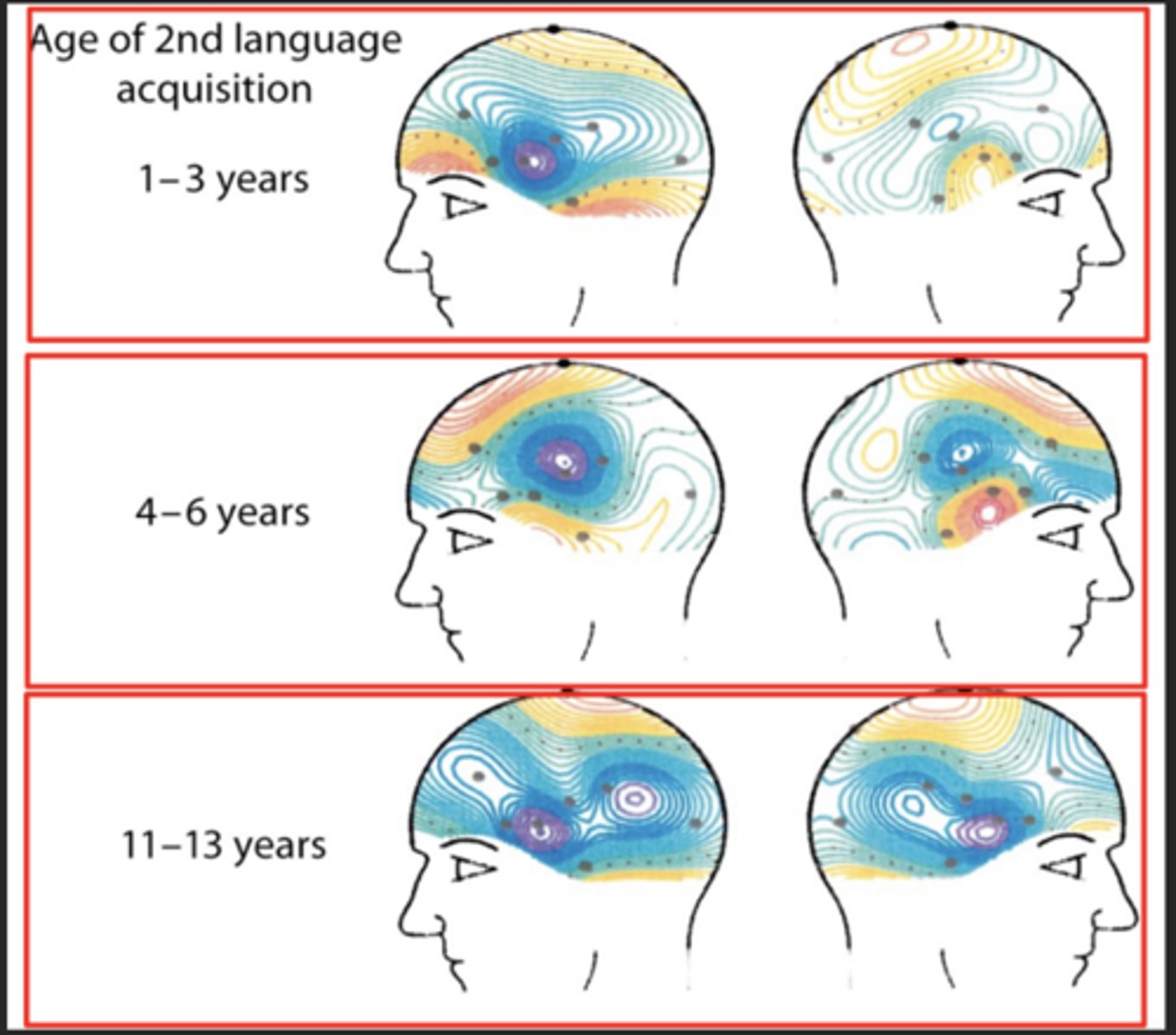
- easier to learn a language when younger than as an adult (even if you do as adult, brain won't process same as primary language - different cerebral organization paths => more right side activation)
- With NSL (nicaraguan Sign language), deaf kids made their own sign language -> those joining 7-8 years couldn't understand language as deeply and quickly as those 3-4 years
What is the role of environment in promoting language development? Observational study with different classes of families?
language results from interplay between innate capacities and environmental inputs
- upper class families, working class families, welfare recipients => 1) all children starting to speak with proper structure/language around same time
- number of words children heard per hour varied -> found had direct relation with number of words children spoke at age 3 (more words from upper class parents)
- poverty constrains ability/time/mental space parents have to be able to say many words to their kids, have these extra conversations
social interactionist view
children learn language to communicate with each other (ex: seen in NSL)
Emotions
adaptive responses (helped us develop as a species) to our context
- includes physiological arousal, expressive behaviors, conscious experiences
Theory of discrete emotions
emotions serve specific function, thought of as different from each other
- applies to level of facial expressions (universally)
What are the six discrete emotions?
1. anger 2. fear 3. disgust 4. surprise 5. sadness 6. happiness
What is an emotion?
1. subjective feeling (ex: fear)
2. context (ex: perceived threat that caused fear)
3. physiological changes: fight or flight from ANS (HR changing, blood pressure, sweating)
4. behaviors - freezing, running away, etc.
James-Lange Theory
arousal drives emotion
1. scary stimulus (context)
2. HR increase and jumping out of chair (physiological change/behavior)
3. fear (subjective feeling)
- we're sad because we cry, scared because we tremble, etc.
- facial feedback hypothesis
facial feedback hypothesis
having a funny comic strip and a neutral comic strip
- half of group has lips forced up and lips turned down
- statistically significant that having facial muscles ins smiling position makes the comic strip seem funnier
 Note
Note  Flashcards (58)