Chapter 6: Skeletal System Lab

0.0(0)
studied byStudied by 0 people
call kaiCall Kai
learnLearn
examPractice Test
spaced repetitionSpaced Repetition
heart puzzleMatch
flashcardsFlashcards
Card Sorting

1/199

encourage image

There's no tags or description

Looks like no tags are added yet.

Last updated 9:32 PM on 2/8/26
Name
Mastery
Learn
Test
Matching
Spaced
Call with Kai

No analytics yet

Send a link to your students to track their progress

200 Terms

1
New cards

SKELETAL

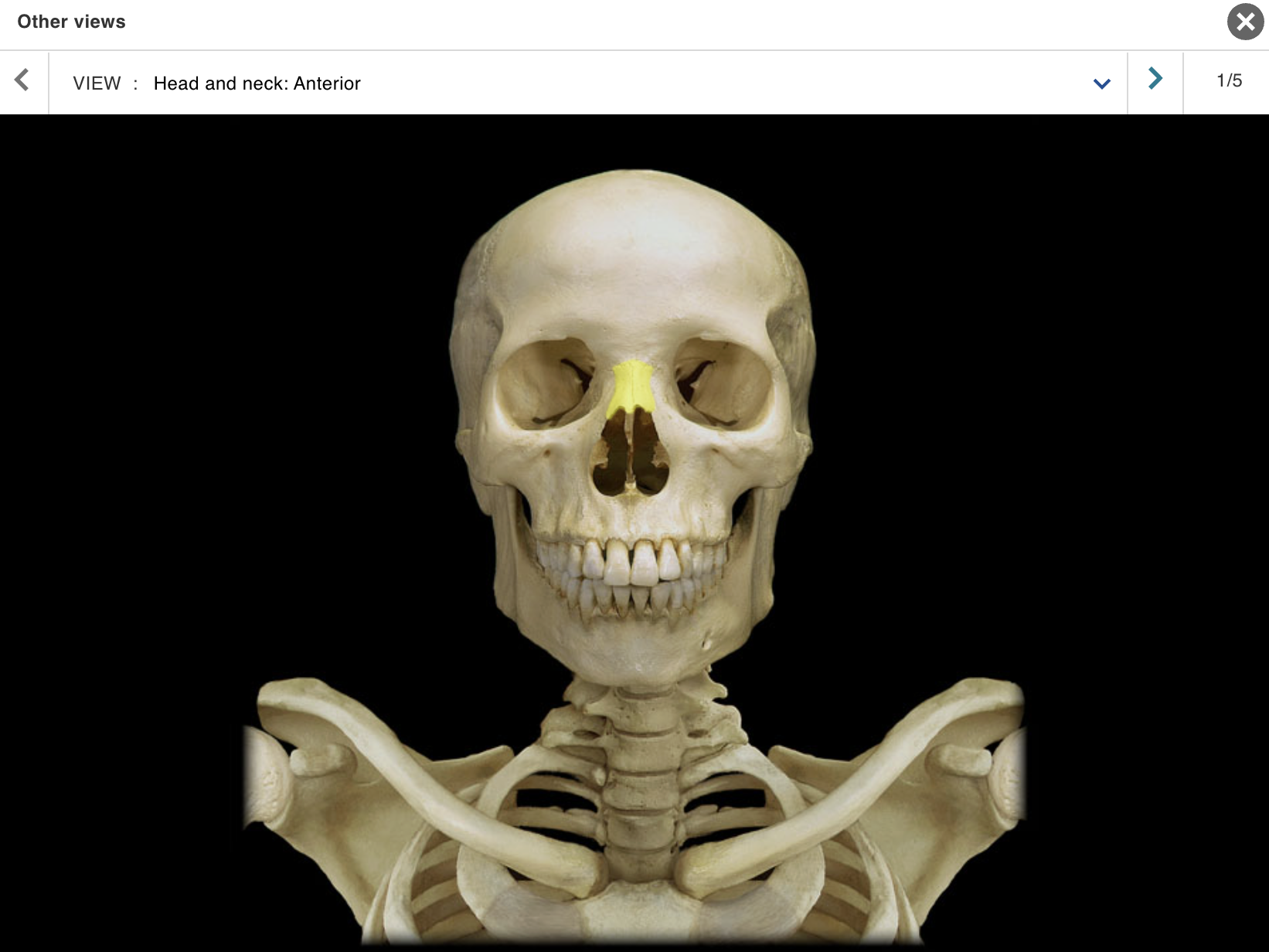
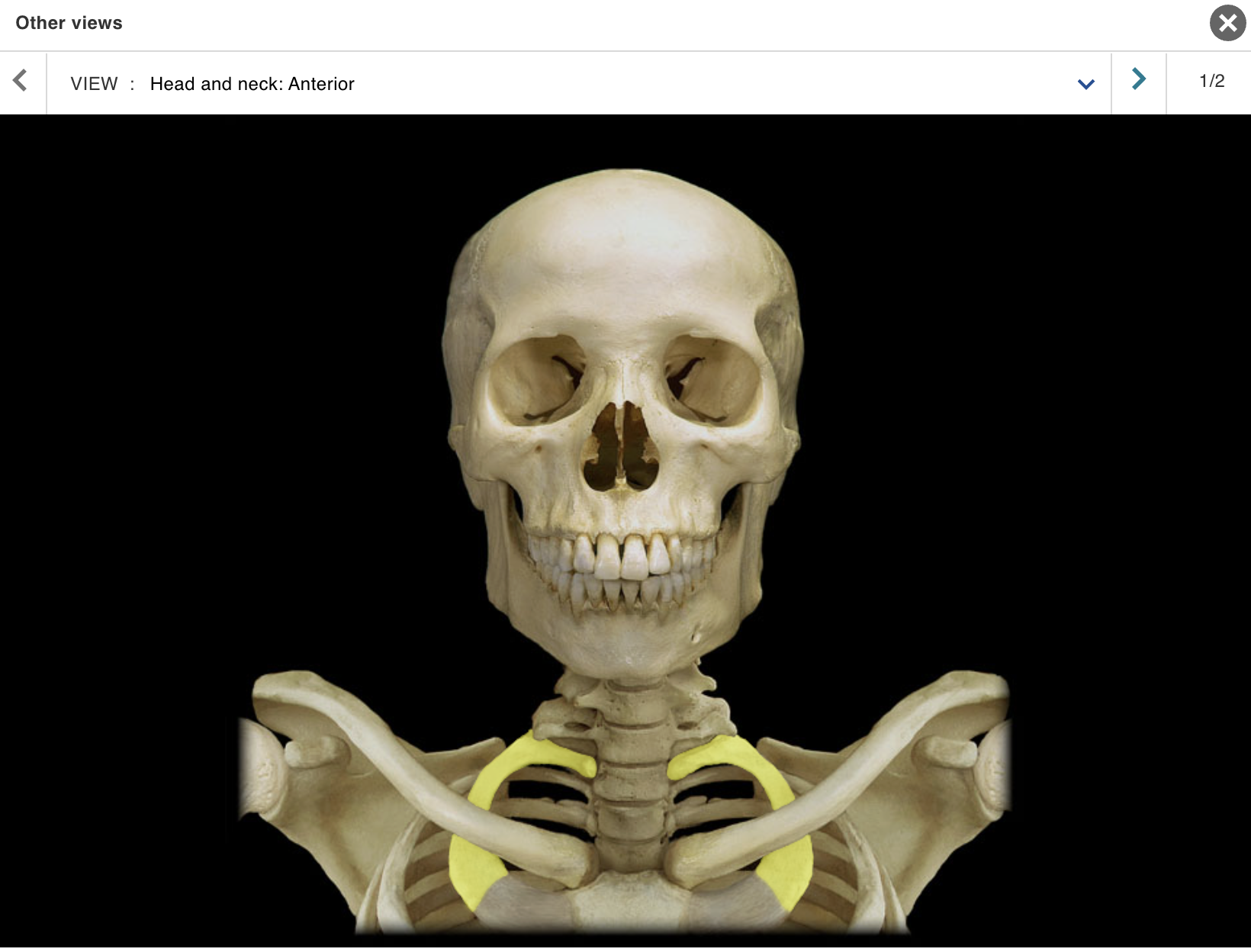
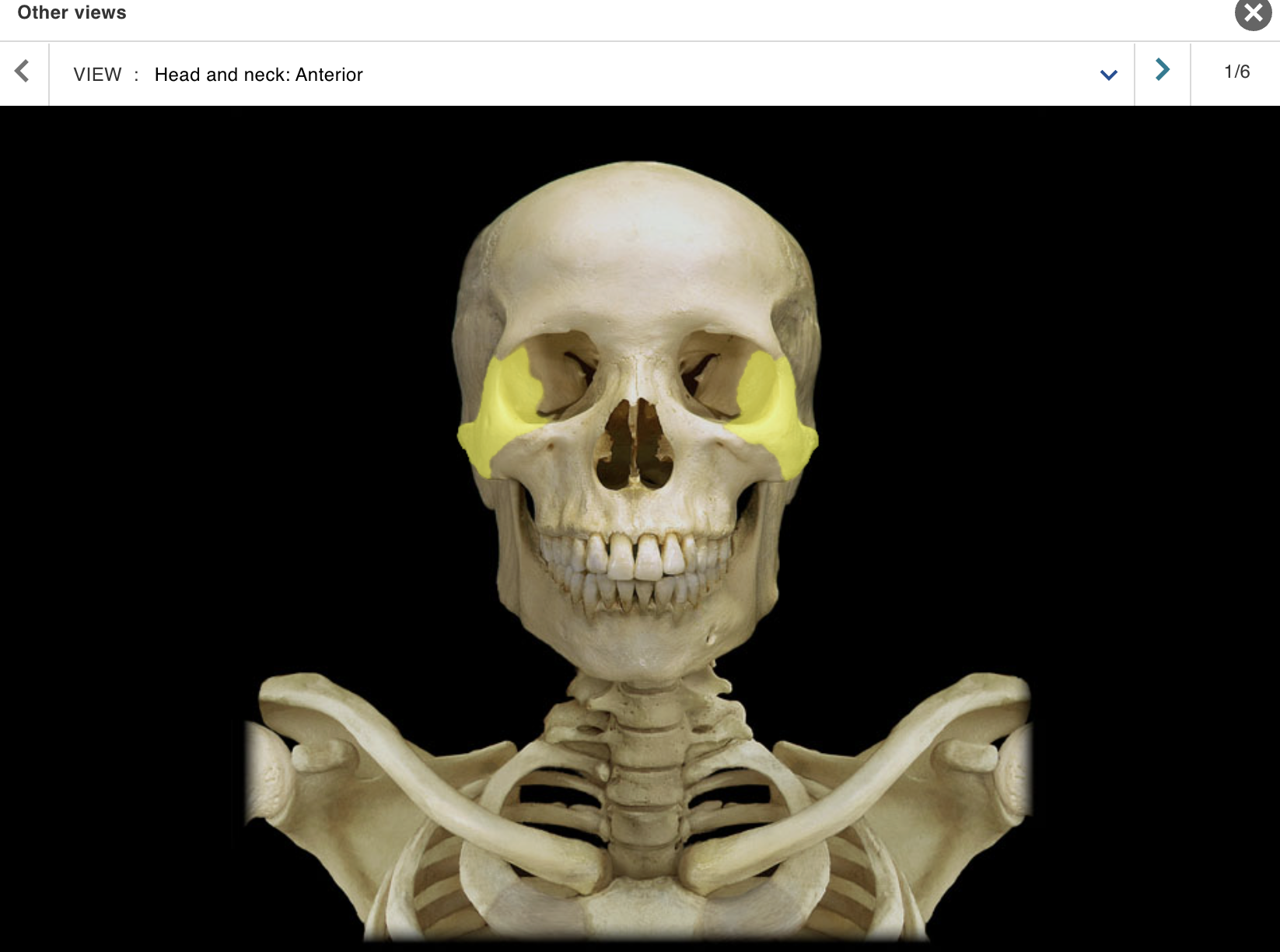
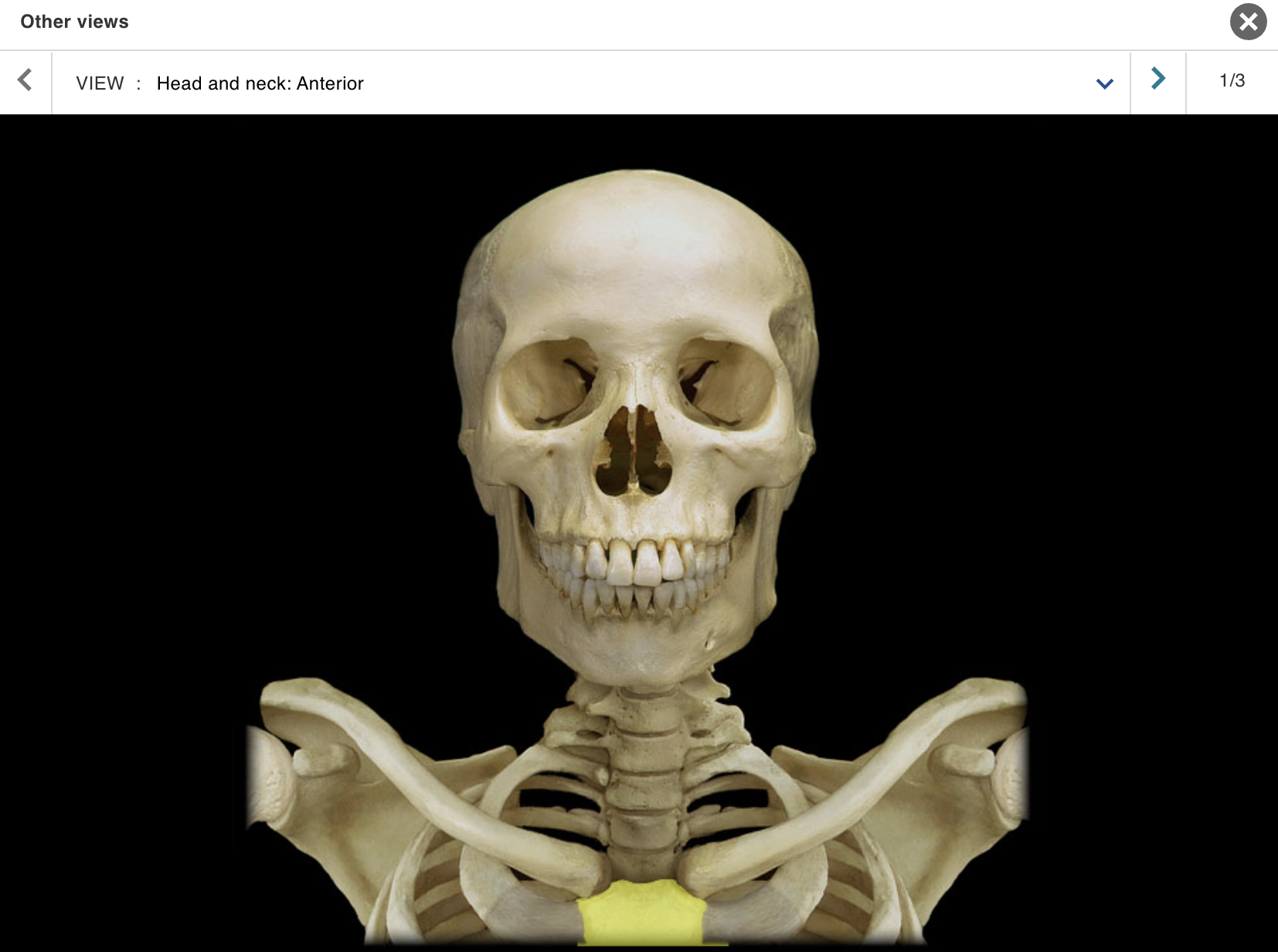
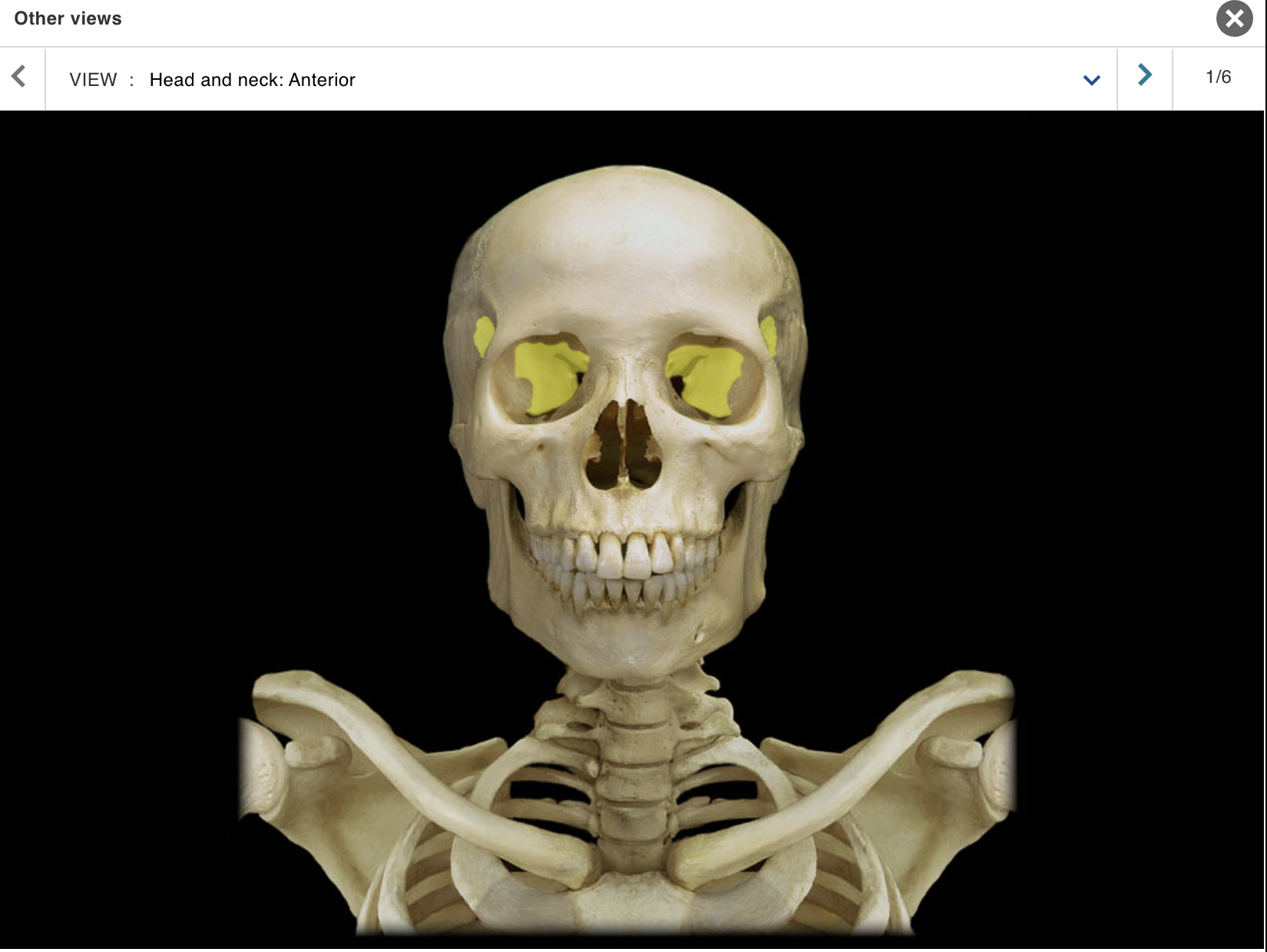
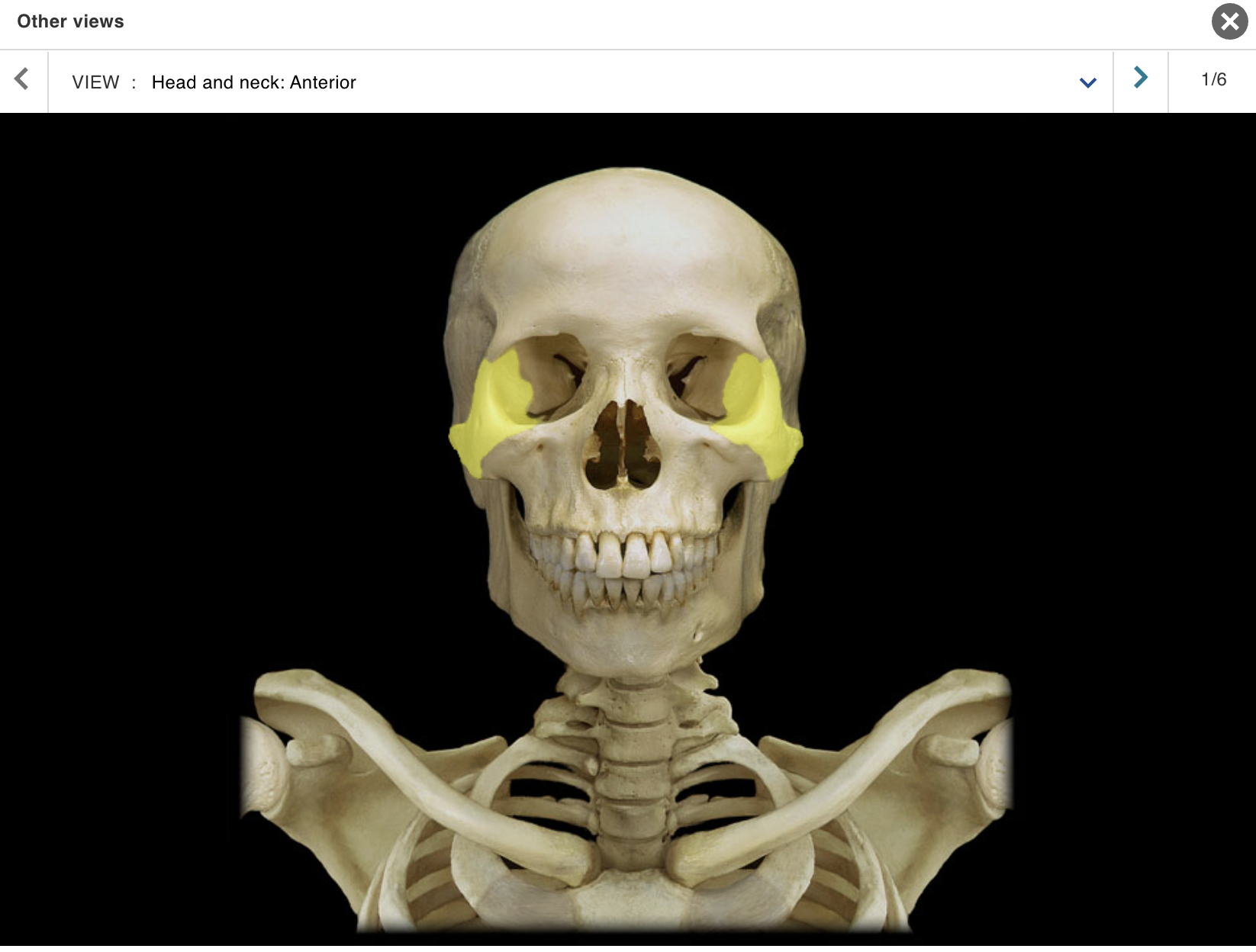
TOPIC: HEAD / NECK / VIEW : ANTERIOR

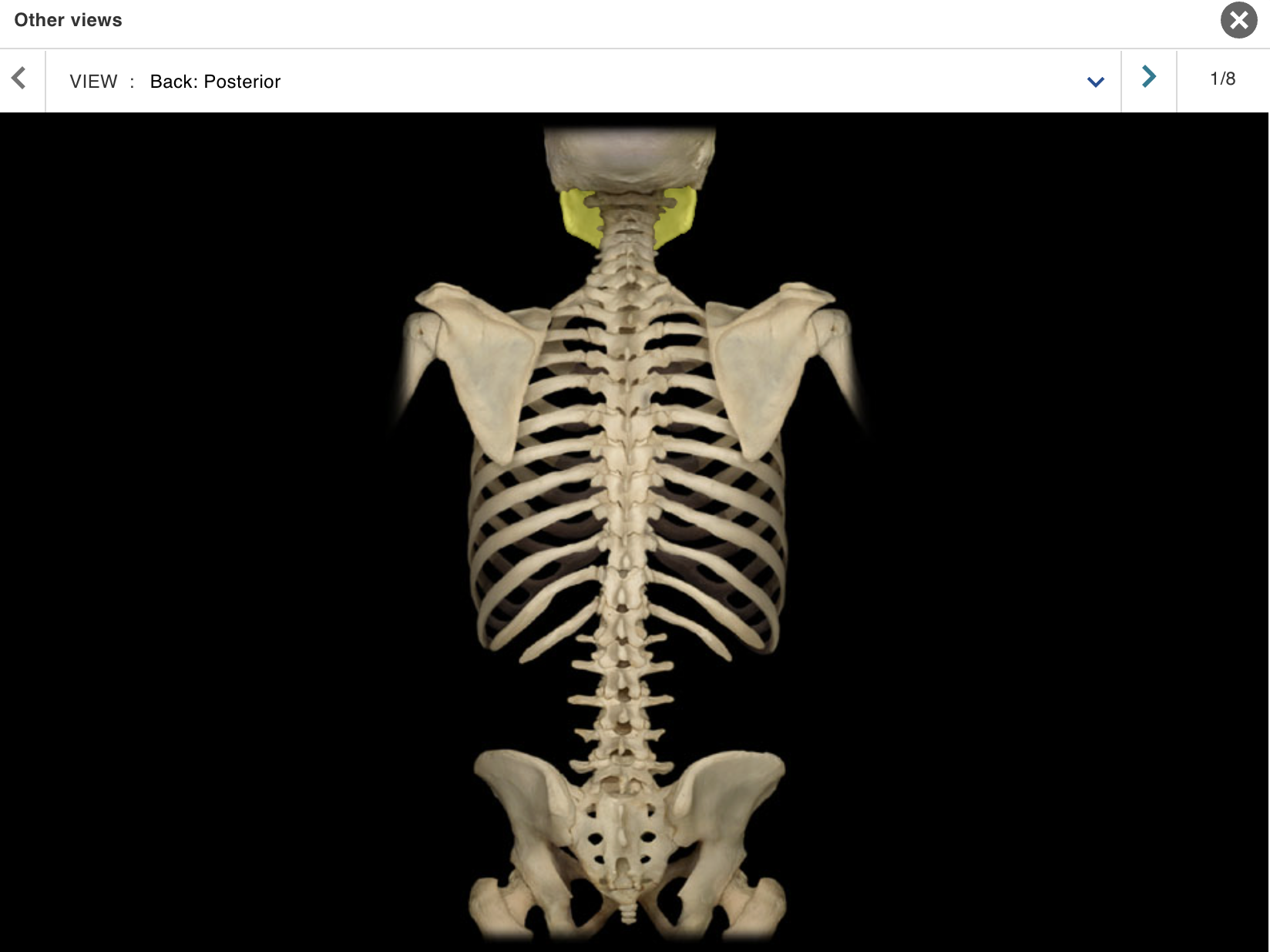
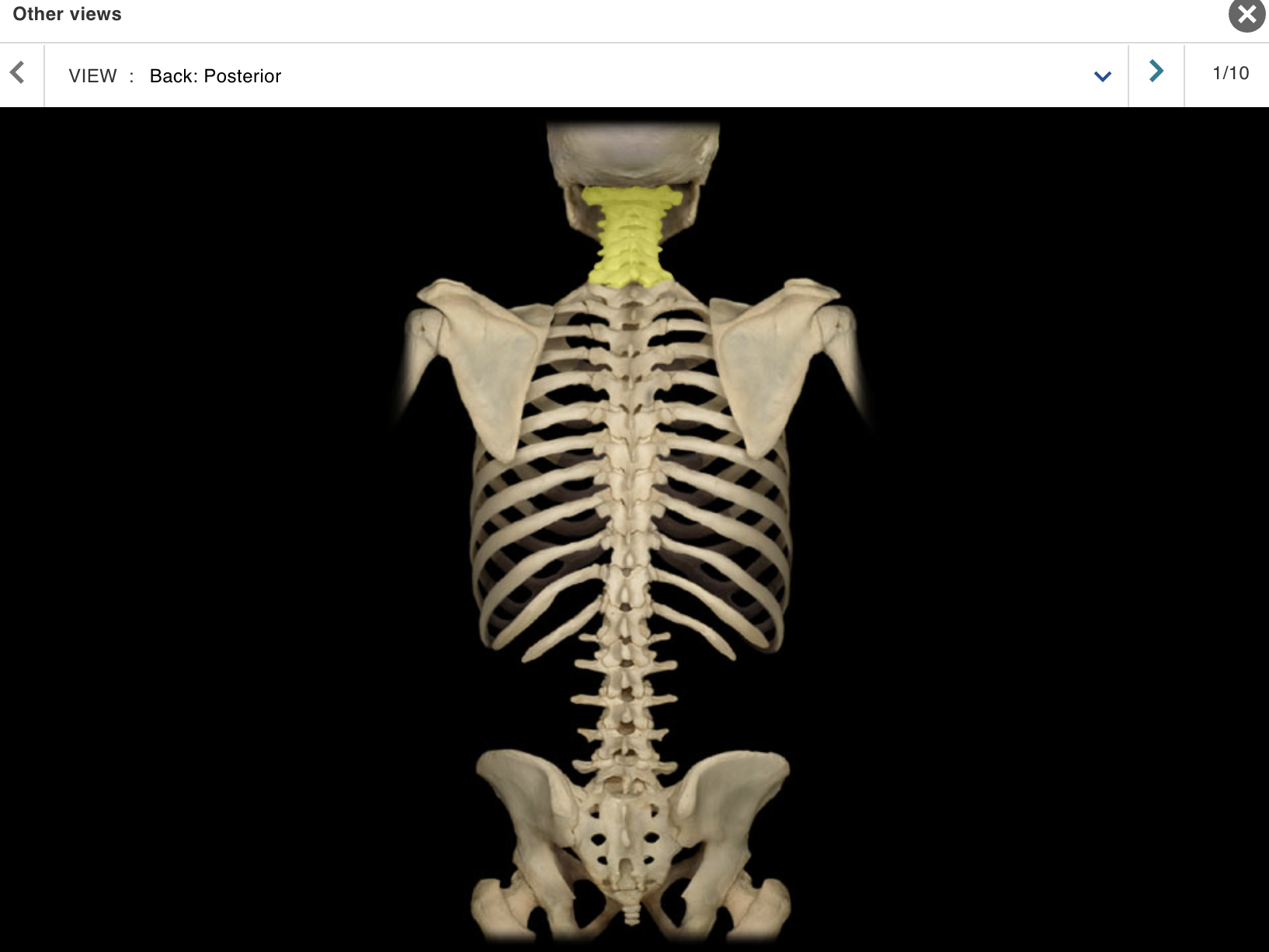
Cervical vertebra

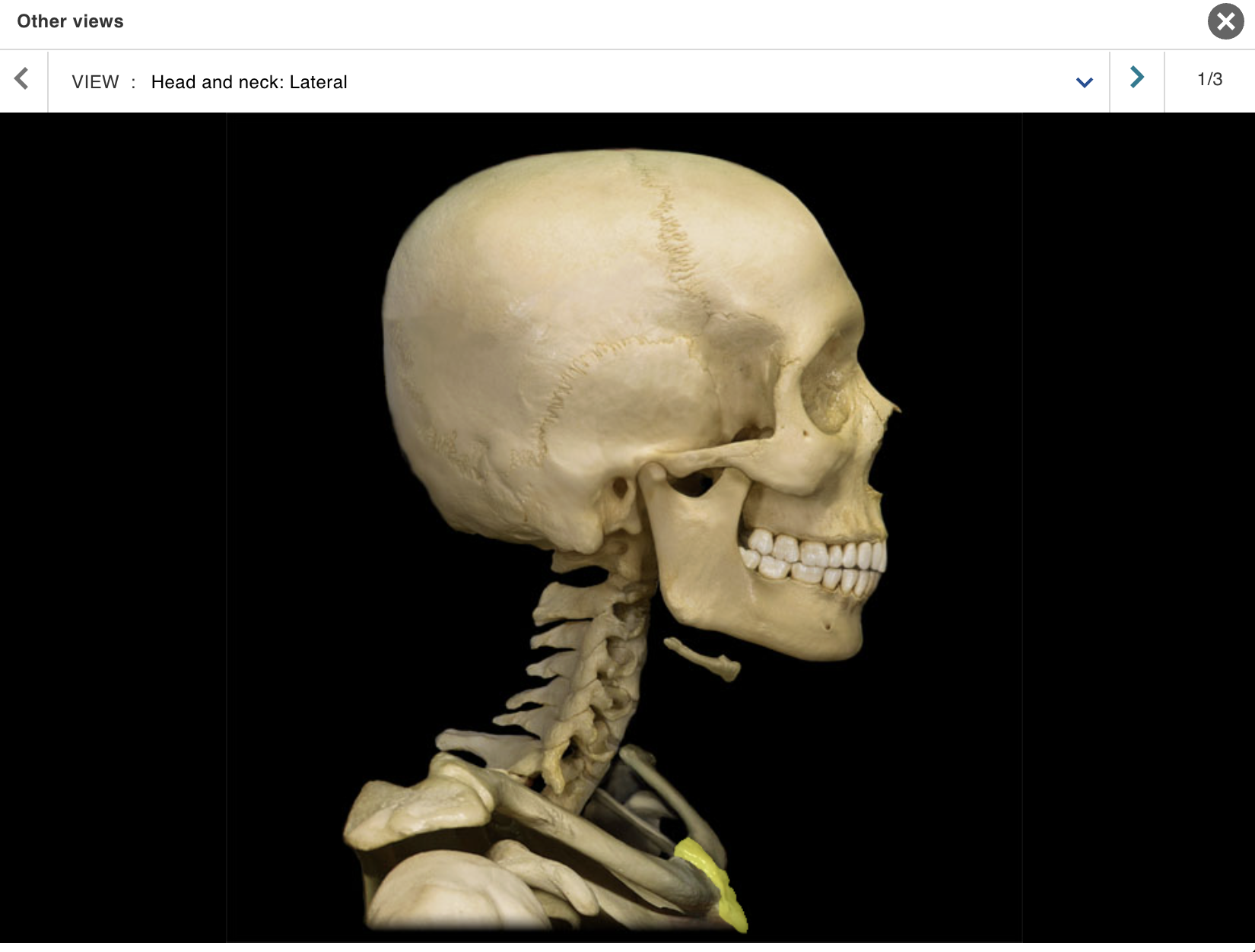
Clavicle

Frontal bone

Mandible

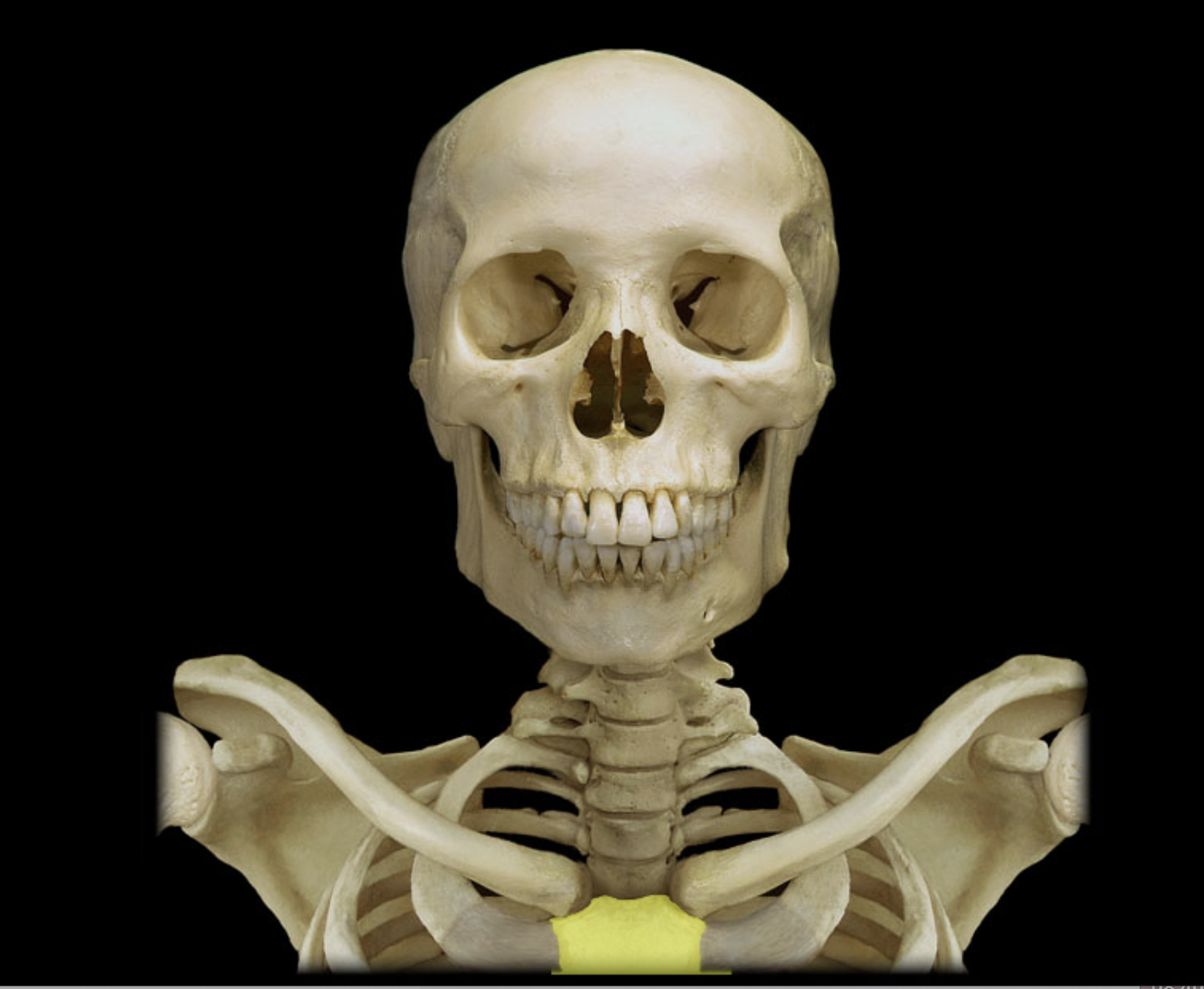
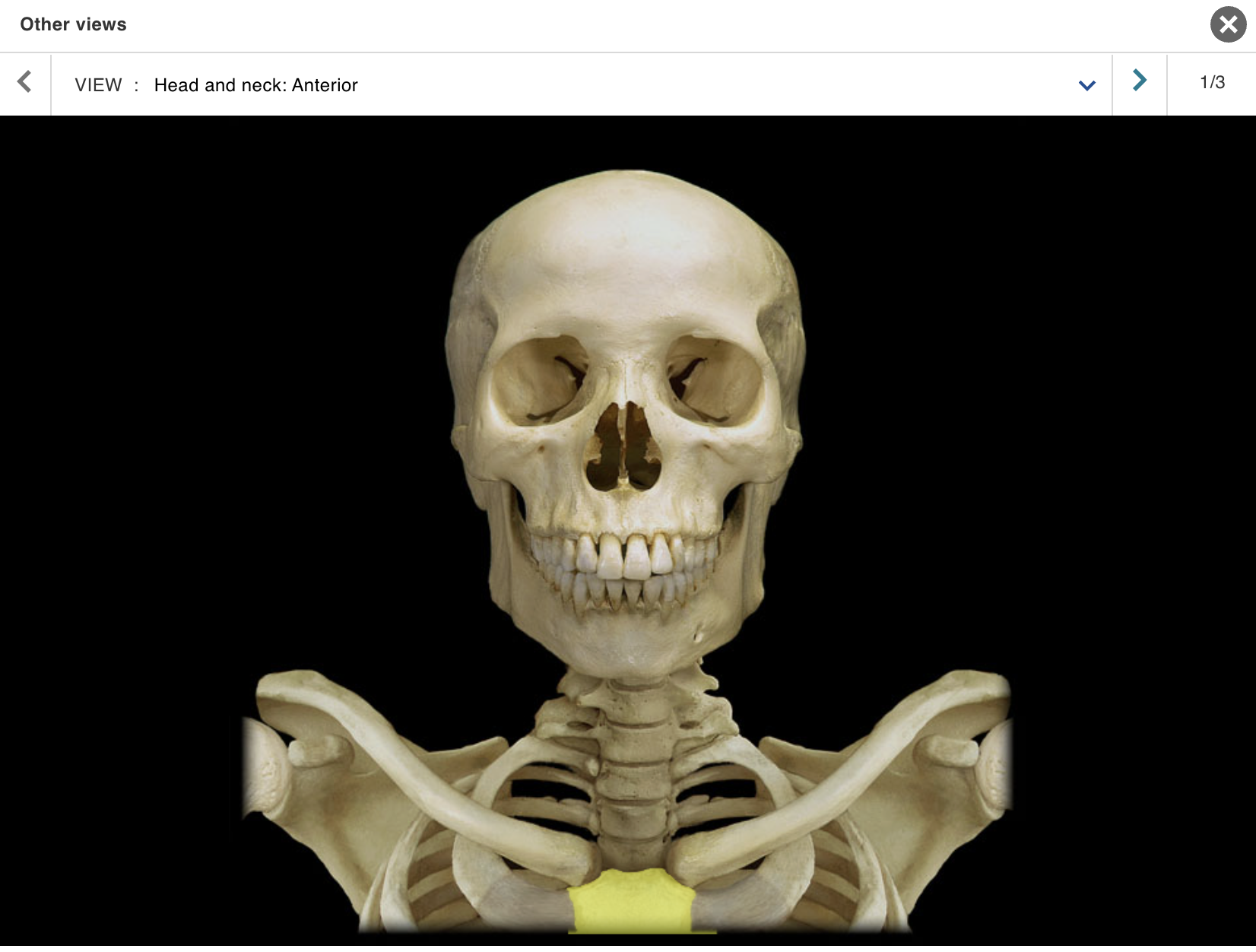
Manubrium

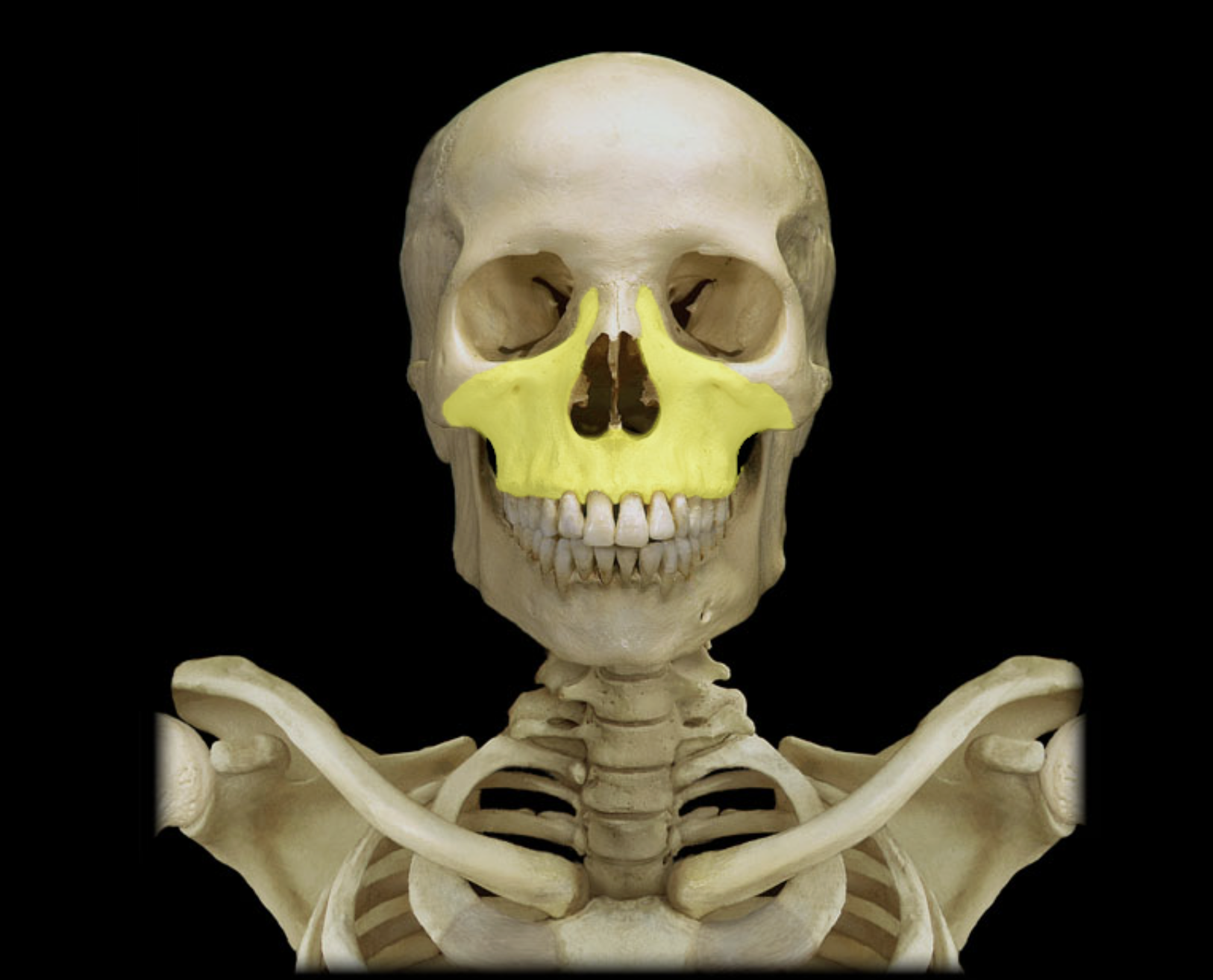
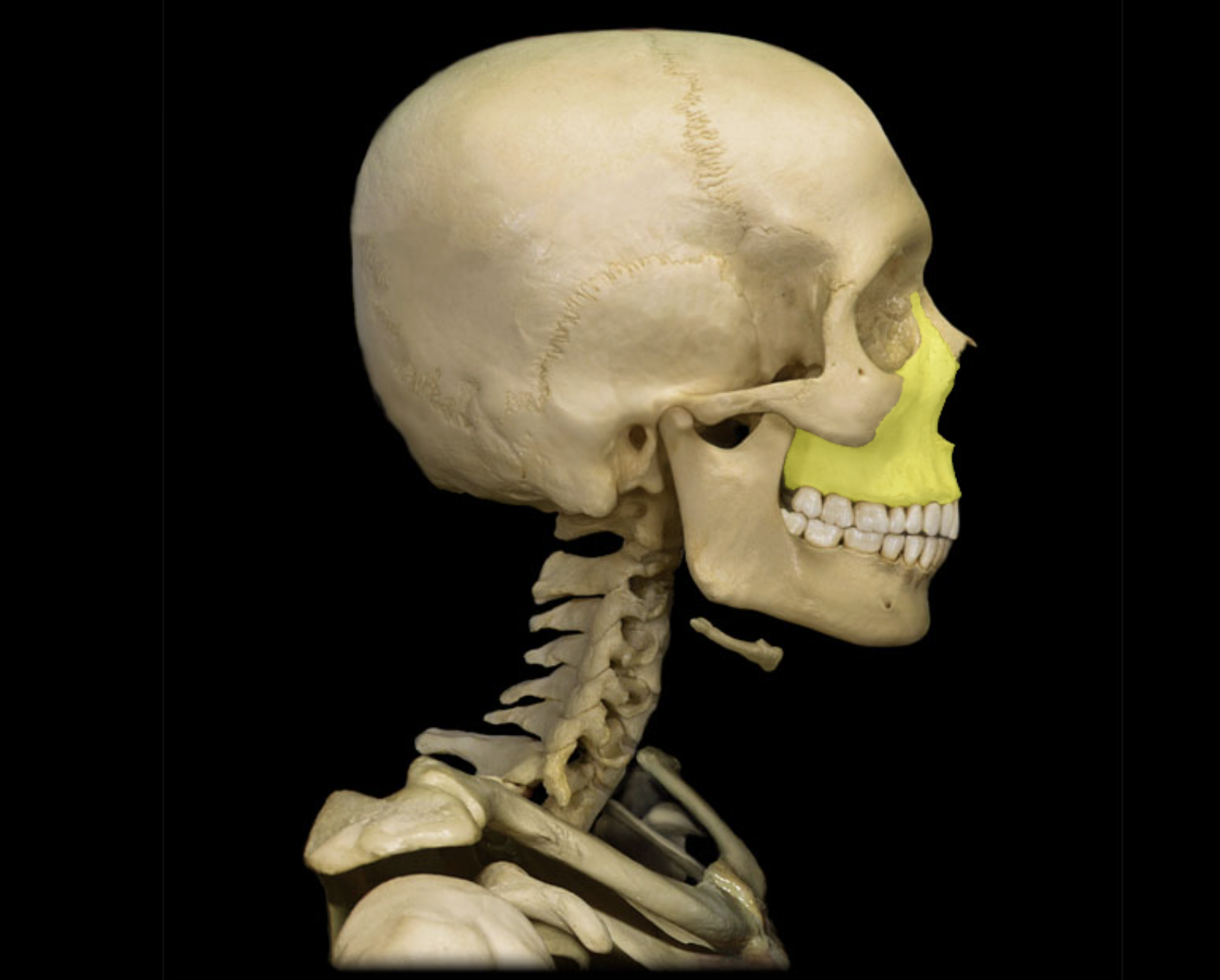
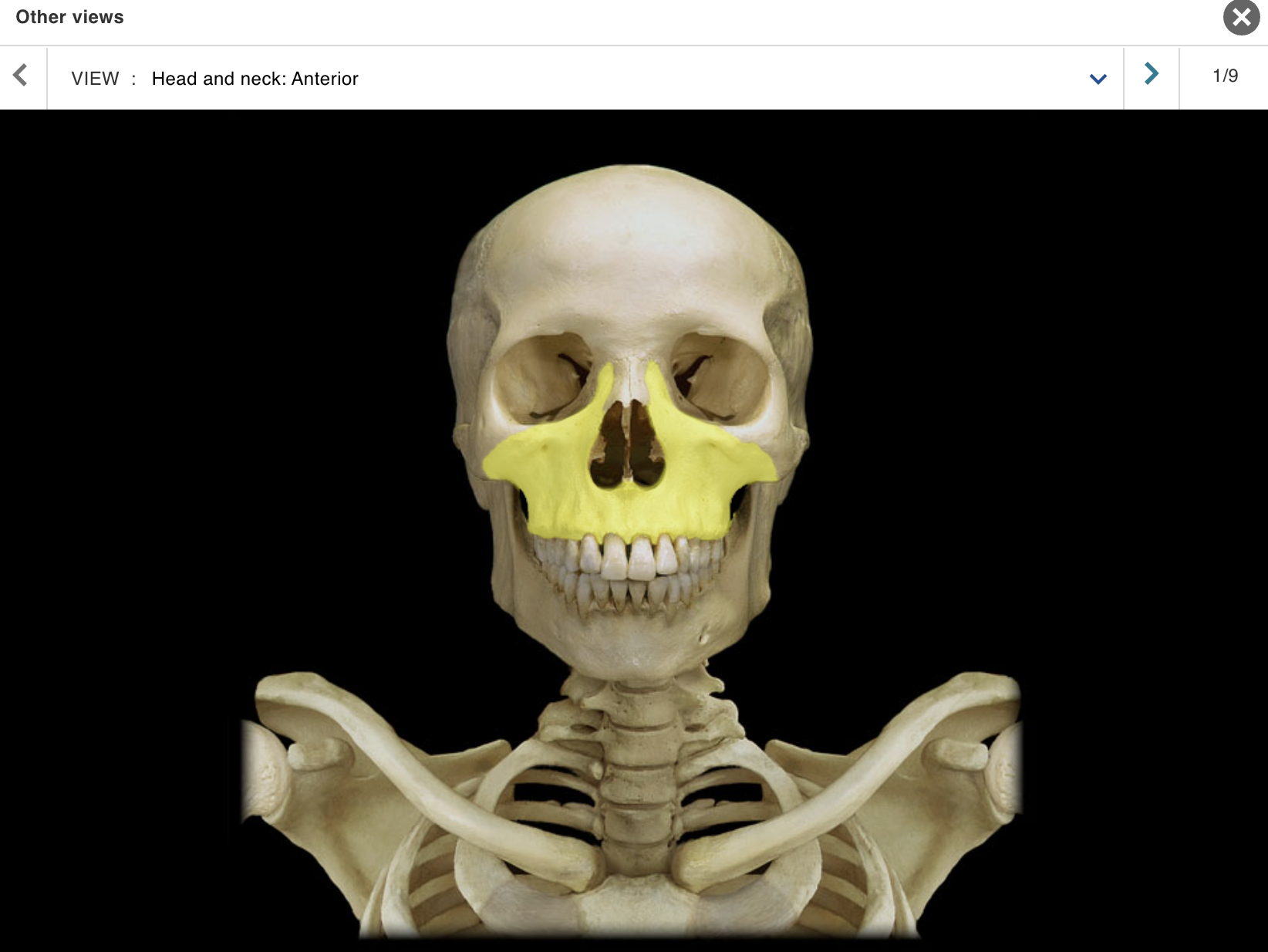
Maxilla

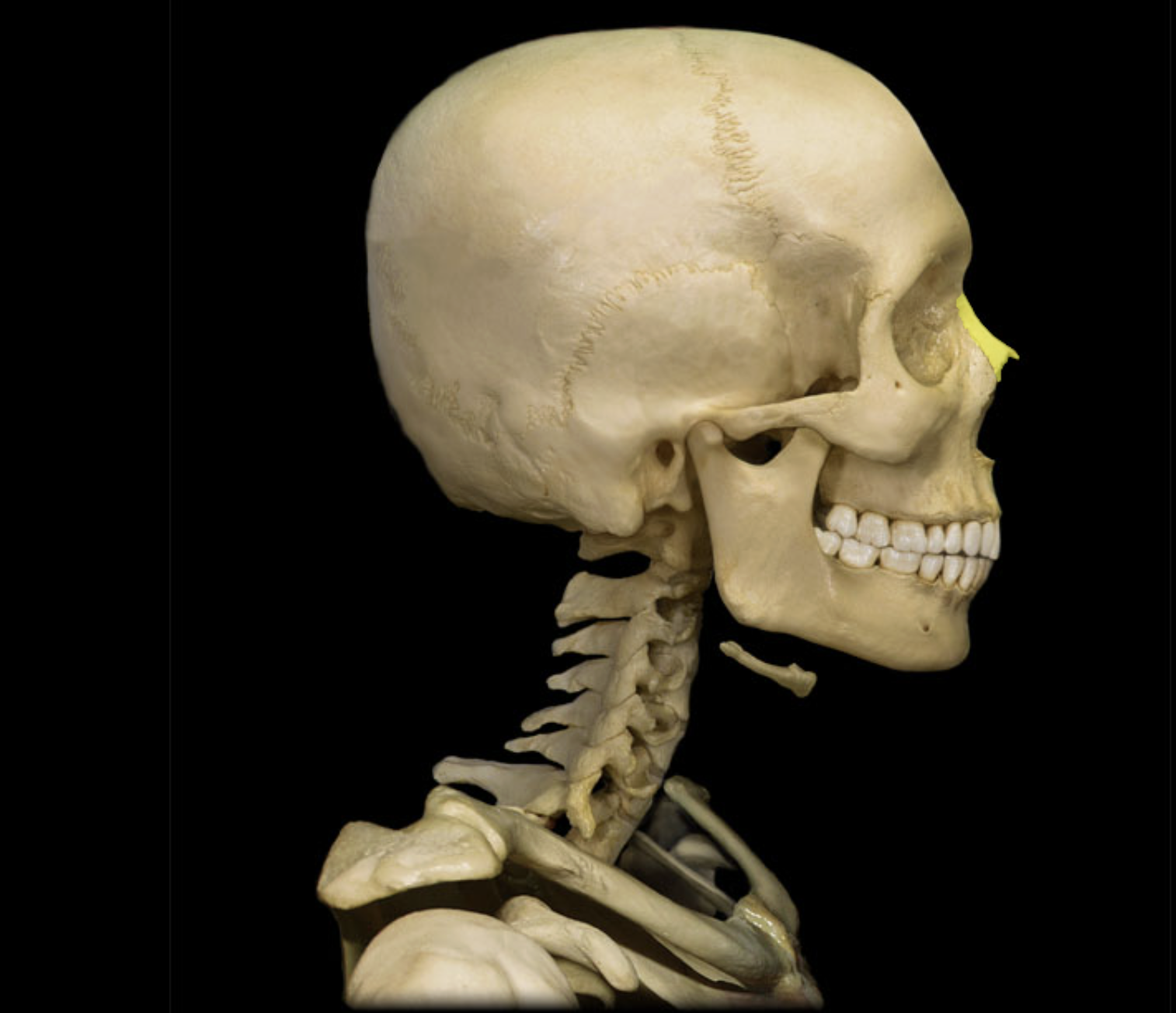
Nasal bone

Orbit

Rib 1

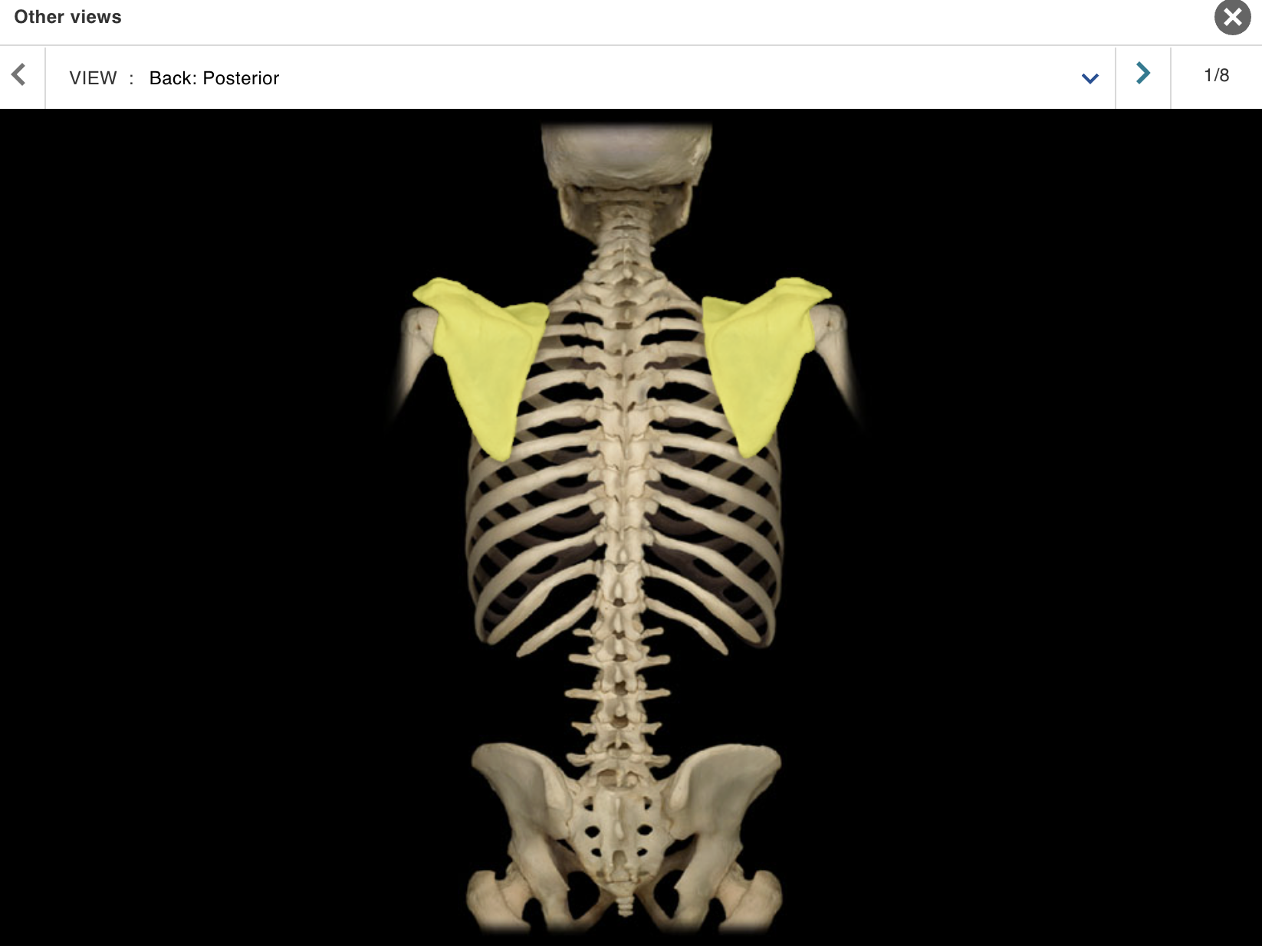
Scapula

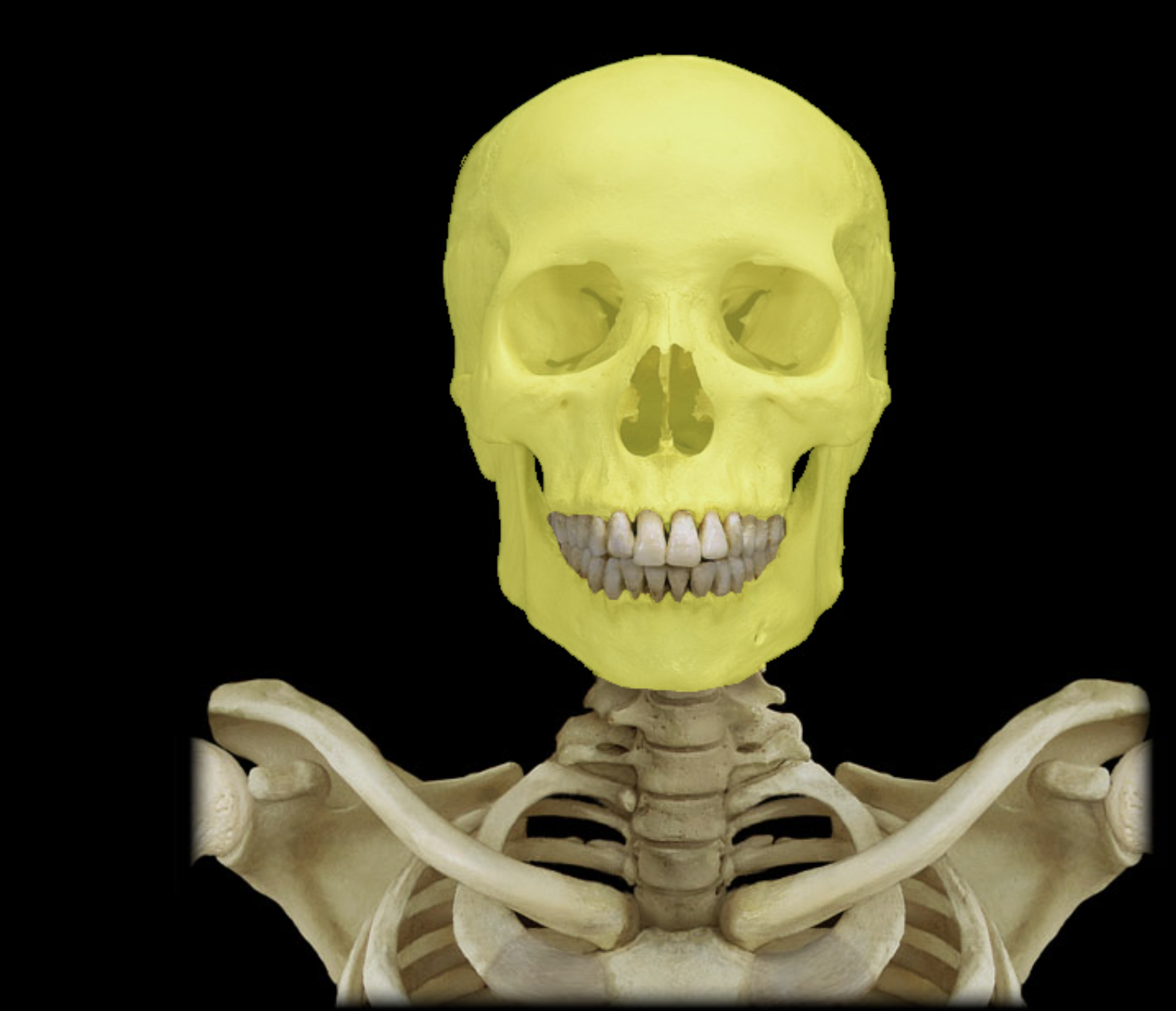
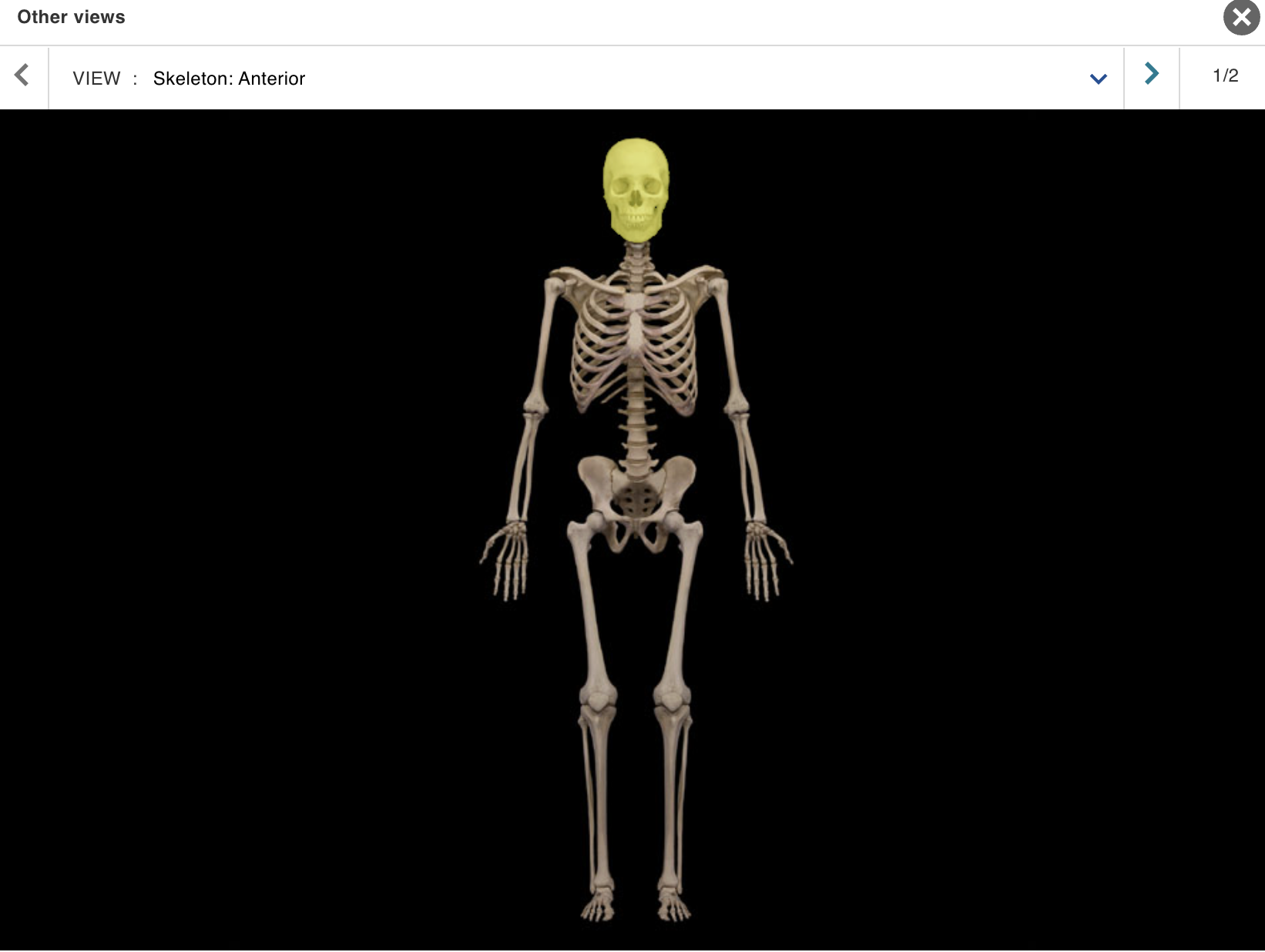
Skull

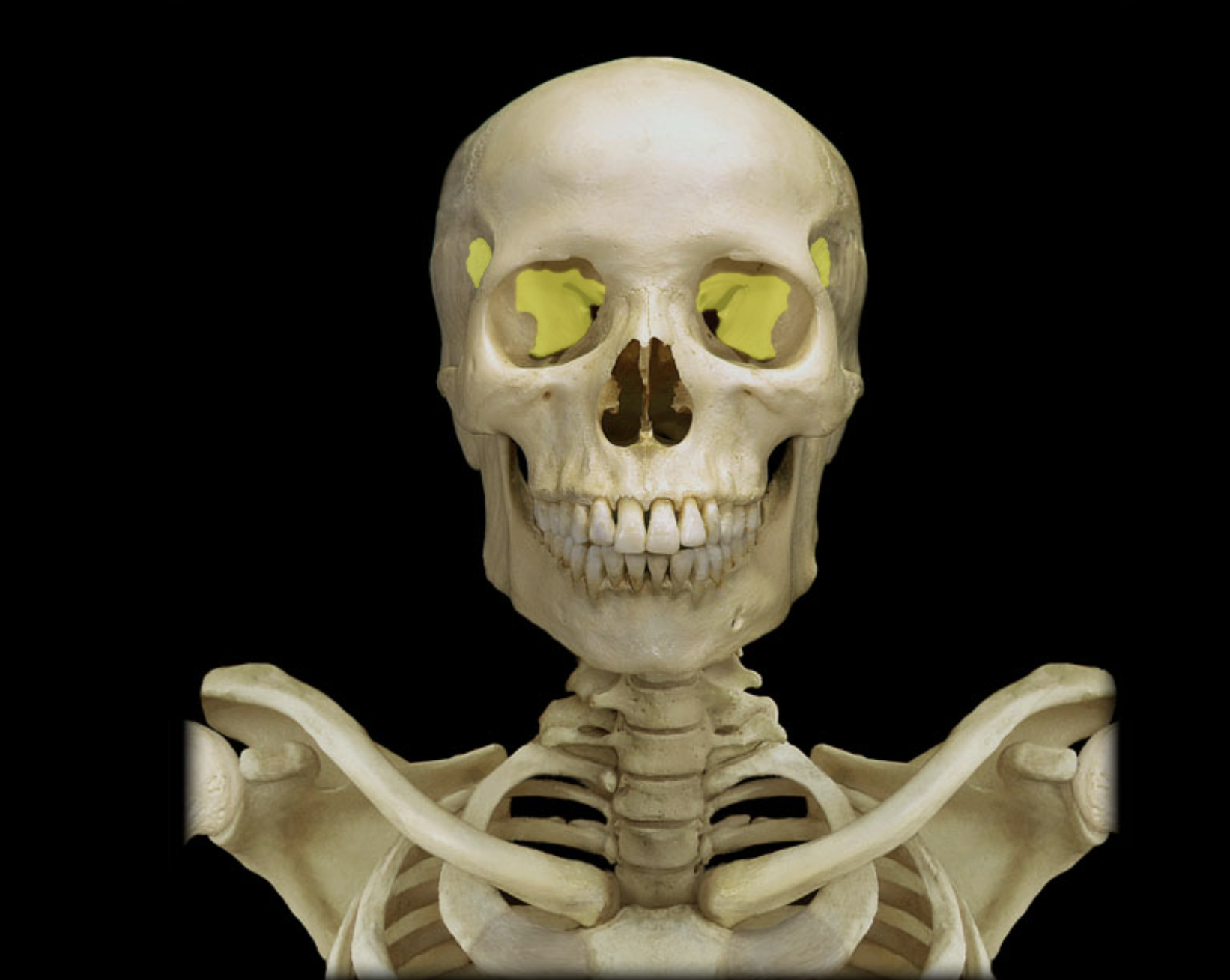
Sphenoid bone

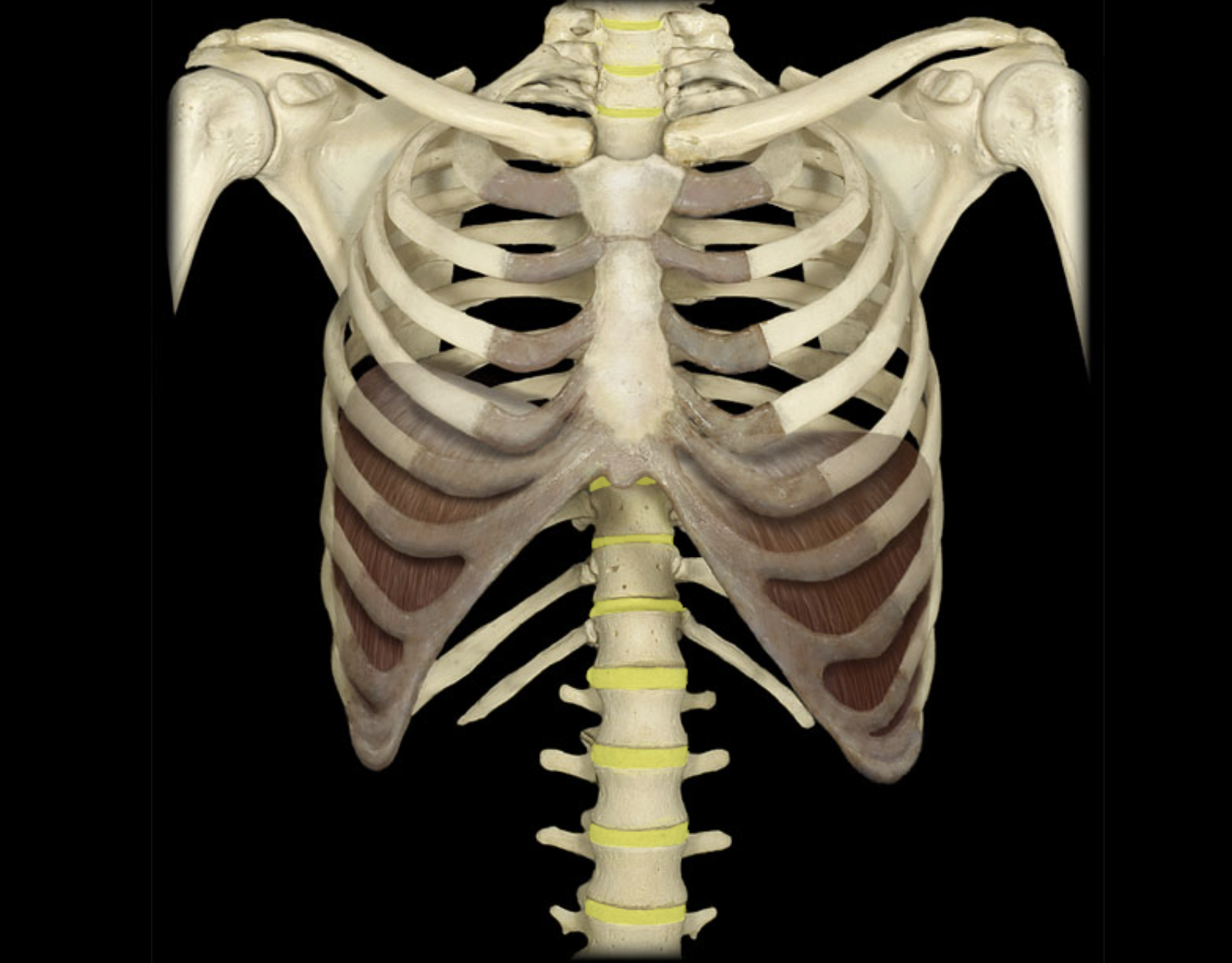
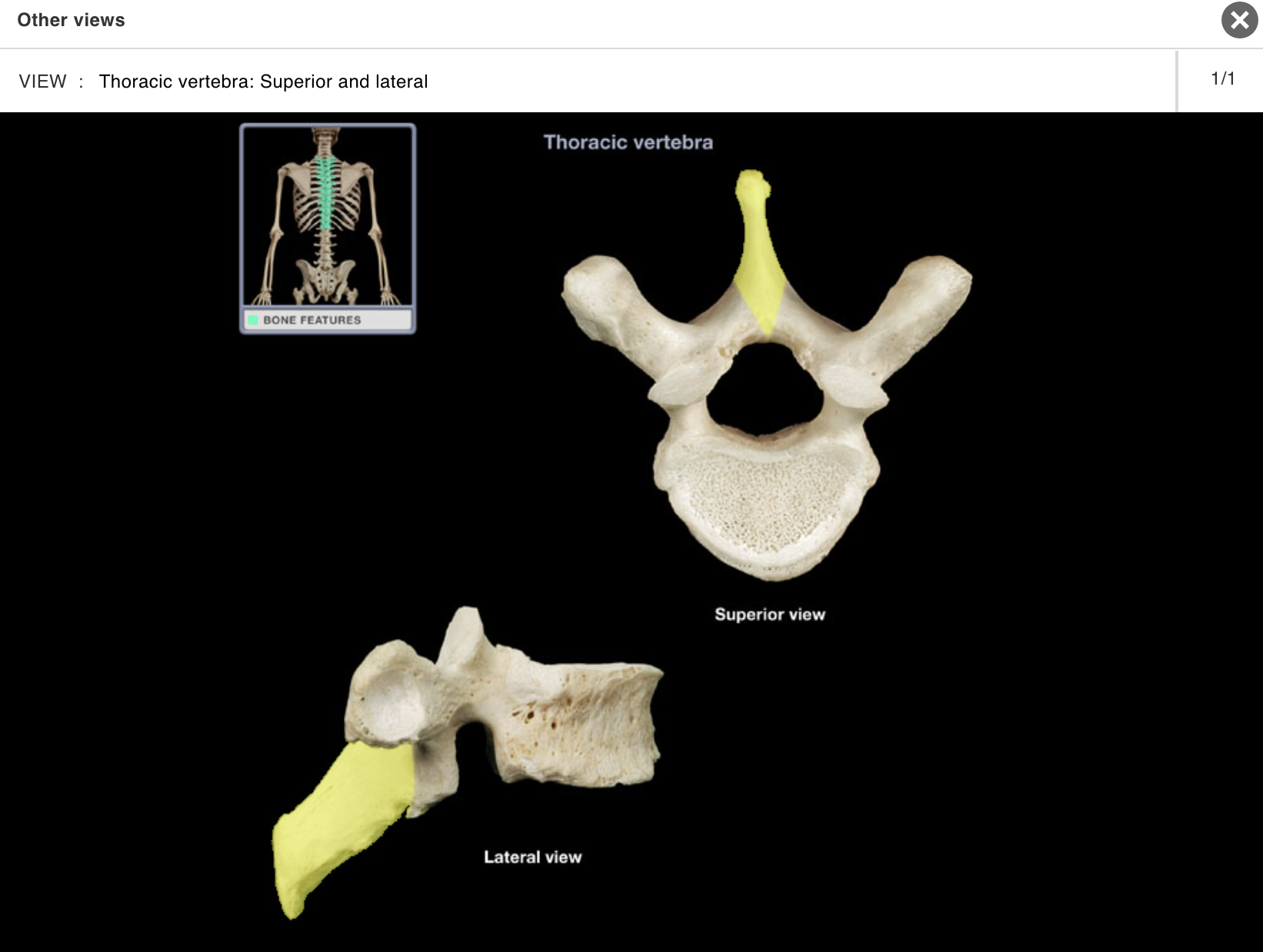
Thoracic vertebra

Zygomatic bone
2
New cards
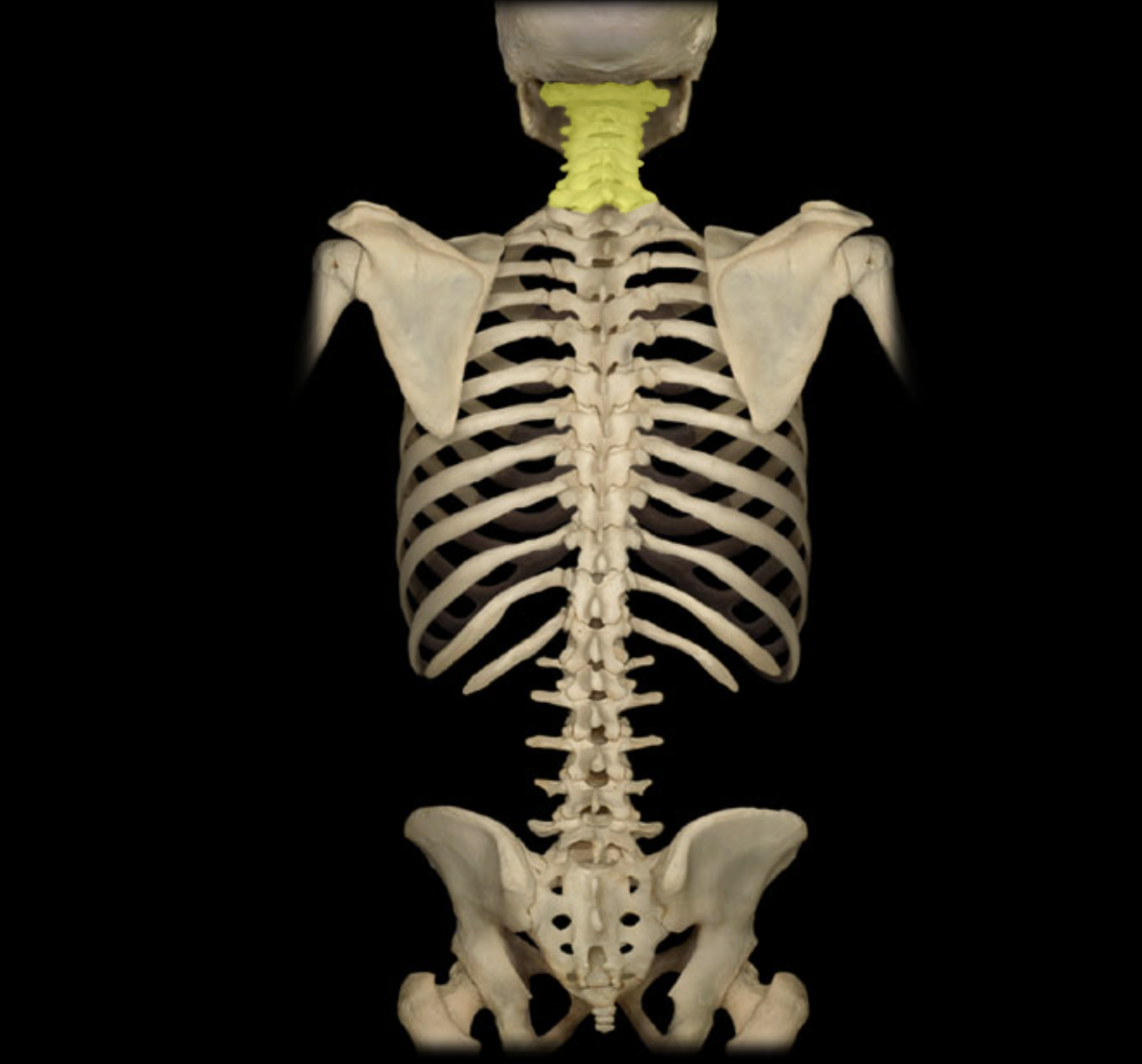
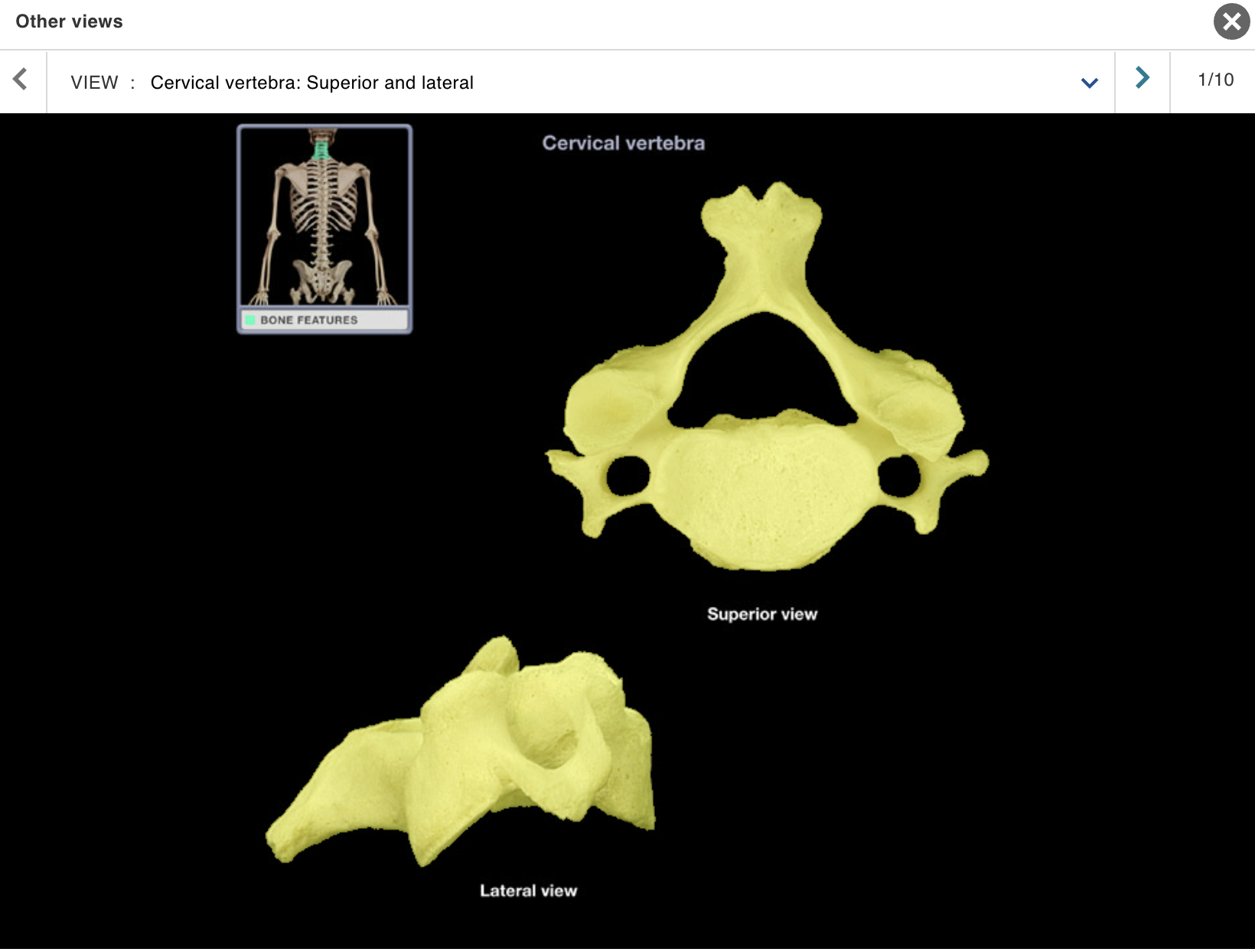
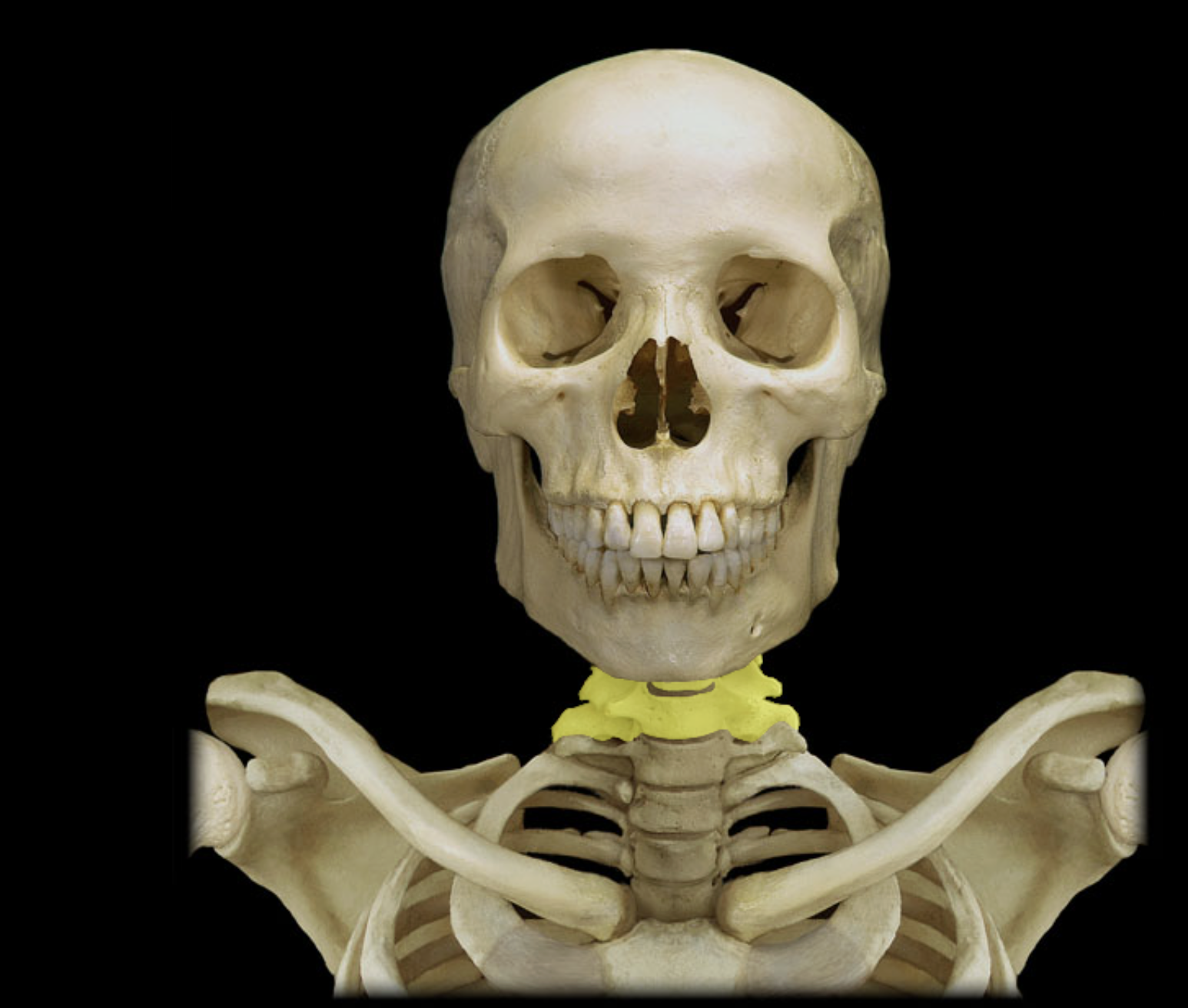
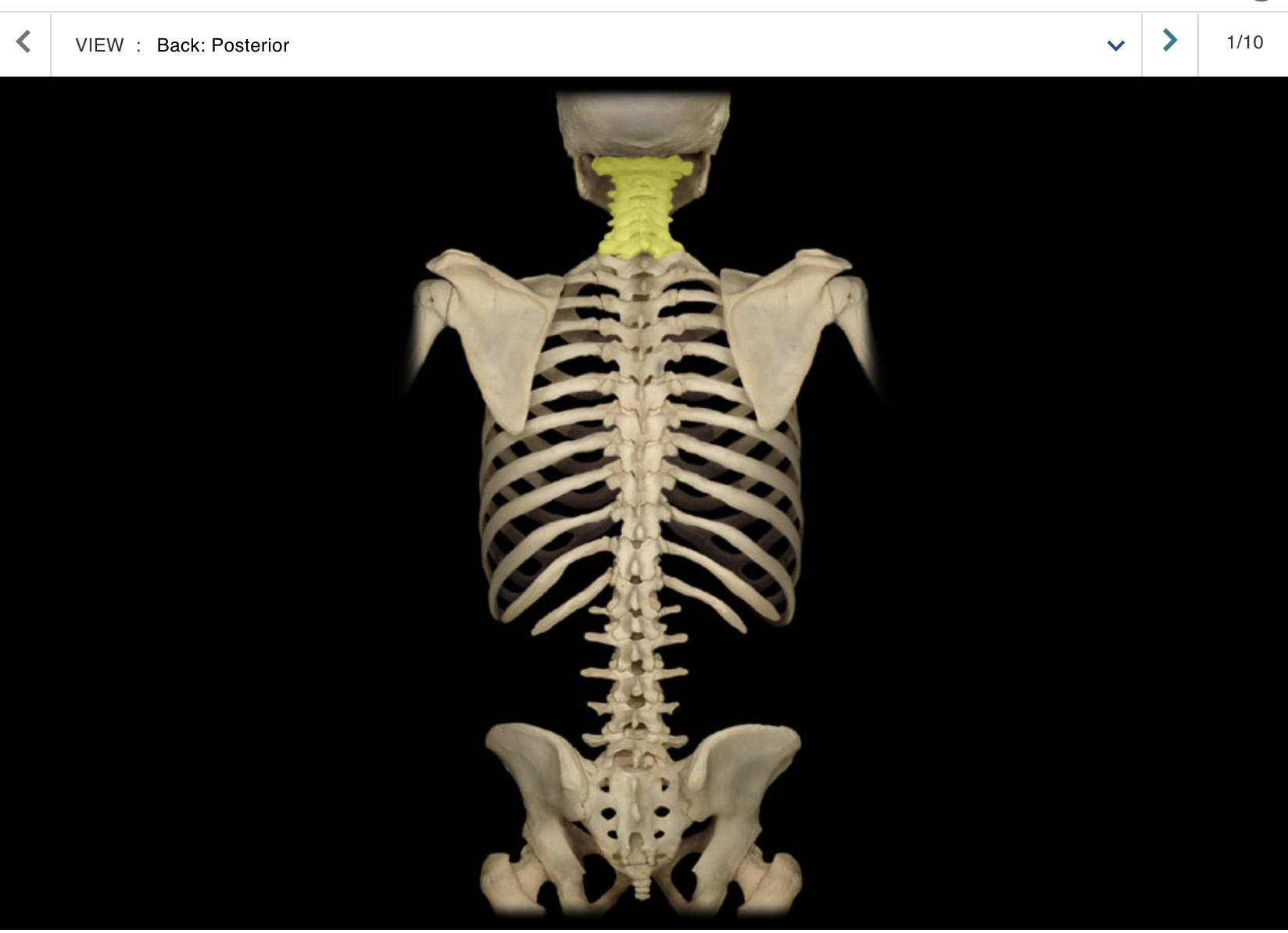
<p>Cervical vertebra</p>

Cervical vertebra

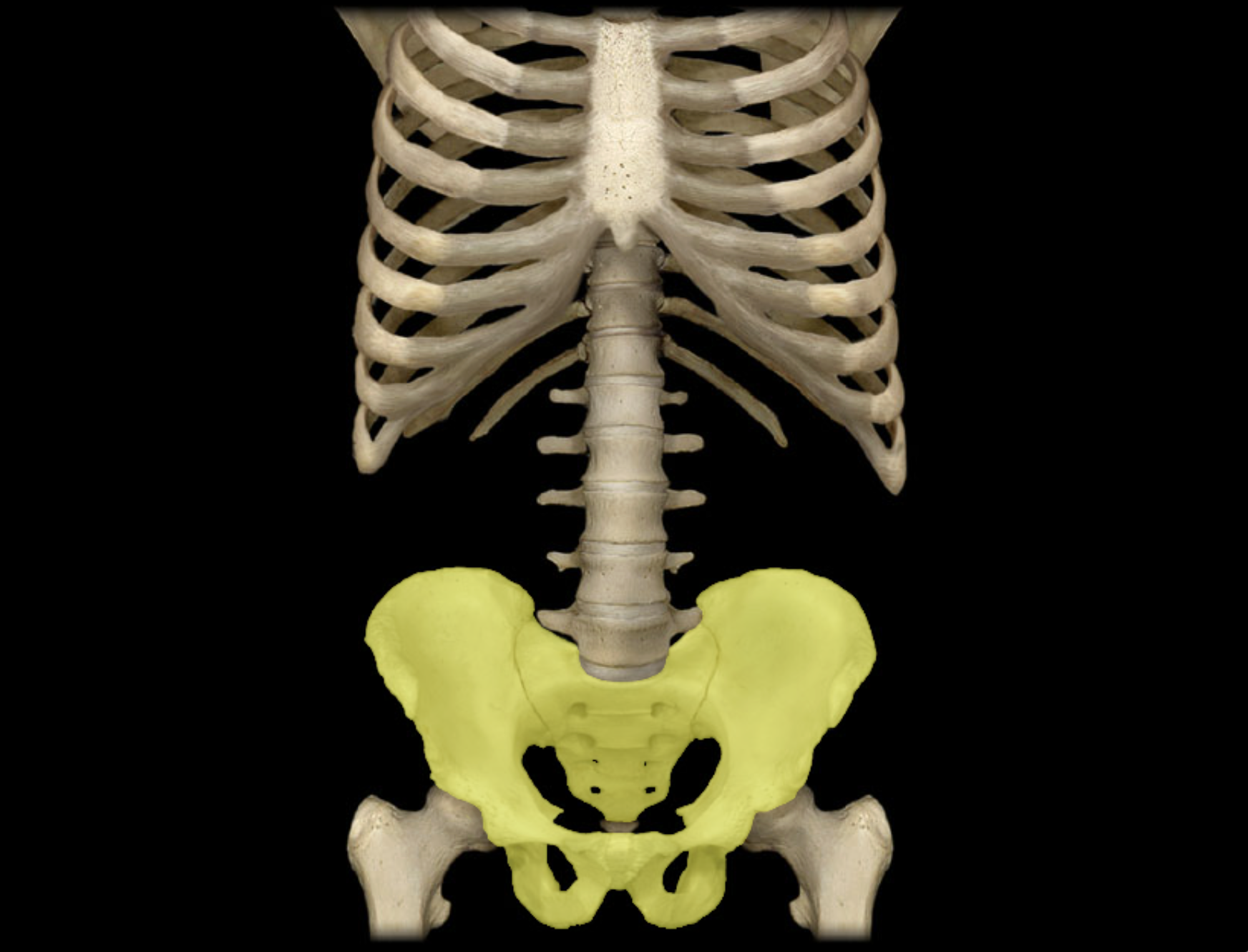
Location:

  • Neck

  • Between occipital bone and T1 vertebra

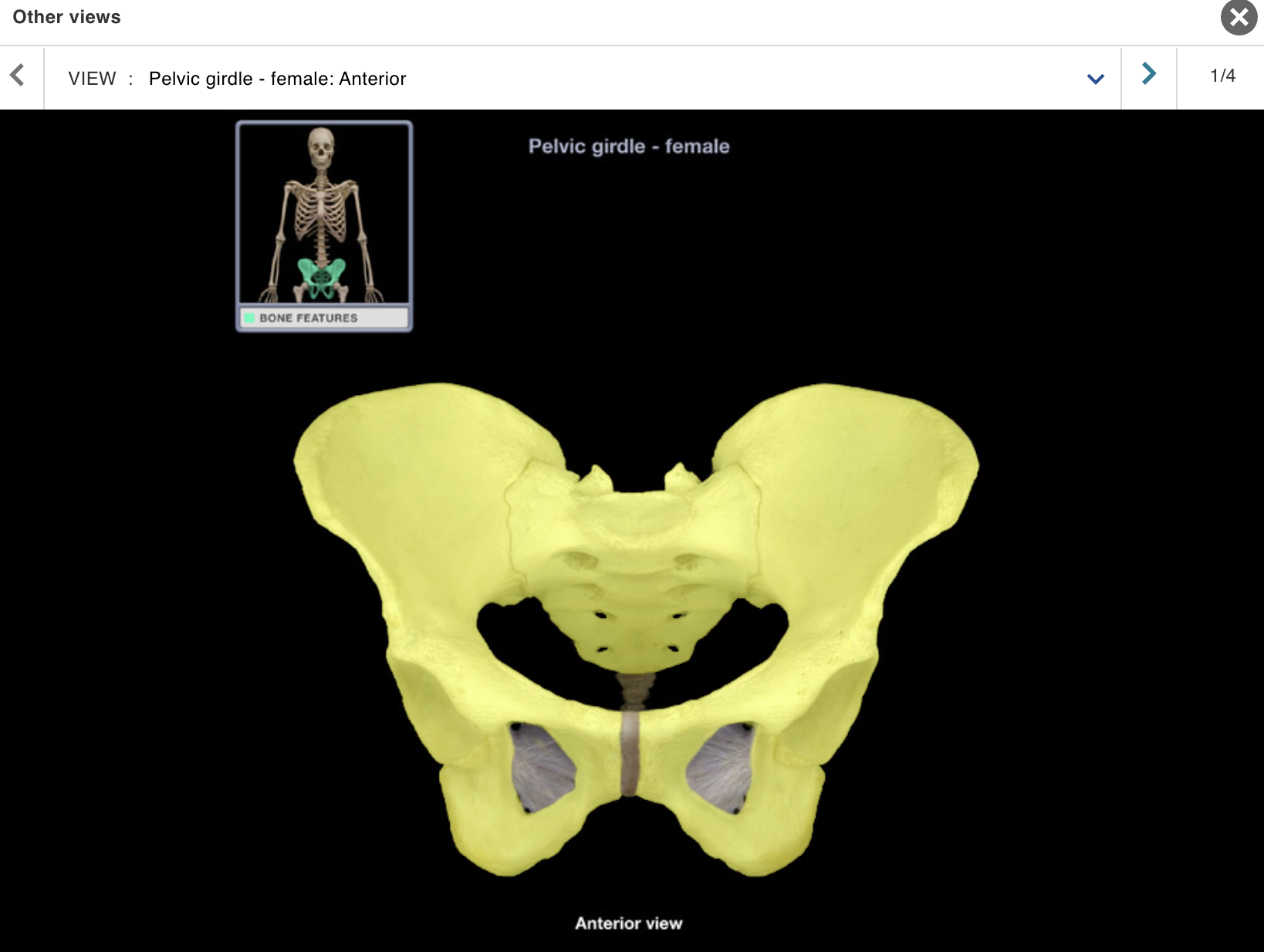
Description:

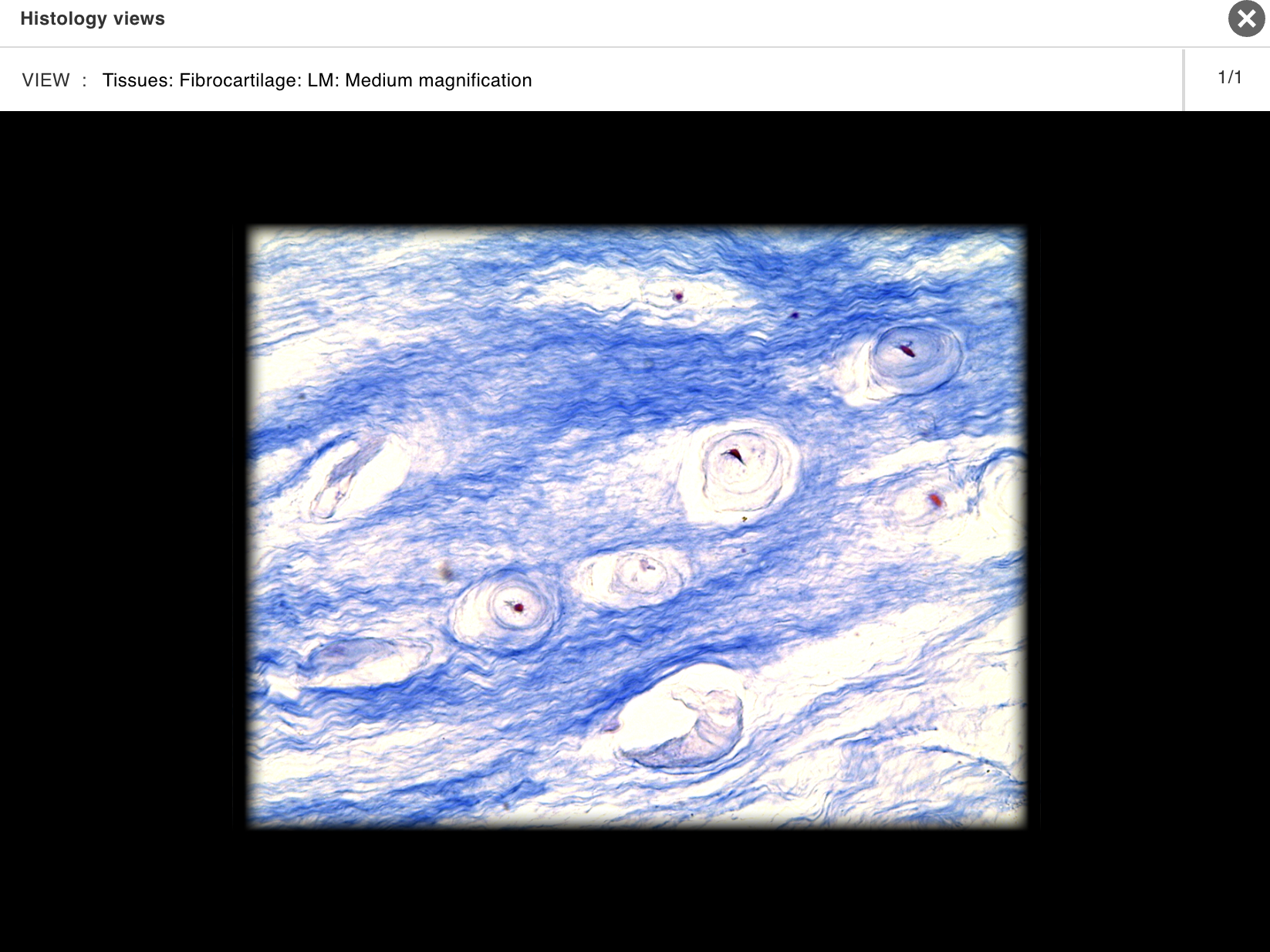
  • Seven individual vertebrae

  • Characteristic features include transverse foramen and bifid (split) spinous process on C3-C6

Comment:

• Atlas (C1 vertebra) articulates with skull
<p>Location:</p><ul><li><p>Neck</p></li><li><p>Between occipital bone and T1 vertebra</p></li></ul><p class="p1">Description:</p><ul><li><p>Seven individual vertebrae</p></li><li><p>Characteristic features include transverse foramen and bifid (split) spinous process on C3-C6</p></li></ul><p>Comment:</p><p class="p1">• Atlas (C1 vertebra) articulates with skull</p>
3
New cards
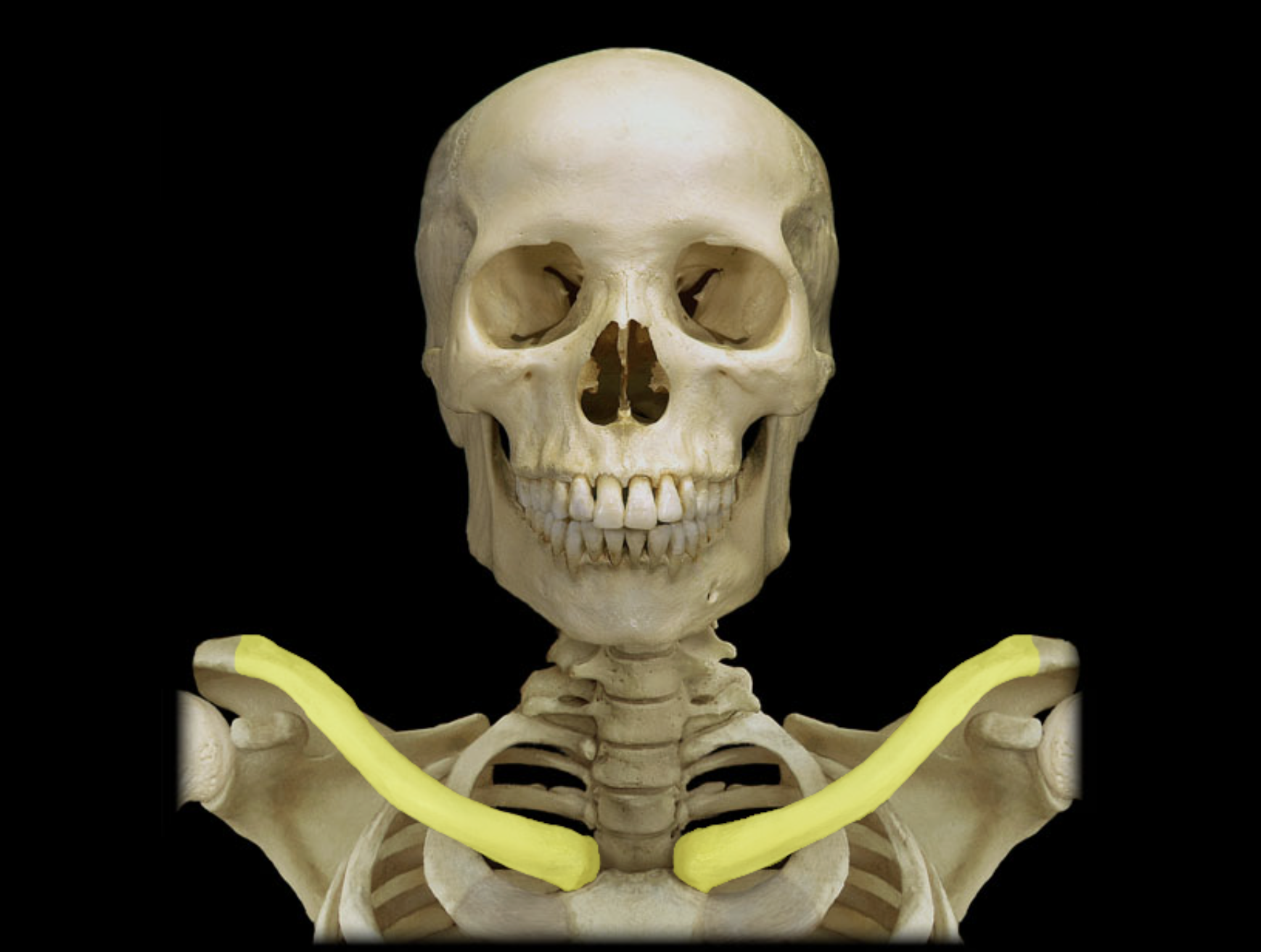
<p>Clavicle</p>

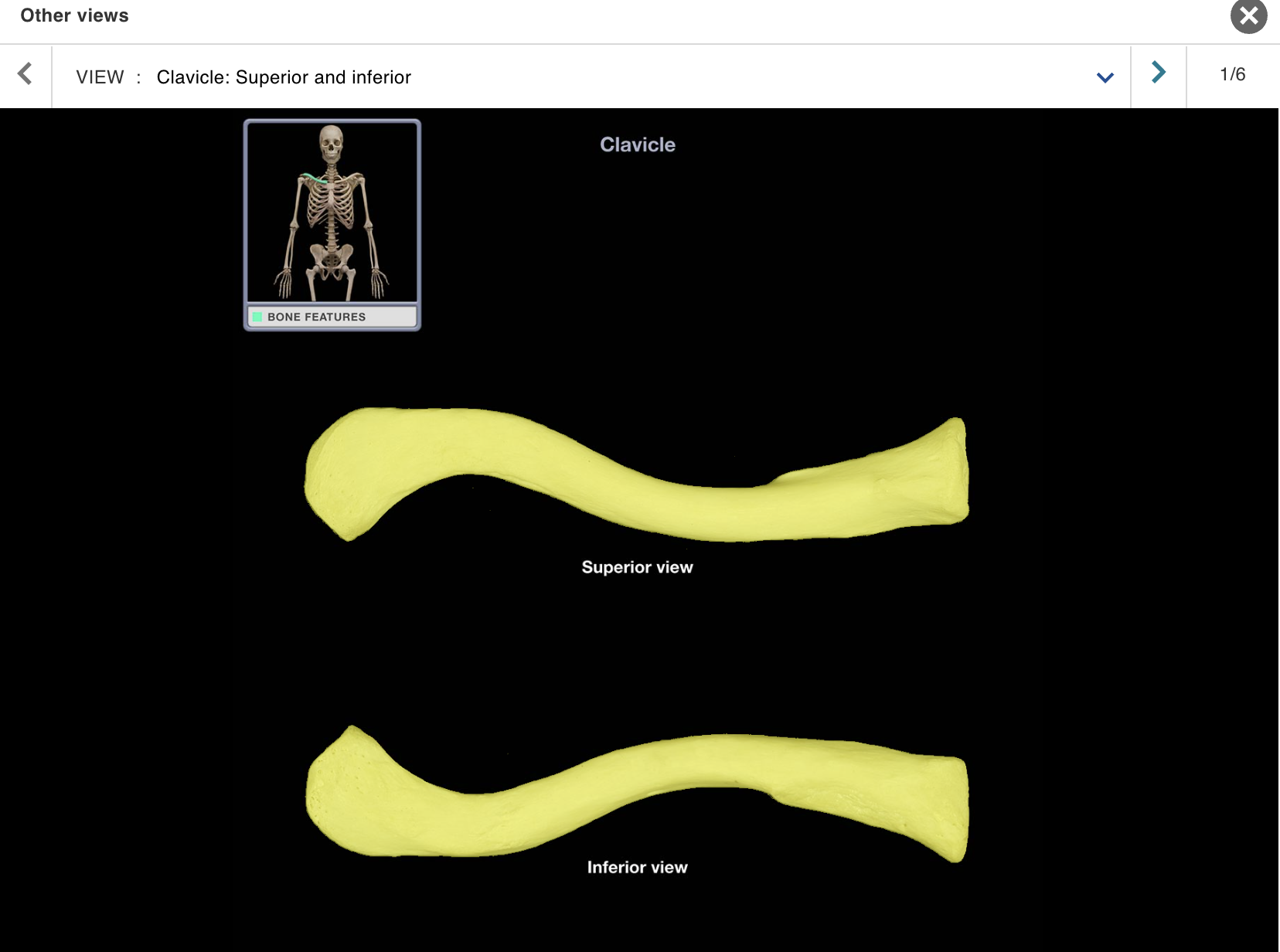
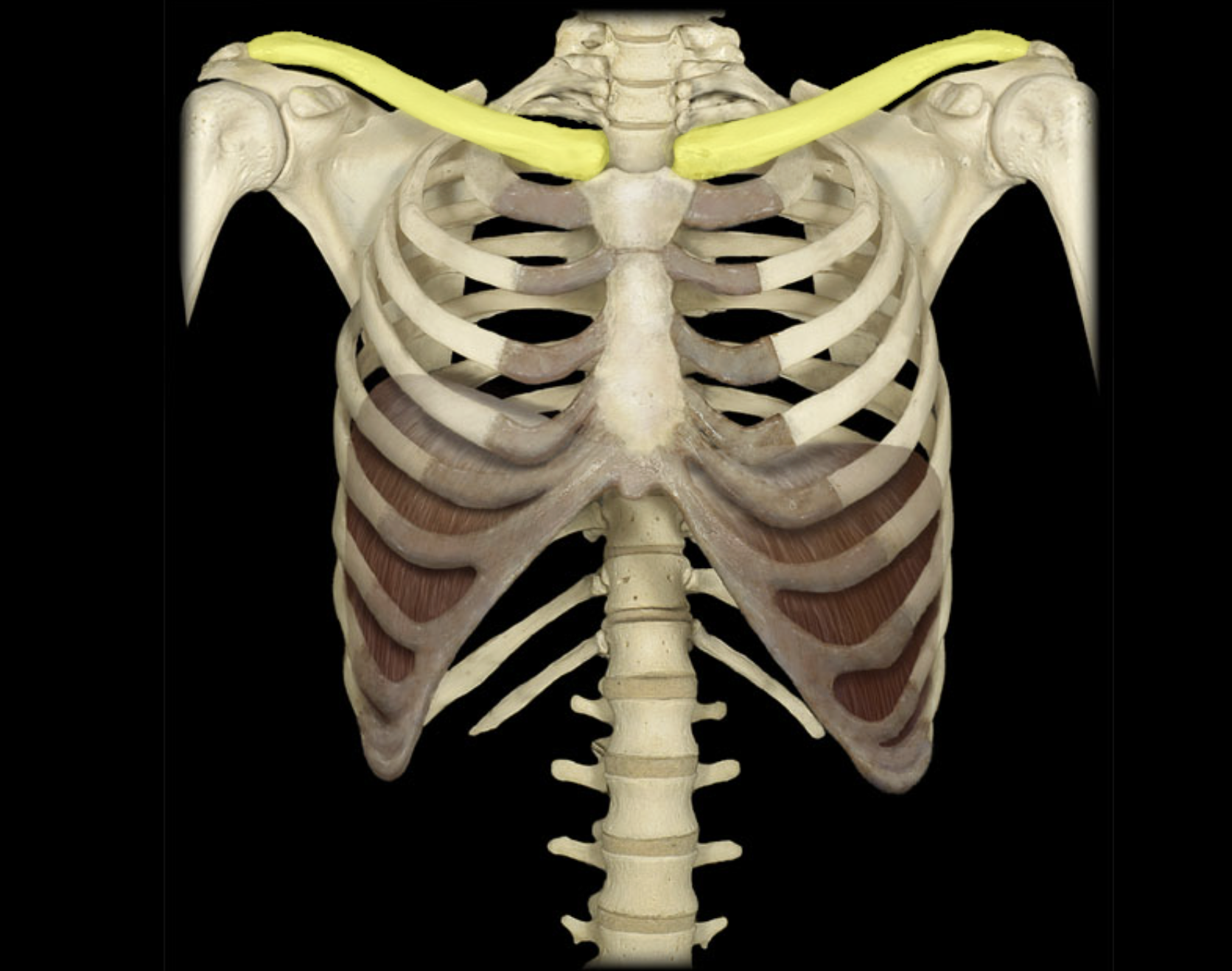
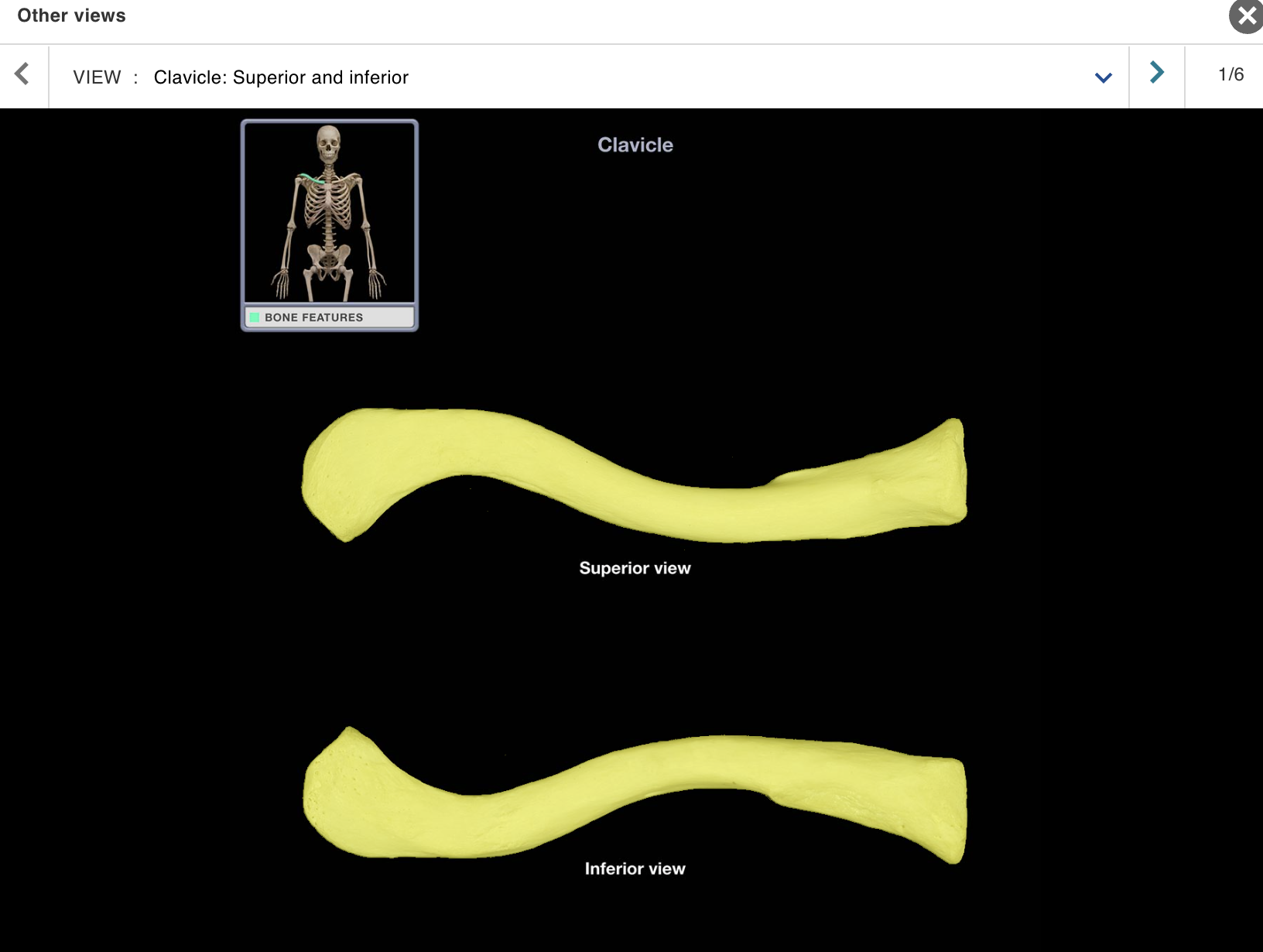
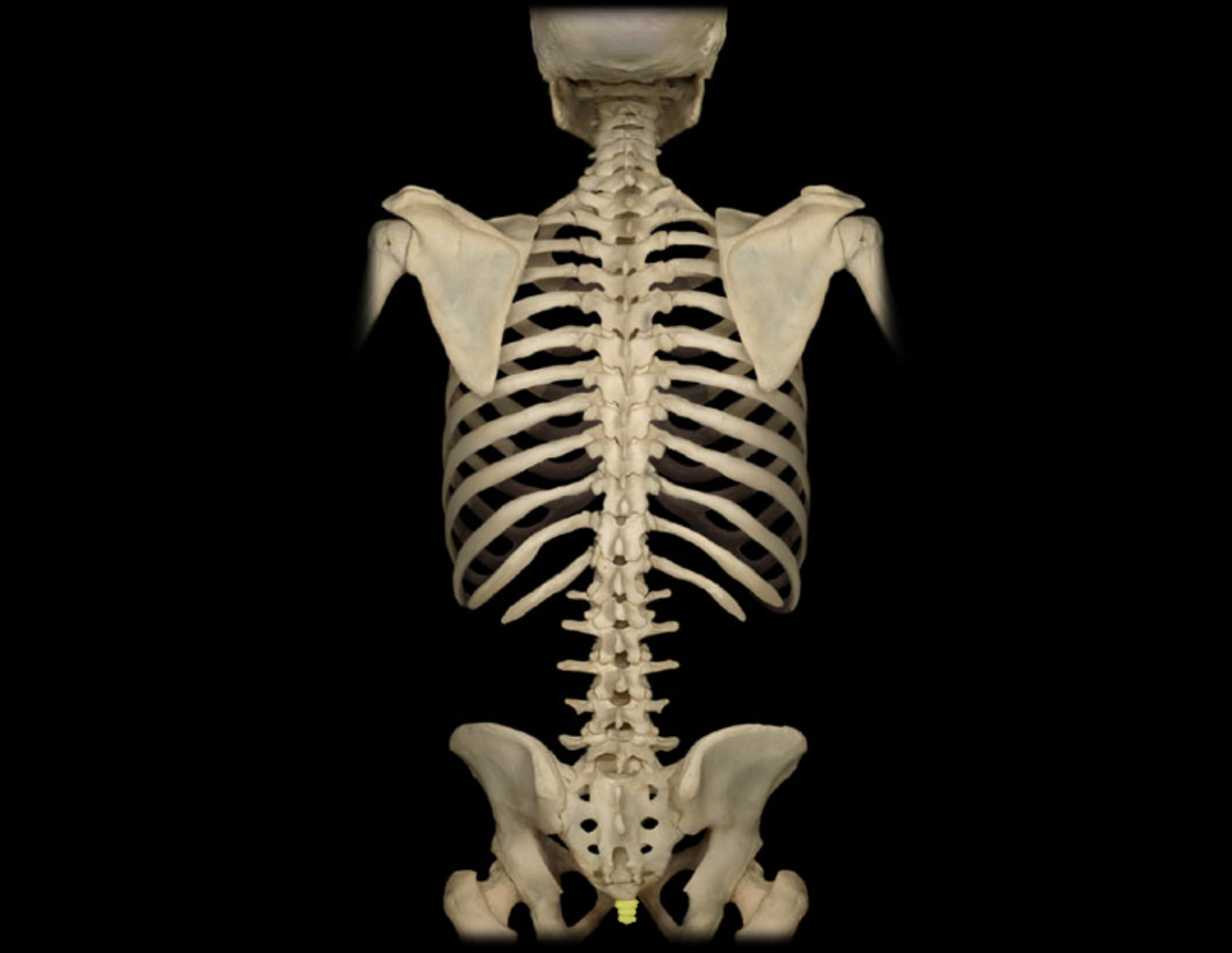
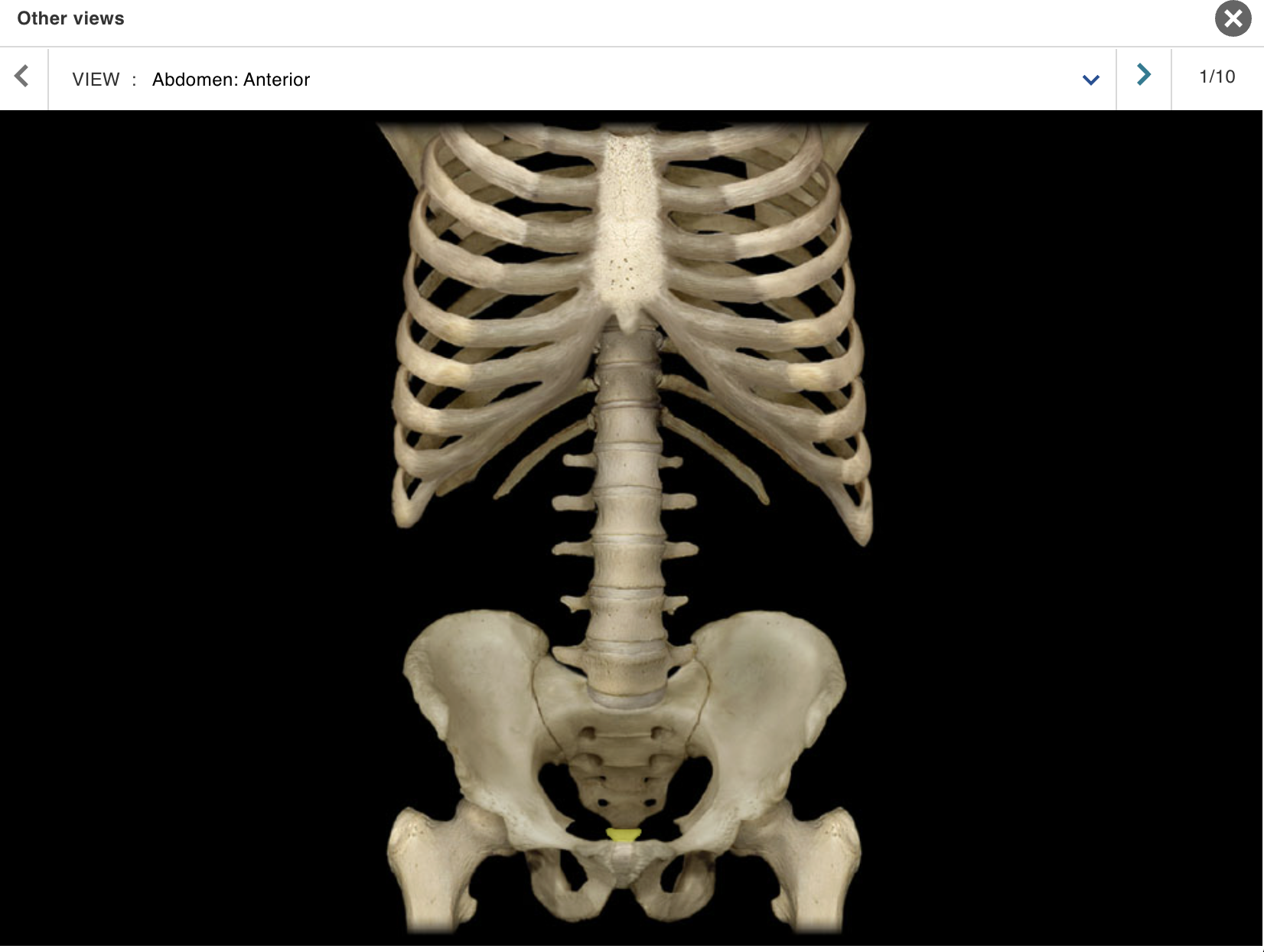
Clavicle

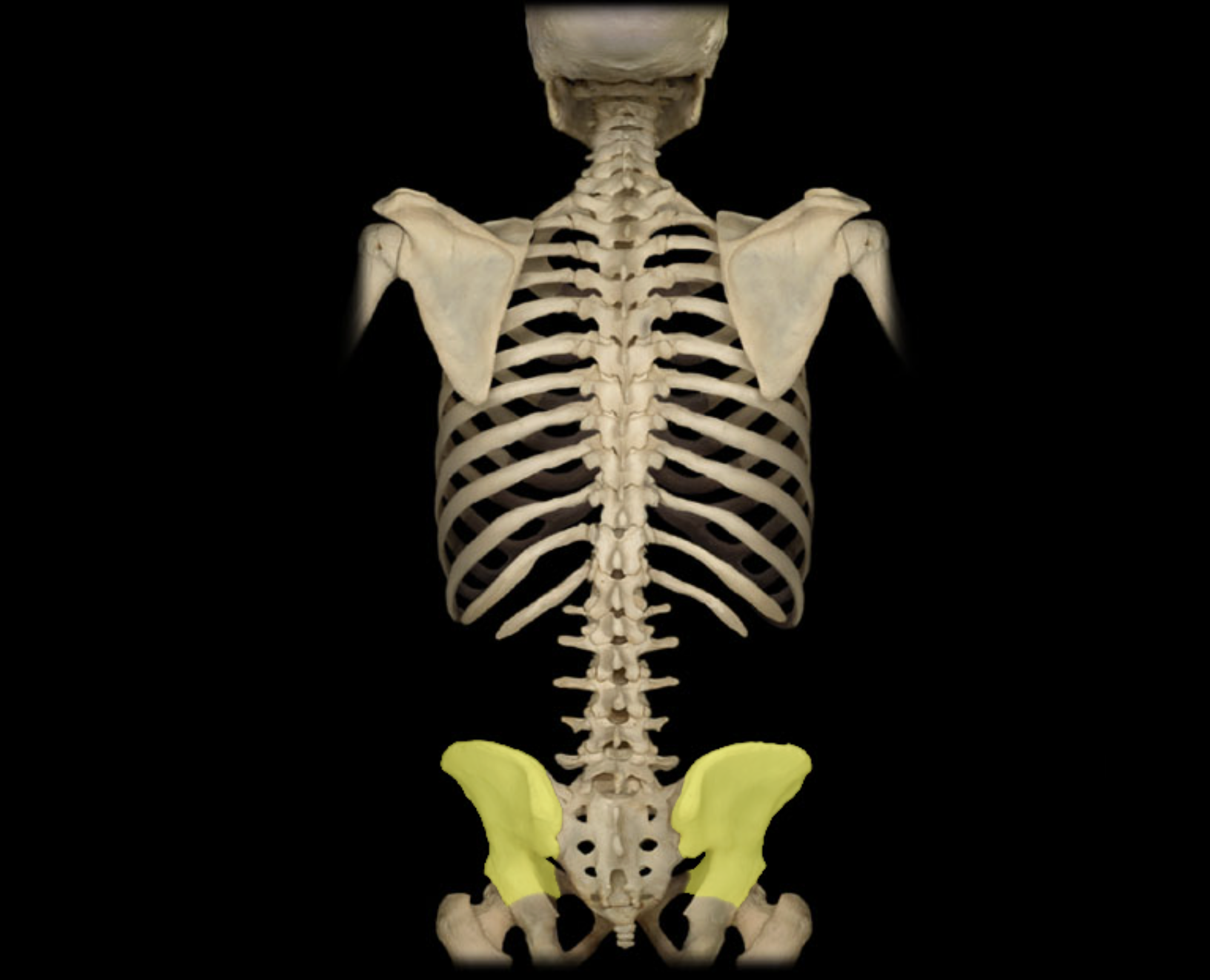
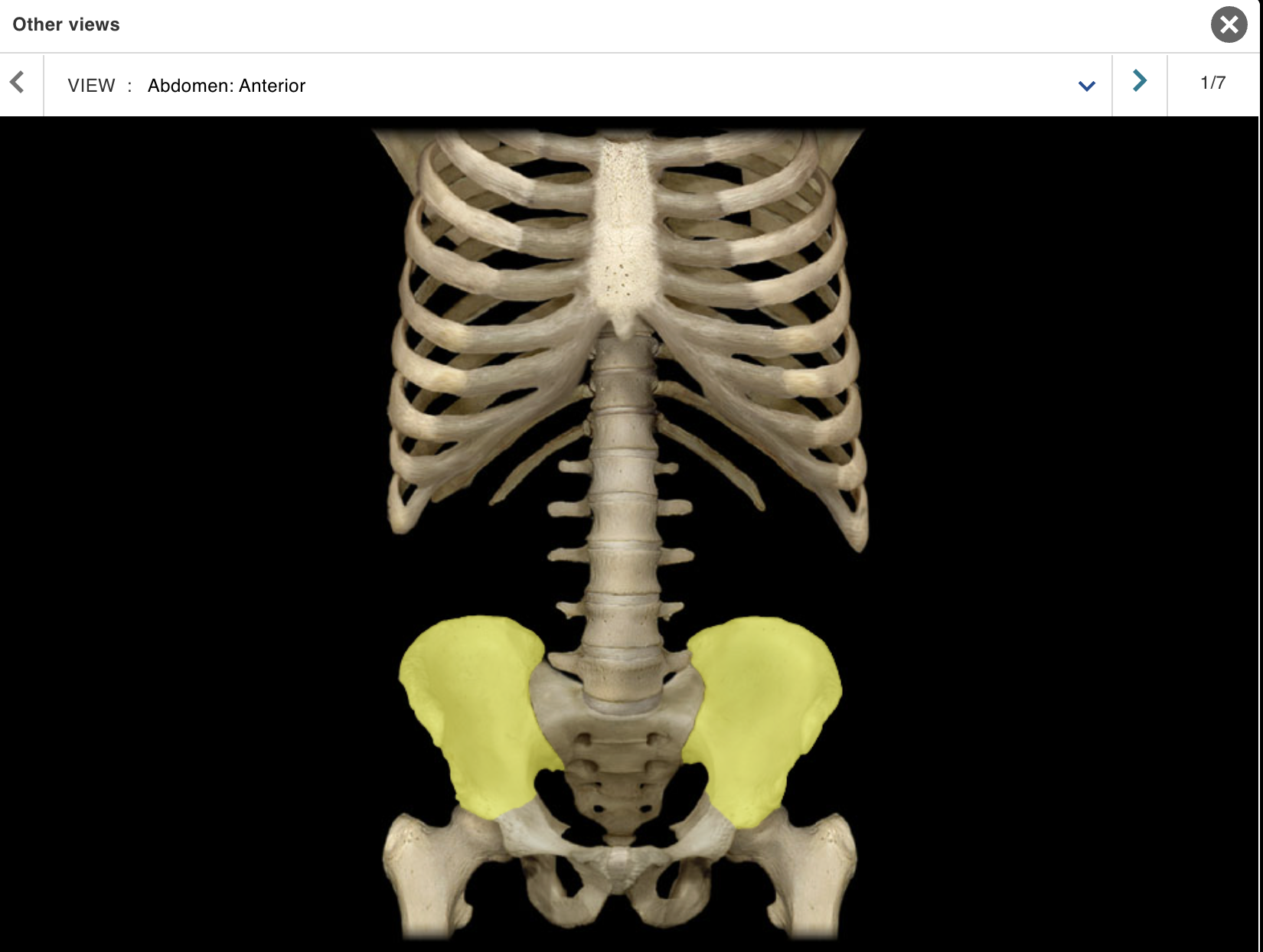
Location:

• Junction of neck and anterior thorax

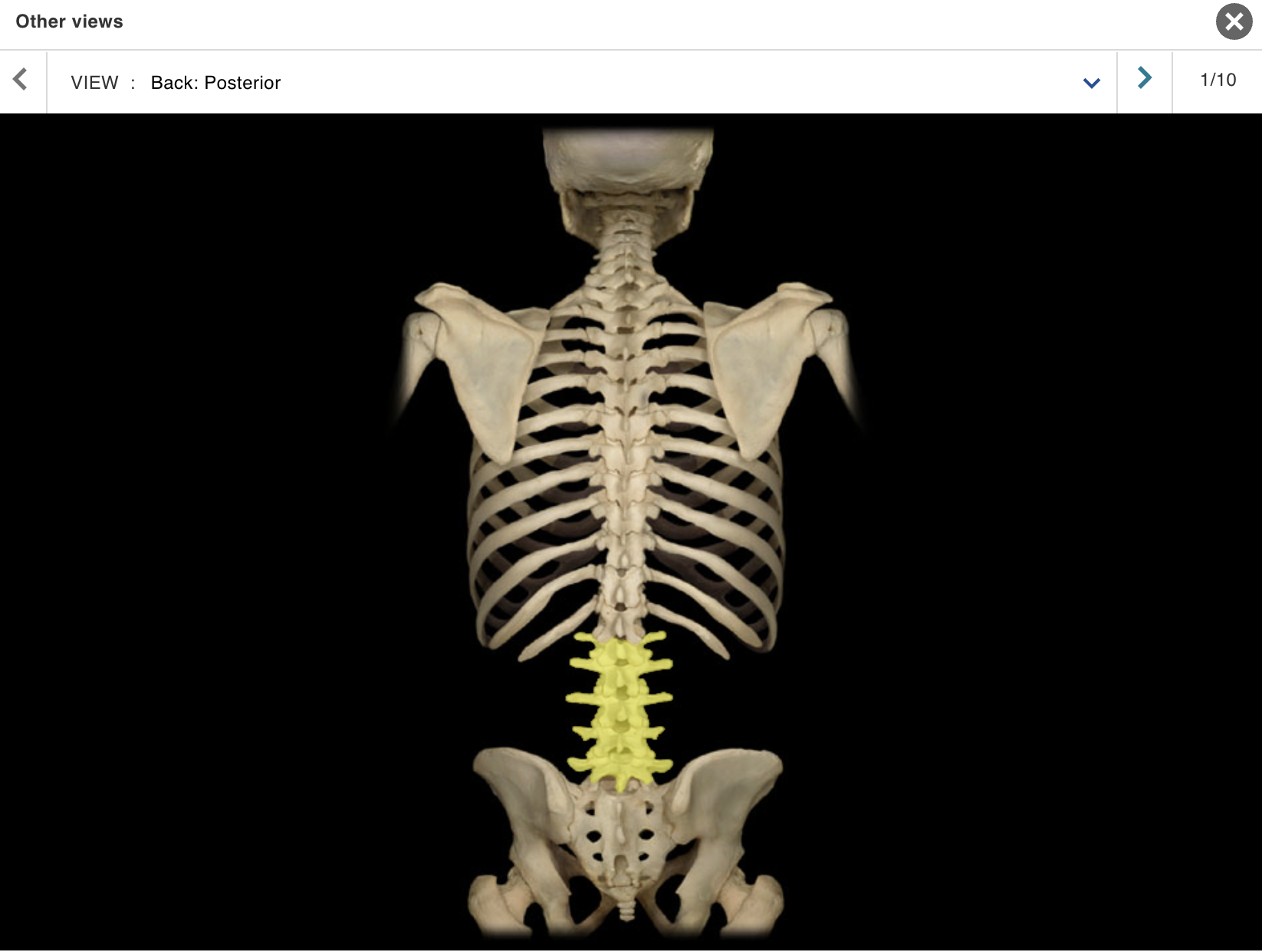
Description:

  • Subcutaneous, S-shaped bone

  • Medial end articulates with sternum at sternoclavicular joint

  • Lateral end articulates with acromion of scapula at acromioclavicular joint

Also known as:

• "Collar bone"

<p>Location:</p><p class="p1">• Junction of neck and anterior thorax</p><p class="p1">Description:</p><ul><li><p>Subcutaneous, S-shaped bone</p></li><li><p>Medial end articulates with sternum at sternoclavicular joint</p></li><li><p>Lateral end articulates with acromion of scapula at acromioclavicular joint</p></li></ul><p>Also known as:</p><p class="p1">• "Collar bone"</p>
4
New cards
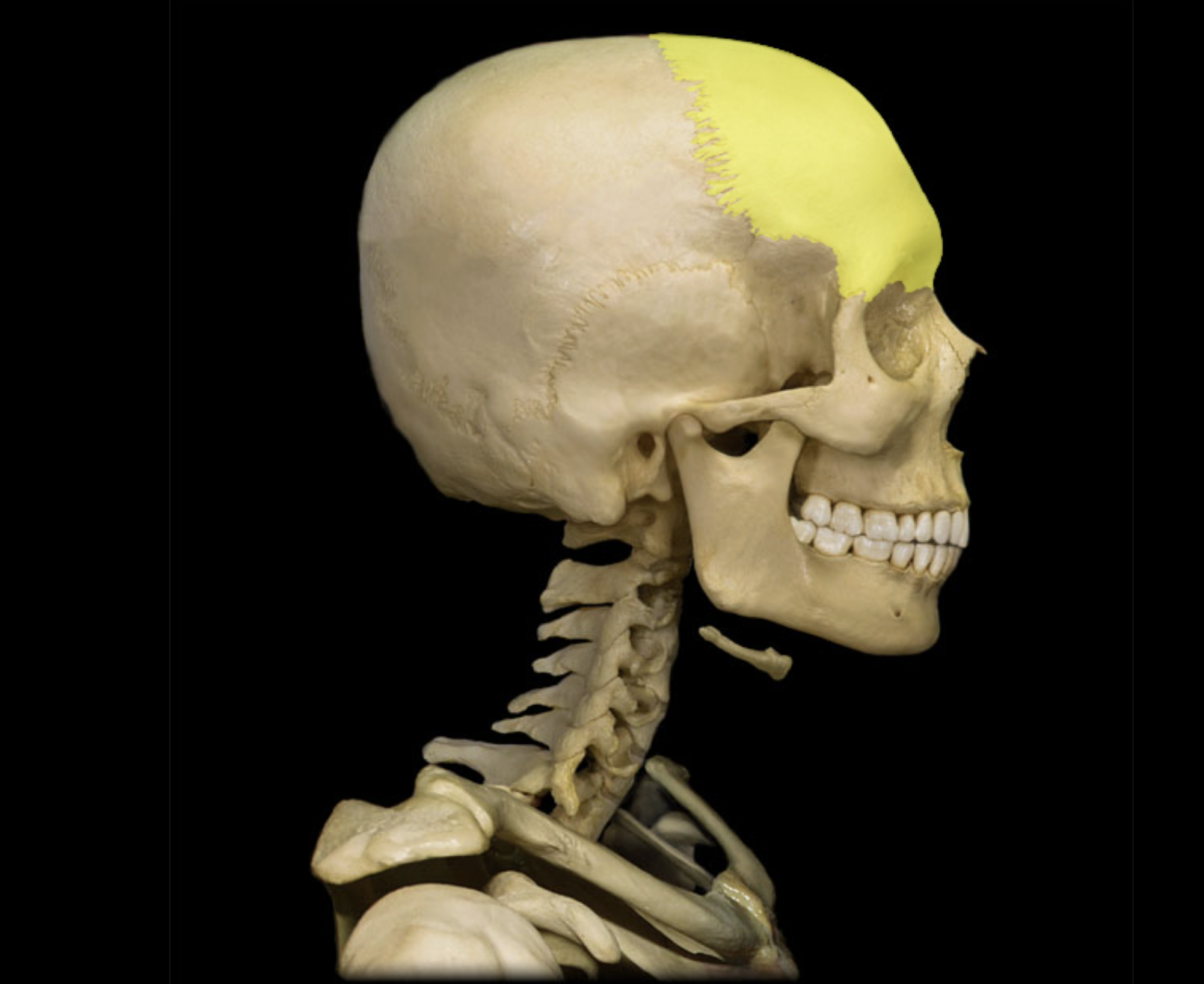
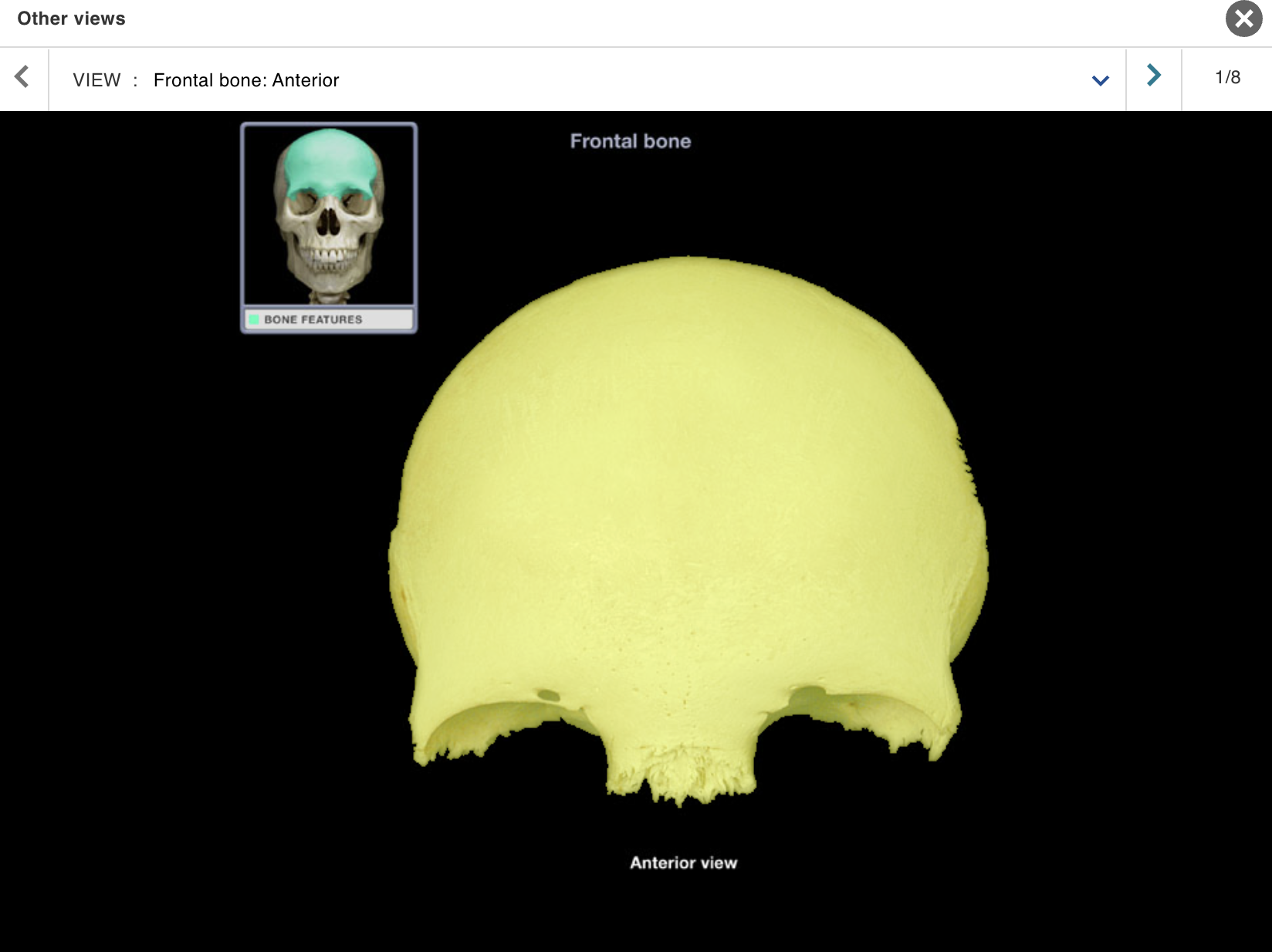
<p>Frontal bone</p>

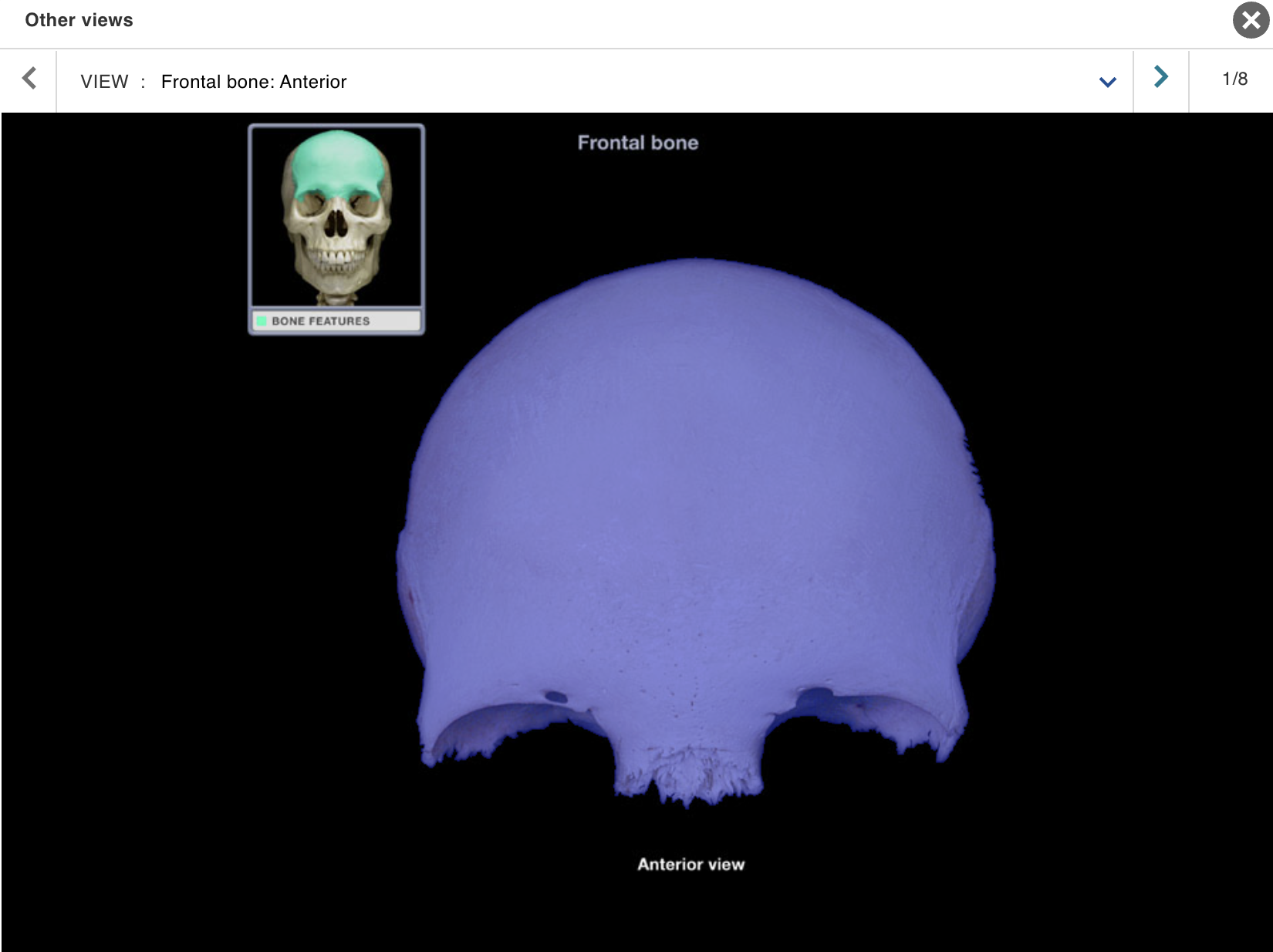
Frontal bone

Location:

• Skull (anterior superior part)

Description:

  • Unpaired, irregular-shaped, flat bone

  • Forms forehead, roof of orbits, and most of anterior cranial fossa

  • Contains frontal air sinuses

Comment:

• Articulates with parietal bone at coronal suture and sphenoid bone at sphenosquamosal suture

<p>Location:</p><p class="p1">• Skull (anterior superior part)</p><p class="p1">Description:</p><ul><li><p>Unpaired, irregular-shaped, flat bone</p></li><li><p>Forms forehead, roof of orbits, and most of anterior cranial fossa</p></li><li><p>Contains frontal air sinuses</p></li></ul><p>Comment:</p><p class="p1">• Articulates with parietal bone at coronal suture and sphenoid bone at sphenosquamosal suture</p>
5
New cards
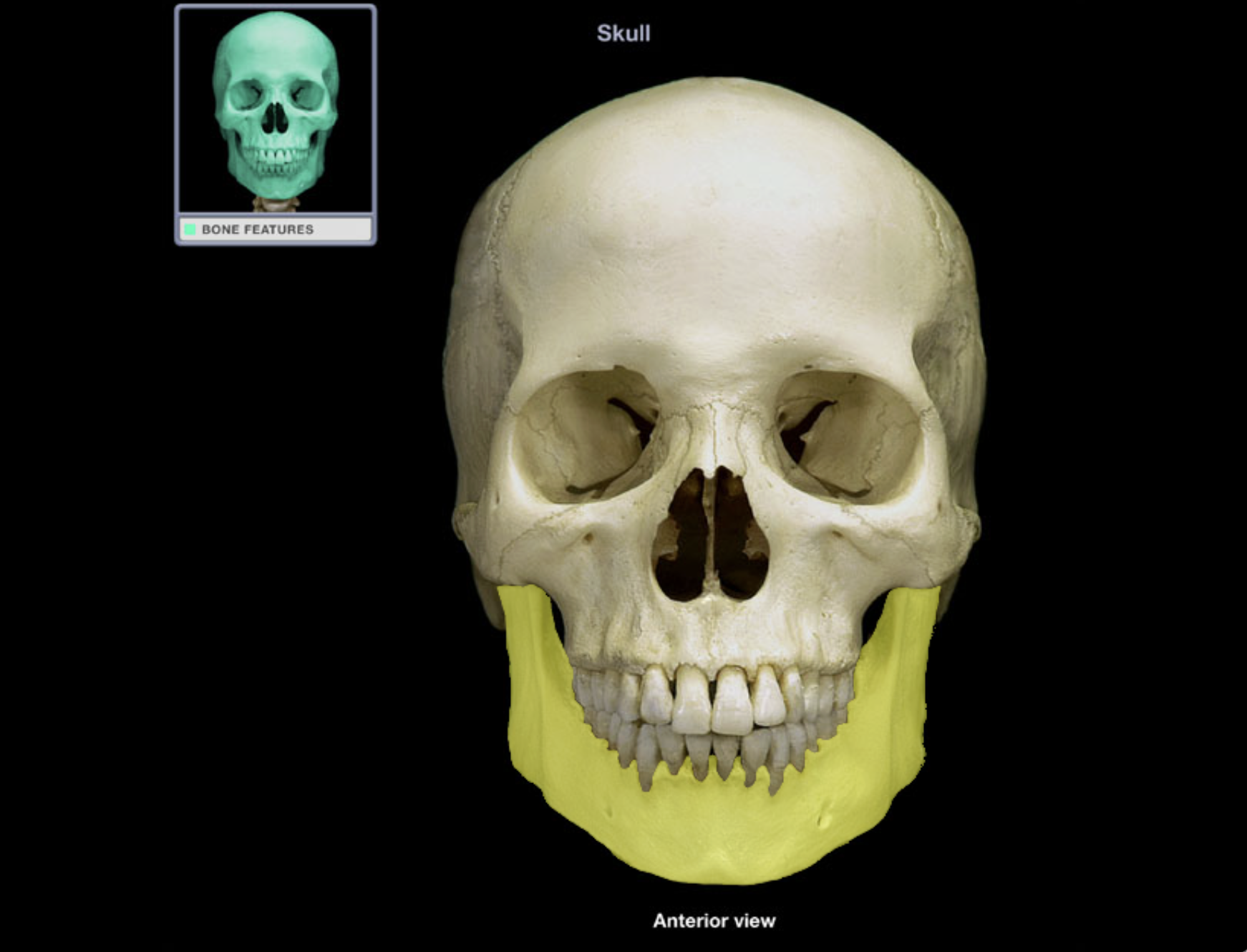
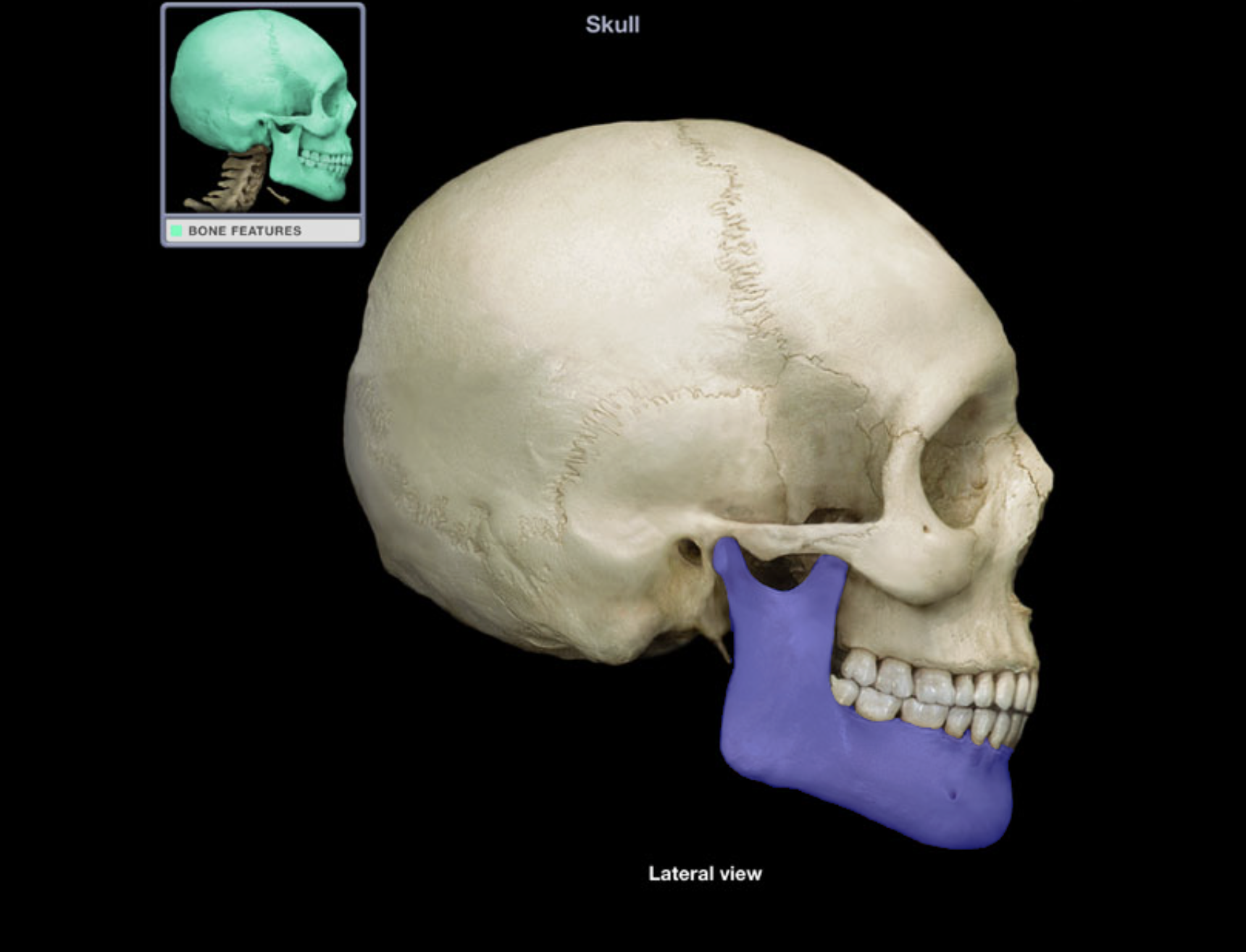
<p>Mandible</p>

Mandible

Location:

• Skull (anterior)

Description:

  • U-shaped bone

  • Each side consists of body (horizontal) and ramus (vertical) with coronoid and condylar processes

  • Mental protuberance forms point of chin

  • Contains alveoli ("sockets") for teeth

Also known as:

• "Lower jaw"

Comment:

• Contributes to temporomandibular joint (TMJ

<p>Location:</p><p class="p1">• Skull (anterior)</p><p class="p1">Description:</p><ul><li><p>U-shaped bone</p></li><li><p>Each side consists of body (horizontal) and ramus (vertical) with coronoid and condylar processes</p></li><li><p>Mental protuberance forms point of chin</p></li><li><p>Contains alveoli ("sockets") for teeth</p></li></ul><p>Also known as:</p><p class="p1">• "Lower jaw"</p><p class="p1">Comment:</p><p class="p1">• Contributes to temporomandibular joint (TMJ</p>
6
New cards
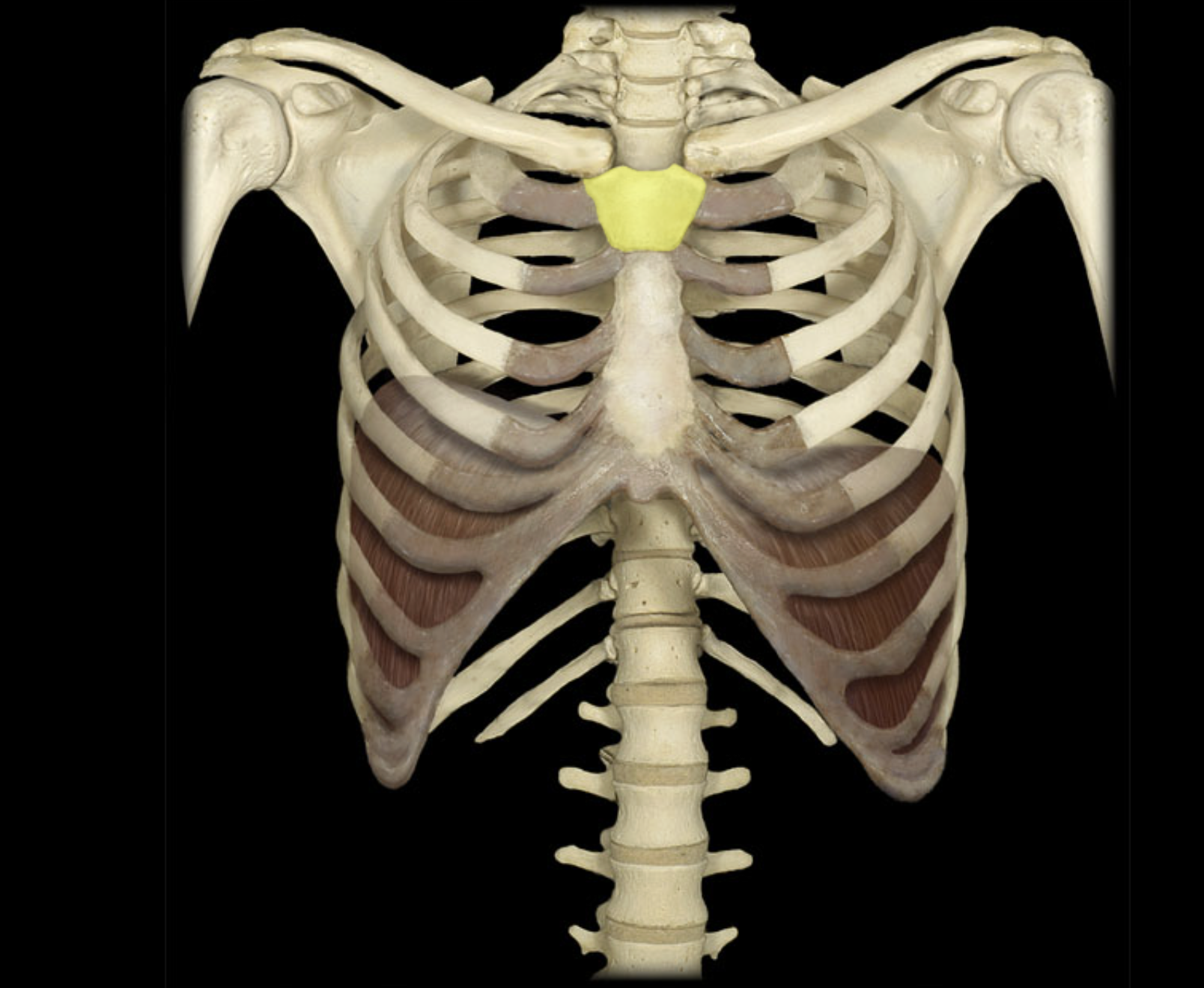
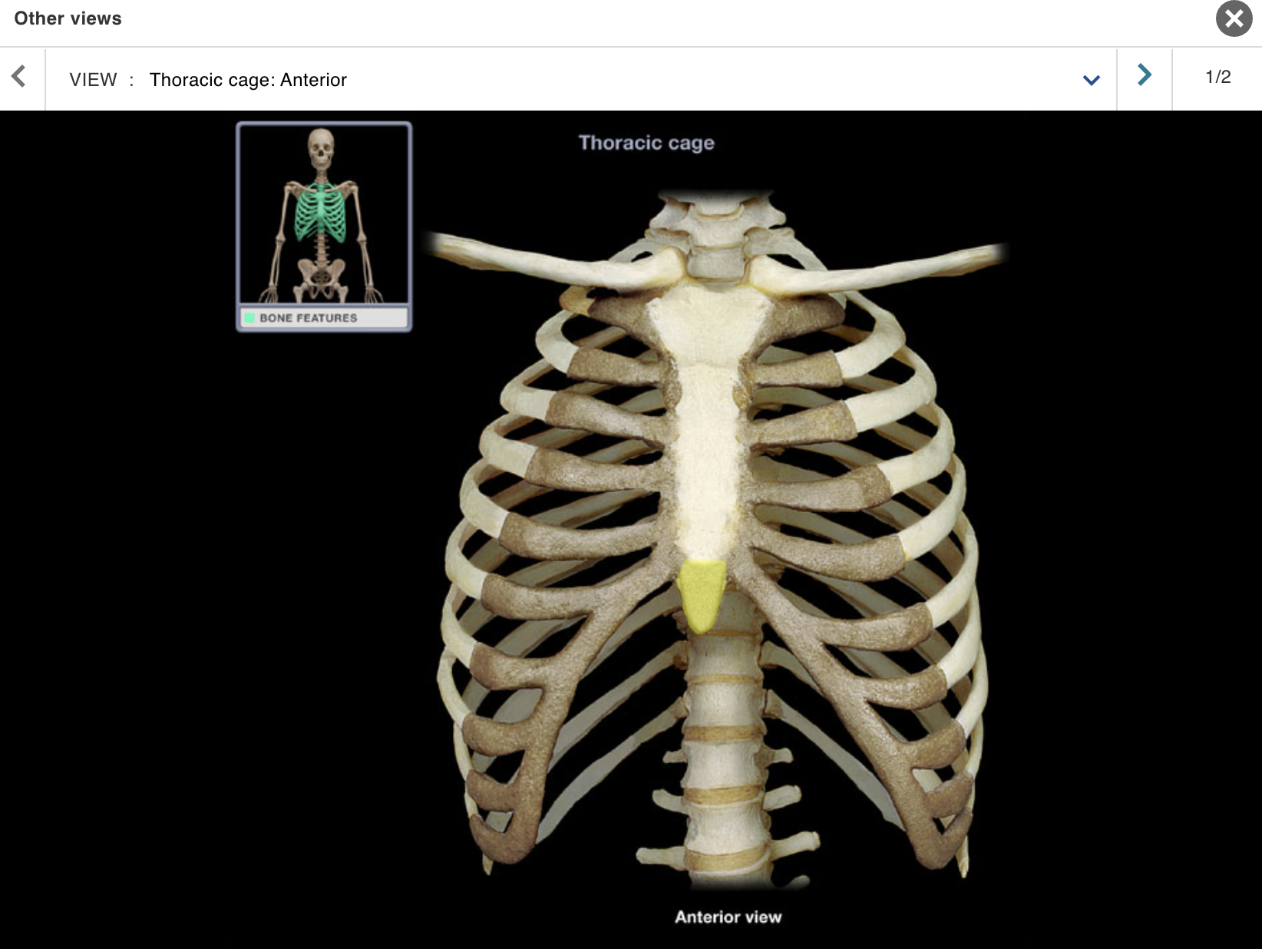
<p>Manubrium</p>

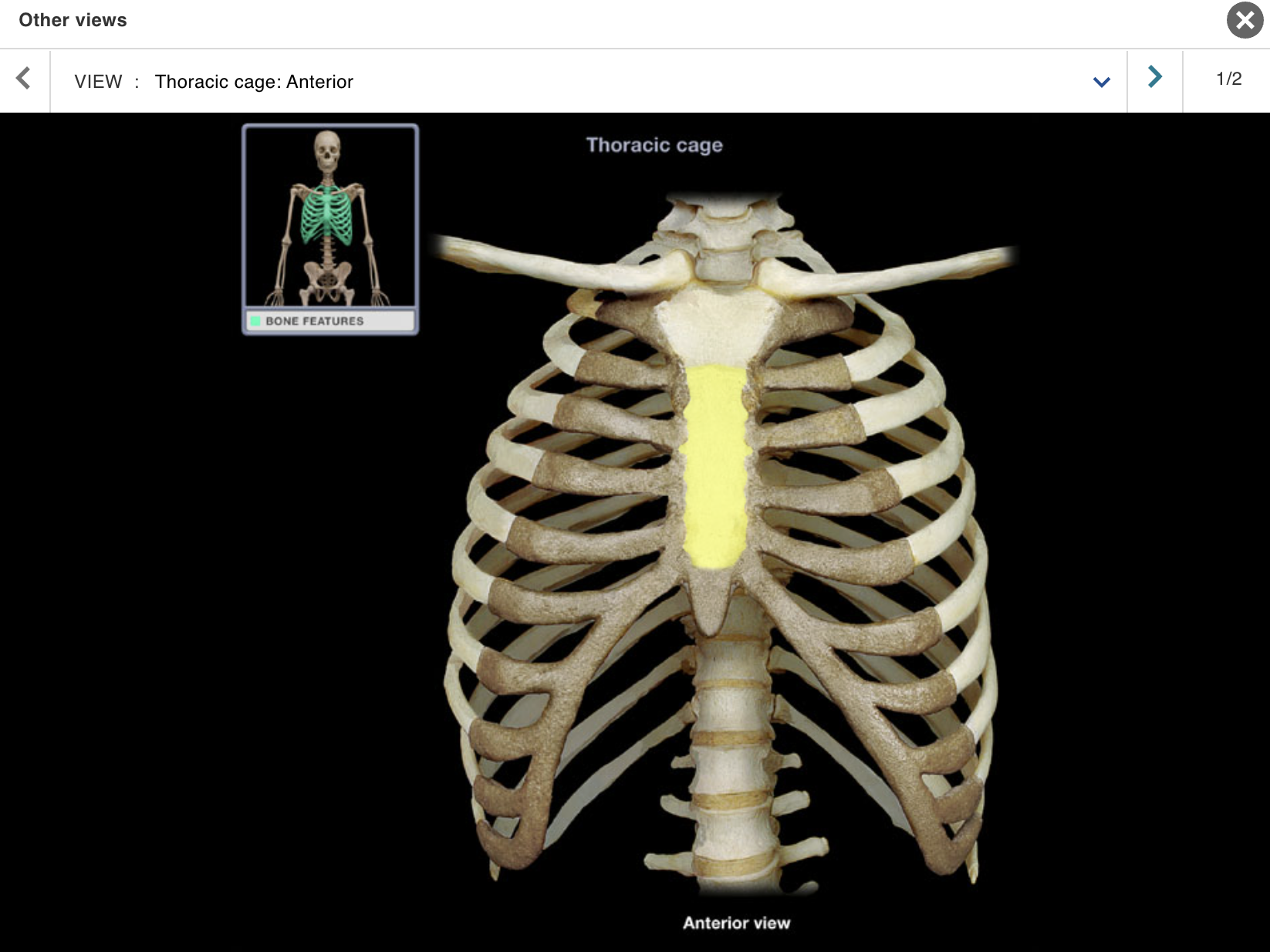
Manubrium

Location:

• Sternum

Description:

  • Triangular shape

  • Superior part of sternum

  • Articulates with costal cartilages of ribs 1-2 and clavicles

Comment:

• Provides attachment for sternocleidomastoid and pectoralis major muscles

<p>Location:</p><p class="p1">• Sternum</p><p class="p1">Description:</p><ul><li><p>Triangular shape</p></li><li><p>Superior part of sternum</p></li><li><p>Articulates with costal cartilages of ribs 1-2 and clavicles</p></li></ul><p>Comment:</p><p class="p1">• Provides attachment for sternocleidomastoid and pectoralis major muscles</p>
7
New cards
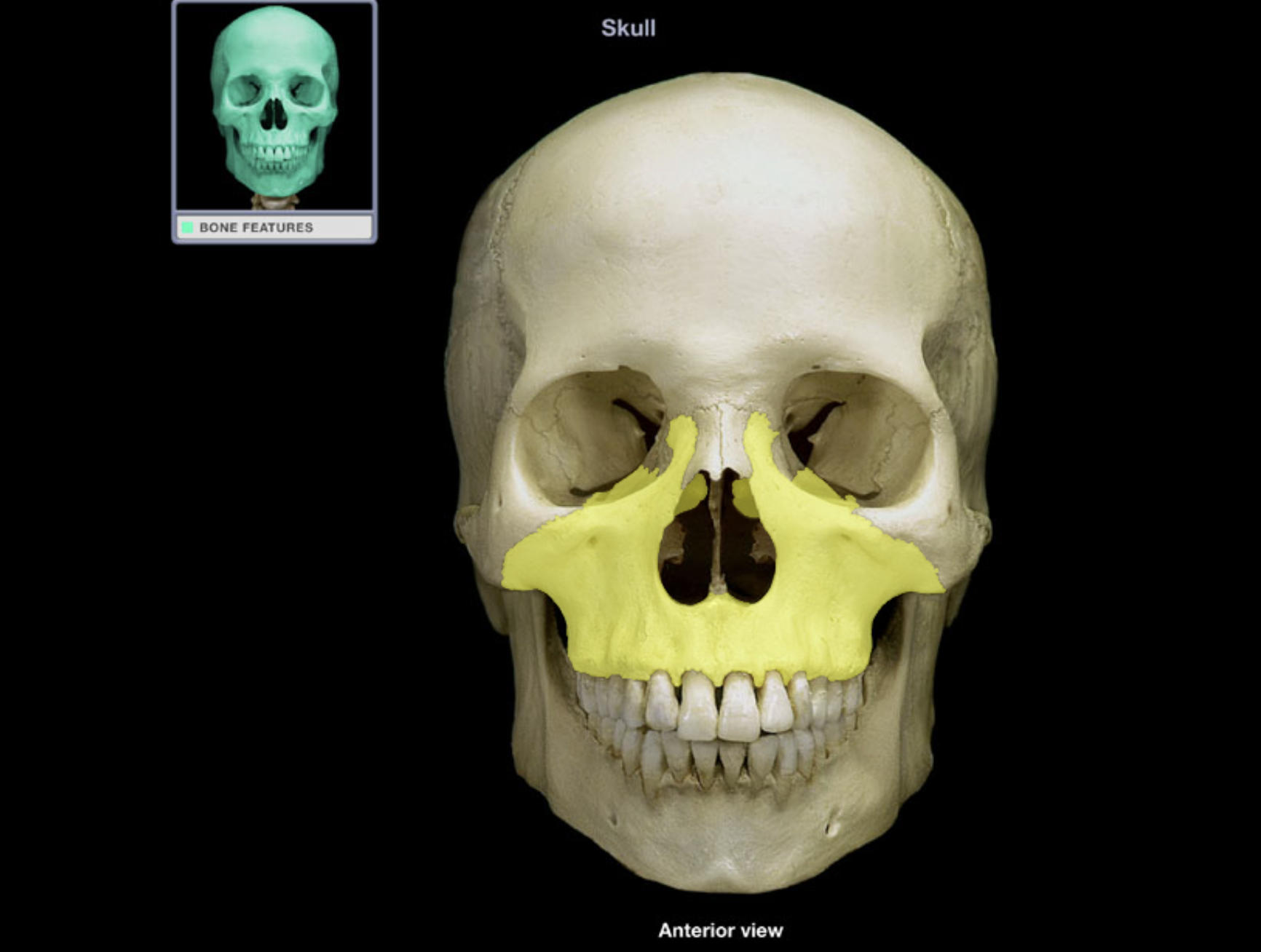
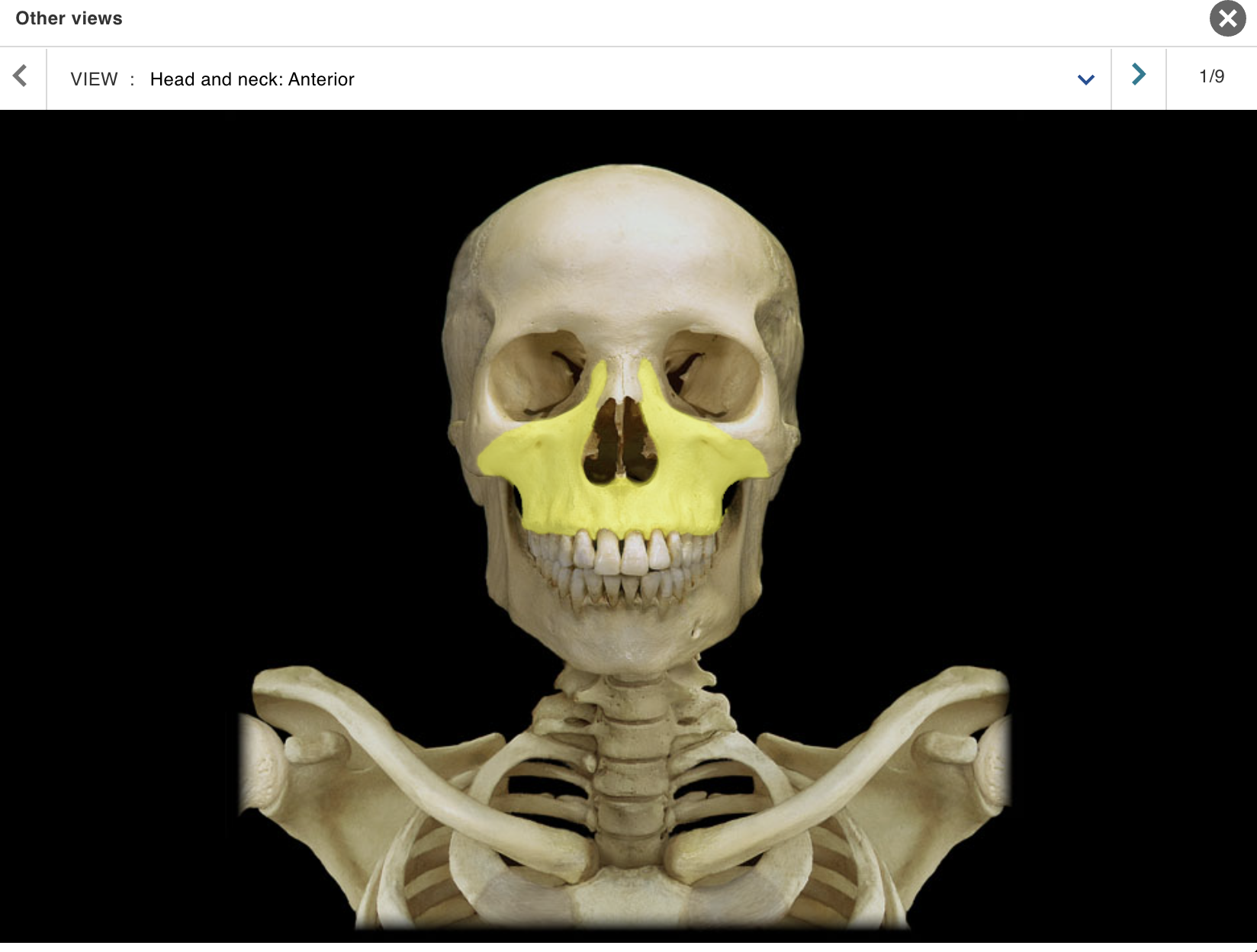
<p>Maxilla</p>

Maxilla

Location:

• Skull (anterior)

Description:

  • Paired, irregular-shaped bone

  • Left and right maxillae unite to form "upper jaw"

  • Contains alveoli ("sockets") for teeth

  • Contains maxillary air sinus on each side

Also known as:

• "Upper jaw"

Comment:

  • Forms part of floor of orbit and anterior part of hard palate

  • Contributes to upper face

<p>Location:</p><p class="p1">• Skull (anterior)</p><p class="p1">Description:</p><ul><li><p>Paired, irregular-shaped bone</p></li><li><p>Left and right maxillae unite to form "upper jaw"</p></li><li><p>Contains alveoli ("sockets") for teeth</p></li><li><p>Contains maxillary air sinus on each side</p></li></ul><p>Also known as:</p><p class="p1">• "Upper jaw"</p><p class="p1">Comment:</p><ul><li><p>Forms part of floor of orbit and anterior part of hard palate</p></li><li><p>Contributes to upper face</p></li></ul><p></p>
8
New cards
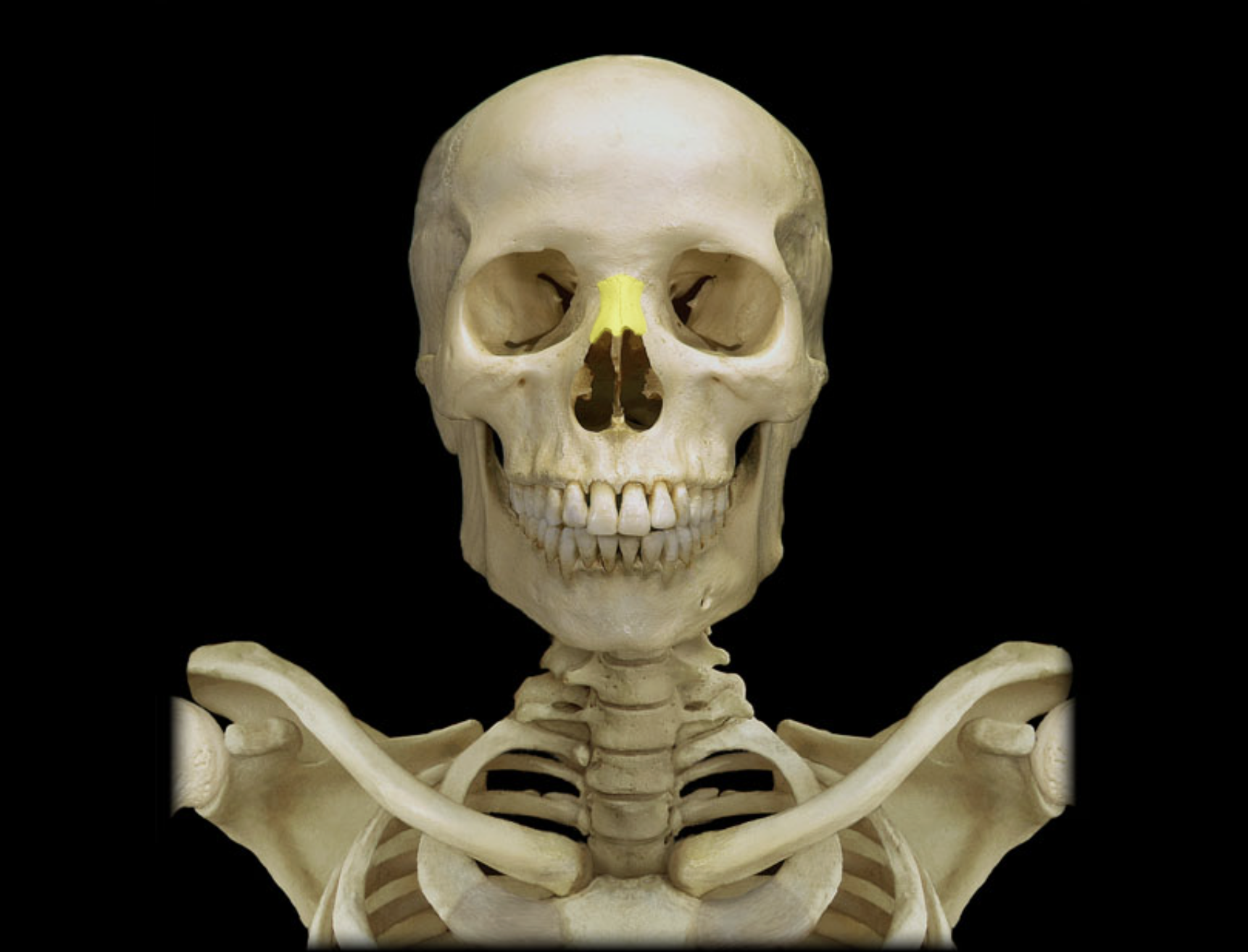
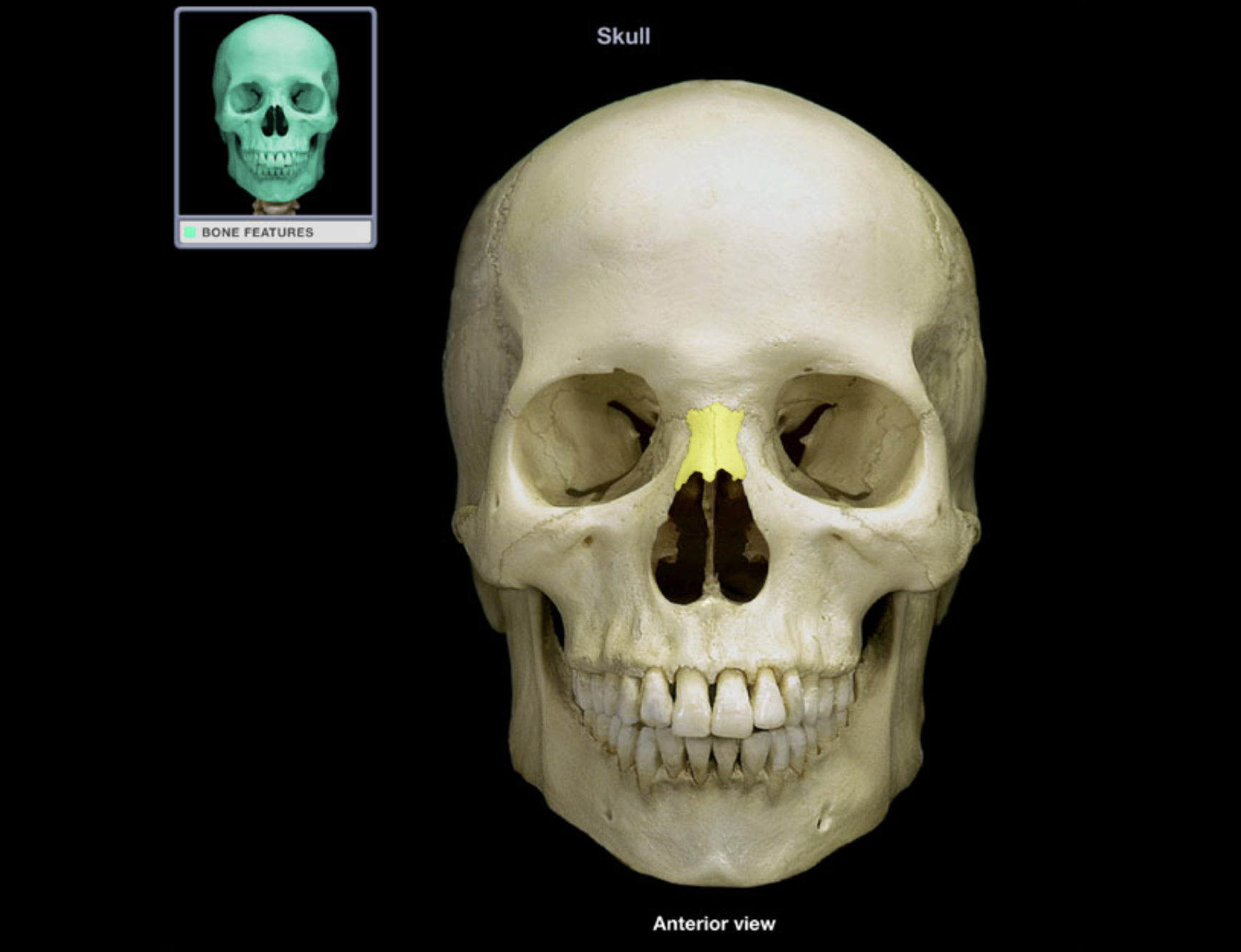
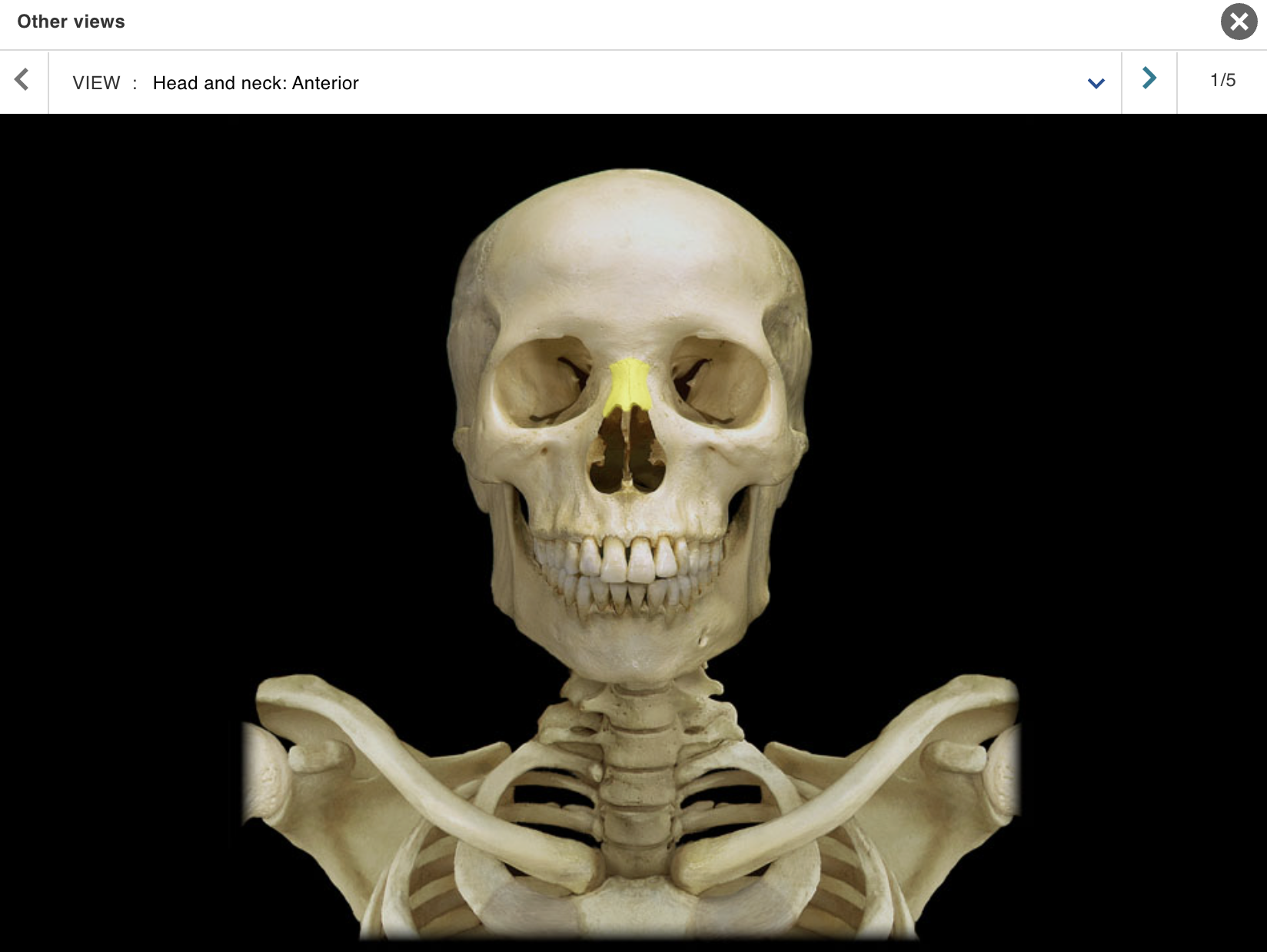
<p>Nasal bone</p>

Nasal bone

Location:

• Skull (anterior)

Description:

  • Small, paired bone

  • Articulates at midline with nasal bone from opposite side

Also known as:

• "Bridge of nose"

Comment:

• Forms bony part of nose

<p>Location:</p><p class="p1">• Skull (anterior)</p><p class="p1">Description:</p><ul><li><p>Small, paired bone</p></li><li><p>Articulates at midline with nasal bone from opposite side</p></li></ul><p class="p1">Also known as:</p><p class="p1">• "Bridge of nose"</p><p class="p1">Comment:</p><p class="p1">• Forms bony part of nose</p>
9
New cards
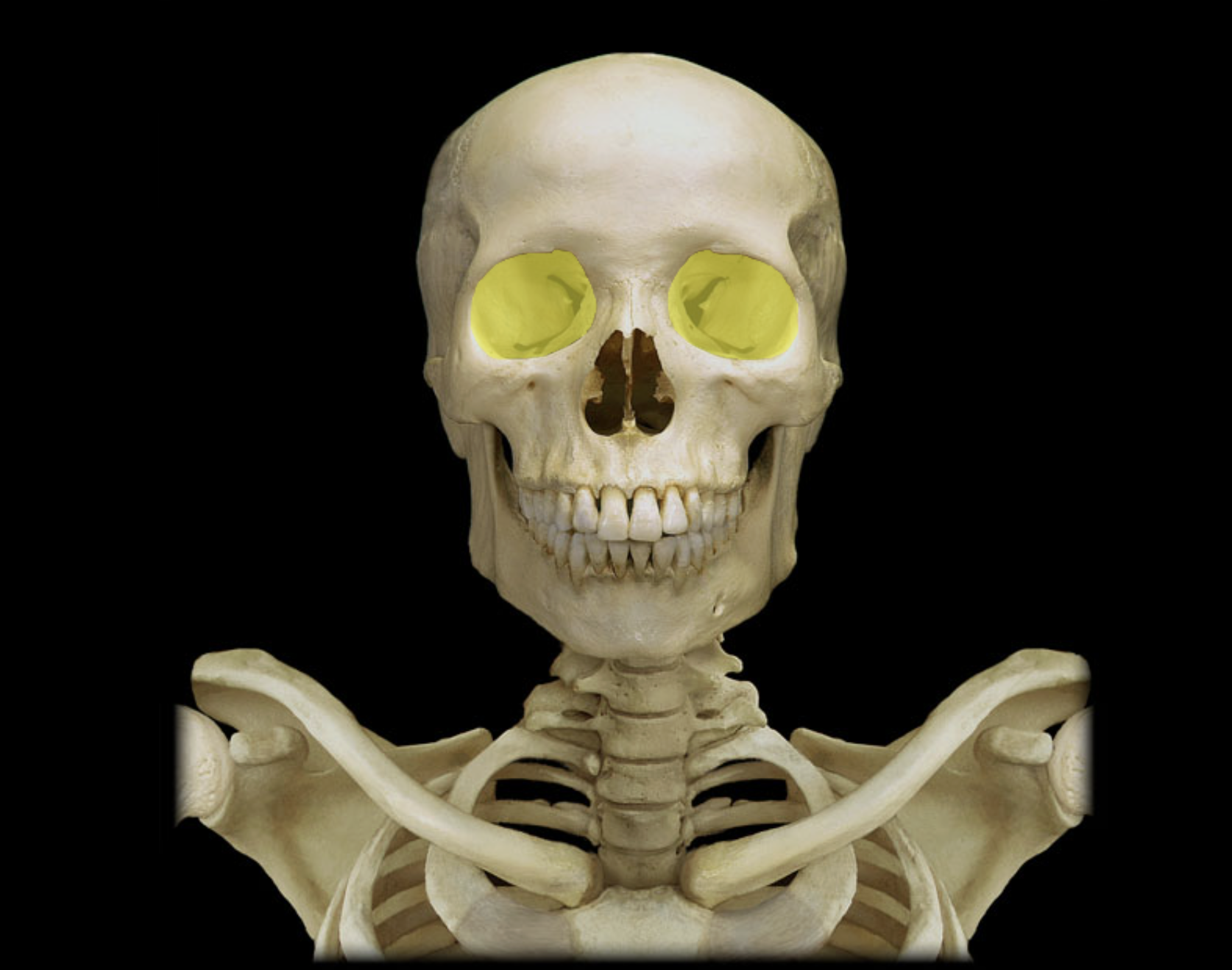
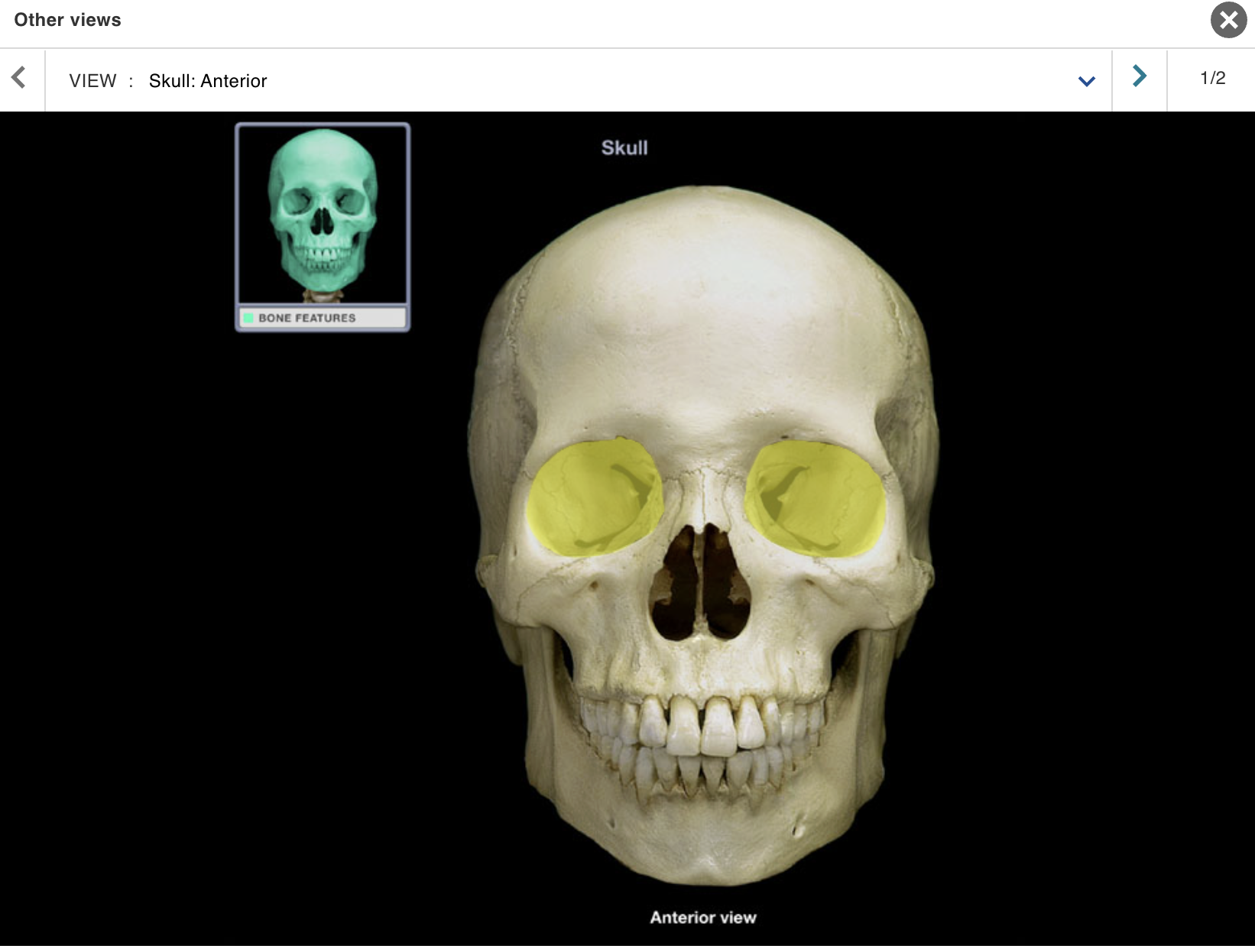
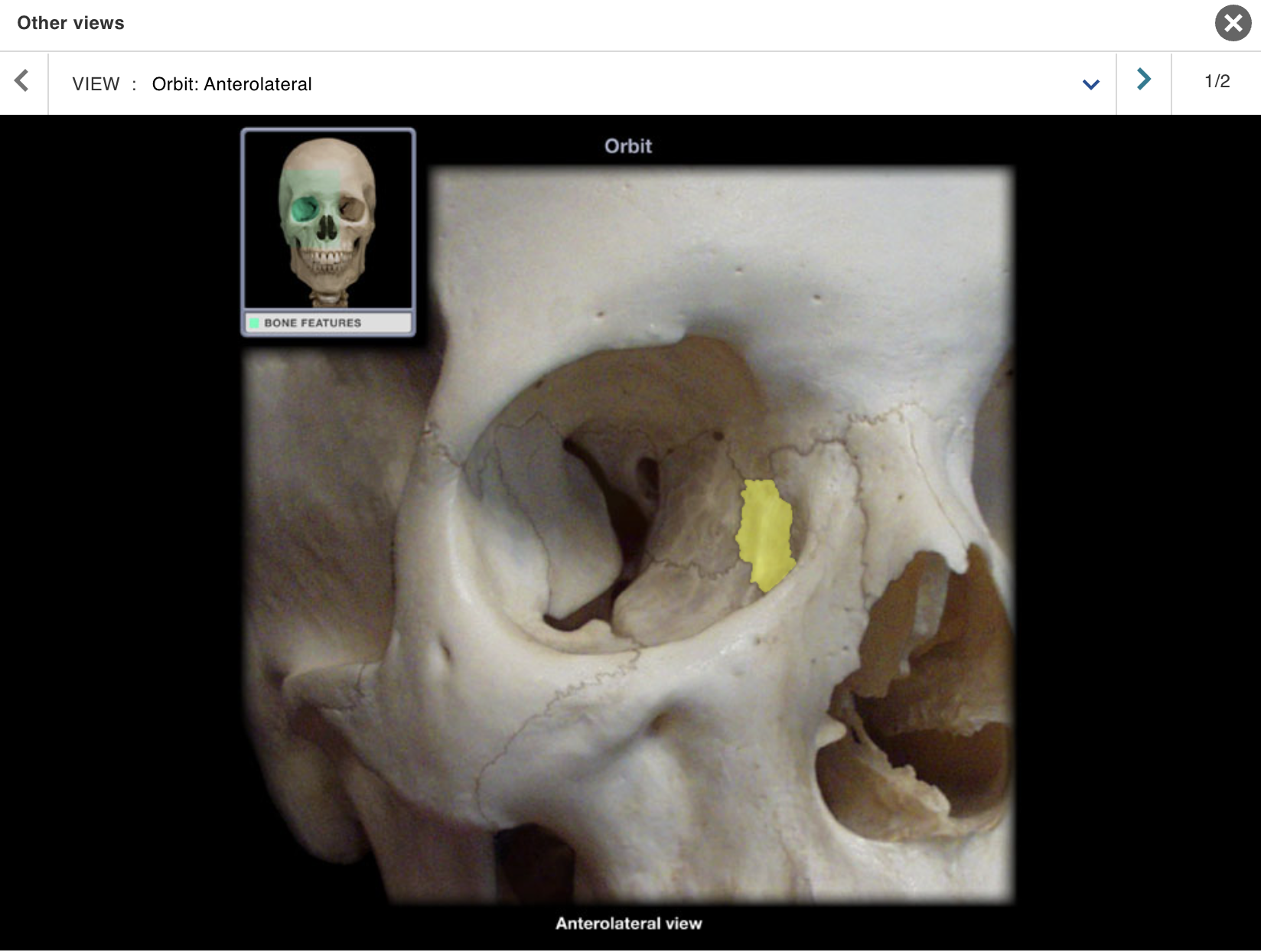
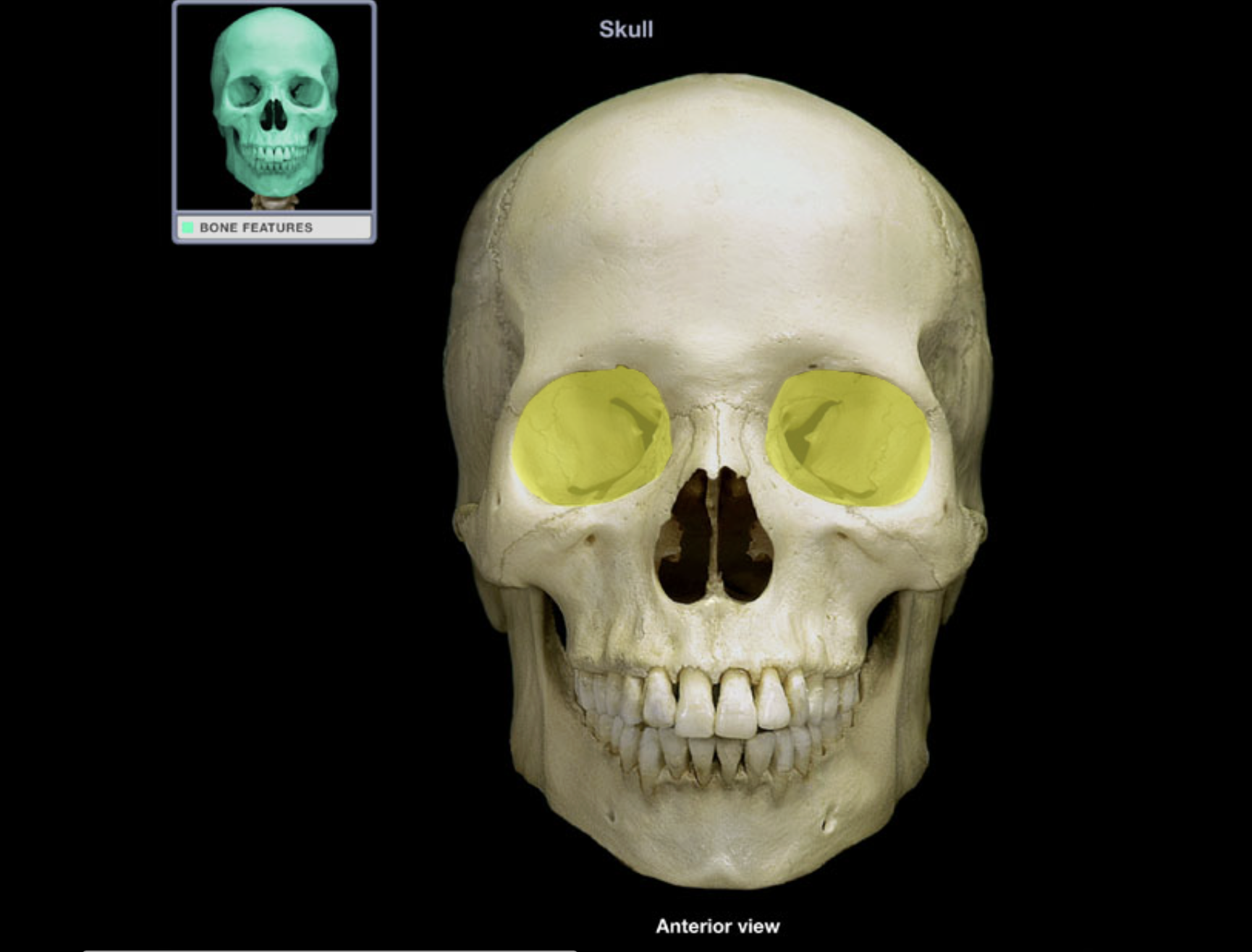
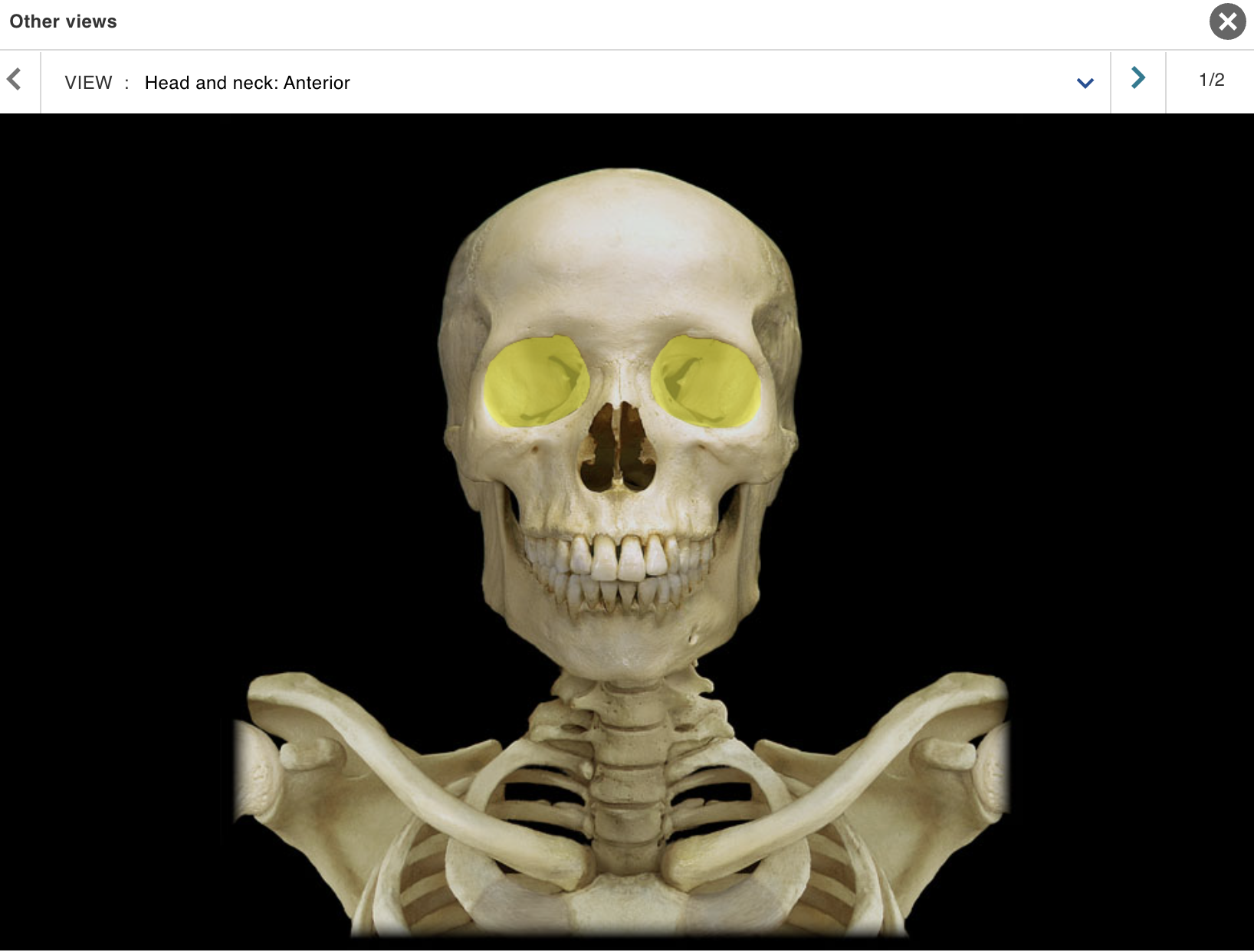
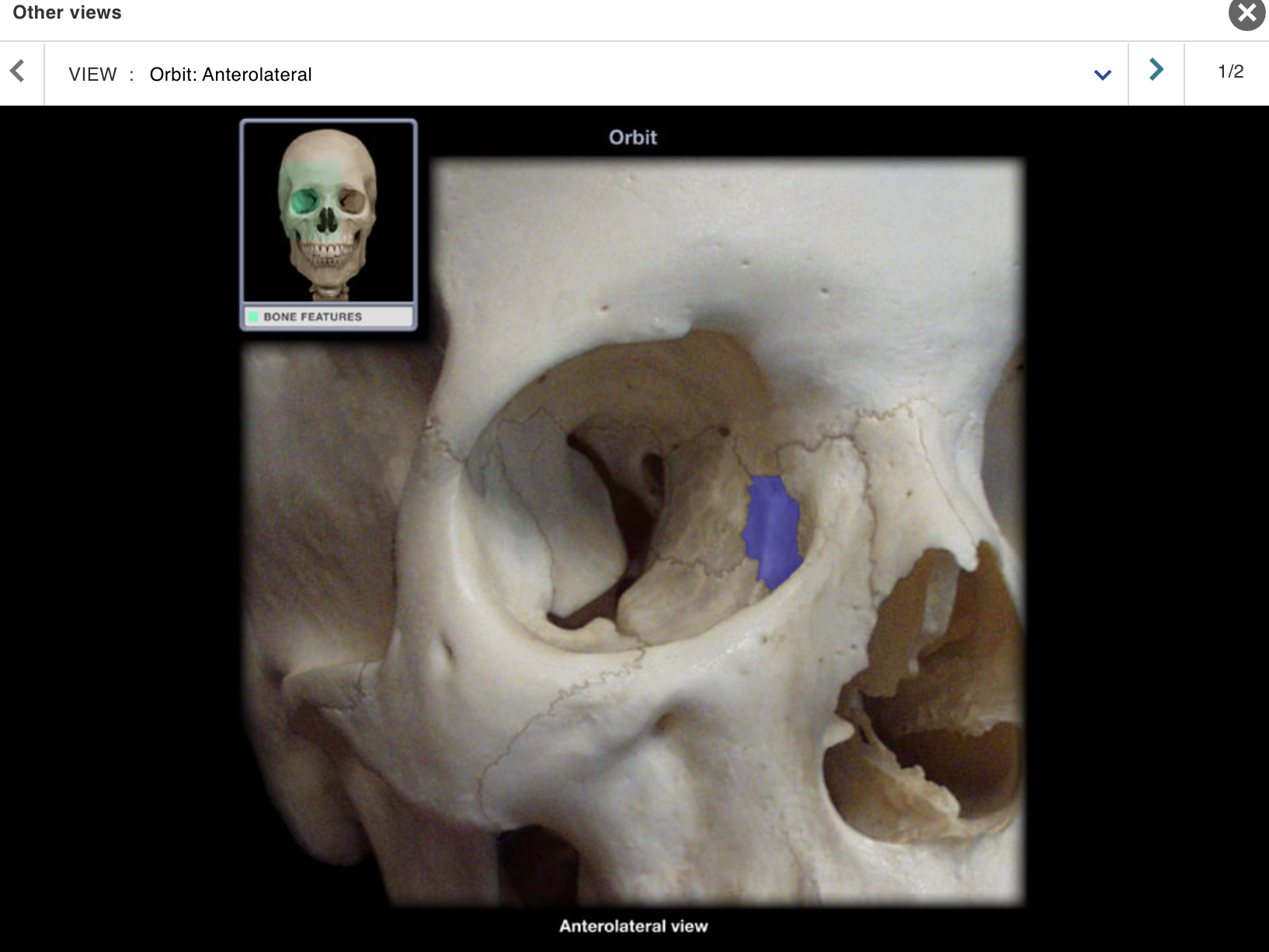
<p>Orbit</p>

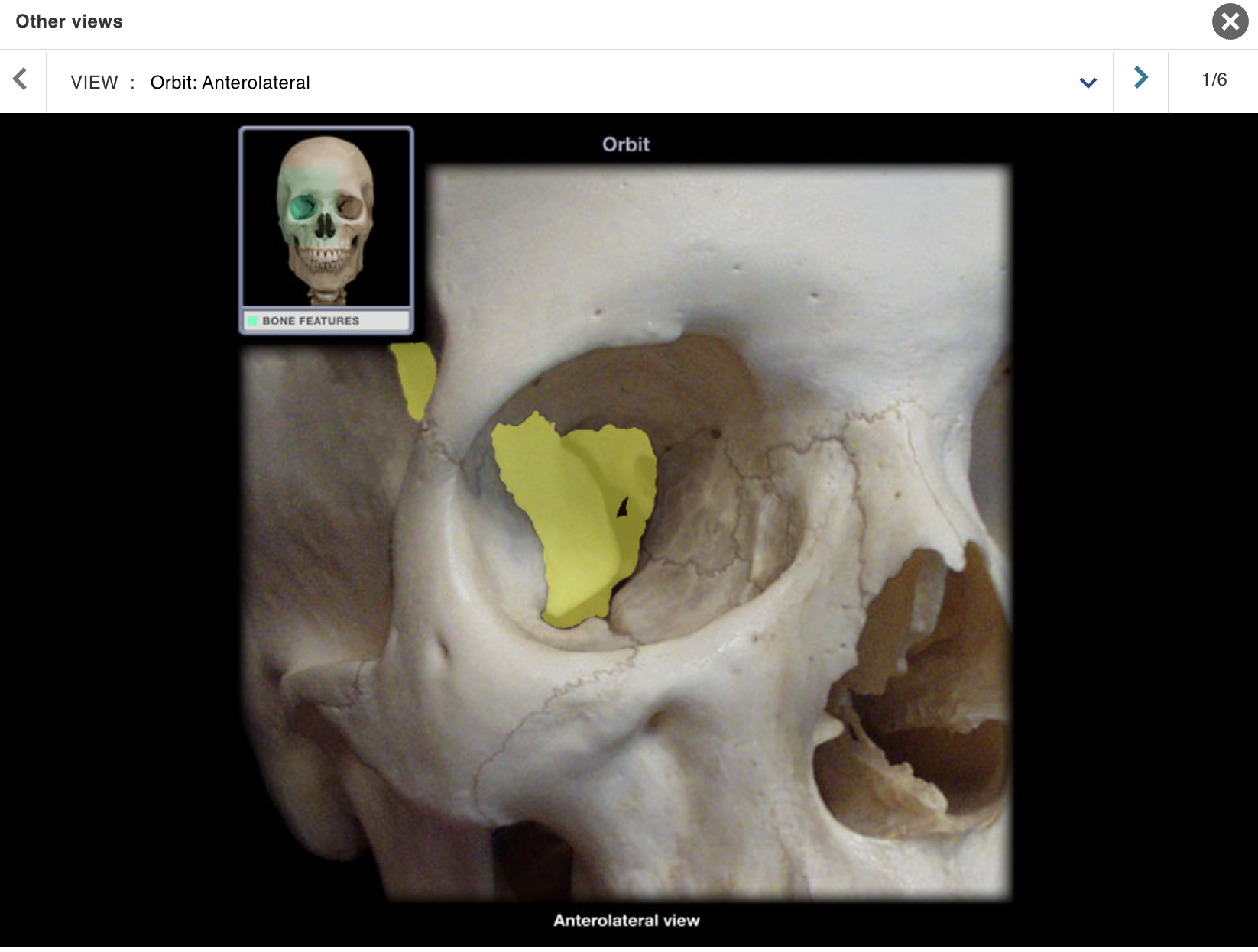
Orbit

Location:

  • Skull (anterior)

  • Lateral to nasal cavity

Description:

  • Pyramidal space with roof, floor, and medial and lateral walls

  • Roof: frontal and sphenoid bones

  • Floor: palatine and zygomatic bones, and maxilla

  • Lateral wall: zygomatic, sphenoid, and frontal bones

  • Medial wall: ethmoid and lacrimal bones, and maxilla

  • Openings include superior and inferior orbital fissures, and optic canal

Also known as:

• Eye socket

Comment:

• Contains eyeball and its muscles; cranial nerves II, III, IV, V1, and VI; vasculature; lacrimal apparatus; and fat

<p>Location:</p><ul><li><p>Skull (anterior)</p></li><li><p>Lateral to nasal cavity</p></li></ul><p>Description:</p><ul><li><p>Pyramidal space with roof, floor, and medial and lateral walls</p></li><li><p>Roof: frontal and sphenoid bones</p></li><li><p>Floor: palatine and zygomatic bones, and maxilla</p></li><li><p>Lateral wall: zygomatic, sphenoid, and frontal bones</p></li><li><p>Medial wall: ethmoid and lacrimal bones, and maxilla</p></li><li><p>Openings include superior and inferior orbital fissures, and optic canal</p></li></ul><p>Also known as:</p><p class="p1">• Eye socket</p><p class="p1">Comment:</p><p class="p1">• Contains eyeball and its muscles; cranial nerves II, III, IV, V1, and VI; vasculature; lacrimal apparatus; and fat</p>
10
New cards
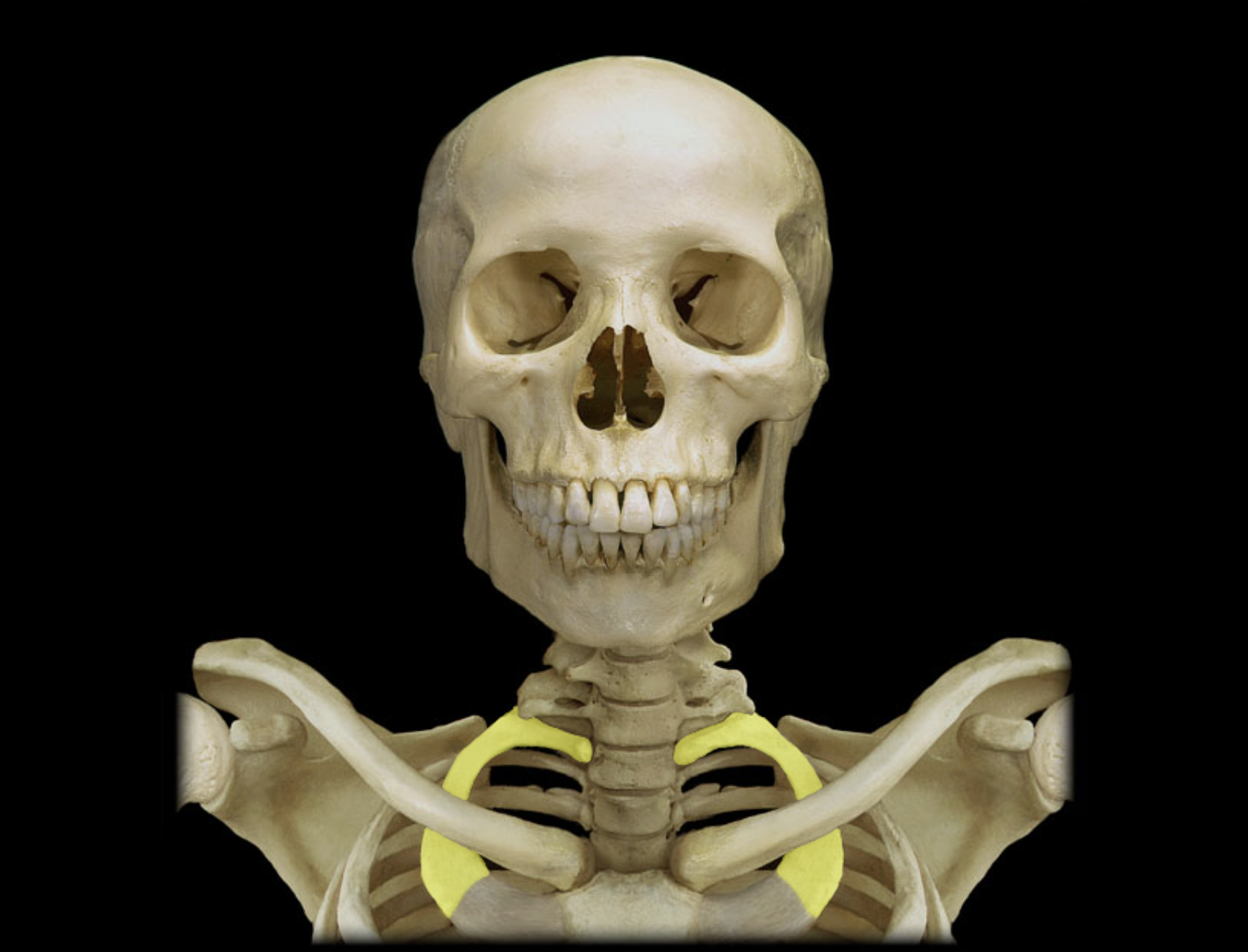
<p>Rib 1</p>

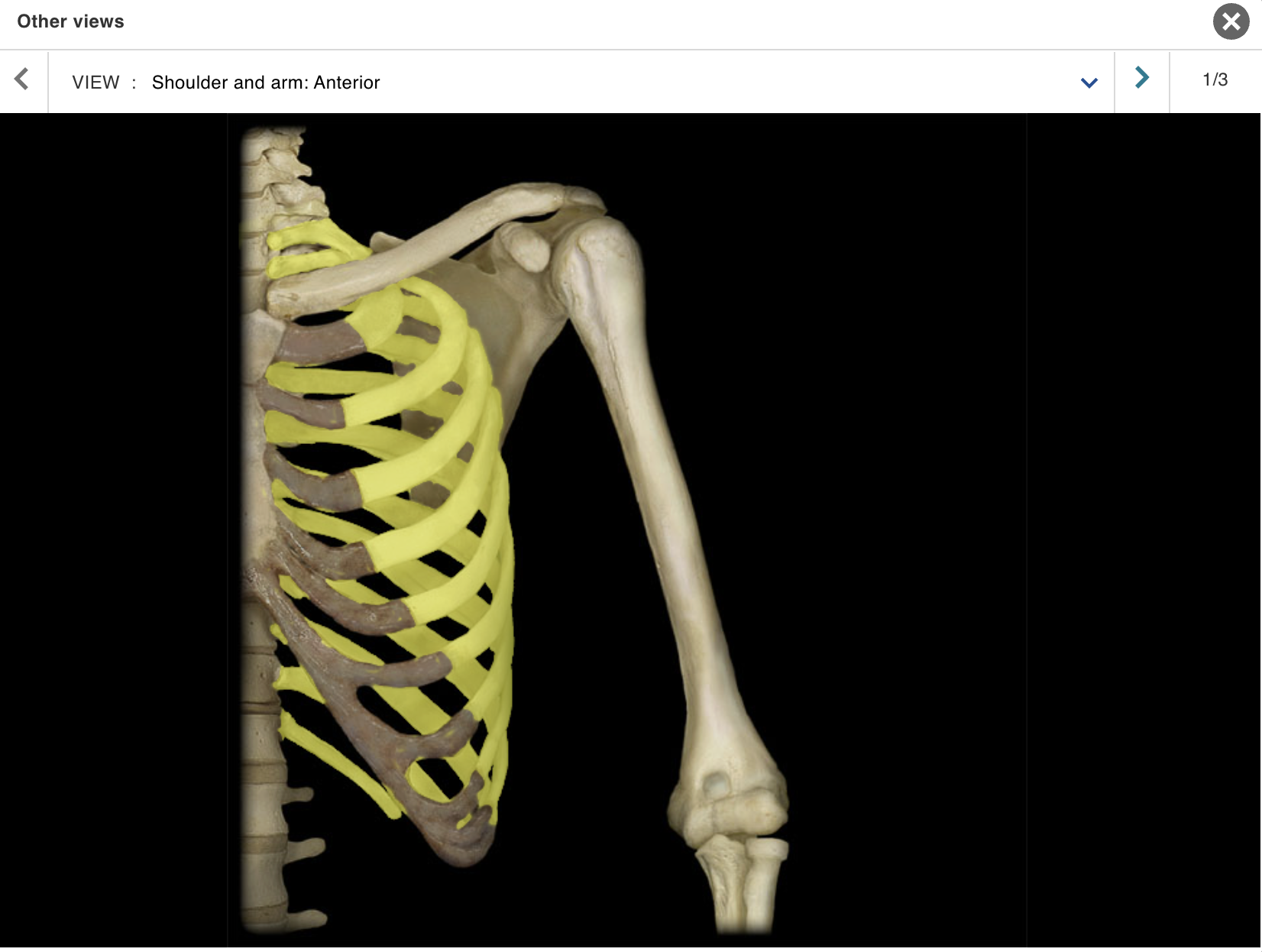
Rib 1

Location:

• Thorax

Description:

  • A true rib (shortest)

  • Articulates with T1 vertebra and, via its costal cartilage, with manubrium of sternum

  • Subclavian artery and vein groove superior surface

Comment:

  • All ribs: articulate with thoracic vertebra

  • True ribs (ribs 1-7): attached directly to sternum by costal cartilages

  • False ribs (ribs 8-10): attach indirectly to sternum via shared costal cartilages

  • Floating ribs (ribs 11-12): not attached to sternum

  • Alternate definition: some include the floating ribs (11-12) as a subcategory of false ribs

<p>Location:</p><p class="p1">• Thorax</p><p class="p1">Description:</p><ul><li><p>A true rib (shortest)</p></li><li><p>Articulates with T1 vertebra and, via its costal cartilage, with manubrium of sternum</p></li><li><p>Subclavian artery and vein groove superior surface</p></li></ul><p>Comment:</p><ul><li><p>All ribs: articulate with thoracic vertebra</p></li><li><p>True ribs (ribs 1-7): attached directly to sternum by costal cartilages</p></li><li><p>False ribs (ribs 8-10): attach indirectly to sternum via shared costal cartilages</p></li><li><p>Floating ribs (ribs 11-12): not attached to sternum</p></li><li><p>Alternate definition: some include the floating ribs (11-12) as a subcategory of false ribs</p></li></ul><p></p>
11
New cards
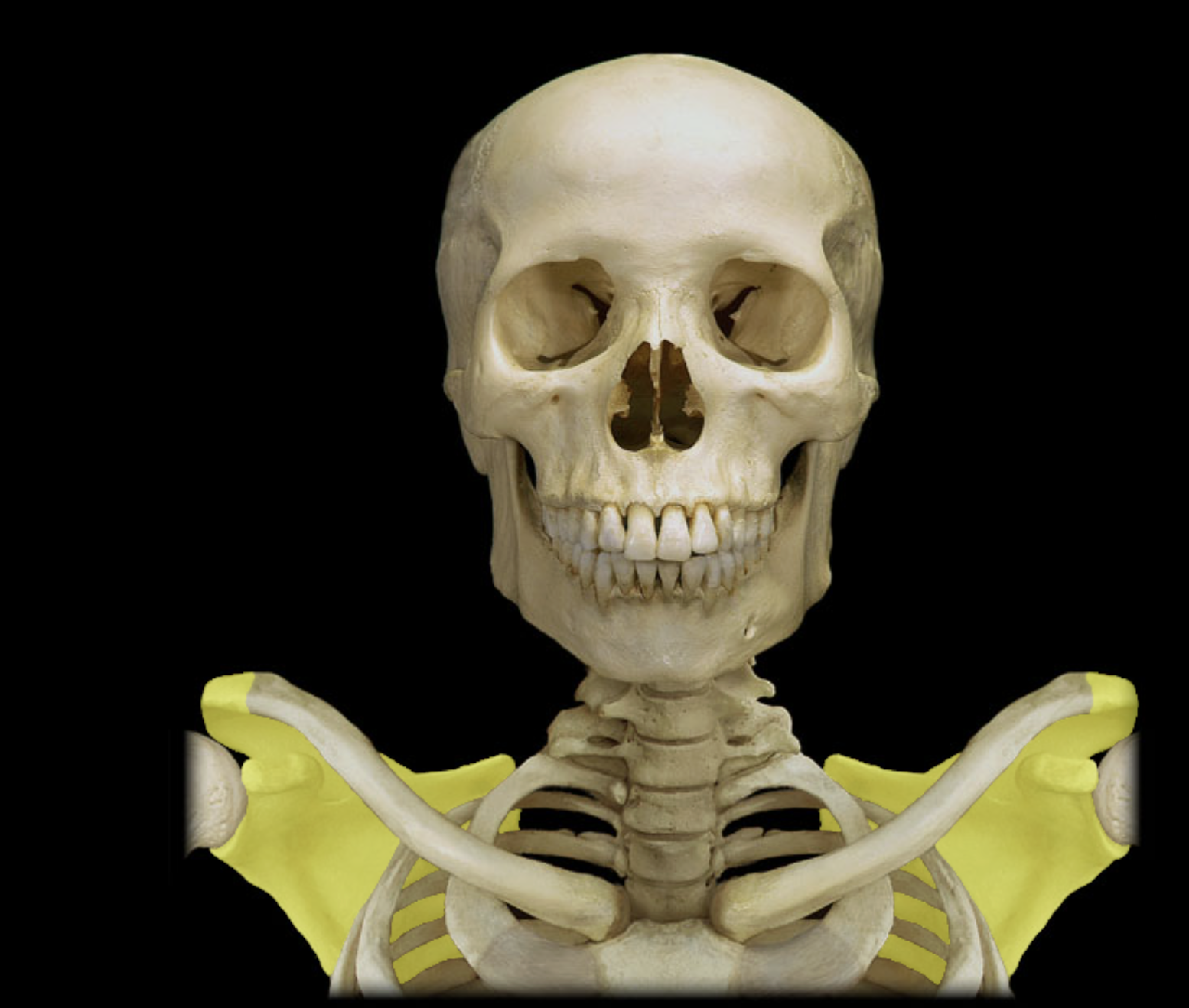
<p>Scapula</p>

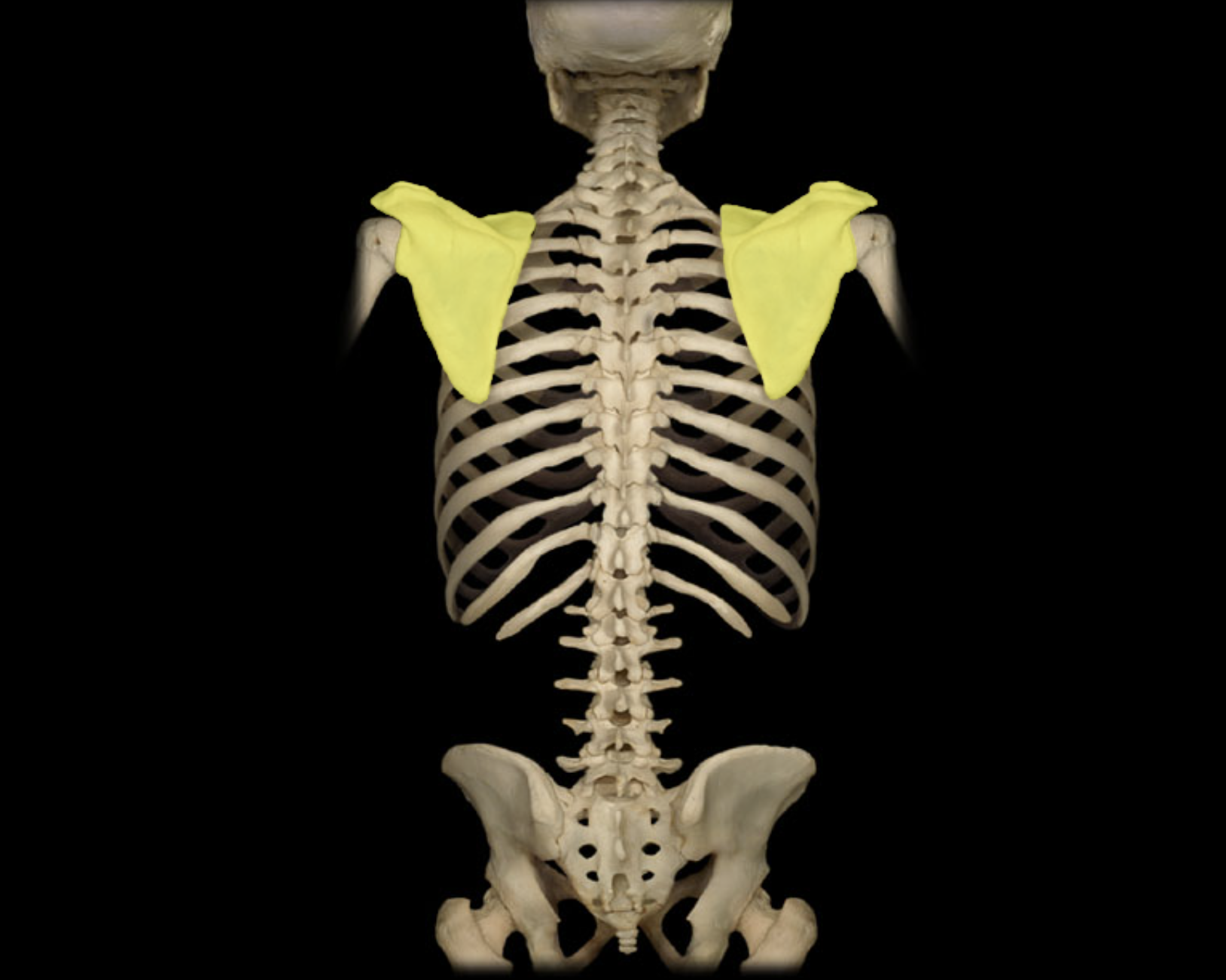
Scapula

Location:

  • Posterior thorax

  • Overlies ribs 2-7

Description:

  • Large, triangular, flat bone

  • Characteristic features include spine, acromion, coracoid process, and glenoid cavity

<p>Location:</p><ul><li><p>Posterior thorax</p></li><li><p>Overlies ribs 2-7</p></li></ul><p class="p1">Description:</p><ul><li><p>Large, triangular, flat bone</p></li><li><p>Characteristic features include spine, acromion, coracoid process, and glenoid cavity</p></li></ul><p></p>
12
New cards
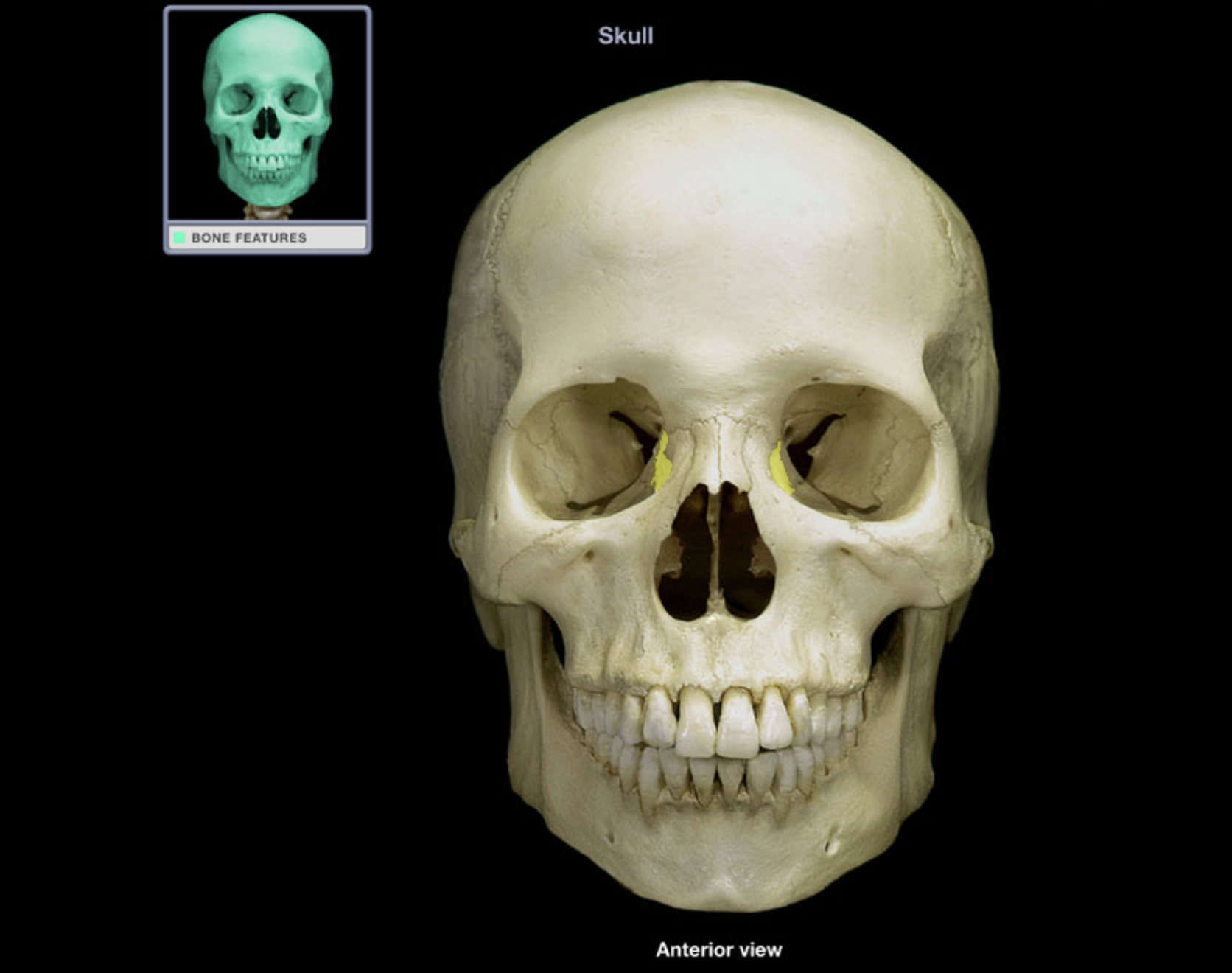
<p>Skull</p>

Skull

Location:

• Head

Description:

  • Paired and unpaired bones divided into cranial and facial
    groups

  • Cranial group: frontal, sphenoid, ethmoid, parietal (2), occipital, and temporal bones (2)

  • Facial group: maxilla, mandible, vomer, nasal (2), lacrimal (2), and zygomatic bones (2)

<p>Location:</p><p class="p1">• Head</p><p class="p1">Description:</p><ul><li><p>Paired and unpaired bones divided into cranial and facial<br>groups</p></li><li><p>Cranial group: frontal, sphenoid, ethmoid, parietal (2), occipital, and temporal bones (2)</p></li><li><p>Facial group: maxilla, mandible, vomer, nasal (2), lacrimal (2), and zygomatic bones (2)</p></li></ul><p></p>
13
New cards
<p>Sphenoid bone</p>

Sphenoid bone

Location:

• Skull

Description:

  • Unpaired, irregular-shaped bone

  • Shape resembles a butterfly

  • Consists of body, and greater and lesser wings

Comment:

  • Contributes to middle cranial fossa, nasal cavities, orbits, and lateral skull (temples)

  • Contains sella turcica ("Turkish saddle"), sphenoidal air sinus, and many foramina

<p>Location:</p><p class="p1">• Skull</p><p class="p1">Description:</p><ul><li><p>Unpaired, irregular-shaped bone</p></li><li><p>Shape resembles a butterfly</p></li><li><p>Consists of body, and greater and lesser wings</p></li></ul><p>Comment:</p><ul><li><p>Contributes to middle cranial fossa, nasal cavities, orbits, and lateral skull (temples)</p></li><li><p>Contains sella turcica ("Turkish saddle"), sphenoidal air sinus, and many foramina</p></li></ul><p></p>
14
New cards
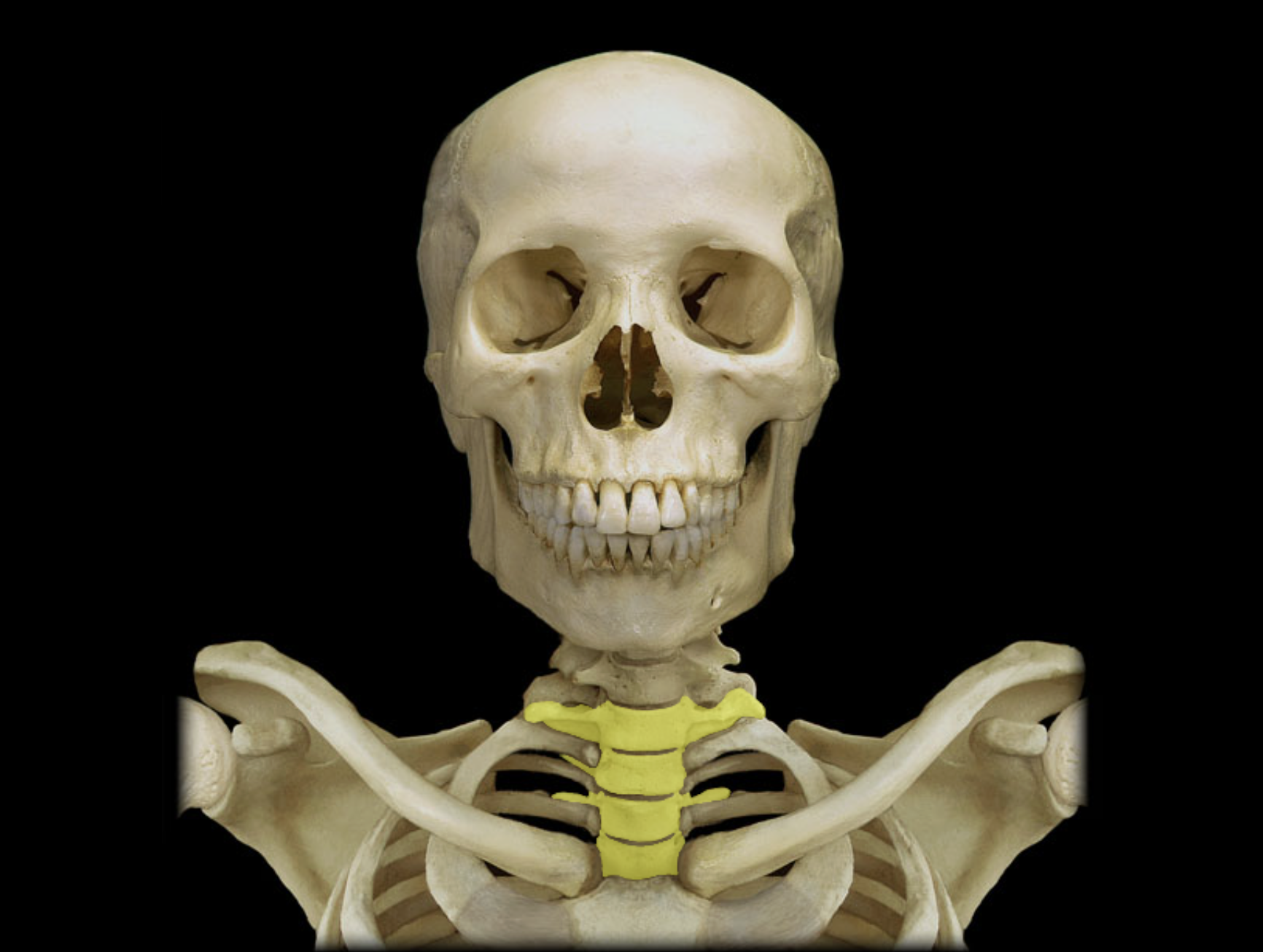
<p>Thoracic vertebra</p>

Thoracic vertebra

Location:

  • Trunk

  • Between C7 and L1 vertebrae

Description:

  • 12 individual vertebrae

  • Characteristic features include costal demifacets (or facets) for articulation with head of rib, spinous process slopes inferiorly, and heart-shaped vertebral body

<p>Location:</p><ul><li><p>Trunk</p></li><li><p>Between C7 and L1 vertebrae</p></li></ul><p class="p1">Description:</p><ul><li><p>12 individual vertebrae</p></li><li><p>Characteristic features include costal demifacets (or facets) for articulation with head of rib, spinous process slopes inferiorly, and heart-shaped vertebral body</p></li></ul><p></p>
15
New cards
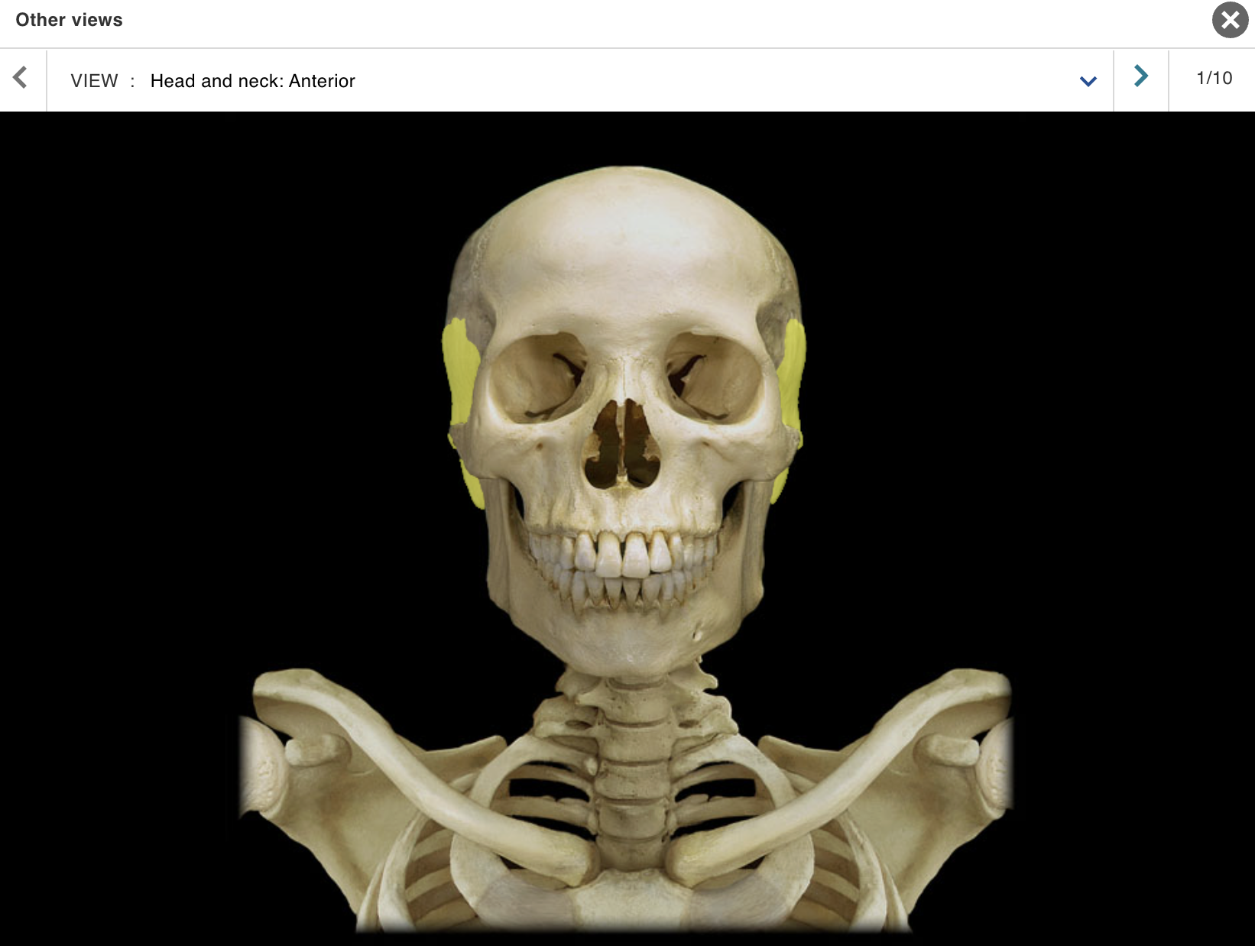
<p>Zygomatic bone</p>

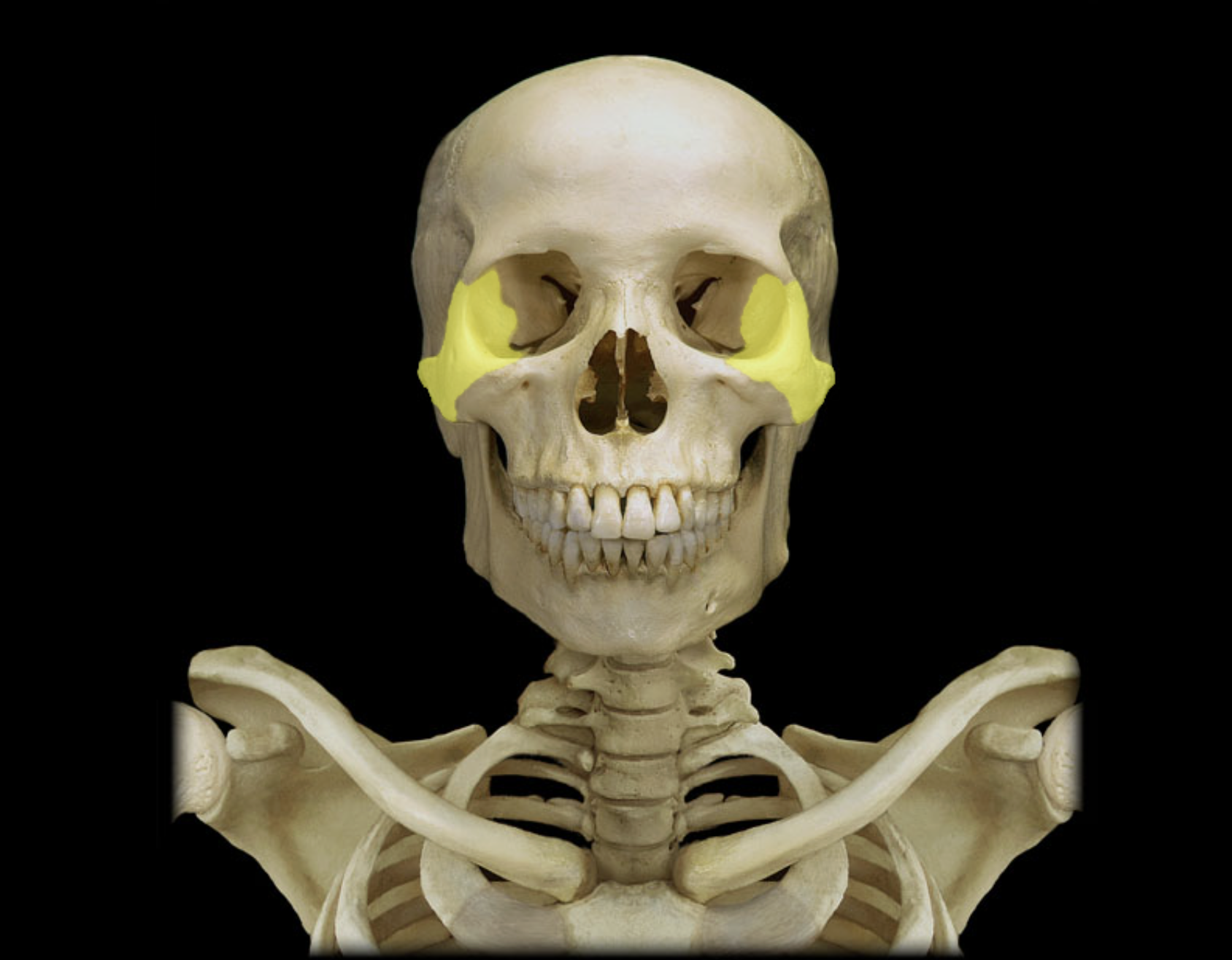
Zygomatic bone

Location:

• Skull (anterior and lateral)

Description:

  • Paired, irregular-shaped bone

  • Temporal process contributes to zvaomatic arch

Also known as:

• "Cheekbone"

Comment:

• Forms part of floor and lateral wall of orbit

<p>Location:</p><p class="p1">• Skull (anterior and lateral)</p><p class="p1">Description:</p><ul><li><p>Paired, irregular-shaped bone</p></li><li><p>Temporal process contributes to zvaomatic arch</p></li></ul><p class="p1">Also known as:</p><p class="p1">• "Cheekbone"</p><p class="p1">Comment:</p><p class="p1">• Forms part of floor and lateral wall of orbit</p>
16
New cards

SKELETAL

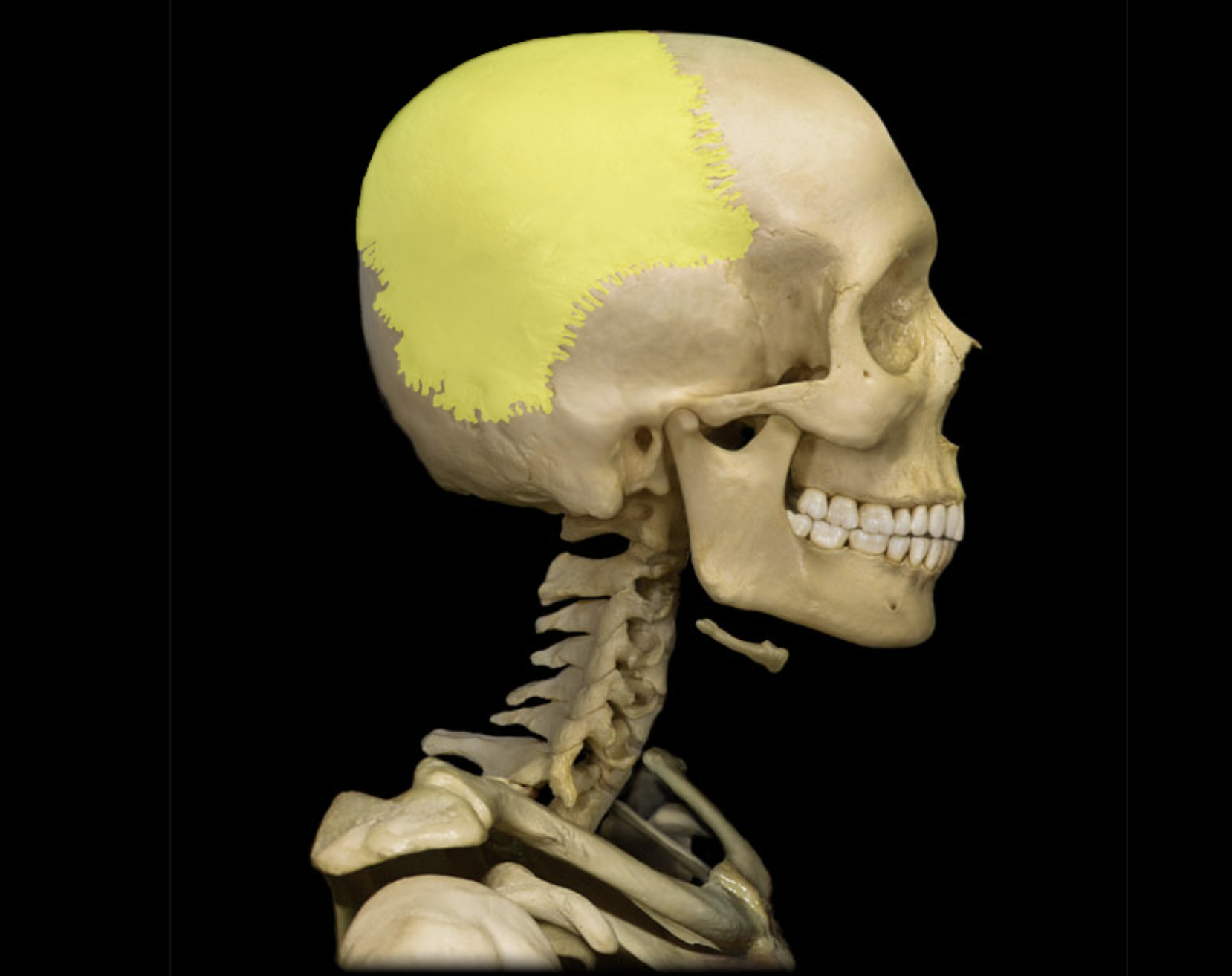
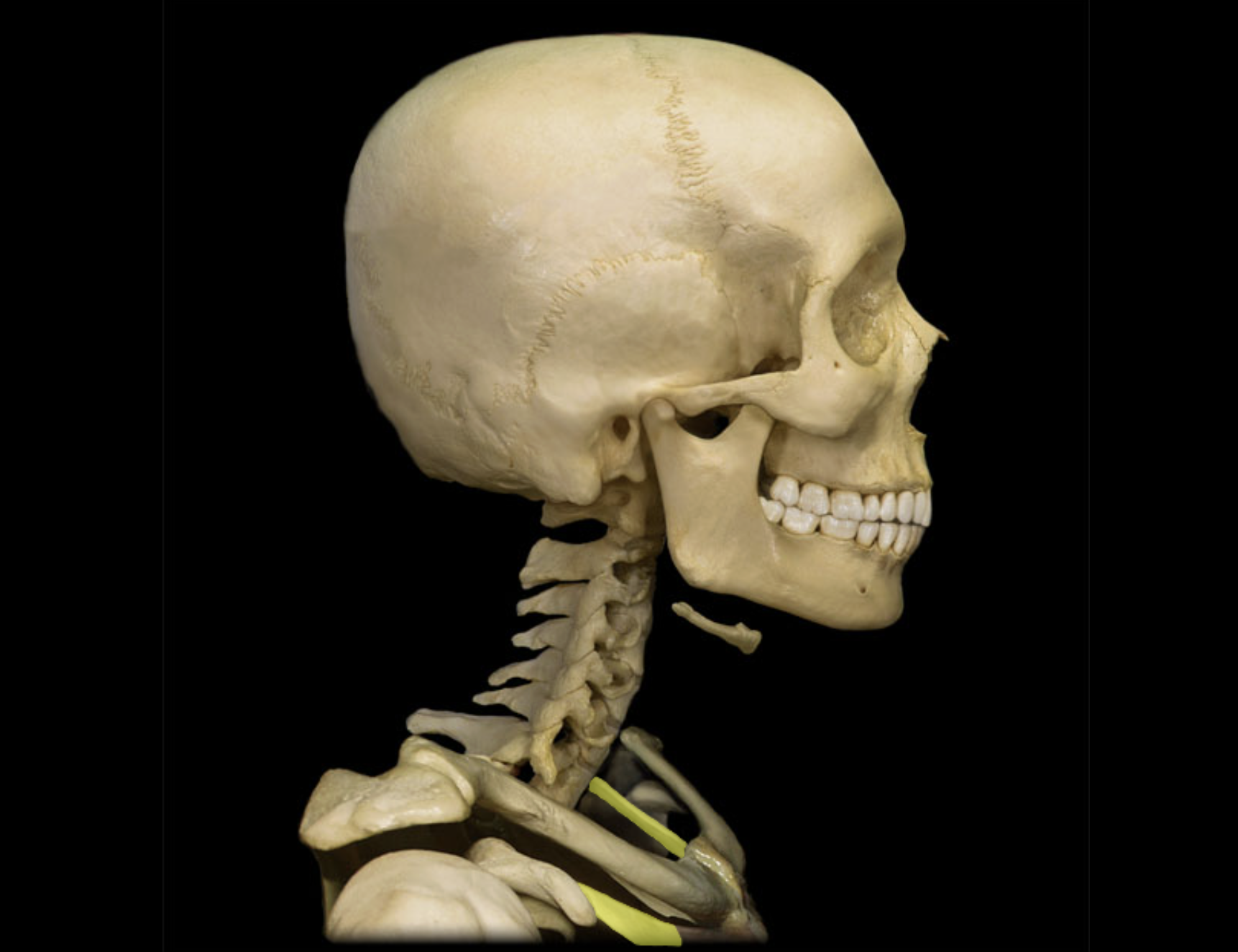
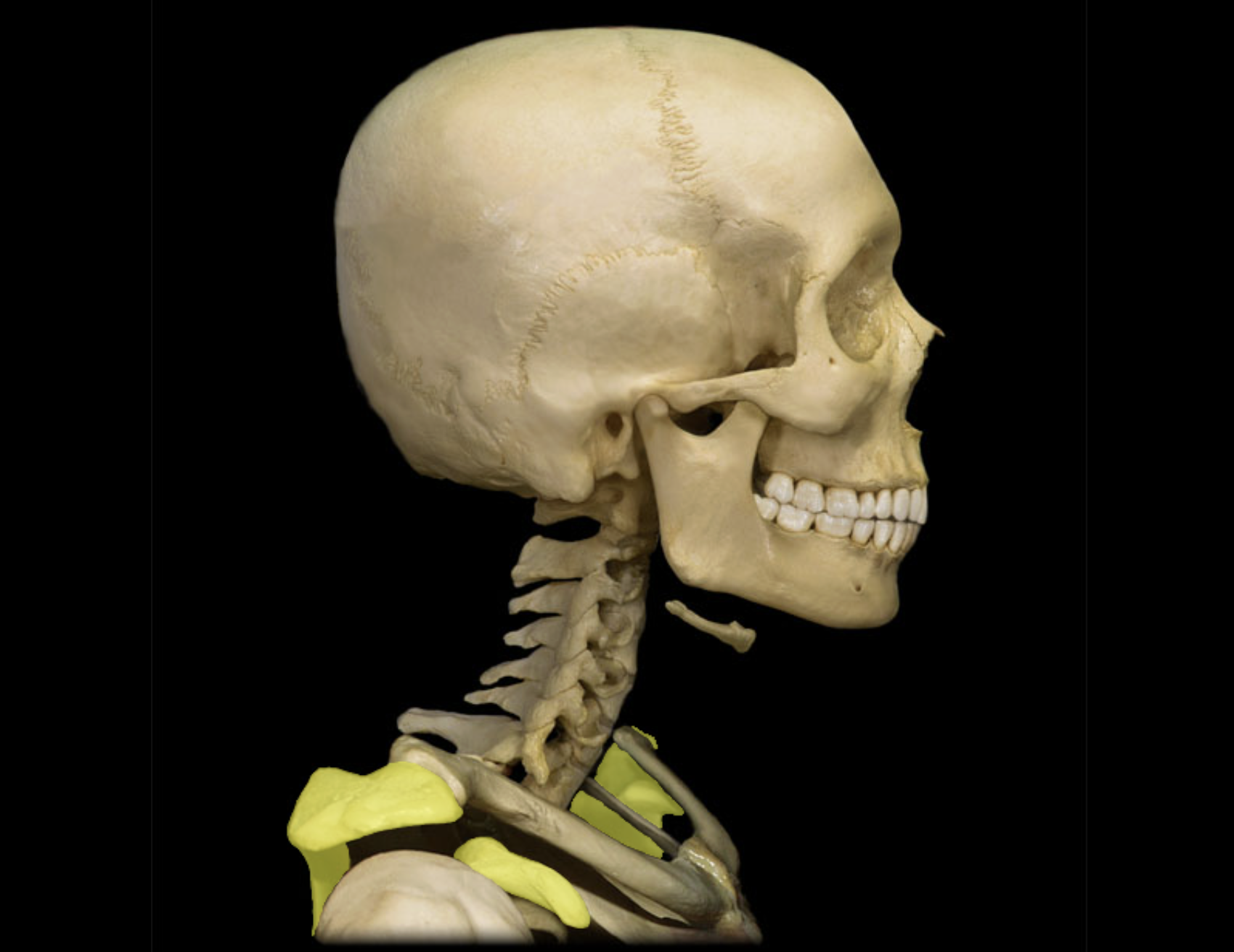
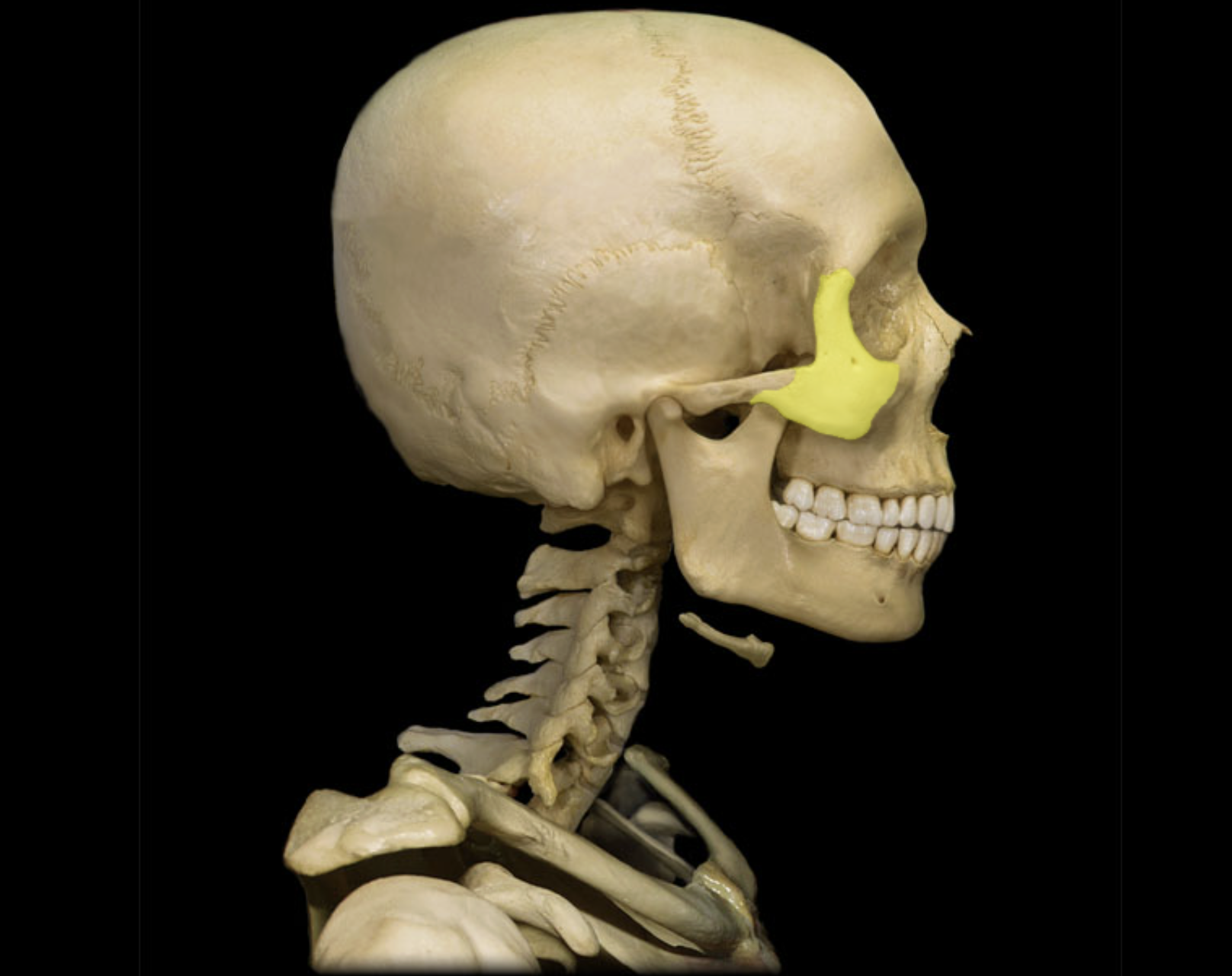
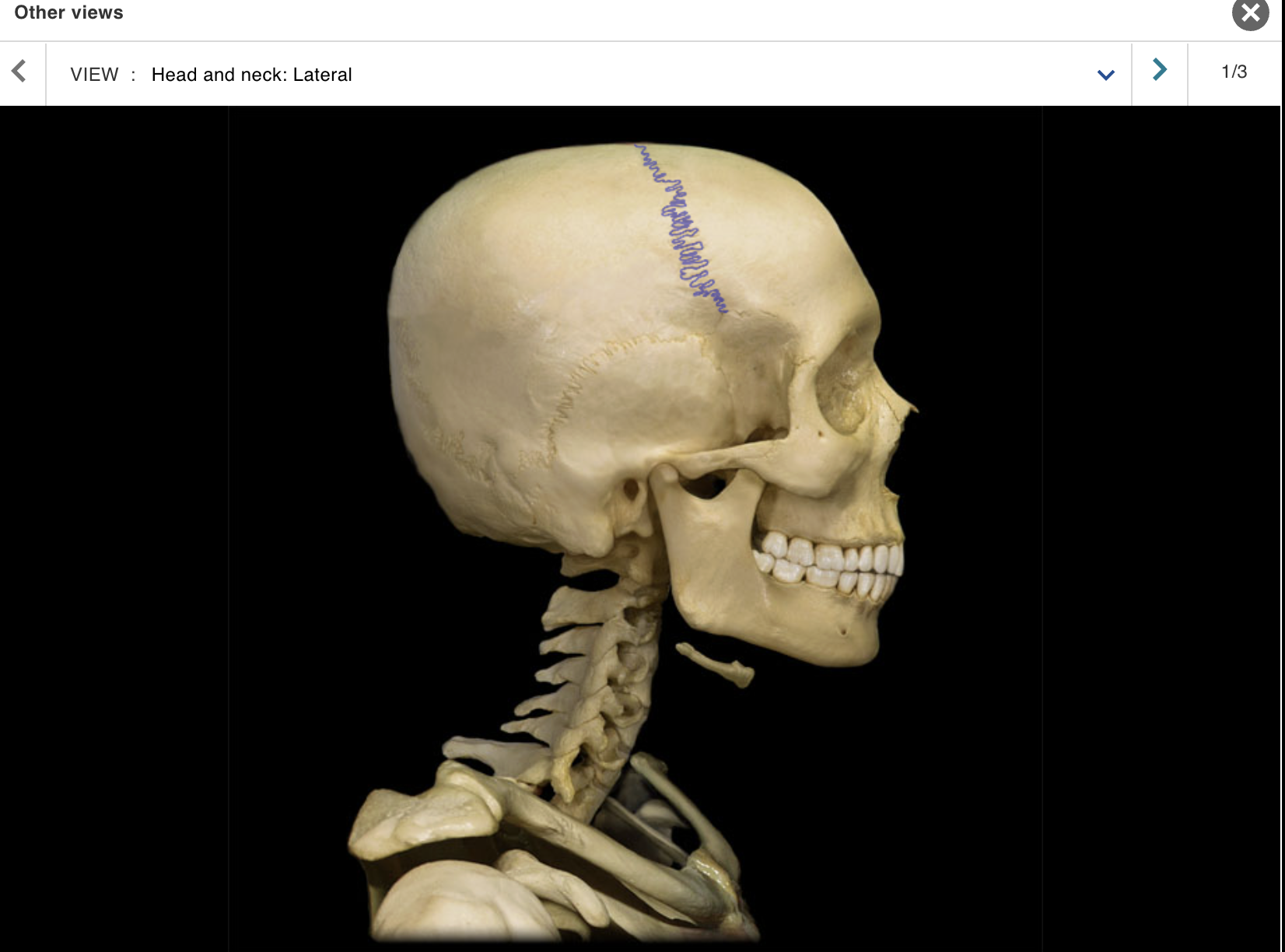
TOPIC: HEAD / NECK / VIEW : LATERAL

Cervical vertebra

Clavicle

Frontal bone

Hyoid bone

Intervertebral disc

Mandible

Manubrium

Maxilla

Nasal bone

Parietal bone

Rib 1

Scapula

Temporal bone

Zygomatic bone

17
New cards
<p>Cervical vertebra</p>

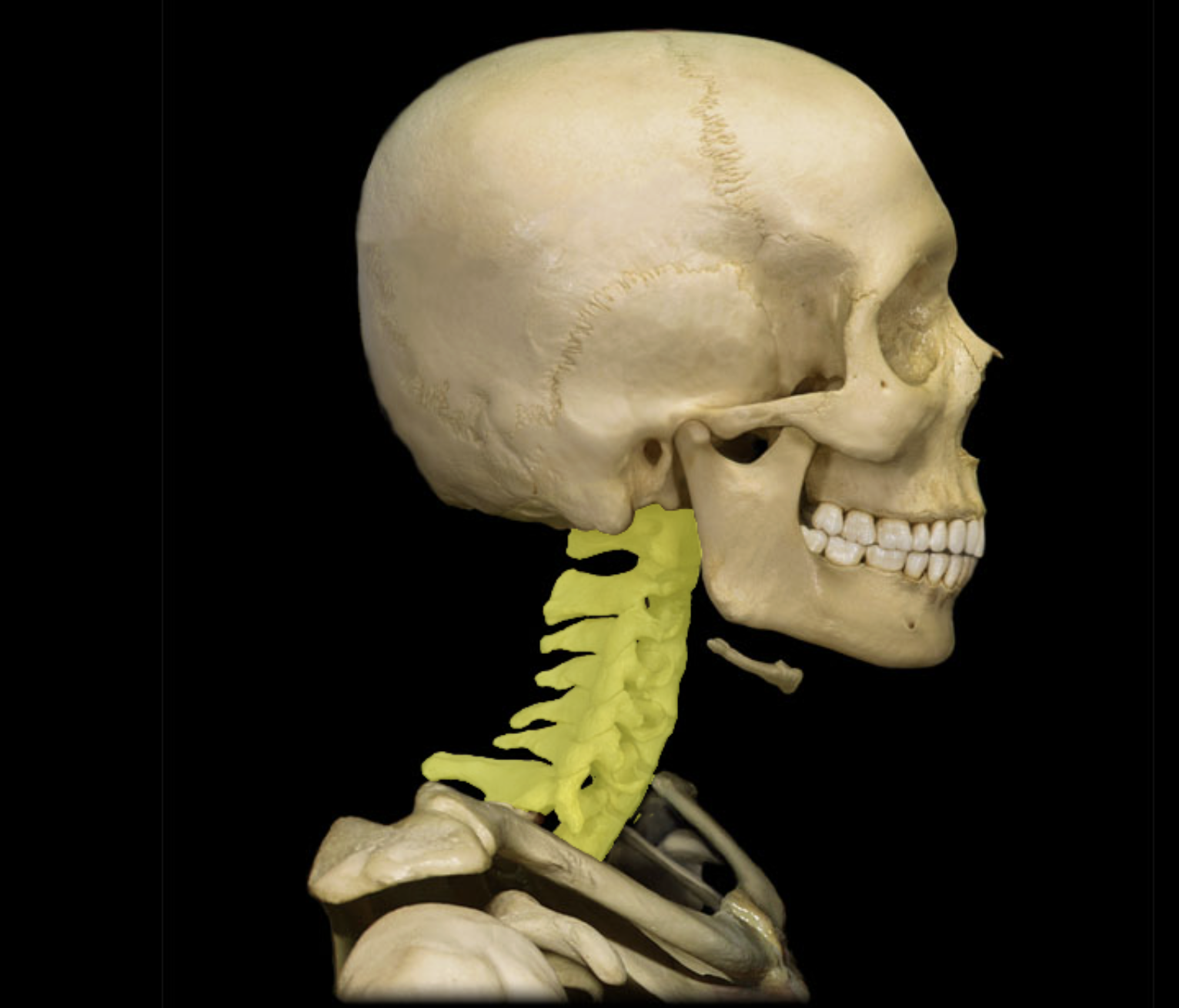
Cervical vertebra

Location:

  • Neck

  • Between occipital bone and T1 vertebra

Description:

  • Seven individual vertebrae

  • Characteristic features include transverse foramen and bifid (split) spinous process on C3-C6

Comment:

• Atlas (C1 vertebra) articulates with skull
18
New cards
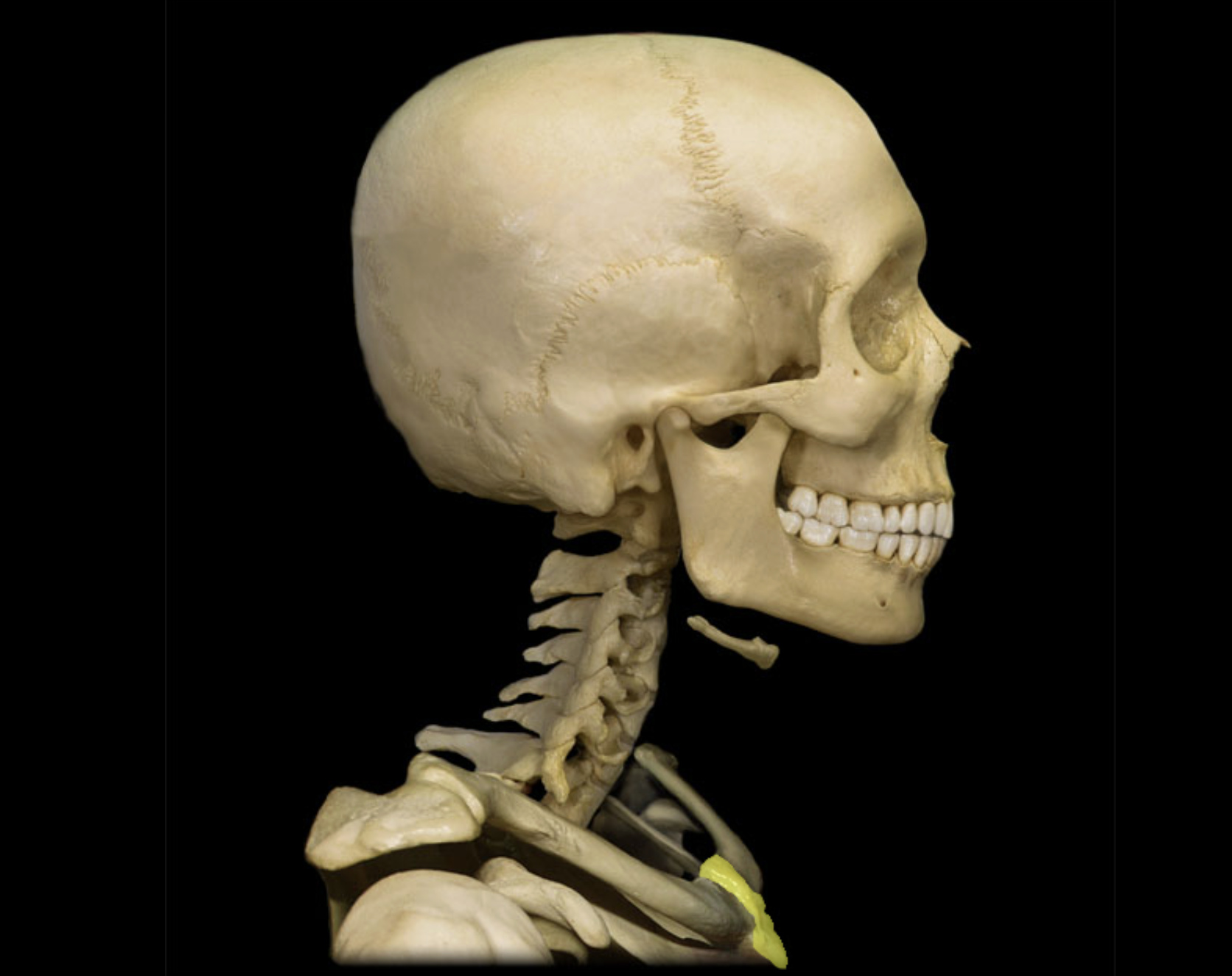
<p>Clavicle</p>

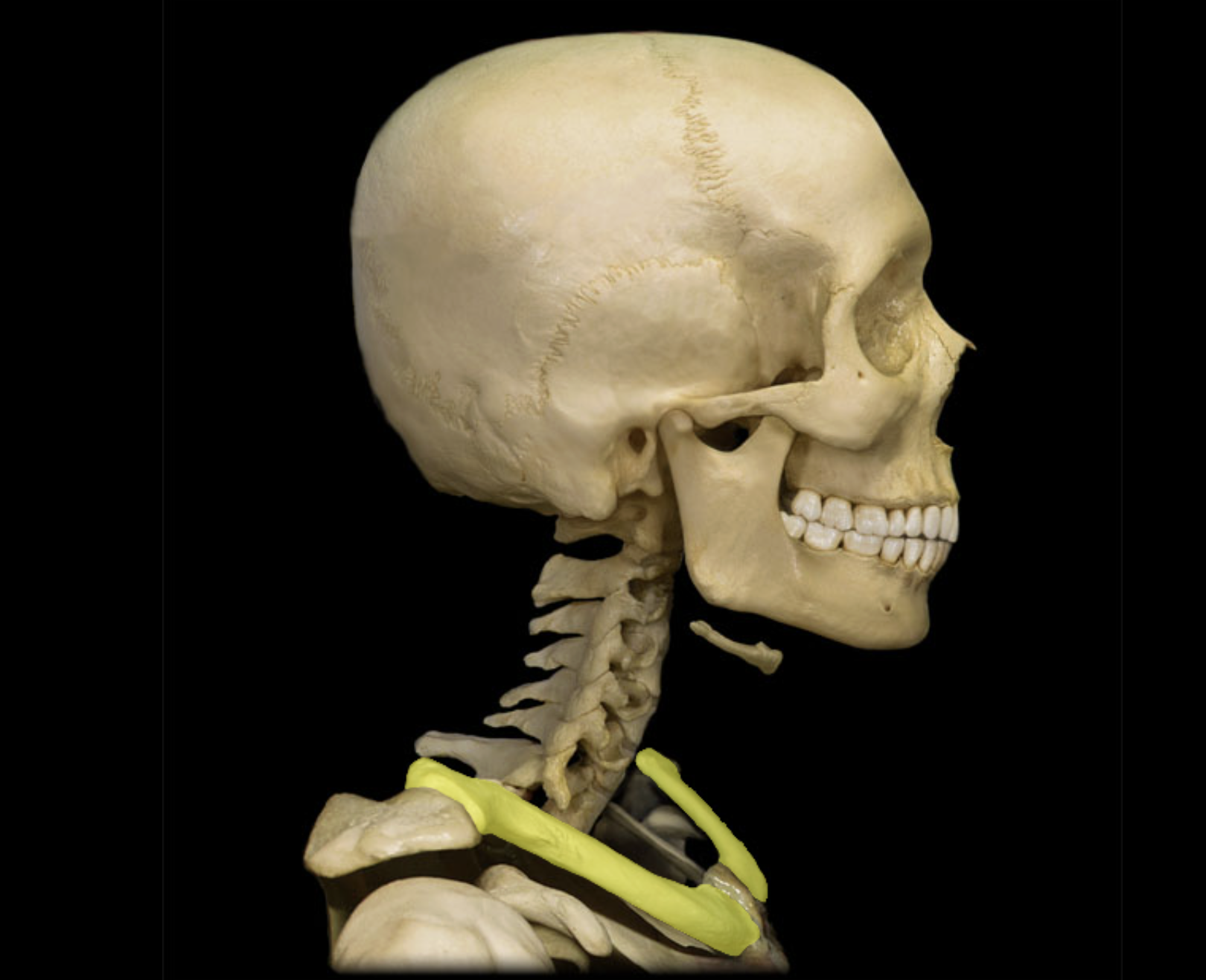
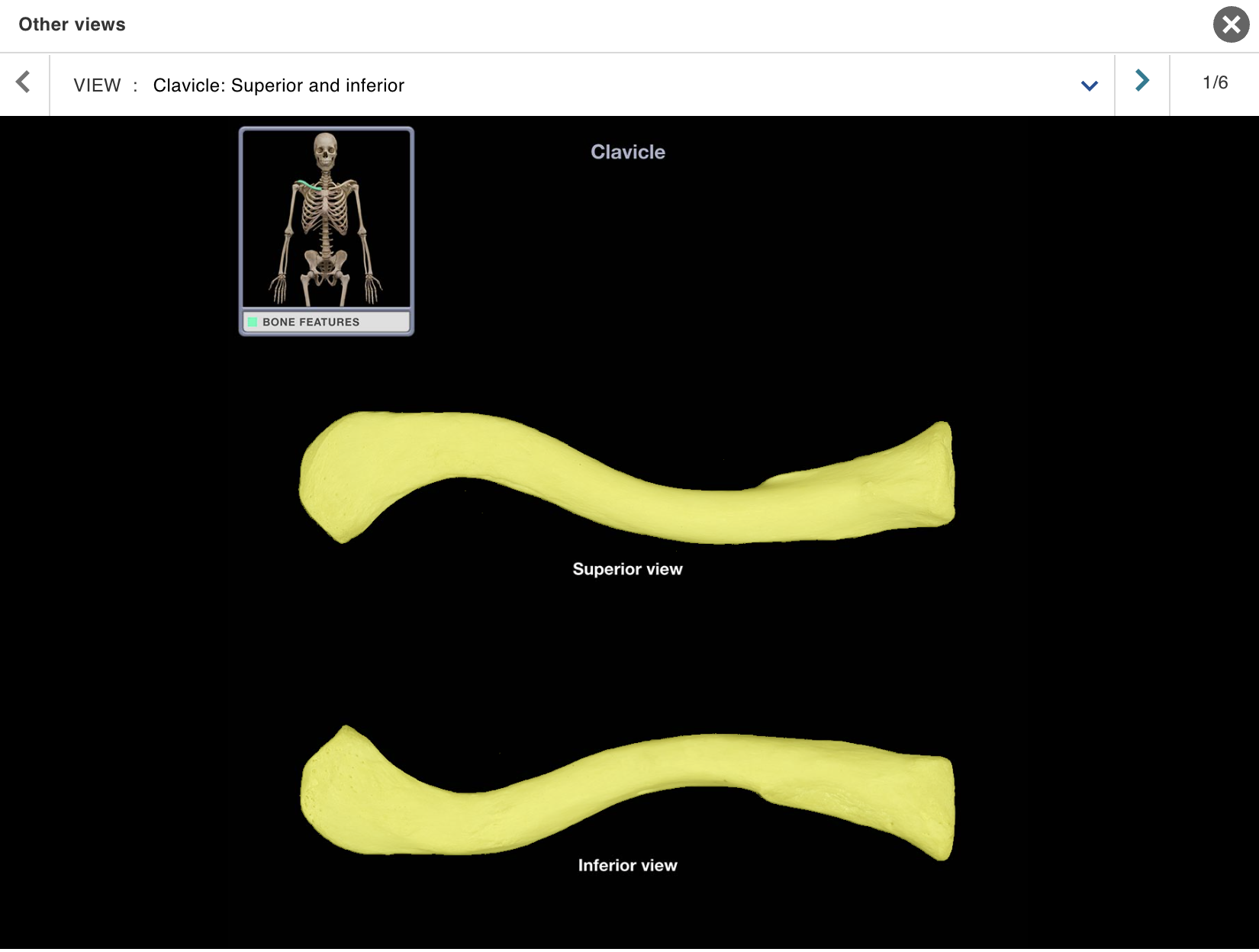
Clavicle

Location:

• Junction of neck and anterior thorax

Description:

  • Subcutaneous, S-shaped bone

  • Medial end articulates with sternum at sternoclavicular joint

  • Lateral end articulates with acromion of scapula at acromioclavicular joint

Also known as:

• "Collar bone"
<p>Location:</p><p class="p1">• Junction of neck and anterior thorax</p><p class="p1">Description:</p><ul><li><p>Subcutaneous, S-shaped bone</p></li><li><p>Medial end articulates with sternum at sternoclavicular joint</p></li><li><p>Lateral end articulates with acromion of scapula at acromioclavicular joint</p></li></ul><p>Also known as:</p><p class="p1">• "Collar bone"</p>
19
New cards
<p>Frontal bone</p>

Frontal bone

Location:

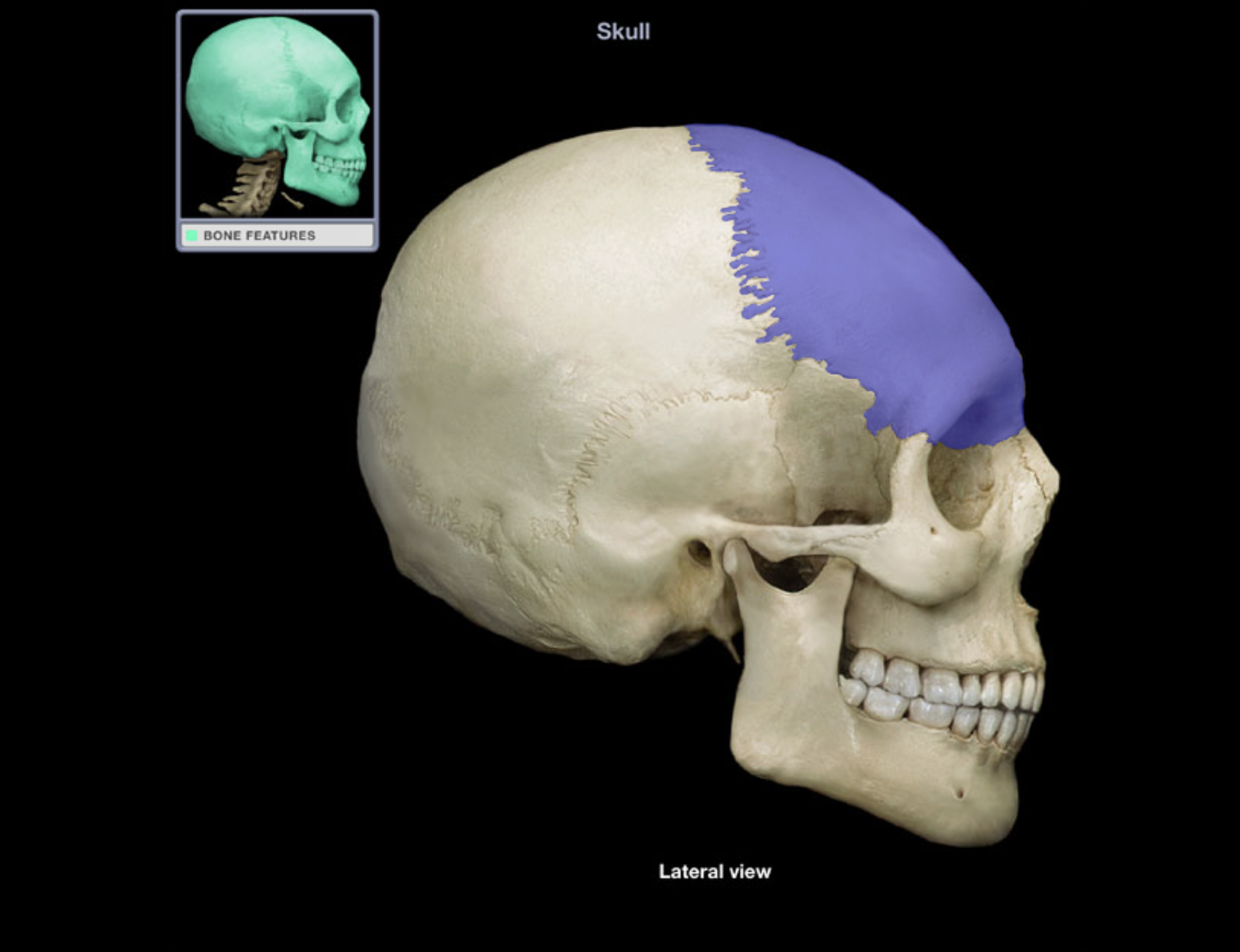
• Skull (anterior superior part)

Description:

  • Unpaired, irregular-shaped, flat bone

  • Forms forehead, roof of orbits, and most of anterior cranial fossa

  • Contains frontal air sinuses

Comment:

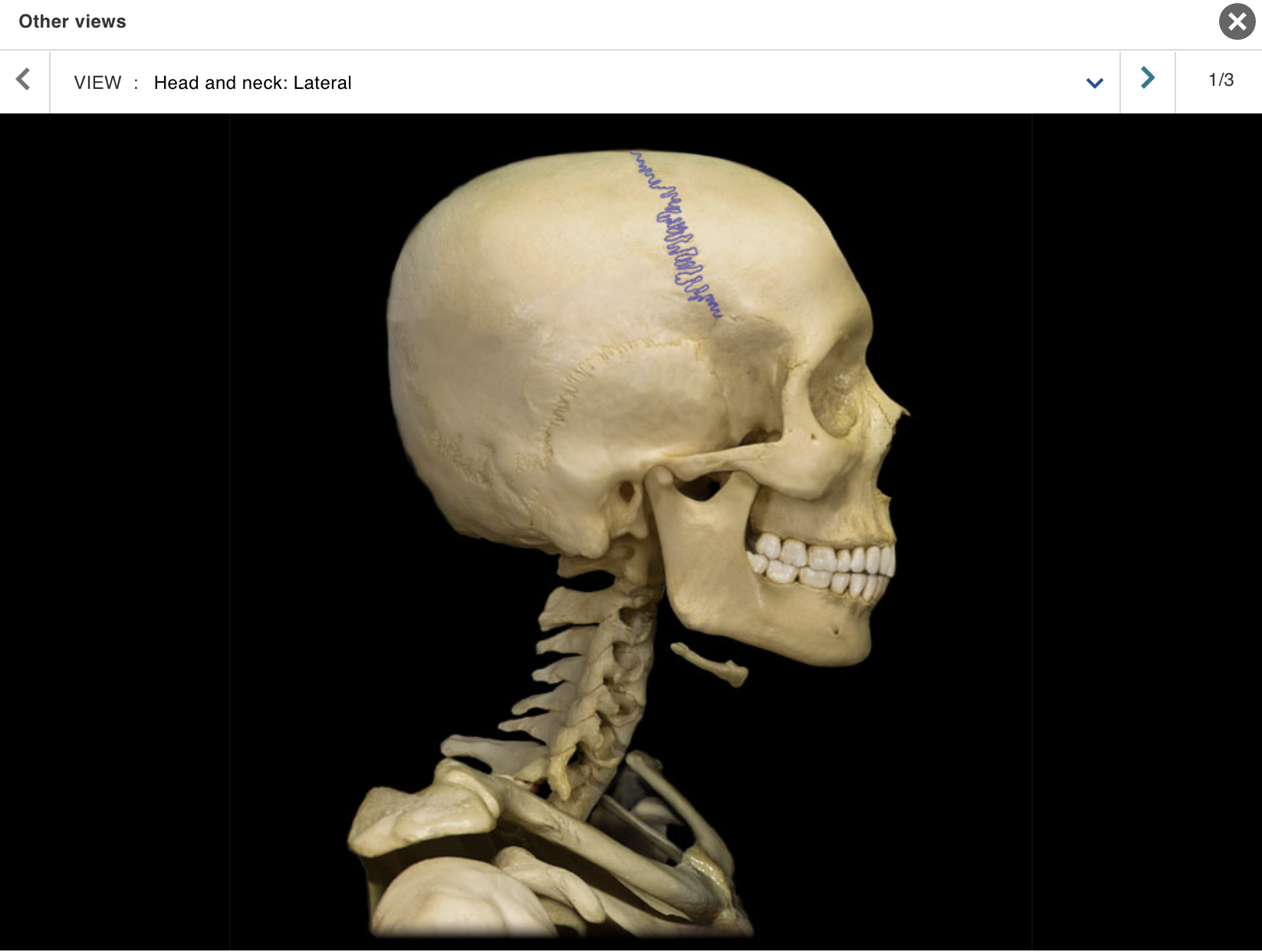
• Articulates with parietal bone at coronal suture and sphenoid bone at sphenosquamosal suture

<p>Location:</p><p class="p1">• Skull (anterior superior part)</p><p class="p1">Description:</p><ul><li><p>Unpaired, irregular-shaped, flat bone</p></li><li><p>Forms forehead, roof of orbits, and most of anterior cranial fossa</p></li><li><p>Contains frontal air sinuses</p></li></ul><p>Comment:</p><p class="p1">• Articulates with parietal bone at coronal suture and sphenoid bone at sphenosquamosal suture</p>
20
New cards
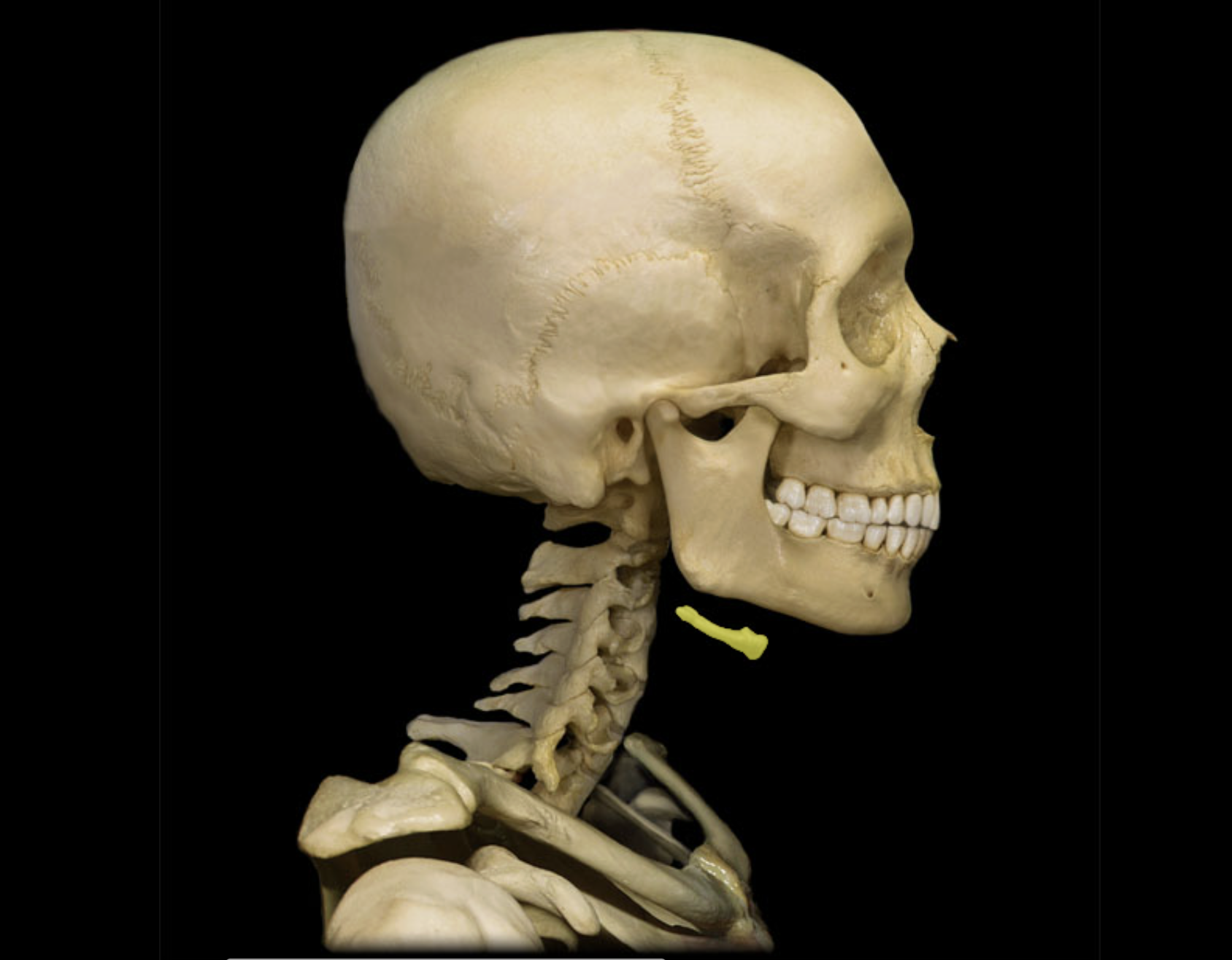
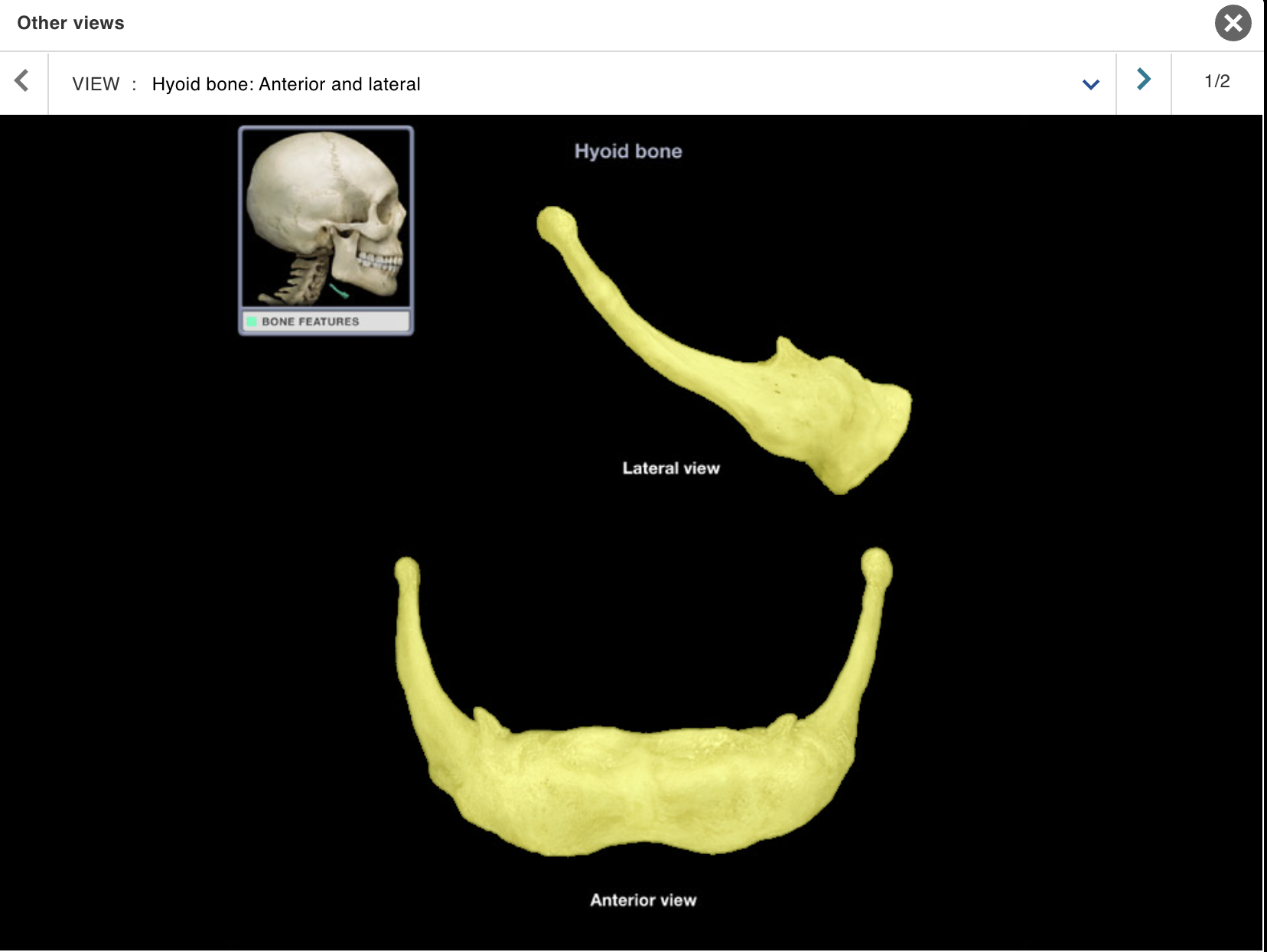
<p>Hyoid bone</p>

Hyoid bone

Location:

  • Anterior neck

  • Between thyroid cartilage and mandible

Description:

  • U-shaped bone

  • Paired projections (greater and lesser horns) on each side

Comment:

  • Attached structures include stylohyoid ligament, suprahyoid and infrahyoid muscles, and extrinsic tongue muscles

  • Does not articulate with any other bone

<p>Location:</p><ul><li><p>Anterior neck</p></li><li><p>Between thyroid cartilage and mandible</p></li></ul><p class="p1">Description:</p><ul><li><p>U-shaped bone</p></li><li><p>Paired projections (greater and lesser horns) on each side</p></li></ul><p>Comment:</p><ul><li><p>Attached structures include stylohyoid ligament, suprahyoid and infrahyoid muscles, and extrinsic tongue muscles</p></li><li><p>Does not articulate with any other bone</p></li></ul><p></p>
21
New cards
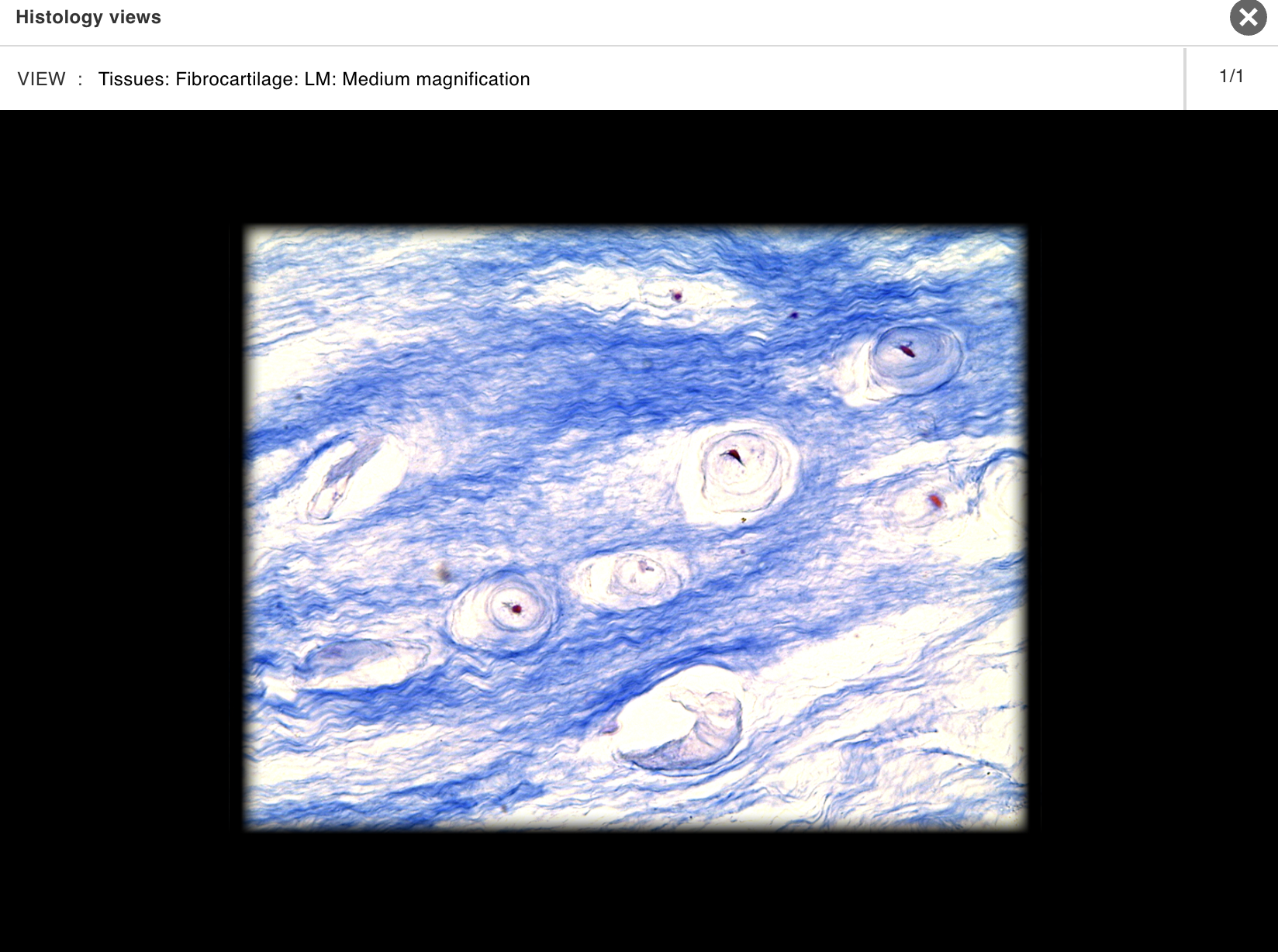
<p>Intervertebral disc</p>

Intervertebral disc

Location:

• Between vertebral bodies (C2 to S1)

Description:

  • Outer part: anulus fibrous consisting of a fibrocartilage ring

  • Inner part: nucleus pulposus composed of mucoid material

Comment:

• No disk between atlas (C1 vertebra) and axis (C2 vertebra)

<p>Location:</p><p class="p1">• Between vertebral bodies (C2 to S1)</p><p class="p1">Description:</p><ul><li><p>Outer part: anulus fibrous consisting of a fibrocartilage ring</p></li><li><p>Inner part: nucleus pulposus composed of mucoid material</p></li></ul><p class="p1">Comment:</p><p class="p1">• No disk between atlas (C1 vertebra) and axis (C2 vertebra)</p>
22
New cards
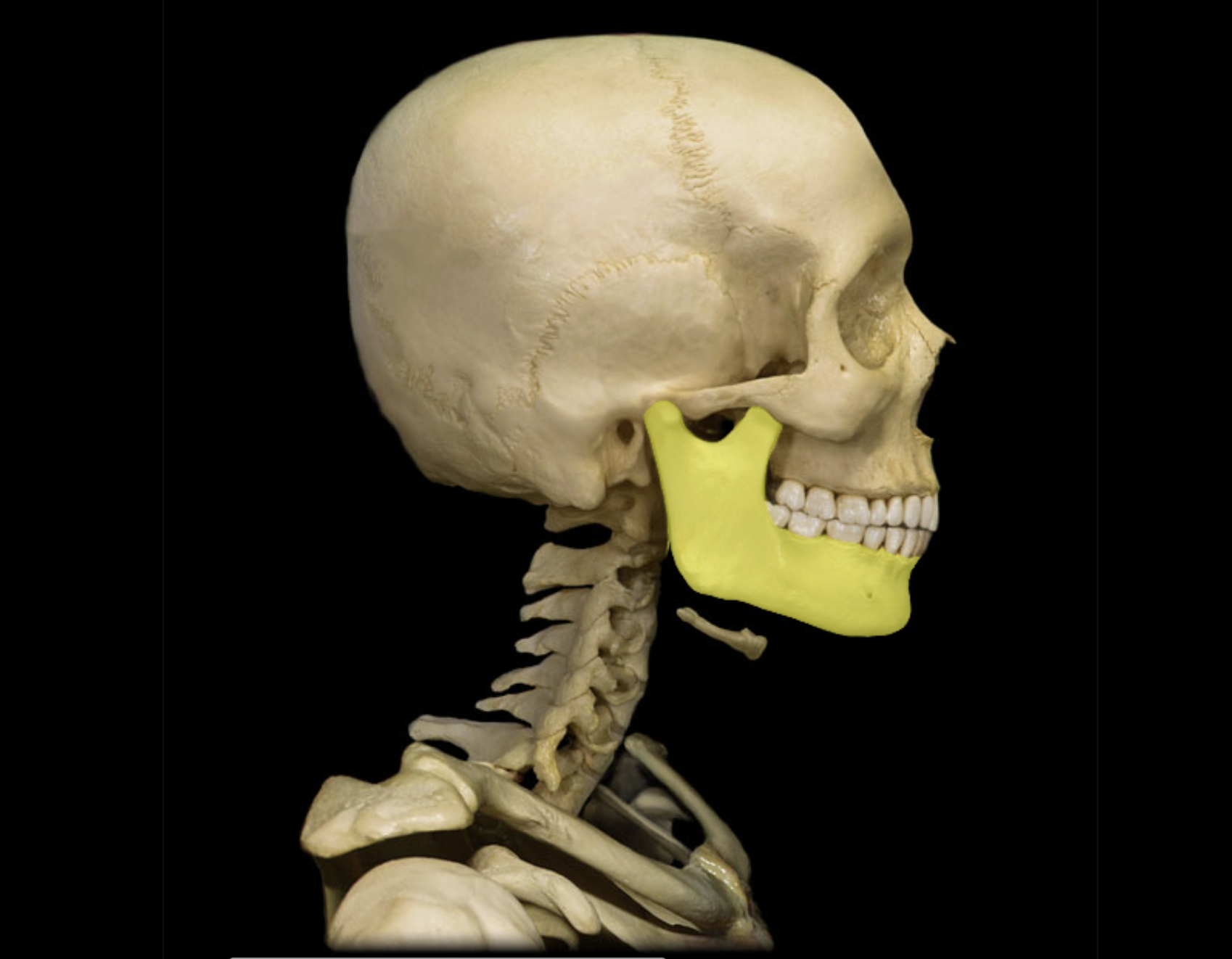
<p>Mandible</p>

Mandible

Location:

• Skull (anterior)

Description:

  • U-shaped bone

  • Each side consists of body (horizontal) and ramus (vertical) with coronoid and condylar processes

  • Mental protuberance forms point of chin

  • Contains alveoli ("sockets") for teeth

Also known as:

• "Lower jaw"

Comment:

• Contributes to temporomandibular joint (TMJ

<p>Location:</p><p class="p1">• Skull (anterior)</p><p class="p1">Description:</p><ul><li><p>U-shaped bone</p></li><li><p>Each side consists of body (horizontal) and ramus (vertical) with coronoid and condylar processes</p></li><li><p>Mental protuberance forms point of chin</p></li><li><p>Contains alveoli ("sockets") for teeth</p></li></ul><p>Also known as:</p><p class="p1">• "Lower jaw"</p><p class="p1">Comment:</p><p class="p1">• Contributes to temporomandibular joint (TMJ</p>
23
New cards
<p>Manubrium</p>

Manubrium

Location:

• Sternum

Description:

  • Triangular shape

  • Superior part of sternum

  • Articulates with costal cartilages of ribs 1-2 and clavicles

Comment:

• Provides attachment for sternocleidomastoid and pectoralis major muscles

<p>Location:</p><p class="p1">• Sternum</p><p class="p1">Description:</p><ul><li><p>Triangular shape</p></li><li><p>Superior part of sternum</p></li><li><p>Articulates with costal cartilages of ribs 1-2 and clavicles</p></li></ul><p class="p1">Comment:</p><p class="p1">• Provides attachment for sternocleidomastoid and pectoralis major muscles</p>
24
New cards
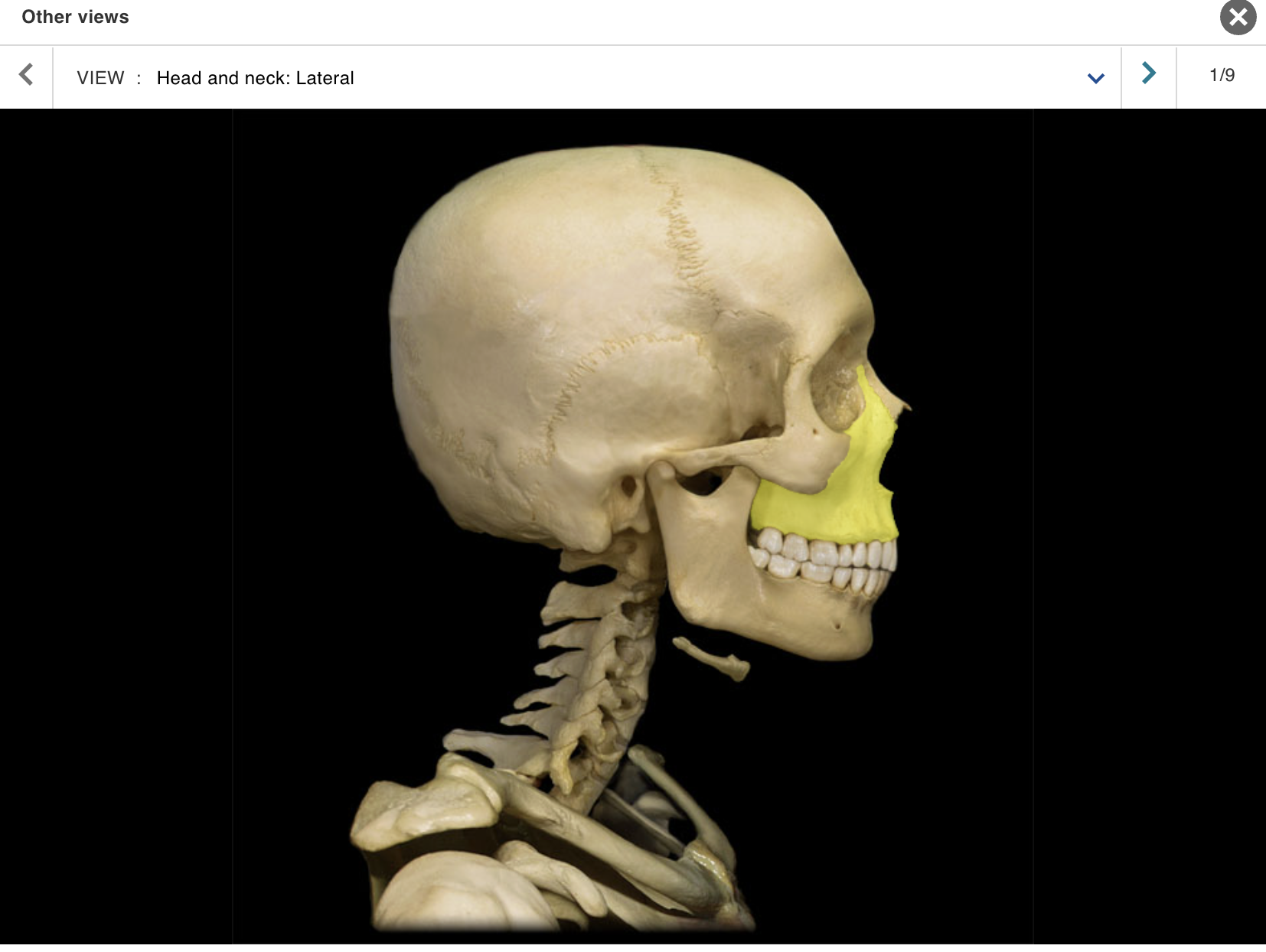
<p>Maxilla</p>

Maxilla

Location:

• Skull (anterior)

Description:

  • Paired, irregular-shaped bone

  • Left and right maxillae unite to form "upper jaw"

  • Contains alveoli ("sockets") for teeth

  • Contains maxillary air sinus on each side

Also known as:

• "Upper jaw"

Comment:

  • Forms part of floor of orbit and anterior part of hard palate

  • Contributes to upper face

<p>Location:</p><p class="p1">• Skull (anterior)</p><p class="p1">Description:</p><ul><li><p>Paired, irregular-shaped bone</p></li><li><p>Left and right maxillae unite to form "upper jaw"</p></li><li><p>Contains alveoli ("sockets") for teeth</p></li><li><p>Contains maxillary air sinus on each side</p></li></ul><p>Also known as:</p><p class="p1">• "Upper jaw"</p><p class="p1">Comment:</p><ul><li><p>Forms part of floor of orbit and anterior part of hard palate</p></li><li><p>Contributes to upper face</p></li></ul><p></p>
25
New cards
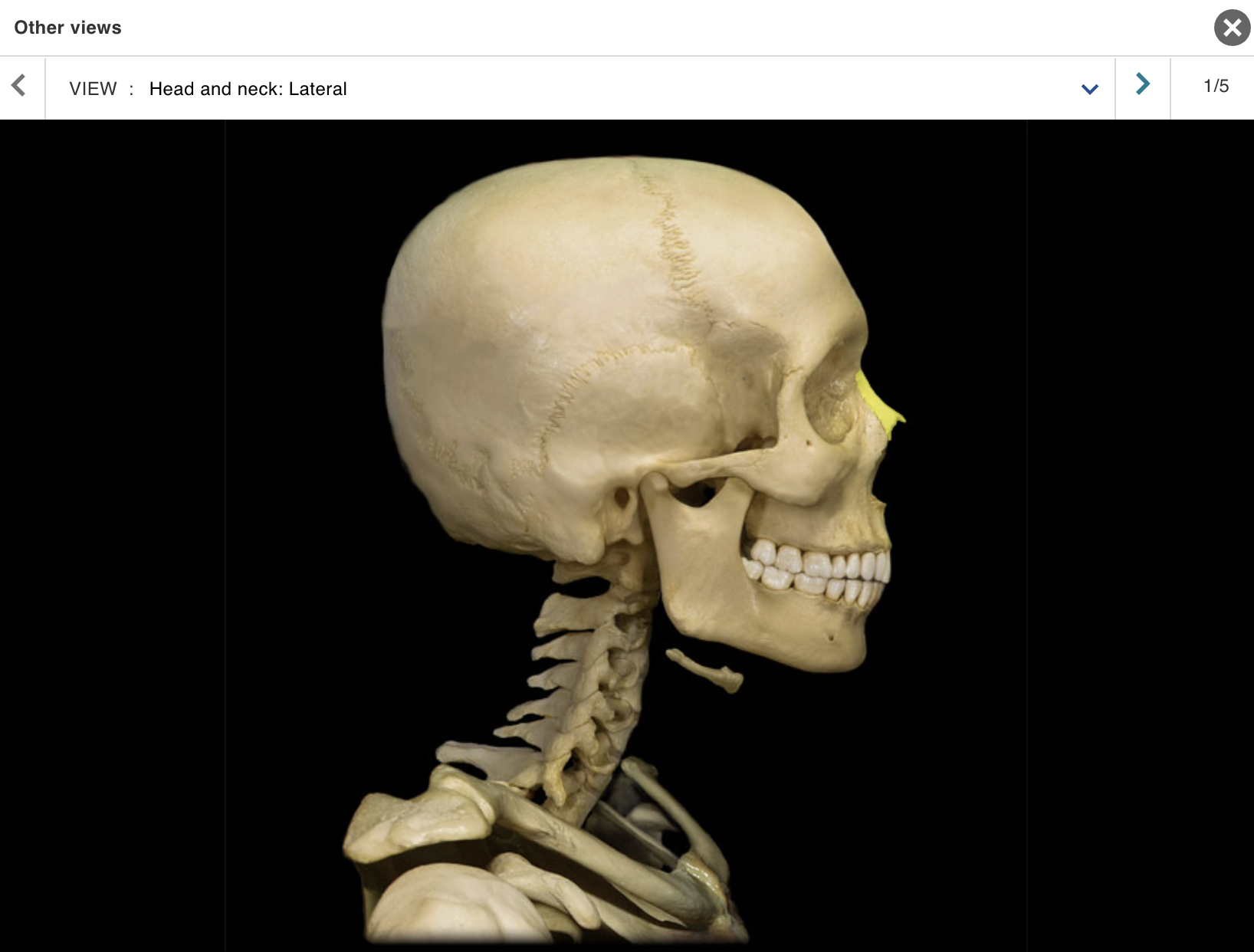
<p>Nasal bone</p>

Nasal bone

Location:

• Skull (anterior)

Description:

  • Small, paired bone

  • Articulates at midline with nasal bone from opposite side

Also known as:

• "Bridge of nose"

Comment:

• Forms bony part of nose

<p>Location:</p><p class="p1">• Skull (anterior)</p><p class="p1">Description:</p><ul><li><p>Small, paired bone</p></li><li><p>Articulates at midline with nasal bone from opposite side</p></li></ul><p class="p1">Also known as:</p><p class="p1">• "Bridge of nose"</p><p class="p1">Comment:</p><p class="p1">• Forms bony part of nose</p>
26
New cards
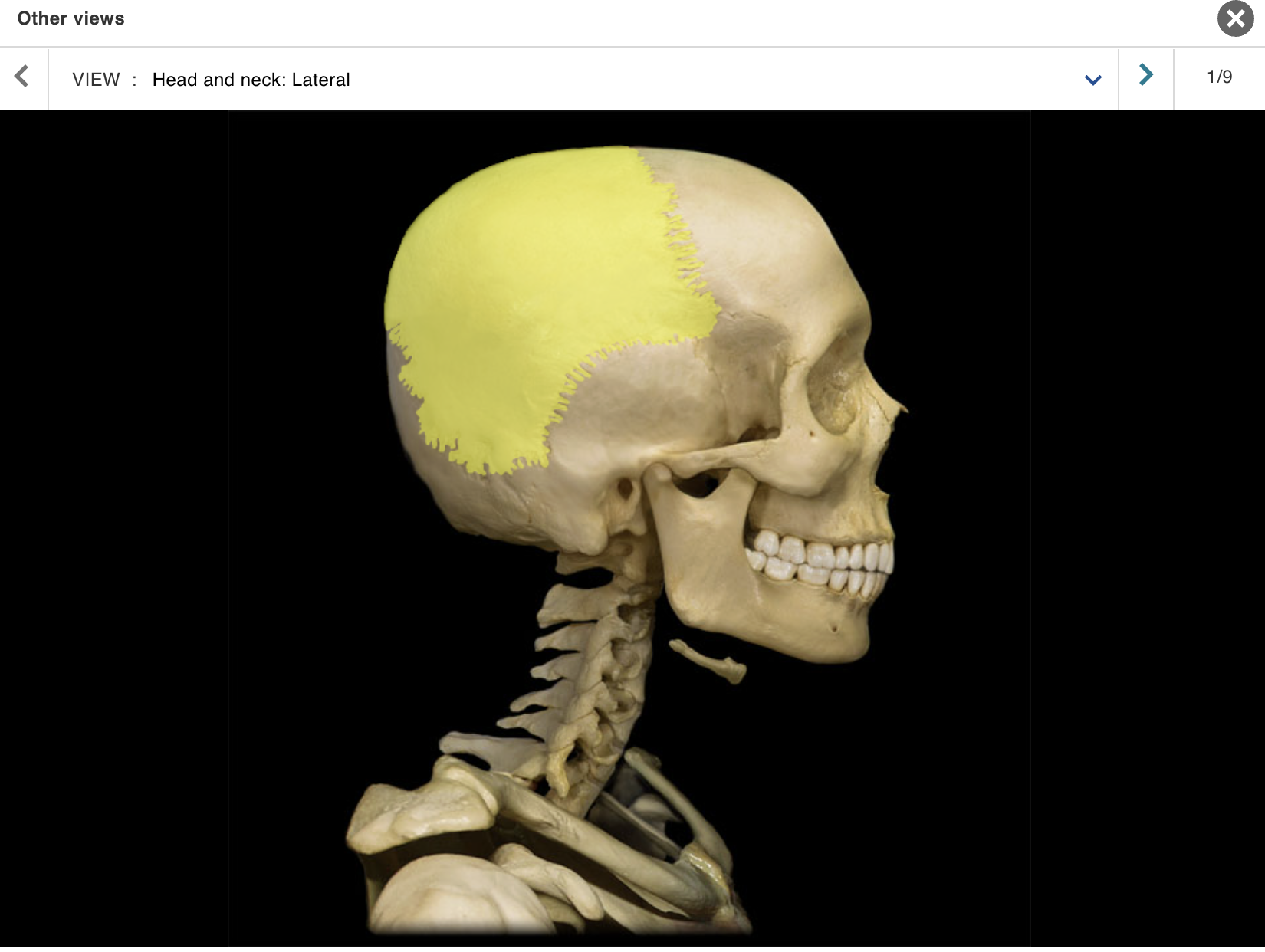
<p>Parietal bone</p>

Parietal bone

Location:

• Skull (lateral)

Description:

  • Paired, flat bone

  • Forms most of lateral skull

Comment:

  • Parietal bones articulate at sagittal suture (midline)

  • Articulates with frontal bone at coronal suture, occipital bone at lambdoid suture, and temporal bone at squamosal suture

<p>Location:</p><p class="p1">• Skull (lateral)</p><p class="p1">Description:</p><ul><li><p>Paired, flat bone</p></li><li><p>Forms most of lateral skull</p></li></ul><p class="p1">Comment:</p><ul><li><p>Parietal bones articulate at sagittal suture (midline)</p></li><li><p>Articulates with frontal bone at coronal suture, occipital bone at lambdoid suture, and temporal bone at squamosal suture</p></li></ul><p></p>
27
New cards
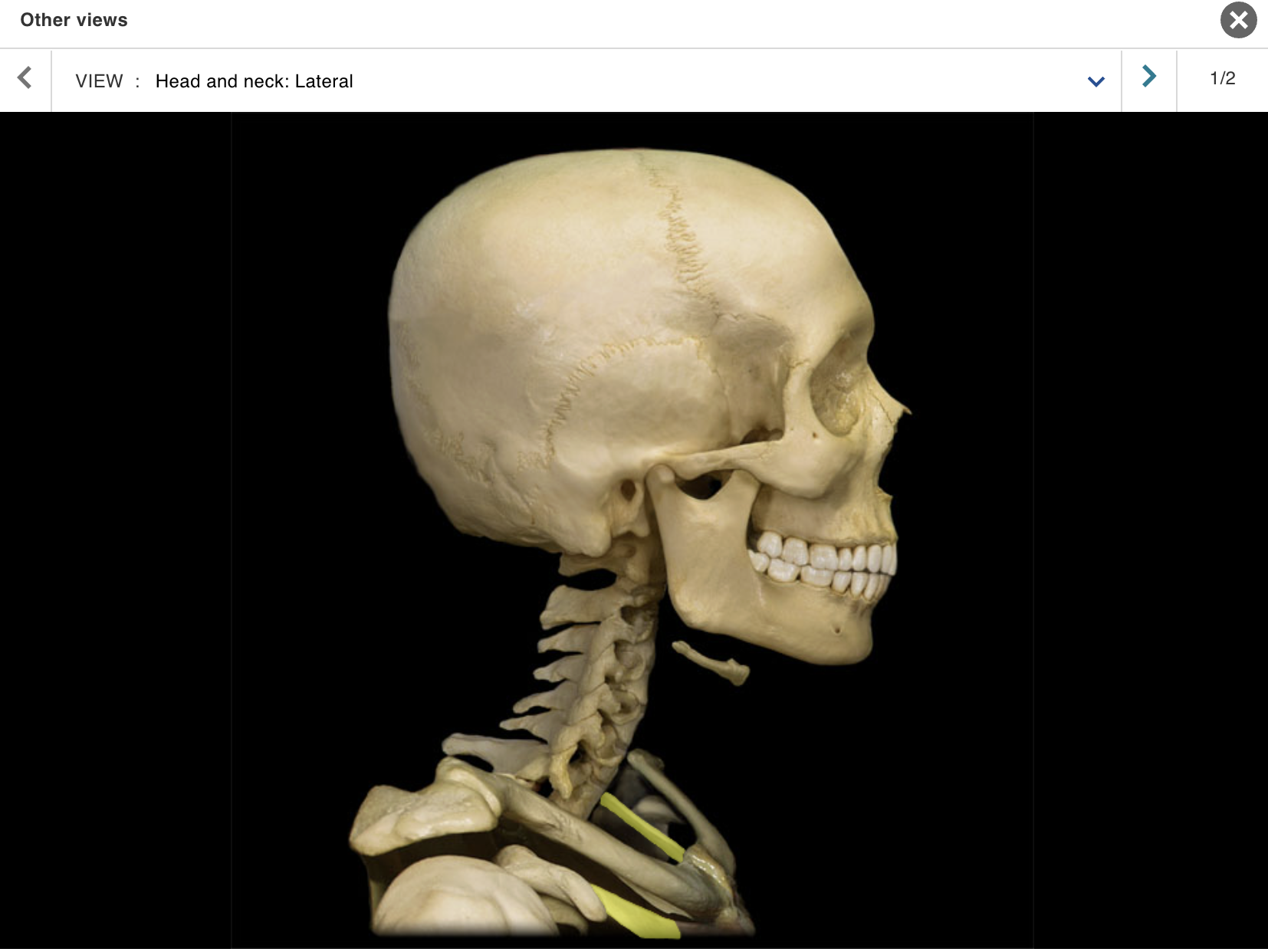
<p>Rib 1</p>

Rib 1

Location:

• Thorax

Description:

  • A true rib (shortest)

  • Articulates with T1 vertebra and, via its costal cartilage, with manubrium of sternum

  • Subclavian artery and vein groove superior surface

Comment:

  • All ribs: articulate with thoracic vertebra

  • True ribs (ribs 1-7): attached directly to sternum by costal cartilages

  • False ribs (ribs 8-10): attach indirectly to sternum via shared costal cartilages

  • Floating ribs (ribs 11-12): not attached to sternum

  • Alternate definition: some include the floating ribs (11-12) as a subcategory of false ribs

<p>Location:</p><p class="p1">• Thorax</p><p class="p1">Description:</p><ul><li><p>A true rib (shortest)</p></li><li><p>Articulates with T1 vertebra and, via its costal cartilage, with manubrium of sternum</p></li><li><p>Subclavian artery and vein groove superior surface</p></li></ul><p>Comment:</p><ul><li><p>All ribs: articulate with thoracic vertebra</p></li><li><p>True ribs (ribs 1-7): attached directly to sternum by costal cartilages</p></li><li><p>False ribs (ribs 8-10): attach indirectly to sternum via shared costal cartilages</p></li><li><p>Floating ribs (ribs 11-12): not attached to sternum</p></li><li><p>Alternate definition: some include the floating ribs (11-12) as a subcategory of false ribs</p></li></ul><p></p>
28
New cards
<p>Scapula</p>

Scapula

Location:

  • Posterior thorax

  • Overlies ribs 2-7

Description:

  • Large, triangular, flat bone

  • Characteristic features include spine, acromion, coracoid process, and glenoid cavity

<p>Location:</p><ul><li><p>Posterior thorax</p></li><li><p>Overlies ribs 2-7</p></li></ul><p class="p1">Description:</p><ul><li><p>Large, triangular, flat bone</p></li><li><p>Characteristic features include spine, acromion, coracoid process, and glenoid cavity</p></li></ul><p></p>
29
New cards
<p>Temporal bone</p>

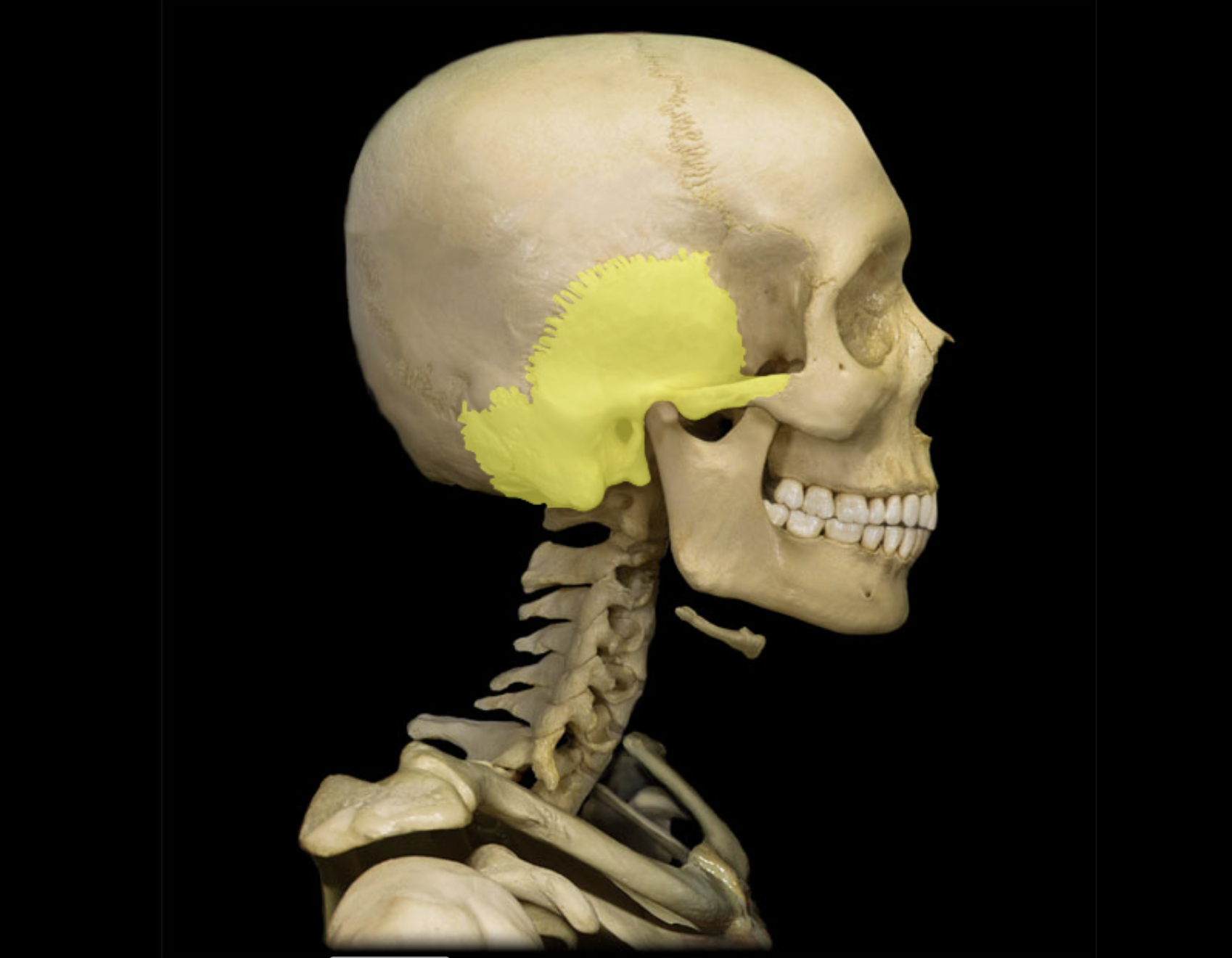
Temporal bone

Location:

• Skull (lateral and inferior)

Description:

  • Paired, irregular-shaped, flat bone

  • Consists of squamous, petrous, mastoid, and tympanic parts

Comment:

  • Forms part of lateral skull (temple)

  • Forms inferior and lateral walls of middle cranial fossa

  • Articulates with sphenoid bone at sphenosquamosal suture, occipital bone at lambdoid suture, and parietal bone at squamosal suture

  • Has mandibular fossa that forms temporomandibular joint with head of mandible

  • Forms zygomatic process that forms zygomatic arch with temporal process of zygomatic bone

<p>Location:</p><p class="p1">• Skull (lateral and inferior)</p><p class="p1">Description:</p><ul><li><p>Paired, irregular-shaped, flat bone</p></li><li><p>Consists of squamous, petrous, mastoid, and tympanic parts</p></li></ul><p>Comment:</p><ul><li><p>Forms part of lateral skull (temple)</p></li><li><p>Forms inferior and lateral walls of middle cranial fossa</p></li><li><p>Articulates with sphenoid bone at sphenosquamosal suture, occipital bone at lambdoid suture, and parietal bone at squamosal suture</p></li><li><p>Has mandibular fossa that forms temporomandibular joint with head of mandible</p></li><li><p>Forms zygomatic process that forms zygomatic arch with temporal process of zygomatic bone</p></li></ul><p></p>
30
New cards
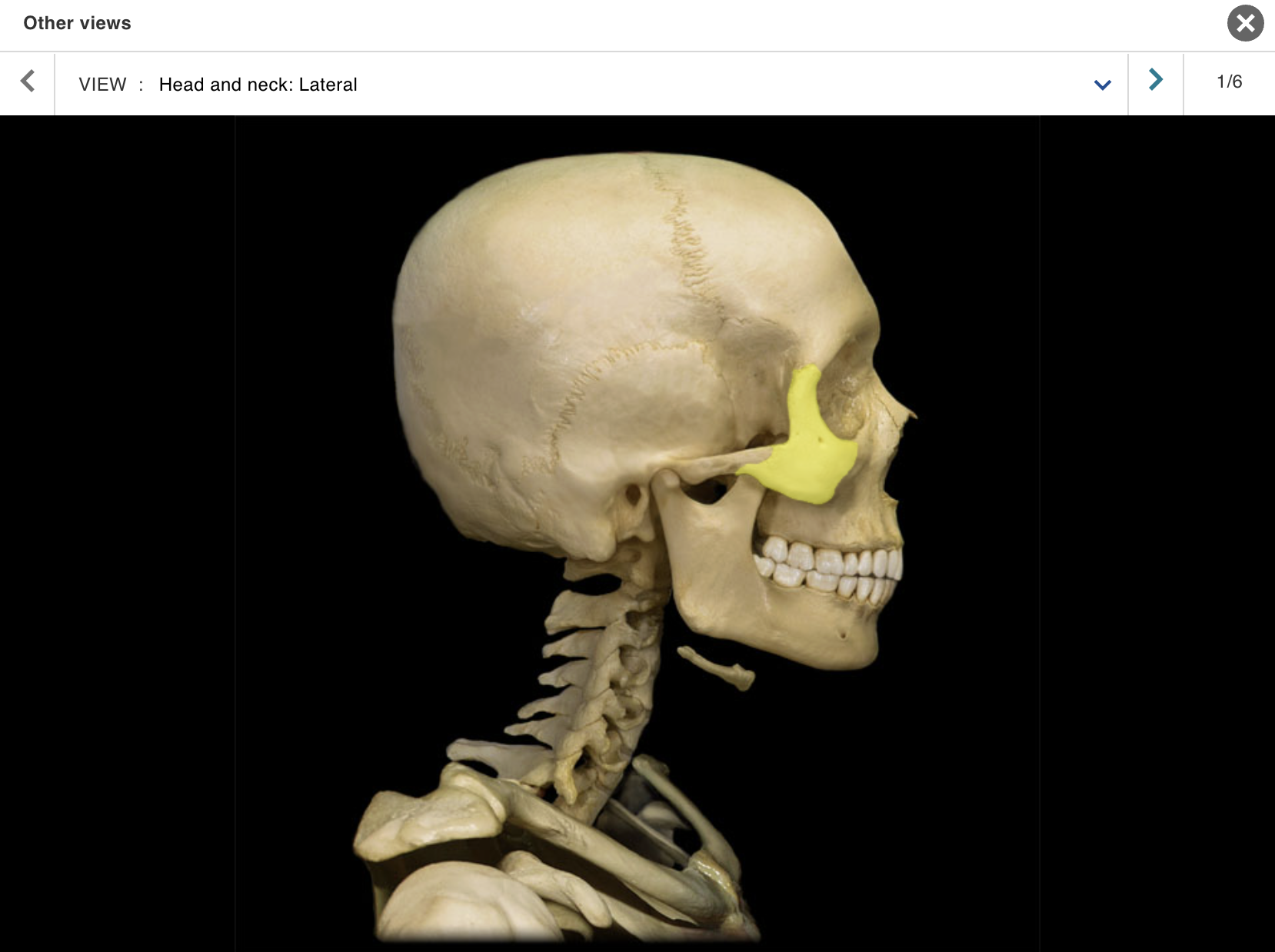
<p>Zygomatic bone</p>

Zygomatic bone

Location:

• Skull (anterior and lateral)

Description:

  • Paired, irregular-shaped bone

  • Temporal process contributes to zygomatic arch

Also known as:

• "Cheekbone"

Comment:

• Forms part of floor and lateral wall of orbit

<p>Location:</p><p class="p1">• Skull (anterior and lateral)</p><p class="p1">Description:</p><ul><li><p>Paired, irregular-shaped bone</p></li><li><p>Temporal process contributes to zygomatic arch</p></li></ul><p class="p1">Also known as:</p><p class="p1">• "Cheekbone"</p><p class="p1">Comment:</p><p class="p1">• Forms part of floor and lateral wall of orbit</p>
31
New cards

SKELETAL

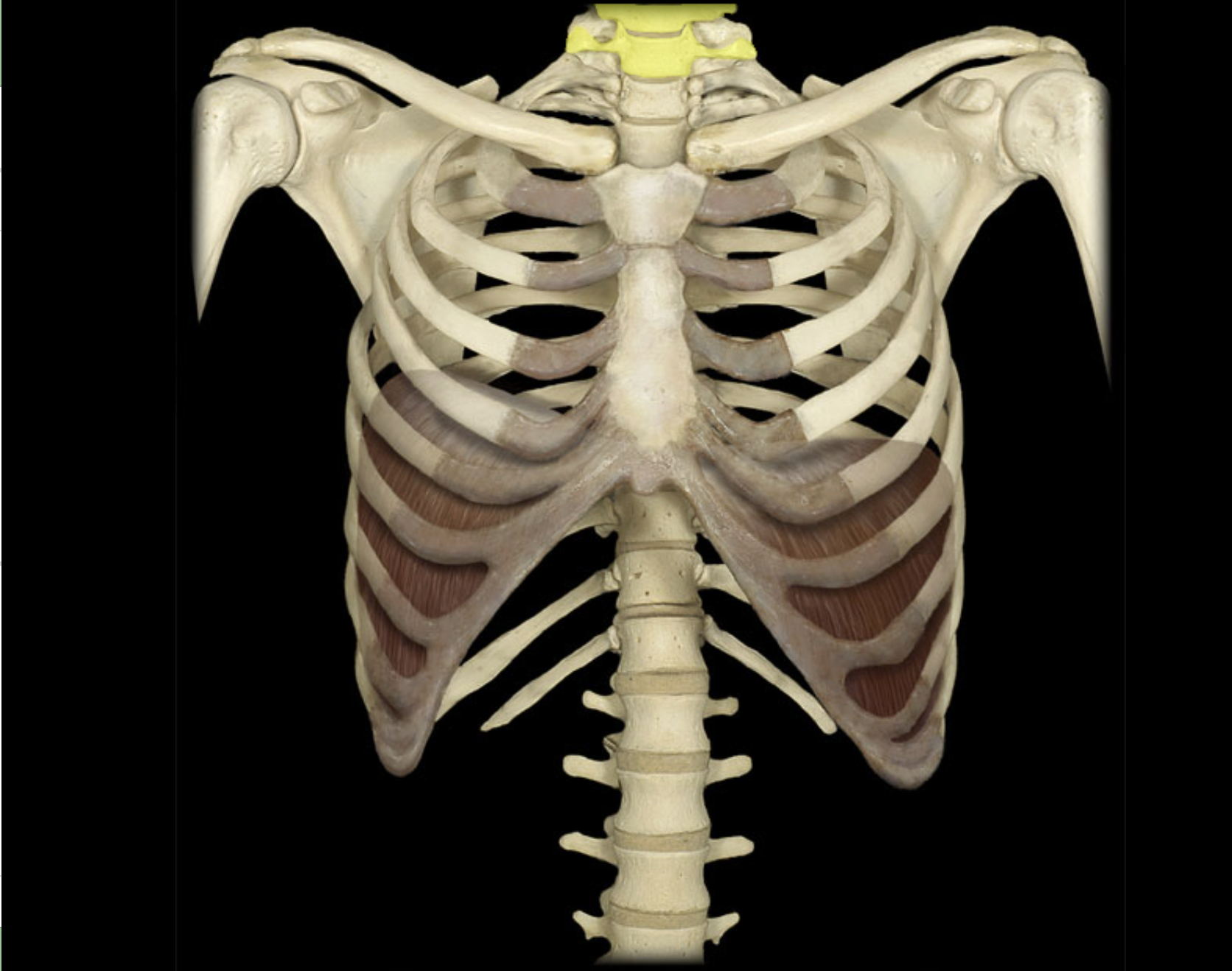
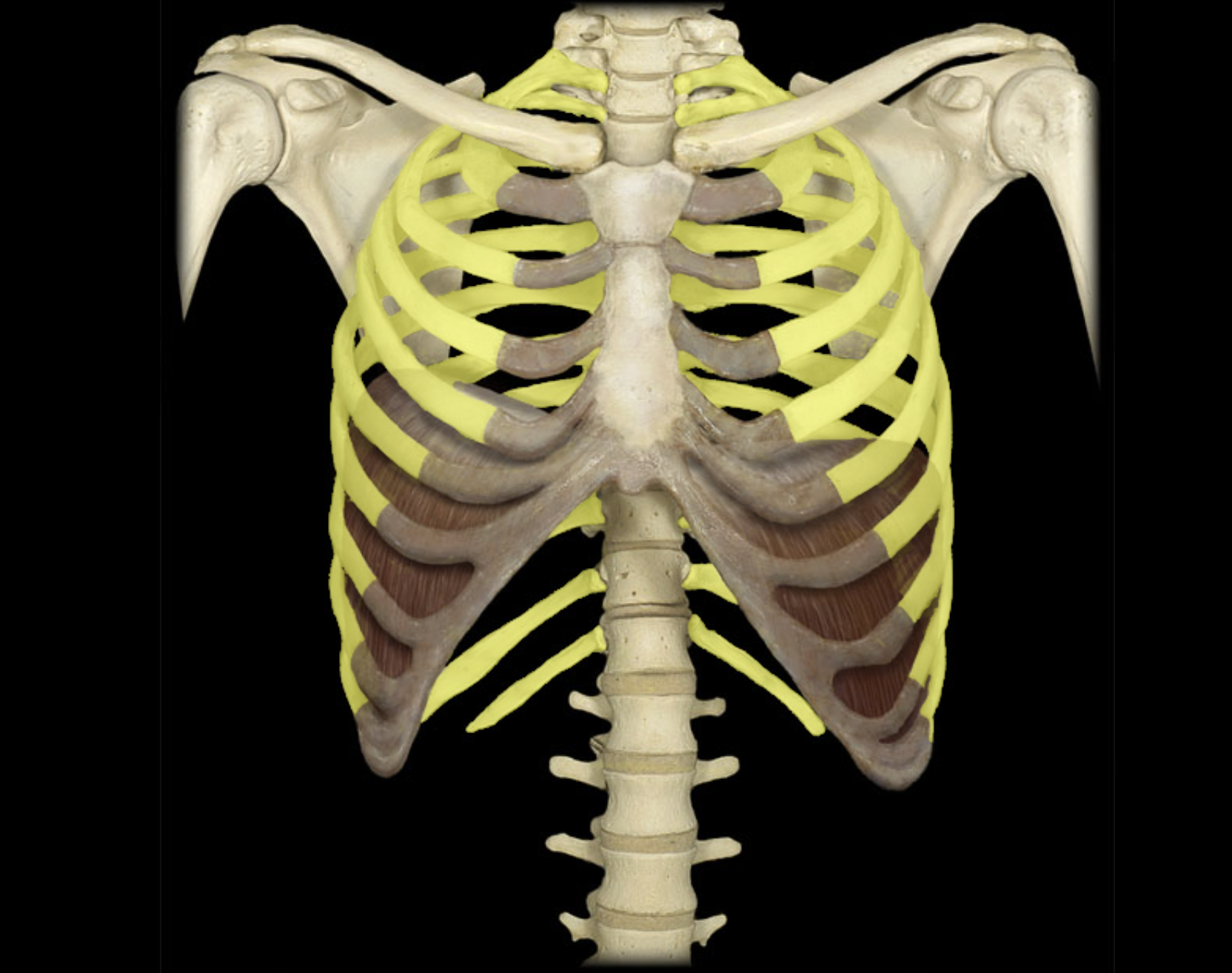
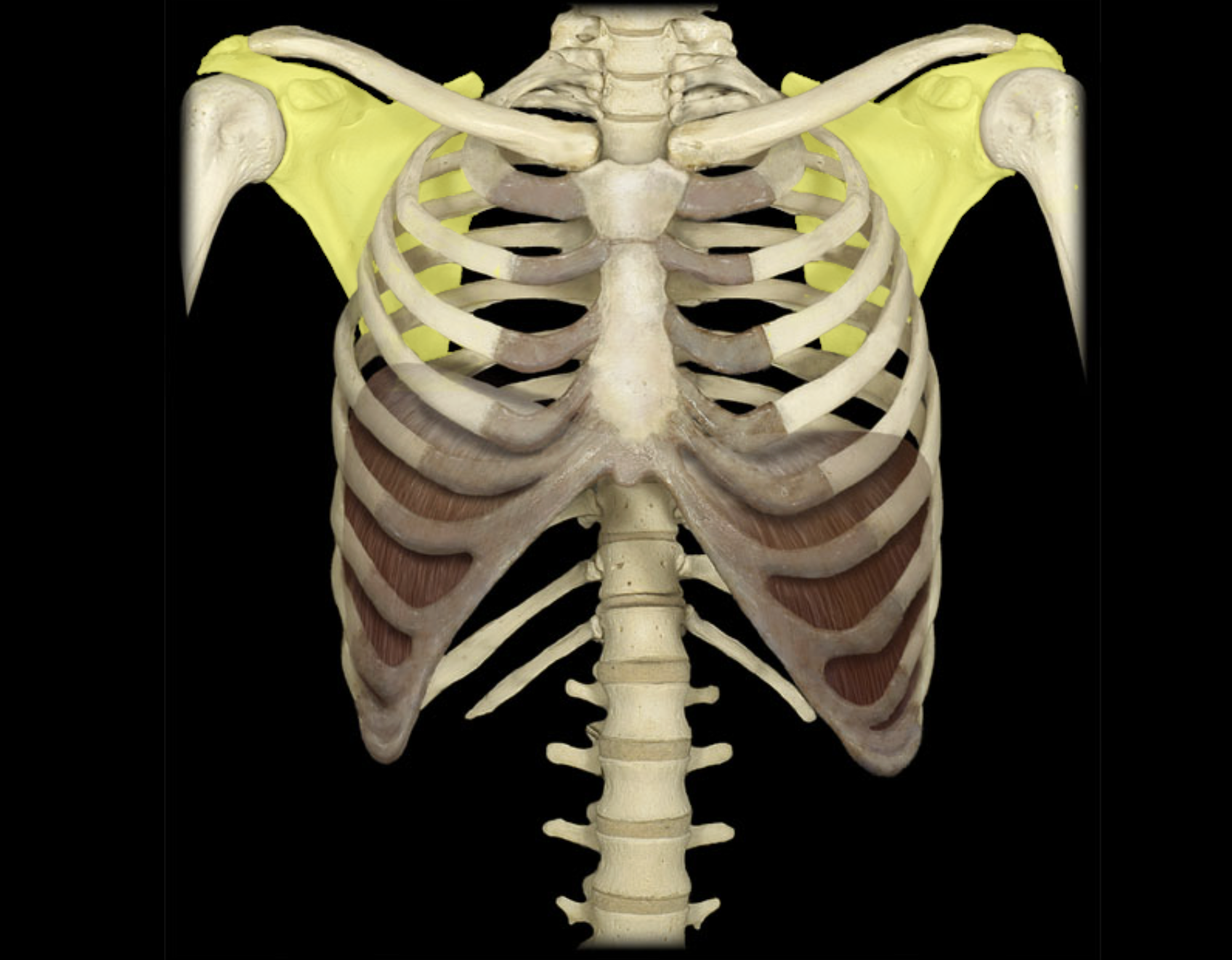
TOPIC: THORAX / VIEW : ANTERIOR

Cervical vertebra

Clavicle

Costal cartilages

Humerus

Intervertebral disc

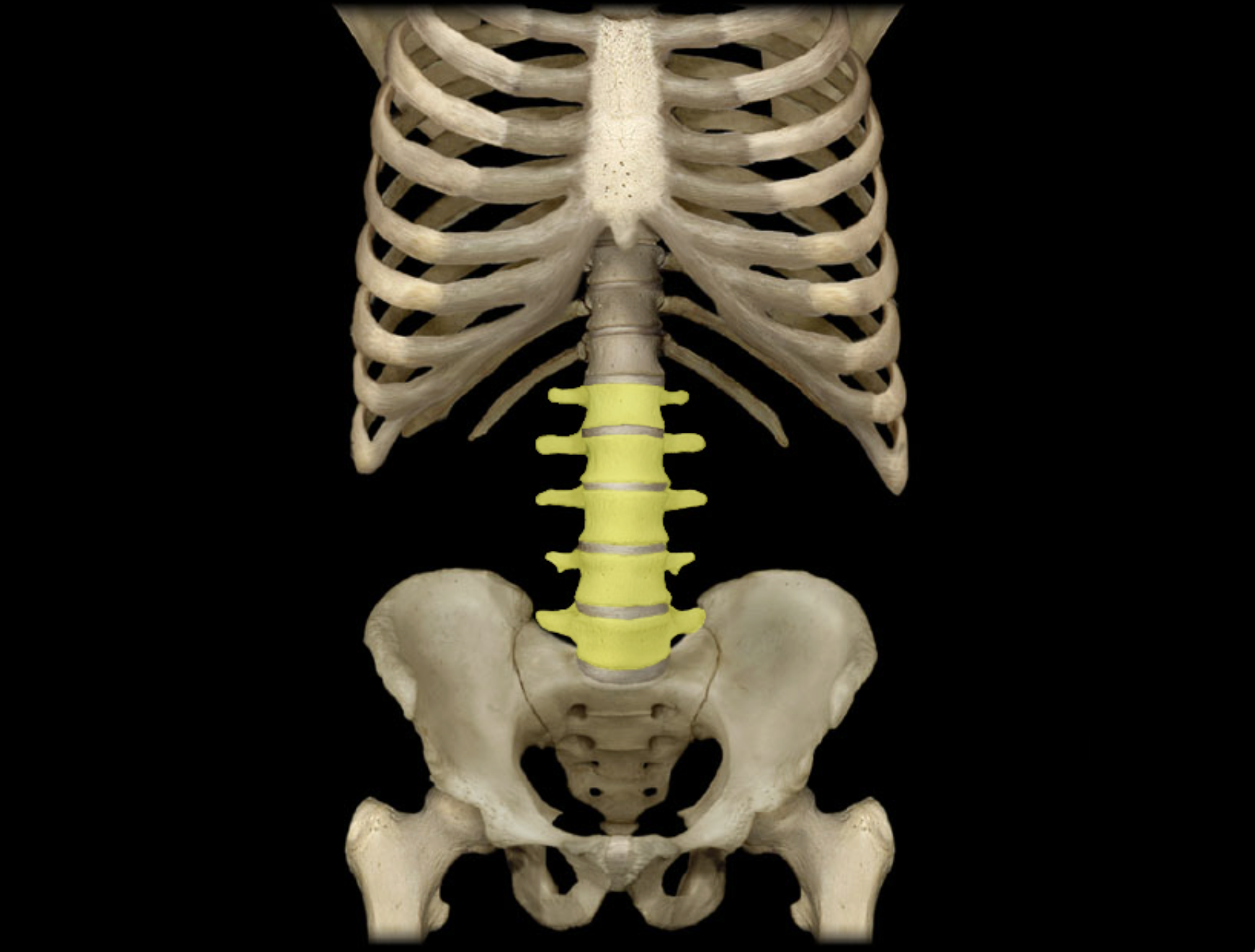
Lumbar vertebra

Manubrium

Ribs 1 - 12

Scapula

Sternum

Thoracic vertebra

32
New cards
<p>Cervical vertebra</p>

Cervical vertebra

Location:

  • Neck

  • Between occipital bone and T1 vertebra

Description:

  • Seven individual vertebrae

  • Characteristic features include transverse foramen and bifid
    (split) spinous process on C3-C6

Comment:

• Atlas (C1 vertebra) articulates with skull

<p>Location:</p><ul><li><p>Neck</p></li><li><p>Between occipital bone and T1 vertebra</p></li></ul><p class="p1">Description:</p><ul><li><p>Seven individual vertebrae</p></li><li><p>Characteristic features include transverse foramen and bifid<br>(split) spinous process on C3-C6</p></li></ul><p class="p1">Comment:</p><p class="p1">• Atlas (C1 vertebra) articulates with skull</p>
33
New cards
<p>Clavicle</p>

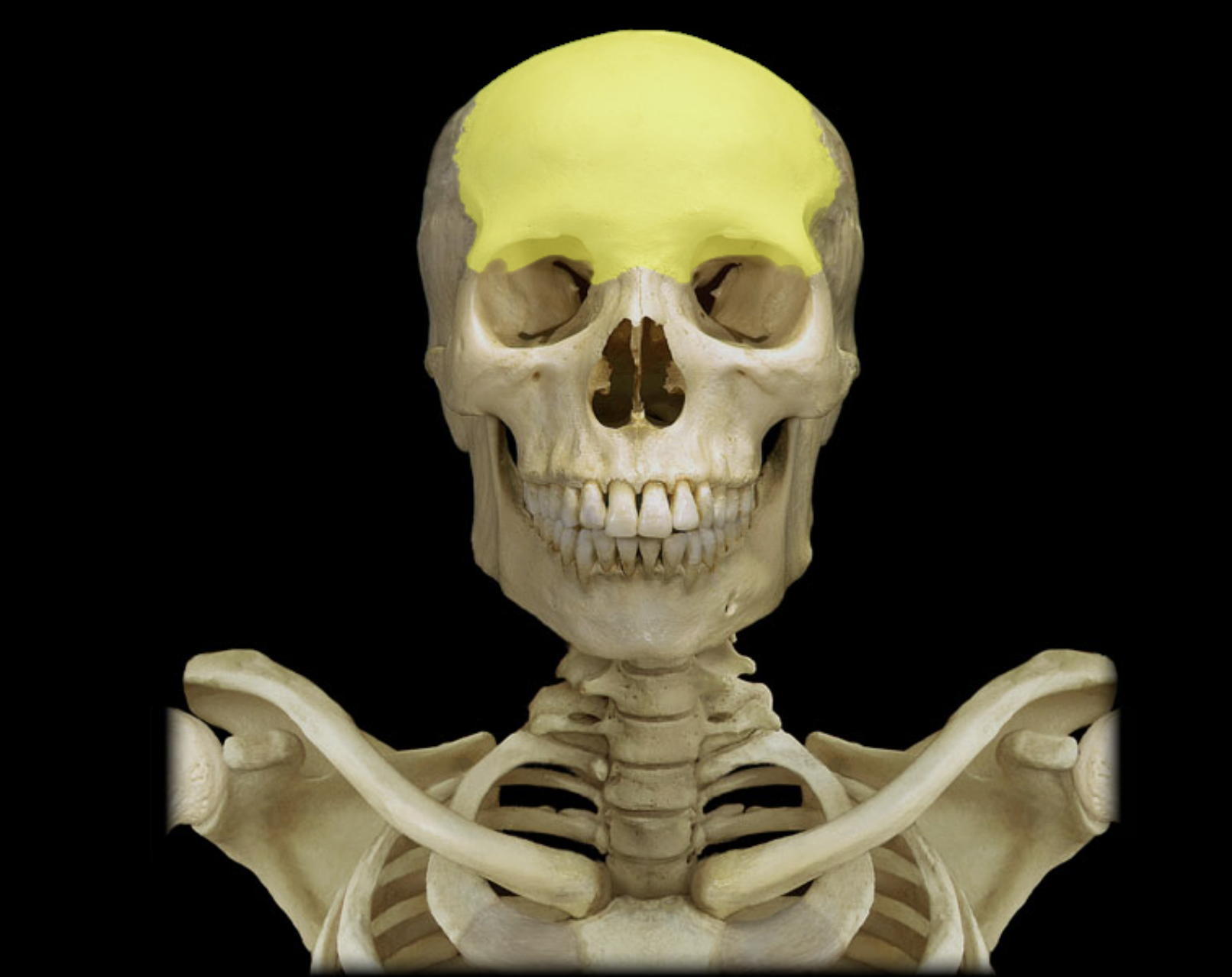
Clavicle

Location:

• Junction of neck and anterior thorax

Description:

  • Subcutaneous, S-shaped bone

  • Medial end articulates with sternum at sternoclavicular joint

  • Lateral end articulates with acromion of scapula at acromioclavicular joint

Also known as:

• "Collar bone"
<p>Location:</p><p class="p1">• Junction of neck and anterior thorax</p><p class="p1">Description:</p><ul><li><p>Subcutaneous, S-shaped bone</p></li><li><p>Medial end articulates with sternum at sternoclavicular joint</p></li><li><p>Lateral end articulates with acromion of scapula at acromioclavicular joint</p></li></ul><p class="p1">Also known as:</p><p class="p1">• "Collar bone"</p>
34
New cards
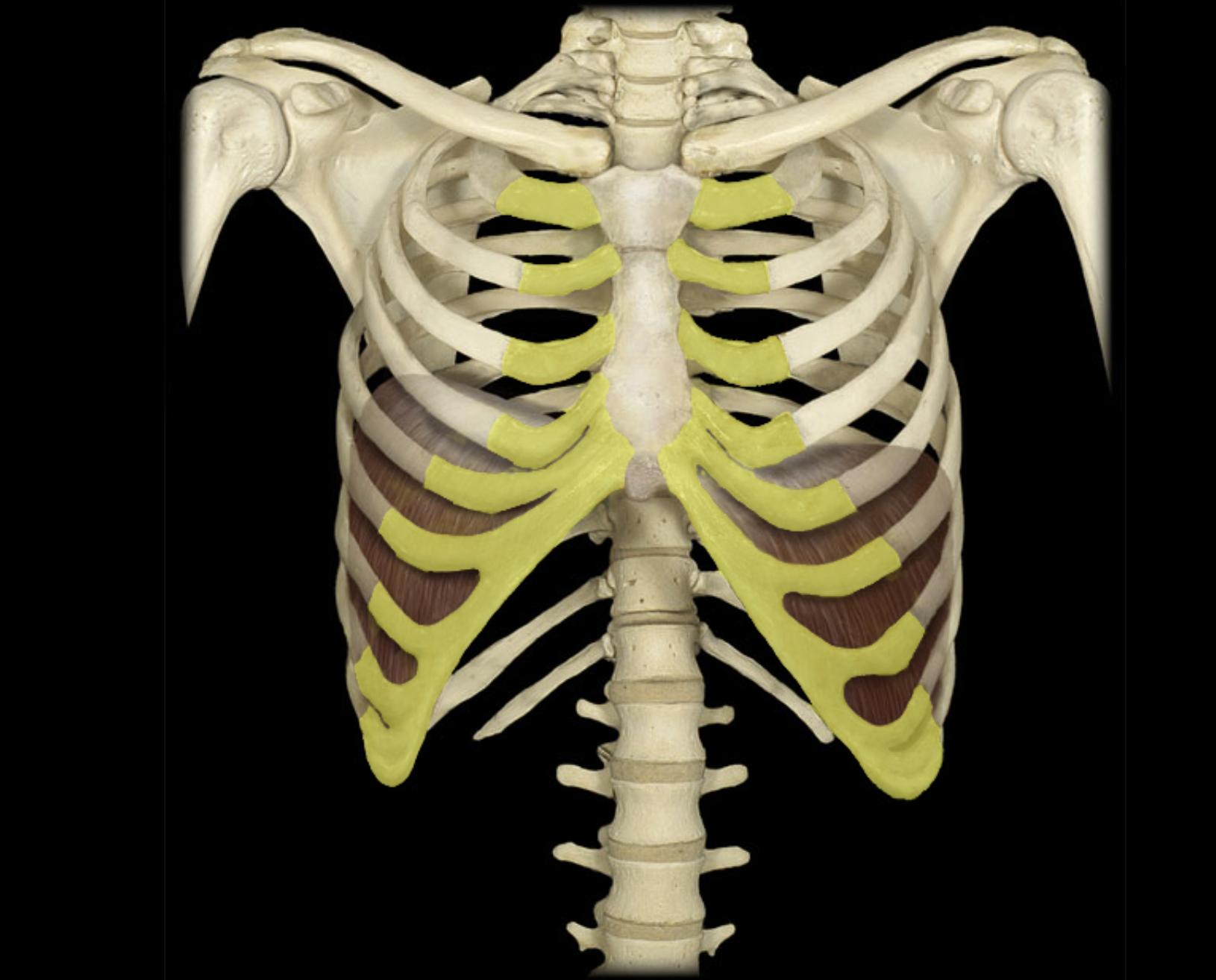
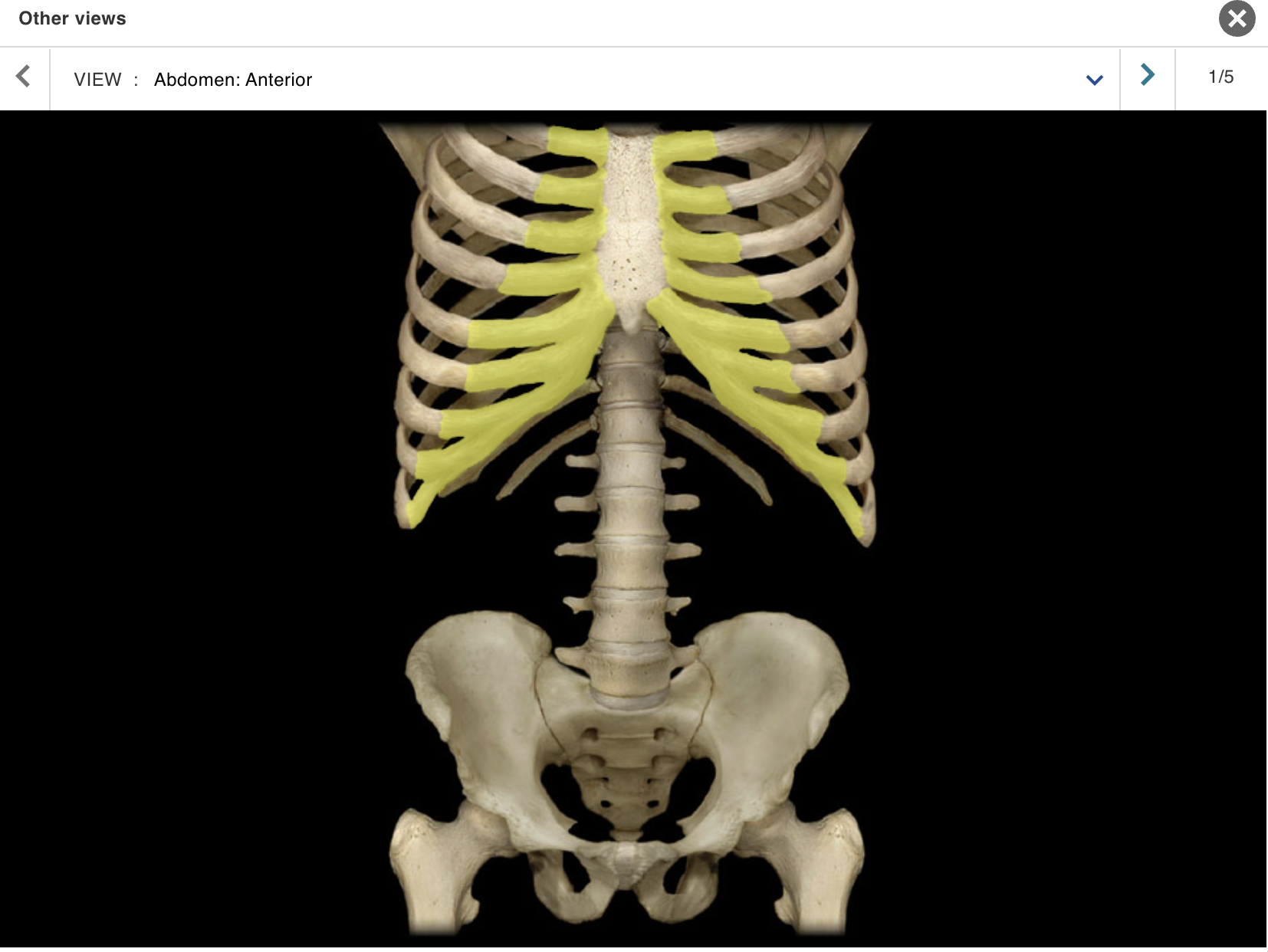
<p>Costal cartilages</p>

Costal cartilages

Location:

• Thorax

Description:

  • Attaches rib to sternum

  • True ribs (ribs 1-7): attached directly to sternum by costal cartilages

  • False ribs (ribs 8-10): attach indirectly to sternum via a shared costal cartilage

  • Costal margin created by costal cartilages of ribs 7-10

Comment:

  • All ribs: articulate with thoracic vertebrae

  • Floating ribs (ribs 11-12): not attached to sternum

  • Alternate definition: some include the floating ribs (11-12) as a subcategory of false ribs

<p>Location:</p><p class="p1">• Thorax</p><p class="p1">Description:</p><ul><li><p>Attaches rib to sternum</p></li><li><p>True ribs (ribs 1-7): attached directly to sternum by costal cartilages</p></li><li><p>False ribs (ribs 8-10): attach indirectly to sternum via a shared costal cartilage</p></li><li><p>Costal margin created by costal cartilages of ribs 7-10</p></li></ul><p>Comment:</p><ul><li><p>All ribs: articulate with thoracic vertebrae</p></li><li><p>Floating ribs (ribs 11-12): not attached to sternum</p></li><li><p>Alternate definition: some include the floating ribs (11-12) as a subcategory of false ribs</p></li></ul><p></p>
35
New cards
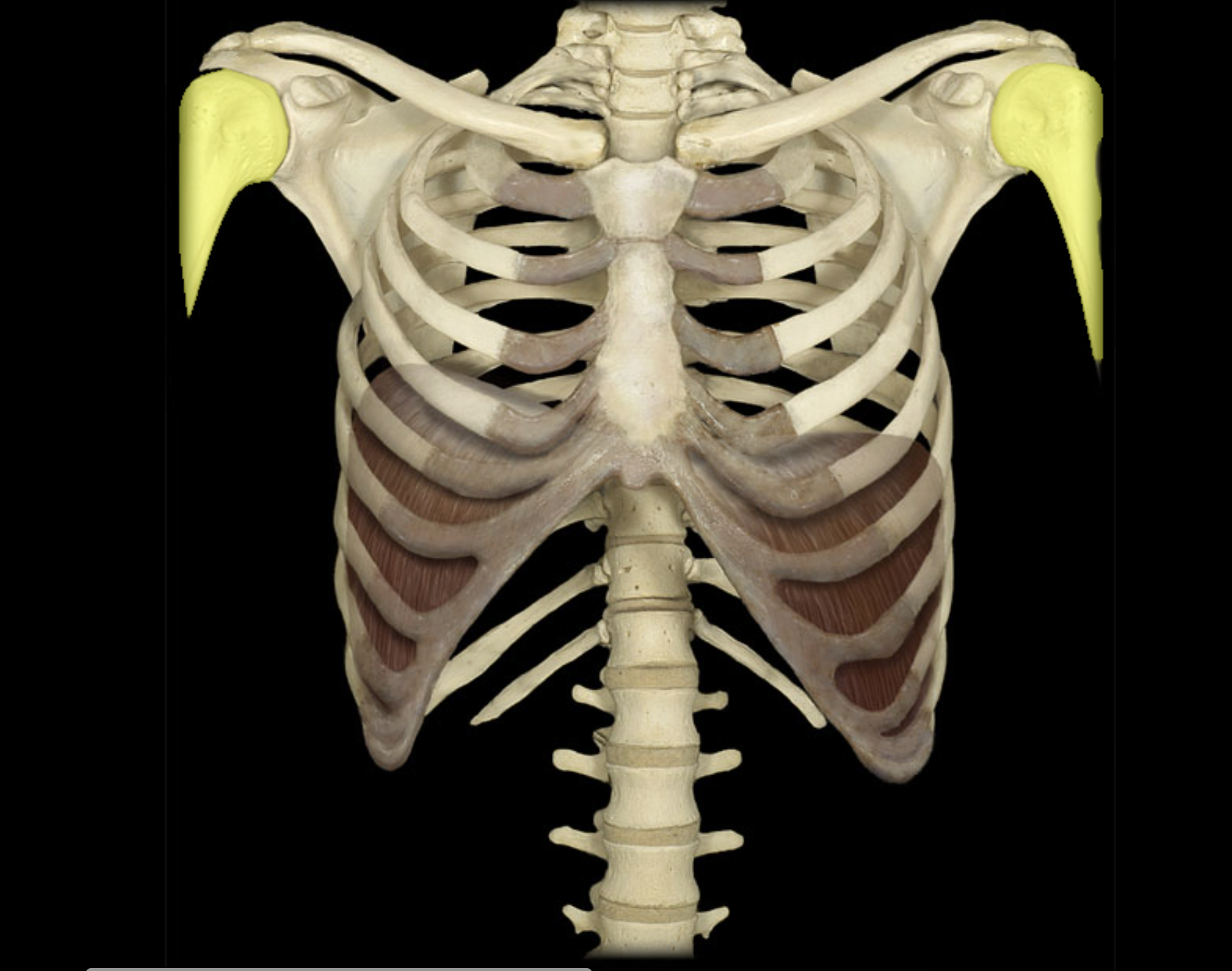
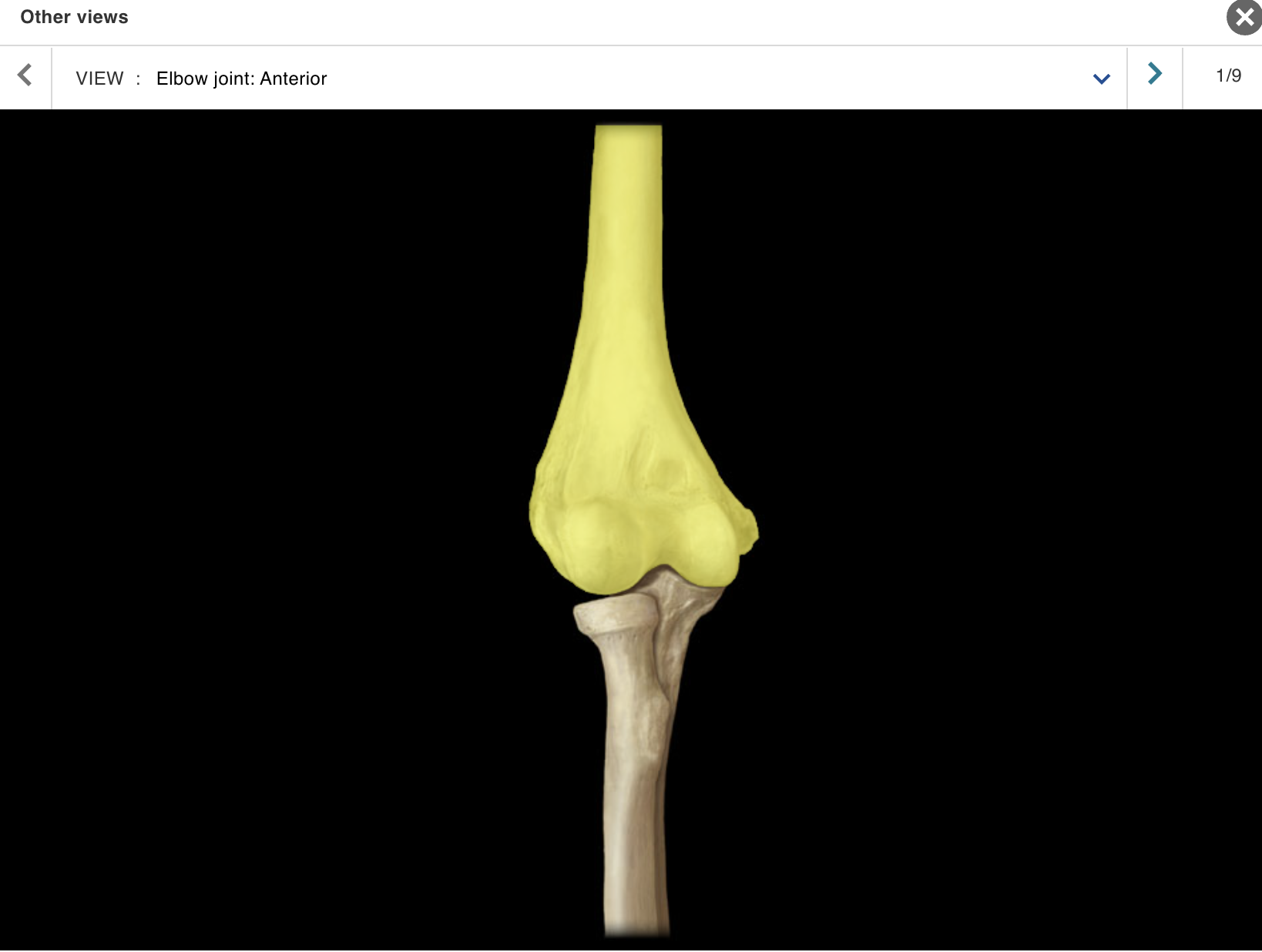
<p>Humerus</p>

Humerus

Location:

• Arm

Description:

  • Long bone

  • Characteristic features include head, neck, greater and lesser tubercles, shaft, medial and lateral epicondyles, capitulum, and trochlea

Comment:

• Largest bone of upper limb

<p>Location:</p><p class="p1">• Arm</p><p class="p1">Description:</p><ul><li><p>Long bone</p></li><li><p>Characteristic features include head, neck, greater and lesser tubercles, shaft, medial and lateral epicondyles, capitulum, and trochlea</p></li></ul><p class="p1">Comment:</p><p class="p1">• Largest bone of upper limb</p>
36
New cards
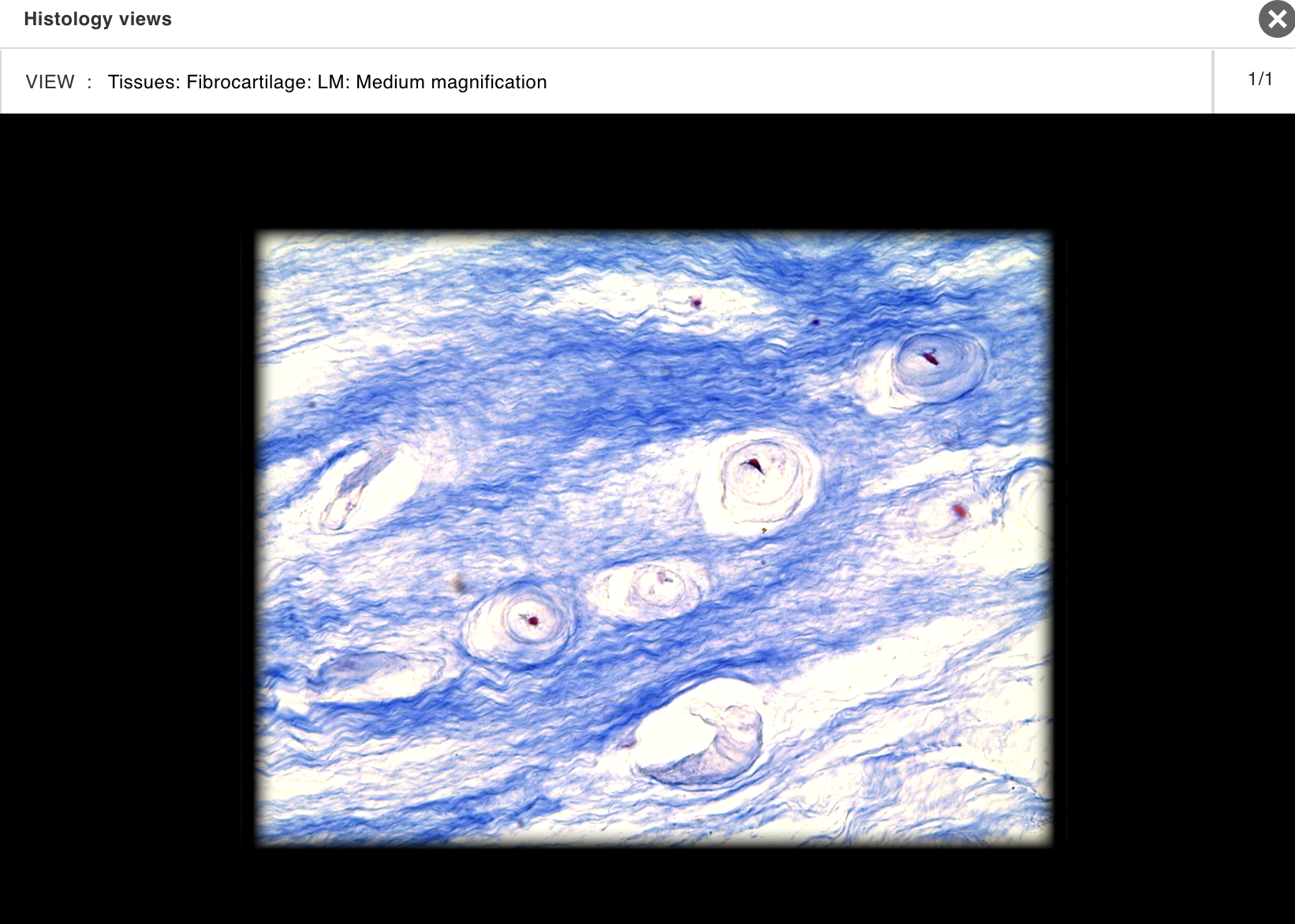
<p>Intervertebral disc</p>

Intervertebral disc

Location:

• Between vertebral bodies (C2 to S1)

Description:

  • Outer part: anulus fibrosus consisting of a fibrocartilage ring

  • Inner part: nucleus pulposus composed of mucoid material

Comment:

• No disk between atlas (C1 vertebra) and axis (C2 vertebra)

<p>Location:</p><p class="p1">• Between vertebral bodies (C2 to S1)</p><p class="p1">Description:</p><ul><li><p>Outer part: anulus fibrosus consisting of a fibrocartilage ring</p></li><li><p>Inner part: nucleus pulposus composed of mucoid material</p></li></ul><p class="p1">Comment:</p><p class="p1">• No disk between atlas (C1 vertebra) and axis (C2 vertebra)</p>
37
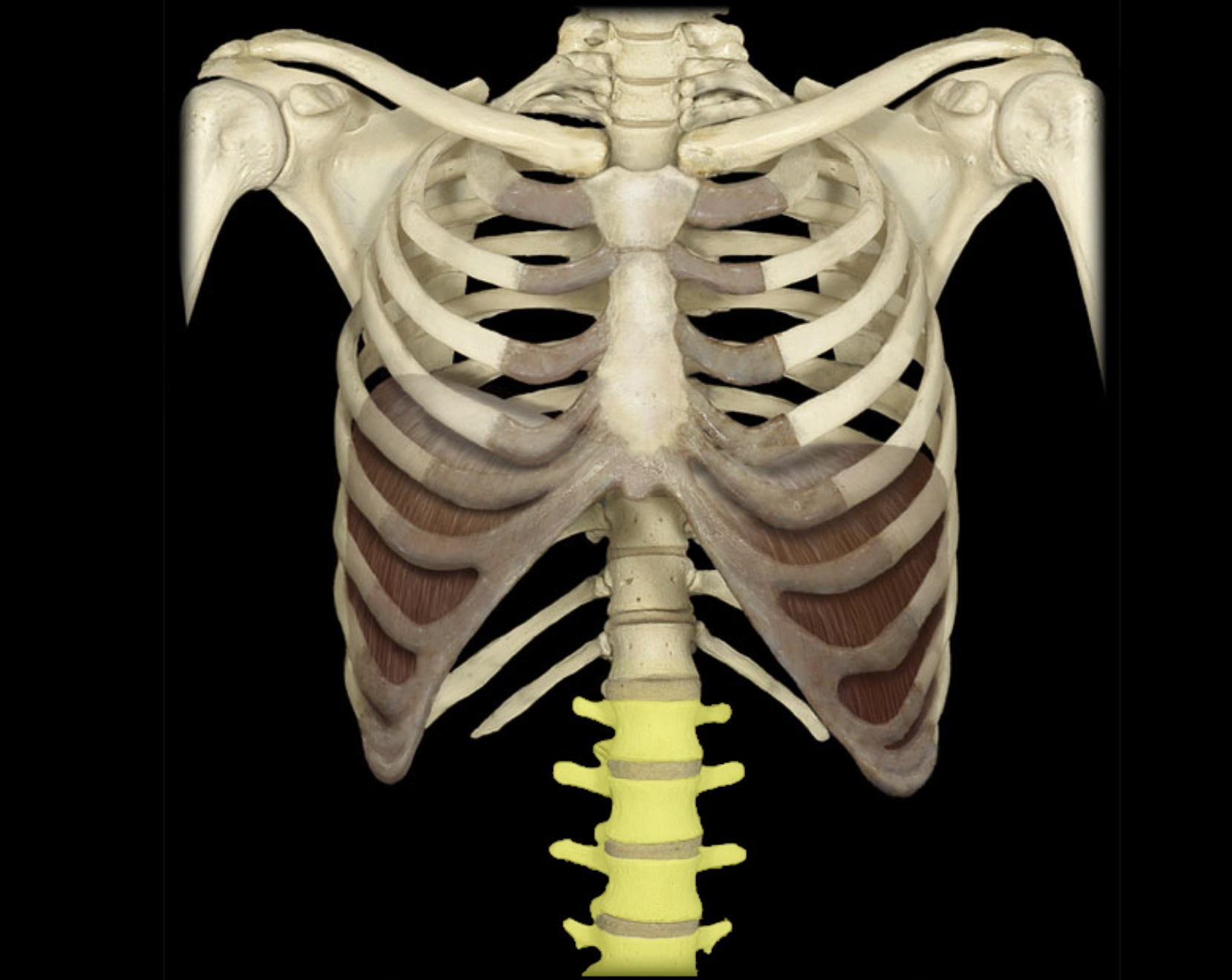
New cards
<p>Lumbar vertebra</p>

Lumbar vertebra

Location:

  • Lower back

  • Between T12 and S1 vertebrae

Description:

  • Five individual vertebrae

  • Characteristic features include large size, kidney bean-shaped body, and a thick, blunt spinous process

Comment:

  • Bodies arranged to form prominent anterior convexity (lumbar curvature; also Known as lumbar lordosis, which can be accentuated pathologically)

  • Intervertebral discs between lumbar vertebrae most commonly herniate ("slipped-disk")

<p>Location:</p><ul><li><p>Lower back</p></li><li><p>Between T12 and S1 vertebrae</p></li></ul><p class="p1">Description:</p><ul><li><p>Five individual vertebrae</p></li><li><p>Characteristic features include large size, kidney bean-shaped body, and a thick, blunt spinous process</p></li></ul><p>Comment:</p><ul><li><p>Bodies arranged to form prominent anterior convexity (lumbar curvature; also Known as lumbar lordosis, which can be accentuated pathologically)</p></li><li><p>Intervertebral discs between lumbar vertebrae most commonly herniate ("slipped-disk")</p></li></ul><p></p>
38
New cards
<p>Manubrium</p>

Manubrium

Location:

• Sternum

Description:

  • Triangular shape

  • Superior part of sternum

  • Articulates with costal cartilages of ribs 1-2 and clavicles

Comment:

• Provides attachment for sternocleidomastoid and pectoralis major muscles

<p>Location:</p><p class="p1">• Sternum</p><p class="p1">Description:</p><ul><li><p>Triangular shape</p></li><li><p>Superior part of sternum</p></li><li><p>Articulates with costal cartilages of ribs 1-2 and clavicles</p></li></ul><p class="p1">Comment:</p><p class="p1">• Provides attachment for sternocleidomastoid and pectoralis major muscles</p>
39
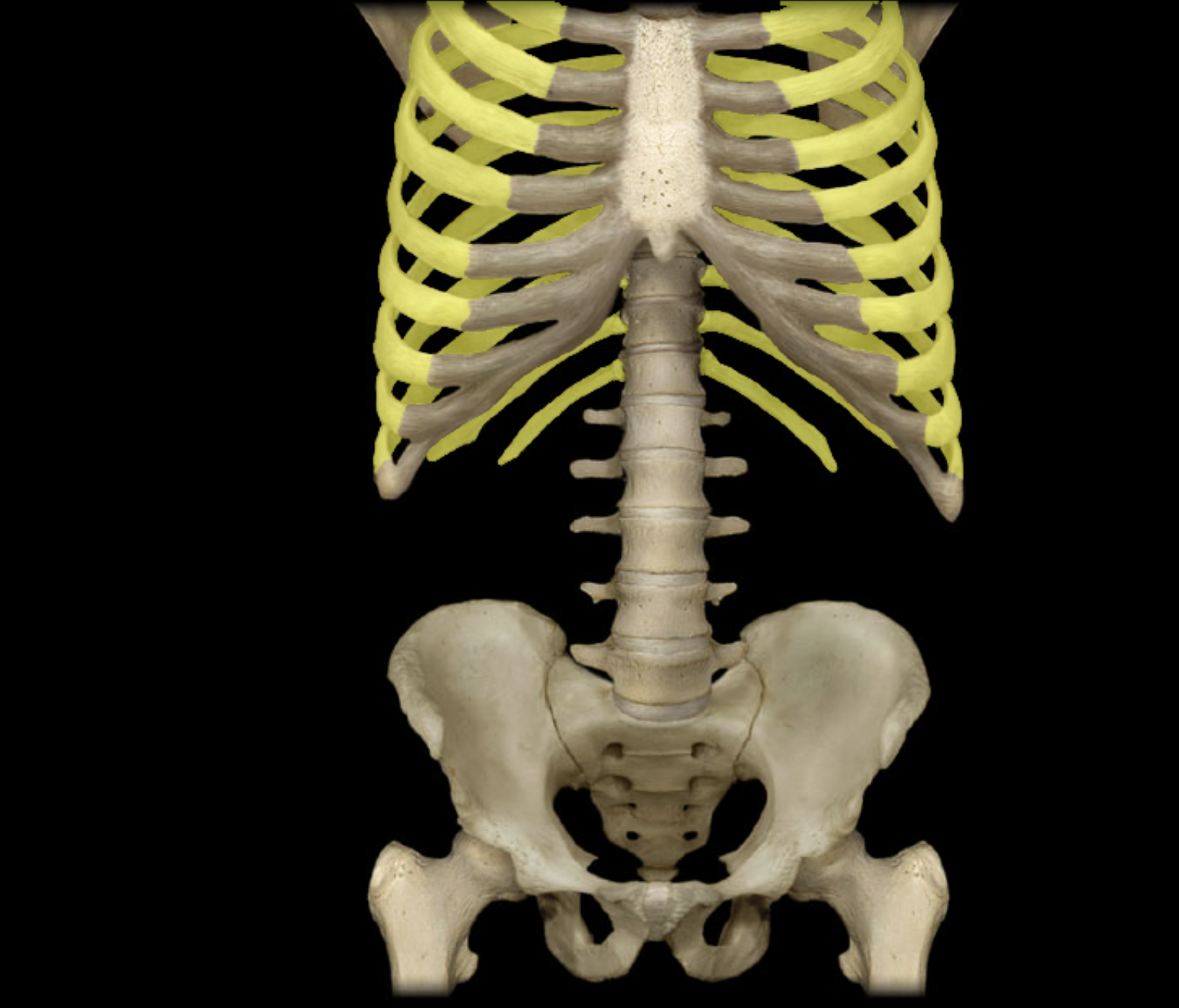
New cards
<p>Ribs 1 - 12</p>

Ribs 1 - 12

Location:

• Thorax

Description:

  • Twelve pairs of curved, flat bones

  • All ribs: articulate with thoracic vertebrae

  • True ribs (ribs 1-7): attached directly to sternum by costal cartilages

  • False ribs (ribs 8-10): attach indirectly to sternum via shared costal cartilages

  • Floating ribs (ribs 11-12): not attached to sternum

Comment:

• Alternate definition: some include the floating ribs (11-12) as a subcategory of false ribs

<p>Location:</p><p class="p1">• Thorax</p><p class="p1">Description:</p><ul><li><p>Twelve pairs of curved, flat bones</p></li><li><p>All ribs: articulate with thoracic vertebrae</p></li><li><p>True ribs (ribs 1-7): attached directly to sternum by costal cartilages</p></li><li><p>False ribs (ribs 8-10): attach indirectly to sternum via shared costal cartilages</p></li><li><p>Floating ribs (ribs 11-12): not attached to sternum</p></li></ul><p>Comment:</p><p class="p1">• Alternate definition: some include the floating ribs (11-12) as a subcategory of false ribs</p>
40
New cards
<p>Scapula</p>

Scapula

Location:

  • Posterior thorax

  • Overlies ribs 2-7

Description:

  • Large, triangular, flat bone

  • Characteristic features include spine, acromion, coracoid process, and glenoid cavity

<p>Location:</p><ul><li><p>Posterior thorax</p></li><li><p>Overlies ribs 2-7</p></li></ul><p class="p1">Description:</p><ul><li><p>Large, triangular, flat bone</p></li><li><p>Characteristic features include spine, acromion, coracoid process, and glenoid cavity</p></li></ul><p></p>
41
New cards
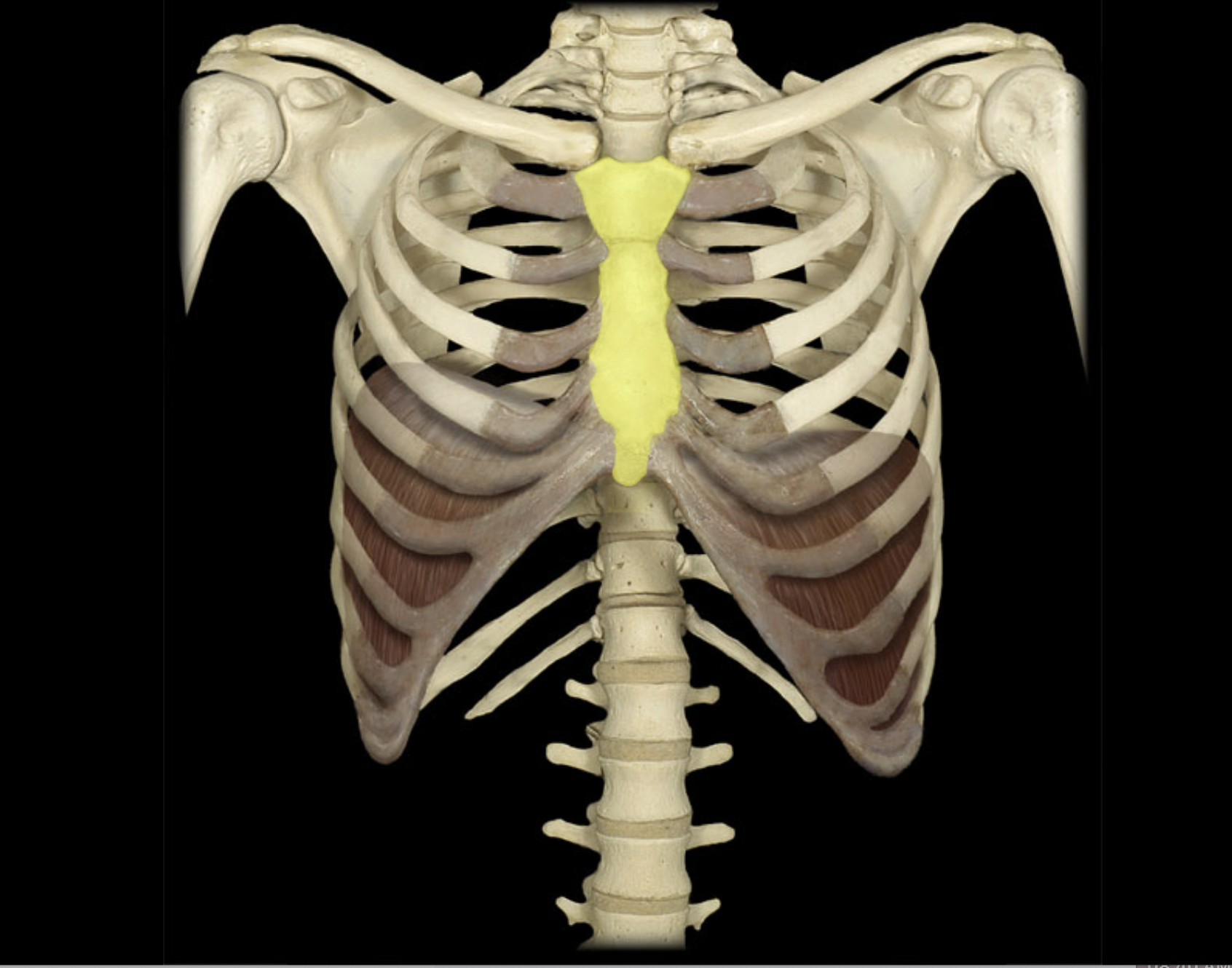
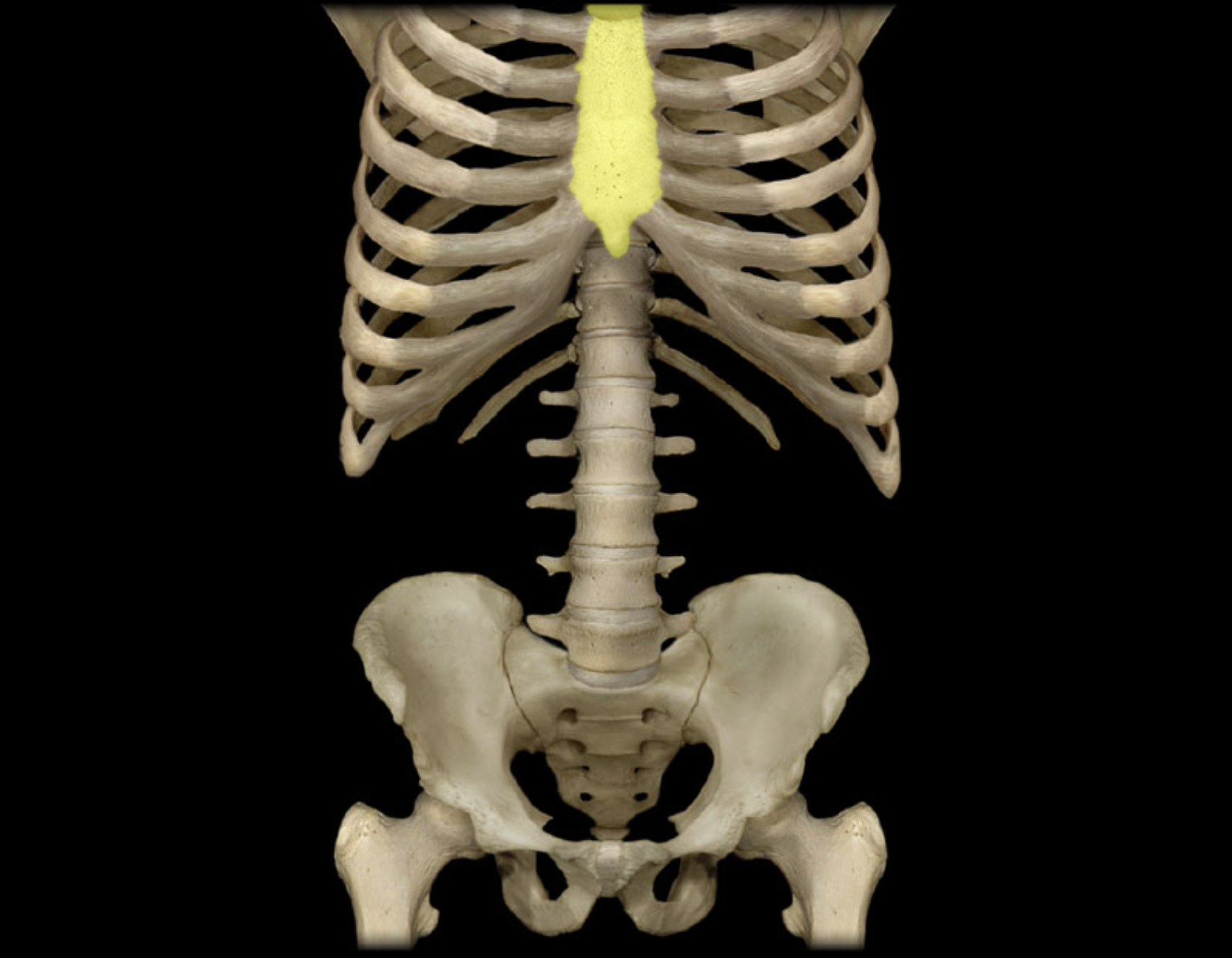
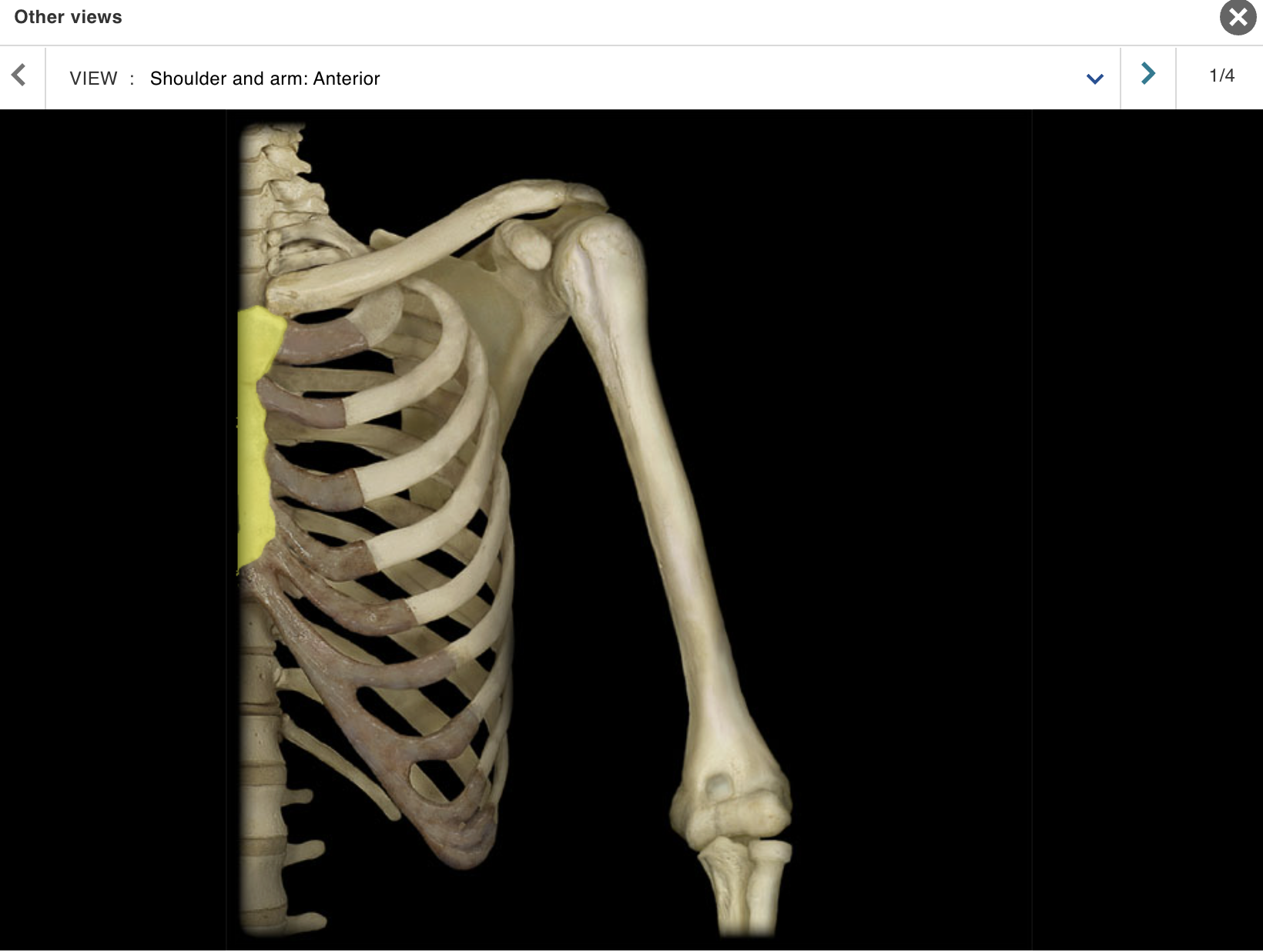
<p>Sternum</p>

Sternum

Location:

• Thorax (anterior midline)

Description:

  • Flat bone with three parts: manubrium, body, and xiphoid
    process

  • Characteristic features include jugular notch and sternal angle (angle of Louis)

  • Articulates with costal cartilages of true ribs (1-7), combined costal cartilages of false ribs (8-10), and clavicles

Also known as:

• "Breastbone"

Comment:

  • Floating ribs (ribs 11-12): not attached to sternum

  • Provides for attachment of sternocleidomastoid, pectoralis major, sternohyoid, and sternothyroid muscles

<p>Location:</p><p class="p1">• Thorax (anterior midline)</p><p class="p1">Description:</p><ul><li><p>Flat bone with three parts: manubrium, body, and xiphoid<br>process</p></li><li><p>Characteristic features include jugular notch and sternal angle (angle of Louis)</p></li><li><p>Articulates with costal cartilages of true ribs (1-7), combined costal cartilages of false ribs (8-10), and clavicles</p></li></ul><p>Also known as:</p><p class="p1">• "Breastbone"</p><p class="p1">Comment:</p><ul><li><p>Floating ribs (ribs 11-12): not attached to sternum</p></li><li><p>Provides for attachment of sternocleidomastoid, pectoralis major, sternohyoid, and sternothyroid muscles</p></li></ul><p></p>
42
New cards
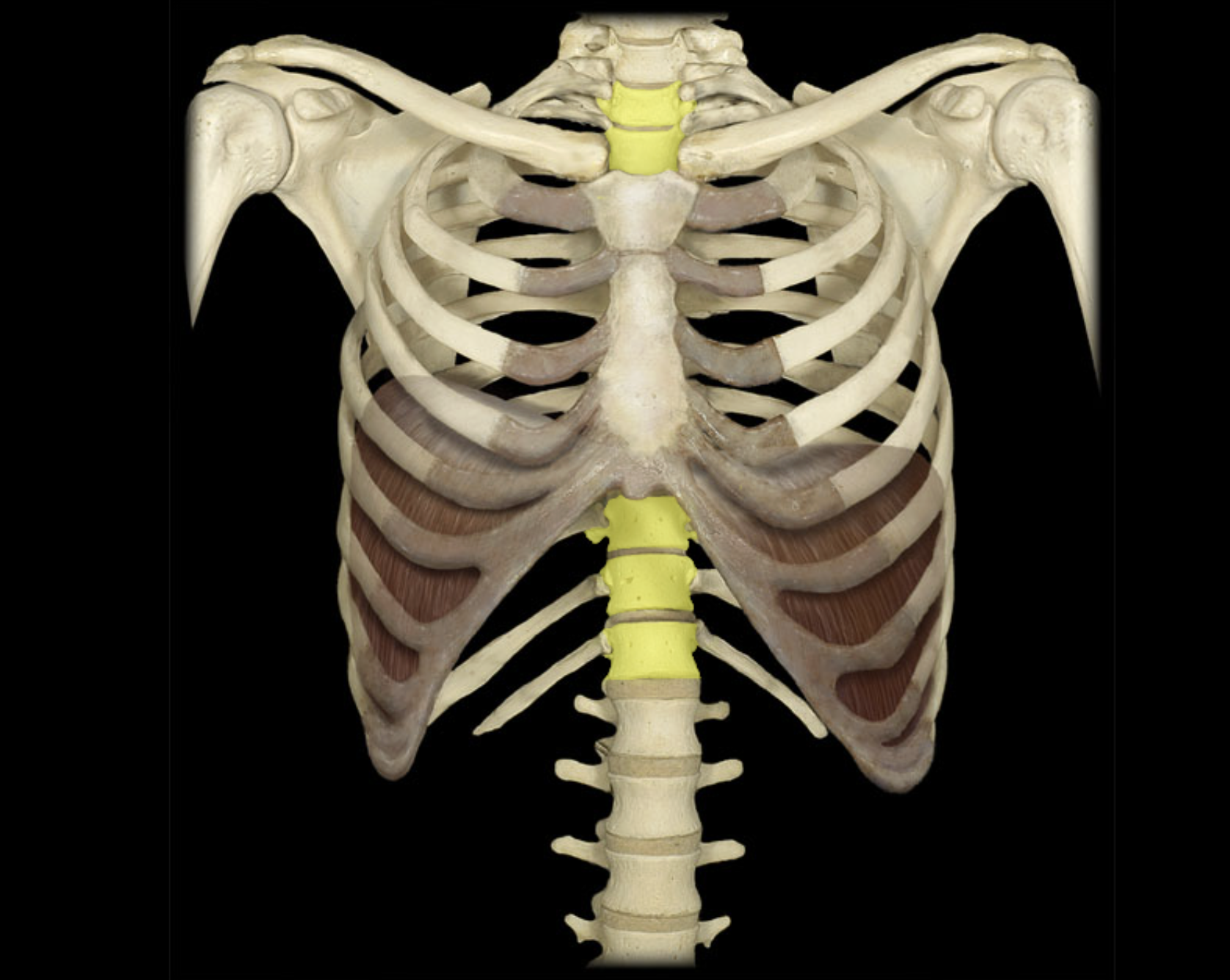
<p>Thoracic vertebra</p>

Thoracic vertebra

Location:

  • Trunk

  • Between C7 and L1 vertebrae

Description:

  • 12 individual vertebrae

  • Characteristic features include costal demifacets (or facets) for articulation with head of rib, spinous process slopes inferiorly, and heart-shaped vertebral body

<p>Location:</p><ul><li><p>Trunk</p></li><li><p>Between C7 and L1 vertebrae</p></li></ul><p class="p1">Description:</p><ul><li><p>12 individual vertebrae</p></li><li><p>Characteristic features include costal demifacets (or facets) for articulation with head of rib, spinous process slopes inferiorly, and heart-shaped vertebral body</p></li></ul><p></p>
43
New cards

ACTIVITY 4: DISSECTION

MODULE: SKELETAL

TOPIC: ABDOMEN / VIEW : ANTERIOR

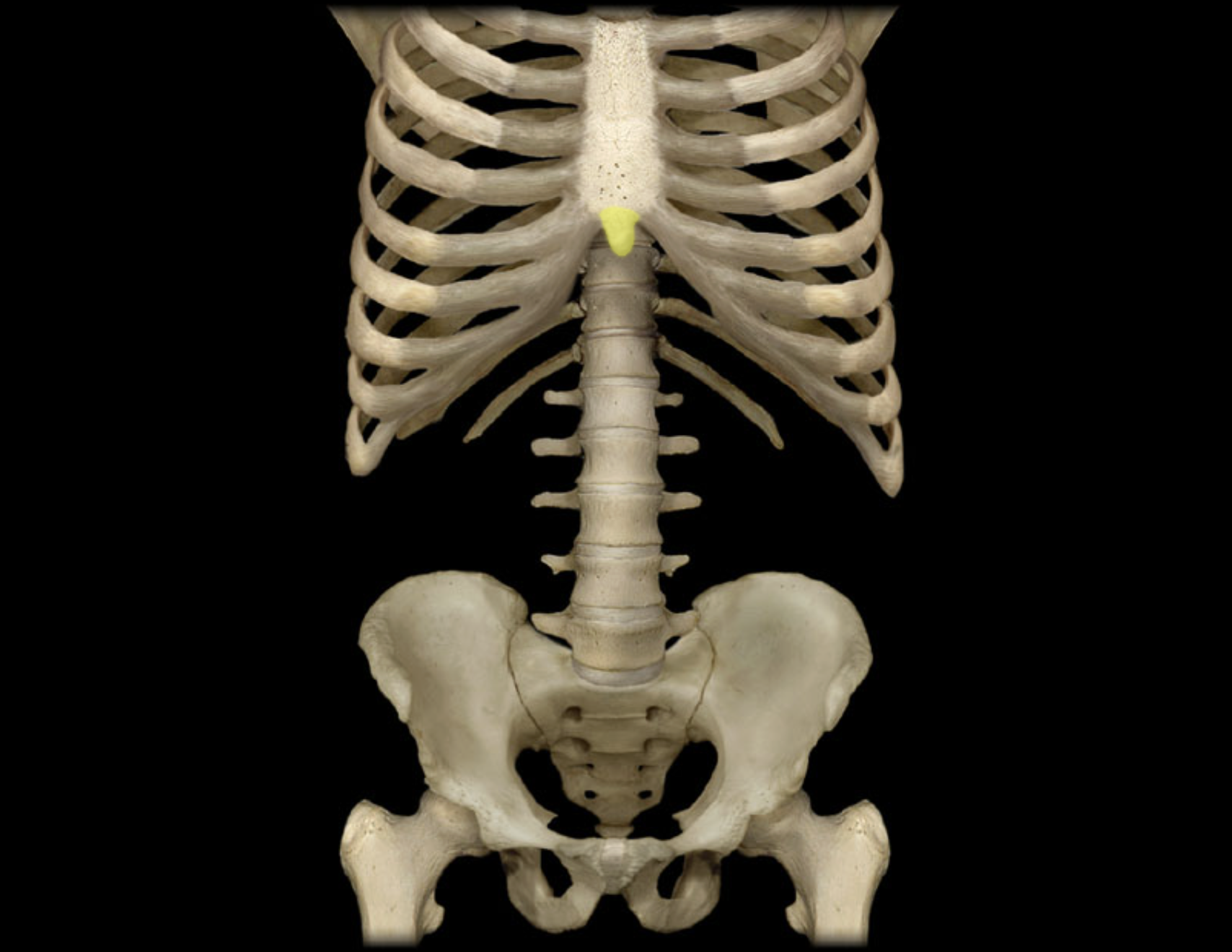
Body of sternum

Соссух

Femur

lium

Ischium

Lumbar vertebra

Pelvic girdle

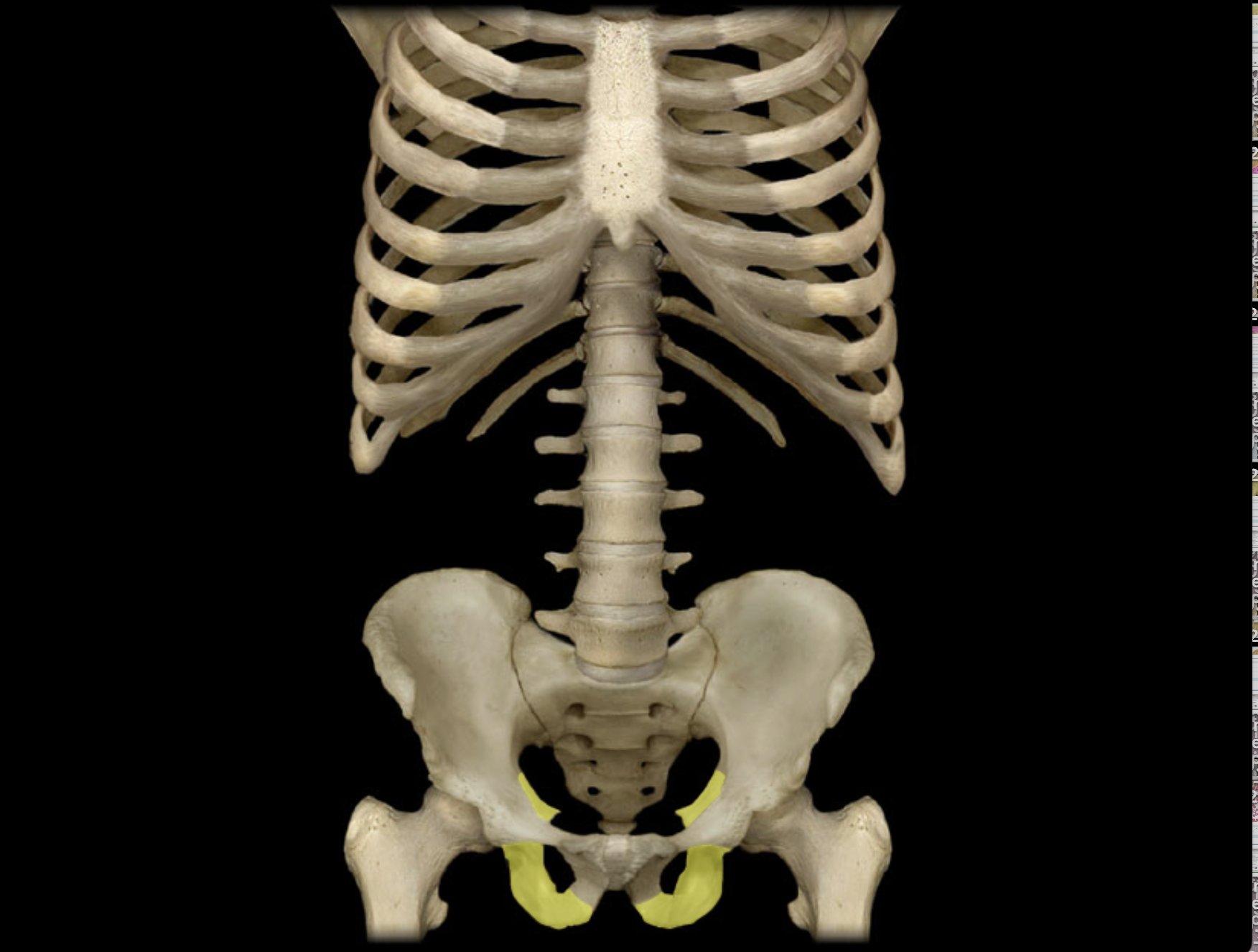
Pubic symphysis

Pubis

Ribs 2 - 12

Sacrum

Sternum

Xiphoid process

44
New cards
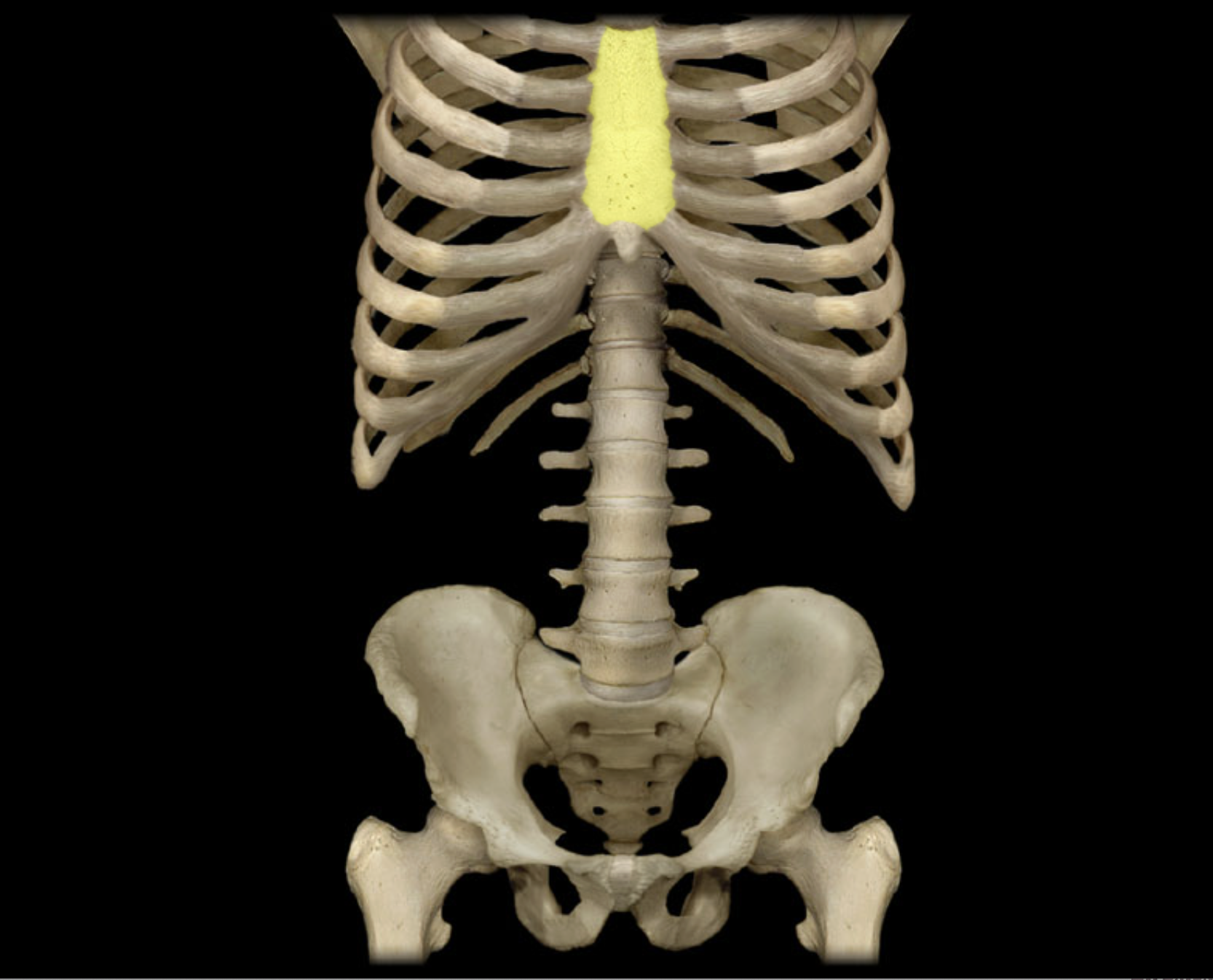
<p>Body of sternum</p>

Body of sternum

Location:

• Sternum

Description:

  • Long flat part of sternum between manubrium and xiphoid process

  • Contributes to sternal angle (angle of Louis) at its superior border

  • Articulates with costal cartilages of ribs 2-7 and combined costal cartilages of false ribs (8-10)

Comment:

  • Floating ribs (ribs 11-12): not attached to sternum

  • Provides attachment for pectoralis major muscle

<p>Location:</p><p class="p1">• Sternum</p><p class="p1">Description:</p><ul><li><p>Long flat part of sternum between manubrium and xiphoid process</p></li><li><p>Contributes to sternal angle (angle of Louis) at its superior border</p></li><li><p>Articulates with costal cartilages of ribs 2-7 and combined costal cartilages of false ribs (8-10)</p></li></ul><p>Comment:</p><ul><li><p>Floating ribs (ribs 11-12): not attached to sternum</p></li><li><p>Provides attachment for pectoralis major muscle</p></li></ul><p></p>
45
New cards
<p>Соссух</p>

Соссух

Location:

  • Posterior pelvic wall

  • Lower back, inferior to S5 vertebra

Description:

  • Small, triangular bone

  • Consists of three to five, variably fused, poorly developed vertebrae

Also known as:

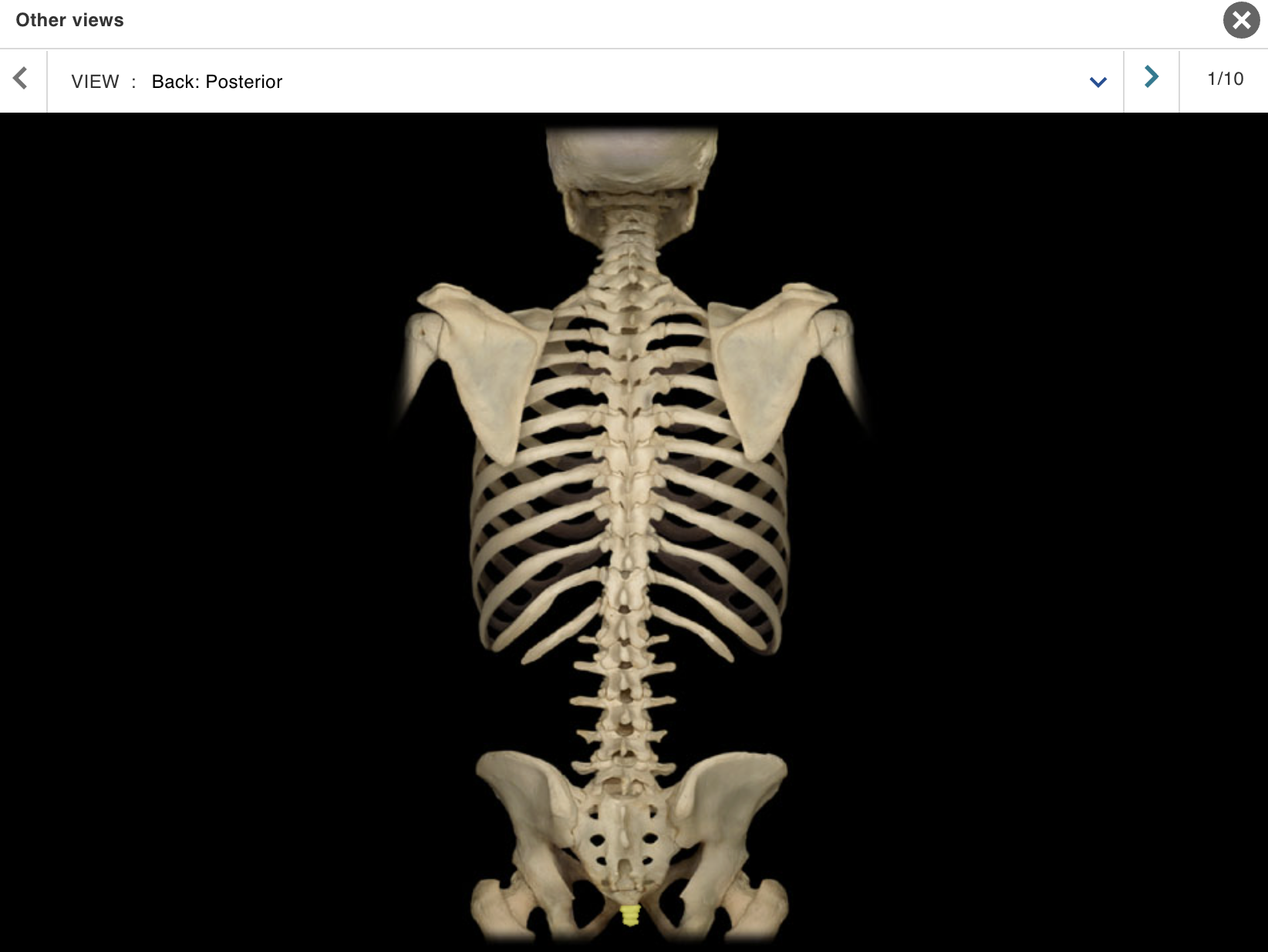
• "Tailbone"

Comment:

• Rudiment of the tail in other vertebrates

<p>Location:</p><ul><li><p>Posterior pelvic wall</p></li><li><p>Lower back, inferior to S5 vertebra</p></li></ul><p class="p1">Description:</p><ul><li><p>Small, triangular bone</p></li><li><p>Consists of three to five, variably fused, poorly developed vertebrae</p></li></ul><p class="p1">Also known as:</p><p class="p1">• "Tailbone"</p><p class="p1">Comment:</p><p class="p1">• Rudiment of the tail in other vertebrates</p>
46
New cards
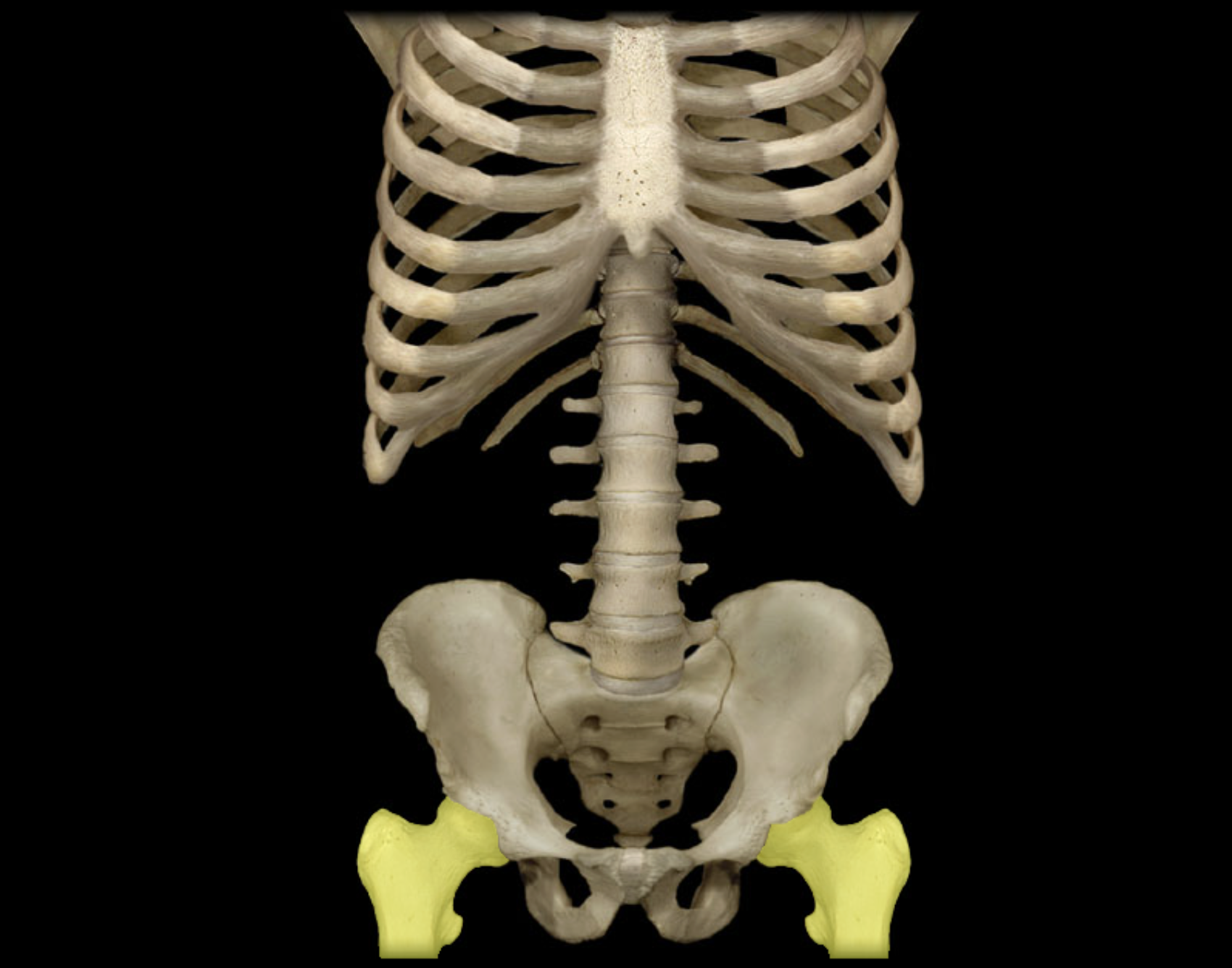
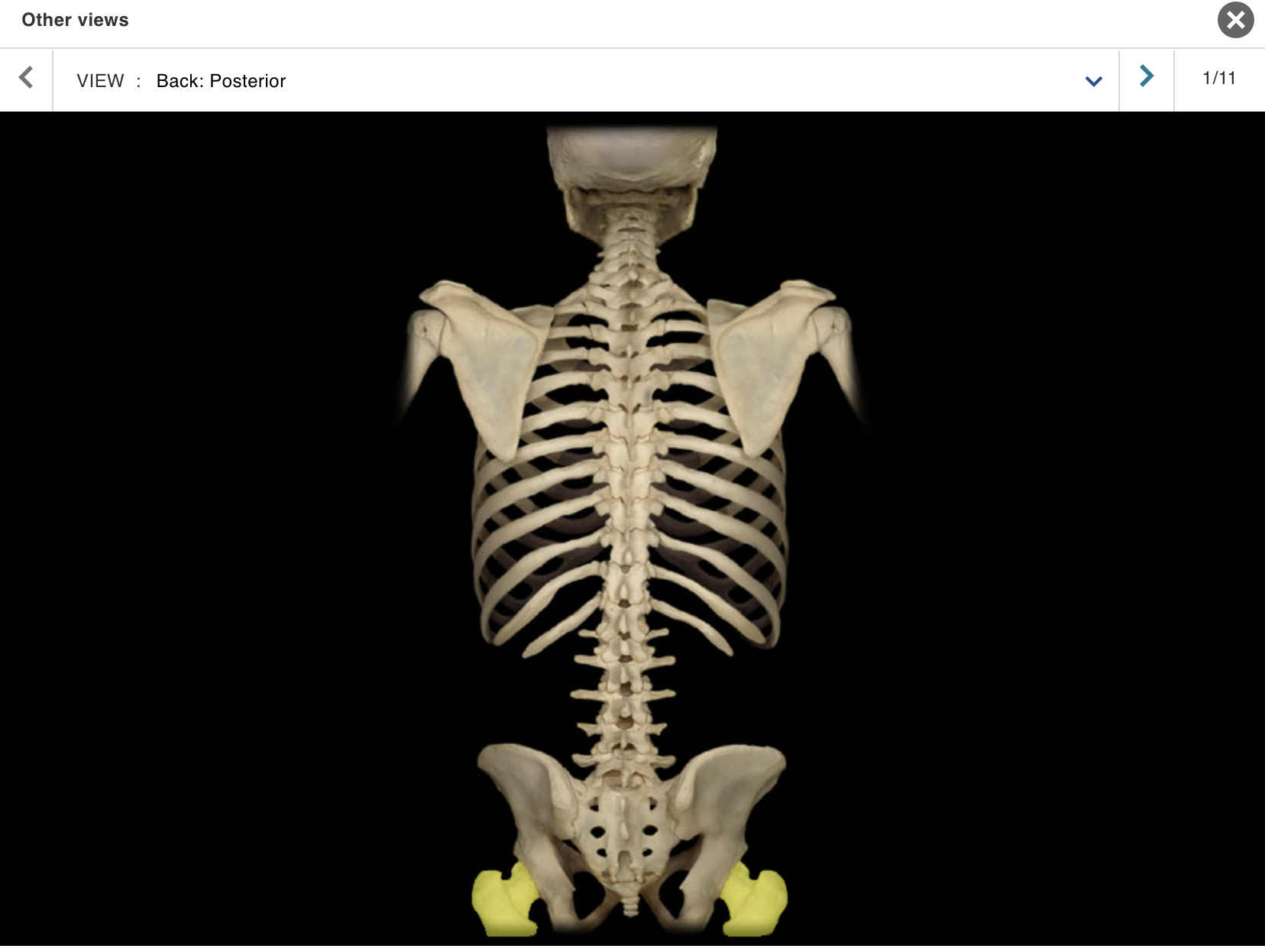
<p>Femur</p>

Femur

Location:

• Thigh

Description:

  • Long bone

  • Characteristic features include head, neck, shaft, greater and lesser trochanters, linea aspera, and medial and lateral condyles

  • Head forms part of hip joint

  • Distal end forms part of knee joint

Comment:

  • Only bone of thigh

  • Longest bone in body; length accurately predicts height of individual

<p>Location:</p><p class="p1">• Thigh</p><p class="p1">Description:</p><ul><li><p>Long bone</p></li><li><p>Characteristic features include head, neck, shaft, greater and lesser trochanters, linea aspera, and medial and lateral condyles</p></li><li><p>Head forms part of hip joint</p></li><li><p>Distal end forms part of knee joint</p></li></ul><p>Comment:</p><ul><li><p>Only bone of thigh</p></li><li><p>Longest bone in body; length accurately predicts height of individual</p></li></ul><p></p>
47
New cards
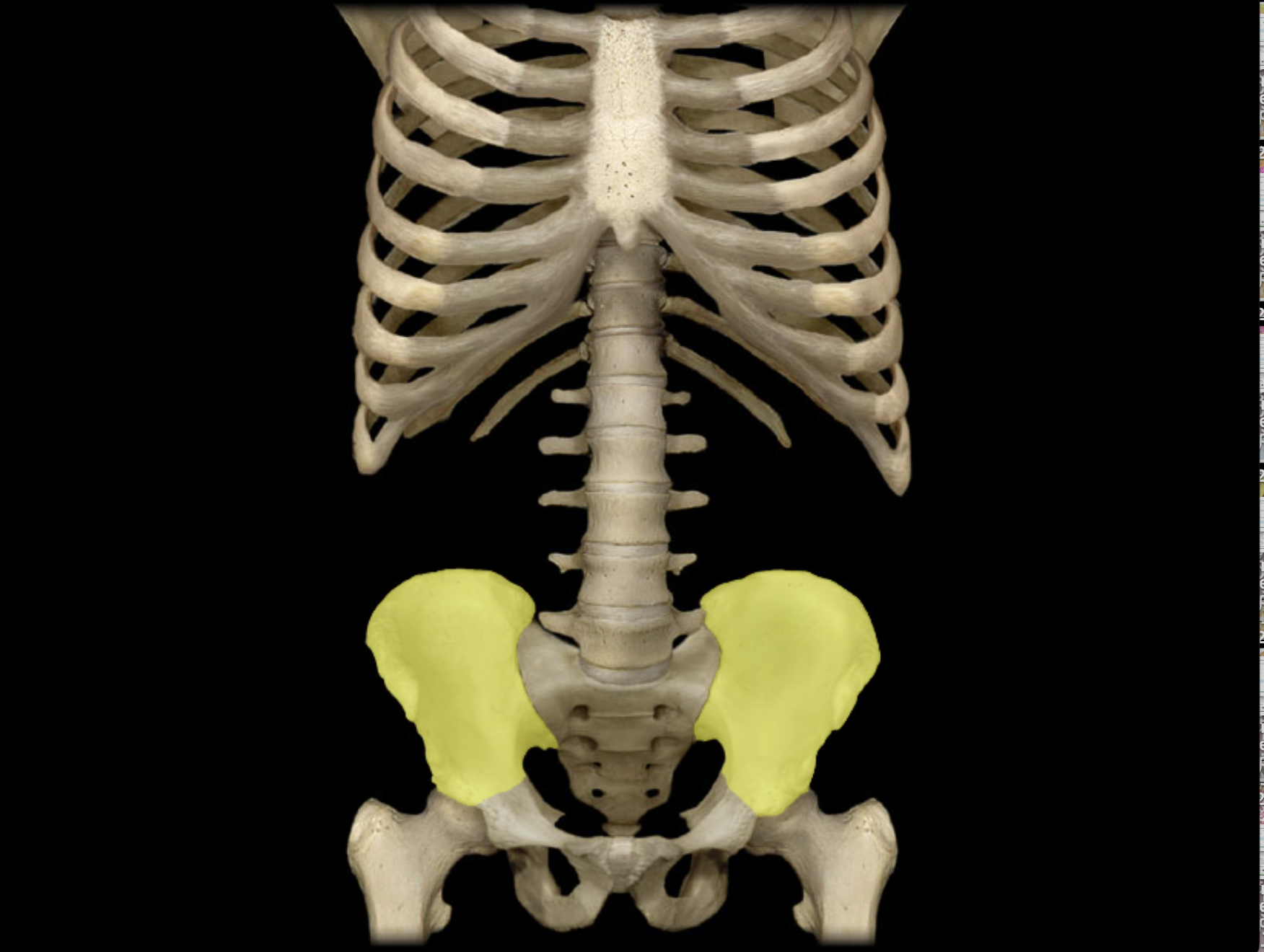
<p>lium</p>

lium

Location:

• Pelvis

Description:

  • Largest of three coxal (hip) bones

  • Has large, wing-like superior extension (ala); the alae form bony walls of greater (false) pelvis

  • Contributes to acetabulum (hip joint socket) and wall of lesser (true) pelvis

  • Articulates with sacrum at sacroiliac joint

Comment:

  • Fused with ischium and pubis in adult to form coxal (hip) bone

  • Bony pelvis formed by paired hip bones and sacrum

<p>Location:</p><p class="p1">• Pelvis</p><p class="p1">Description:</p><ul><li><p>Largest of three coxal (hip) bones</p></li><li><p>Has large, wing-like superior extension (ala); the alae form bony walls of greater (false) pelvis</p></li><li><p>Contributes to acetabulum (hip joint socket) and wall of lesser (true) pelvis</p></li><li><p>Articulates with sacrum at sacroiliac joint</p></li></ul><p>Comment:</p><ul><li><p>Fused with ischium and pubis in adult to form coxal (hip) bone</p></li><li><p>Bony pelvis formed by paired hip bones and sacrum</p></li></ul><p></p>
48
New cards
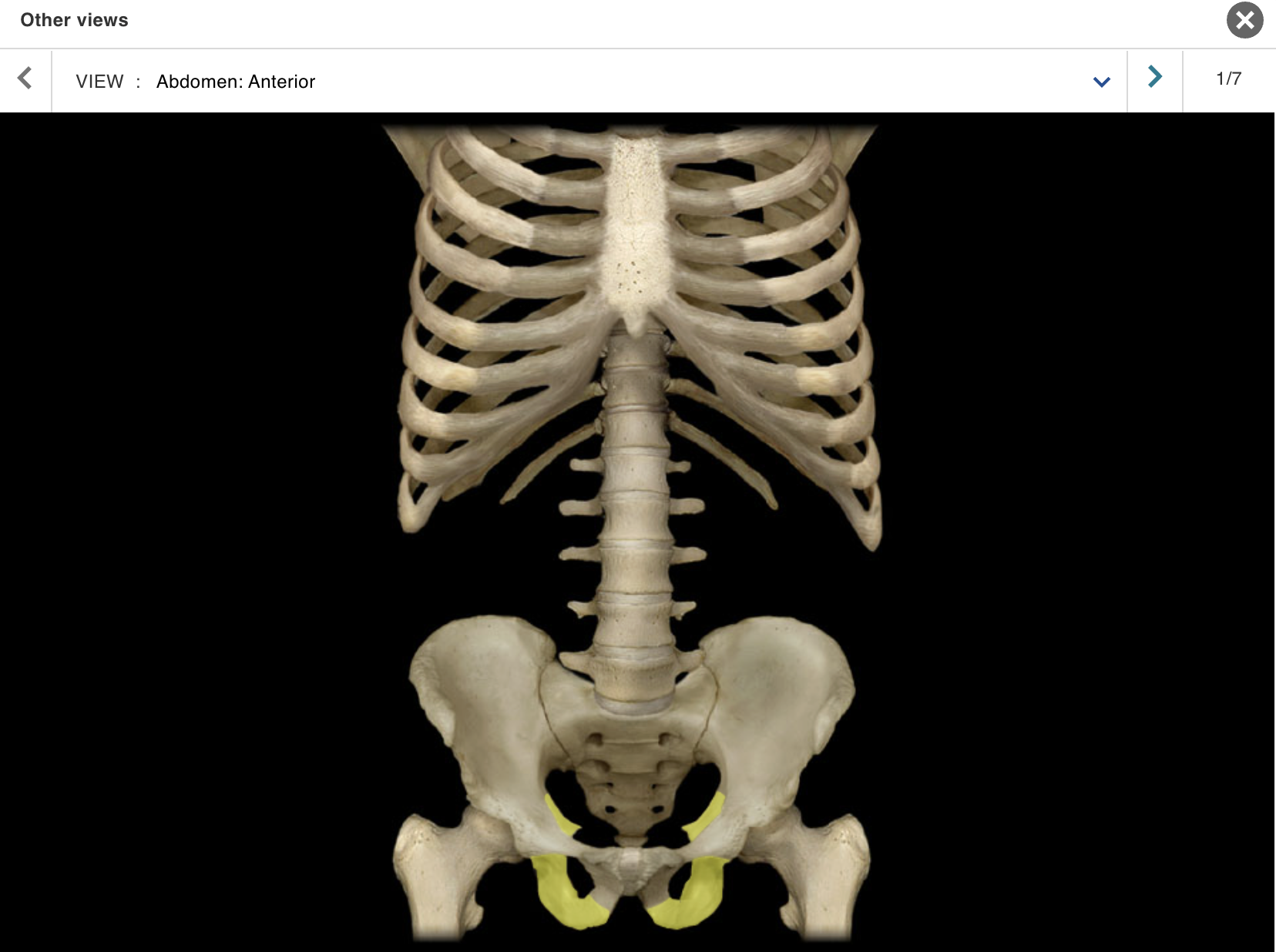
<p>Ischium</p>

Ischium

Location:

• Pelvis

Description:

  • One of three coxal (hip) bones

  • Characteristic features include tuberosity and spine

  • Contributes to acetabulum (hip joint socket), obturator foramen, and wall of lesser (true) pelvis

Comment:

  • Fused with ilium and pubis in adult to form coxal (hip) bone

  • Bony pelvis formed by paired hip bones and sacrum

  • Obturator foramen formed by rami of pubis and ischium

<p>Location:</p><p class="p1">• Pelvis</p><p class="p1">Description:</p><ul><li><p>One of three coxal (hip) bones</p></li><li><p>Characteristic features include tuberosity and spine</p></li><li><p>Contributes to acetabulum (hip joint socket), obturator foramen, and wall of lesser (true) pelvis</p></li></ul><p>Comment:</p><ul><li><p>Fused with ilium and pubis in adult to form coxal (hip) bone</p></li><li><p>Bony pelvis formed by paired hip bones and sacrum</p></li><li><p>Obturator foramen formed by rami of pubis and ischium</p></li></ul><p></p>
49
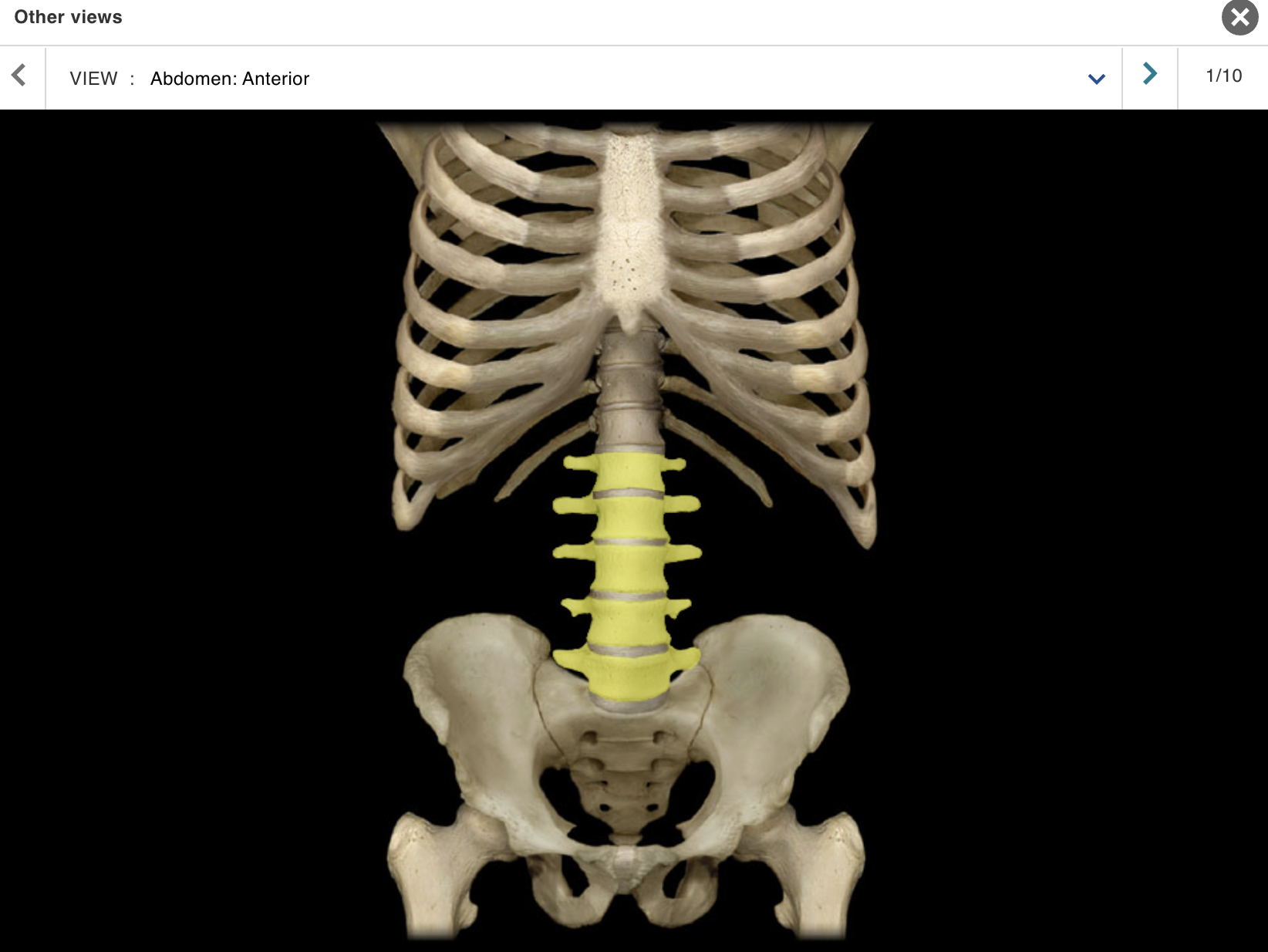
New cards
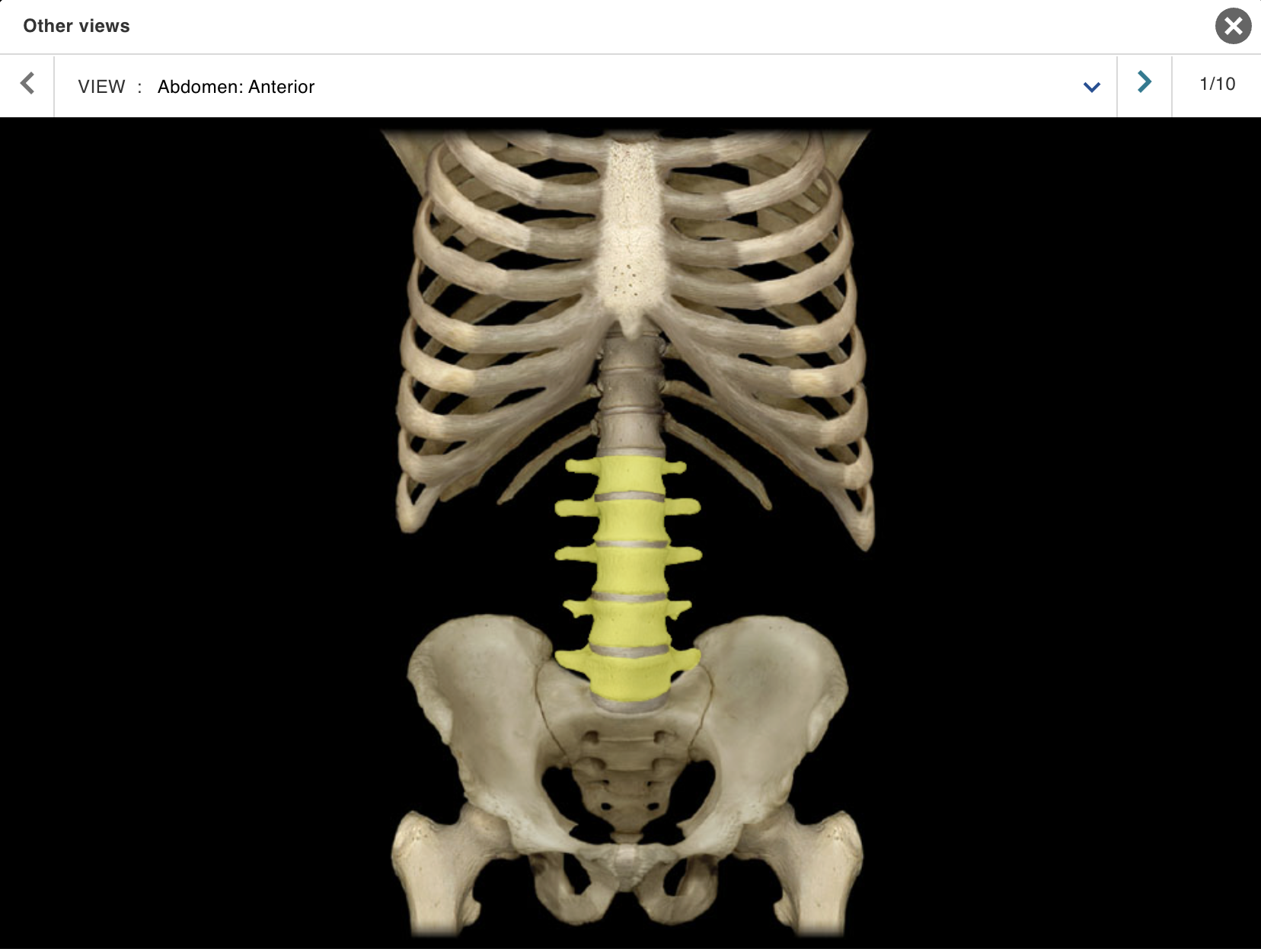
<p>Lumbar vertebra</p>

Lumbar vertebra

Location:

  • Lower back

  • Between T12 and S1 vertebrae

Description:

  • Five individual vertebrae

  • Characteristic features include large size, kidney bean-shaped body, and a thick, blunt spinous process

Comment:

  • Bodies arranged to form prominent anterior convexity (lumbar curvature; also known as lumbar lordosis, which can be accentuated pathologically)

  • Intervertebral discs between lumbar vertebrae most commonly herniate ("slipped-disk")

<p>Location:</p><ul><li><p>Lower back</p></li><li><p>Between T12 and S1 vertebrae</p></li></ul><p class="p1">Description:</p><ul><li><p>Five individual vertebrae</p></li><li><p>Characteristic features include large size, kidney bean-shaped body, and a thick, blunt spinous process</p></li></ul><p>Comment:</p><ul><li><p>Bodies arranged to form prominent anterior convexity (lumbar curvature; also known as lumbar lordosis, which can be accentuated pathologically)</p></li><li><p>Intervertebral discs between lumbar vertebrae most commonly herniate ("slipped-disk")</p></li></ul><p></p>
50
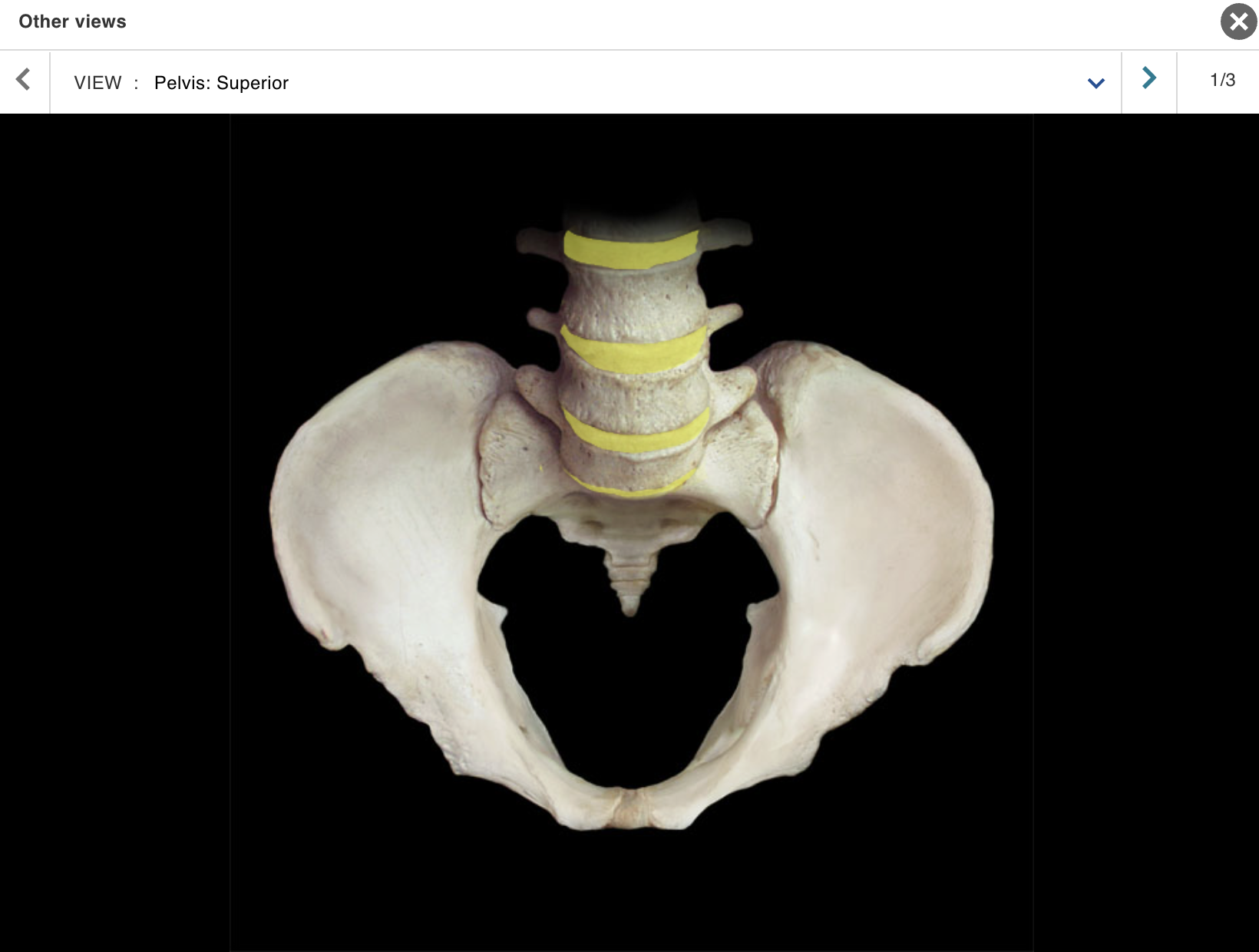
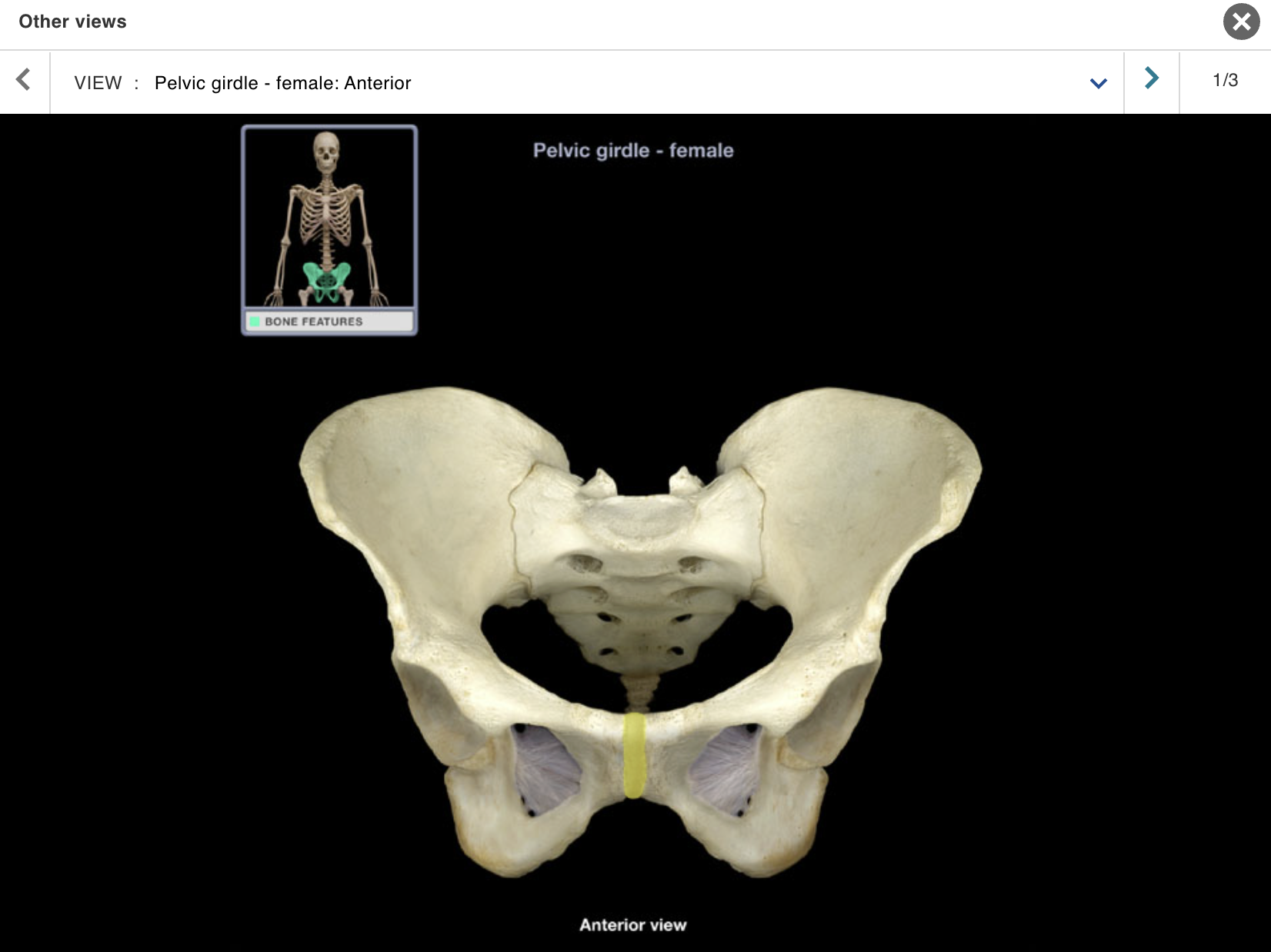
New cards
<p>Pelvic girdle</p>

Pelvic girdle

Location:

• Pelvis

Description:

  • Hip bones (ilium, ischium, and pubis)

  • Sacrum

Comment:

joint

• Pelvic girdle articulates with axial skeleton only at sacroiliac

• Pelvic girdle sometimes considered to include hip bones only (i.e., sacrum not included)

• Hip bones also known as os coxae

<p>Location:</p><p class="p1">• Pelvis</p><p class="p1">Description:</p><ul><li><p>Hip bones (ilium, ischium, and pubis)</p></li><li><p>Sacrum</p></li></ul><p class="p1">Comment:</p><p class="p1">joint</p><p class="p1">• Pelvic girdle articulates with axial skeleton only at sacroiliac</p><p class="p1">• Pelvic girdle sometimes considered to include hip bones only (i.e., sacrum not included)</p><p class="p1">• Hip bones also known as os coxae</p><p></p>
51
New cards
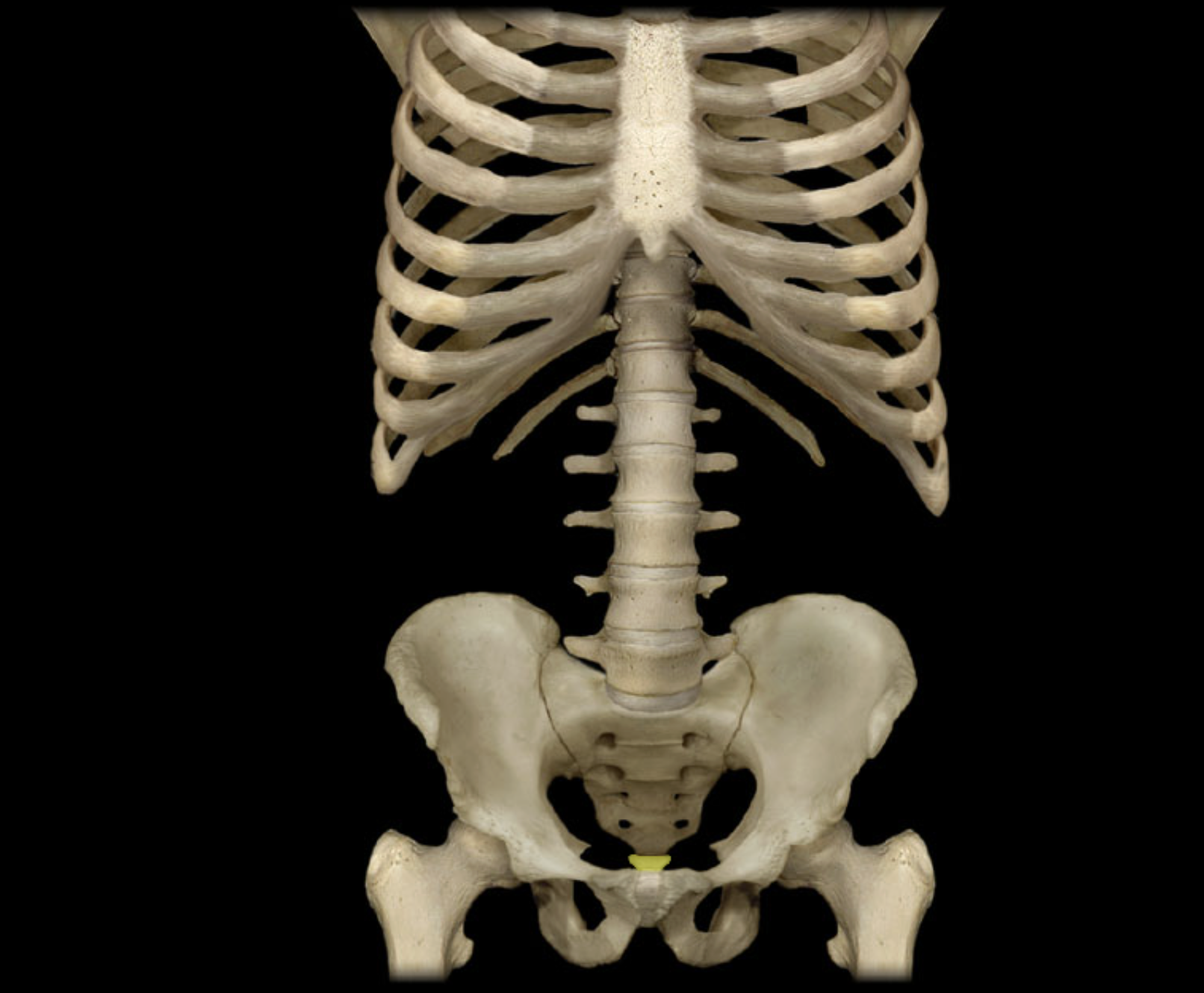
<p>Pubic symphysis</p>

Pubic symphysis

Location:

• Pelvis (anterior midline)

Description:

• Joint formed by two pubic bones and intervening fibrocartilage disc

Comment:

• In female, fibrocartilage softens in late pregnancy to allow slight separation of pubic bones

<p>Location:</p><p class="p1">• Pelvis (anterior midline)</p><p class="p1">Description:</p><p class="p1">• Joint formed by two pubic bones and intervening fibrocartilage disc</p><p class="p1">Comment:</p><p class="p1">• In female, fibrocartilage softens in late pregnancy to allow slight separation of pubic bones</p>
52
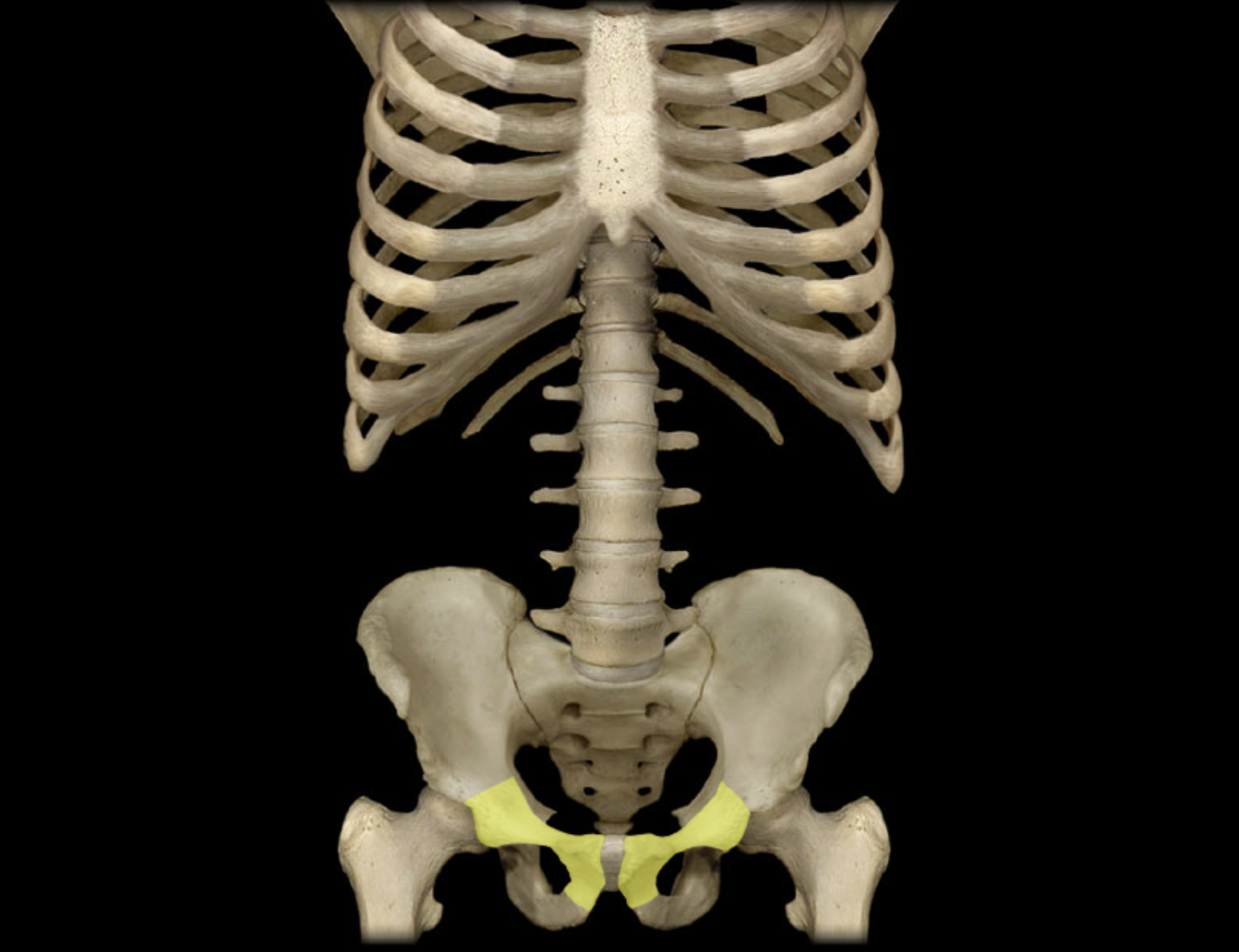
New cards
<p>Pubis </p>

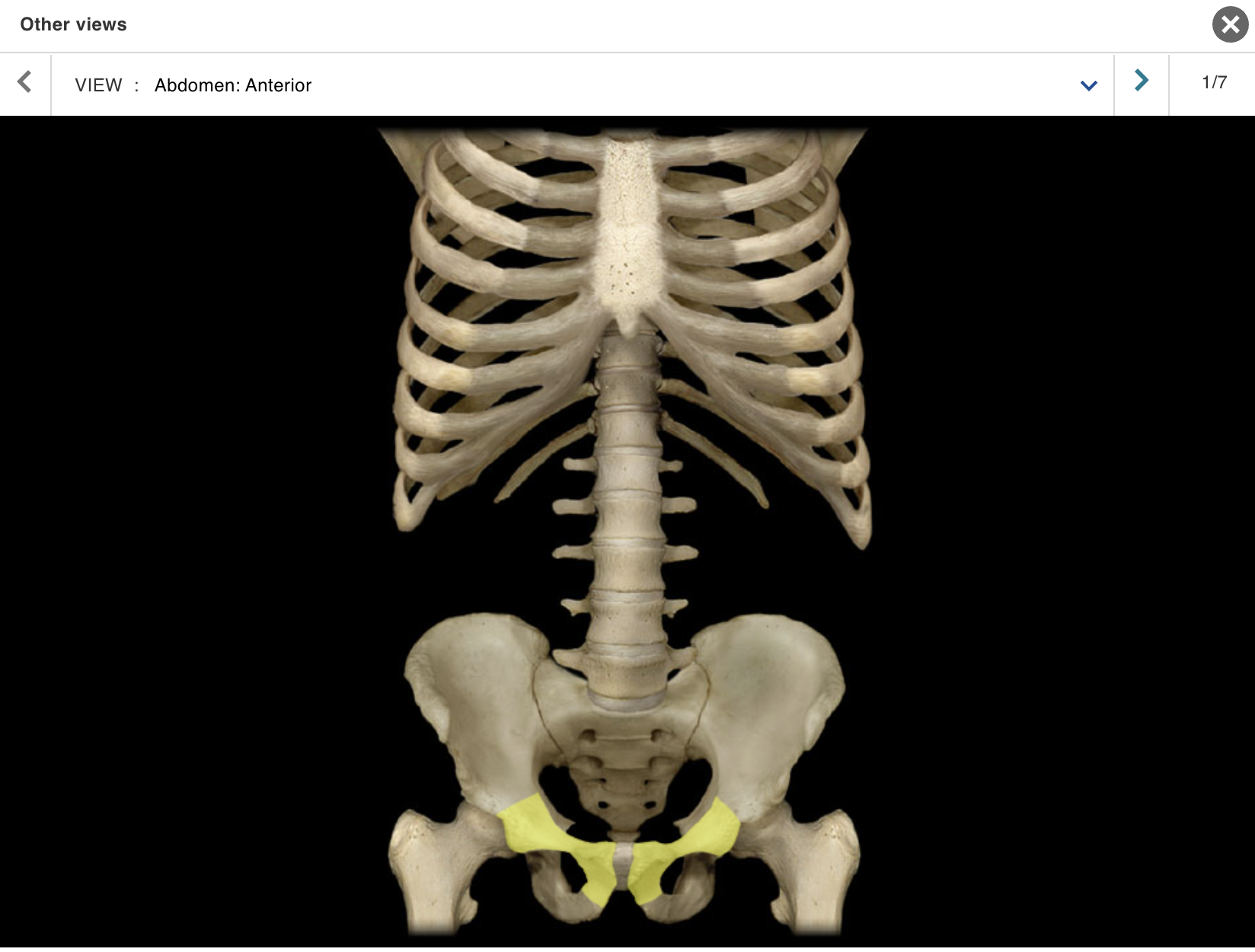
Pubis

Location:

• Pelvis

Description:

  • One of three coxal (hip) bones

  • Characteristic features include body and rami (superior and inferior)

  • Midline junction of pubic bones forms pubic symphysis

  • Contributes to acetabulum (hip joint socket), obturator foramen, and wall of lesser (true) pelvis

Comment:

  • Fused with ilium and ischium in adult to form coxal (hip) bone

  • Bony pelvis formed by paired hip bones and sacrum

  • Obturator foramen formed by rami of pubis and ischium

<p>Location:</p><p class="p1">• Pelvis</p><p class="p1">Description:</p><ul><li><p>One of three coxal (hip) bones</p></li><li><p>Characteristic features include body and rami (superior and inferior)</p></li><li><p>Midline junction of pubic bones forms pubic symphysis</p></li><li><p>Contributes to acetabulum (hip joint socket), obturator foramen, and wall of lesser (true) pelvis</p></li></ul><p>Comment:</p><ul><li><p>Fused with ilium and ischium in adult to form coxal (hip) bone</p></li><li><p>Bony pelvis formed by paired hip bones and sacrum</p></li><li><p>Obturator foramen formed by rami of pubis and ischium</p></li></ul><p></p>
53
New cards
<p>Ribs 2 - 12</p>

Ribs 2 - 12

Location:

• Thorax

Description:

  • Pairs of curved, flat bones

  • All ribs: articulate with thoracic vertebrae

  • True ribs (ribs 1-7): attached directly to sternum by costal cartilages

  • False ribs (ribs 8-10): attach indirectly to sternum via shared costal cartilages

  • Floating ribs (ribs 11-12): not attached to sternum

Comment:

• Alternate definition: some include the floating ribs (11-12) as a subcategory of false ribs

54
New cards
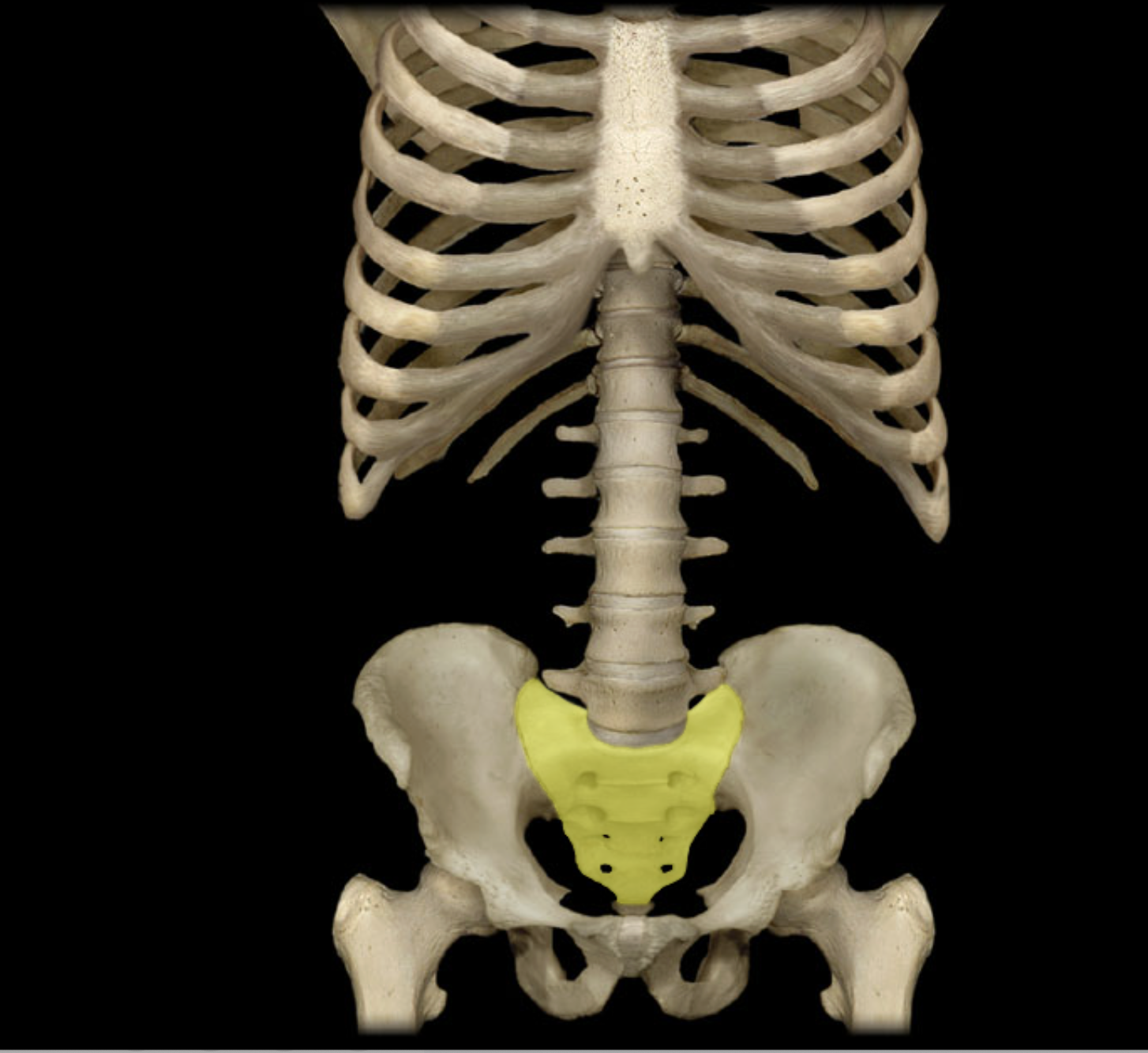
<p>Sacrum</p>

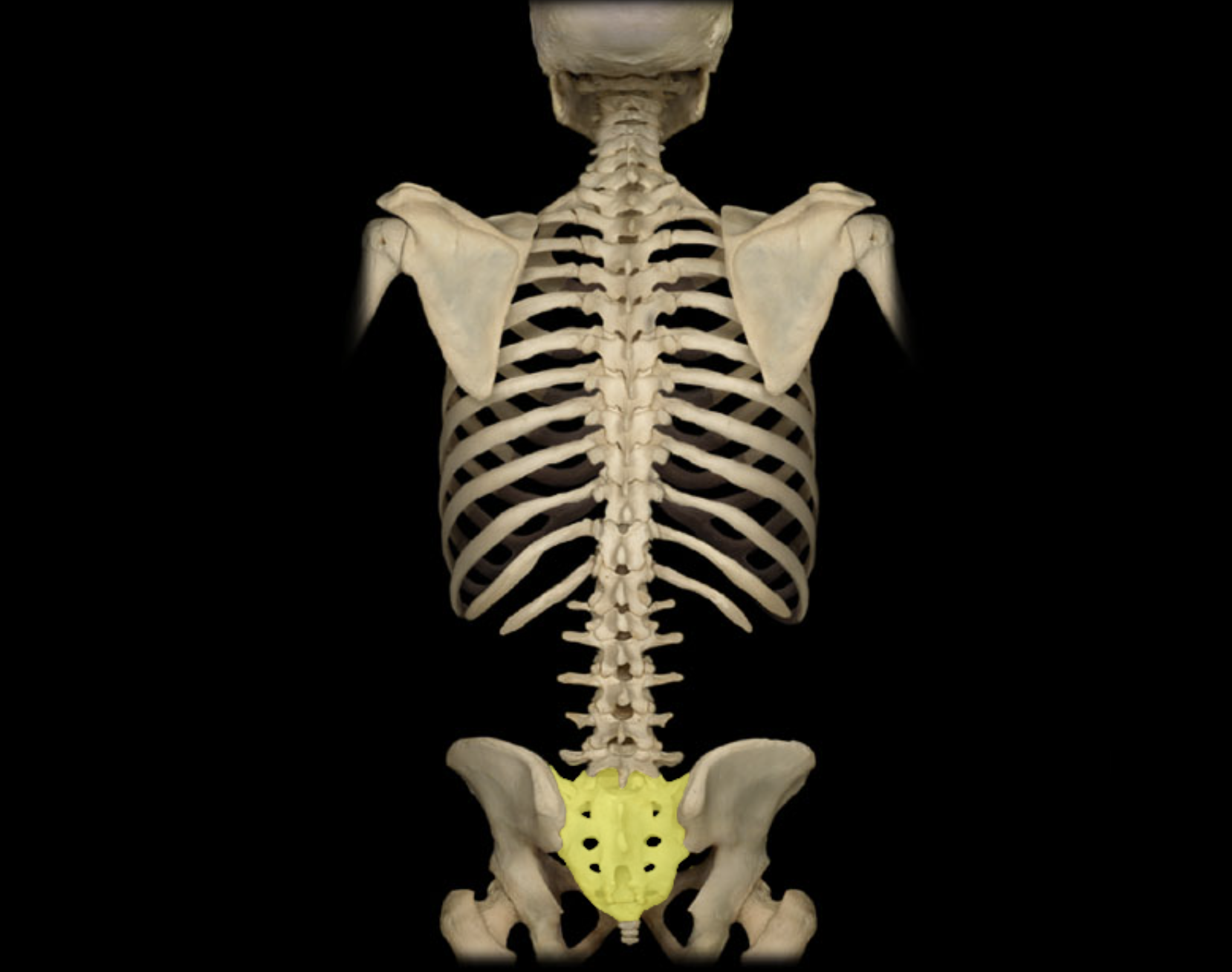
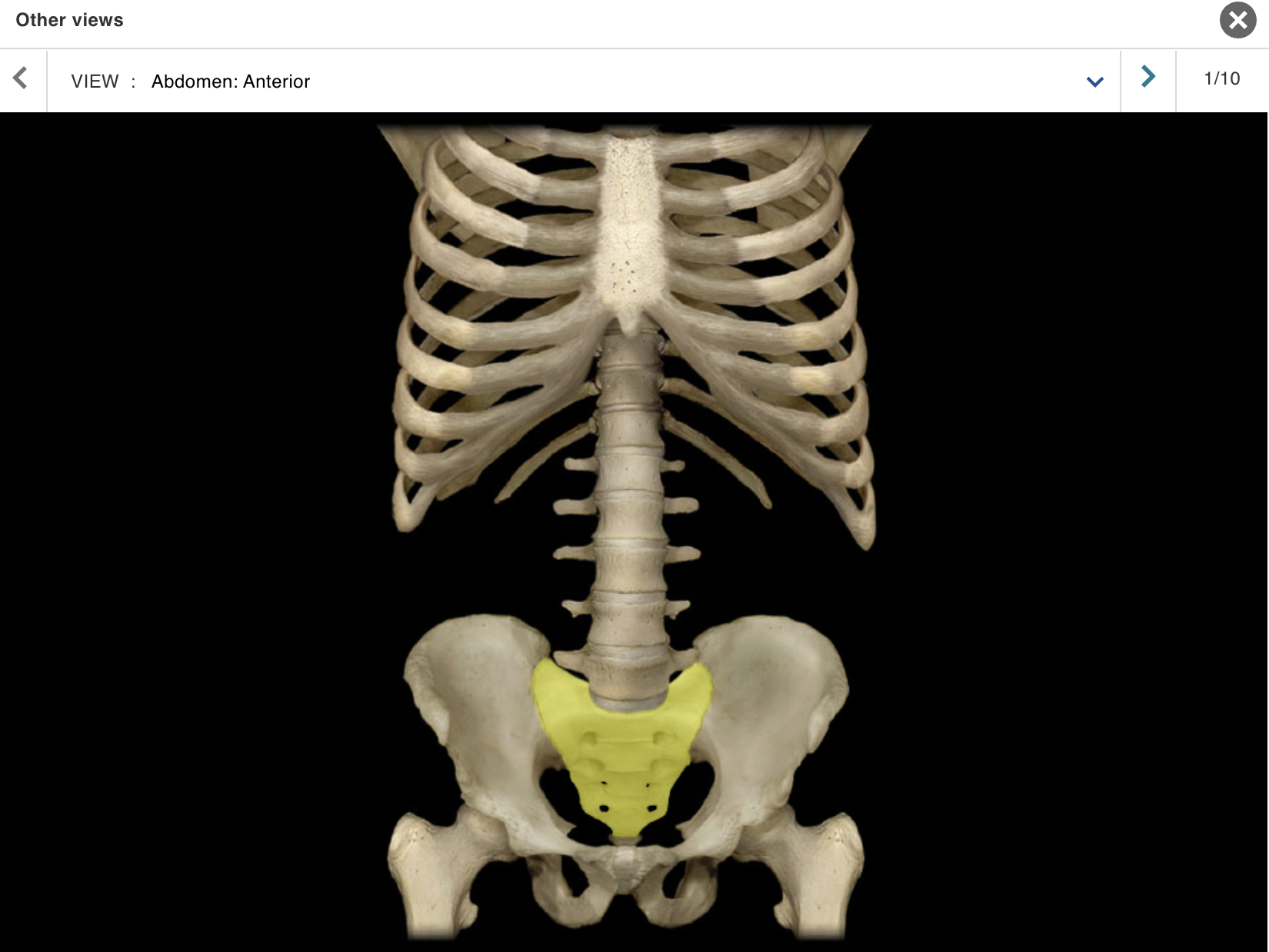
Sacrum

Location:

  • Lower back

  • Between L5 and Co1 vertebrae

  • Posterior wall of pelvis

Description:

  • Five fused vertebrae

  • Triangular bone wedged between hip bones

Comment:

• Sacral promontory (the prominent, projecting edge of base of sacrum formed by superior border of S1 vertebral body) is landmark for establishing female pelvic dimensions

<p>Location:</p><ul><li><p>Lower back</p></li><li><p>Between L5 and Co1 vertebrae</p></li><li><p>Posterior wall of pelvis</p></li></ul><p class="p1">Description:</p><ul><li><p>Five fused vertebrae</p></li><li><p>Triangular bone wedged between hip bones</p></li></ul><p>Comment:</p><p class="p1">• Sacral promontory (the prominent, projecting edge of base of sacrum formed by superior border of S1 vertebral body) is landmark for establishing female pelvic dimensions</p>
55
New cards
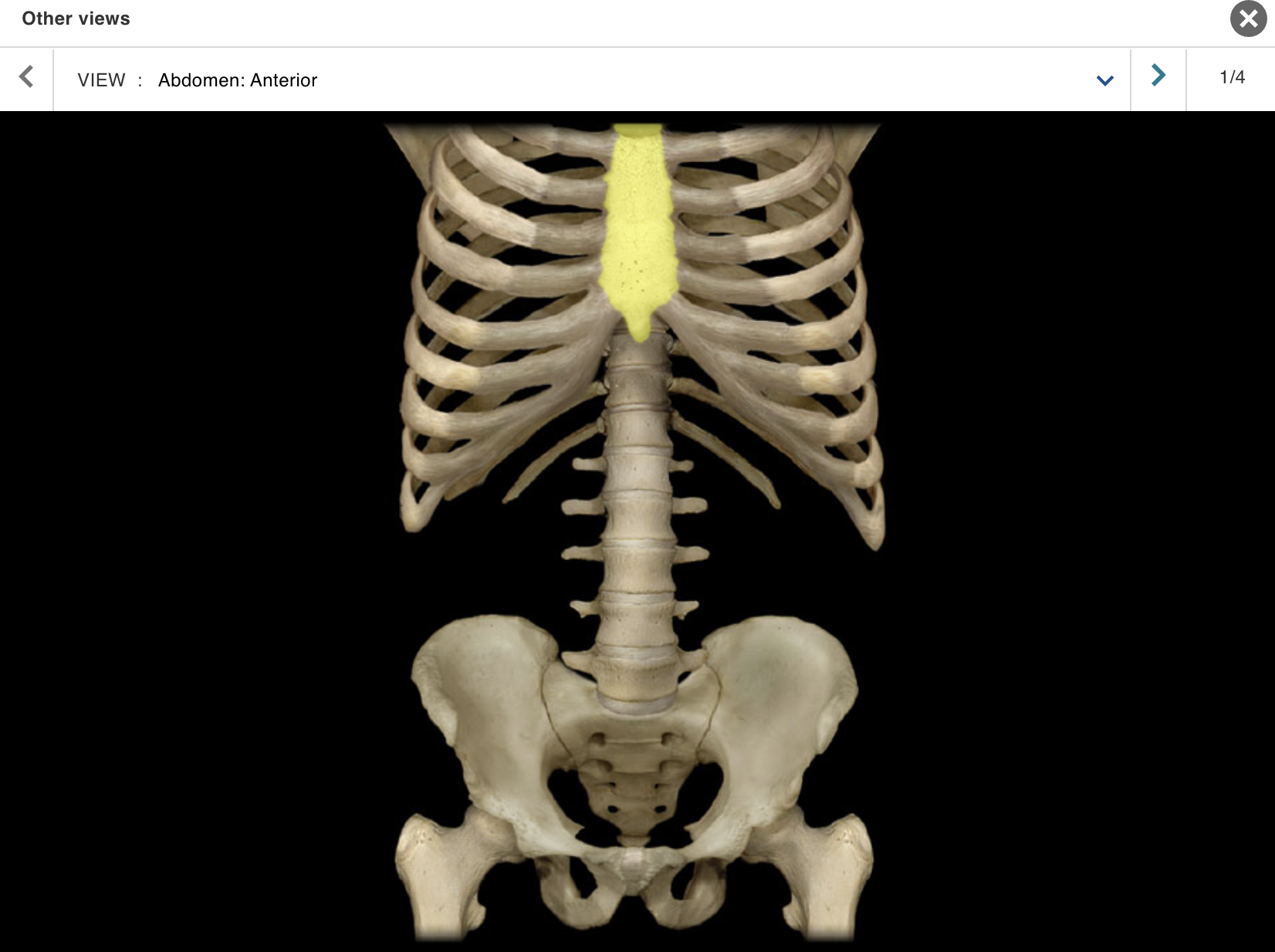
<p>Sternum</p>

Sternum

Location:

• Thorax (anterior midline)

Description:

  • Flat bone with three parts: manubrium, body, and xiphoid process

  • Characteristic features include jugular notch and sternal angle (angle of Louis)

  • Articulates with costal cartilages of true ribs (1-7), combined costal cartilages of false ribs (8-10), and clavicles

Also known as:

• "Breastbone"

Comment:

  • Floating ribs (ribs 11-12): not attached to sternum

  • Provides for attachment of sternocleidomastoid, pectoralis major, sternohyoid, and sternothyroid muscles

<p>Location:</p><p class="p1">• Thorax (anterior midline)</p><p class="p1">Description:</p><ul><li><p>Flat bone with three parts: manubrium, body, and xiphoid process</p></li><li><p>Characteristic features include jugular notch and sternal angle (angle of Louis)</p></li><li><p>Articulates with costal cartilages of true ribs (1-7), combined costal cartilages of false ribs (8-10), and clavicles</p></li></ul><p>Also known as:</p><p class="p1">• "Breastbone"</p><p class="p1">Comment:</p><ul><li><p>Floating ribs (ribs 11-12): not attached to sternum</p></li><li><p>Provides for attachment of sternocleidomastoid, pectoralis major, sternohyoid, and sternothyroid muscles</p></li></ul><p></p>
56
New cards
<p>Xiphoid process</p>

Xiphoid process

Location:

• Sternum (inferior part)

Description:

  • Midline shallow depression

  • Cartilage until approximately 5th decade of life

Comment:

  • Provides attachment for anterior abdominal wall muscles

  • Landmark for cardiopulmonary resuscitation (CPR)

<p>Location:</p><p class="p1">• Sternum (inferior part)</p><p class="p1">Description:</p><ul><li><p>Midline shallow depression</p></li><li><p>Cartilage until approximately 5th decade of life</p></li></ul><p class="p1">Comment:</p><ul><li><p>Provides attachment for anterior abdominal wall muscles</p></li><li><p>Landmark for cardiopulmonary resuscitation (CPR)</p></li></ul><p></p>
57
New cards

ACTIVITY 4: DISSECTION

MODULE: SKELETAL

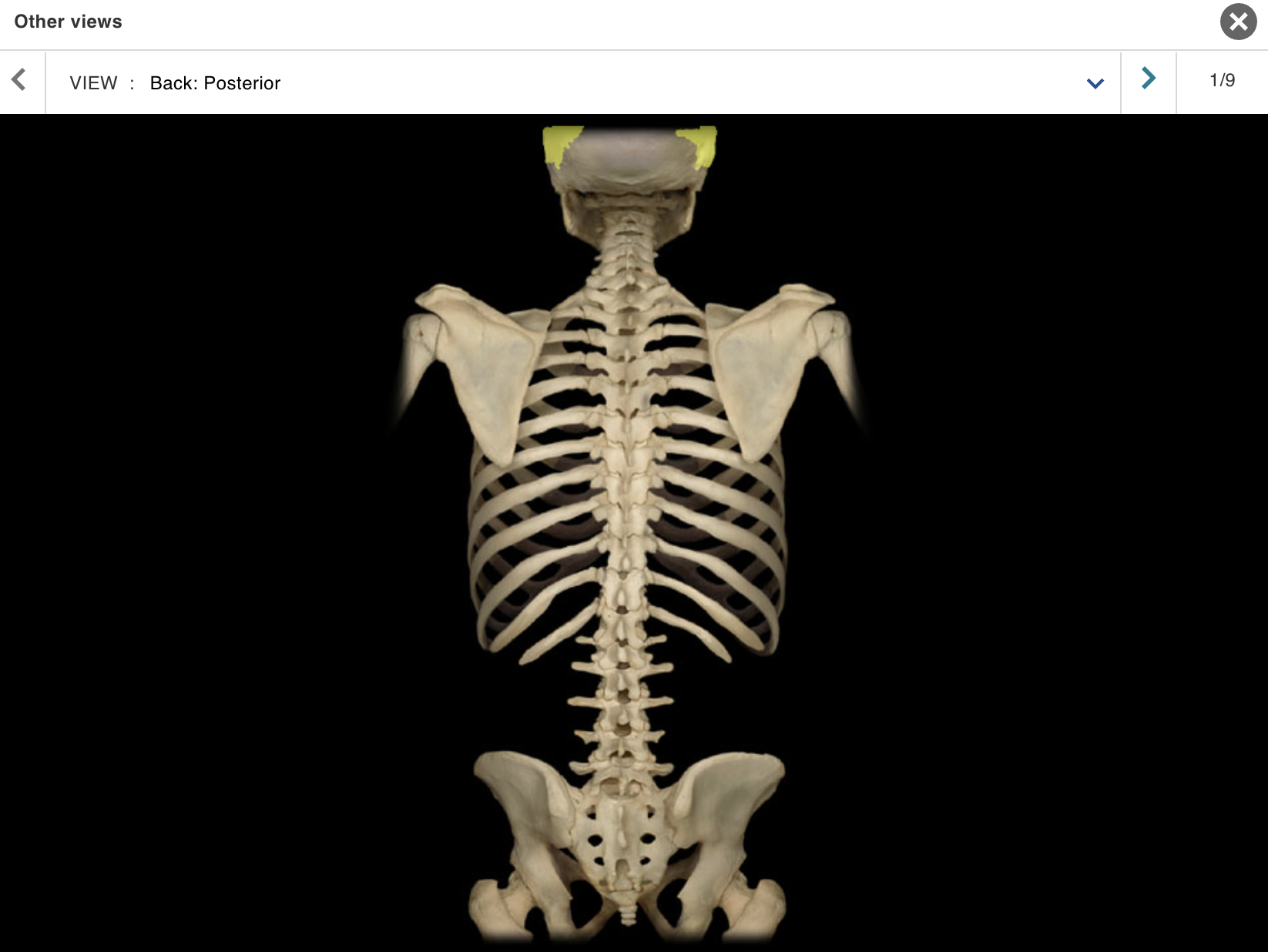
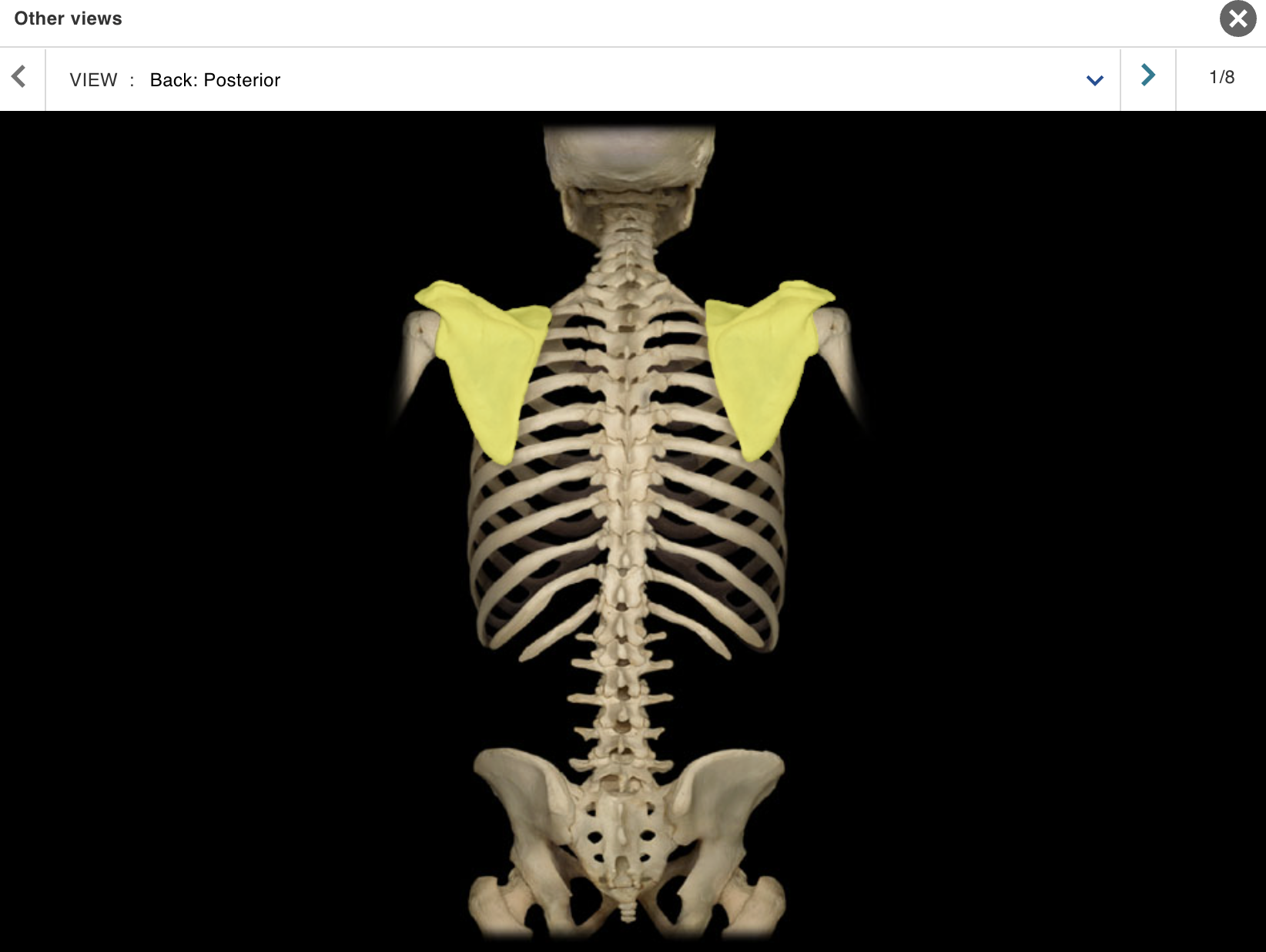
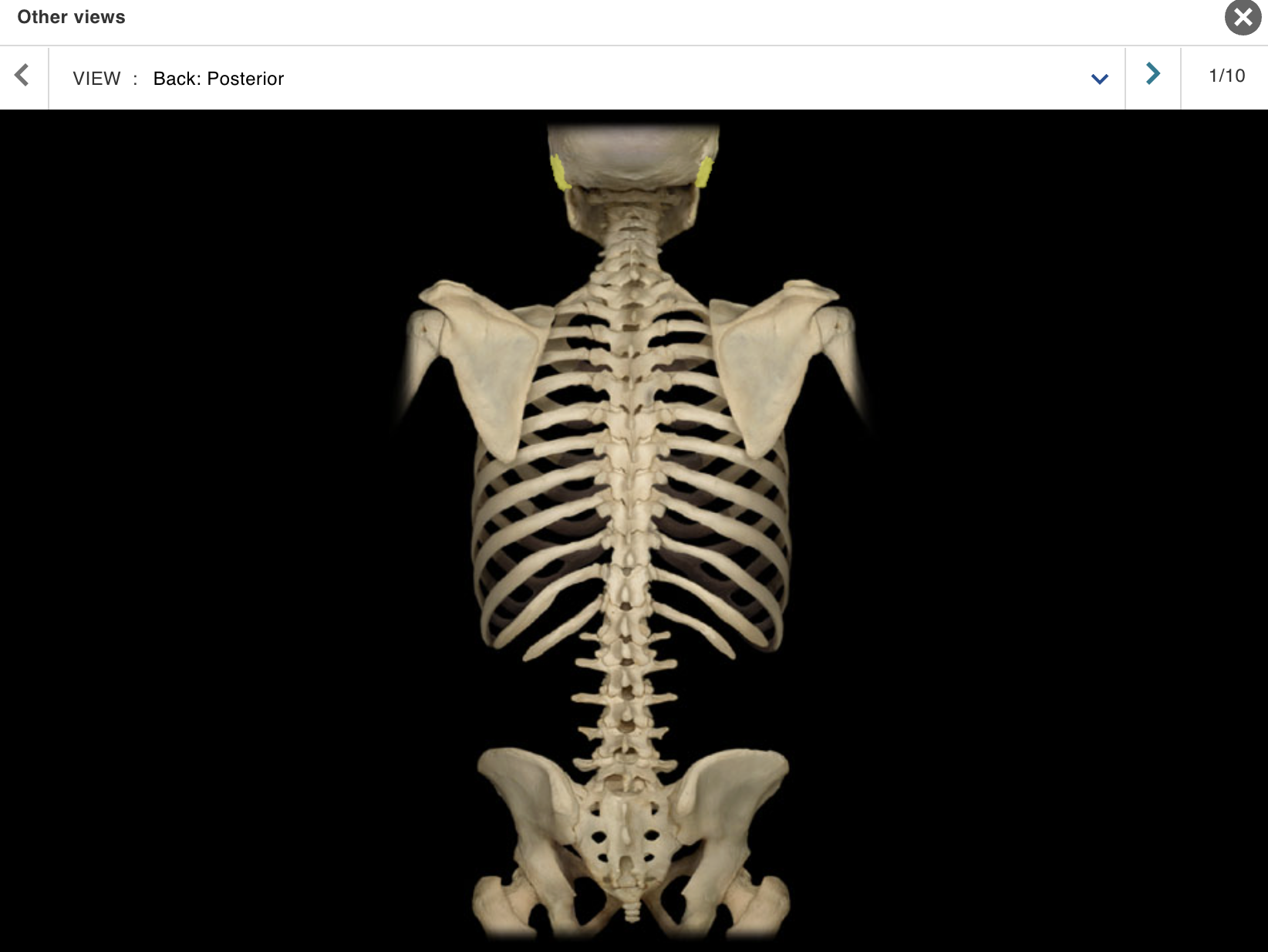
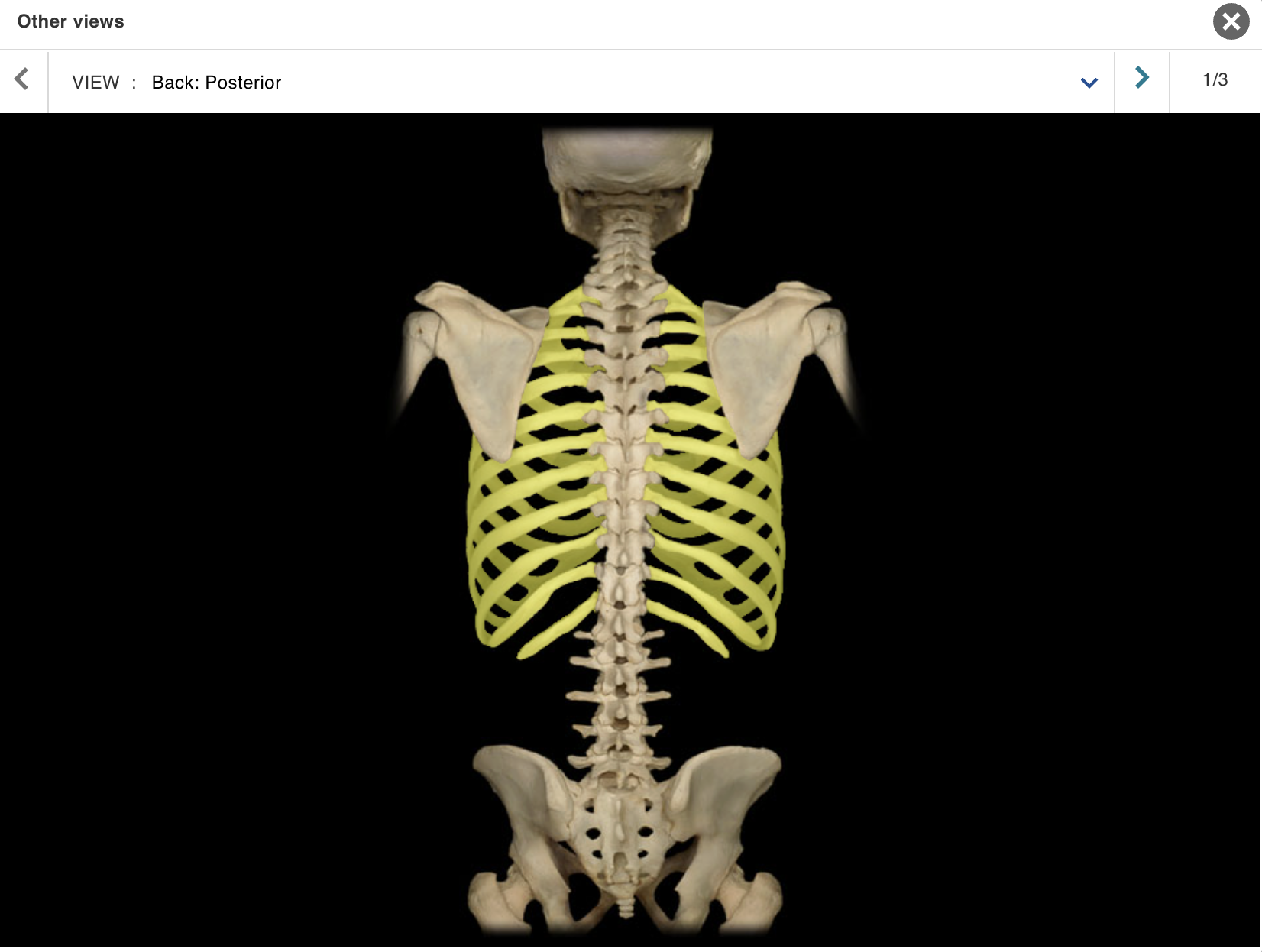
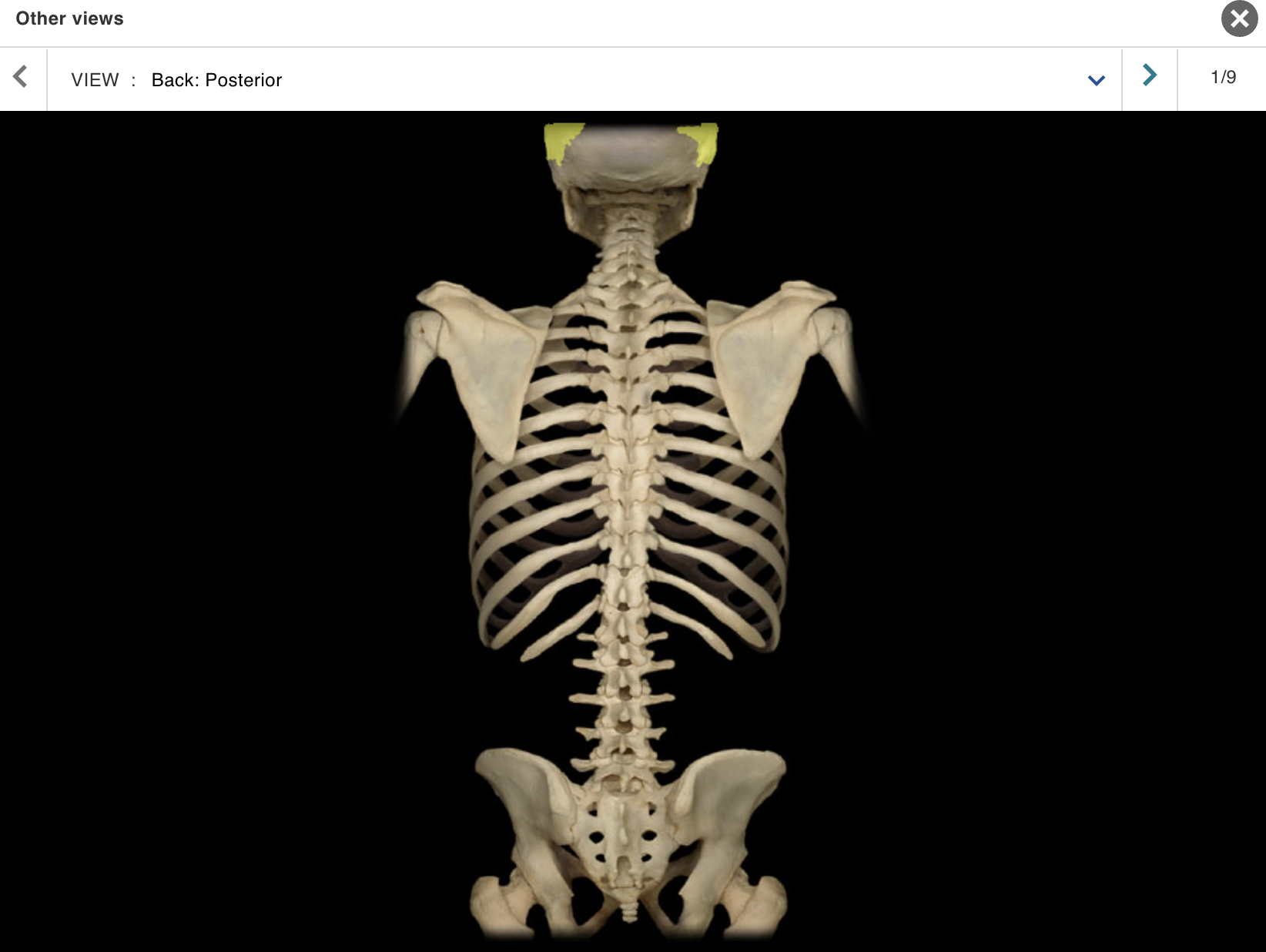
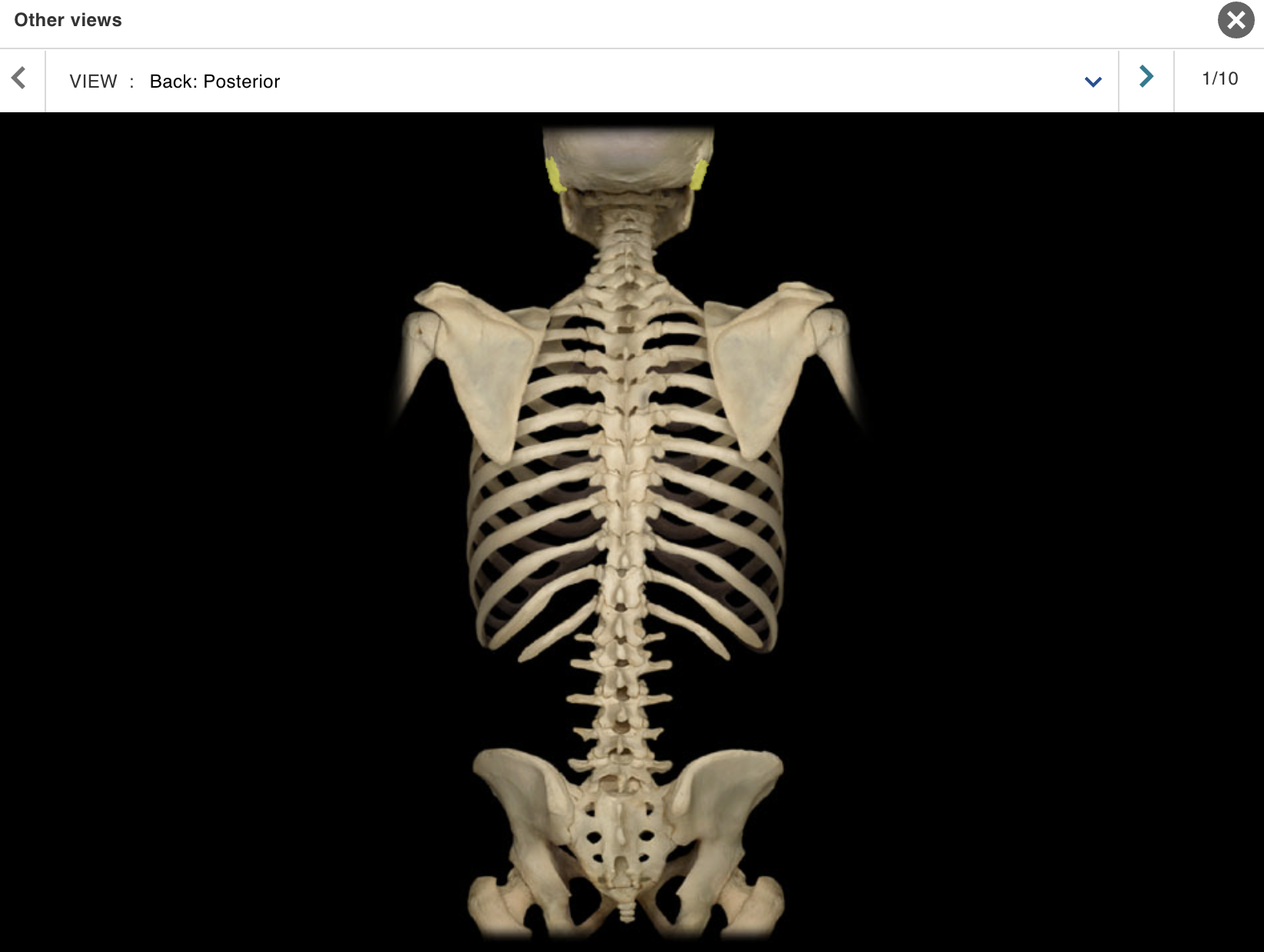
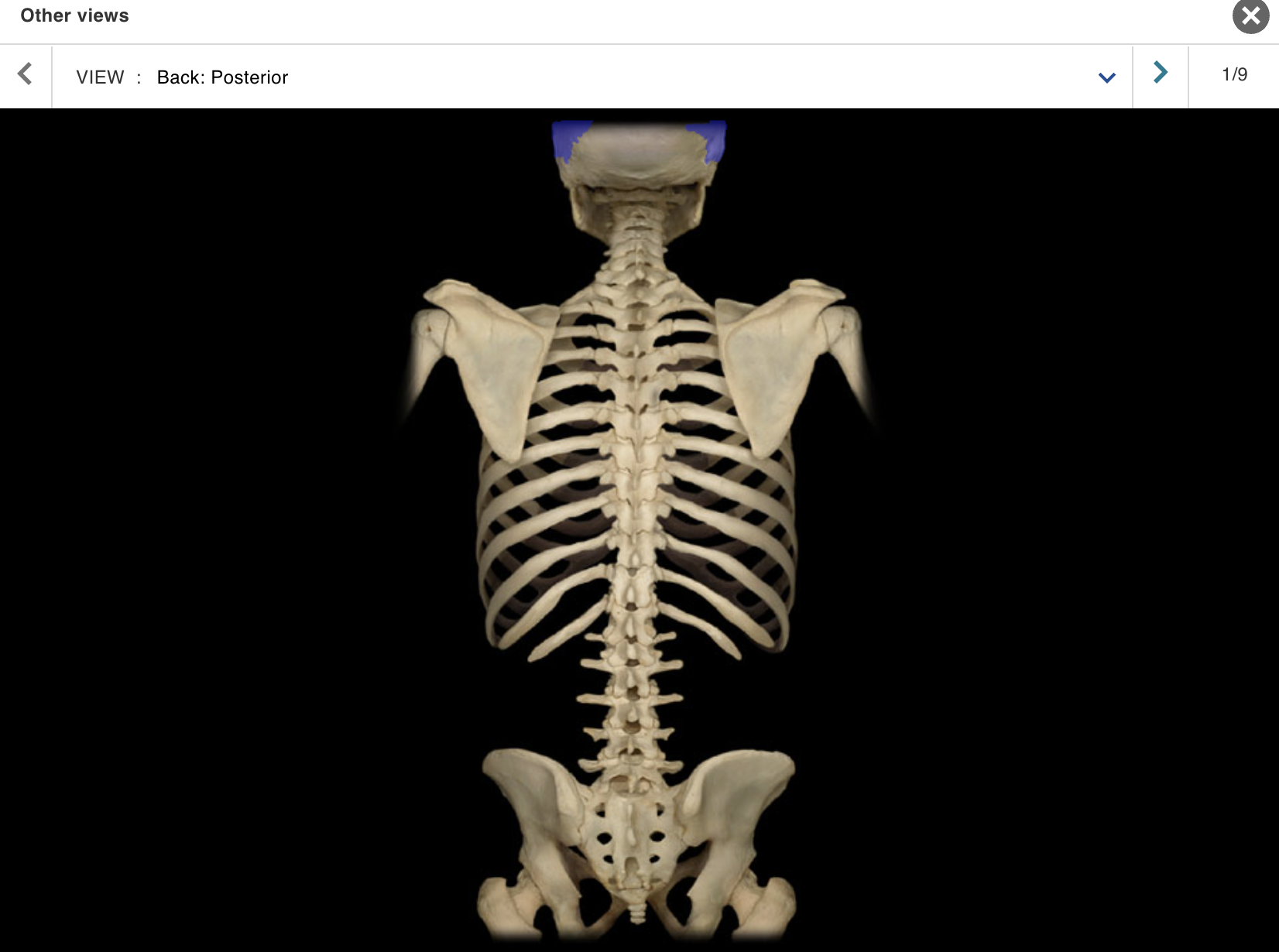
TOPIC: BACK / VIEW : POSTERIOR

Cervical vertebra

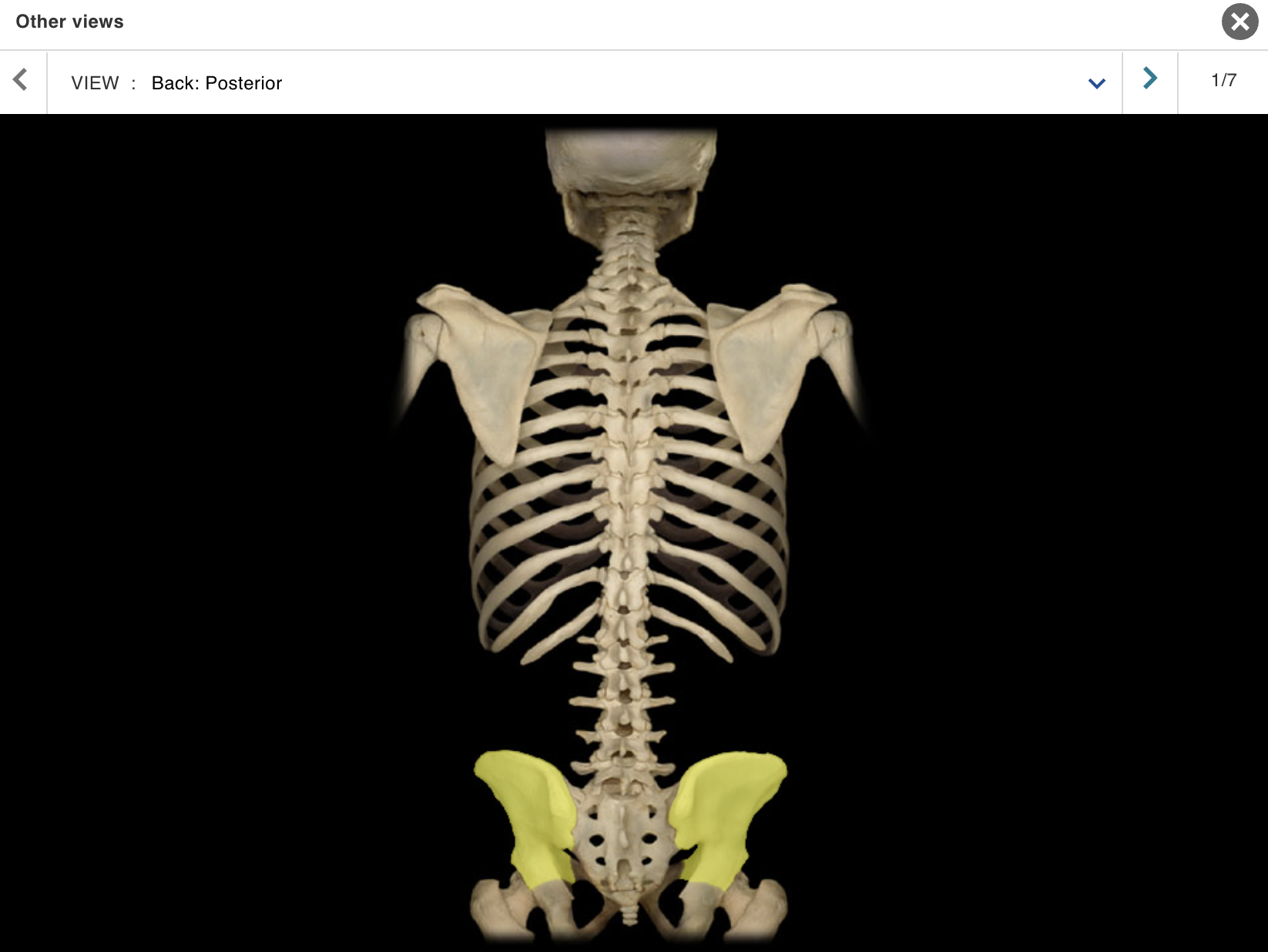
Соссух

lium

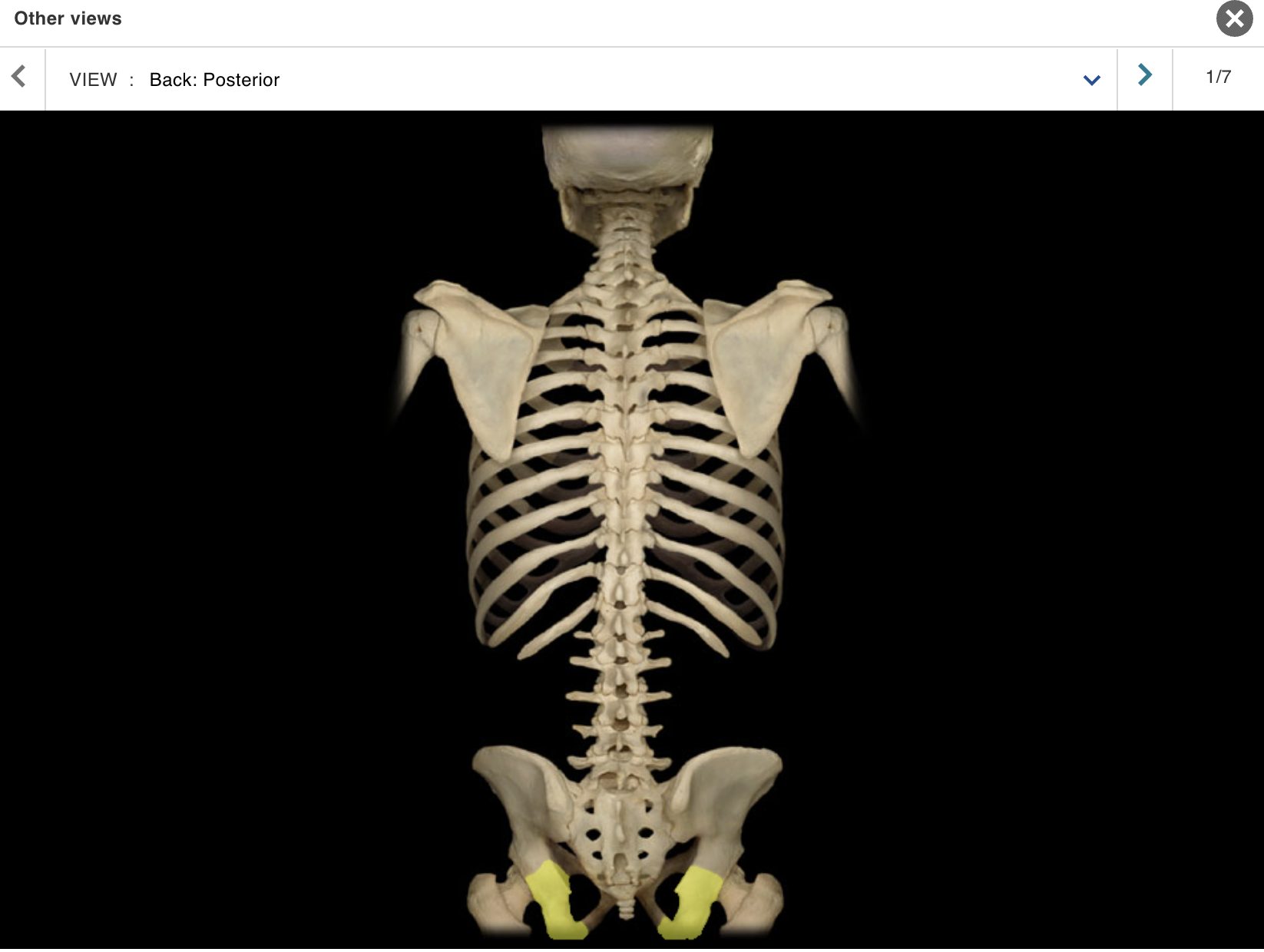
Ischium

Lumbar vertebra

Mandible

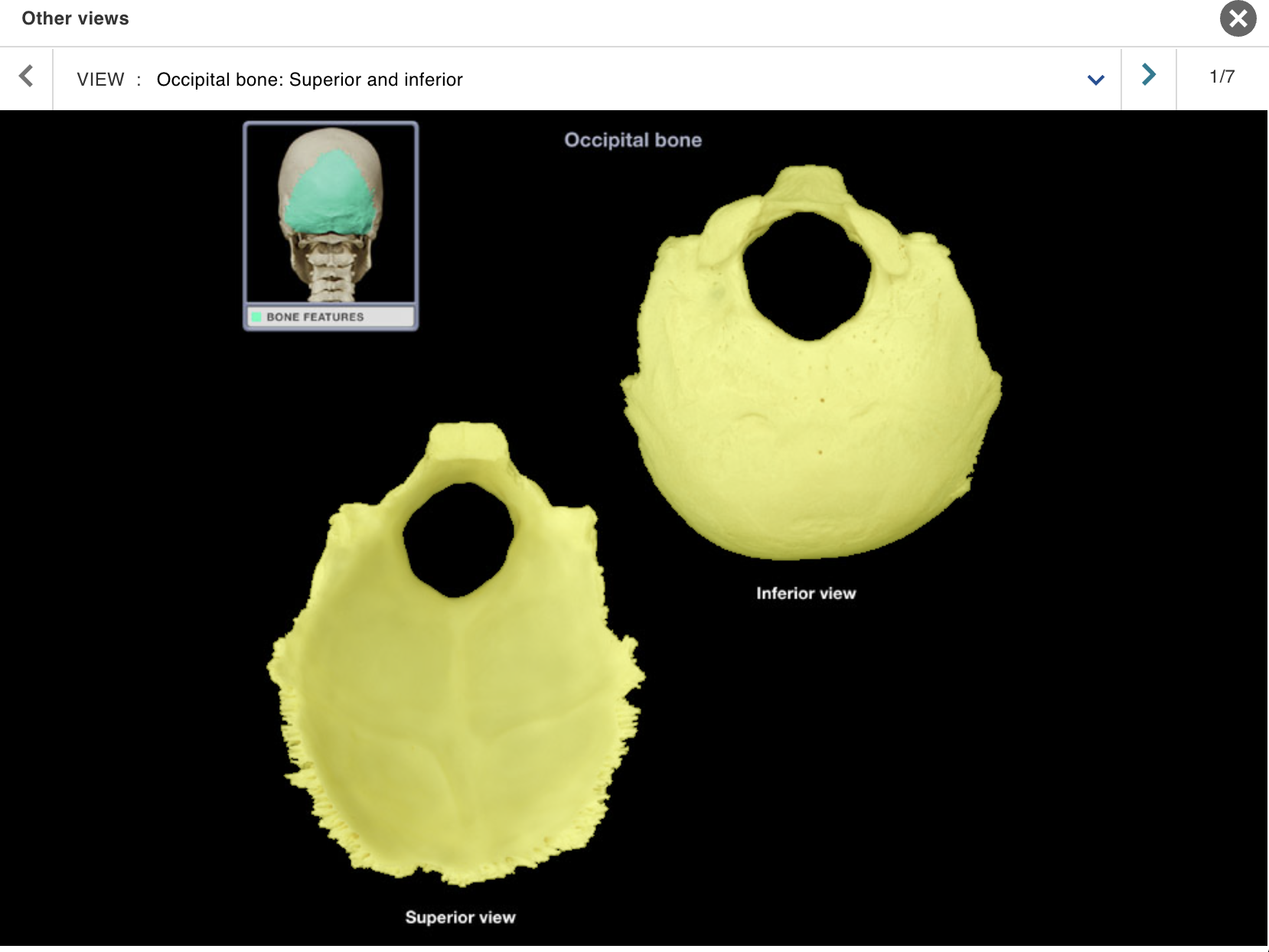
Occipital bone

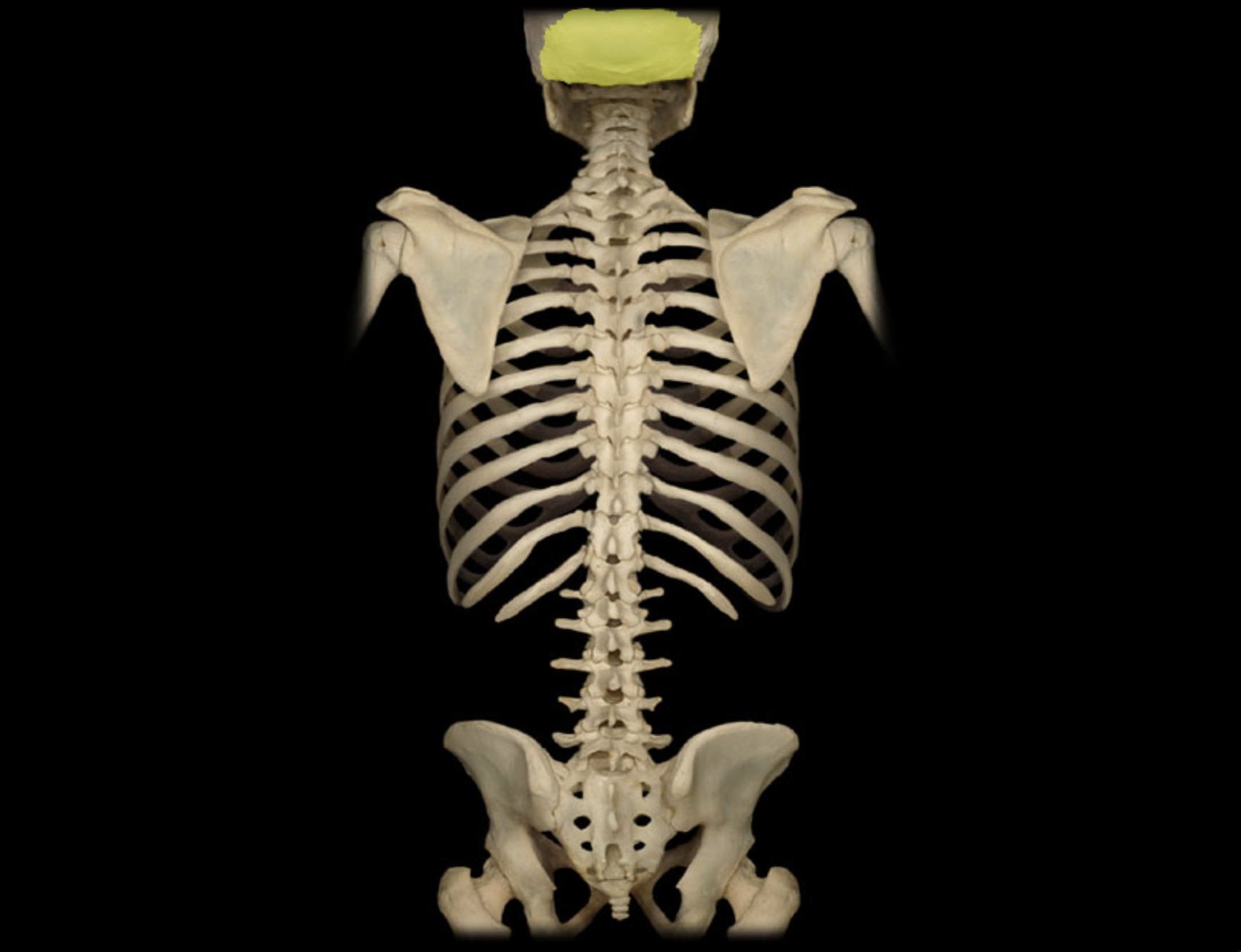
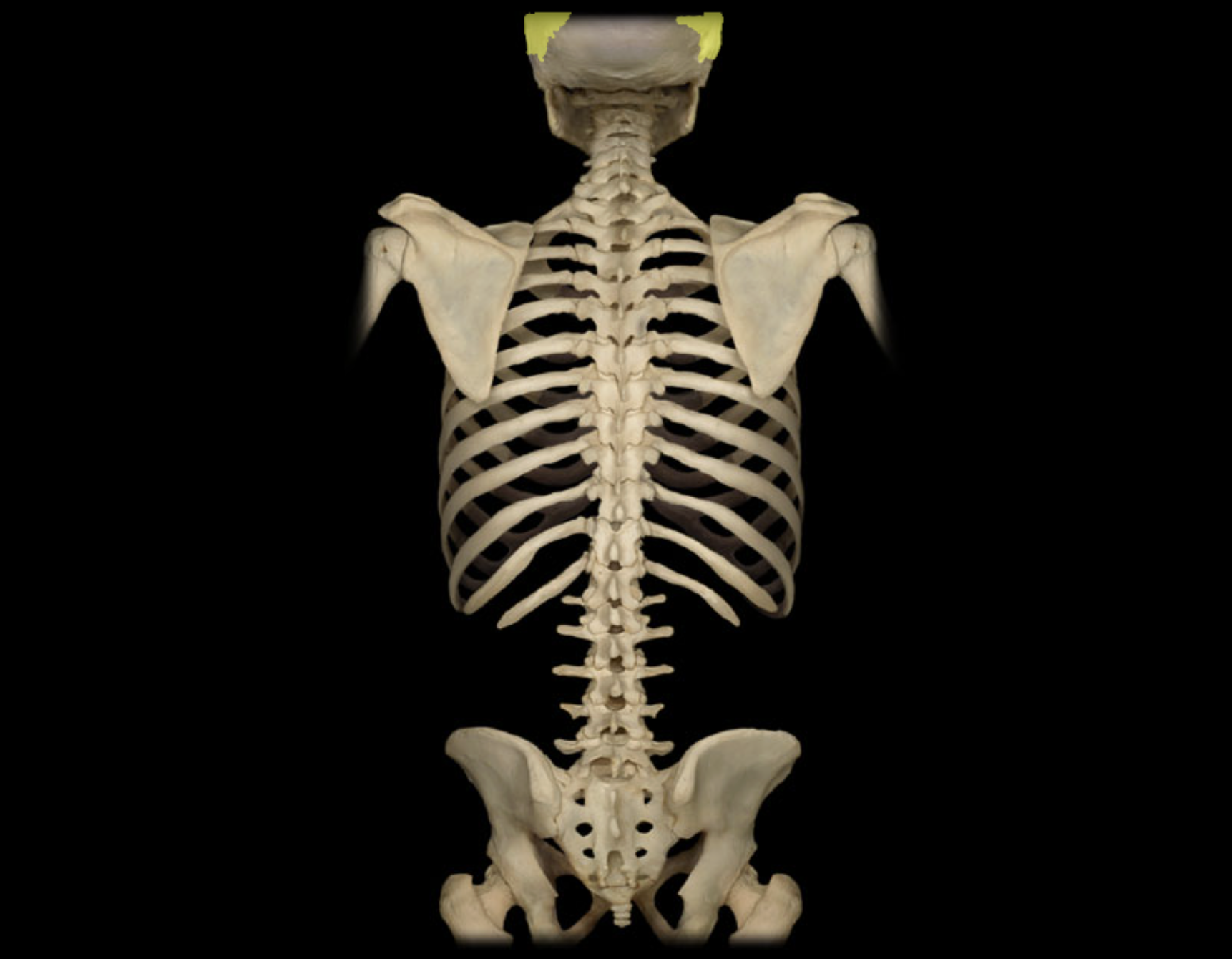
Parietal bone

Pubis

Ribs 1 - 12

Sacrum

Scapula

Spinous process of lumbar vertebra

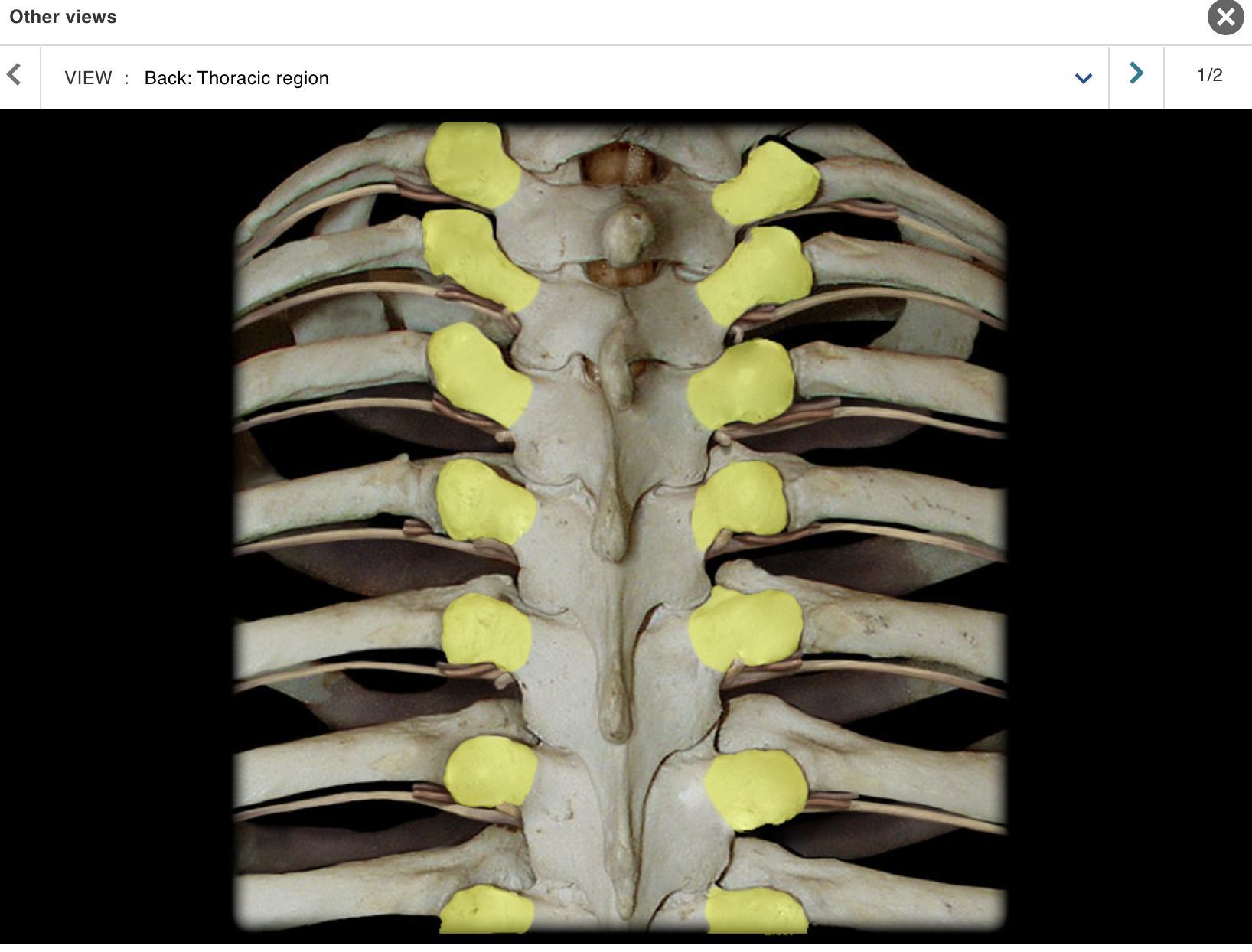
Spinous process of thoracic vertebra

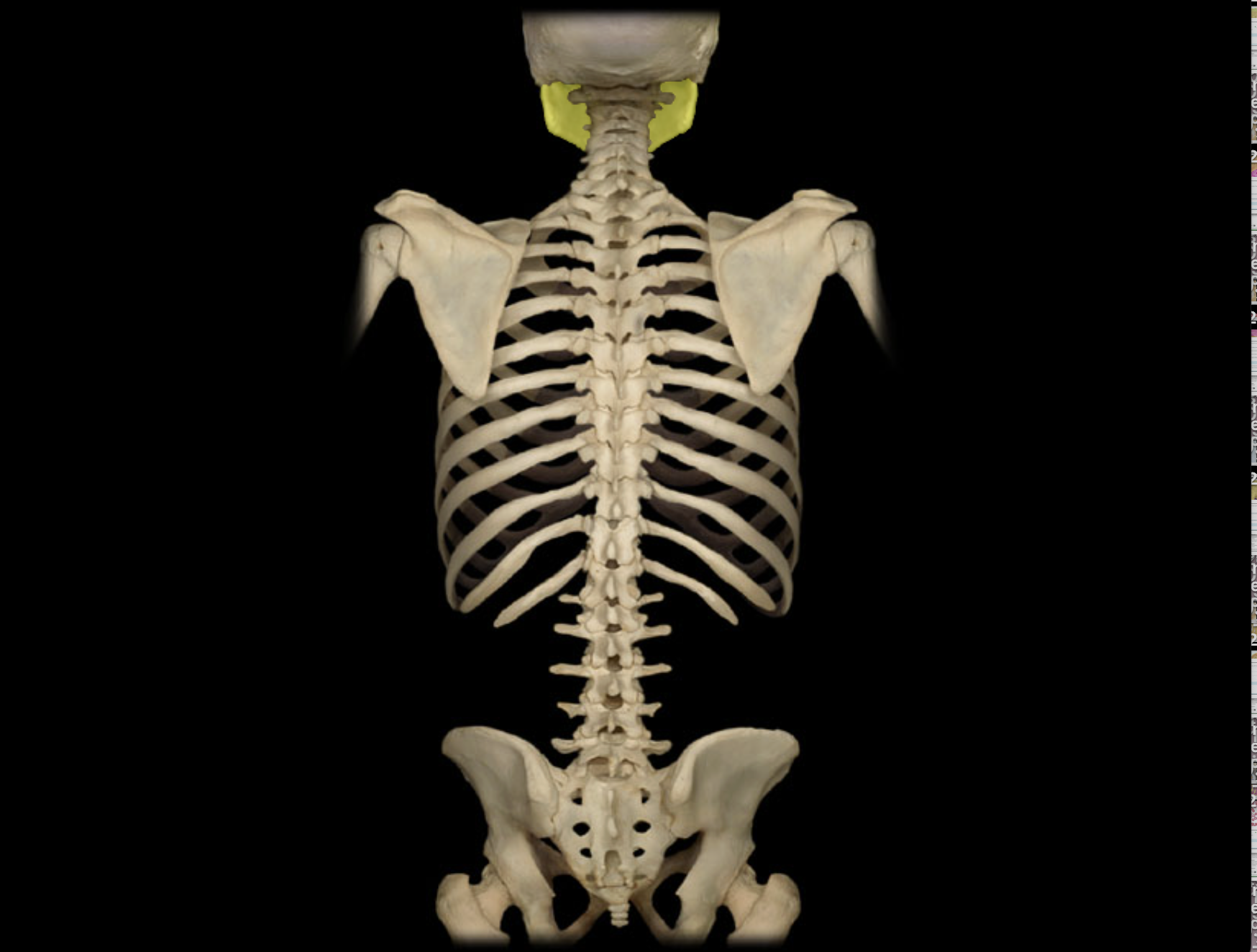
Temporal bone

Thoracic vertebra

Transverse process of lumbar vertebra

Transverse process of thoracic vertebra

58
New cards
<p>Cervical vertebra</p>

Cervical vertebra

Location:

  • Neck

  • Between occipital bone and T1 vertebra

Description:

  • Seven individual vertebrae

  • Characteristic features include transverse foramen and bifid
    (split) spinous process on C3-C6

Comment:

• Atlas (C1 vertebra) articulates with skull

<p>Location:</p><ul><li><p>Neck</p></li><li><p>Between occipital bone and T1 vertebra</p></li></ul><p class="p1">Description:</p><ul><li><p>Seven individual vertebrae</p></li><li><p>Characteristic features include transverse foramen and bifid<br>(split) spinous process on C3-C6</p></li></ul><p class="p1">Comment:</p><p class="p1">• Atlas (C1 vertebra) articulates with skull</p>
59
New cards
<p>Соссух</p>

Соссух

Location:

  • Posterior pelvic wall

  • Lower back, inferior to S5 vertebra

Description:

  • Small, triangular bone

  • Consists of three to five, variably fused, poorly developed vertebrae

Also known as:

• "Tailbone"

Comment:

• Rudiment of the tail in other vertebrates

<p>Location:</p><ul><li><p>Posterior pelvic wall</p></li><li><p>Lower back, inferior to S5 vertebra</p></li></ul><p class="p1">Description:</p><ul><li><p>Small, triangular bone</p></li><li><p>Consists of three to five, variably fused, poorly developed vertebrae</p></li></ul><p class="p1">Also known as:</p><p class="p1">• "Tailbone"</p><p class="p1">Comment:</p><p class="p1">• Rudiment of the tail in other vertebrates</p>
60
New cards
<p>lium</p>

lium

Location:

• Pelvis

Description:

  • Largest of three coxal (hip) bones

  • Has large, wing-like superior extension (ala); the alae form bony walls of greater (false) pelvis

  • Contributes to acetabulum (hip joint socket) and wall of lesser (true) pelvis

  • Articulates with sacrum at sacroiliac joint

Comment:

  • Fused with ischium and pubis in adult to form coxal (hip) bone

  • Bony pelvis formed by paired hip bones and sacrum

<p>Location:</p><p class="p1">• Pelvis</p><p class="p1">Description:</p><ul><li><p>Largest of three coxal (hip) bones</p></li><li><p>Has large, wing-like superior extension (ala); the alae form bony walls of greater (false) pelvis</p></li><li><p>Contributes to acetabulum (hip joint socket) and wall of lesser (true) pelvis</p></li><li><p>Articulates with sacrum at sacroiliac joint</p></li></ul><p>Comment:</p><ul><li><p>Fused with ischium and pubis in adult to form coxal (hip) bone</p></li><li><p>Bony pelvis formed by paired hip bones and sacrum</p></li></ul><p></p>
61
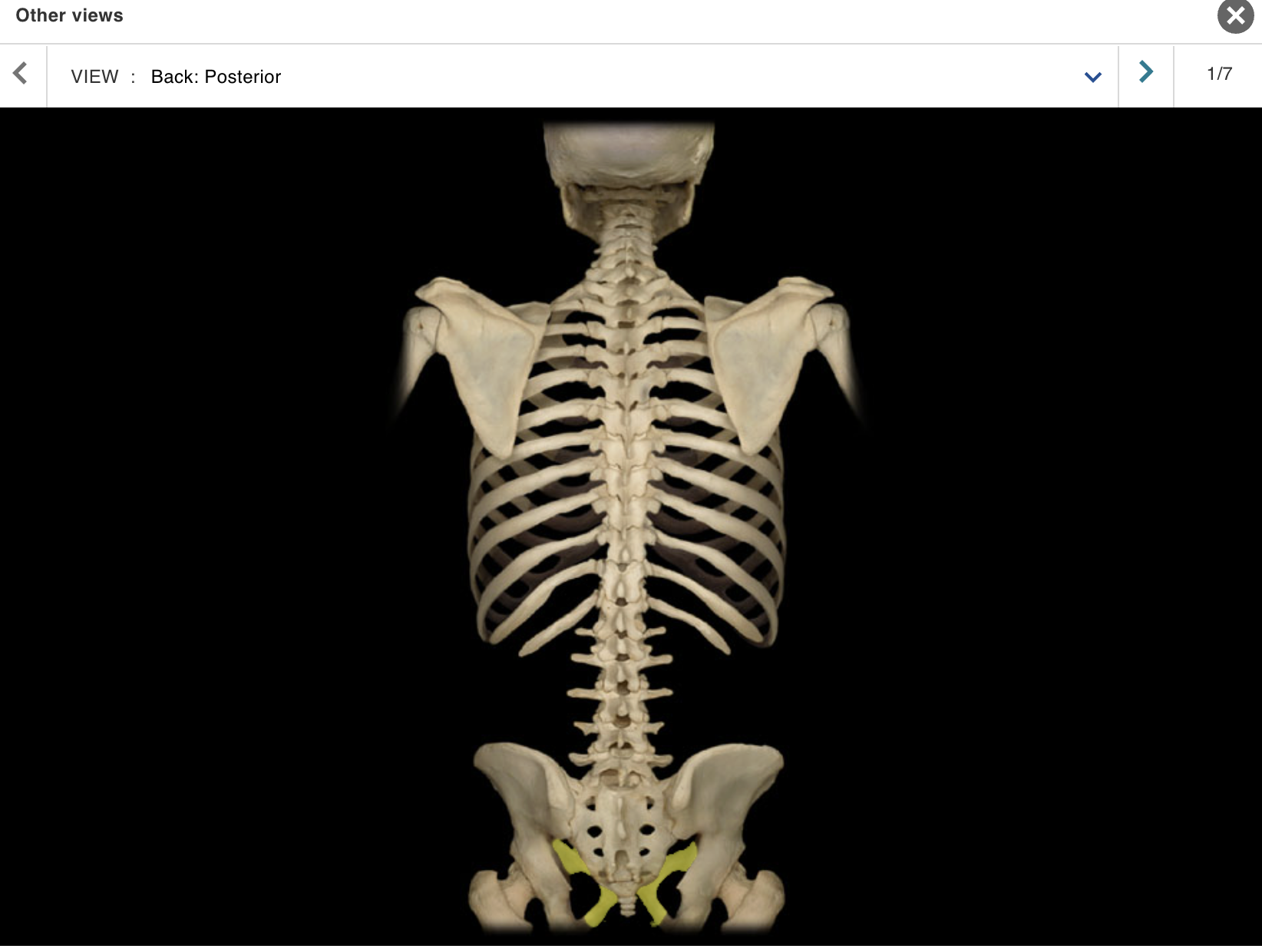
New cards
<p>Ischium</p>

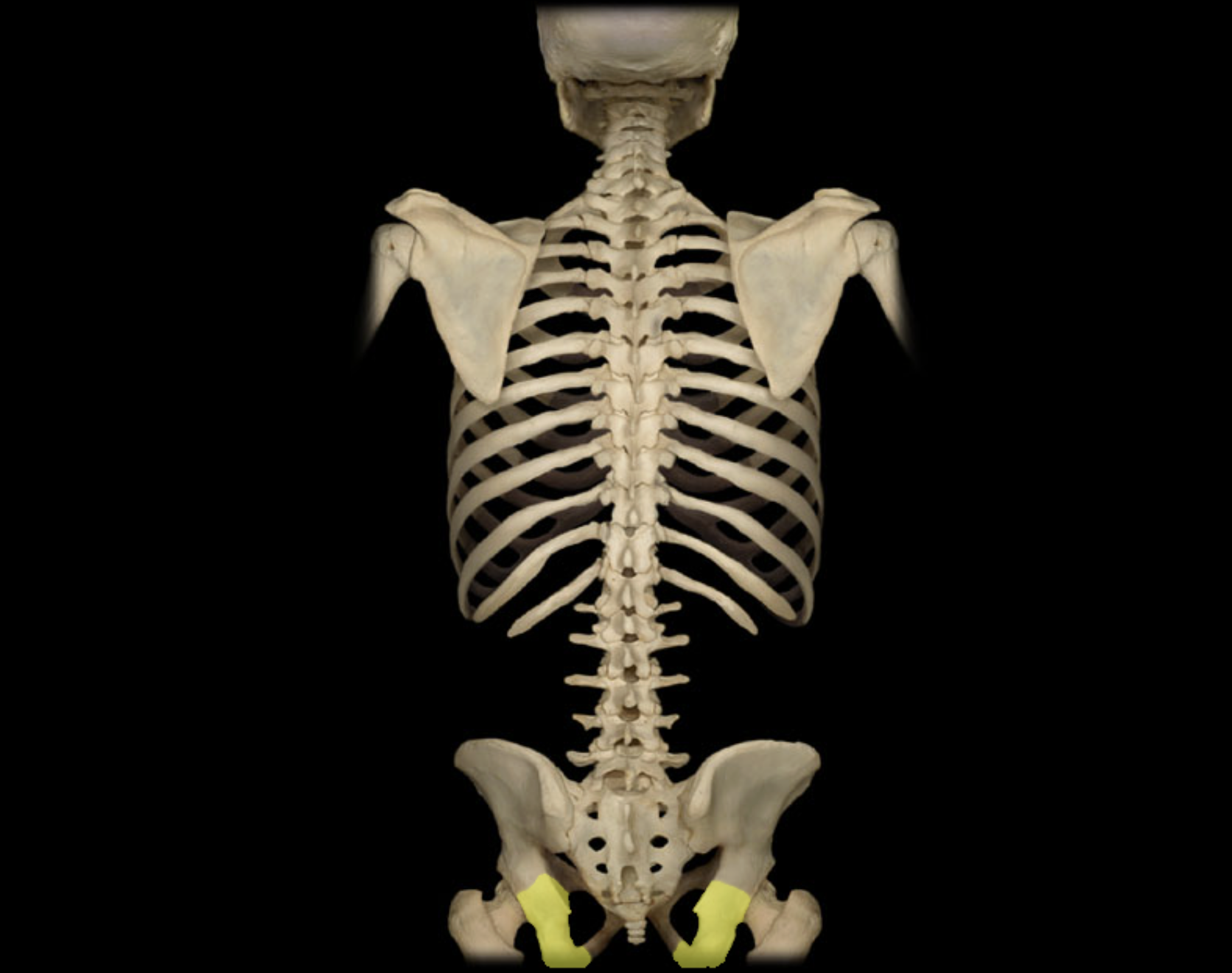
Ischium

Location:

• Pelvis

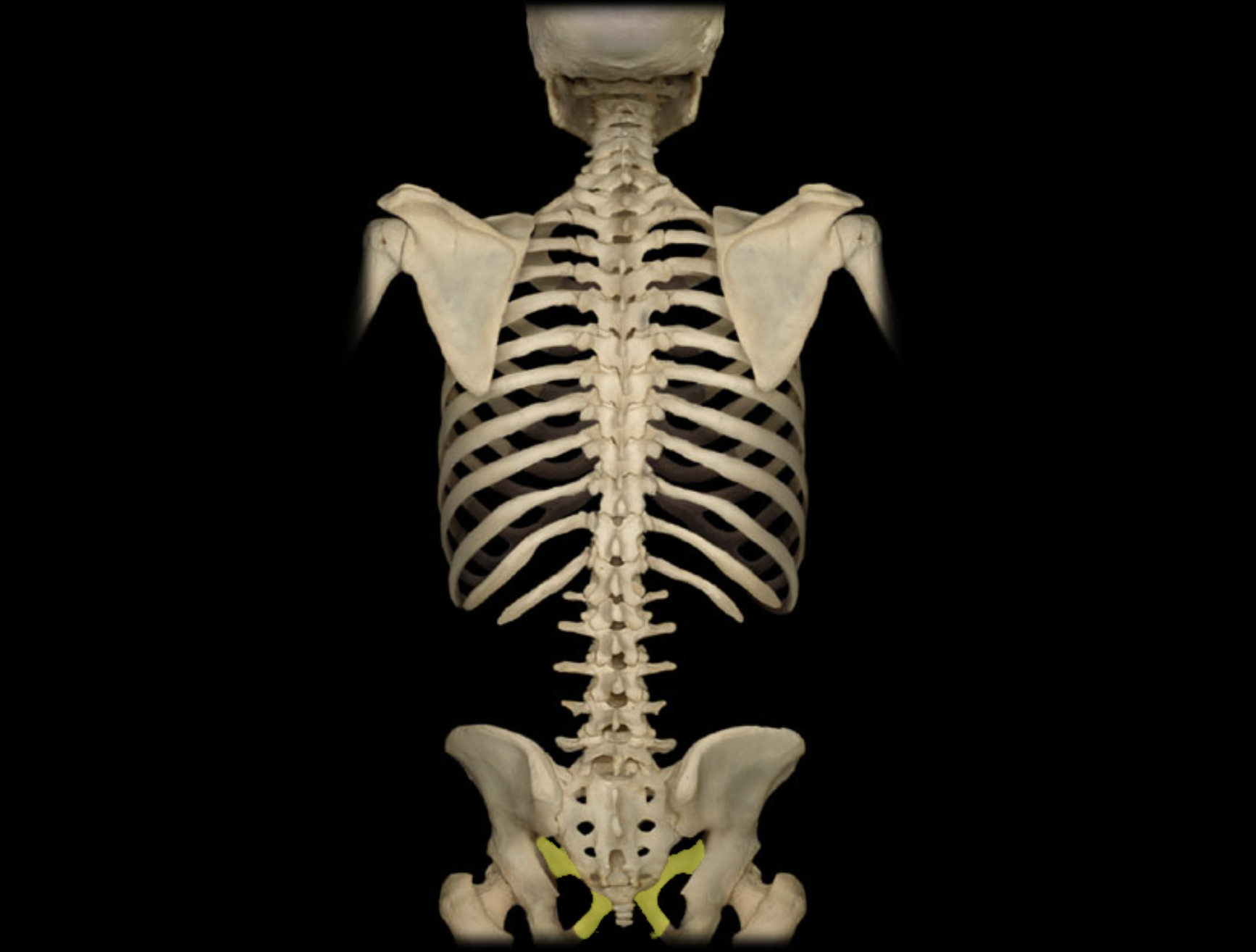
Description:

  • One of three coxal (hip) bones

  • Characteristic features include tuberosity and spine

  • Contributes to acetabulum (hip joint socket), obturator foramen, and wall of lesser (true) pelvis

Comment:

  • Fused with ilium and pubis in adult to form coxal (hip) bone

  • Bony pelvis formed by paired hip bones and sacrum

  • Obturator foramen formed by rami of pubis and ischium

<p>Location:</p><p class="p1">• Pelvis</p><p class="p1">Description:</p><ul><li><p>One of three coxal (hip) bones</p></li><li><p>Characteristic features include tuberosity and spine</p></li><li><p>Contributes to acetabulum (hip joint socket), obturator foramen, and wall of lesser (true) pelvis</p></li></ul><p>Comment:</p><ul><li><p>Fused with ilium and pubis in adult to form coxal (hip) bone</p></li><li><p>Bony pelvis formed by paired hip bones and sacrum</p></li><li><p>Obturator foramen formed by rami of pubis and ischium</p></li></ul><p></p>
62
New cards
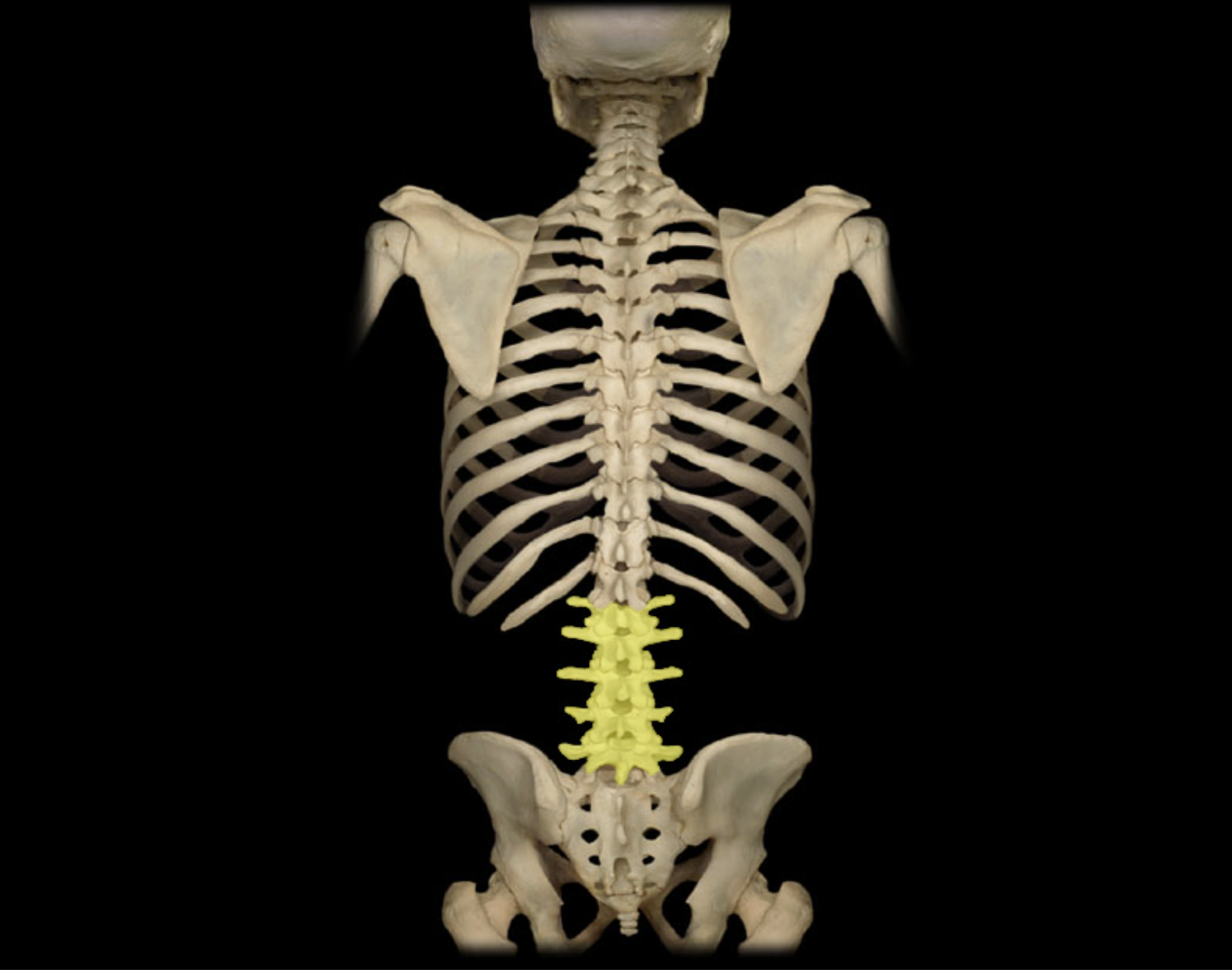
<p>Lumbar vertebra</p>

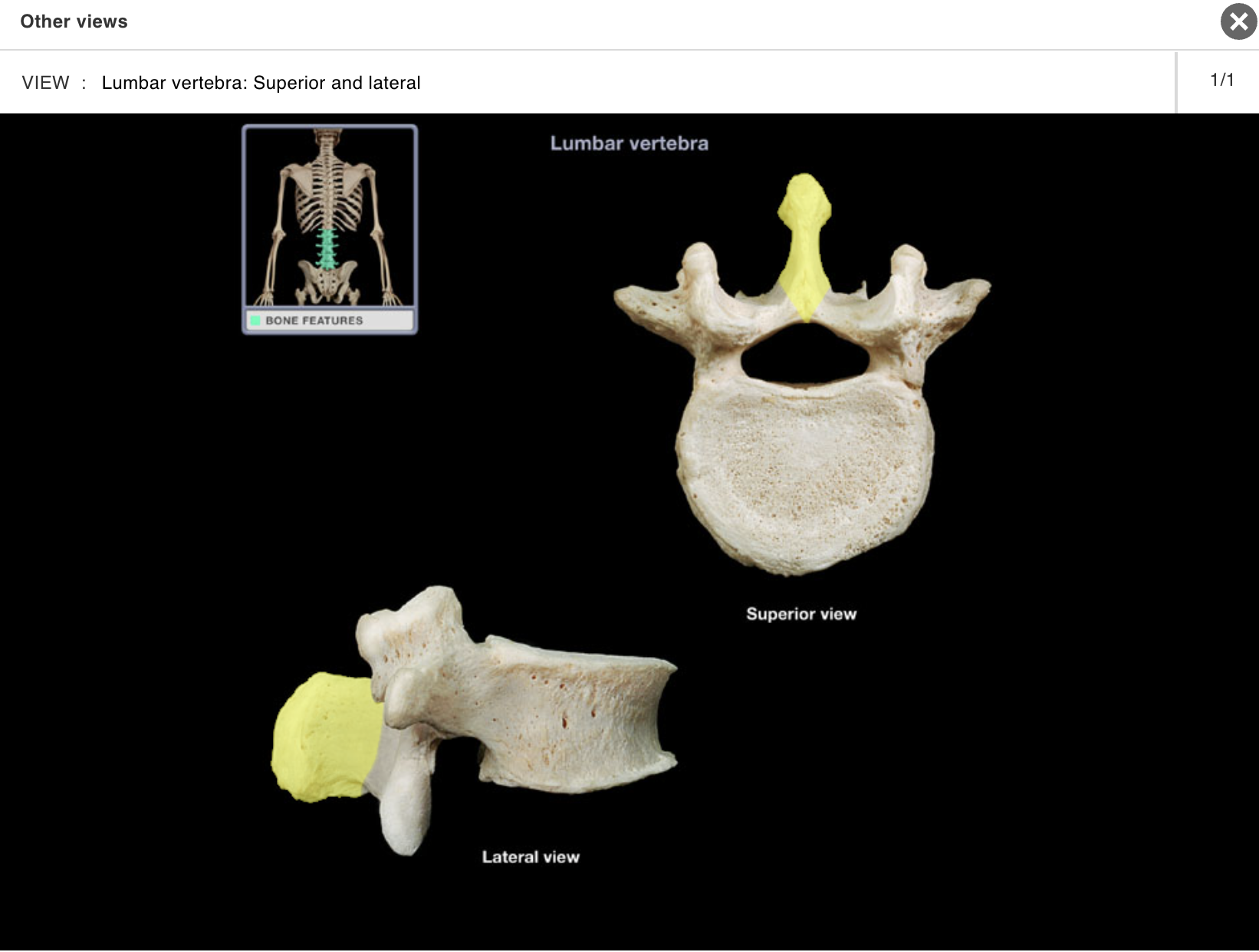
Lumbar vertebra

Location:

  • Lower back

  • Between T12 and S1 vertebrae

Description:

  • Five individual vertebrae

  • Characteristic features include large size, kidney bean-shaped body, and a thick, blunt spinous process

Comment:

  • Bodies arranged to form prominent anterior convexity (lumbar curvature; also known as lumbar lordosis, which can be accentuated pathologically)

  • Intervertebral discs between lumbar vertebrae most commonly herniate ("slipped-disk")

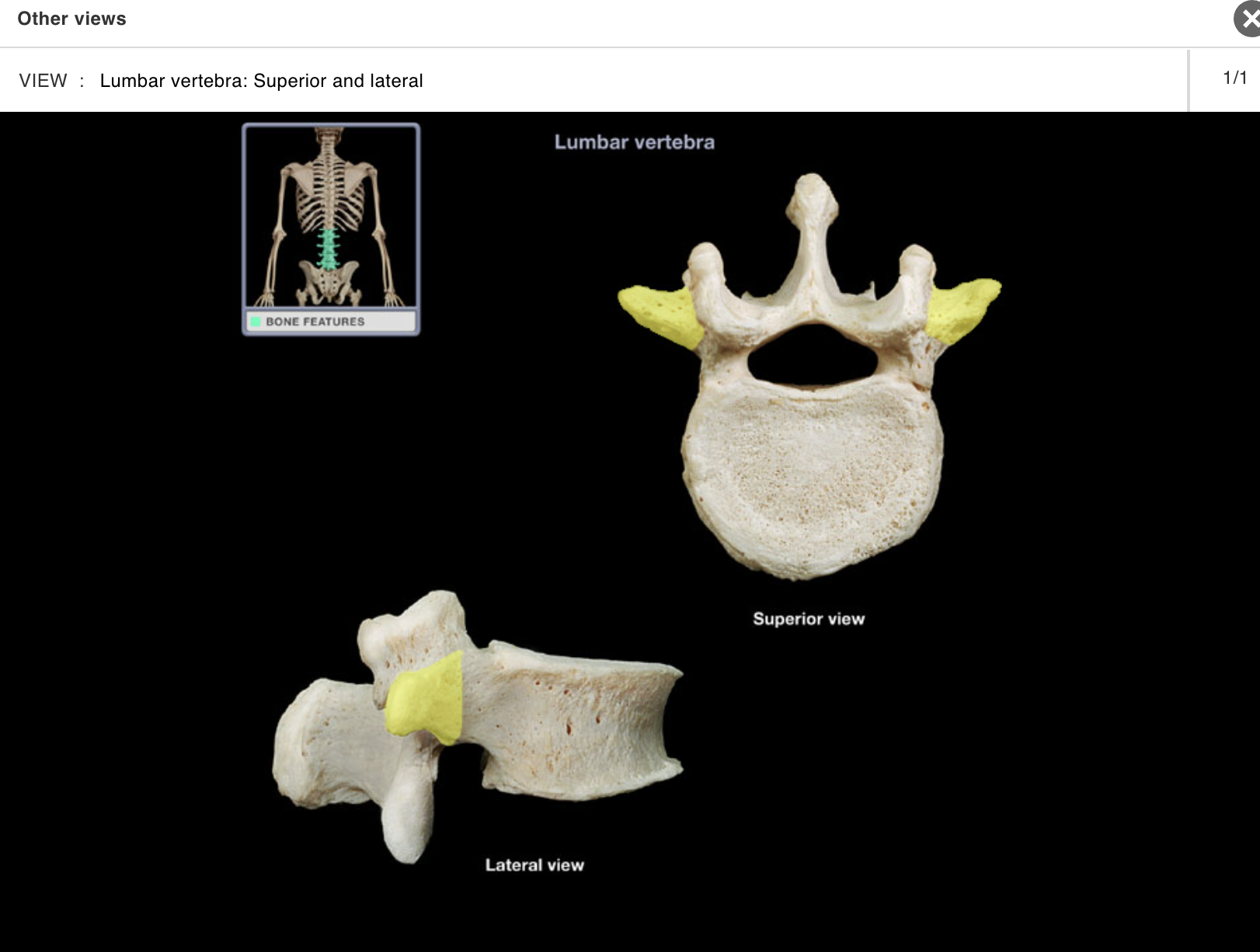
<p>Location:</p><ul><li><p>Lower back</p></li><li><p>Between T12 and S1 vertebrae</p></li></ul><p class="p1">Description:</p><ul><li><p>Five individual vertebrae</p></li><li><p>Characteristic features include large size, kidney bean-shaped body, and a thick, blunt spinous process</p></li></ul><p>Comment:</p><ul><li><p>Bodies arranged to form prominent anterior convexity (lumbar curvature; also known as lumbar lordosis, which can be accentuated pathologically)</p></li><li><p>Intervertebral discs between lumbar vertebrae most commonly herniate ("slipped-disk")</p></li></ul><p></p>
63
New cards
<p>Mandible</p>

Mandible

Location:

• Skull (anterior)

Description:

  • U-shaped bone

  • Each side consists of body (horizontal) and ramus (vertical) with coronoid and condylar processes

  • Mental protuberance forms point of chin

  • Contains alveoli ("sockets") for teeth

Also known as:

• "Lower jaw"

Comment:

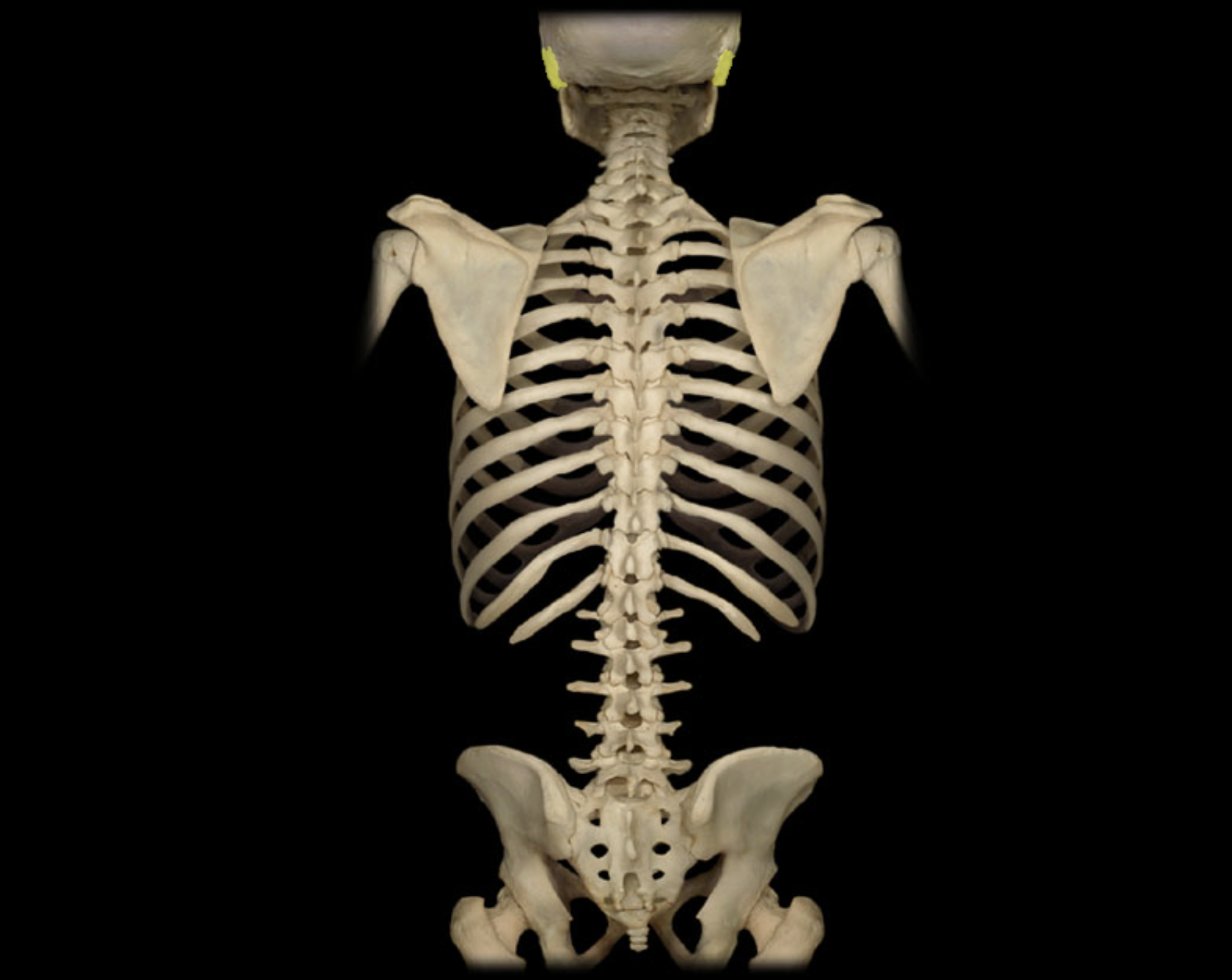
• Contributes to temporomandibular joint (TMJ)

<p>Location:</p><p class="p1">• Skull (anterior)</p><p class="p1">Description:</p><ul><li><p>U-shaped bone</p></li><li><p>Each side consists of body (horizontal) and ramus (vertical) with coronoid and condylar processes</p></li><li><p>Mental protuberance forms point of chin</p></li><li><p>Contains alveoli ("sockets") for teeth</p></li></ul><p>Also known as:</p><p class="p1">• "Lower jaw"</p><p class="p1">Comment:</p><p class="p1">• Contributes to temporomandibular joint (TMJ)</p>
64
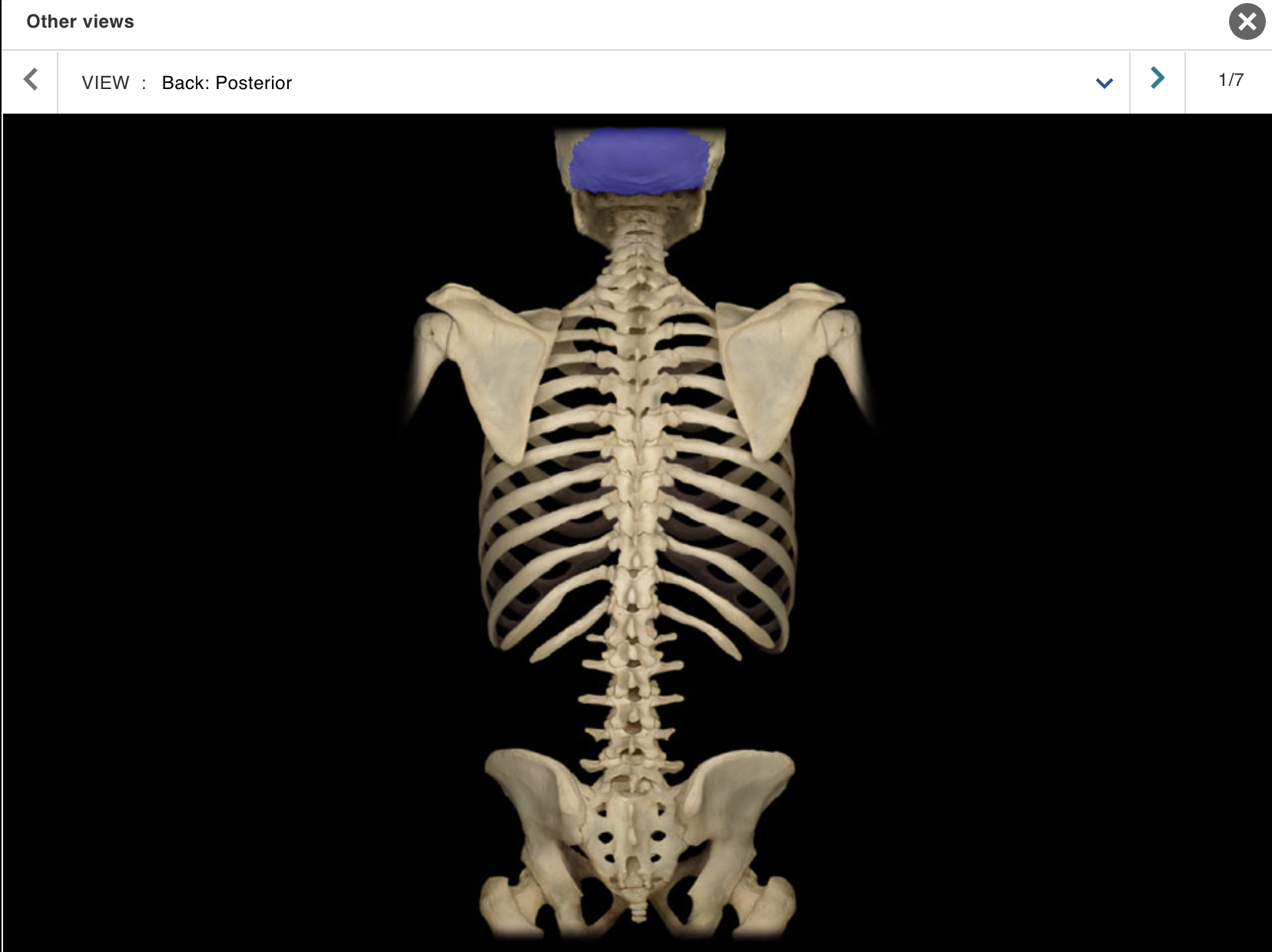
New cards
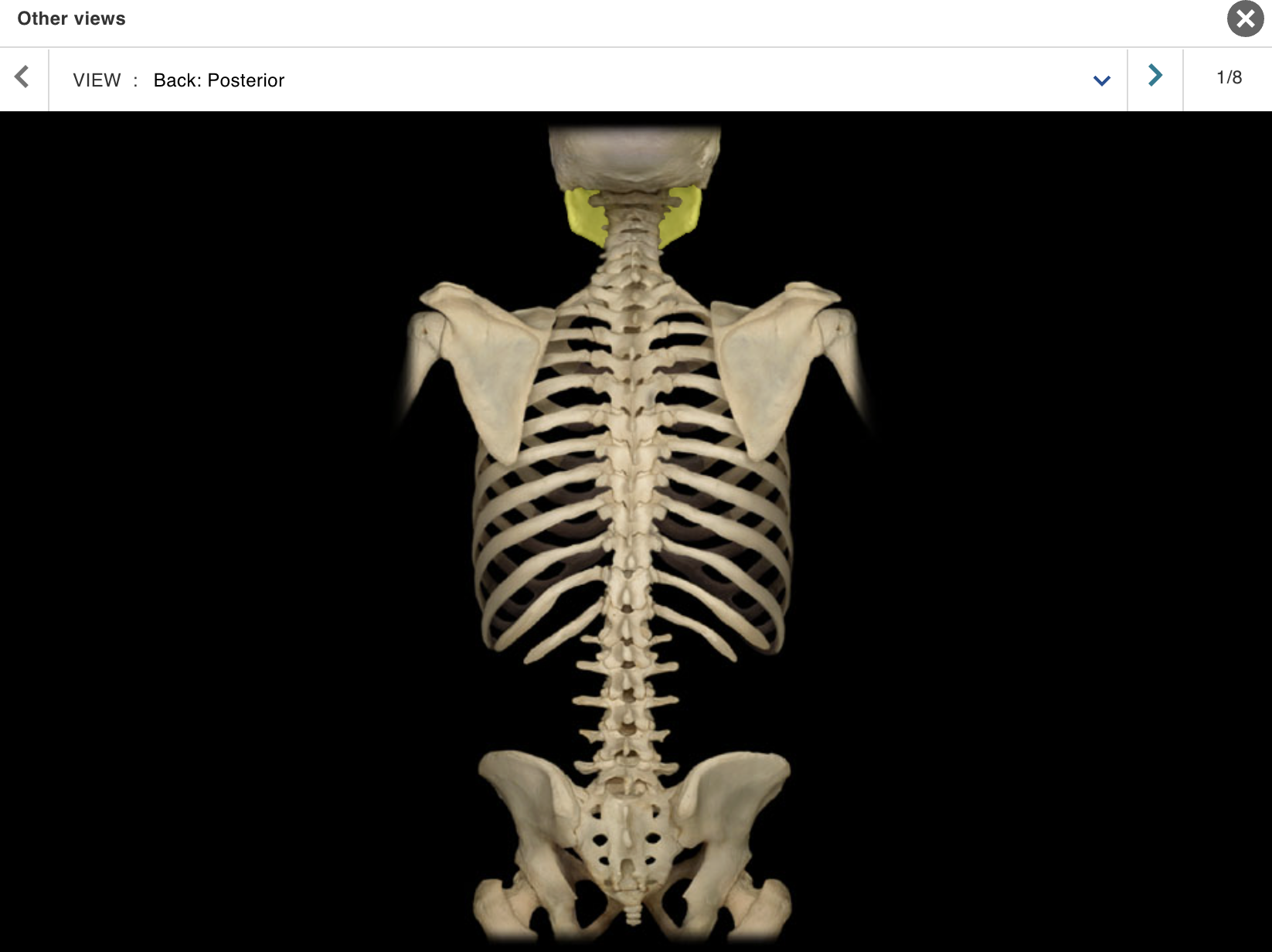
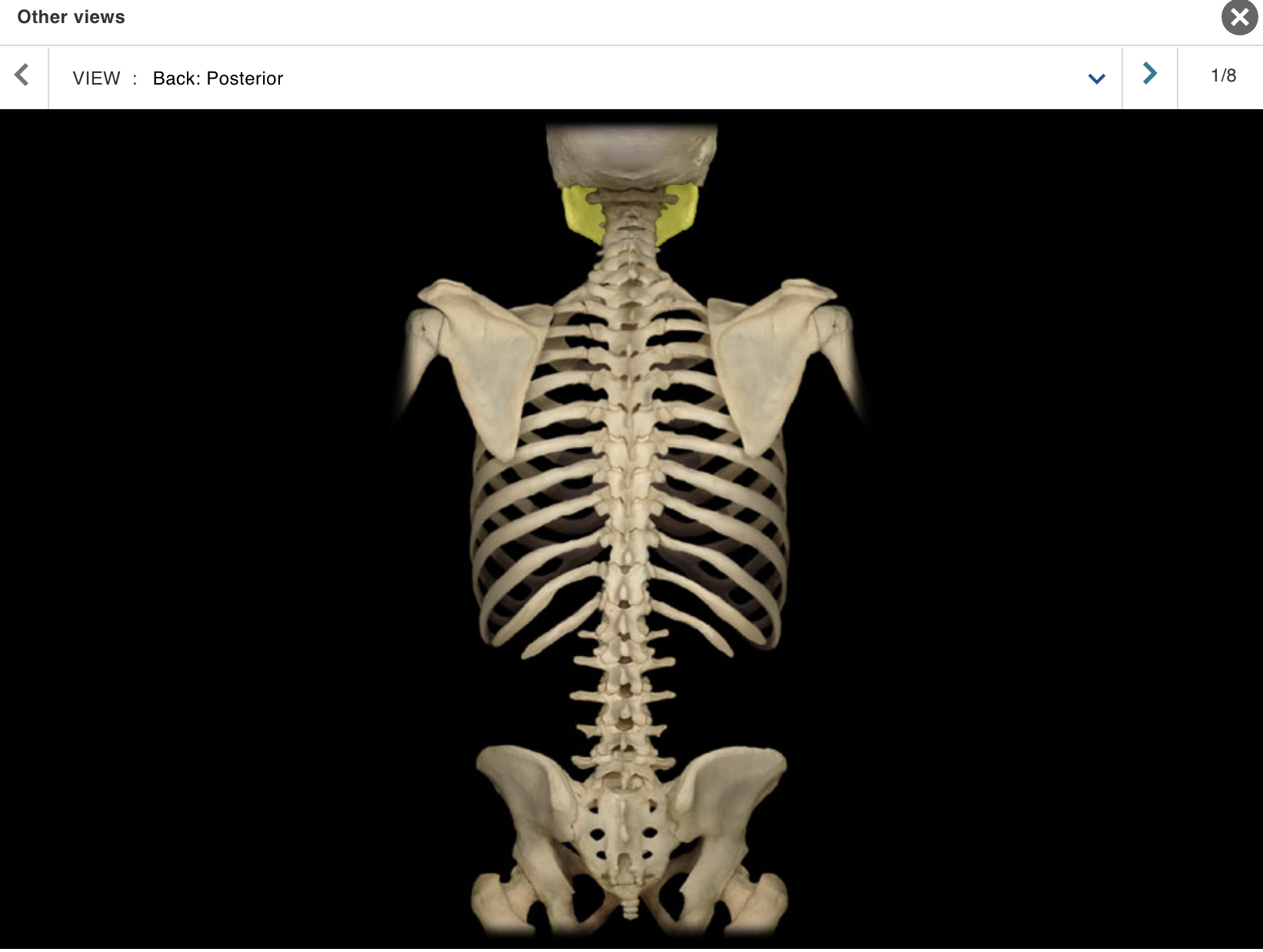
<p>Occipital bone</p>

Occipital bone

Location:

• Skull (posterior and inferior)

Description:

  • Irregular-shaped bone

  • Contains foramen magnum in central portion

Comment:

  • Forms most of posterior skull

  • Forms most of posterior cranial fossa

  • Articulates with parietal bone at lambdoid suture, temporal bone at occipitomastoid and other sutures, and sphenoid bone at spheno-occipital synchondrosis

  • Articulates with atlas (C1 vertebra)

<p>Location:</p><p class="p1">• Skull (posterior and inferior)</p><p class="p1">Description:</p><ul><li><p>Irregular-shaped bone</p></li><li><p>Contains foramen magnum in central portion</p></li></ul><p class="p1">Comment:</p><ul><li><p>Forms most of posterior skull</p></li><li><p>Forms most of posterior cranial fossa</p></li><li><p>Articulates with parietal bone at lambdoid suture, temporal bone at occipitomastoid and other sutures, and sphenoid bone at spheno-occipital synchondrosis</p></li><li><p>Articulates with atlas (C1 vertebra)</p></li></ul><p></p>
65
New cards
<p>Parietal bone</p>

Parietal bone

Location:

• Skull (lateral)

Description:

  • Paired, flat bone

  • Forms most of lateral skull

Comment:

  • Parietal bones articulate at sagittal suture (midline)

  • Articulates with frontal bone at coronal suture, occipital bone at lambdoid suture, and temporal bone at squamosal suture

<p>Location:</p><p class="p1">• Skull (lateral)</p><p class="p1">Description:</p><ul><li><p>Paired, flat bone</p></li><li><p>Forms most of lateral skull</p></li></ul><p class="p1">Comment:</p><ul><li><p>Parietal bones articulate at sagittal suture (midline)</p></li><li><p>Articulates with frontal bone at coronal suture, occipital bone at lambdoid suture, and temporal bone at squamosal suture</p></li></ul><p></p>
66
New cards
<p>Pubis</p>

Pubis

Location:

• Pelvis

Description:

  • One of three coxal (hip) bones

  • Characteristic features include body and rami (superior and inferior)

  • Midline junction of pubic bones forms pubic symphysis

  • Contributes to acetabulum (hip joint socket), obturator foramen, and wall of lesser (true) pelvis

Comment:

  • Fused with ilium and ischium in adult to form coxal (hip) bone

  • Bony pelvis formed by paired hip bones and sacrum

  • Obturator foramen formed by rami of pubis and ischium

<p>Location:</p><p class="p1">• Pelvis</p><p class="p1">Description:</p><ul><li><p>One of three coxal (hip) bones</p></li><li><p>Characteristic features include body and rami (superior and inferior)</p></li><li><p>Midline junction of pubic bones forms pubic symphysis</p></li><li><p>Contributes to acetabulum (hip joint socket), obturator foramen, and wall of lesser (true) pelvis</p></li></ul><p>Comment:</p><ul><li><p>Fused with ilium and ischium in adult to form coxal (hip) bone</p></li><li><p>Bony pelvis formed by paired hip bones and sacrum</p></li><li><p>Obturator foramen formed by rami of pubis and ischium</p></li></ul><p></p>
67
New cards
<p>Ribs 1 - 12</p>

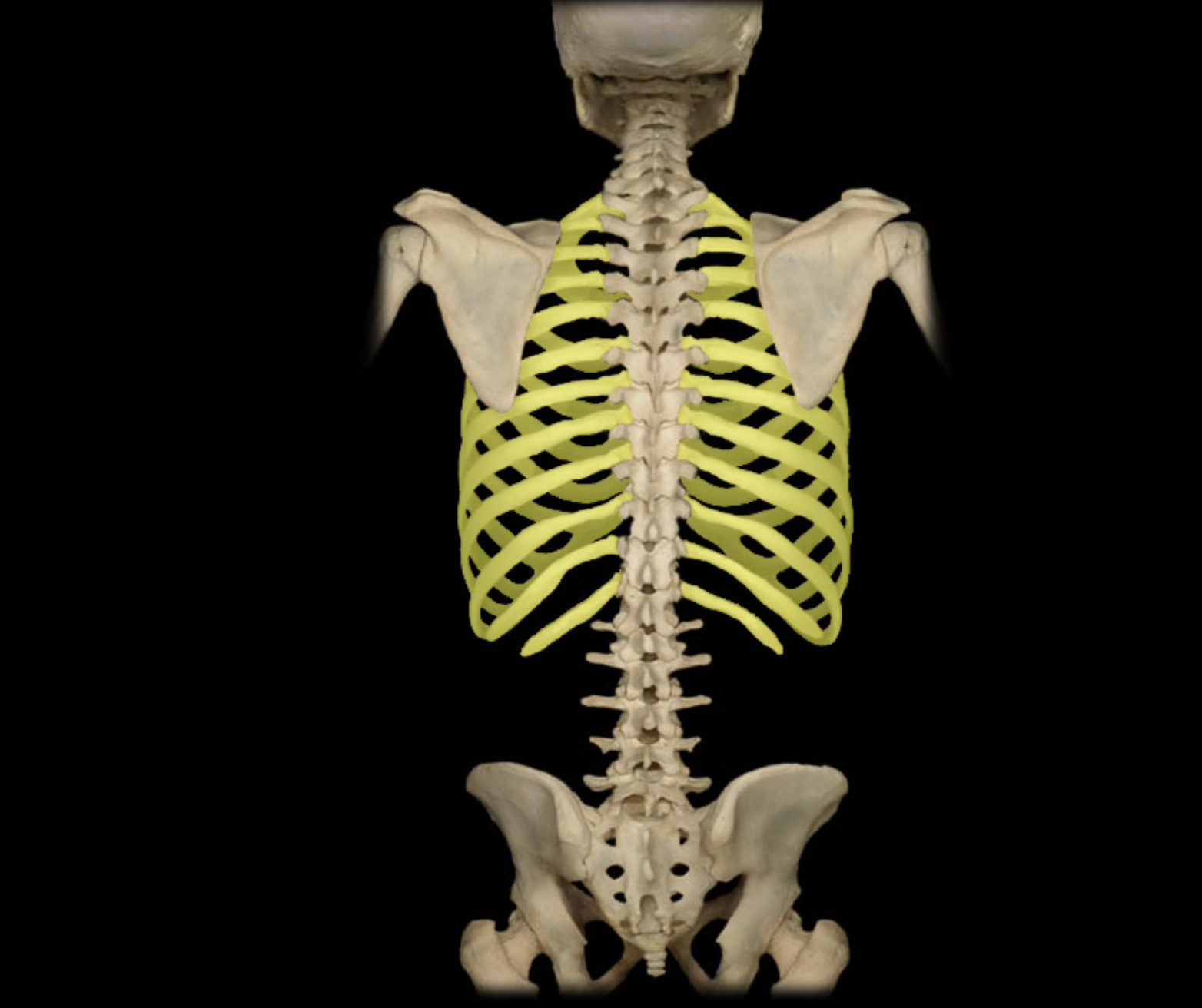
Ribs 1 - 12

Location:

• Thorax

Description:

  • Twelve pairs of curved, flat bones

  • All ribs: articulate with thoracic vertebrae

  • True ribs (ribs 1-7): attached directly to sternum by costal cartilages

  • False ribs (ribs 8-10): attach indirectly to sternum via shared costal cartilages

  • Floating ribs (ribs 11-12): not attached to sternum

Comment:

• Alternate definition: some include the floating ribs (11-12) as a subcategory of false ribs

<p>Location:</p><p class="p1">• Thorax</p><p class="p1">Description:</p><ul><li><p>Twelve pairs of curved, flat bones</p></li><li><p>All ribs: articulate with thoracic vertebrae</p></li><li><p>True ribs (ribs 1-7): attached directly to sternum by costal cartilages</p></li><li><p>False ribs (ribs 8-10): attach indirectly to sternum via shared costal cartilages</p></li><li><p>Floating ribs (ribs 11-12): not attached to sternum</p></li></ul><p>Comment:</p><p class="p1">• Alternate definition: some include the floating ribs (11-12) as a subcategory of false ribs</p>
68
New cards
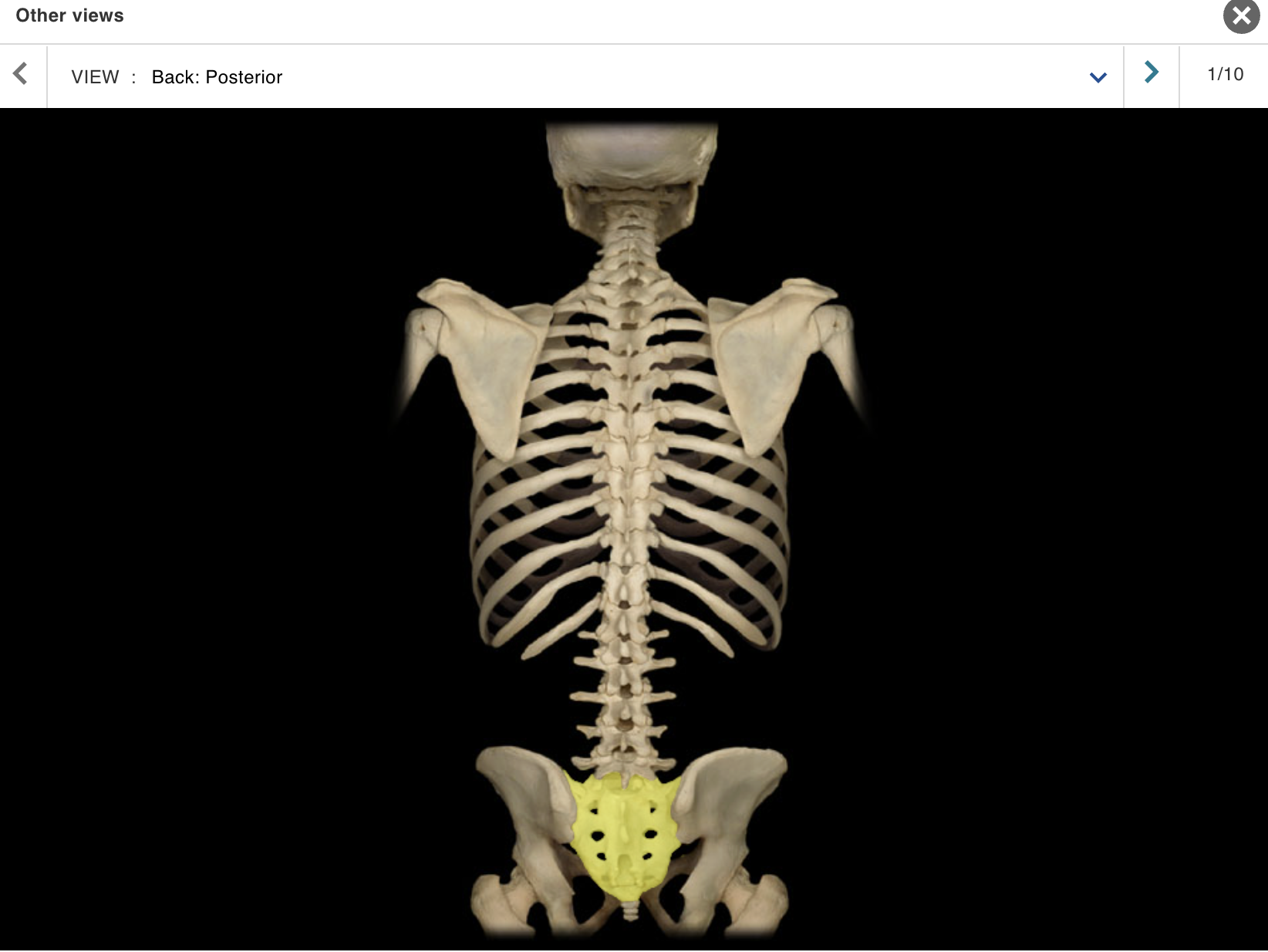
<p>Sacrum</p>

Sacrum

Location:

  • Lower back

  • Between L5 and Co1 vertebrae

  • Posterior wall of pelvis

Description:

  • Five fused vertebrae

  • Triangular bone wedged between hip bones

Comment:

• Sacral promontory (the prominent, projecting edge of base of sacrum formed by superior border of S1 vertebral body) is landmark for establishing female pelvic dimensions

<p>Location:</p><ul><li><p>Lower back</p></li><li><p>Between L5 and Co1 vertebrae</p></li><li><p>Posterior wall of pelvis</p></li></ul><p class="p1">Description:</p><ul><li><p>Five fused vertebrae</p></li><li><p>Triangular bone wedged between hip bones</p></li></ul><p>Comment:</p><p class="p1">• Sacral promontory (the prominent, projecting edge of base of sacrum formed by superior border of S1 vertebral body) is landmark for establishing female pelvic dimensions</p>
69
New cards
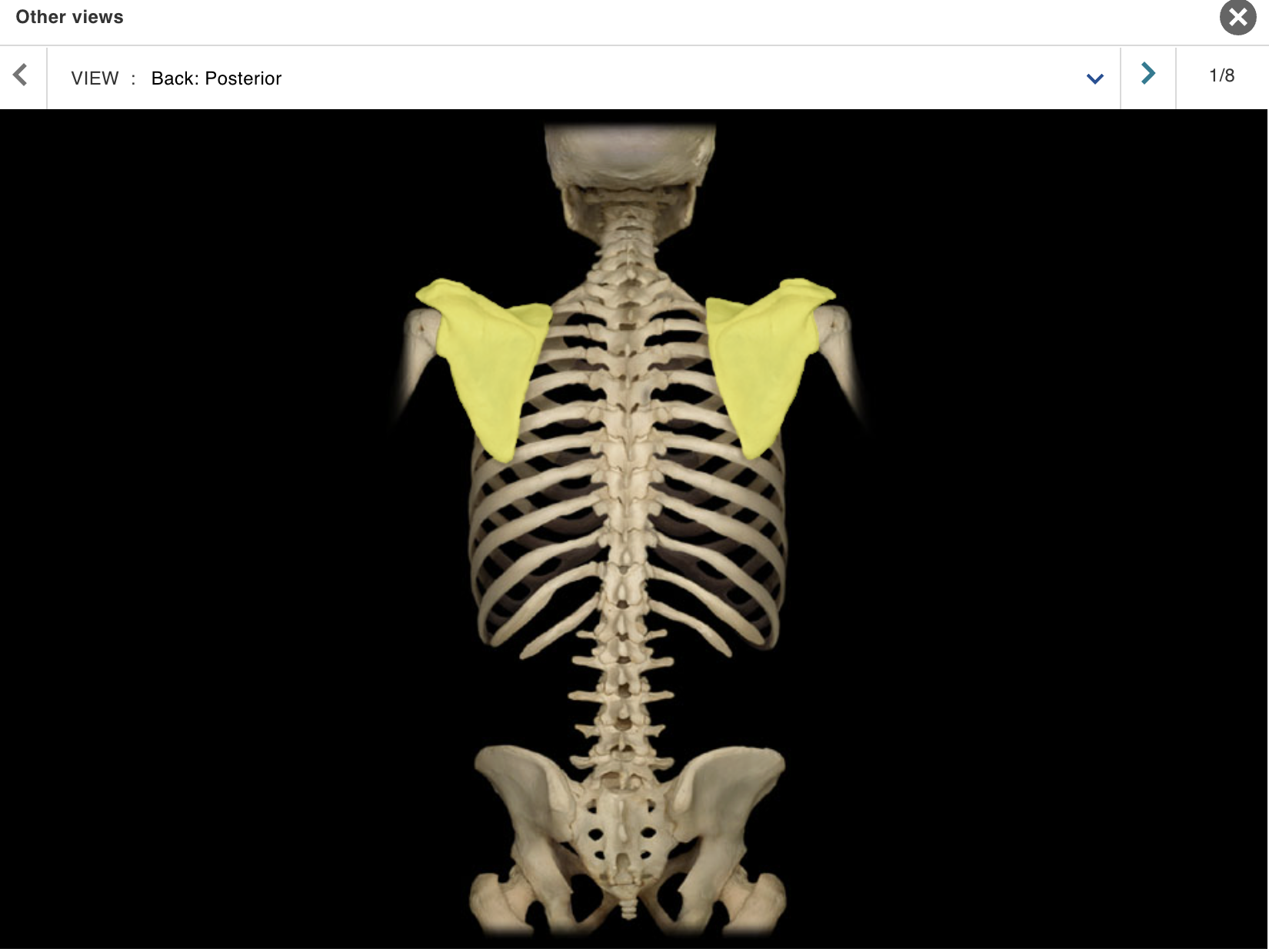
<p>Scapula</p>

Scapula

Location:

  • Posterior thorax

  • Overlies ribs 2-7

Description:

  • Large, triangular, flat bone

  • Characteristic features include spine, acromion, coracoid process, and glenoid cavity

<p>Location:</p><ul><li><p>Posterior thorax</p></li><li><p>Overlies ribs 2-7</p></li></ul><p class="p1">Description:</p><ul><li><p>Large, triangular, flat bone</p></li><li><p>Characteristic features include spine, acromion, coracoid process, and glenoid cavity</p></li></ul><p></p>
70
New cards
<p>Spinous process of lumbar vertebra</p>

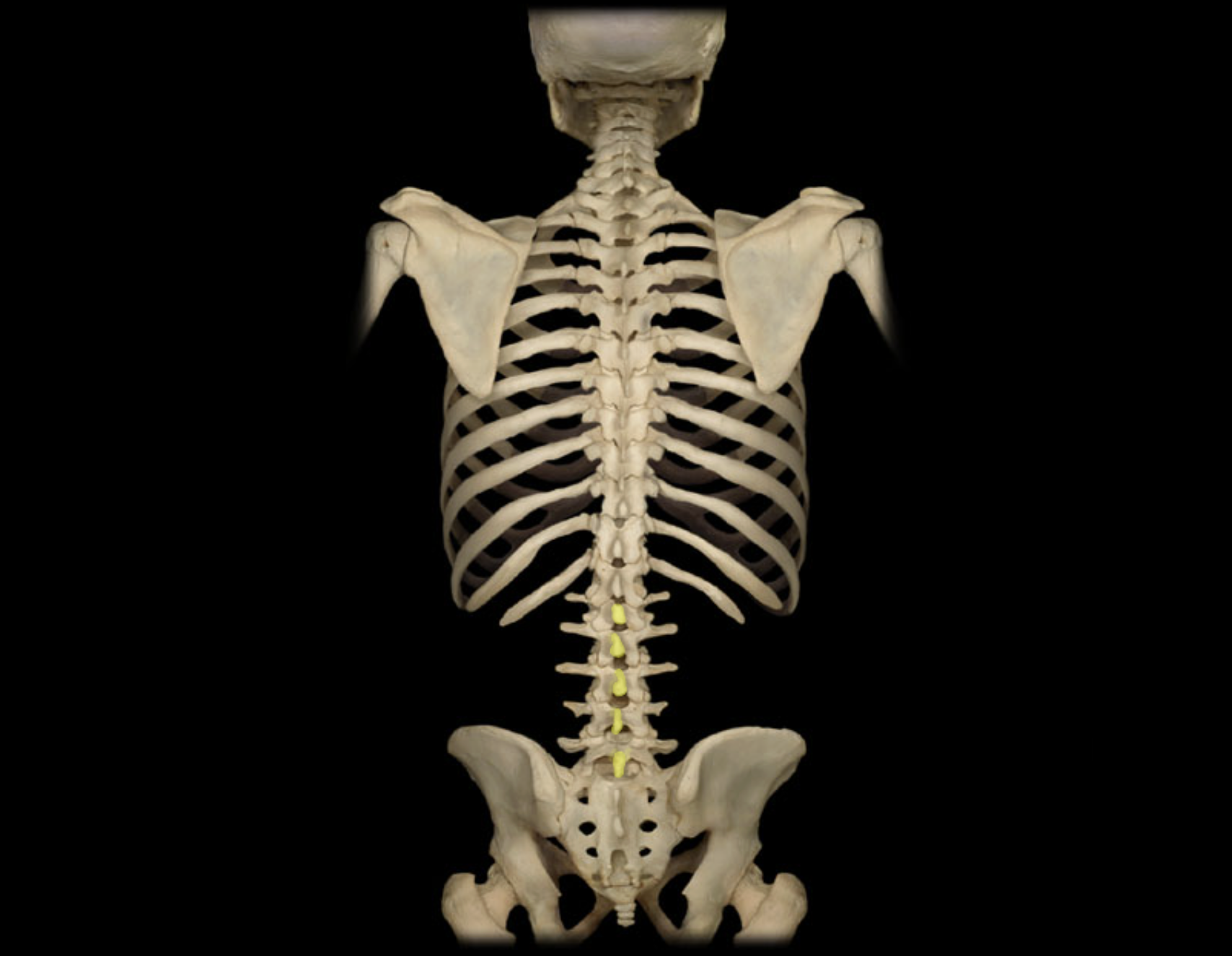
Spinous process of lumbar vertebra

Location:

• Vertebrae (posterior aspect)

Description:

  • Unpaired, posterior projection from midline of vertebral arch

  • Has characteristic thick, blunt form

Comment:

  • Spinous process present on all vertebrae except the atlas (C1 vertebra) and coccygeal vertebrae

  • Provides attachment for muscles and ligaments

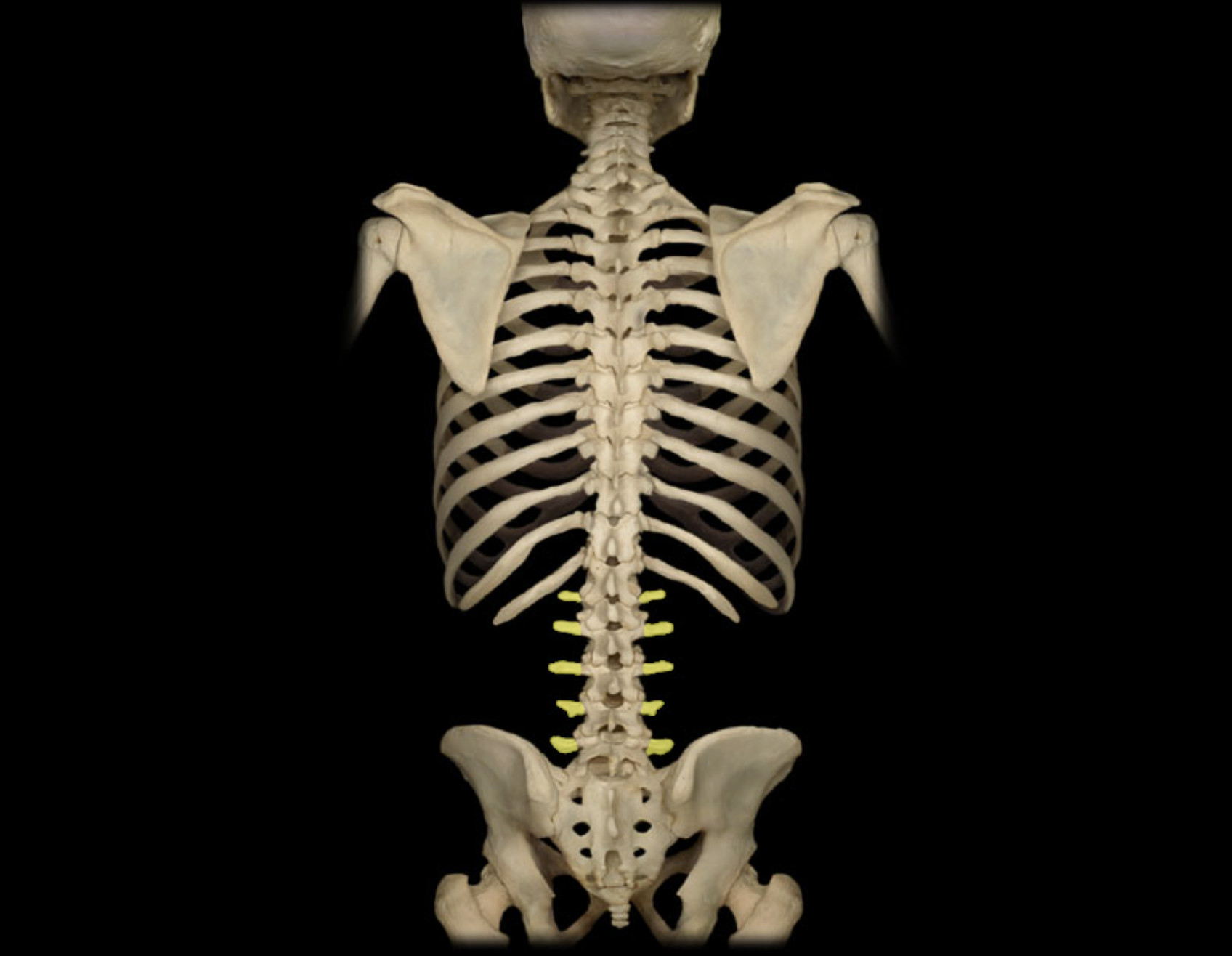
<p>Location:</p><p class="p1">• Vertebrae (posterior aspect)</p><p class="p1">Description:</p><ul><li><p>Unpaired, posterior projection from midline of vertebral arch</p></li><li><p>Has characteristic thick, blunt form</p></li></ul><p class="p1">Comment:</p><ul><li><p>Spinous process present on all vertebrae except the atlas (C1 vertebra) and coccygeal vertebrae</p></li><li><p>Provides attachment for muscles and ligaments</p></li></ul><p></p>
71
New cards
<p>Spinous process of thoracic vertebra</p>

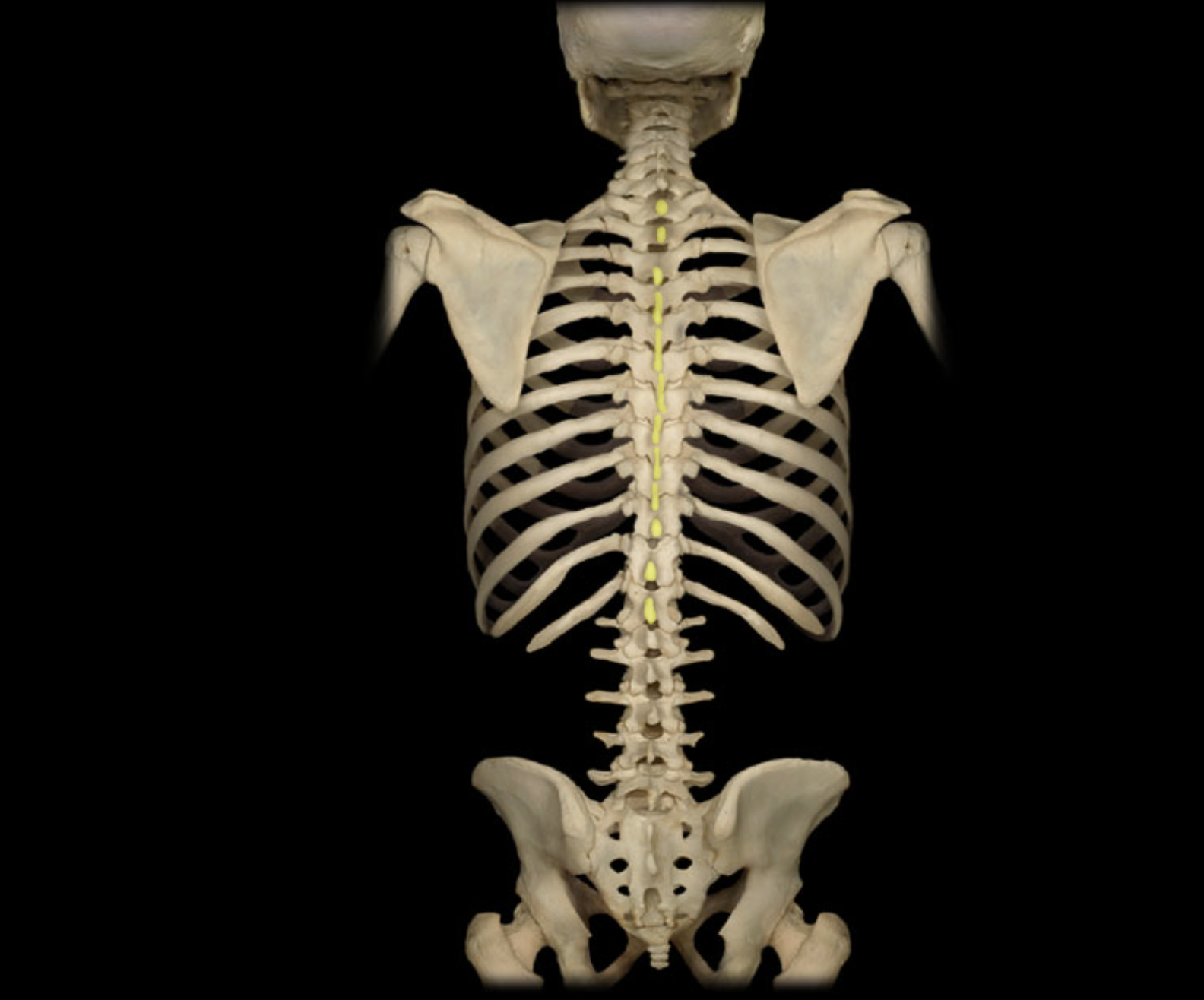
Spinous process of thoracic vertebra

Location:

• Thoracic vertebra

Description:

  • Unpaired posterior midline projection from vertebral arch

  • Has characteristic long, slender form

  • Processes of inferior thoracic vertebrae directed inferiorly

Comment:

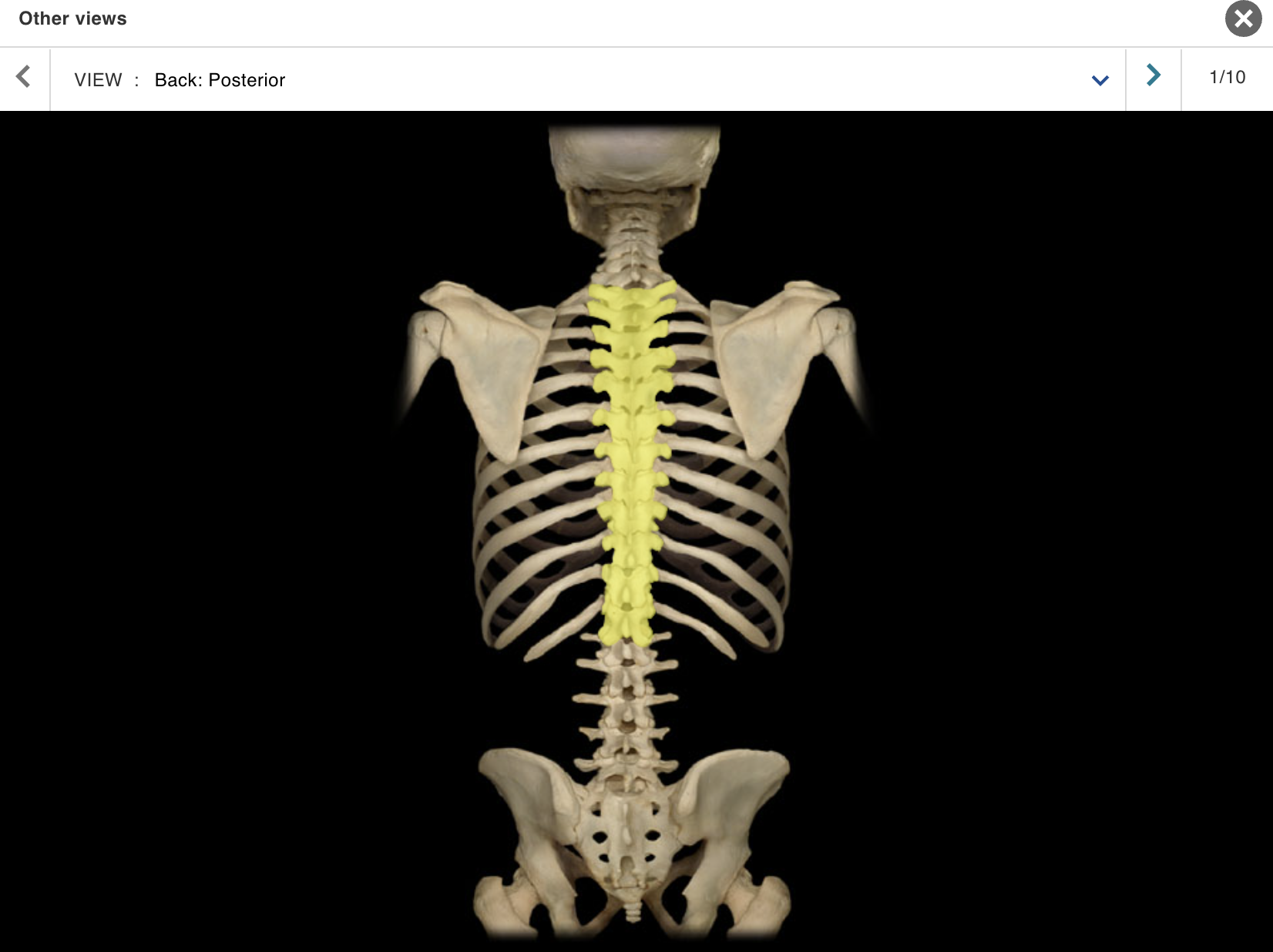
• Spinous process present on all vertebrae except atlas (C1 vertebra) and coccygeal vertebrae

• Provides attachment for muscles and ligaments

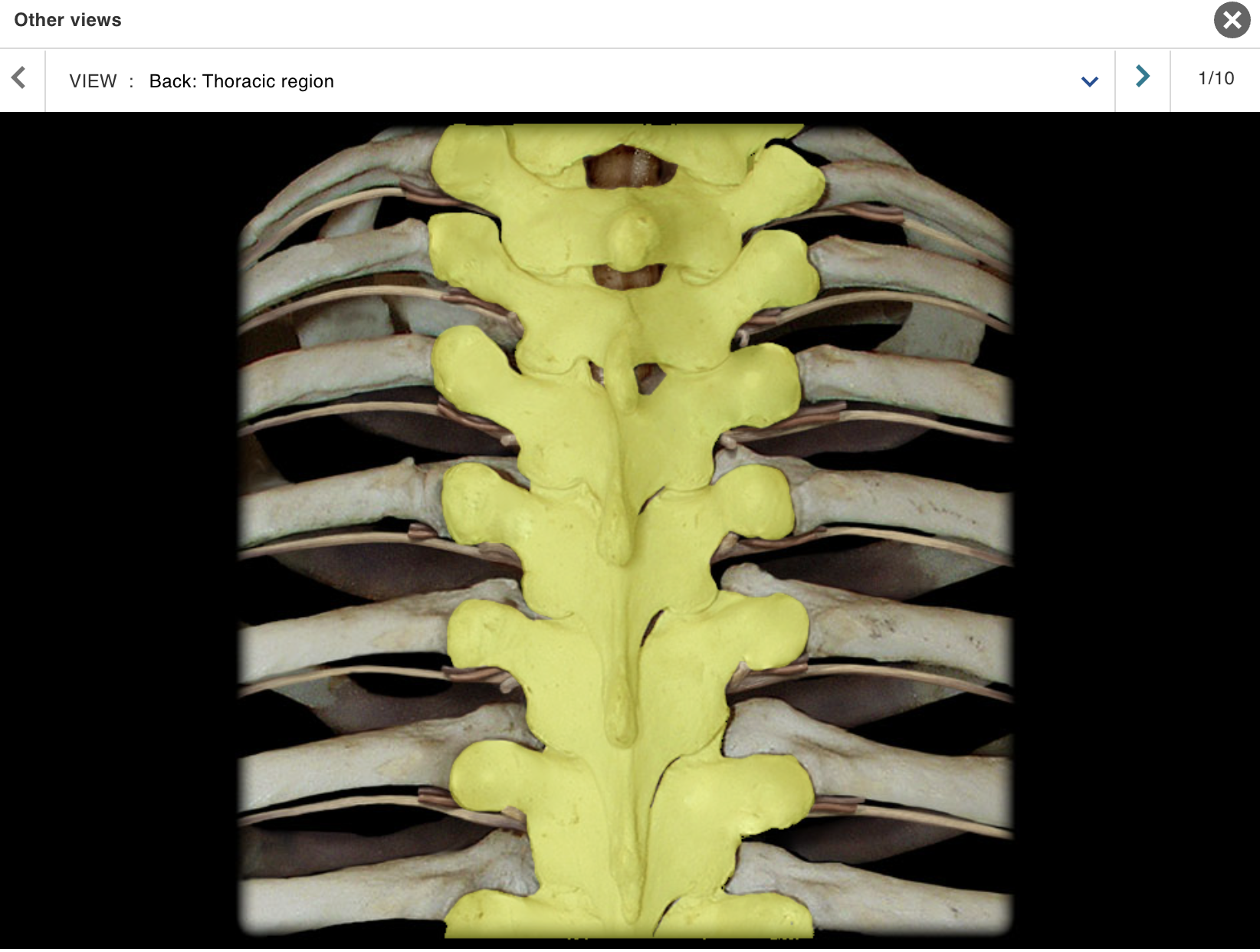
<p>Location:</p><p class="p1">• Thoracic vertebra</p><p class="p1">Description:</p><ul><li><p>Unpaired posterior midline projection from vertebral arch</p></li><li><p>Has characteristic long, slender form</p></li><li><p>Processes of inferior thoracic vertebrae directed inferiorly</p></li></ul><p class="p1">Comment:</p><p class="p1">• Spinous process present on all vertebrae except atlas (C1 vertebra) and coccygeal vertebrae</p><p class="p1">• Provides attachment for muscles and ligaments</p>
72
New cards
<p>Temporal bone</p>

Temporal bone

Location:

• Skull (lateral and inferior)

Description:

  • Paired, irregular-shaped, flat bone

  • Consists of squamous, petrous, mastoid, and tympanic parts

Comment:

  • Forms part of lateral skull (temple)

  • Forms inferior and lateral walls of middle cranial fossa

  • Articulates with sphenoid bone at sphenosquamosal suture, occipital bone at lambdoid suture, and parietal bone at squamosal suture

  • Has mandibular fossa that forms temporomandibular joint with
    head of mandible

  • Forms zygomatic process that forms zygomatic arch with temporal process of zygomatic bone

<p>Location:</p><p class="p1">• Skull (lateral and inferior)</p><p class="p1">Description:</p><ul><li><p>Paired, irregular-shaped, flat bone</p></li><li><p>Consists of squamous, petrous, mastoid, and tympanic parts</p></li></ul><p class="p1">Comment:</p><ul><li><p>Forms part of lateral skull (temple)</p></li><li><p>Forms inferior and lateral walls of middle cranial fossa</p></li><li><p>Articulates with sphenoid bone at sphenosquamosal suture, occipital bone at lambdoid suture, and parietal bone at squamosal suture</p></li><li><p>Has mandibular fossa that forms temporomandibular joint with<br>head of mandible</p></li><li><p>Forms zygomatic process that forms zygomatic arch with temporal process of zygomatic bone</p></li></ul><p></p>
73
New cards
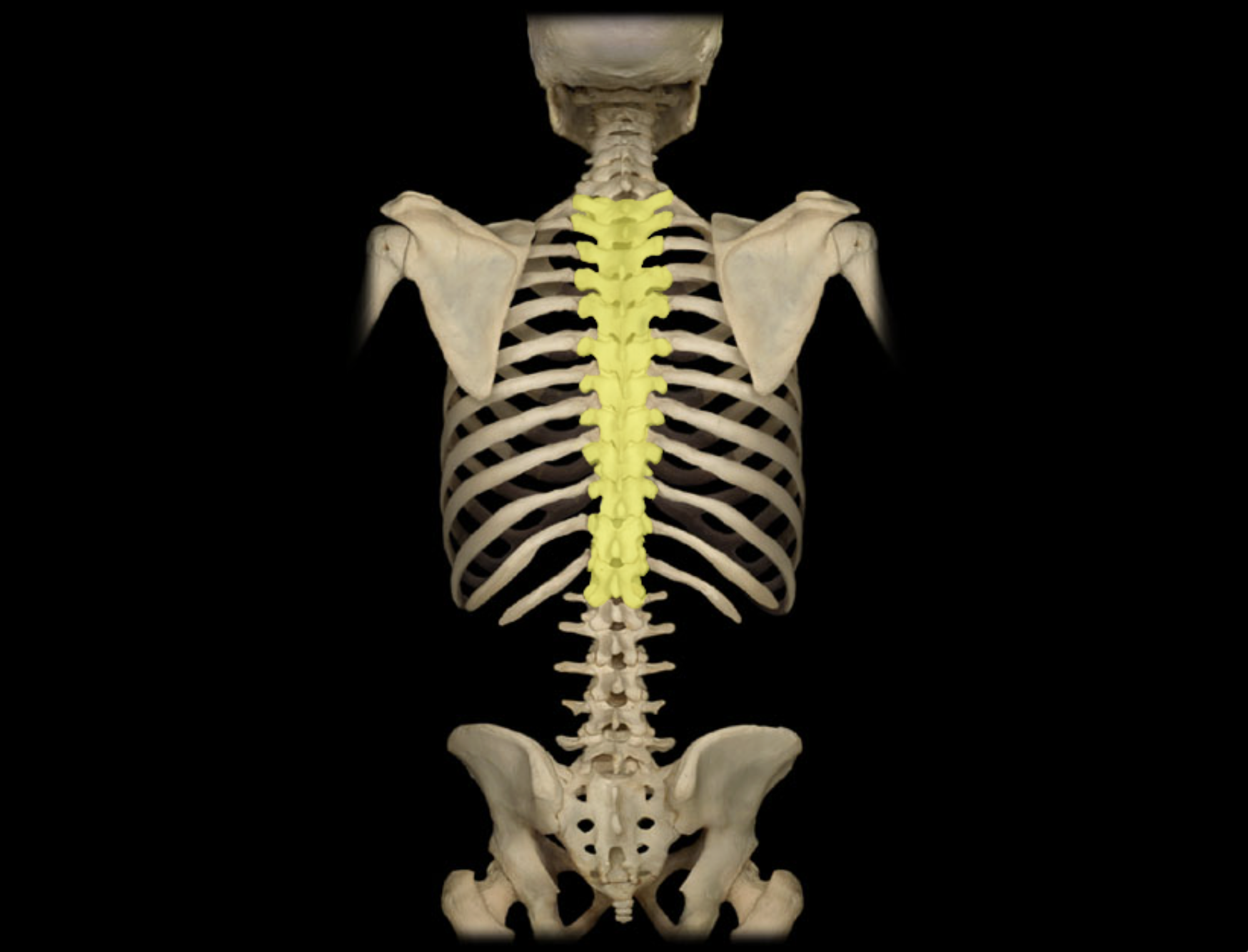
<p>Thoracic vertebra</p>

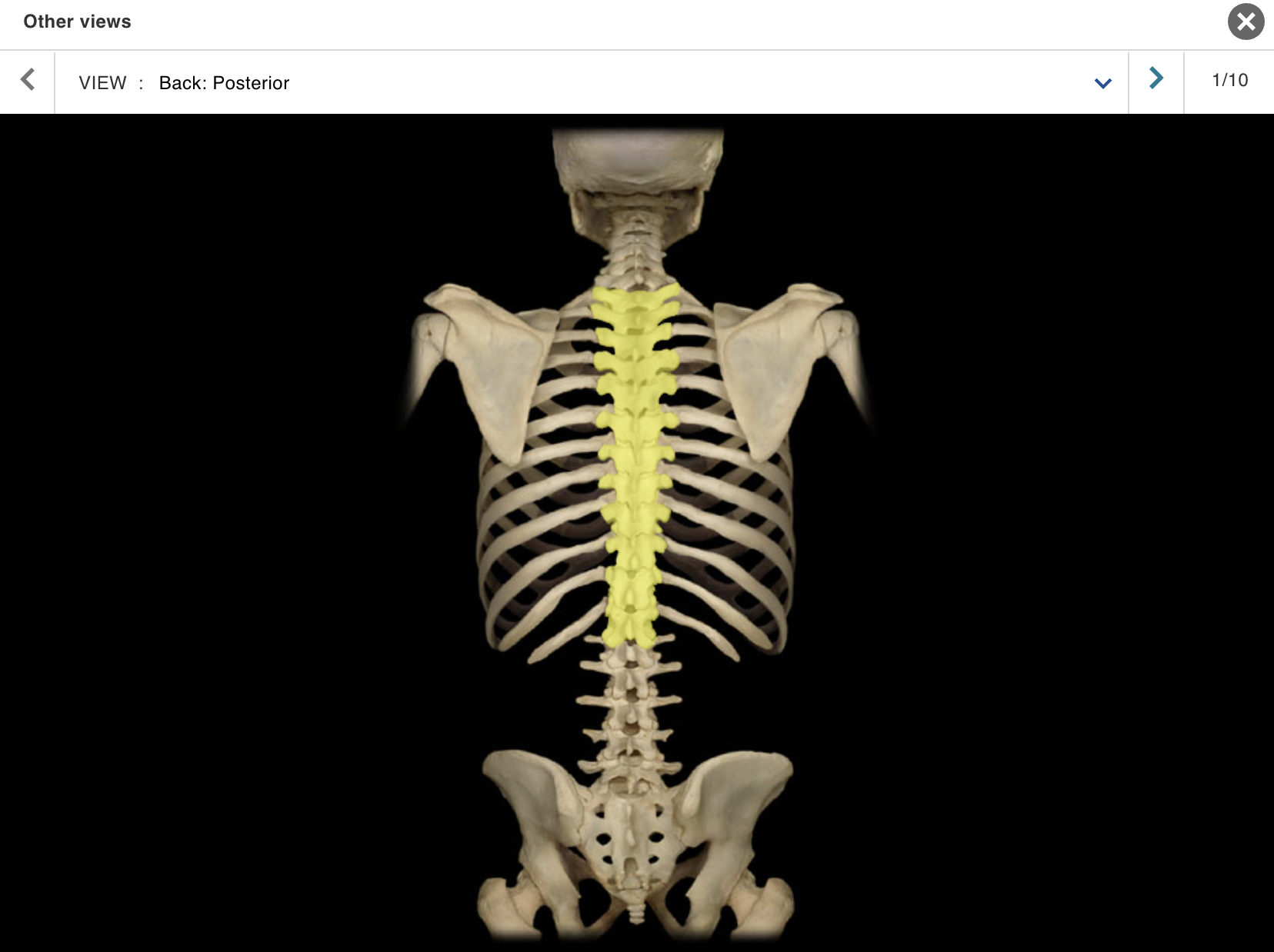
Thoracic vertebra

Location:

  • Trunk

  • Between C7 and L1 vertebrae

Description:

  • 12 individual vertebrae

  • Characteristic features include costal demifacets (or facets) for articulation with head of rib, spinous process slopes inferiorly, and heart-shaped vertebral body

<p>Location:</p><ul><li><p>Trunk</p></li><li><p>Between C7 and L1 vertebrae</p></li></ul><p class="p1">Description:</p><ul><li><p>12 individual vertebrae</p></li><li><p>Characteristic features include costal demifacets (or facets) for articulation with head of rib, spinous process slopes inferiorly, and heart-shaped vertebral body</p></li></ul><p></p>
74
New cards
<p>Transverse process of lumbar vertebra</p>

Transverse process of lumbar vertebra

Location:

• Lateral aspect of lumbar vertebra

Description:

• Prominent, paired, laterally-directed process

Comment:

• Provides attachment for intrinsic back muscles and ligaments

<p>Location:</p><p class="p1">• Lateral aspect of lumbar vertebra</p><p class="p1">Description:</p><p class="p1">• Prominent, paired, laterally-directed process</p><p class="p1">Comment:</p><p class="p1">• Provides attachment for intrinsic back muscles and ligaments</p>
75
New cards
<p>Transverse process of thoracic vertebra</p>

Transverse process of thoracic vertebra

Location:

• Lateral aspect of thoracic vertebra

Description:

• Prominent, paired, laterally-directed process

Comment:

• Provides attachment for intrinsic back muscles and ligaments

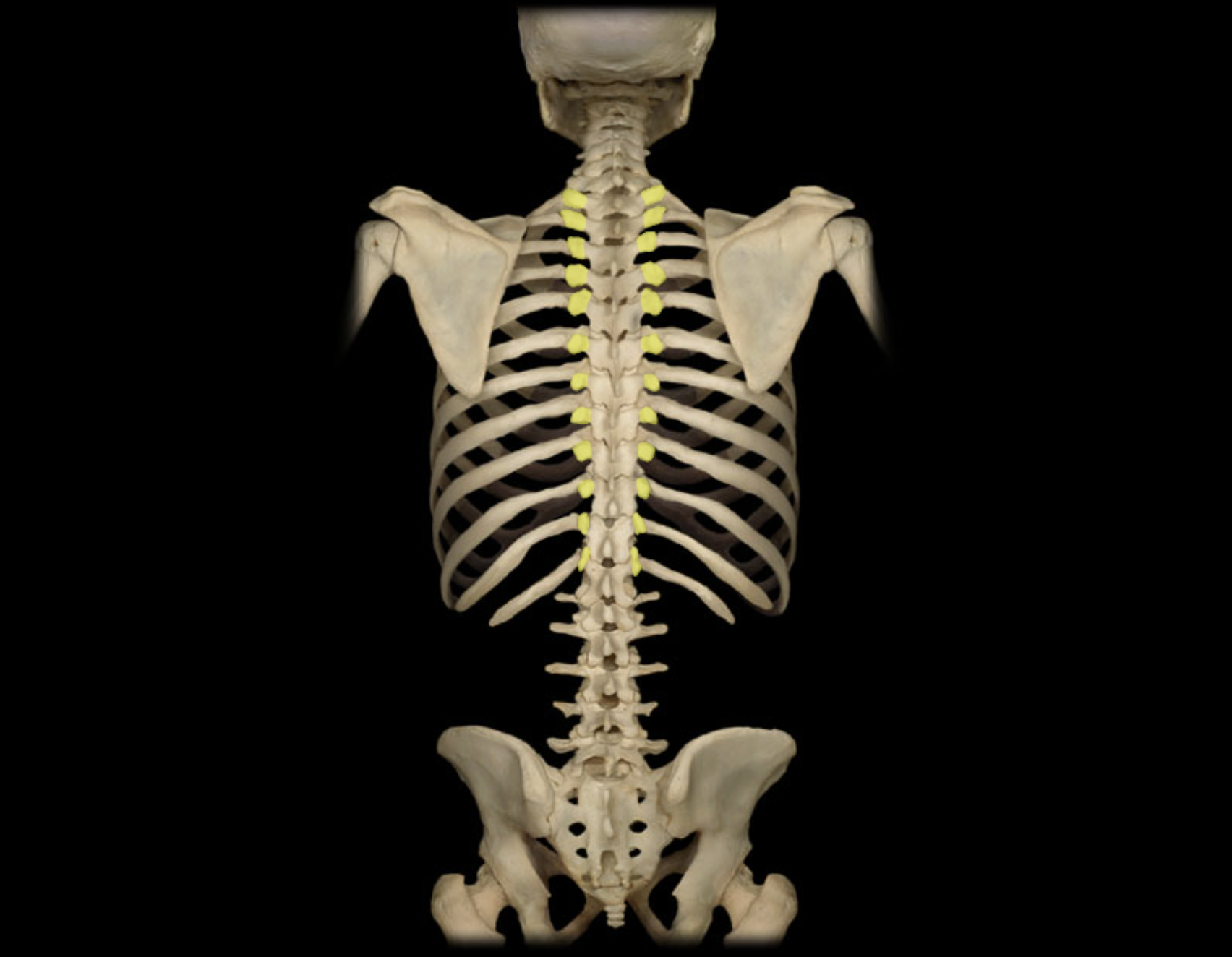
<p>Location:</p><p class="p1">• Lateral aspect of thoracic vertebra</p><p class="p1">Description:</p><p class="p1">• Prominent, paired, laterally-directed process</p><p class="p1">Comment:</p><p class="p1">• Provides attachment for intrinsic back muscles and ligaments</p>
76
New cards

ACTIVITY 6 : DISSECTION

MODULE: SKELETAL

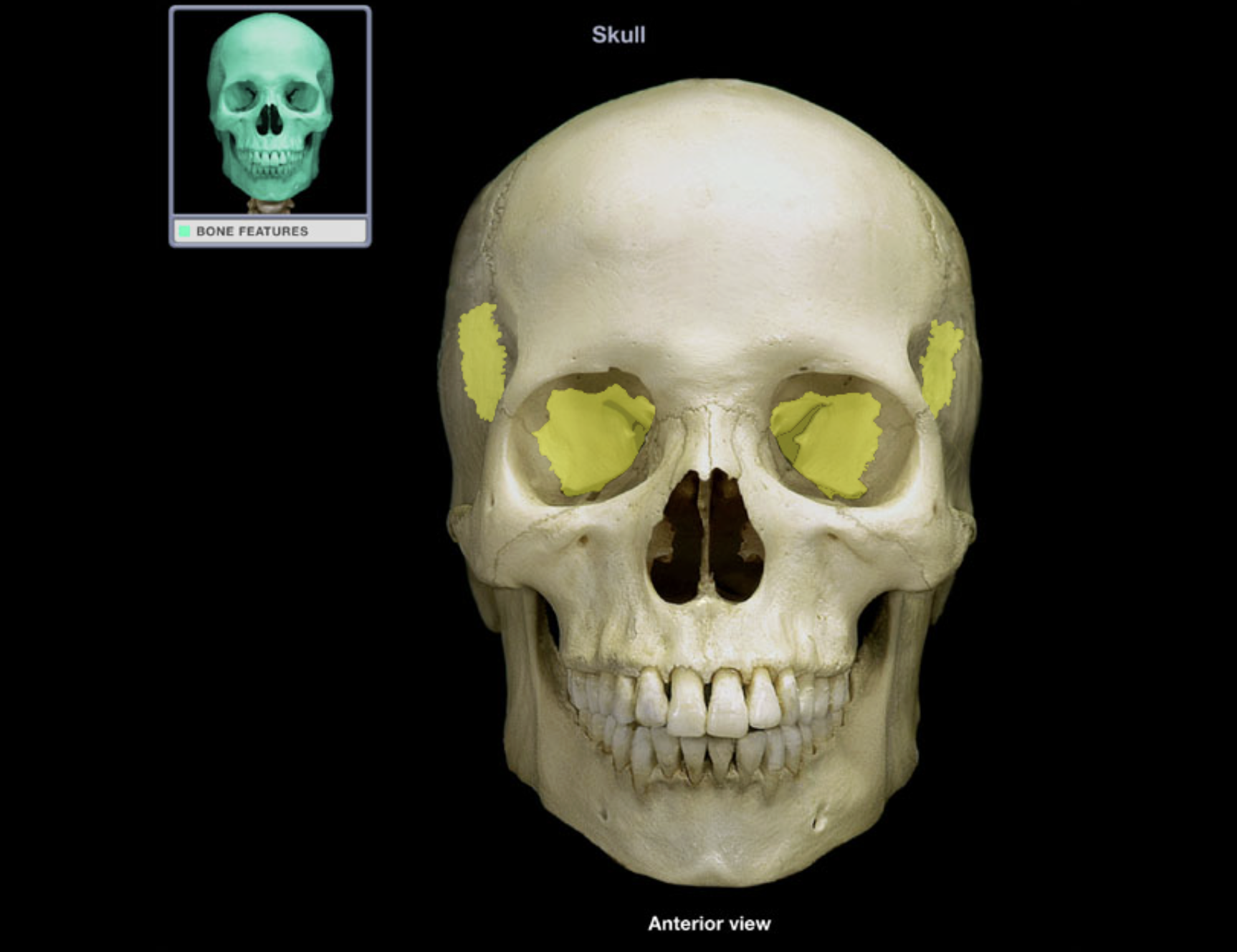
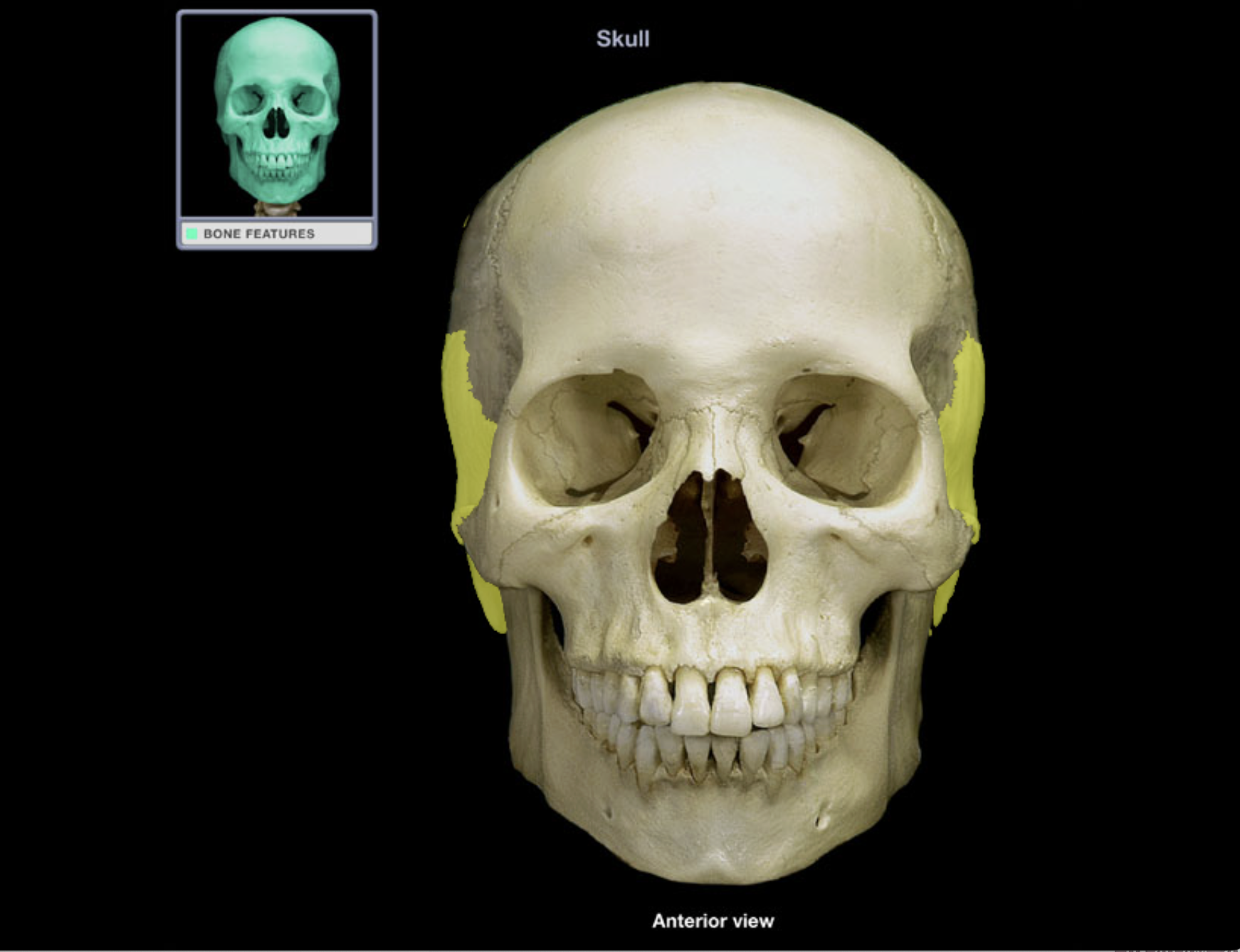
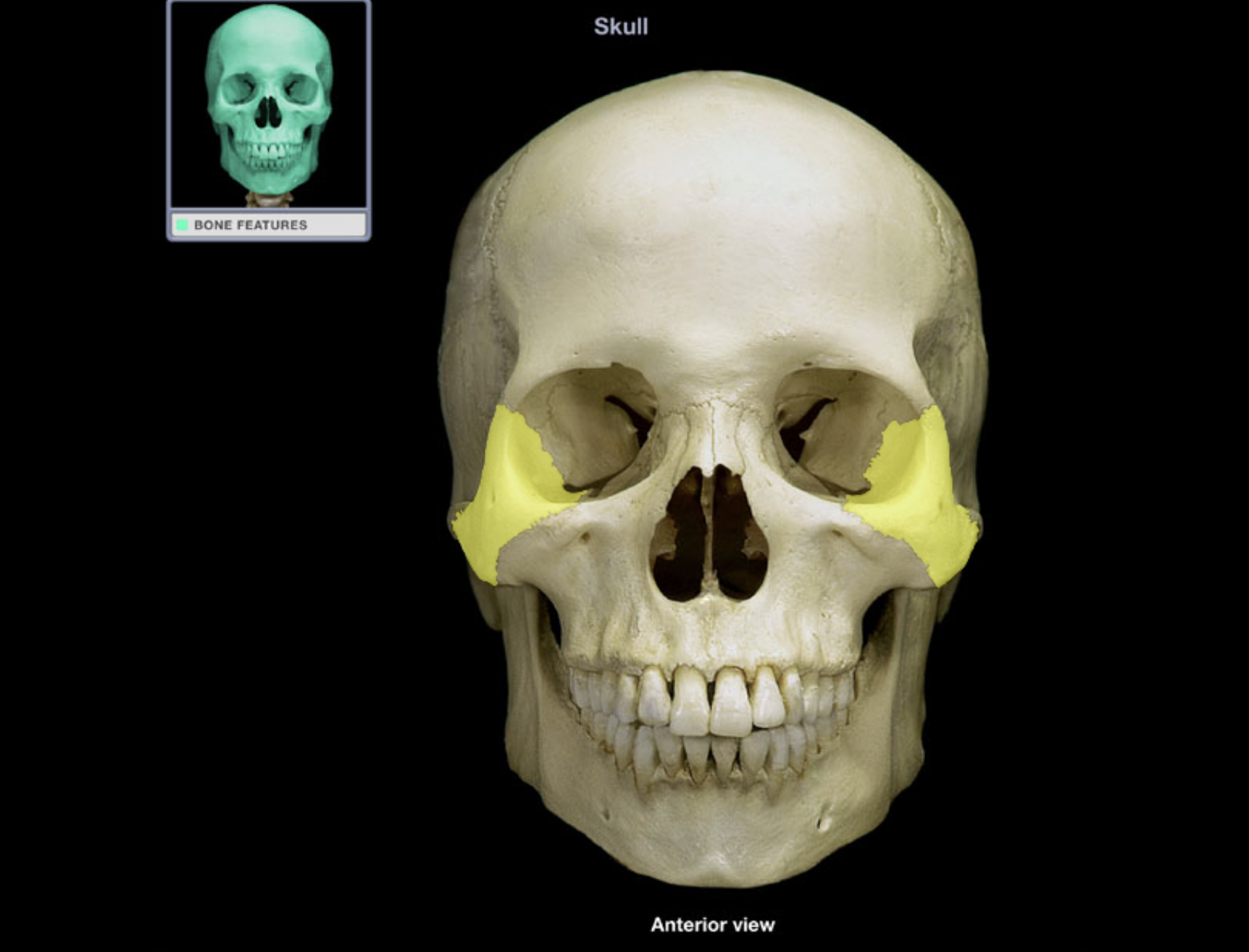
TOPIC: SKULL / VIEW : ANTERIOR

Ethmoid bone

Frontal bone

Lacrimal bone

Mandible

Maxilla

Nasal bone

Orbit

Parietal bone

Sphenoid bone

Temporal bone

Zygomatic bone

77
New cards
<p>Ethmoid bone</p>

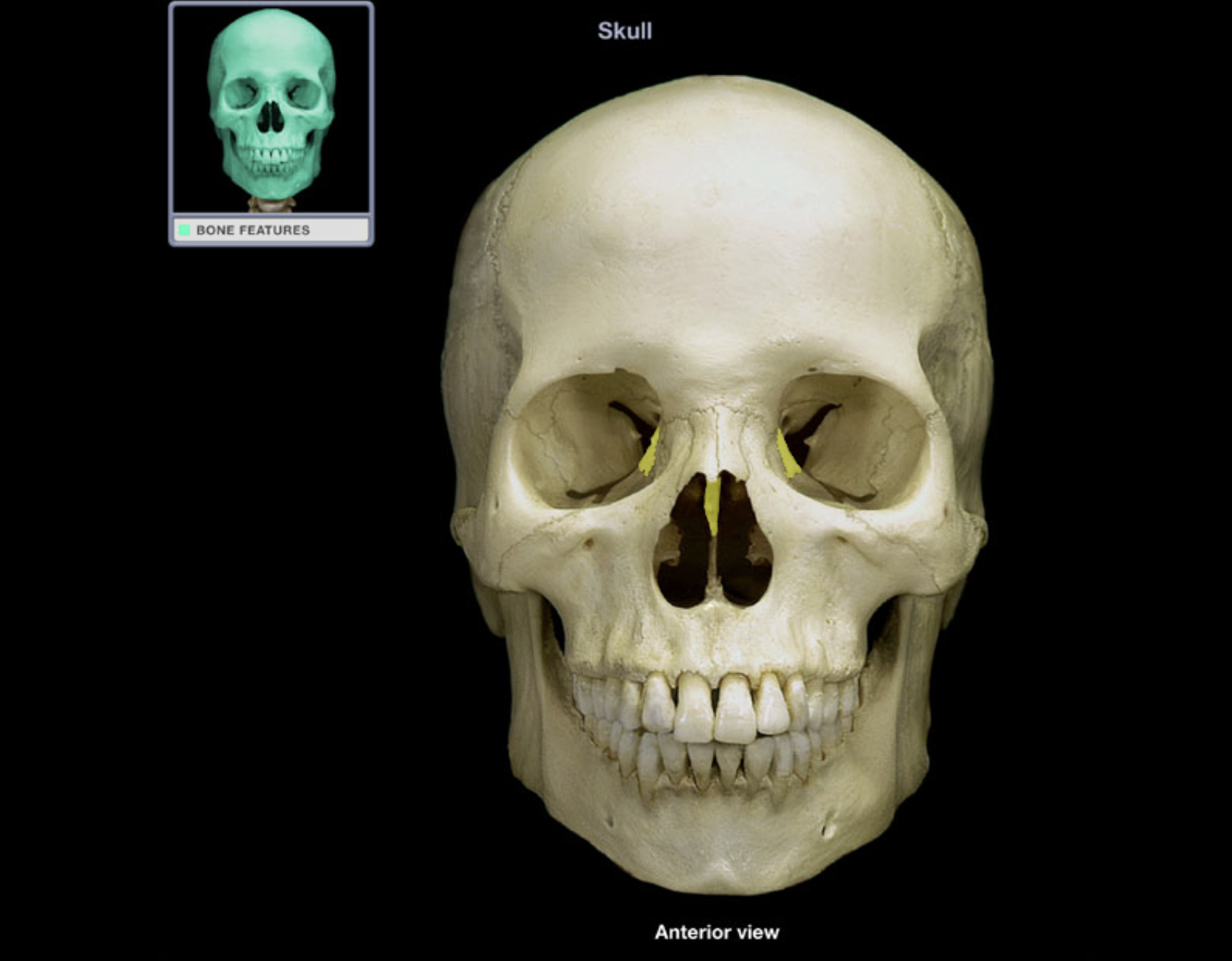
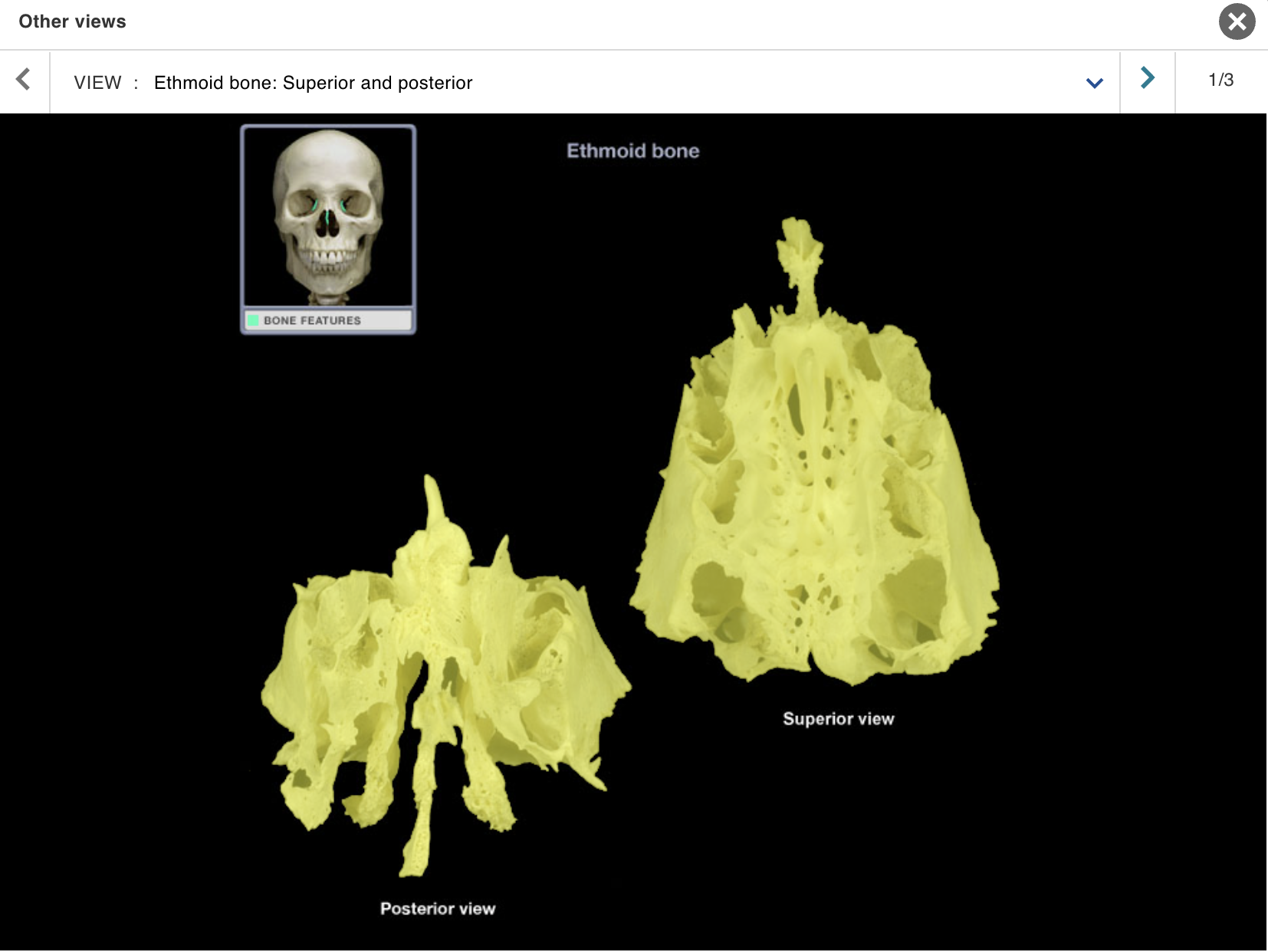
Ethmoid bone

Location:

• Nasal cavity

Description:

  • Irregular-shaped bone

  • Characteristic features include cribriform plate, crista galli, and perpendicular plate

Comment:

  • Contributes to anterior cranial fossa, nasal cavity, and orbit

  • Contains numerous sinuses (air cells)

<p>Location:</p><p class="p1">• Nasal cavity</p><p class="p1">Description:</p><ul><li><p>Irregular-shaped bone</p></li><li><p>Characteristic features include cribriform plate, crista galli, and perpendicular plate</p></li></ul><p class="p1">Comment:</p><ul><li><p>Contributes to anterior cranial fossa, nasal cavity, and orbit</p></li><li><p>Contains numerous sinuses (air cells)</p></li></ul><p></p>
78
New cards
<p>Frontal bone</p>

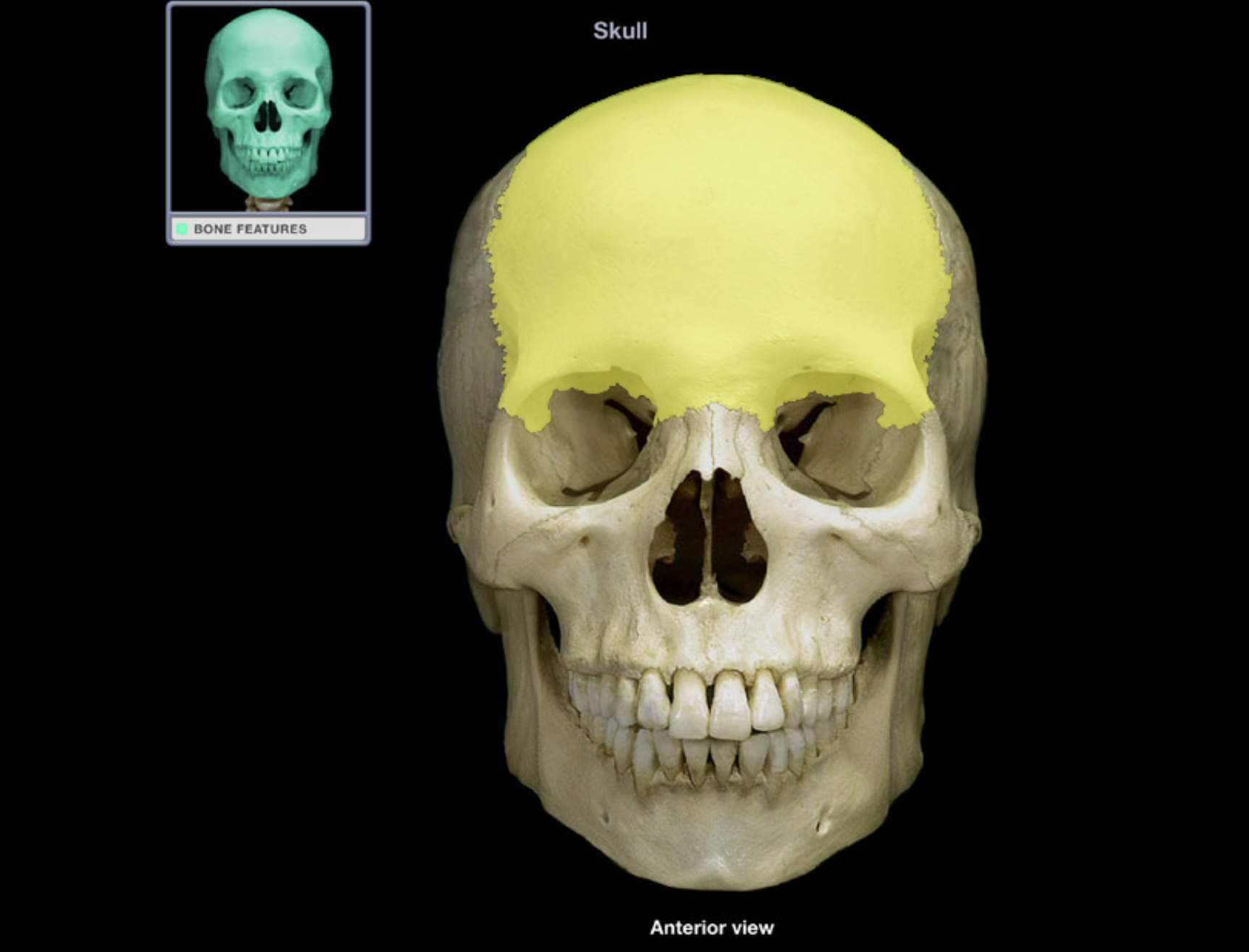
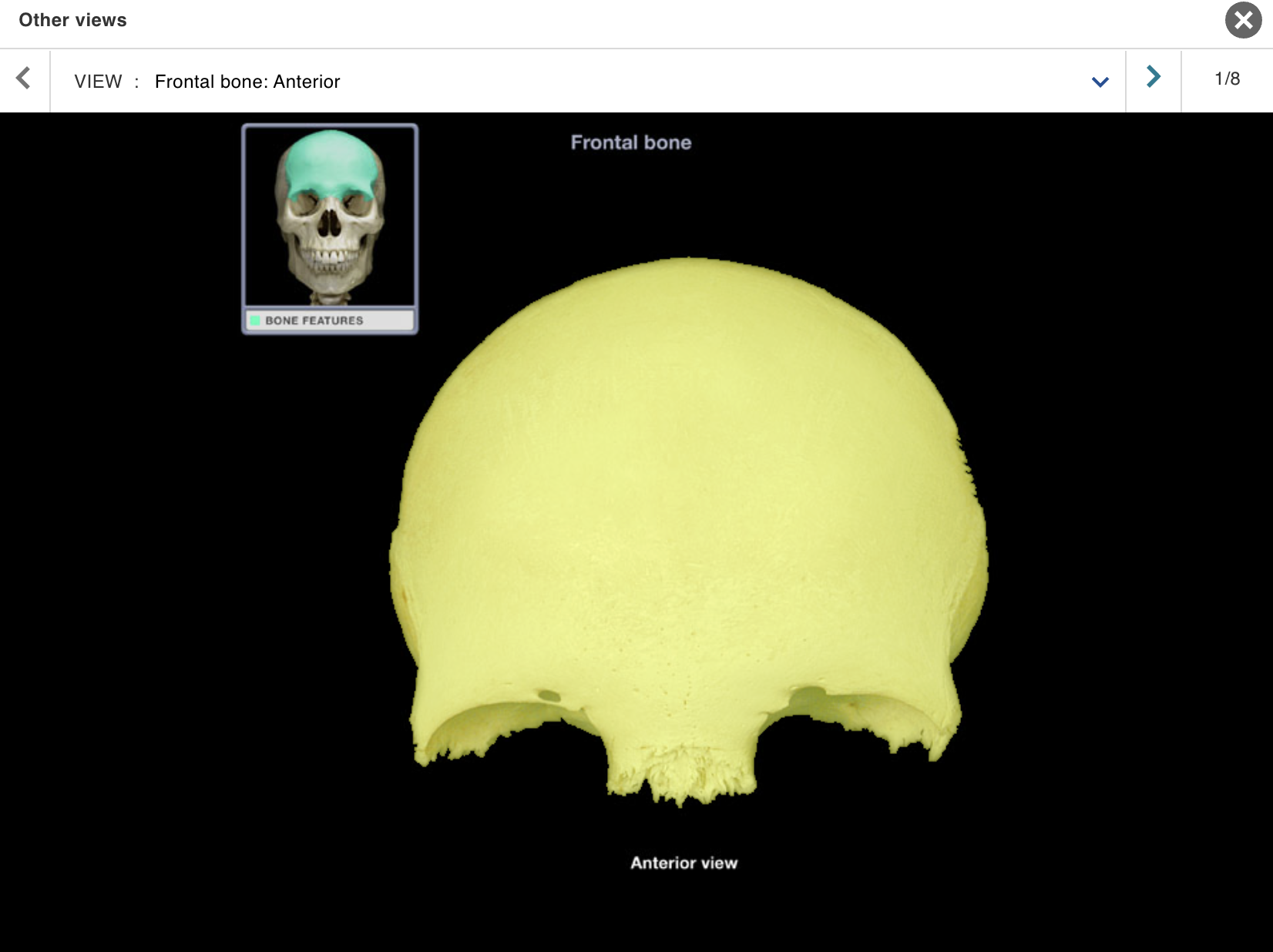
Frontal bone

Location:

• Skull (anterior superior part)

Description:

  • Unpaired, irregular-shaped, flat bone

  • Forms forehead, roof of orbits, and most of anterior cranial fossa

  • Contains frontal air sinuses

Comment:

• Articulates with parietal bone at coronal suture and sphenoid bone at sphenosquamosal suture
<p>Location:</p><p class="p1">• Skull (anterior superior part)</p><p class="p1">Description:</p><ul><li><p>Unpaired, irregular-shaped, flat bone</p></li><li><p>Forms forehead, roof of orbits, and most of anterior cranial fossa</p></li><li><p>Contains frontal air sinuses</p></li></ul><p class="p1">Comment:</p><p class="p1">• Articulates with parietal bone at coronal suture and sphenoid bone at sphenosquamosal suture</p>
79
New cards
<p>Lacrimal bone</p>

Lacrimal bone

Location:

  • Orbit (anterior and medial)

  • Nasal cavity (lateral wall)

Description:

  • Smallest and most delicate bone of skull

  • Orbital surface contributes to fossa for lacrimal sac and
    nasolacrimal groove

  • Nasal surface contributes to middle nasal concha

Comment:

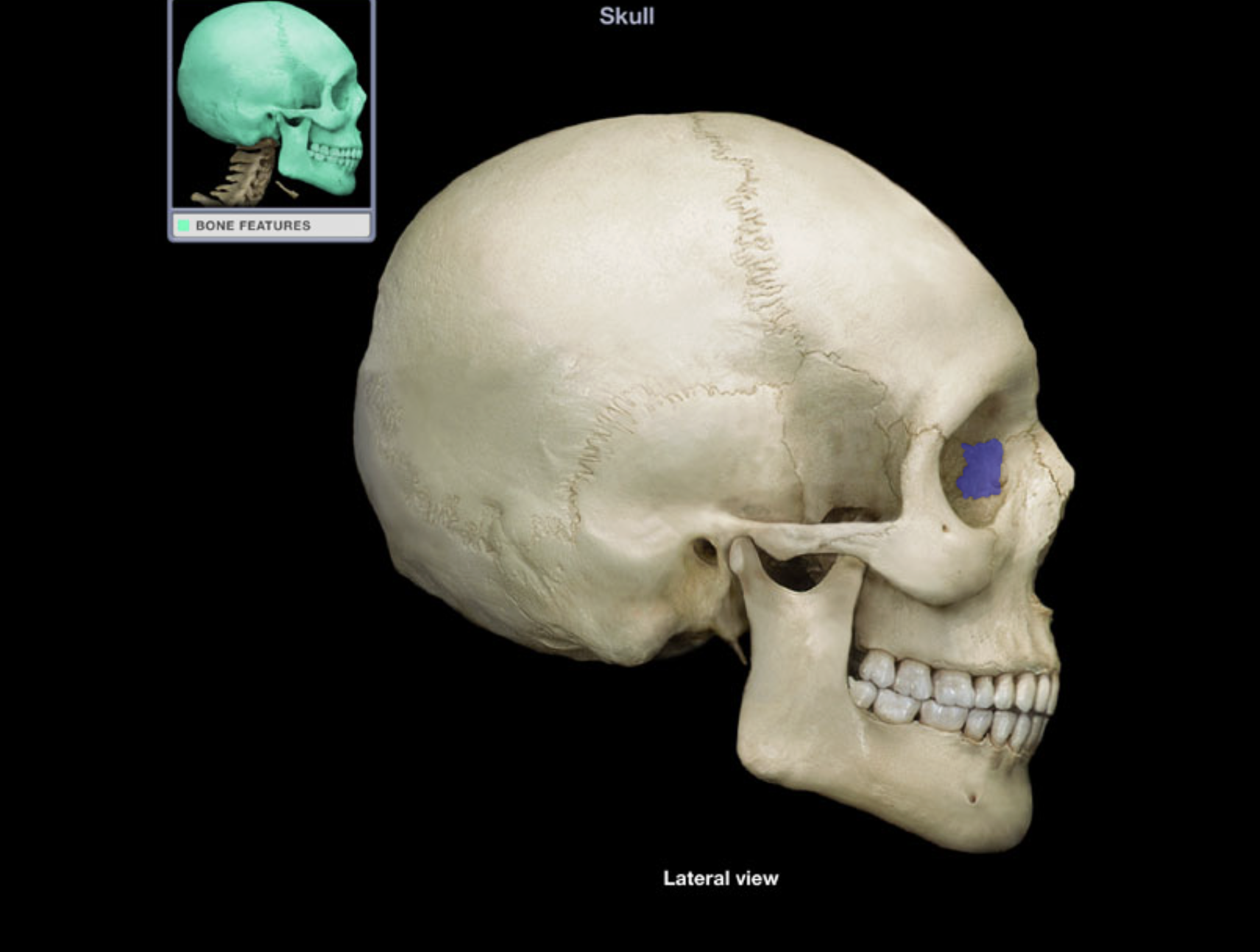
• Some fibers of orbicularis oculi attach to lacrimal bone

<p>Location:</p><ul><li><p>Orbit (anterior and medial)</p></li><li><p>Nasal cavity (lateral wall)</p></li></ul><p class="p1">Description:</p><ul><li><p>Smallest and most delicate bone of skull</p></li><li><p>Orbital surface contributes to fossa for lacrimal sac and<br>nasolacrimal groove</p></li><li><p>Nasal surface contributes to middle nasal concha</p></li></ul><p>Comment:</p><p class="p1">• Some fibers of orbicularis oculi attach to lacrimal bone</p>
80
New cards
<p>Mandible</p>

Mandible

Location:

• Skull (anterior)

Description:

  • U-shaped bone

  • Each side consists of body (horizontal) and ramus (vertical) with coronoid and condylar processes

  • Mental protuberance forms point of chin

  • Contains alveoli ("sockets") for teeth

Also known as:

• "Lower jaw"

Comment:

• Contributes to temporomandibular joint (TMJ)

<p>Location:</p><p class="p1">• Skull (anterior)</p><p class="p1">Description:</p><ul><li><p>U-shaped bone</p></li><li><p>Each side consists of body (horizontal) and ramus (vertical) with coronoid and condylar processes</p></li><li><p>Mental protuberance forms point of chin</p></li><li><p>Contains alveoli ("sockets") for teeth</p></li></ul><p>Also known as:</p><p class="p1">• "Lower jaw"</p><p class="p1">Comment:</p><p class="p1">• Contributes to temporomandibular joint (TMJ)</p>
81
New cards
<p>Maxilla</p>

Maxilla

Location:

• Skull (anterior)

Description:

  • Paired, irregular-shaped bone

  • Left and right maxillae unite to form "upper jaw"

  • Contains alveoli ("sockets") for teeth

  • Contains maxillary air sinus on each side

Also known as:

• "Upper jaw"

Comment:

  • Forms part of floor of orbit and anterior part of hard palate

  • Contributes to upper face

<p>Location:</p><p class="p1">• Skull (anterior)</p><p class="p1">Description:</p><ul><li><p>Paired, irregular-shaped bone</p></li><li><p>Left and right maxillae unite to form "upper jaw"</p></li><li><p>Contains alveoli ("sockets") for teeth</p></li><li><p>Contains maxillary air sinus on each side</p></li></ul><p class="p1">Also known as:</p><p class="p1">• "Upper jaw"</p><p class="p1">Comment:</p><ul><li><p>Forms part of floor of orbit and anterior part of hard palate</p></li><li><p>Contributes to upper face</p></li></ul><p></p>
82
New cards
<p>Nasal bone</p>

Nasal bone

Location:

• Skull (anterior)

Description:

  • Small, paired bone

  • Articulates at midline with nasal bone from opposite side

Also known as:

• "Bridge of nose"

Comment:

• Forms bony part of nose

<p>Location:</p><p class="p1">• Skull (anterior)</p><p class="p1">Description:</p><ul><li><p>Small, paired bone</p></li><li><p>Articulates at midline with nasal bone from opposite side</p></li></ul><p class="p1">Also known as:</p><p class="p1">• "Bridge of nose"</p><p class="p1">Comment:</p><p class="p1">• Forms bony part of nose</p>
83
New cards
<p>Orbit</p>

Orbit

Location:

  • Skull (anterior)

  • Lateral to nasal cavity

Description:

  • Pyramidal space with roof, floor, and medial and lateral walls

  • Roof: frontal and sphenoid bones

  • Floor: palatine and zygomatic bones, and maxilla

  • Lateral wall: zygomatic, sphenoid, and frontal bones

  • Medial wall: ethmoid and lacrimal bones, and maxilla

  • • Openings include superior and inferior orbital fissures, and optic canal

    Also known as:

    • Eye socket

    Comment:

    • Contains eyeball and its muscles; cranial nerves II, III, IV, V1, and VI; vasculature; lacrimal apparatus; and fat

<p>Location:</p><ul><li><p>Skull (anterior)</p></li><li><p>Lateral to nasal cavity</p></li></ul><p class="p1">Description:</p><ul><li><p>Pyramidal space with roof, floor, and medial and lateral walls</p></li><li><p>Roof: frontal and sphenoid bones</p></li><li><p>Floor: palatine and zygomatic bones, and maxilla</p></li><li><p>Lateral wall: zygomatic, sphenoid, and frontal bones</p></li><li><p>Medial wall: ethmoid and lacrimal bones, and maxilla</p></li><li><p>• Openings include superior and inferior orbital fissures, and optic canal</p><p class="p1">Also known as:</p><p class="p1">• Eye socket</p><p class="p1">Comment:</p><p class="p1">• Contains eyeball and its muscles; cranial nerves II, III, IV, V1, and VI; vasculature; lacrimal apparatus; and fat</p></li></ul><p></p>
84
New cards
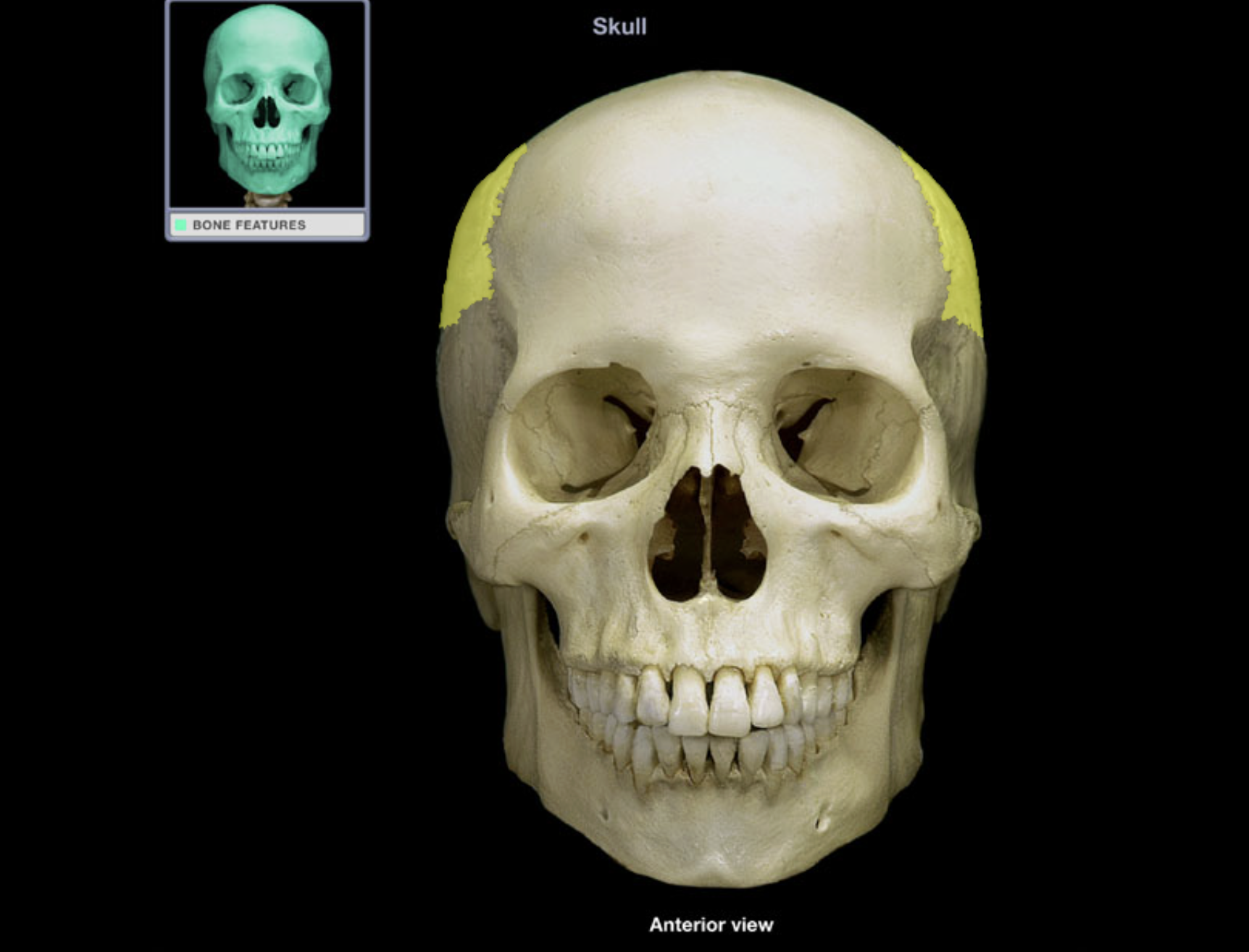
<p>Parietal bone</p>

Parietal bone

Location:

• Skull (lateral)

Description:

  • Paired, flat bone

  • Forms most of lateral skull

Comment:

  • Parietal bones articulate at sagittal suture (midline)

  • Articulates with frontal bone at coronal suture, occipital bone at lambdoid suture, and temporal bone at squamosal suture

<p>Location:</p><p class="p1">• Skull (lateral)</p><p class="p1">Description:</p><ul><li><p>Paired, flat bone</p></li><li><p>Forms most of lateral skull</p></li></ul><p class="p1">Comment:</p><ul><li><p>Parietal bones articulate at sagittal suture (midline)</p></li><li><p>Articulates with frontal bone at coronal suture, occipital bone at lambdoid suture, and temporal bone at squamosal suture</p></li></ul><p></p>
85
New cards
<p>Sphenoid bone</p>

Sphenoid bone

Location:

• Skull

Description:

  • Unpaired, irregular-shaped bone

  • Shape resembles a butterfly

  • Consists of body, and greater and lesser wings

Comment:

• Contributes to middle cranial fossa, nasal cavities, orbits, and lateral skull (temples)

• Contains sella turcica ("Turkish saddle"), sphenoidal air sinus, and many foramina

<p>Location:</p><p class="p1">• Skull</p><p class="p1">Description:</p><ul><li><p>Unpaired, irregular-shaped bone</p></li><li><p>Shape resembles a butterfly</p></li><li><p>Consists of body, and greater and lesser wings</p></li></ul><p class="p1">Comment:</p><p class="p1">• Contributes to middle cranial fossa, nasal cavities, orbits, and lateral skull (temples)</p><p class="p1">• Contains sella turcica ("Turkish saddle"), sphenoidal air sinus, and many foramina</p>
86
New cards
<p>Temporal bone</p>

Temporal bone

Location:

• Skull (lateral and inferior)

Description:

  • Paired, irregular-shaped, flat bone

  • Consists of squamous, petrous, mastoid, and tympanic parts

Comment:

  • Forms part of lateral skull (temple)

  • Forms inferior and lateral walls of middle cranial fossa

  • Articulates with sphenoid bone at sphenosquamosal suture, occipital bone at lambdoid suture, and parietal bone at squamosal suture

  • Has mandibular fossa that forms temporomandibular joint with
    head of mandible

  • Forms zygomatic process that forms zygomatic arch with temporal process of zygomatic bone

<p>Location:</p><p class="p1">• Skull (lateral and inferior)</p><p class="p1">Description:</p><ul><li><p>Paired, irregular-shaped, flat bone</p></li><li><p>Consists of squamous, petrous, mastoid, and tympanic parts</p></li></ul><p class="p1">Comment:</p><ul><li><p>Forms part of lateral skull (temple)</p></li><li><p>Forms inferior and lateral walls of middle cranial fossa</p></li><li><p>Articulates with sphenoid bone at sphenosquamosal suture, occipital bone at lambdoid suture, and parietal bone at squamosal suture</p></li><li><p>Has mandibular fossa that forms temporomandibular joint with<br>head of mandible</p></li><li><p>Forms zygomatic process that forms zygomatic arch with temporal process of zygomatic bone</p></li></ul><p></p>
87
New cards
<p>Zygomatic bone</p>

Zygomatic bone

Location:

• Skull (anterior and lateral)

Description:

  • Paired, irregular-shaped bone

  • Temporal process contributes to zygomatic arch

Also known as:

• "Cheekbone"

Comment:

• Forms part of floor and lateral wall of orbit

<p>Location:</p><p class="p1">• Skull (anterior and lateral)</p><p class="p1">Description:</p><ul><li><p>Paired, irregular-shaped bone</p></li><li><p>Temporal process contributes to zygomatic arch</p></li></ul><p class="p1">Also known as:</p><p class="p1">• "Cheekbone"</p><p class="p1">Comment:</p><p class="p1">• Forms part of floor and lateral wall of orbit</p>
88
New cards

ACTIVITY 6 : DISSECTION

MODULE: SKELETAL

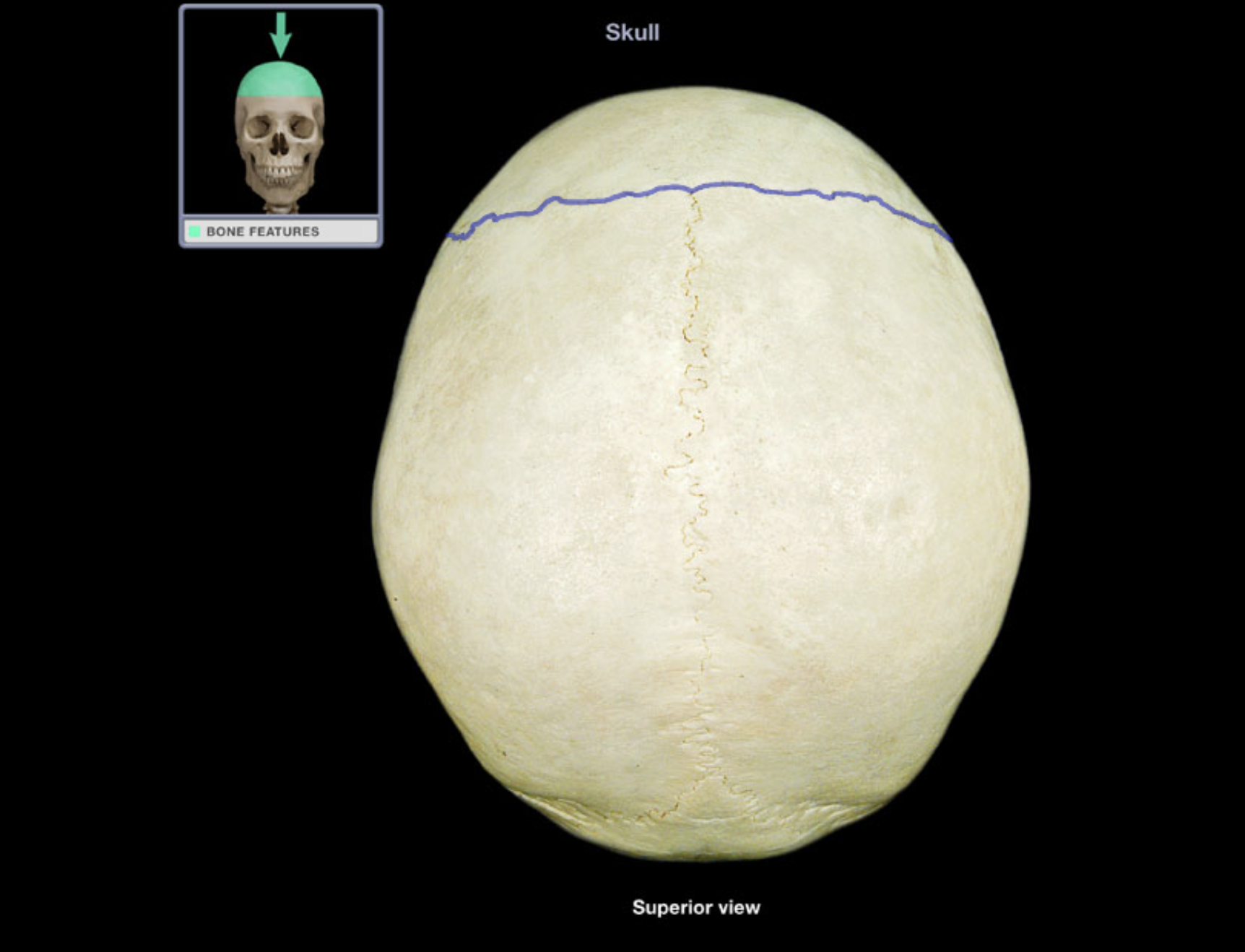
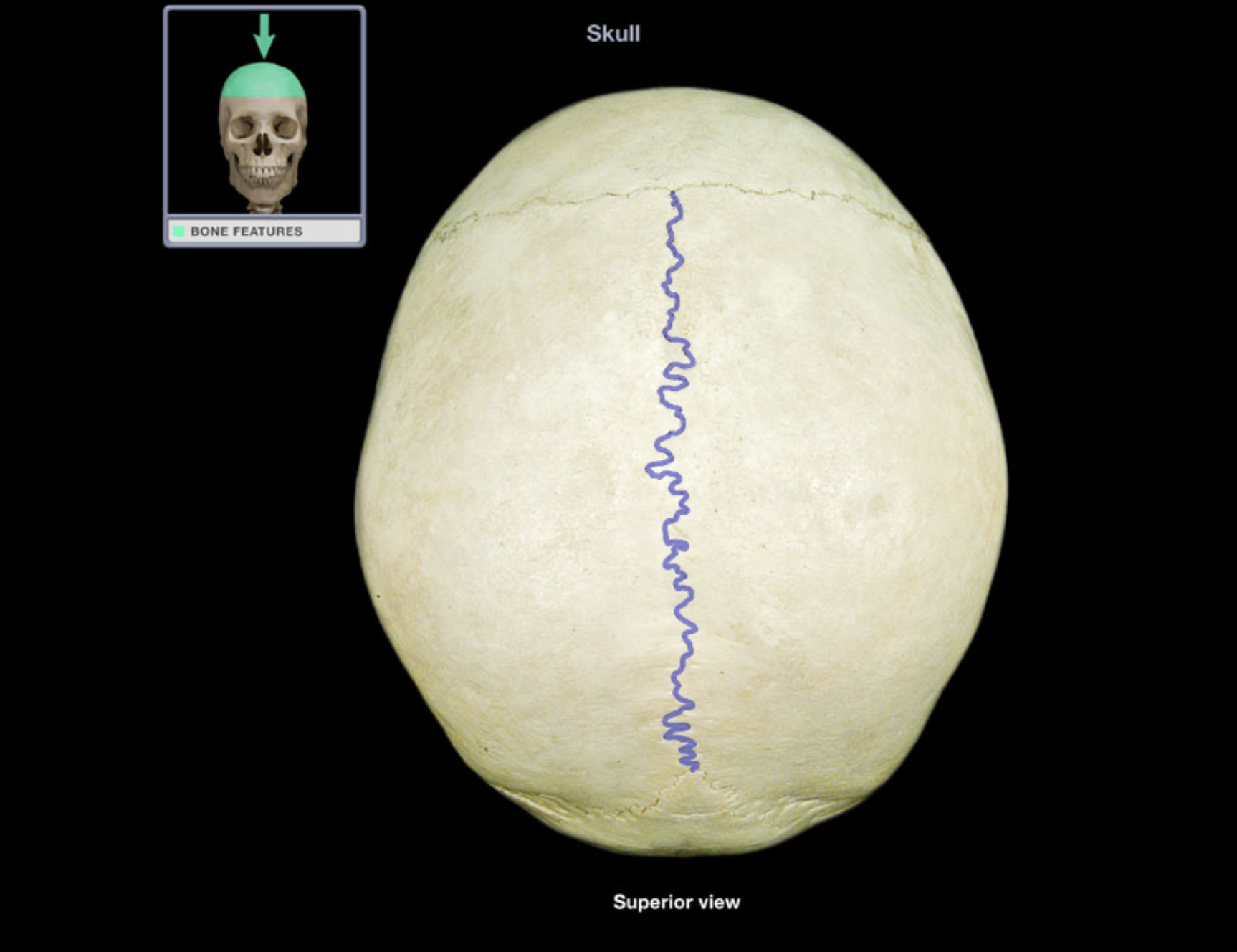
TOPIC: SKULL / VIEW : SUPERIOR

Coronal suture

Frontal bone

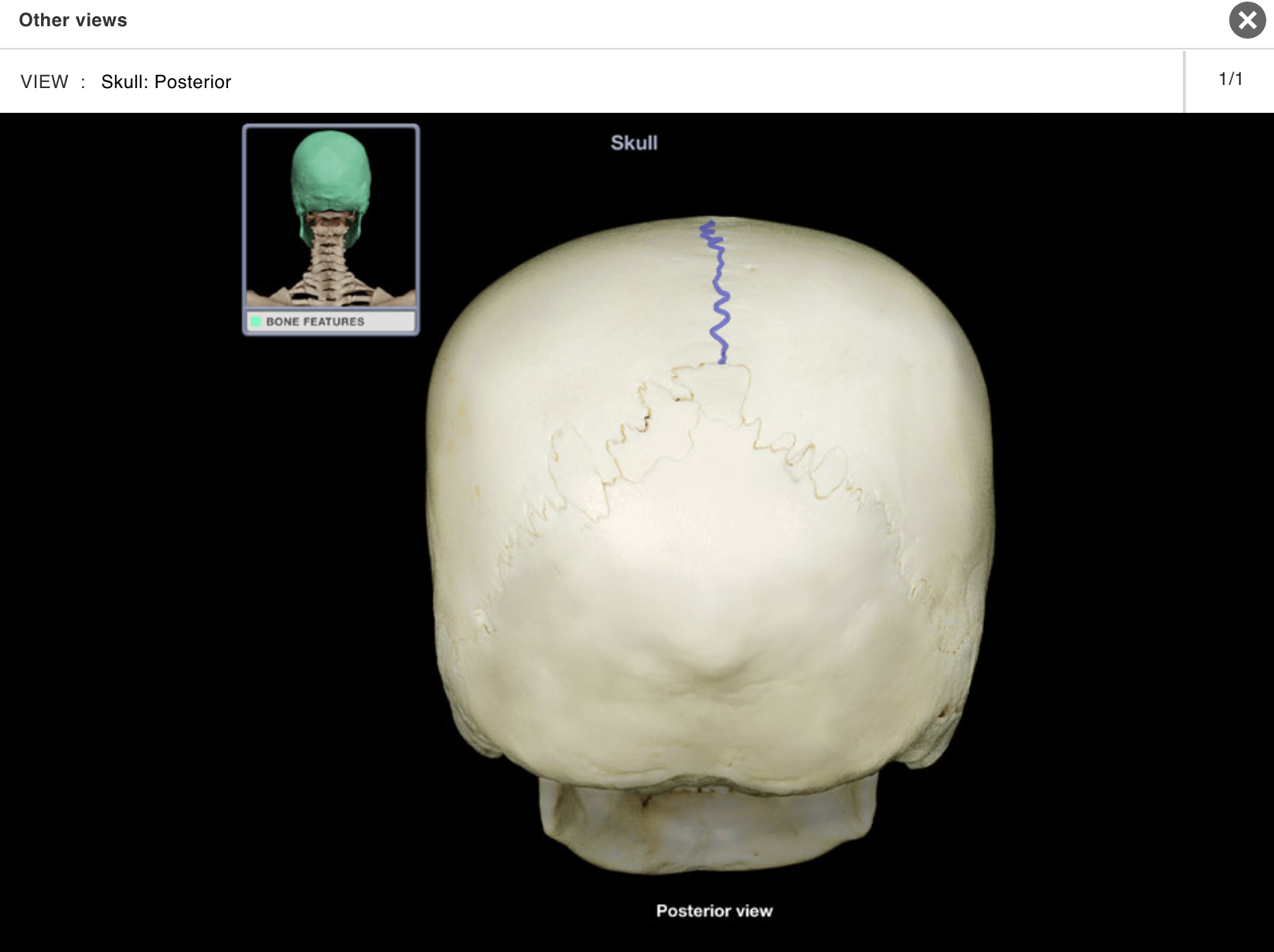
Lambdoid suture

Occipital bone

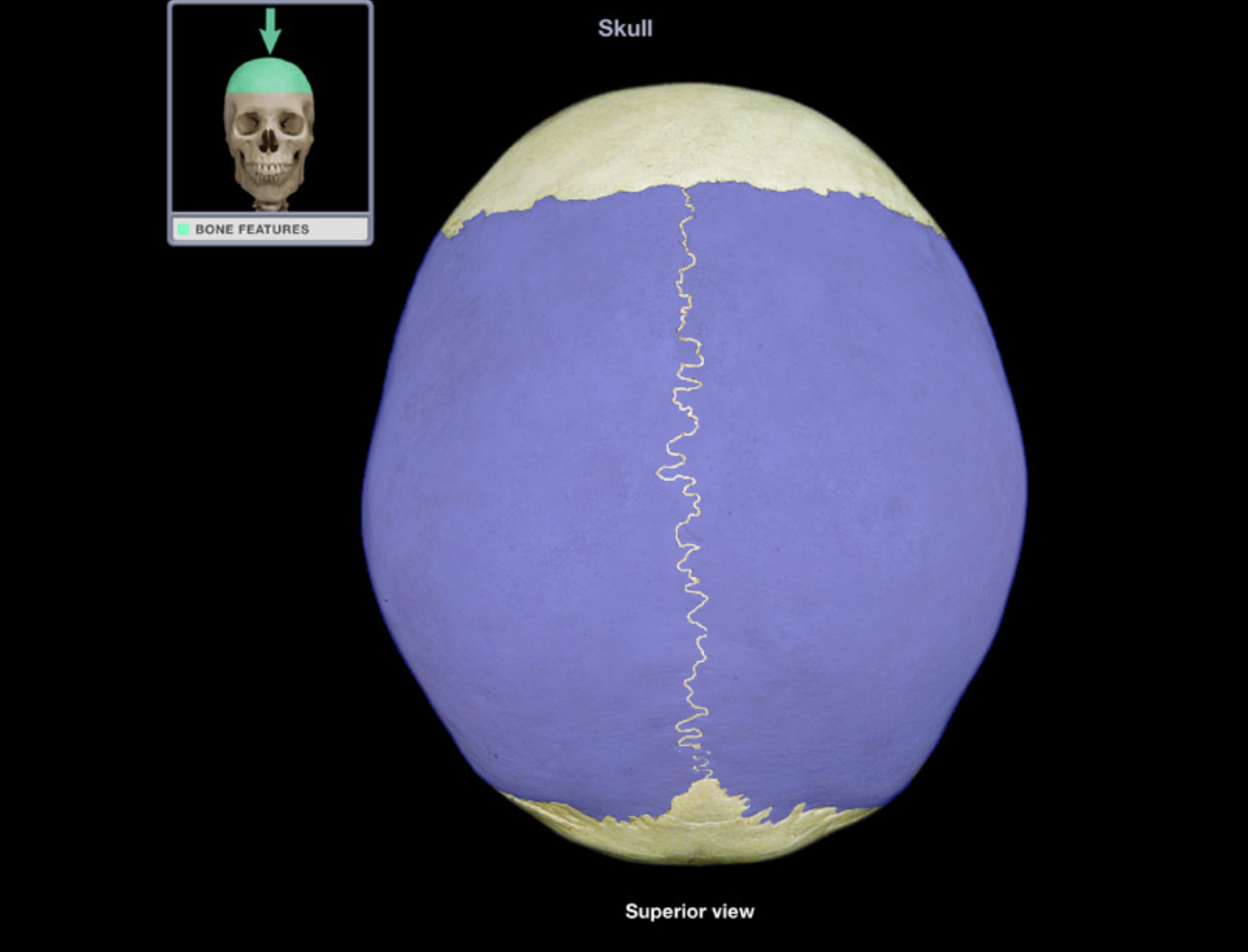
Parietal bone

Sagittal suture

89
New cards
<p>Coronal suture</p>

Coronal suture

Location:

• Skull (superior)

Description:

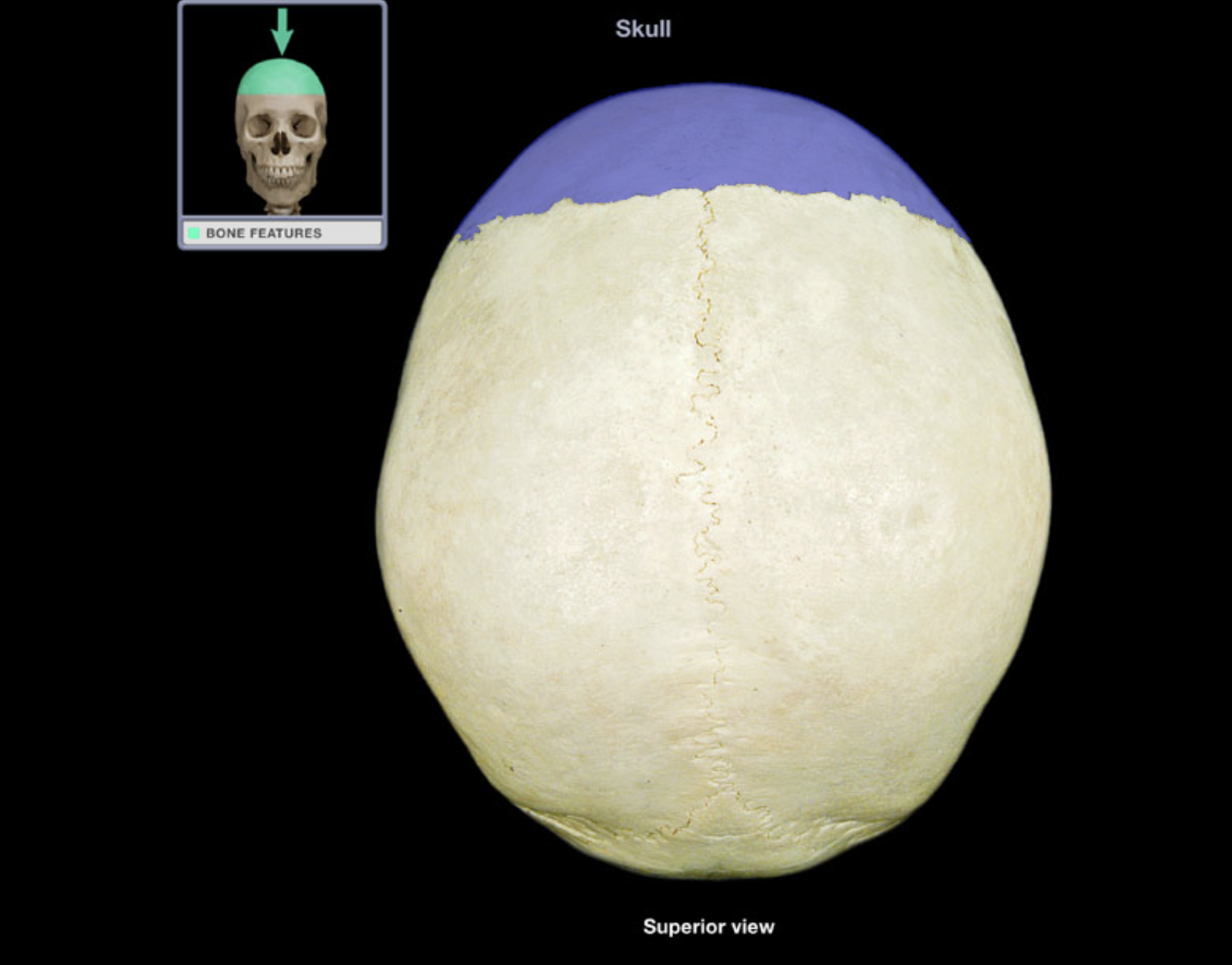
• Joint between frontal and parietal bones

<p>Location:</p><p class="p1">• Skull (superior)</p><p class="p1">Description:</p><p class="p1">• Joint between frontal and parietal bones</p>
90
New cards
<p>Frontal bone</p>

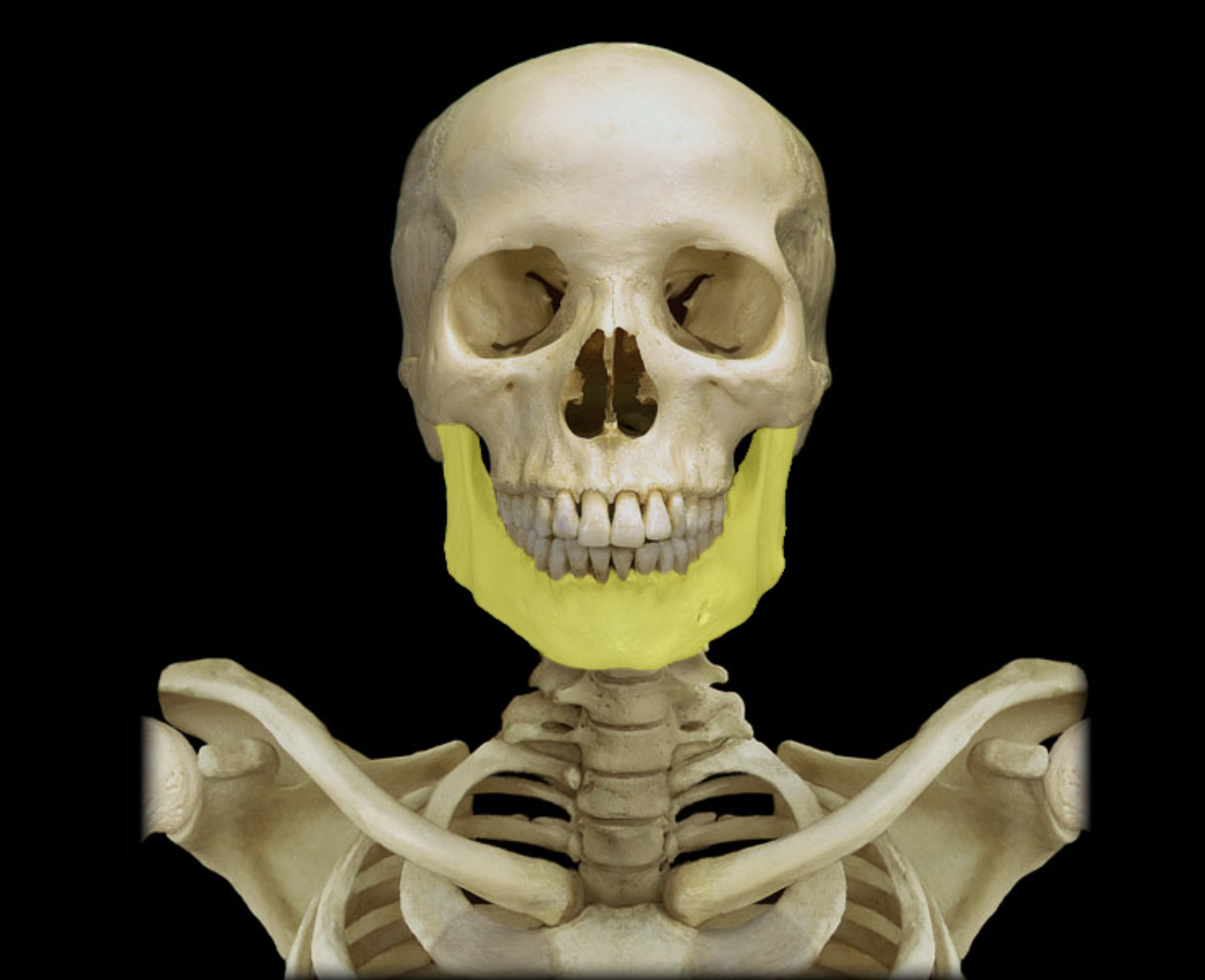
Frontal bone

Location:

• Skull (anterior superior part)

Description:

  • Unpaired, irregular-shaped, flat bone

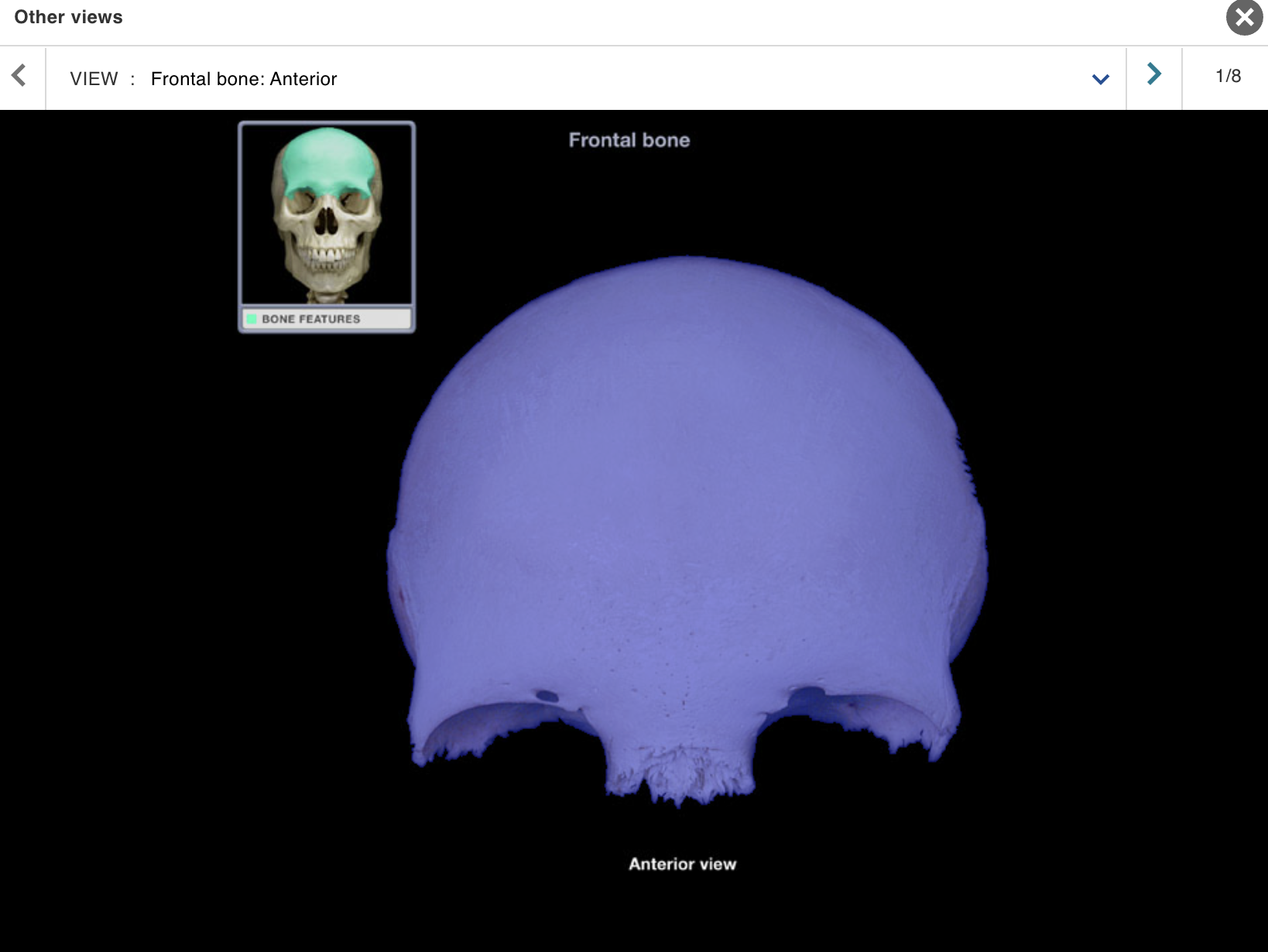
  • Forms forehead, roof of orbits, and most of anterior cranial fossa

  • Contains frontal air sinuses

Comment:

• Articulates with parietal bone at coronal suture and sphenoid bone at sphenosquamosal suture
<p>Location:</p><p class="p1">• Skull (anterior superior part)</p><p class="p1">Description:</p><ul><li><p>Unpaired, irregular-shaped, flat bone</p></li><li><p>Forms forehead, roof of orbits, and most of anterior cranial fossa</p></li><li><p>Contains frontal air sinuses</p></li></ul><p>Comment:</p><p class="p1">• Articulates with parietal bone at coronal suture and sphenoid bone at sphenosquamosal suture</p>
91
New cards
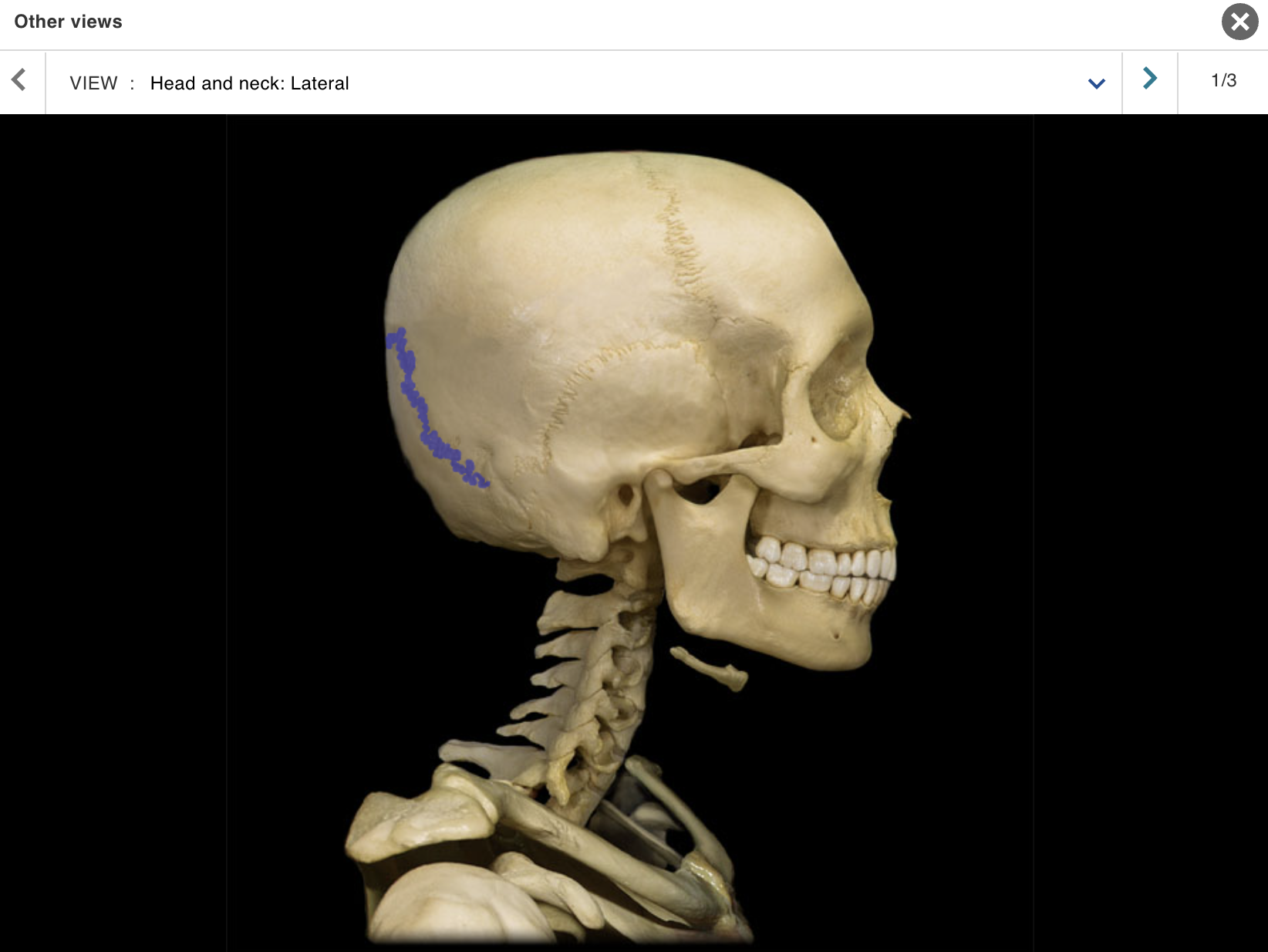
<p>Lambdoid suture</p>

Lambdoid suture

Location:

• Skull (posterior)

Description:

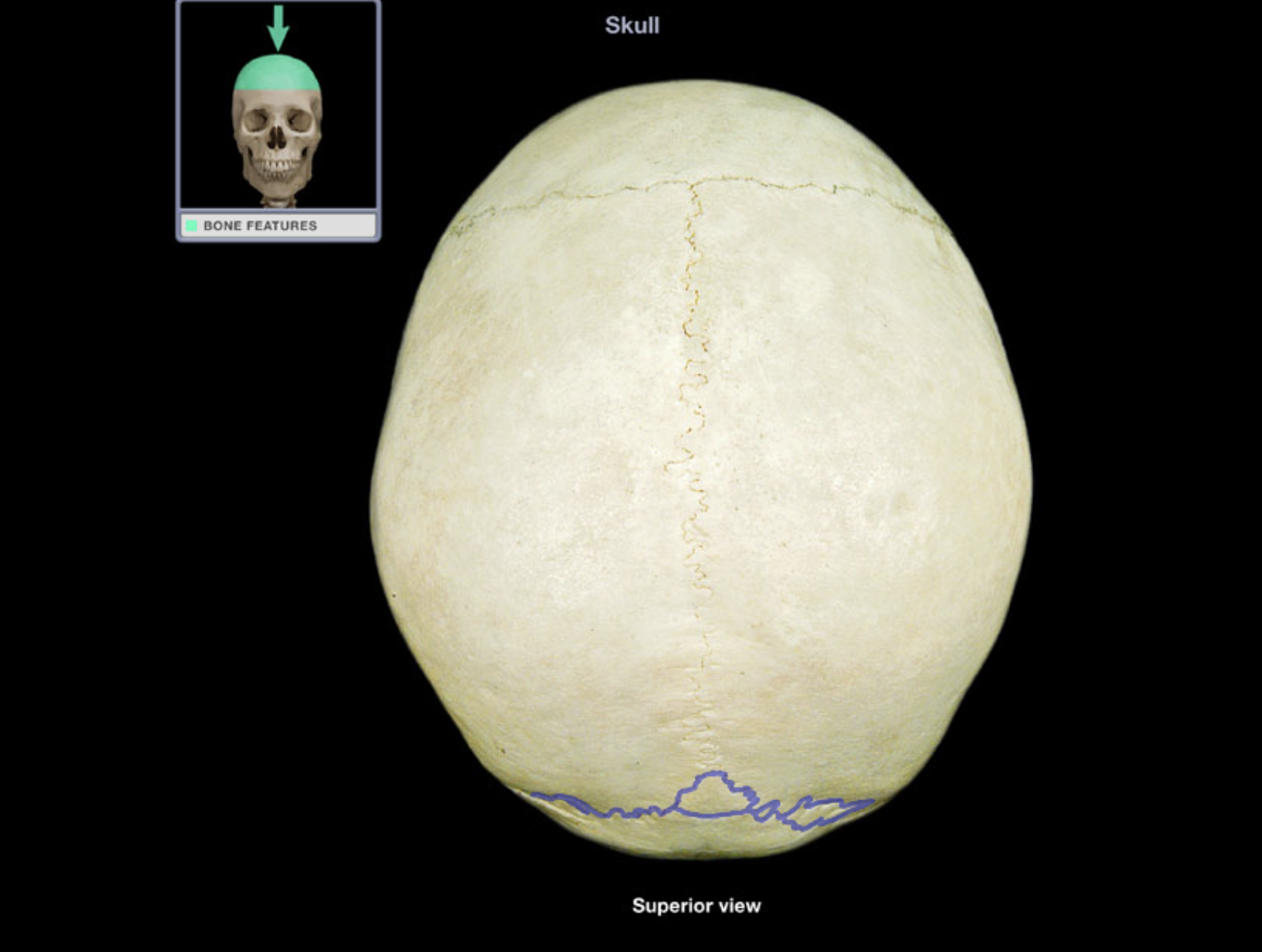
• Joint between parietal and occipital bones

<p>Location:</p><p class="p1">• Skull (posterior)</p><p class="p1">Description:</p><p class="p1">• Joint between parietal and occipital bones</p>
92
New cards
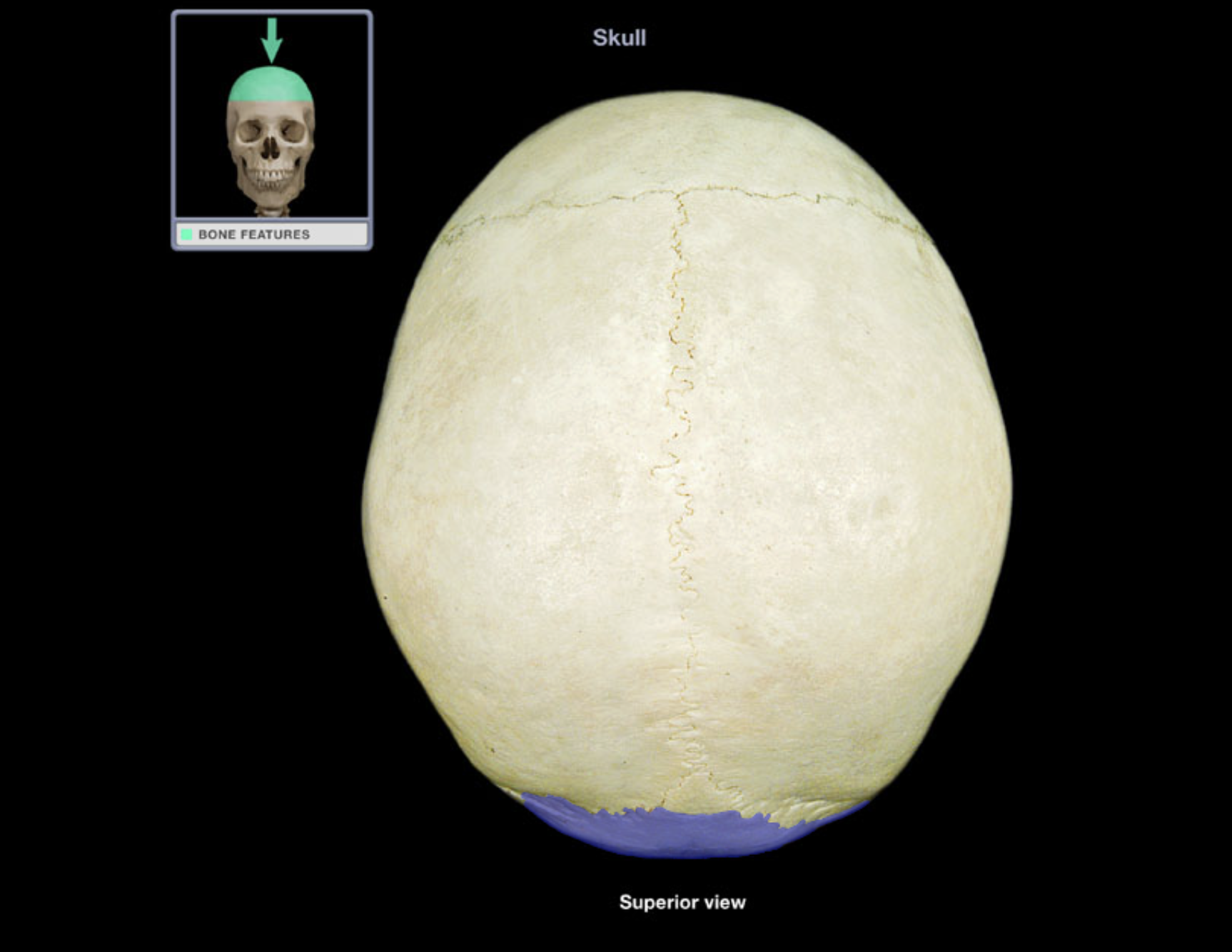
<p>Occipital bone</p>

Occipital bone

Location:

• Skull (posterior and inferior)

Description:

  • Irregular-shaped bone

  • Contains foramen magnum in central portion

Comment:

  • Forms most of posterior skull

  • Forms most of posterior cranial fossa

  • Articulates with parietal bone at lambdoid suture, temporal bone at occipitomastoid and other sutures, and sphenoid bone at spheno-occipital synchondrosis

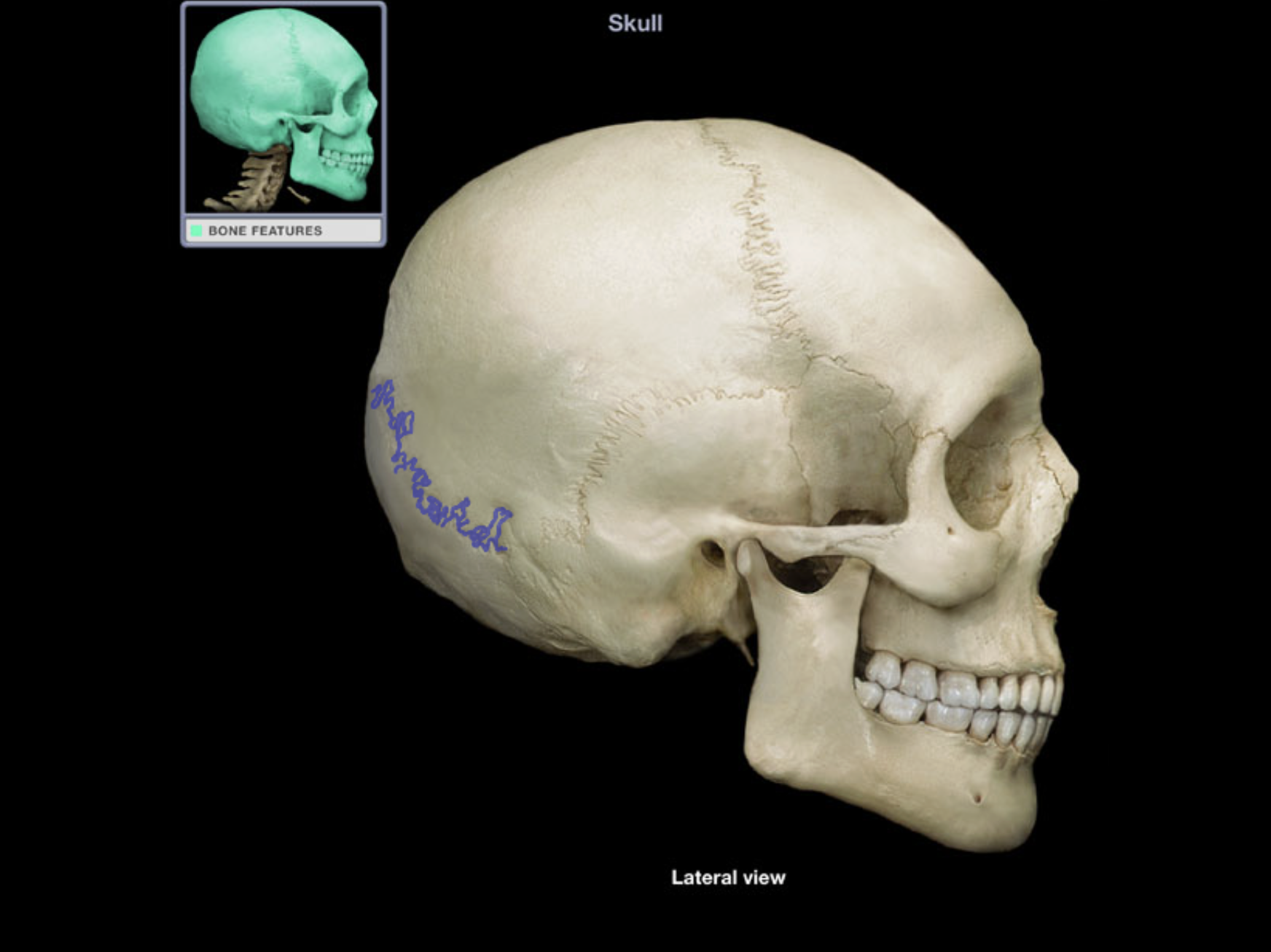
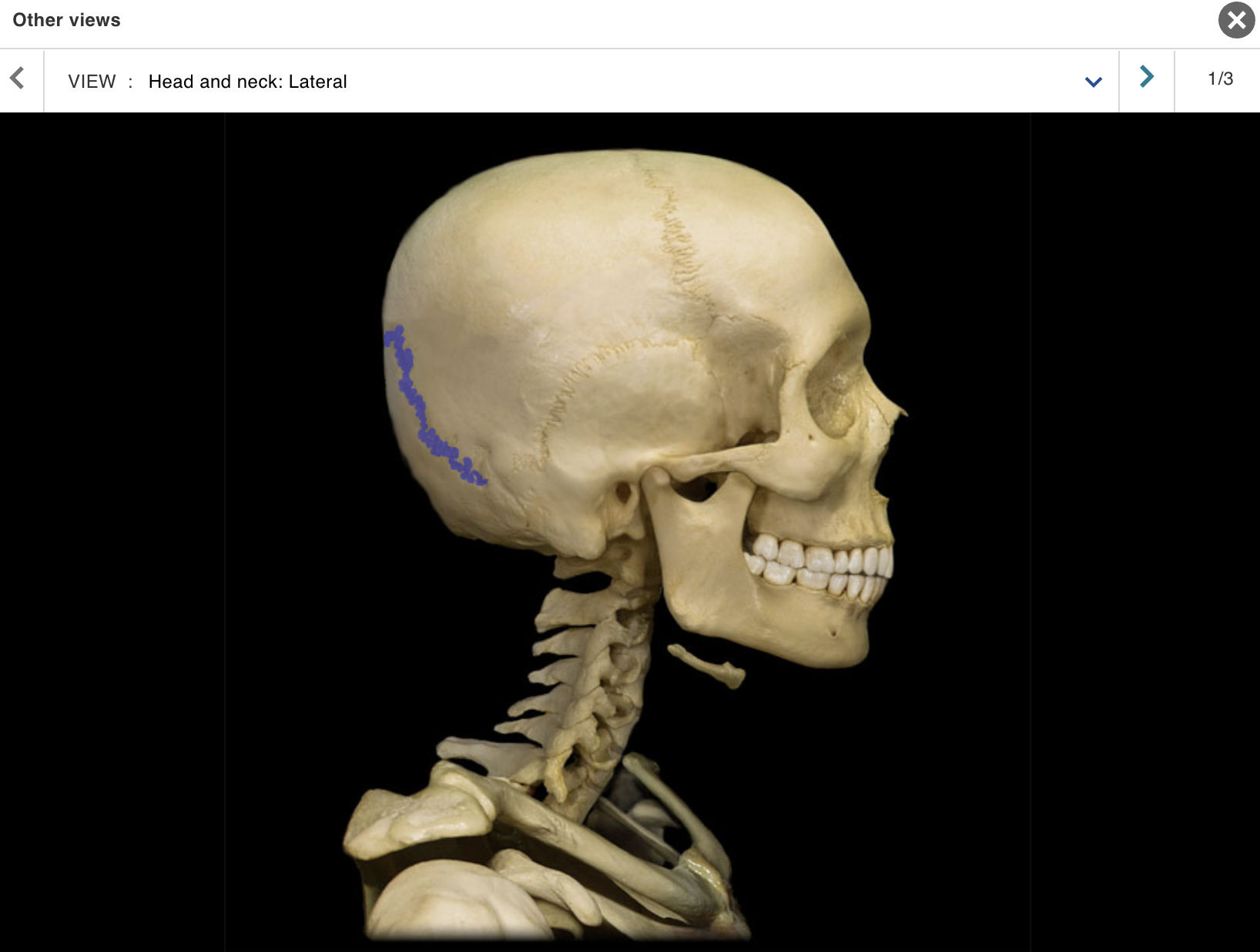
  • Articulates with atlas (C1 vertebra)

<p>Location:</p><p class="p1">• Skull (posterior and inferior)</p><p class="p1">Description:</p><ul><li><p>Irregular-shaped bone</p></li><li><p>Contains foramen magnum in central portion</p></li></ul><p class="p1">Comment:</p><ul><li><p>Forms most of posterior skull</p></li><li><p>Forms most of posterior cranial fossa</p></li><li><p>Articulates with parietal bone at lambdoid suture, temporal bone at occipitomastoid and other sutures, and sphenoid bone at spheno-occipital synchondrosis</p></li><li><p>Articulates with atlas (C1 vertebra)</p></li></ul><p></p>
93
New cards
<p>Parietal bone</p>

Parietal bone

Location:

• Skull (lateral)

Description:

  • Paired, flat bone

  • Forms most of lateral skull

Comment:

  • Parietal bones articulate at sagittal suture (midline)

  • Articulates with frontal bone at coronal suture, occipital bone at lambdoid suture, and temporal bone at squamosal suture

<p>Location:</p><p class="p1">• Skull (lateral)</p><p class="p1">Description:</p><ul><li><p>Paired, flat bone</p></li><li><p>Forms most of lateral skull</p></li></ul><p class="p1">Comment:</p><ul><li><p>Parietal bones articulate at sagittal suture (midline)</p></li><li><p>Articulates with frontal bone at coronal suture, occipital bone at lambdoid suture, and temporal bone at squamosal suture</p></li></ul><p></p>
94
New cards
<p class="p1">Sagittal suture</p>

Sagittal suture

Location:

• Skull (superior)

Description:

• Joint between parietal bones

<p>Location:</p><p class="p1">• Skull (superior)</p><p class="p1">Description:</p><p class="p1">• Joint between parietal bones</p>
95
New cards

ACTIVITY 8 : DISSECTION

MODULE: SKELETAL

TOPIC: SKULL / VIEW : LATERAL

Coronal suture

Frontal bone

Lacrimal bone

Lambdoid suture

Mandible

Maxilla

Nasal bone

Occipital bone

Parietal bone

Temporal bone

Zygomatic bone

96
New cards
<p>Coronal suture</p>

Coronal suture

Location:

• Skull (superior)

Description:

• Joint between frontal and parietal bones

<p>Location:</p><p class="p1">• Skull (superior)</p><p class="p1">Description:</p><p class="p1">• Joint between frontal and parietal bones</p>
97
New cards
<p>Frontal bone</p>

Frontal bone

Location:

• Skull (anterior superior part)

Description:

  • Unpaired, irregular-shaped, flat bone

  • Forms forehead, roof of orbits, and most of anterior cranial fossa

  • Contains frontal air sinuses

Comment:

• Articulates with parietal bone at coronal suture and sphenoid bone at sphenosquamosal suture
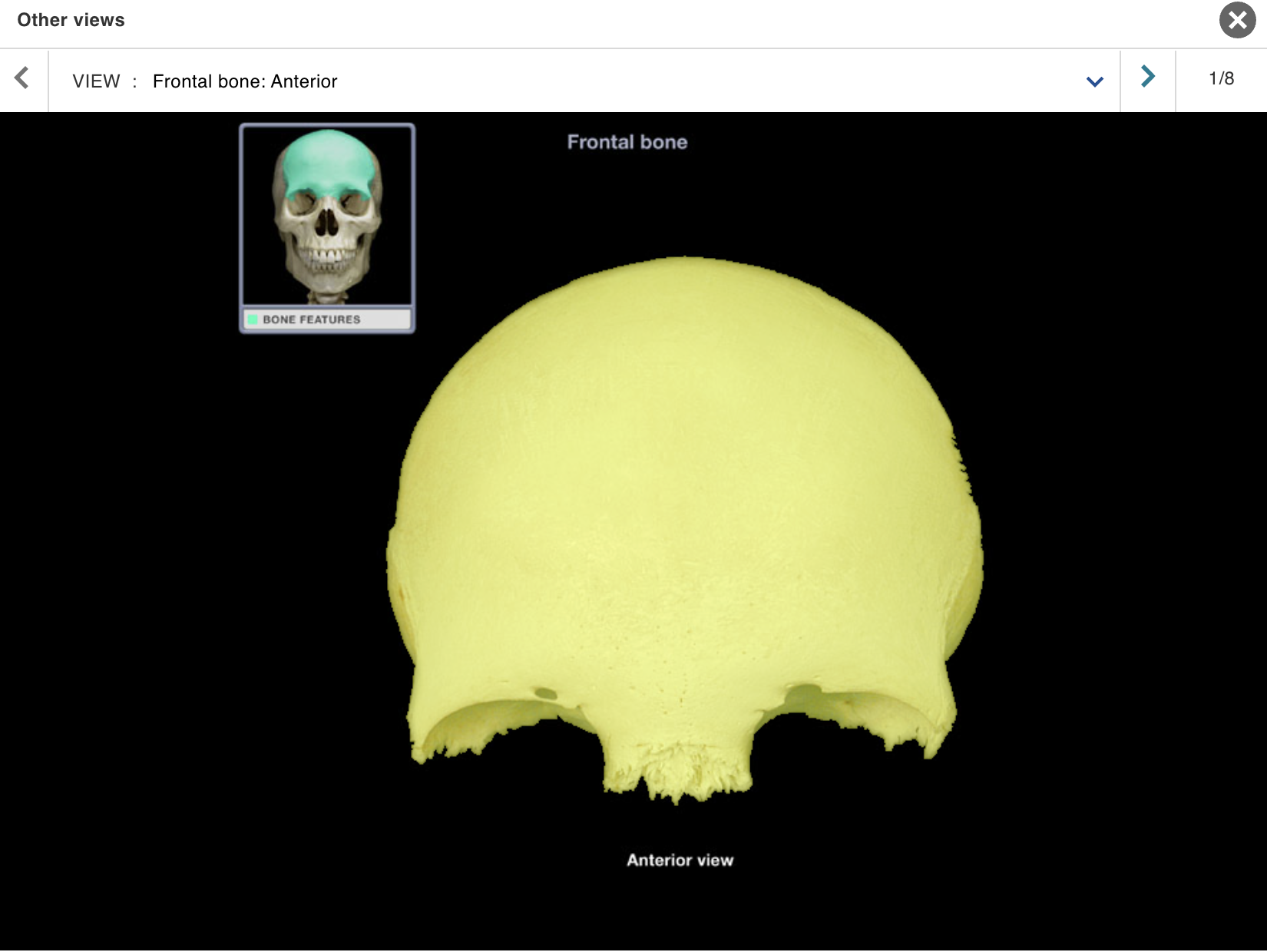
<p>Location:</p><p class="p1">• Skull (anterior superior part)</p><p class="p1">Description:</p><ul><li><p>Unpaired, irregular-shaped, flat bone</p></li><li><p>Forms forehead, roof of orbits, and most of anterior cranial fossa</p></li><li><p>Contains frontal air sinuses</p></li></ul><p>Comment:</p><p class="p1">• Articulates with parietal bone at coronal suture and sphenoid bone at sphenosquamosal suture</p>
98
New cards
<p>Lacrimal bone</p>

Lacrimal bone

Location:

  • Orbit (anterior and medial)

  • Nasal cavity (lateral wall)

Description:

  • Smallest and most delicate bone of skull

  • Orbital surface contributes to fossa for lacrimal sac and
    nasolacrimal groove

  • Nasal surface contributes to middle nasal concha

Comment:

• Some fibers of orbicularis oculi attach to lacrimal bone

<p>Location:</p><ul><li><p>Orbit (anterior and medial)</p></li><li><p>Nasal cavity (lateral wall)</p></li></ul><p class="p1">Description:</p><ul><li><p>Smallest and most delicate bone of skull</p></li><li><p>Orbital surface contributes to fossa for lacrimal sac and<br>nasolacrimal groove</p></li><li><p>Nasal surface contributes to middle nasal concha</p></li></ul><p>Comment:</p><p class="p1">• Some fibers of orbicularis oculi attach to lacrimal bone</p>
99
New cards
<p>Lambdoid suture</p>

Lambdoid suture

Location:

• Skull (posterior)

Description:

• Joint between parietal and occipital bones

<p>Location:</p><p class="p1">• Skull (posterior)</p><p class="p1">Description:</p><p class="p1">• Joint between parietal and occipital bones</p>
100
New cards
<p>Mandible</p>

Mandible

Location:

• Skull (anterior)

Description:

  • U-shaped bone

  • Each side consists of body (horizontal) and ramus (vertical) with coronoid and condylar processes

  • Mental protuberance forms point of chin

  • Contains alveoli ("sockets") for teeth

  • Also known as:

    • "Lower jaw"

    Comment:

    • Contributes to temporomandibular joint (TMJ)
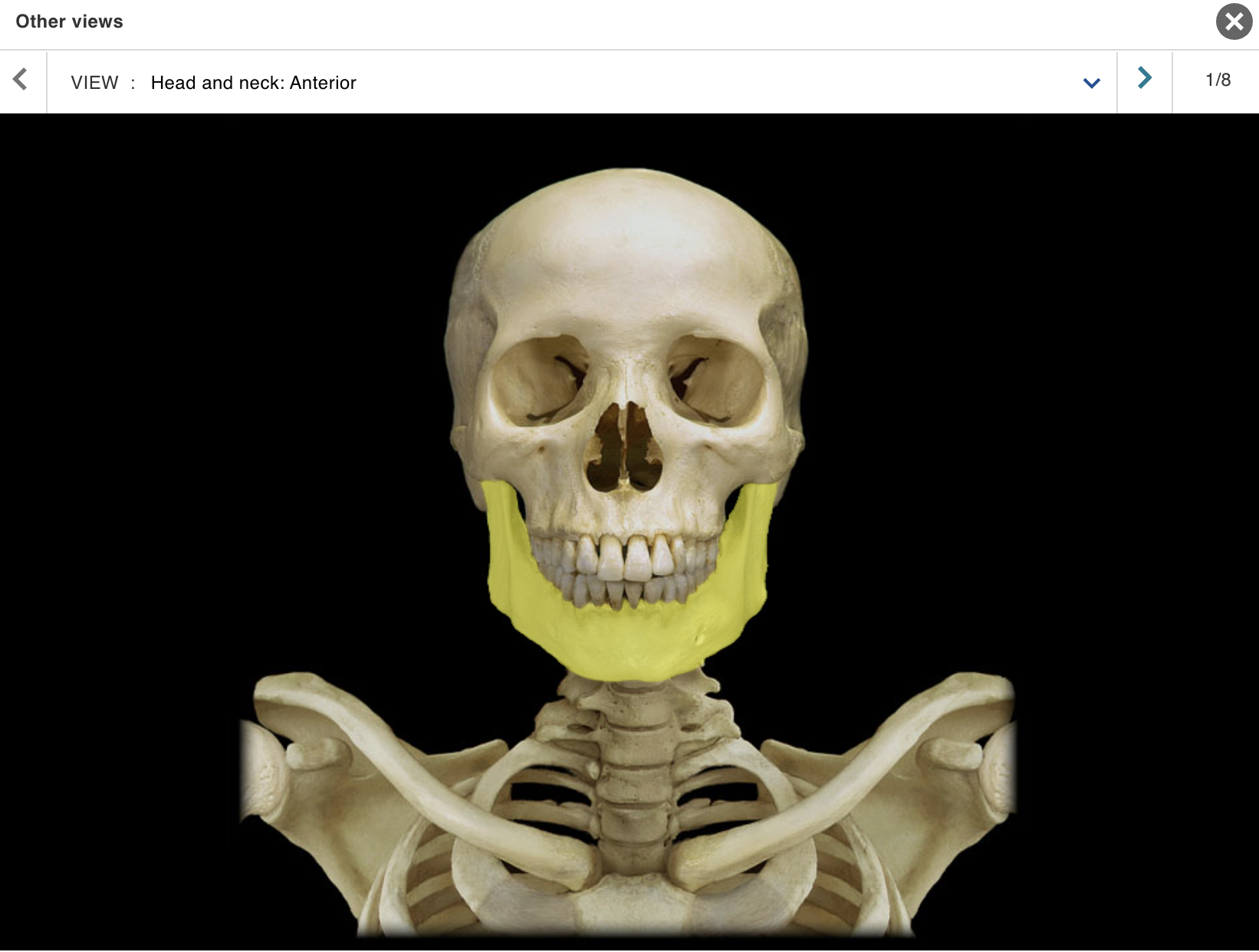
<p>Location:</p><p class="p1">• Skull (anterior)</p><p class="p1">Description:</p><ul><li><p>U-shaped bone</p></li><li><p>Each side consists of body (horizontal) and ramus (vertical) with coronoid and condylar processes</p></li><li><p>Mental protuberance forms point of chin</p></li><li><p>Contains alveoli ("sockets") for teeth</p></li><li><p>Also known as:</p><p class="p1">• "Lower jaw"</p><p class="p1">Comment:</p><p class="p1">• Contributes to temporomandibular joint (TMJ)</p></li></ul><p></p>

Explore top flashcards

USH Unit 1 Review
Updated 154d ago
flashcards Flashcards (114)
1
Updated 191d ago
flashcards Flashcards (119)
HISTOLOGIJA
Updated 638d ago
flashcards Flashcards (53)
EXP 8: Enzymes
Updated 310d ago
flashcards Flashcards (41)
USH Unit 1 Review
Updated 154d ago
flashcards Flashcards (114)
1
Updated 191d ago
flashcards Flashcards (119)
HISTOLOGIJA
Updated 638d ago
flashcards Flashcards (53)
EXP 8: Enzymes
Updated 310d ago
flashcards Flashcards (41)