ANT Lecture 1
 Studied by 0 people
 Call Kai
 Learn
Learn Practice Test
 Spaced Repetition
 Match
Match Flashcards
 Knowt Play
1/39

There's no tags or description
Looks like no tags are added yet.
Name | Mastery | Learn | Test | Matching | Spaced | Call with Kai |
|---|
No analytics yet
Send a link to your students to track their progress
40 Terms
Important trends in evolution
bipedal (upright) walking
increasing brain size
changes in dentition
What ways to scientists learn about human evolution
fossil record
archeology
molecular evidence
the two types of dating methods
relative dating
direct dating
relative dating
orders past events relative to one another
Lower precision
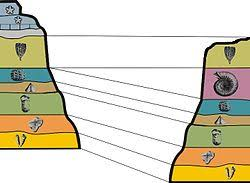
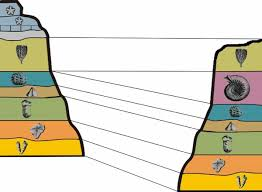
Uses geological principles of stratigraphy (eg, biostratigraphy)
Biostratigraphy:
Correlates the relative ages of strata (layers) using the fossils in them
Ex: Hipparion:
Came into africa from eurasia, dated between 10.5 - 12 Ma
If you find Hipparion in Africa, the stratum probably dates between 12 Ma and 10.5 Ma
But
This requires prior knowledge of the time range of the species
direct dating
returns numeric dates (years, etc)
High precision (with error)
Uses chemical properties of stone and biological materials
radioactive methods
Measures the decay of unstable radioactive isotopes in sediments/remains
Based on principle that radioactive isotopes change into stable isotopes at a steady rate
Info needed
Event that starts the decay “clock”
Known rate of decay
evolution is not..
…progressive
…has no end goal
fitness
depends on the environment- there is no objective “Better” species
bipedalism
walking and running upright on two legs
Facultative bipedalism
used with other locomotion as needed
habitual bipedalism
used day-to-day as a main form of locomotion
obligate bipedlaism
used exclusively; highly efficient
What Parts of the body are most important for understanding bipedalism?:
bicondylar angle
arches
lumbar spine
Bicondylar angle:
the oblique found in the human femur which centers body weight over the feet
arches
are a part of human feet to absorb shock
Hypothesises for increasing brain size
ecological brain hypothesis
social brain hypothesis
ecological brain size
primates evolved large brains to find food, like fruits, in difficult environments
social brain hypothesis
primates evolved large brains to manage living in groups with complex social relationships
All primates have a high EQ (Encephalization: Quotient: ratio of brain mass to body mass) relative to to other mammals
This trend is even more pronounced in hominins
Brain size increased dramatically in hominins during the Pleistocene (2.6 Ma)
dental changes
Humans have relatively smaller teeth than other primates- especially canines
“Honing complex” between canine and P3 (premolar) absent in humans
possible explanation for dental changes
Lack of male-male competition
Use of tools
Chimp detention: large canines and C-P3 honing complex
the fossil record
Fossils of extinct organisms
Geological context
Environmental reconstruction
What are fossils?:
Evidence of plant and animal life preserved in the Earth’s crust
Mineralized organic material
Making sense of fossils: comparative morphology
We gain useful information from fossils thru comparison
Comparison among fossils and with living species
ancestral and derived traits
ancestral trait
inherited unchanged from an ancestor
Ex: 5 fingers on each hand (pentadactyl) in ancestral for humans because we inherited the trait from our common ancestor with other animals
derived
new trait in a species or group, relative to its ancestors
Ex: the bony chin is derived in modern humans because our common ancestor with our closest relatives did NOT have this trait
Symplesiomorphy:
shared-ancestral
Synapomorphy:
shared-derived
Autapomorphy:
unique derived
Homoplasy:
independently shared (not inherited from a common ancestor)
Ex: wings are a classic homoplasy they have evolved separately several times in different lineages
Fossilization steps
Decay of soft tissue
Rapid burial by sediment
Organic material slowly replaced by minerals
Exposure by erosure
is very rare: the vast majority of plants and animals never become fossils
Different factors influence if a particular organism’s remains are preserved or destroyed
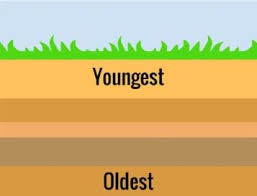
Law of Superposition:
layers of sedimentary rock are older than the layers above and younger than layers below
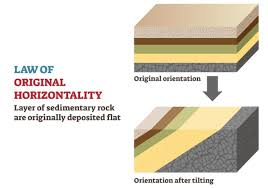
Law of original horizontality:
Layers of sediment are deposited horizontally under gravity
Sedimentary rocks left undisturbed will remain horizontal
Layers have been tilted or deformed did so after formation
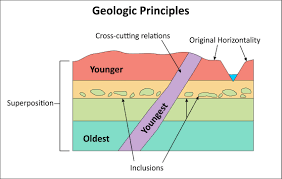
Law of crossing-cutting relationships
If a fault or other body of rock cuts through another body of rock, then it must be younger in age than the rock through which it cuts and deposits.
Law of Faunal Succession:
sedimentary rock strata contain fossilized flora and fauna
These fossils succeed each other in a specific, reliable order that can be identified over wide distances
Makes it possible to use biostratigraphy to date fossils
Archeology:
The study of material culture
Using artifacts (objects made/used by people) to understand the past
Our key to understanding behavior in the past
Dynamics (what happened in the past) → Statics (artifacts)
The hominin archaeological record:
3.3 Ma to present
Composed mainly of stone artifacts until 200 Ka
Molecular evidence:
Newest line of evidence for researchers
Modern human DNA
Divergence from other living species (“molecular clock”)
Natural selection for specific traits
Introgression between populations
Ancient DNA and proteomics
Biological material preserved in ancient remains
The Molecular Clock:
Estimates the time of split between lineages
Difference in immune systems (ID) between two species is related to the amount of time since they diverged
Assumes a constant rate of change in immune system
Issues with the molecular clock:
Relies on the fossil record for estimation of the mutation rate
Assumes a constant rate of change in ID (or other mutations/differences)
Large standard deviation
Does not match fossil record:
Short chronology does not fit with the oldest hominin fossils eg, Sahelanthropus and Orrorin
 Note
Note  Flashcards (50)