org. evolution - CH16 - speciation
 Call Kai
 Learn
Learn Practice Test
 Spaced Repetition
 Match
Match Flashcards
 Knowt Play
1/38

There's no tags or description
Looks like no tags are added yet.
Name | Mastery | Learn | Test | Matching | Spaced | Call with Kai |
|---|
No analytics yet
Send a link to your students to track their progress
39 Terms
What is the effect of gene flow on populations?
Gene flow is a homogenizing force that reduces differences between populations
What evolutionary forces promote divergence between populations?
Natural selection
Genetic drift
Sexual selection
What happens when gene flow is reduced or absent?
Populations diverge genetically
What happens when gene flow increases between populations?
Populations become more similar (homogenization)
What are the three possible outcomes when two populations come back into contact (hybrid zone)?
Reinforcement
Fusion
Stability
Define sympatric speciation.
Speciation that occurs in the same geographic location without physical separation
What must occur for sympatric speciation to happen?
Reproductive isolation must evolve (behavioral, temporal, etc.)
What is polyploidy?
A multiplication of chromosome number that can cause instant reproductive isolation
In what organisms is polyploidy most common?
Plants
Why does polyploidy lead to speciation?
It creates immediate reproductive isolation from the original population
What is ecological speciation?
Speciation driven by divergent natural selection in different environments
What type of selection is commonly involved in ecological speciation?
Disruptive selection
How can ecological speciation lead to reproductive isolation?
Differences in environment → differences in traits → temporal or behavioral isolation develops
What is temporal isolation?
Populations reproduce at different times, preventing interbreeding
Can speciation occur even with gene flow?
Yes — if selection is strong enough, divergence can still occur
What experiment showed that divergence can occur despite gene flow?
Endler (1973) Drosophila experiment
What is speciation driven by sexual selection?
Speciation caused by differences in mate preference
How can sexual selection reduce gene flow?
Individuals prefer certain traits → they stop mating with others → isolation
Give an example of speciation by sexual selection.
African cichlid fish in Lake Victoria
What trait mainly differs among African cichlid species?
Male coloration
Why are African cichlids reproductively isolated?
Female mating preferences for specific male colors
What happens to mate choice under different light conditions in cichlids?
Normal light → assortative mating (same species)
Monochrome light → random mating
What environmental factor influenced cichlid speciation?
Light differences in water depth affecting color perception
What is the effect of eutrophication on speciation?
Can lead to hybridization and loss of biodiversity
What determines whether populations diverge or stay similar?
The balance between gene flow and selection/drift/sexual selection
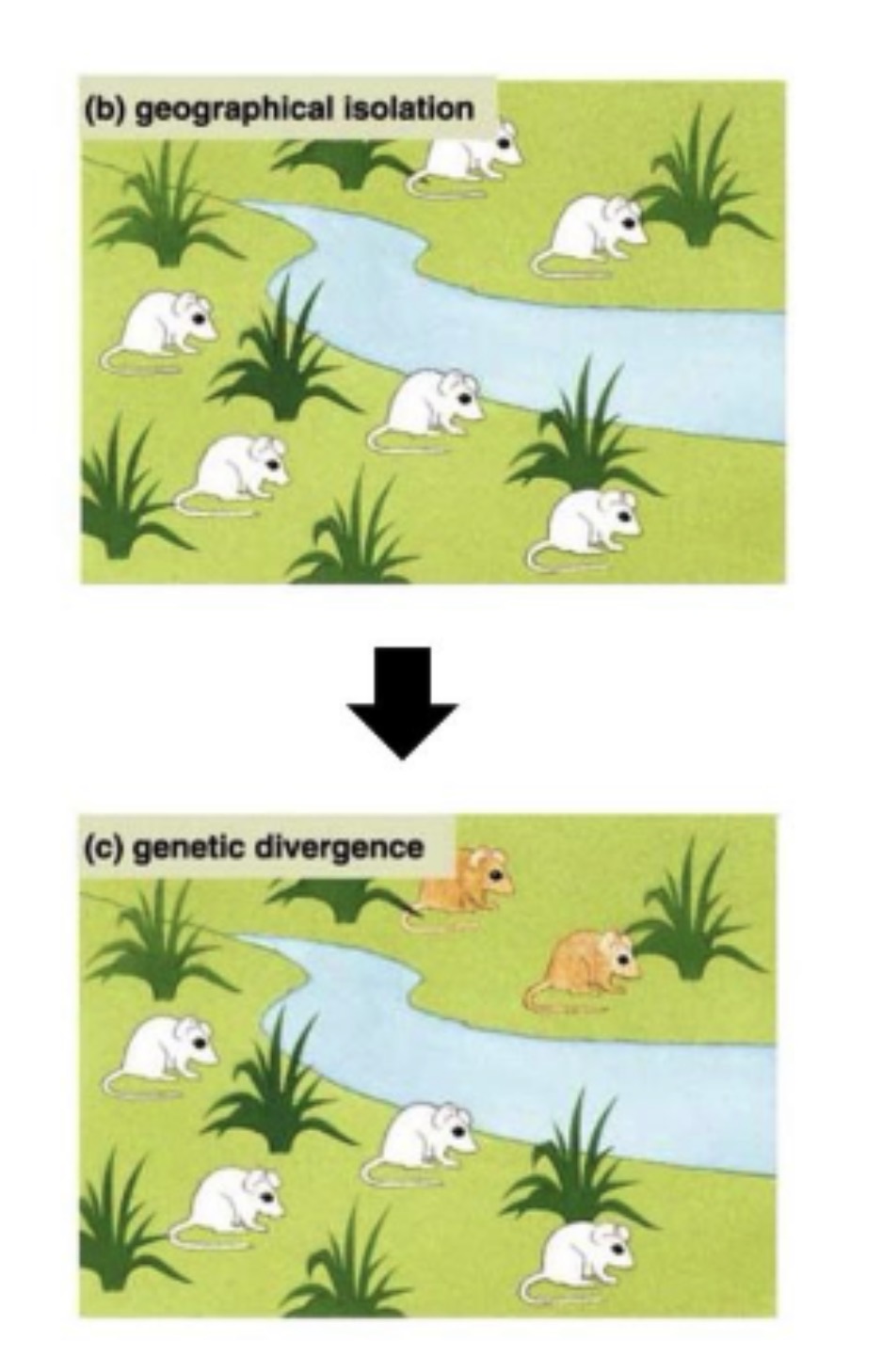
What causes genetic differences to accumulate between geographically isolated populations?
A. Mutations
B. Natural selection
C. Genetic drift
D. Sexual selection
E. All of the above
E
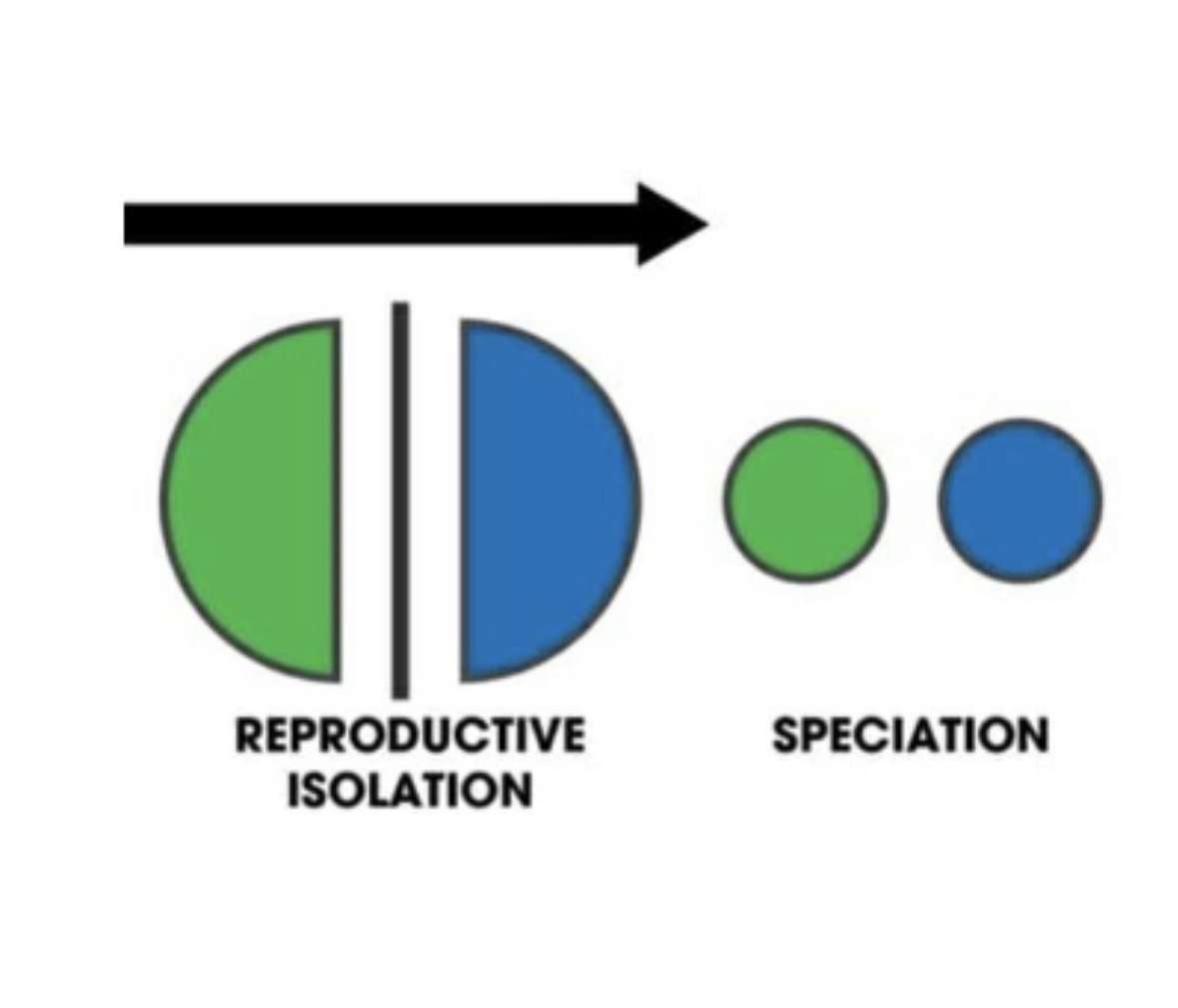
What is a condition that prevents isolated populations from mixing again, once the geographic barrier is removed?
A. Anatomical incompatibility
B. Gene flow
C. Both
A
What is a shortcoming of the biological species concept?
A. It is more subjective than the other concepts.
B. It cannot distinguish cryptic species.
C. It is not applicable to asexual species.
D. It only works for extinct species.
C
According to Coyne, what is the most common cause of speciation?
A. Geographic isolation
B. Sexual selection
C. Natural selection
D. Temporal isolation
E. Hybrid sterility
A
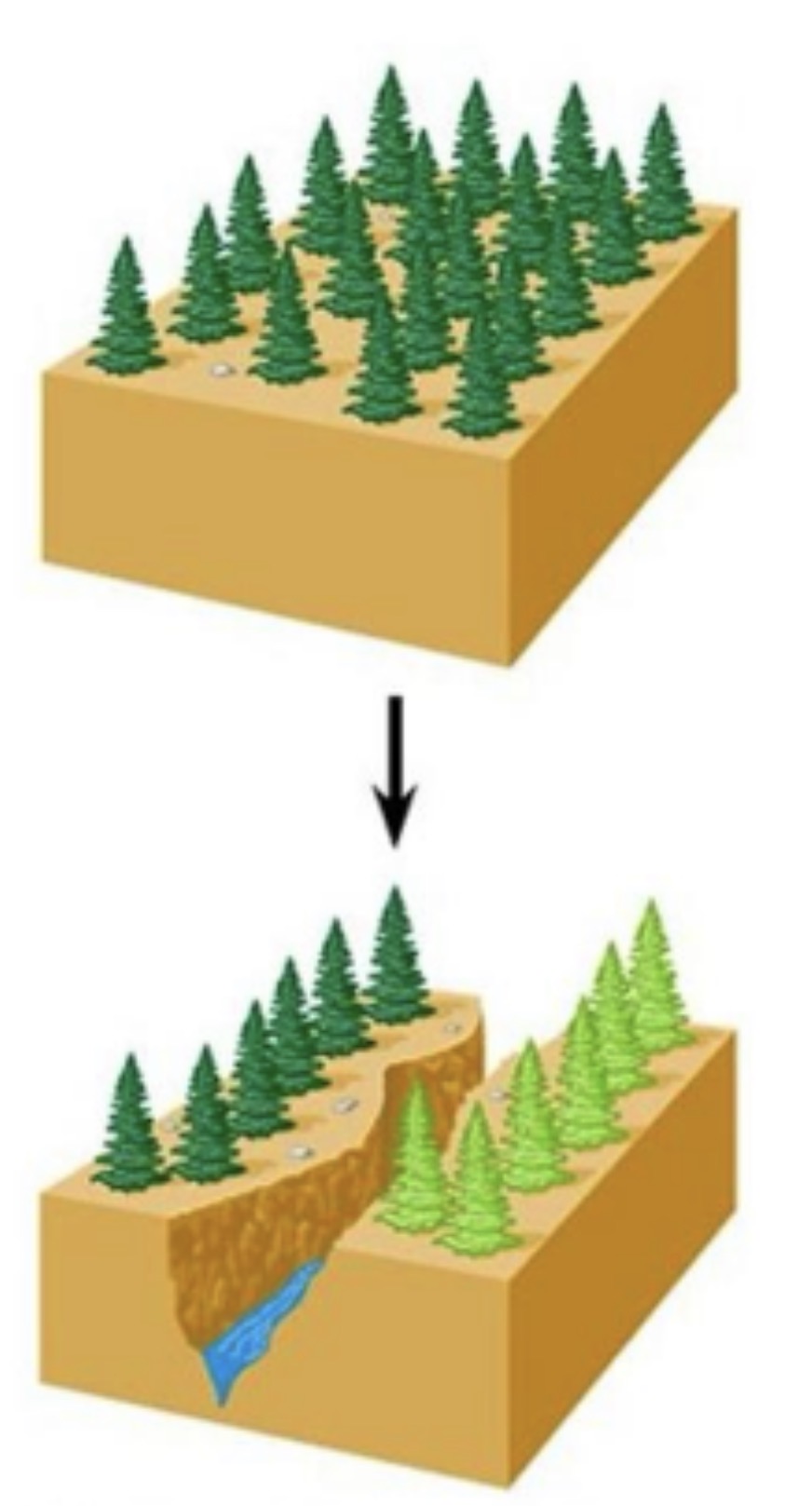
What evidence did Coyne give for the claim that allopatry is the predominant mode of speciation?
A. Groups that have been isolated for longer periods display greater genetic dissimilarity.
B. Closest living relative species are usually non-overlapping.
C. Many hybrids are infertile
B
What REDUCES genetic variation between populations?
A. Behavioral isolation
B. Sexual selection
C. Genetic drift
D. Gene flow
E. All of the above
D
Two isolated lakes are invaded by a species of leech. In lake 1, the leeches produce 70% females, and in lake 2, the leeches produce 50% females. Assuming all else is equal, which leech population size should grow the fastest?
A. Lake 1’s
B. Lake 2’s
C. They should grow at the same rate
A
Which pair of populations is likely to show the greatest genetic divergence?
A. A pair that has been partly isolated for 2 mil years with 9% gene flow during that time.
B. A pair that has been partly isolated for 0.5 mil years with 30% gene flow during that time.
C. A pair that has been partly isolated for 3 mil years with 4% gene flow during that time.
C
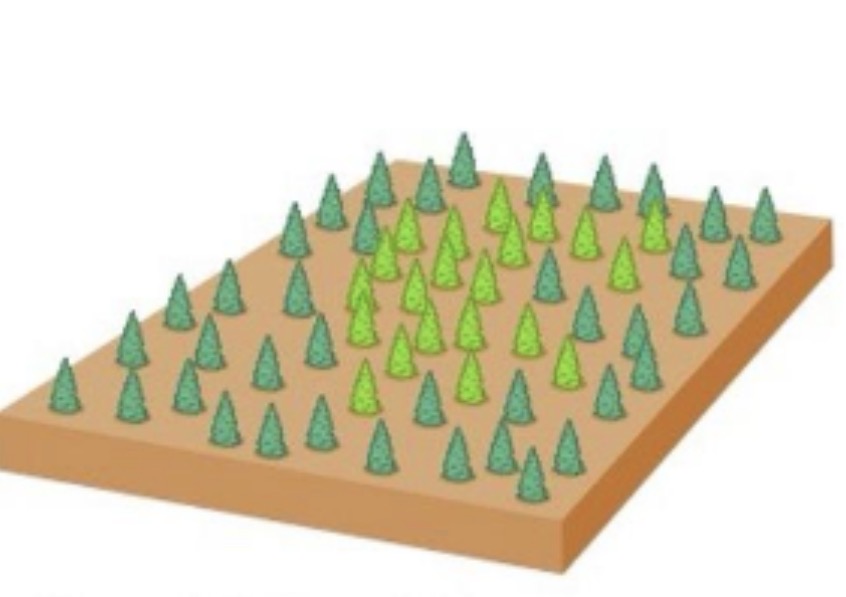
According to Coyne, what is the most common cause of sympatric speciation?
A. Behavioral isolation
B. Sexual selection
C. Polyploidy
D. Temporal isolation
E. Hybrid sterility
C
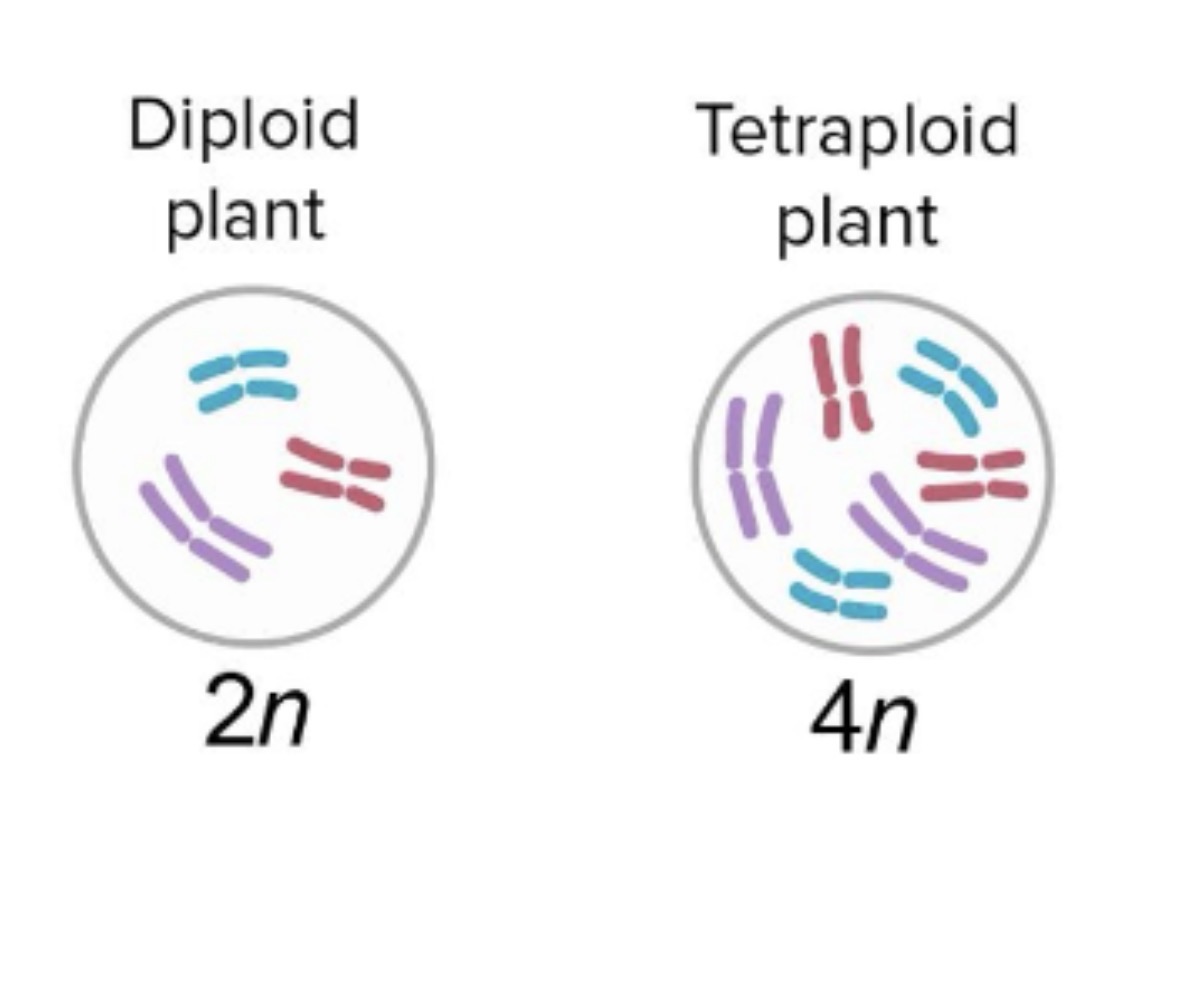
Why can’t a polyploid plant mate with its diploid individuals from its parent population?
A. They release pollen at different times
B. They don’t attract the same pollinators
C. Their offspring would end up with an odd number of chromosomes
C
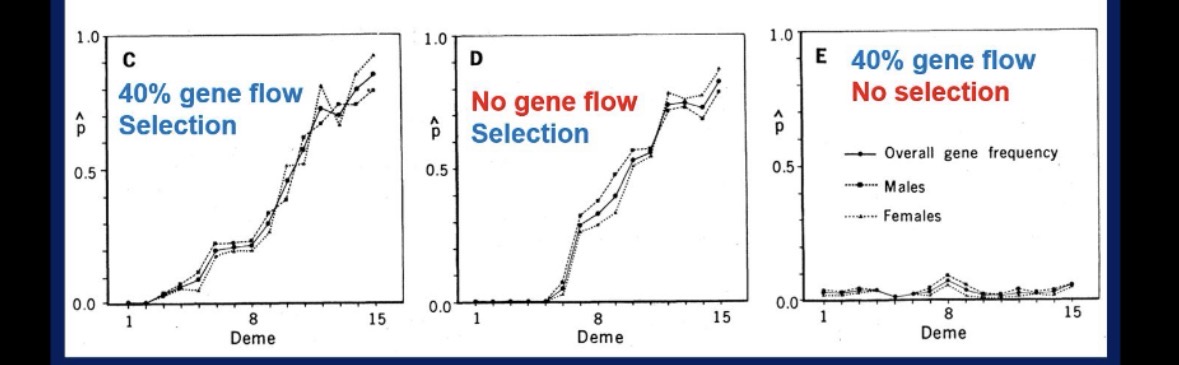
What conclusion about divergence can we draw from this data?
A. 40% gene flow is a stronger force than the artificial selection.
B. Artificial selection is a stronger force than 40% gene flow.
C. The relative influences of artificial selection and 40% gene flow on divergence are approximately the same.
B
Studies have shown that female zebrafish strongly prefer genetically modified red fluorescent Glofish® males to wildtype males. Is this evidence for the good genes hypothesis?
A. Yes
B. No
B
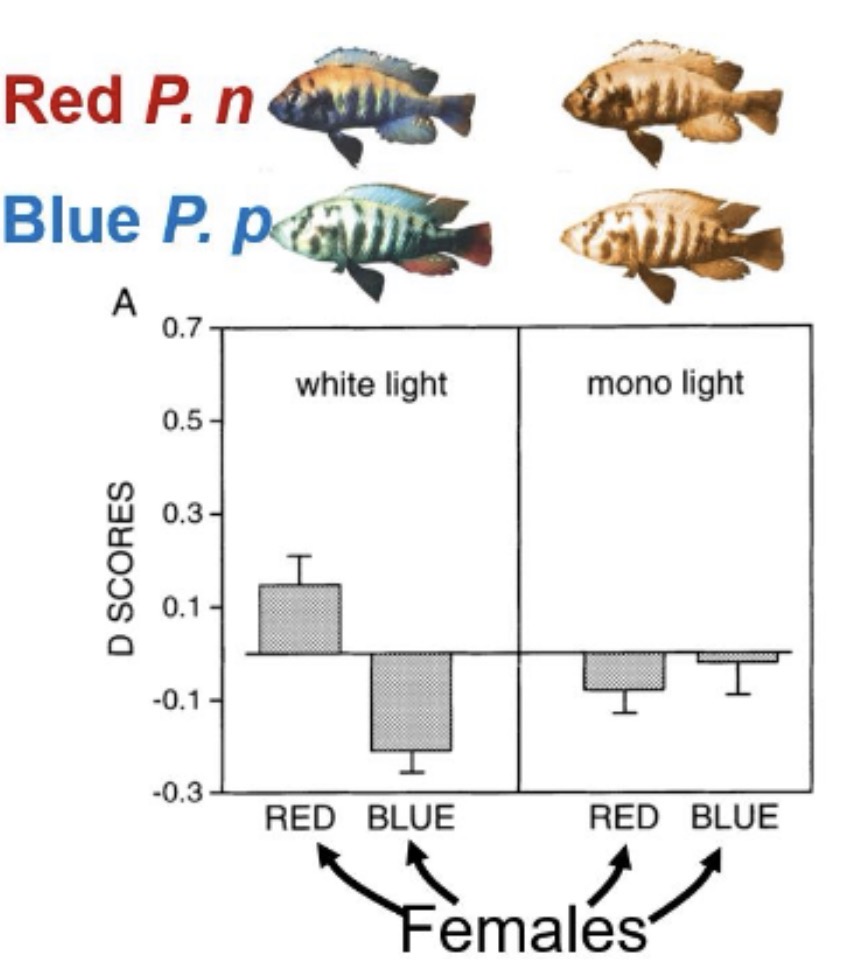
What conclusion can we draw from this data? D score represents responsiveness to red male minus responsive to blue male, where positive values = red preference and negative values = blue preference.
A. The mono light makes each female prefer its own type as a mate.
B. The mono light makes each female prefer the other type as a mate.
C. The mono light makes each female prefer the blue type as a mate.
C
Given the results of that study, what would be the most likely effect of eutrophication, leading to cloudy water within the east African lakes?
A. Fewer species of cichlid
B. More species of cichlid
C. No change in number of cichlid species
A

