HPED1020: Leadership and Communication (2)
 Studied by 0 people
 Call Kai
 Learn
Learn Practice Test
 Spaced Repetition
 Match
Match Flashcards
 Knowt Play
1/55

There's no tags or description
Looks like no tags are added yet.
Name | Mastery | Learn | Test | Matching | Spaced |
|---|
No study sessions yet.
56 Terms
Communication
The process of acting on information
Human communication: The process of creating or sharing meaning through interaction with other human beings
The process of making sense out of the world and sharing that sense with others by creating meaning through verbal and nonverbal messages
Studying communication improves employment, relationships, and physical and emotional health
Interpersonal Communication
Communication that takes place between two people who share a relationship
Involves relationship between two unique individuals — “I-Thou” relationship
True dialogue and honest sharing of self with others
Impersonal Communication
Involves relationship between an individual and an object — “I-It” relationship
Mechanical and stilted; no honest sharing of feelings
Reasons for Communication
To inform
To persuade
To entertain
Models of Communication
Transfer or exchange of information ↓
Give and take approach ↓
Process
Communication: What Is Involved
Source
Encoding (creating message in head)
Channels (written, verbal, physical, etc.)
Receiver
Decoding (make sense of the message)
Feedback
Noise (external, internal, semantic)
Barriers to Communication: Different Contexts
Physical
Social
Historical
Psychological
Cultural
Physical Barriers to Communication
Noise
Distance
Walls / Closed Doors / Faulty Technology
Social Barriers to Communication
Stereotypes and prejudice
Cultural or age gaps and differences
Differing communication styles (i.e., direct vs subtle)
Historical Barriers to Communication
Language differences
Lack of technology
Vast physical distances
Cultural clashes (beliefs, norms, gestures)
Psychological Barriers to Communication
Internal mental or emotional blocks (stress, fear, self-esteem, anger, lack of attention)
Emotions (particularly negative ones like anger, fear, anxiety, jealous or sadness can cloud judgment)
Selective Perception/Attention: filtering information based on personal needs, interests, or what we want to hear
Cultural Barriers to Communication
Language differences
Cultural differences (difference in cultural norms, gestures, what is considered appropriate or inappropriate may differ, etc.)
Ethnocentrism and other forms of prejudice
Conflicting Values/Norms (i.e., time perception, formality)
Characteristics of Communication
Inescapable
Irreversible
Complicated
Emphasizes context and relationships
Governed by rules
Verbal Communication: The Nature of Language
Words as symbols (i.e. “dawn” for new beginnings)
Meaning to words
Denotative and Connotative meanings for words (dictionary literal definition vs cultural, emotional, or suggested meanings through the literal; i.e., “home” is a place where one lives, but also the word “home” connotes warmth, family, safety)
Concrete and abstract meanings through words
Culture bound
Context bound
Reasons for Different Meanings
Homonyms: words that sound alike but have different meanings
Substitution: people have different meanings for words
Semantic Blanks: do not know the meaning of the word used
Improving Verbal Communication: Speaking Clearly
Use specific language (specific, concrete, and precise words)
Provide details and examples
Dating information
Indexing generalizations
Word Barriers
Bypassing: miscommunication because of different understandings of the same words
Lack of precision (i.e., jargon)
Allness: i.e. “all women are bad drivers”
Static Evaluation: statements that fail to recognize change (labels tend to do this)
Polarization: extremes in all black and white; no shades or nuance: i.e., “you either love me or you don’t”
Improving Verbal Communication: Speak Appropriately
Consider formality of language
Jargon and slang
Profanity and vulgarity
Sensitivity
Non-Verbal Communication: Challenges
Ambiguous
Continuous
Multi-channelled
Cultural-based
Codes of Non-Verbal Communication
Eye contact
Facial expressions
Gesture
Posture
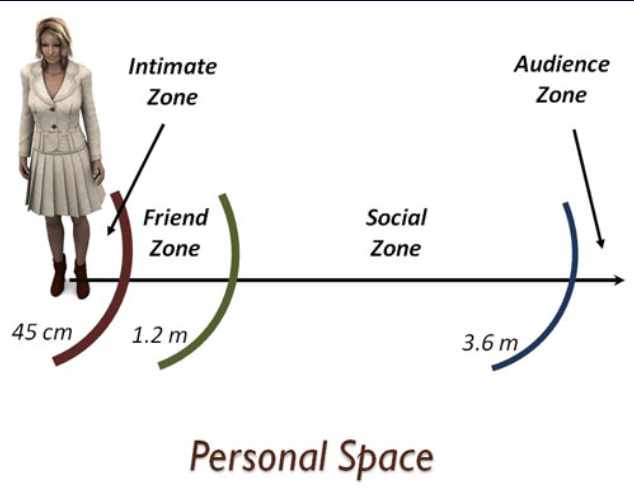
Proximity (see image)
Codes of Nonverbal Communication: Body Movement
Emblems: Take the place of a word or phrase (i.e., thumbs up for “okay” or approval)
Illustrators: Illustrate what the speaker is saying (i.e. spreading hands wide when saying “it was huge”)
Affect Displays: Display feelings that have not been expressed verbally (i.e., facial expressions, body language, vocal cues)
Regulators: Control the flow of a conversation (i.e. eye contact, head nods, or hand gestures)
Adaptors: Relieve tension (i.e., fidgeting with a pen, twirling hair, adjusting glasses)
Non-Verbal Communication: Variations
Cultural
Eye contact
Gestures, posture, and facial expressions
Gender
Eye contact
Facial expressions
Paralanguage
“It’s not what you said, it’s how you said it”
Adding meaning to words through elements like pitch, tone, volume, rate, and pauses/silence, working alongside body language (gestures, facial expressions) to convey emotions, intentions, and emphasis
Perception
An active process by which you become aware of what is around you
Interpersonal Perception: Making judgments about people and actions
Everyone uses shortcuts — shortcuts may mislead you
Memory is influenced by preconceptions; stereotypes may distort perception
Process of Perception
Selection
Organization
Interpretation
Process of Perception: Selection
Selective Perception: make sense based on our beliefs, values, etc.
Selective Attention: focus on specific stimuli; fulfill your needs
Selective Exposure: with people that confirm or add to your thoughts
Selective Recall: remember things we want to remember
Process of Perception: Selection (2)
Visual & Aural Stimulation: sights, sounds, smell
Needs & Interests: focus on things that interest you or meet your needs
Expectations: tuned in when expecting something to happen or when not expecting something but out of ordinary
Process of Perception: Organization
Rules: things that go together, things that are very different, things that are similar
Search for patterns
Proximity: things that are close together
Similarity: things that are similar
Difference: things that are different
Closure: fill in missing information
Process of Perception: Interpretation
Interpreting actions, behaviours of others
Assign meaning to experiences
Form impressions of others
The Processes of Perception: Perceiving Others
How we form impressions of others
Impressions: collection of perceptions; used to interpret others’ behaviors
Primary-Recency
Primacy Effect: What happens first exerts the most influence (first impressions are the most important)
Recency Effect: What happens most recently exerts the most influence
Perceptions: How We Describe Others
Halo Effect: Inferring many positive qualities from one
Horn (Reverse Halo) Effect: Inferring many negative qualities from one
Barriers to Perception
Ignoring information
Oversimplifying
Stereotyping
Imposing consistency
Focusing on the negative
Fundamental attribution error (more likely to believe that others are to blame when things go wrong)
Self-serving bias (when things go right, it’s because of me; when go things go wrong, it’s because of others)
Perception-Checking
Three parts:
Description of behaviour (“When you stomped out of the room and slammed the door,”)
At least two possible interpretations (“I wasn’t sure if you were mad at me or in a rush”)
Request for clarification (“How did you feel?)
Increasing Accuracy in Perception
Analyze your perceptions
Check your perceptions
Reduce uncertainty
Be culturally sensitive
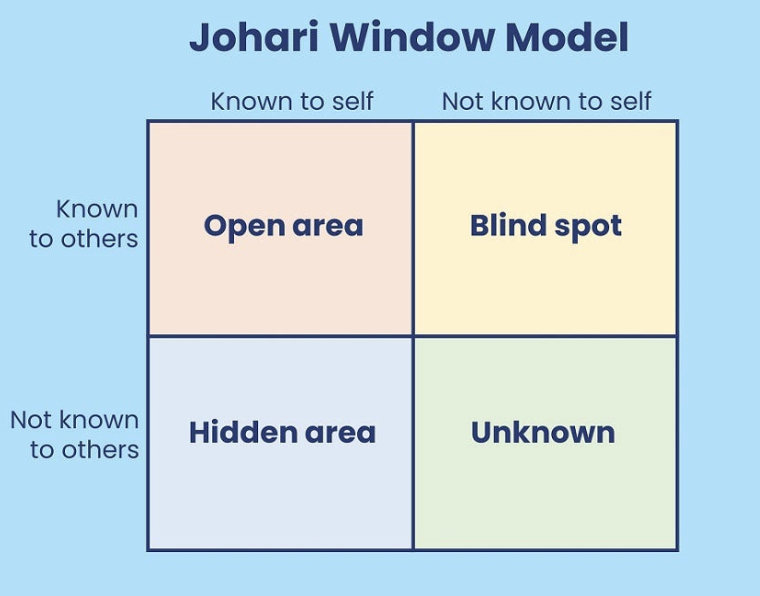
Johari’s Window
Developed by Joseph Luft and Harry Ingham
Used to describe human interactions, relationships, communication, group dynamics, trust building, and self-learning
Important Aspect: Feedback + Self-Disclosure = Positive Environment
Challenges With Electronic/Digital/Virtual Communication
Can cause confusion, not include enough information, or not provide enough details leaving readers to interpret the information
Speed, technical issues, no body language, lack of context
Emotional detachment, digital distractions, privacy and security, etiquette and professionalism
Challenges With Electronic/Digital/Virtual Non-Verbal Communication
Only one speaker at time: How do you communicate if you have something to add to the conversation?
Misleading or deceiving: How can you tell when someone is focused on virtual? Or if they are being truthful?
Perceptions: How are you perceived by your audience / other communicators on a virtual call?
Benefits of Electronic/Digital/Virtual Communication
Efficiency
Cost-effective
Global reach
Flexibility
Real-time feedback
Personalization
Things to Consider: Electronic/Digital/Virtual Communication
Your interpretation, give the benefit of the doubt, think positive
Pick up the phone, wait 24 hours, consider accessibility
Understanding your audience, simplicity, choose the right channels
Create emotional connections
Email address, number of recipients, spelling, use the subject line, keep it short and to the point, emphasize actional items
Decision-Making
Figuring out what to do from a variety of options (i.e., how many people to hire)
Steps in Decision-Making: DGDRM
Determine the scope of the decision
Get the facts
Develop alternatives
Rate each alternative
Make a decision
Decision Categories
Crisis
Non-crisis
Opportunities
Programmed Decisions — Routine
Non-programmed Decisions — No previous rules
Creativity in Decision Making
4 Phases of Creative Thinking
Preparation — gathering information
Incubation — relax and think
Illumination — when the decision comes
Verification — examines usefulness of decision
Qualities That Support Creativity
Freedom
Good leadership
Resources
Encouragement
Feedback
Time
Challenge
Steps to Brainstorming
No evaluation, no criticism, no positive or negative feedback
Think up wild activities
Quantity breads quality
Build off or modify ideas
How Decisions Are Made
Individual vs. Group
Group decisions:
Leader — authority
Group expert — expert decides
Average
Group representative — identified leader
Minority — legitimate role
Majority — most common
Consensus — everyone agrees
Advantages of Group Decision Making
Everyone gets a say
Allows for more input/ideas/perspectives
Increases buy-in and commitment from those involved
Fosters collaboration and team spirit
Disadvantages of Group Decision Making
Time consuming
Not everyone may agree or be happy with the decision made, even when it is one made through consensus
Some members may not be as heard from as other members
Reduced individual effort
Factors Which Affect Decision Making
Lack of understanding
Deny there is a problem
Nervousness of participants
Decisiveness
Bias
Lack of openness to change
Problem-Solving
Deciding on an action to solve a problem (i.e., how to run successful programs with less funding)
Recognize there is a problem
Define the program
Determine the objective — What is the ideal outcome?
Formulate alternatives
Decide and implement solution
Evaluate solution
Ethical Decision Making
How to “test” if you are making an ethical decision
End result ethics: think about the outcomes
Rules ethics: agencies, policies, and procedures,
Organization values: examine organization’s values
Personal conviction: personal beliefs
Historical Leaders
Key players in the history of recreation/sport leadership: Joseph Lee, Dorothy Enderis, Josephine D. Randall, Kurt Hahn, Jane Addams, George Butler
All made significant reforms and pioneered contributions in public recreation and sport leadership during different eras (~1900s)
Jane Addams, for instance, was an American reformer and social worker/activist who advocated for women’s suffrage; she revolutionized recreation by seeing it as vital for democracy, citizenship, and human development, not just play; recreation could be used to socialize democracy by connecting people across classes and cultures through shared activities like the Hull-House programs she implemented
Difficult Conversations: How to Prepare
Decide what it is you want to achieve: what is your goal of the conversation?
Due diligence: check facts and gather documents
Other side: Put yourself in the situation of the other party involved
Decide if you need support
Consider the logistics: timing, environment (face to face vs online), location (private vs public), layout of the space, distractions, etc.
Prepare: What are you going to say?
Give them time to prepare
Difficult Conversations: Steps for Success
State the Problem: What is the purpose of the meeting, what is it that you are trying to resolve, and how has it been impacting you?
Listen and Question: “How do you feel about that?” “Tell me about that…”
Acknowledge the other party’s feelings and view
Reassess your position: Clarify your position without minimizing theirs — “Given this conversation, I can see how you formulated this conclusion … however …”
Look for solutions
Adjourn the conversation and make next steps if necessary
Difficult Conversations: Emotions
Understanding and managing emotions are an important part of difficult conversations. Consider:
Rational approach
Be mindful of body language
Calm voice / don’t raise your voice
Speak at a reasonable pace
Keep language simple
Taking a pause or a few breaths can be helpful
Show genuine interest for the other person’s emotions as well
 Note
Note  Flashcards (42)