Econ 102 - CHAPTER 14: Market Structure and Degrees of Market Power
 Studied by 0 people
 Call Kai
 Learn
Learn Practice Test
 Spaced Repetition
 Match
Match Flashcards
 Knowt Play
1/18

There's no tags or description
Looks like no tags are added yet.
Name | Mastery | Learn | Test | Matching | Spaced | Call with Kai |
|---|
No analytics yet
Send a link to your students to track their progress
19 Terms
Market Structure
The type of competitive environment in which a business operates.
It determines market power — your ability to charge higher prices without losing many customers.
Market Power
The extent to which a seller can charge a higher price without losing many sales to competing businesses.
Market power informs yourpricing strategy.
Ex:
Only gas station in town: high market power.
One of many gas stations: little or no market power.
The ability to charge a higher price without losing many customers.
If your business has market power, then you are NOT a price taker
Perfect Competition:
Markets in which...
1. All businesses in an industry sell identical
goods.
2. There are many sellers and many buyers,
each of whom is small relatively to the size
of the market.
# of sellers - Many
Type of product - Identical
Market Power - None
Relatively flat curve → Highly elastic
ex:
Corn farmers
stock market
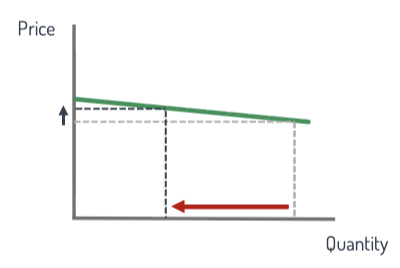
Monopolistic Competition
A market with many small businesses competing, each
selling differentiated products.
# of sellers - Many
Type of product - Differentiated
Market Power - some
some market power → more inelastic
ex:
clothing brands
restaurants
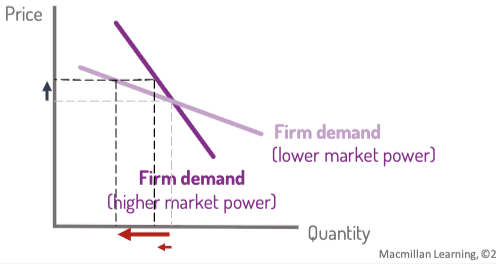
Oligopoly
A market with only a handful of
large sellers.
Products can be somewhat different or
somewhat similar.
# of sellers - Few
Type of product - similar or different
Market Power - some
some market power → more inelastic
ex:
cell phone carriers
airlines
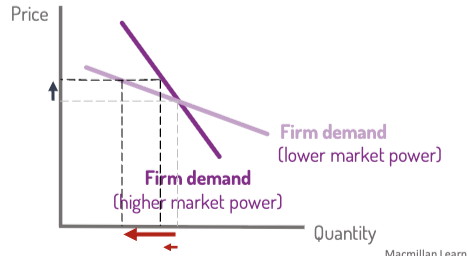
Monopoly
When there is only one seller in
the market.
No other businesses are selling the same
thing as you
# of sellers - one
Type of product - unique
Market Power - high
relatively steep (inelastic) → Your firm’s demand curve IS the market demand
curve.
ex:
Utilities
local water company
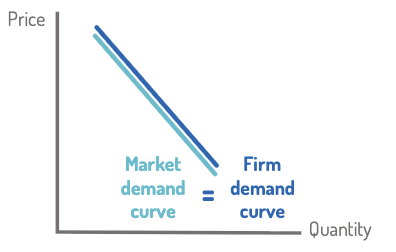
Spectrum of Market Power
Perfect competition → Imperfect competition (monopolistic & oligopoly) → Monopoly
Most real-world businesses fall somewhere in between — imperfect competition.
Least market power to most →
Five Key Insights into Imperfect Competition
More competitors → less market power.
Market power → price-setting ability.
Product differentiation → more market power.
Few buyers → more buyer bargaining power.
Interdependence: your choices depend on rivals’ actions (pricing, products, entry).
Firm demand curve
Illustrates how the quantity that buyers demand from an individual business varies as it changes the price it charges
Focuses on YOUR specific firm or
businessesSummarizes the market power of
your firm
Market Power | Demand Curve Shape | Elasticity |
|---|
Low | Flat | Elastic (many substitutes) |
High | Steep | Inelastic (few substitutes) |
Marginal cost
The cost of producing one more unit
Marginal Revenue (MR)
The addition to total revenue you get from selling one more unit.
The change in total revenue from selling one more unit.
Formula:
MR = ΔTR = P×Q
Rule:
When you lower price to sell more, two effects happen:
Output Effect: You gain revenue from selling a larger quantity of items
Discount Effect: You lose revenue because all units now sell at the lower price.
MR = Output Effect − Discount Effect
Output Effect (MR)
You gain revenue from selling a larger quantity of items
Selling this extra unit of output boosts revenue by an amount equal to the price of that item
Output effect on revenue = Price
The price of the extra item you sell
Discount Effect
You lose revenue because all units now sell at the lower price.
To sell the extra item, you lower your price a bit. This lower price applies to ALL the units you sell.
Discount effect on revenue = ∆P x Q
The price cut you have to offer x the quantity subject to that price cut
Marginal Revenue Curve
Always below the demand curve (because of discount effect).
Declines faster than the demand curve as quantity increases.
Rational Rule for Sellers
Sell one more unit if MR ≥ MC.
Four Consequences of Market Power
Higher Prices: Price > MC.
Underproduction: Quantity < efficient level (MC < MB → missed surplus).
Higher Profits: Firms restrict output to increase price.
Inefficiency: Less pressure to reduce costs or innovate.
The Policy Trade-off
More competition → better outcomes for society as a whole
Less competition → more market power and larger profits for incumbent firms
Governments regulate to balance innovation incentives with fairness.
Policies to Ensure Competition (Antitrust Laws)
Anti-Collusion Laws | Prevent competitors from agreeing not to compete. | Airlines fixing prices; companies agreeing to split markets. |
Merger Laws | Prevent mergers that reduce competition. | AT&T + T-Mobile blocked (2011); Staples + Office Depot (1997). |
Ban on Monopolization | Illegal to attempt to monopolize (predatory pricing, exclusivity deals). | Forcing suppliers to avoid competitors. |
Encouraging International Trade | Imports increase competition & reduce power of domestic monopolies. | Car imports increased competition for U.S. automakers. |
Policies to Minimize Harm from Market Power
Price Ceilings | Caps how much monopolies can charge → prevents abuse. | Utility pricing regulations. |
Regulating Natural Monopolies | When one firm can serve the market cheapest, the gov’t regulates price instead of breaking it up. | Electricity, water, gas services. |
 Note
Note  Flashcards (31)