BIOL 1308 Final Exam
0.0(0)
 Studied by 0 people
 Call Kai
 Learn
Learn Practice Test
 Spaced Repetition
 Match
Match Flashcards
 Knowt Play
Card Sorting
1/141

Earn XP
Description and Tags
Last updated 5:01 PM on 5/1/23
Name | Mastery | Learn | Test | Matching | Spaced | Call with Kai |
|---|
No analytics yet
Send a link to your students to track their progress
142 Terms
1
New cards
**CHAPTER 13 - Processes of Evolution**
2
New cards
(13.1) Define evolution and give one example from nature.
\
Change in gene composition of populations over time.
Ex. finches on the Galapagos Islands have developed different shaped beaks to take advantage of the different kinds of food available on different islands
Change in gene composition of populations over time.
Ex. finches on the Galapagos Islands have developed different shaped beaks to take advantage of the different kinds of food available on different islands
3
New cards
(13.1) Define the term “theory” as it relates to scientific theories.
A broad explanation, supported by a lot of evidence.
\
\[concise, coherent, systematic, predictive, broadly applicable\]
\
\[concise, coherent, systematic, predictive, broadly applicable\]
4
New cards
(13.1) Explain how theories differ from hypotheses.
A hypothesis is an assumption made before an experiment while a theory is a principle to explain what is shown in data.
5
New cards
(13.2) Define the terms “allele” and “gene pool”. Explain the relationship between the two terms.
Allele - one of two or more versions of DNA sequence (a single base or a segment of bases) at a given genomic location.
\
Genepool - the collection of different genes within an interbreeding population.
\
Genepool - the collection of different genes within an interbreeding population.
6
New cards
(13.2) Using examples, explain how selection can lead to new phenotypes.
One qualitative trait mutation might be liked more than another and with selection their offspring could inherit the phenotype.
7
New cards
(13.2) Discuss the effects of selection on both beneficial and deleterious mutations.
Organisms with beneficial mutations can survive more and make more babies and seem more attractive to mates.
\
Organisms with deleterious mutations will be selected less by mates and selected more as an easy target against survival.
\
Organisms with deleterious mutations will be selected less by mates and selected more as an easy target against survival.
8
New cards
(13.2) Define the terms “natural selection” and “artificial selection”. Then, compare/contrast natural selection and artificial selection through the use of examples.
Natural = differential survival reproduction of organisms based on inherited traits, in which they procreate more if surviving
\
Artificial = humans breeding organisms
\
Artificial = humans breeding organisms
9
New cards
(13.2) State the requirements for natural selection to occur.
* Variation
* Inheritance
* Selections
* Time
* Inheritance
* Selections
* Time
10
New cards
(13.2) Explain how the term “adaptation” is used in evolutionary biology.
Heritable traits that improve an organism’s survival/reproduction
11
New cards
(13.2) Define the term “gene flow” and explain what it can do to the frequencies of alleles in a population.
Movement of genes into/out of a population
* Can change allele frequency by adding new alleles
* Can change allele frequency by adding new alleles
12
New cards
(13.2) Define the term “genetic drift” and give an example from nature.
Random changes in allele frequency from one generation to the next
\
Ex. Consider a population of rabbits with brown fur and white fur, white fur being the dominant allele. Due to genetic drift, only the brown population might remain, with all the white ones eliminated.
\
Ex. Consider a population of rabbits with brown fur and white fur, white fur being the dominant allele. Due to genetic drift, only the brown population might remain, with all the white ones eliminated.
13
New cards
(13.2) Explain the relationship between population size and the expected effects of genetic drift.
Smaller populations are affected more
14
New cards
(13.2) Define the terms “population bottleneck” and “founder effect”. Explain how genetic drift relates to these phenomena.
Random changes in allele frequencies (small pop.)
\
Bottleneck - environmental event that only a small amount of individuals survive
\
Founder effect - random change in allele frequencies
\
Bottleneck - environmental event that only a small amount of individuals survive
\
Founder effect - random change in allele frequencies
15
New cards
(13.2) Define sexual selection and explain how it is a form of nonrandom mating.
Differential reproductive success based on traits, chosen through patterns of genotype
16
New cards
(13.2) Explain the difference between natural and sexual selection. Then, explain how they are similar.
Sexual - mating success
\
Natural - due to variance in all other fitness components
\
Similar: Chosen by genotype patterns
\
Natural - due to variance in all other fitness components
\
Similar: Chosen by genotype patterns
17
New cards
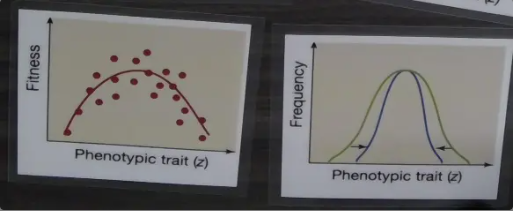
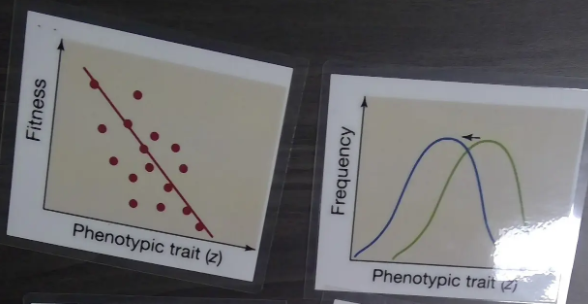
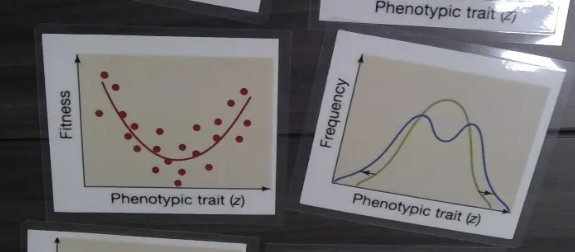
(13.4) Explain how selection can be stabilizing, directional, or disruptive.
Stabilizing selection - preserves average characteristics of population by favoring the average
\
Directional selection - Individual at one extreme of character distribution contribute more offspring to next generation
\
Disruptive selection - Individual at one extreme of character distribution contribute more offspring to next generation
\
Directional selection - Individual at one extreme of character distribution contribute more offspring to next generation
\
Disruptive selection - Individual at one extreme of character distribution contribute more offspring to next generation
18
New cards
(13.4) Explain the following statements and then sketch a graph that represents each: 1) stabilizing selection preserves the average characteristics of a population by favoring average individuals
Least Variability
19
New cards
(13.4) Explain the following statements and then sketch a graph that represents each: 2) directional selection changes the characteristics of a population by favoring individuals that vary in one direction (away from the mean)
Less variability, could move either positively or negatively
20
New cards
(13.4) Explain the following statements and then sketch a graph that represents each: 3) disruptive selection changes the characteristics of a population by favoring individuals that vary in both directions from the mean
Most variability, mean is decreasing in frequency, most likely for speciation (will split into two species over time)
21
New cards
(13.4) Understand which type of selection is most likely to result in speciation and explain why this is the case.
Disruptive selection,
Most variability, mean is decreasing in frequency, most likely for speciation (will split into two species over time)
Most variability, mean is decreasing in frequency, most likely for speciation (will split into two species over time)
22
New cards
(13.4) Give a real-world example of each of the three types of selection.
1. Stabilizing - One example is beak size in a bird population such as with the Superb starling bird (Spreo superbus) that had to go through years of evolution to get their beaks to be the perfect shape that is small and pointy for their diets of insects when picking at or through the ground, making those with a specific shape survive the best. Those with a bigger beak would have a hard time burrowing their beak for food and with too small a beak, not being able to carry as many types of fruits and insects. (5)
\
2. Directional - The giraffe (Giraffa) is an example of directional selection due to the ones with the longest necks (one extreme being preferred) survived best by being able to reach food in the higher trees found in the Savanna. Shorter necked or mid-length necked giraffes would struggle and have a harder time to feed themselves and survive. (6)
\
3. Disruptive - The african forest elephant and the african bush elephant are capable of interbreeding sharing a common ancestor. The disruptive selection occurred because certain populations residing in the forest became much smaller and darker whereas the African bush elephants became larger and lighter, eventually causing a divergence. (8)
23
New cards
(13.3) Define genotype and allele *frequencies* and describe/use them in the context of a population.
Genotype frequency - proportion of genotype in population
\
Allele frequency - proportion of particular allele in gene pool
\
Allele frequency - proportion of particular allele in gene pool
24
New cards
(13.3) Define the term “locus” and explain why the sum of allele frequencies at a specific locus is equal to 1.
Locus - a particular location (gene) on a chromosome
\
It is because there are two alleles P(A) and q(a) at **one** locus
\
It is because there are two alleles P(A) and q(a) at **one** locus
25
New cards
(13.3) Define the terms *p* and *q* in the Hardy–Weinberg principle and explain why allele frequencies remain the same at equilibrium.
p = A dominant
q = a recessive
\
There is no appreciable rate of new mutation. Individuals with all genotypes are equally capable of mating and passing on their genes; that is, there is no selection against any particular genotype. (the conditions)
q = a recessive
\
There is no appreciable rate of new mutation. Individuals with all genotypes are equally capable of mating and passing on their genes; that is, there is no selection against any particular genotype. (the conditions)
26
New cards
(13.3) Use the Hardy-Weinberg equations to calculate allele frequencies, genotype frequencies, the number of specific alleles in a population, and number of individuals with each genotype in a population, if given one or more of those values.
Allele frequencies → p + q = 1
\
Genotype frequencies → p^2 + 2pq + q^2 = 1
\
Genotype frequencies → p^2 + 2pq + q^2 = 1
27
New cards
(13.3) List and describe the five evolutionary agents. Be able to differentiate the five evolutionary agents from each other.
1. Mutation = Change in nucleotides sequence of DNA
2. Natural Selection = Differential survival reproduction of organisms based on inherited traits
3. Gene Flow = movement of genes into/ out of population
4. Genetic Drift = Random changes in allele frequency from one generation to the next
5. Nonrandom Mating = mating patterns after genotype, not chosen at random
28
New cards
**CHAPTER 14 - Reconstructing and Using Phylogenies**
29
New cards
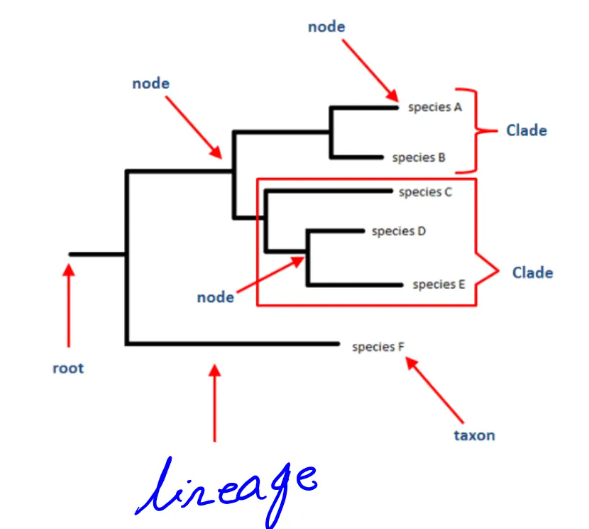
(14.1) Describe the structure of a phylogenetic tree and how it relates different organisms.
30
New cards
(14.1) If a trait is described to you, be able to determine if it is homologous or analogous.
Homologous - traits are similar in 2+ taxa due to inheritance from a common ancestor
\
Analogous - same structure, different origin
\
Analogous - same structure, different origin
31
New cards
(14.1) Compare and contrast ancestral and derived traits; understand that synapomorphies are a subset of derived traits.
synapomorphies are a subset of derived traits.
Ancestral traits are shared throughout the larger group. Derived traits are present only in a smaller group.
Ancestral traits are shared throughout the larger group. Derived traits are present only in a smaller group.
32
New cards
(14.1) What is the term for traits that arose by convergent evolution?
creates **analogous** traits = similar function, different origin (common ancestor doesn’t have the trait)
33
New cards
(14.1) Compare and contrast convergent evolution with evolutionary reversal.
convergent evolution - same trait, different origin
\
evolutionary reversal - going back closer to origin traits
\
evolutionary reversal - going back closer to origin traits
34
New cards
(14.2) Define the “principle of parsimony” and explain why it is a preferred strategy for constructing phylogenies.
**Parsimony principle –** the preferred explanation of data is the simplest explanation
* Minimizing the number of evolutionary changes that need to be assumed
* Minimizing the number of evolutionary changes that need to be assumed
35
New cards
(14.2) Data type: Morphology
\
presence, size, shape, of body parts
* Benefits: been around a long time, easy to use
* Limitations: species can look very similar, hard to compare morphology of earthworms and mammals, the environment causes differences sometimes
presence, size, shape, of body parts
* Benefits: been around a long time, easy to use
* Limitations: species can look very similar, hard to compare morphology of earthworms and mammals, the environment causes differences sometimes
36
New cards
(14.2) Data type: development
similarities in developmental patterns
* Benefits: reveals similarities we might not see if just comparing adults
* Limitations: only useful for extant animal species
* Benefits: reveals similarities we might not see if just comparing adults
* Limitations: only useful for extant animal species
37
New cards
(14.2) Data type: Paleontology
\
fossil record
* Benefits: helps us distinguish between ancestral and derived traits
* Limitations: some groups and traits don’t fossilize well
fossil record
* Benefits: helps us distinguish between ancestral and derived traits
* Limitations: some groups and traits don’t fossilize well
38
New cards
(14.2) Data type: Behavior
\
**Behavior** – innate (genetically coded) behaviors help reveal relationships
* Limitations: only relevant to extant animal species; need to avoid learned behaviors like bird songs
**Behavior** – innate (genetically coded) behaviors help reveal relationships
* Limitations: only relevant to extant animal species; need to avoid learned behaviors like bird songs
39
New cards
(14.2) Data type: Molecular data
all heritable variation is encoded in DNA, so we can look at DNA or protein sequences
* Benefit: widely used, least subjective method
* Limitations: time consuming, expensive, difficult or impossible for extinct species
* Benefit: widely used, least subjective method
* Limitations: time consuming, expensive, difficult or impossible for extinct species
40
New cards
(14.4) Write scientific names and other taxa names (like Kingdoms) using correct formatting.
* Genus species
* *First letter of genus is capitalized, the rest lower case*
* *Either italicized (if in type) or underlined (if written)*
* *E.g.: Homo sapiens or H. sapiens*
* *First letter of genus is capitalized, the rest lower case*
* *Either italicized (if in type) or underlined (if written)*
* *E.g.: Homo sapiens or H. sapiens*
41
New cards
(14.4) Diagram the structure of the Linnaean system from Domain to Species.
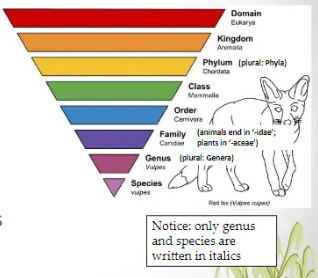
42
New cards
(14.4) Define *monophyletic*
Taxa should be **monophyletic**
= containing all descendants of a particular ancestor, and no other organisms
= containing all descendants of a particular ancestor, and no other organisms
43
New cards
(14.4) Identify whether a group of species is monophyletic, paraphyletic, or polyphyletic from a phylogenetic tree or a description.
**Monophyletic** = containing all descendants of a particular ancestor, and no other organisms
\
**Polyphyletic =** containing members of different lineages; common ancestor and possibly some descendants are missing
\
**Paraphyletic =** containing only some descendants of a particular ancestor
\
**Polyphyletic =** containing members of different lineages; common ancestor and possibly some descendants are missing
\
**Paraphyletic =** containing only some descendants of a particular ancestor
44
New cards
**CHAPTER 16 - Speciation**
45
New cards
(16.1) Write a definition of the “biological species concept” in your own words.
Groups organisms into species if they actually or potentially reproduce together.
46
New cards
(16.1) Discuss the strengths and weaknesses of the biological species concept.
* Strengths:
* No issues with cryptic species and other morphological differences within species
* Incorporates the fact that lineages diverge when genes can no longer be exchanged between populations
* Weaknesses:
* Not always practical to test if two populations can breed
* Can’t be used for asexual
* …or for extinct species or ancestors
* No issues with cryptic species and other morphological differences within species
* Incorporates the fact that lineages diverge when genes can no longer be exchanged between populations
* Weaknesses:
* Not always practical to test if two populations can breed
* Can’t be used for asexual
* …or for extinct species or ancestors
47
New cards
(16.1) Under what circumstances will the biological species concept be most applicable.
A group of organisms must produce healthy, fertile offspring when they interbreed
48
New cards
(16.1) List and briefly describe two additional common species concepts.
**morphological species concept -** Groups organisms into species based on physical traits
\
**lineage (phylogenetic) species concept -** Groups organisms into species whenever they are part of a lineage between two divergences (nodes)
\
**lineage (phylogenetic) species concept -** Groups organisms into species whenever they are part of a lineage between two divergences (nodes)
49
New cards
(16.1) Describe the importance of reproductive isolation to speciation.
speciation is the divergence of biological lineages and the emergence of reproductive isolation between lineages
50
New cards
(16.3) Explain the relationship between geographic barriers and genetic divergence in allopatric speciation.
The borders cause allopatric speciation because they evolve separately
* also form sister species (species that are each others closest relative existing in diff geographic barriers
* also form sister species (species that are each others closest relative existing in diff geographic barriers
51
New cards
(16.3) Compare and contrast disruptive selection and polyploidy as mechanisms of sympatric speciation.
disruptive selection - favors two extreme phenotypes and can result in divergence between two species.
\
polploidy - mistake during cell division results in an individual with cells that have more than one copy of the genome. Can usually live and reproduce(viable) but can't produce normal diploid individuals(genetically isolated)
\
polploidy - mistake during cell division results in an individual with cells that have more than one copy of the genome. Can usually live and reproduce(viable) but can't produce normal diploid individuals(genetically isolated)
52
New cards
**CHAPTER 17 - The History of Life on Earth**
53
New cards
(17.1) State the approximate age of the Earth, and the approximate age of life on Earth.
**Age of Earth:** 4.6 billion yrs ago
**Age of life:** Archean about 3.8 billion yrs ago
**Age of life:** Archean about 3.8 billion yrs ago
54
New cards
(17.1) Describe the different dating methods that can be used to estimate the age of rock layers and fossils. Include an overview of how each works and a list of materials they can be used to date (either directly or indirectly – specify which is which).
Relative Dating
* **Stratigraphy** = study of geological **strata** (=layers of rock)
* oldest is at the bottom (vise-versa)
\
Absolute Dating
* Radiometric = **method for dating fossils that uses the rate of decay of radioisotopes (half-life)**
* Better to use igneous rocks
* Paleomagnetic = Relates ages of rocks to patterns in Earth’s magnetism
* **Stratigraphy** = study of geological **strata** (=layers of rock)
* oldest is at the bottom (vise-versa)
\
Absolute Dating
* Radiometric = **method for dating fossils that uses the rate of decay of radioisotopes (half-life)**
* Better to use igneous rocks
* Paleomagnetic = Relates ages of rocks to patterns in Earth’s magnetism
55
New cards
(17.2) Impacts of rapid climate change
The Earth has been both colder and warmer than it is today.
* Cold periods > glaciation > drop in sea levels > marine mass extinctions
* Cold periods > glaciation > drop in sea levels > marine mass extinctions
56
New cards
(17.2) Impacts of meteorites
Large meteorites can cause mass extinctions
* E.g. Chicxulub asteroid at end of Cretaceous
* Made a crater \~112 miles across
* Caused great tsunamis
* Debris blocked the sun (no photosynthesis) and trapped heat – temps rose 100s of degrees, massive fires started
* Involved extinction of non-avian dinosaurs
* E.g. Chicxulub asteroid at end of Cretaceous
* Made a crater \~112 miles across
* Caused great tsunamis
* Debris blocked the sun (no photosynthesis) and trapped heat – temps rose 100s of degrees, massive fires started
* Involved extinction of non-avian dinosaurs
57
New cards
(17.2) Impacts of volcanoes
Occasionally spew enough sulfur dioxide gas into air to create a **parasol effect**
* Sulfurous acid forms in high clouds; blocks some sunlight and lowers global temperatures
* So when oceanic and continental plates collide → many volcanos erupt at once → major drop in temperature
* Sulfurous acid forms in high clouds; blocks some sunlight and lowers global temperatures
* So when oceanic and continental plates collide → many volcanos erupt at once → major drop in temperature
58
New cards
(17.2) Describe the dynamics of oxygen over the past 4.5 billion years, and how these dynamics relate to the life forms that evolved or dominated in different time periods.
* Early Earth – no O2 gas
* 2.5 bya ancestors of cyanobacteria started photosynthesizing
* 2 bya – enough O2 to do aerobic respiration
* Organisms could get bigger
* 2.5 bya ancestors of cyanobacteria started photosynthesizing
* 2 bya – enough O2 to do aerobic respiration
* Organisms could get bigger
59
New cards
(17.3) Draw a timeline that includes the following events in the correct order (no dates needed), with labels for the Precambrian and the Phanerozoic. Then, add notes to your timeline to describe the changes in oxygen level that occurred between or alongside the events listed below.
Precambrian: 4.5 billion years ago
1. First life on Earth
2. Photosynthetic organisms evolve
3. First eukaryotes evolve (including multicellular)
\
Phanerozoic: 0.5 billion years ago
1. Plants and animals colonize on land
2. First mammals evolve
3. First flowering plants
1. First life on Earth
2. Photosynthetic organisms evolve
3. First eukaryotes evolve (including multicellular)
\
Phanerozoic: 0.5 billion years ago
1. Plants and animals colonize on land
2. First mammals evolve
3. First flowering plants
60
New cards
**CHAPTER 18 - Bacteria, Archaea, and Viruses**
61
New cards
(18.1) Name the three domains of life and list at least three features that are shared between the three domains of life, providing evidence that all organisms share a single common ancestor.
Bacteria
Archaea
Eukarya
\
* Cell membranes
* Ribosomes
* Cytoplasm
* DNA as genetic material that replicates semi-conservatively
* All follow the central dogma
* Metabolic pathways like glycolysis
Archaea
Eukarya
\
* Cell membranes
* Ribosomes
* Cytoplasm
* DNA as genetic material that replicates semi-conservatively
* All follow the central dogma
* Metabolic pathways like glycolysis
62
New cards
(18.1) Describe at least one characteristic of Eukaryotes that is not present within Bacteria and Archaea (difference between Eukaryotes and Bacteria/Archaea).
Almost all bacteria have peptidoglycan in their cell walls - gives it structure;
Archaea does not have this.
Archaea does not have this.
63
New cards
(18.1) Consider the evidence that parts of the eukaryote genome are more similar to bacteria than to archaea. Then, write a statement explaining this phenomenon using information on the evolutionary history of life on Earth.
the mitochondria of eukaryotes (as well as the chloroplasts of photosynthetic eukaryotes, such as plants) originated through endosymbiosis with a bacterium.
64
New cards
(18.2) Identify the following taxonomic groups of Bacteria with their taxa names:
1. Members responsible for oxygenating the atmosphere
2. Members most closely related to the mitochondria
3. Members capable of endospore formation, as well as multiple Bacteria important for human health
4. Members that include the bacterium that causes tuberculosis AND antibiotic producing Bacteria
5. Members that include the bacterium from which Taq polymerase originates, and taxa resistant to radiation
1. Members responsible for oxygenating the atmosphere
2. Members most closely related to the mitochondria
3. Members capable of endospore formation, as well as multiple Bacteria important for human health
4. Members that include the bacterium that causes tuberculosis AND antibiotic producing Bacteria
5. Members that include the bacterium from which Taq polymerase originates, and taxa resistant to radiation
1. Members responsible for oxygenating the atmosphere
**Cyanobacteria**
2. Members most closely related to the mitochondria
**Proteobacteria**
3. Members capable of endospore formation, as well as multiple Bacteria important for human health
**Firmicutes**
4. Members that include the bacterium that causes tuberculosis AND antibiotic producing Bacteria
**Actinobacteria**
5. Members that include the bacterium from which Taq polymerase originates, and taxa resistant to radiation
**Hadobacteria**
65
New cards
(18.2) Identify the following taxonomic groups of Archaea with their taxa names:
1. Members that live in extreme environments that are hot and/or acidic
2. Members that include taxa that produce methane AND taxa that live in extreme environments with high salinity and pH levels
3. Members that include the closest relative of the Eukaryotes
1. Members that live in extreme environments that are hot and/or acidic
2. Members that include taxa that produce methane AND taxa that live in extreme environments with high salinity and pH levels
3. Members that include the closest relative of the Eukaryotes
1. Members that live in extreme environments that are hot and/or acidic
**Crenarchaeota**
2. Members that include taxa that produce methane AND taxa that live in extreme environments with high salinity and pH levels
**Euryarchaeota**
3. Members that include the closest relative of the Eukaryotes
**Lokiarchaeum**
66
New cards
(18.2) If given the name of a taxonomic group, identify whether it is a member of Domain Bacteria or Domain Archaea.
Look at additional flashcards/notes
67
New cards
(18.4) Are viruses generally considered to be living? Why or why not?
No,
* not made of cells and no organelles, ribosomes, etc.
* They cannot replicate or metabolize chemicals (make energy) or make proteins on their own
* not made of cells and no organelles, ribosomes, etc.
* They cannot replicate or metabolize chemicals (make energy) or make proteins on their own
68
New cards
(18.4) Describe at least two characteristics of viruses that are also characteristics of Bacteria, Archaea, and Eukarya. Then, state at least two characteristics that are only found in viruses, and **not** in Bacteria, Archaea, or Eukarya.
ARE:
1. They contain a nucleic acid genome
2. They evolve
\
NOT:
1. They aren't classified as living things
2. Classified by type of genome, rather than evolutionary relationships
1. They contain a nucleic acid genome
2. They evolve
\
NOT:
1. They aren't classified as living things
2. Classified by type of genome, rather than evolutionary relationships
69
New cards
(18.4) State the name of at least four different examples of viruses that are in different classification categories AND cause a disease in humans. Then, state the category each virus falls into and, if not part of the virus’s name, state the human disease that each virus causes.
1\. Negative-sense single-strand RNA viruses
**influenza A, measles, rabies**
2\. Positive-sense single-strand RNA viruses
**Coronavirus - caused SARS, COVID-19; common cold, hepatitis C**
3\. RNA retroviruses
**HIV - leads to AIDS**
4\. Double-stranded RNA viruses
**rotaviruses - cause infant diarrheal disease in humans**
**influenza A, measles, rabies**
2\. Positive-sense single-strand RNA viruses
**Coronavirus - caused SARS, COVID-19; common cold, hepatitis C**
3\. RNA retroviruses
**HIV - leads to AIDS**
4\. Double-stranded RNA viruses
**rotaviruses - cause infant diarrheal disease in humans**
70
New cards
**CHAPTER 19 - The Origin and Diversification of Eukaryotes**
71
New cards
(19.1) Describe the theory of endosymbiosis and name the organelles that arose from this process.
The **endosymbiotic theory** describes how mitochondria and chloroplasts (cell organelles) came to exist in eukaryotic organisms.
\
Organelles that arose:
Chloroplasts found in
* primary: red algae, green algae, land plants
* secondary: euglenoids
* tertiary: dinoflagellates
\
Organelles that arose:
Chloroplasts found in
* primary: red algae, green algae, land plants
* secondary: euglenoids
* tertiary: dinoflagellates
72
New cards
(19.2) A list of taxa for each of the five protist groups (e.g. dinoflagellates, apicomplexans, and ciliates for the alveolate branch of the phylogeny).
1. **Alveolates**
1. Dinoflagellates
2. Apicomplexans
3. Ciliates
2. **Stramenopiles**
1. Diatoms
2. Brown Algae
3. **Rhizarians**
1. Foraminiferans
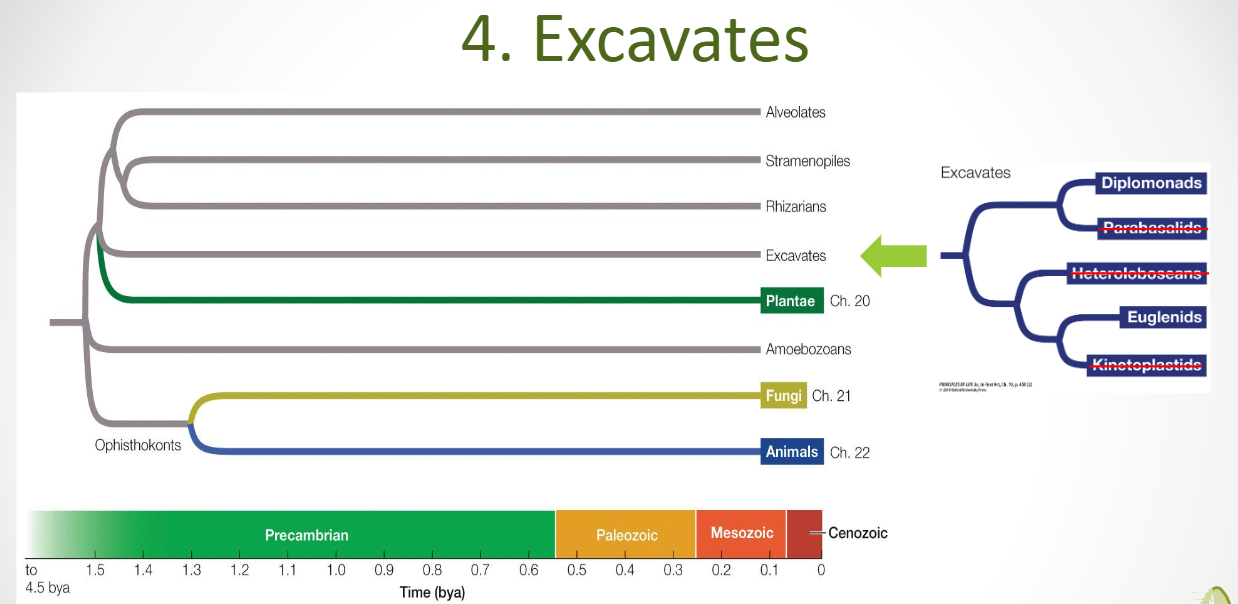
4. **Excavates**
1. Diplomonads
2. Euglenids
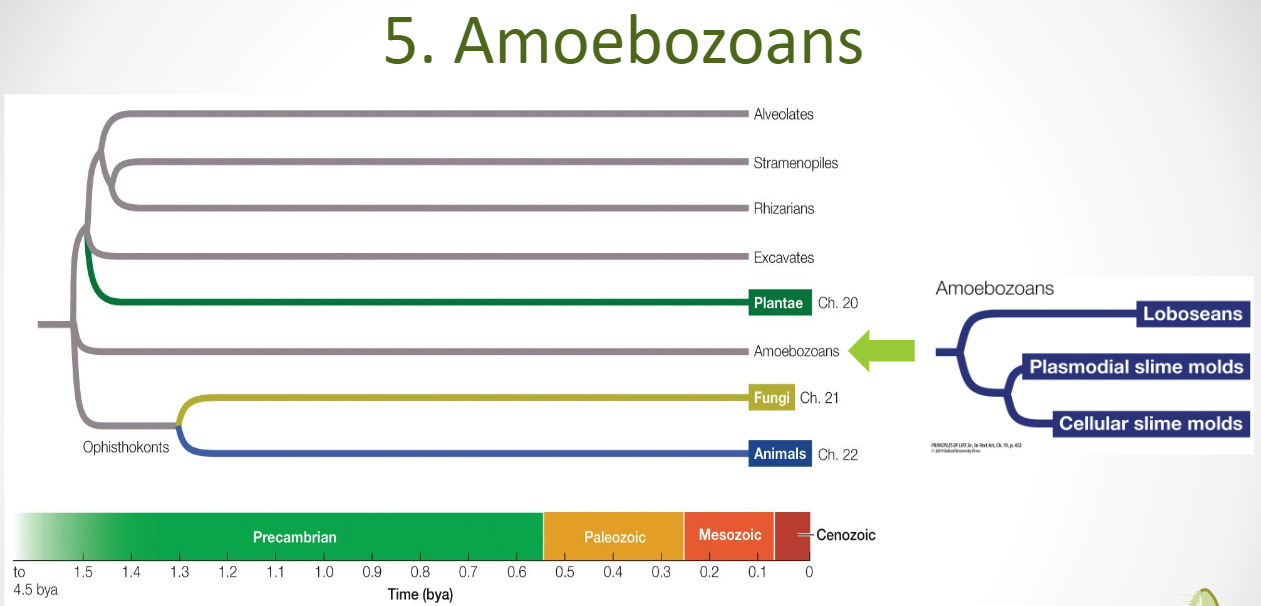
5. **Amoebozoans**
1. Loboseans
2. Plasmodial Slime Molds
3. Cellular Slime Molds
73
New cards
(19.2) Draw a phylogenetic tree with **Alveolates**
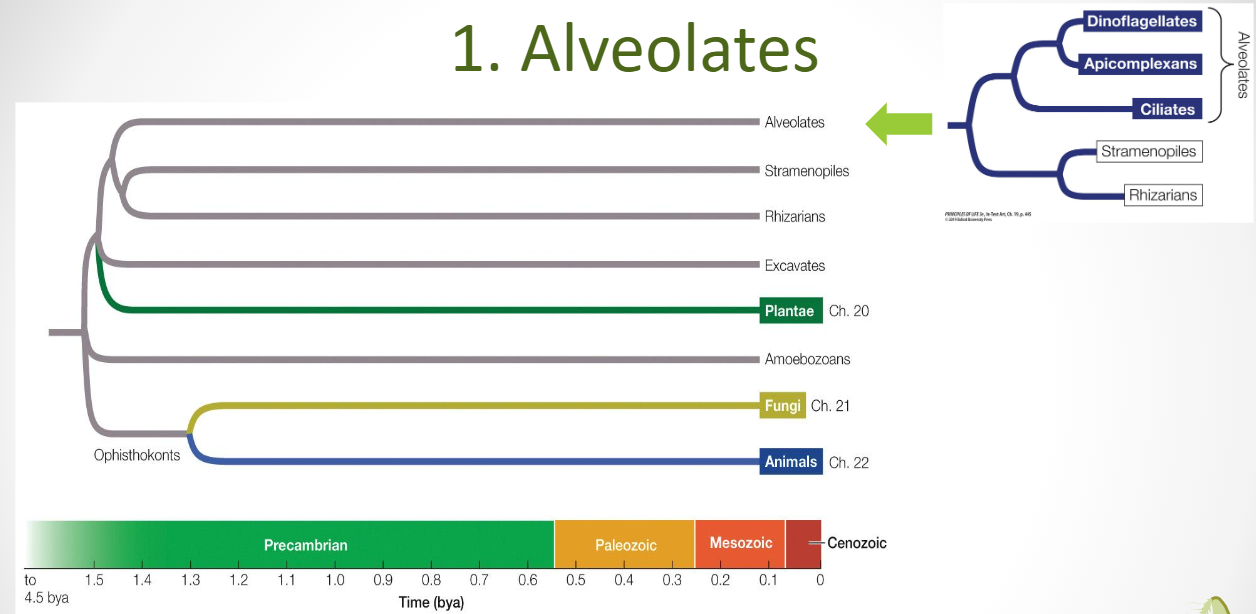
74
New cards
(19.2) Draw a phylogenetic tree with **Stramenopiles**
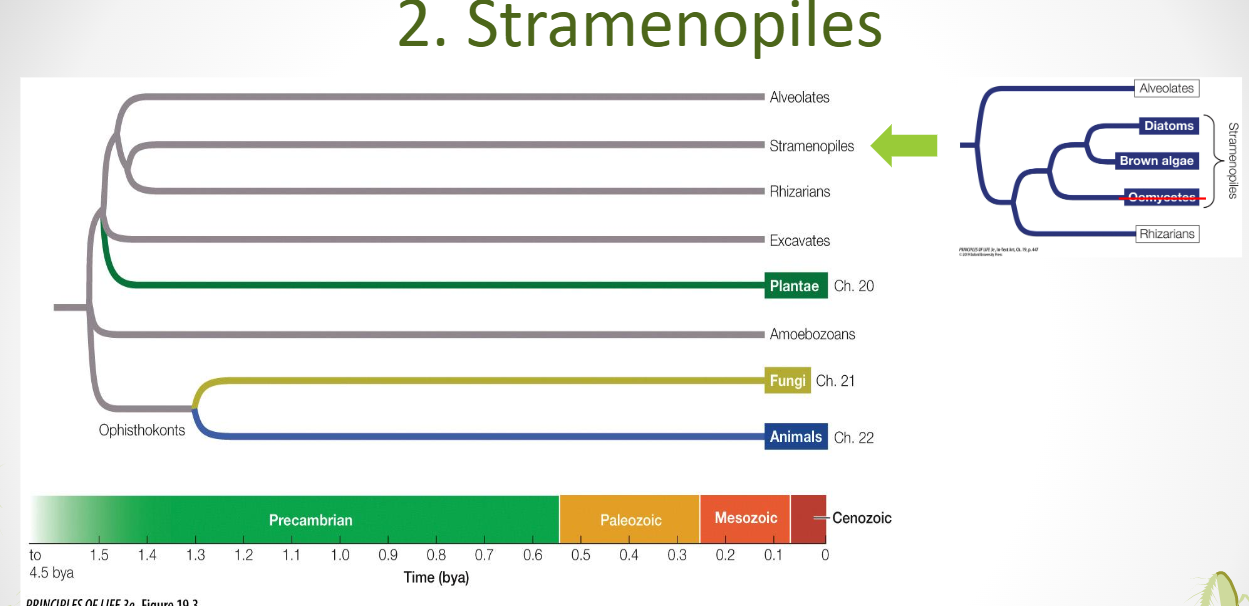
75
New cards
(19.2) Draw a phylogenetic tree with **Rhizarians**
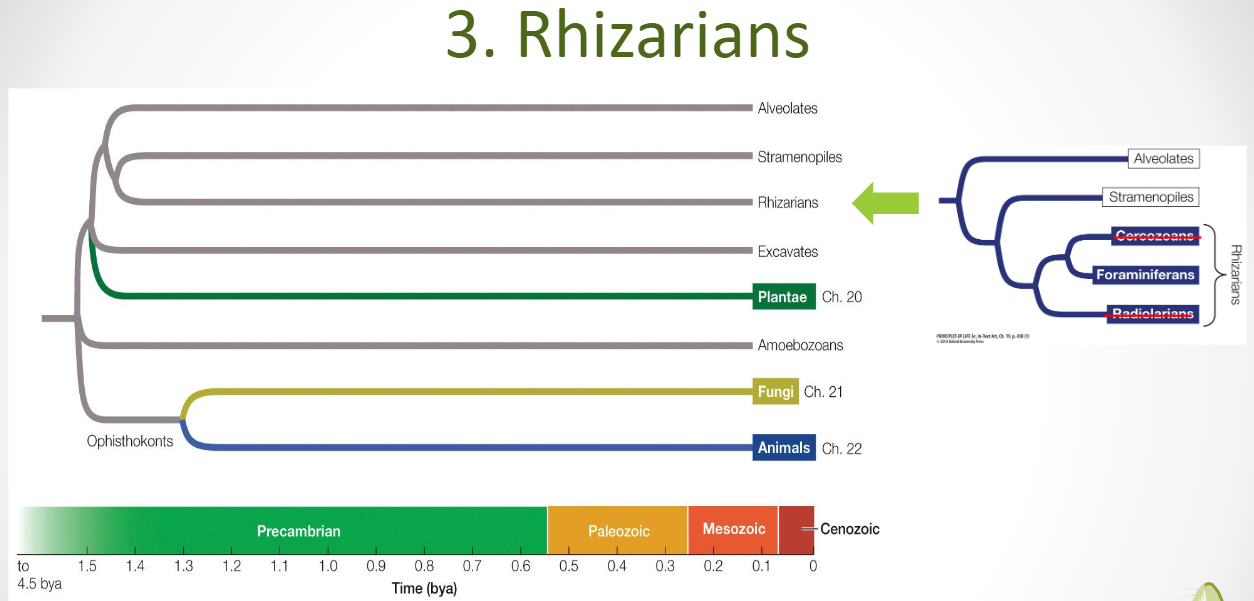
76
New cards
(19.2) Draw a phylogenetic tree with **Excavates**
77
New cards
(19.2) Draw a phylogenetic tree with **Amoebozoans**
78
New cards
(19.4) Define the term *phytoplankton*. List the two major protist components of phytoplankton that we discussed.
1. Phytoplankton contribute half of the photosynthesis (and thus Oxygen) on earth
2. They are the base of the ocean food web.
79
New cards
(19.4) Describe the taxonomy and defining characteristics of diatoms.
Stramenopilles > Diatoms
* unicellular
* silica walls
* store oil as energy reserve
* photosynthetic producers (phytoplankton)
* unicellular
* silica walls
* store oil as energy reserve
* photosynthetic producers (phytoplankton)
80
New cards
(19.4) Discuss three ways in which diatoms are important for human societies.
Some species of diatoms are also able to perform nitrogen fixation and are involved in the nitrogen cycle.
81
New cards
(19.4) State the genus name, the taxonomic groups, and the defining characteristics of the malarial parasite.
Alveolates > Apicomplexans
\
*Plasmodium* – carried by mosquitos
\
* Parasitic
* Nonmotile (cant move)
* Use apical complex to invade host cells
\
*Plasmodium* – carried by mosquitos
\
* Parasitic
* Nonmotile (cant move)
* Use apical complex to invade host cells
82
New cards
(19.4) State the name, taxonomic groups, and defining characteristics of the protists that form symbiotic relationships with coral animals.
Protists > Alveolates > Dinoflagellates
\
Dinoflagellates (phytoplankton / corals / red tides)
\
Dinoflagellates (phytoplankton / corals / red tides)
83
New cards
**CHAPTER 20 - The Evolution of Plants**
84
New cards
(20.1) List the features that green algae and land plants have in common. Then, describe the characteristics biologists use to distinguish land plants from green algae.
green algae and land plants both have chloroplasts, chlorophyll, while some green algae retain their eggs in the parental organism and exhibit branched apical growth similar to land plants
85
New cards
(20.1) Draw a phylogeny with the following groups (one branch each): glaucophytes, red algae, green algae, liverworts, mosses, hornworts, lycophytes, monilophytes, gymnosperms, angiosperms. Label the phylogeny with ancestral traits and with synapomorphies/ derived traits between each lineage divergence (between each node). Draw a series of brackets to label the taxa that are land plants, nonvascular land plants, vascular plants, and seed plants.
86
New cards
(20.2) Discuss five evolutionary adaptations found in the most successful land plants.
* Symbiotic relationship with animals
* Roots
* Being able to transfer seeds
* Roots
* Being able to transfer seeds
87
New cards
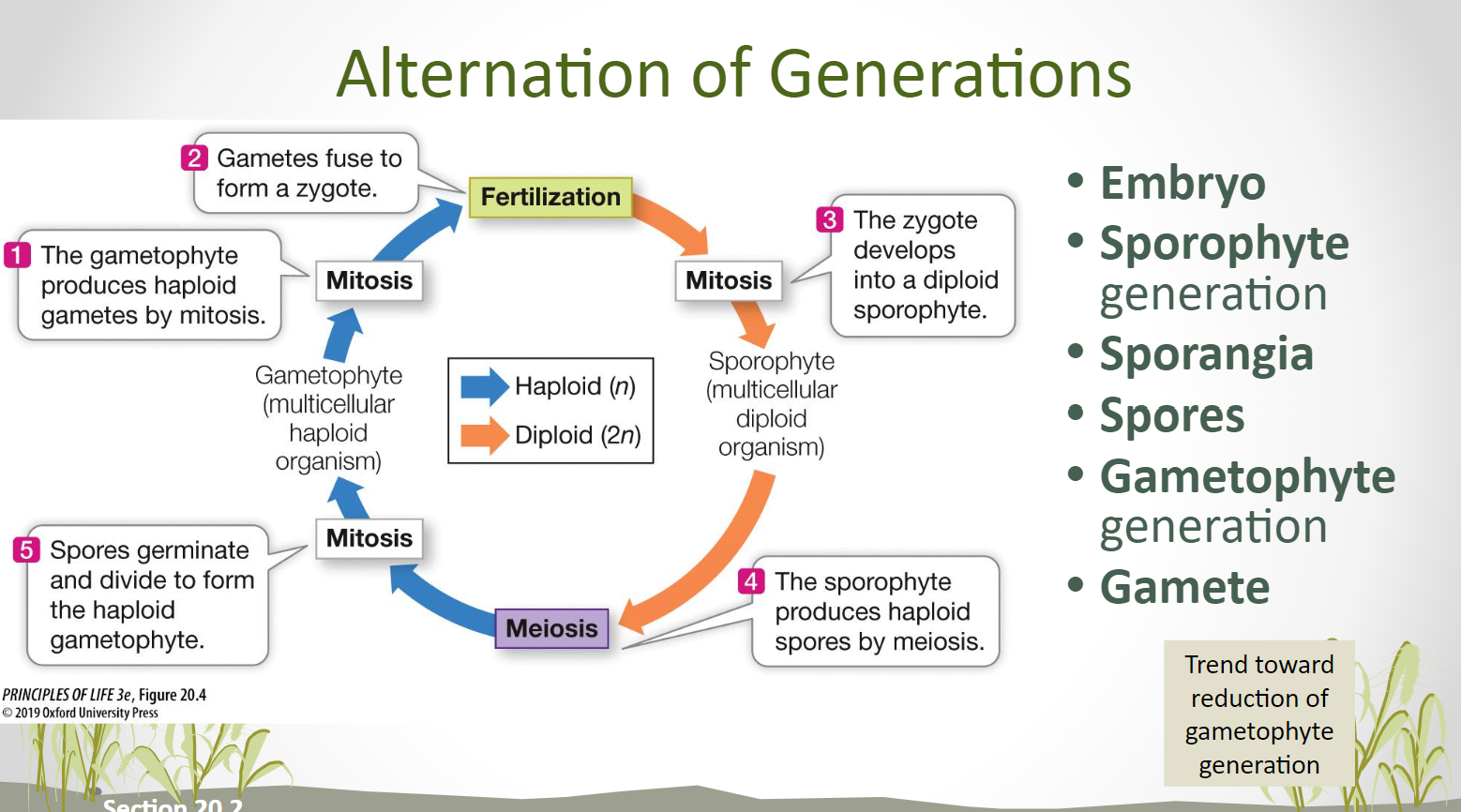
(20.2) Diagram a generalized alternation of generations life cycle as found in land plants. Include the name of the five structures that are involved (e.g. sporophyte), how many sets of chromosomes each structure has, and the name of each process that leads from one structure to the next.
88
New cards
(20.2) Define and provide a function in the plant life cycle for the following: spores, sporangia, gametangia, and gametes.
* spores: produced through meiosis which goes through mitosis to form gametophyte;
* sporangia: cells contained within specialized reproductive organs of the sporophyte which produces the spores through meiosis;
* gametangia: cells which create the gamete;
* gametes: sexual reproduction cell produced from mitosis
* sporangia: cells contained within specialized reproductive organs of the sporophyte which produces the spores through meiosis;
* gametangia: cells which create the gamete;
* gametes: sexual reproduction cell produced from mitosis
89
New cards
(20.2) List the three groups of living nonvascular plants and discuss the limitations to their success in a terrestrial environment. What is the typical result for their structure and habitat?
liverworts, mosses, and hornworts;
\
dependent on aquatic environment due to the lack of a vascular system that can transport water and minerals from soil to the rest of the body, if they do grow on land it's due to their relationship with fungi for nutrients
\
dependent on aquatic environment due to the lack of a vascular system that can transport water and minerals from soil to the rest of the body, if they do grow on land it's due to their relationship with fungi for nutrients
90
New cards
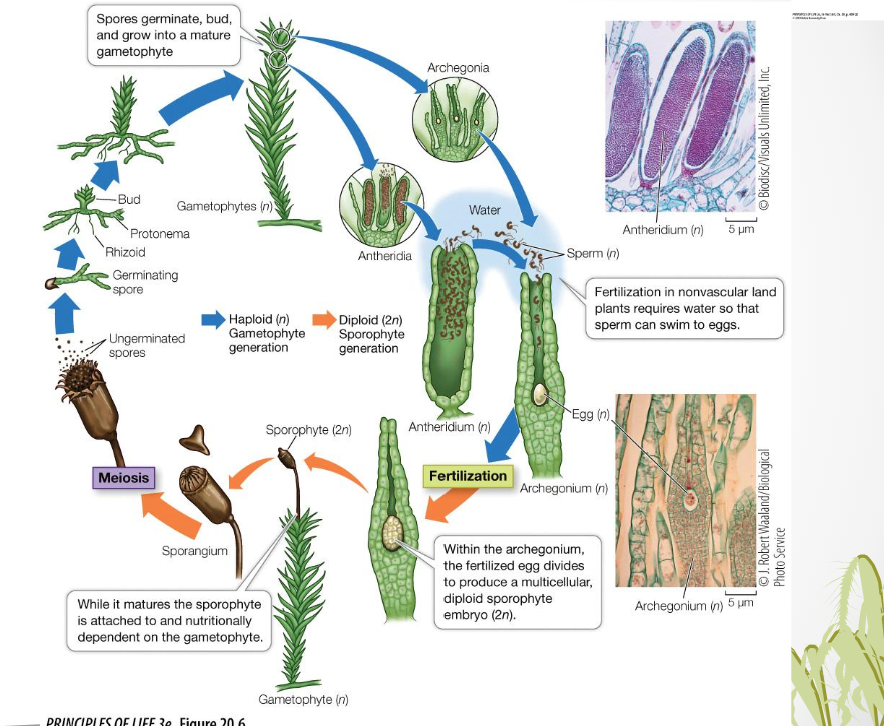
(20.2) Draw the life cycle of a moss by placing the following terms in the correct sequence (some used more than once): spore, egg, sperm, sporophyte, gametophyte, fertilization, zygote, mitosis, and meiosis. Make sure to add pictures/drawings for major structures (e.g. sporophyte). Use your alternation of generations life cycle to help you!
91
New cards
(20.2) Compare and contrast the life cycle of the moss with that of the fern.
* fern doesn't require water to transfer pollen to egg;
* for moss the sporophyte is reliant on the gametophyte
* for moss the sporophyte is reliant on the gametophyte
92
New cards
(20.2) Provide one trait for each of the major nonvascular land plant groups to distinguish them from each other.
* **Liverworts -** do not have stomata
* **Mosses -** Simple water-conducting cells called hydroids
* **Hornworts -** Plate-like chloroplasts
* **Mosses -** Simple water-conducting cells called hydroids
* **Hornworts -** Plate-like chloroplasts
93
New cards
(20.3) Compare and contrast the characteristics of vascular plants and nonvascular land plants. List the groups of vascular plants.
* both groups possess a stomata and persistently green spopphytes;
* vascular plants possess fluid-conducting cells called tracheids
\
List the groups of Vascular Plants
* **Lycophytes –** club mosses and relatives
* **Monilophytes –** horsetails and ferns
* **Gymnosperms –** mostly evergreens
* **Angiosperms –** flowering plants
* vascular plants possess fluid-conducting cells called tracheids
\
List the groups of Vascular Plants
* **Lycophytes –** club mosses and relatives
* **Monilophytes –** horsetails and ferns
* **Gymnosperms –** mostly evergreens
* **Angiosperms –** flowering plants
94
New cards
(20.3) Name and provide the function for the two types of vascular tissues in plants.
* xylem: conducts water and minerals from soil
* phloem: Transports sugars
* phloem: Transports sugars
95
New cards
(20.3) Differentiate generally between the life cycles of nonvascular land plants and vascular land plants. Which stage of the life cycle is dominant (largest or longest living) in these two groups of land plants?
* vascular plants - dominant sporophyte
\
* non-vascular plant - dominant gametophyte
\
* non-vascular plant - dominant gametophyte
96
New cards
(20.3) Give the common name of lycophytes. Explain how they differ from the other vascular plants.
Club Mosses, microphylls instead of true leaves
97
New cards
(20.3) List the major plant groups found in the monilophyte clade. Explain how monilophytes differ from the other groups of vascular plants.
horsetails and ferns are found in the monilophyte clade
\
have true leaves
\
\
have true leaves
\
98
New cards
(20.3) Draw the life cycle of a fern by placing the following terms in the correct sequence (some used more than once): spore, egg, sperm, sporophyte, gametophyte, fertilization, zygote, mitosis, and meiosis. Make sure to add pictures/drawings for the major structures (e.g. sporophyte).
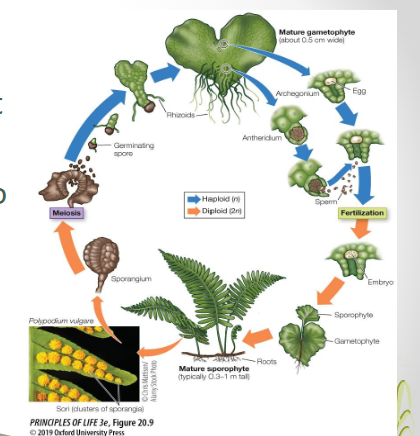
99
New cards
(20.3) What is the difference between homosporous and heterosporous life cycles? List the plant clades that use each type.
Homosporous - Produces only one type of spore that contains both the male and female parts.
Heterosporous - Produces two different types of spores that contain either male parts or female parts.
* gymnosperms
* cycads
* ginkgos
* gnetophytes
* conifers
Heterosporous - Produces two different types of spores that contain either male parts or female parts.
* gymnosperms
* cycads
* ginkgos
* gnetophytes
* conifers
100
New cards
(20.4) List the two major groups of seed plants and provide defining characteristics of each group.
**Gymnosperms**
* “Naked seeds” – do not form flowers or fruits
* Second most dominant land plant
* Pollen carried by wind
**Angiosperm**
* flowering plants
* double fertilization
* “Naked seeds” – do not form flowers or fruits
* Second most dominant land plant
* Pollen carried by wind
**Angiosperm**
* flowering plants
* double fertilization
 Note
Note  Flashcards (34)