EXAM I PSYC 212 social psychology
 Studied by 14 people
 Call Kai
 Learn
Learn Practice Test
 Spaced Repetition
 Match
Match Flashcards
 Knowt Play
1/182

Earn XP
Description and Tags
ch. 3,4,6,7
Name | Mastery | Learn | Test | Matching | Spaced | Call with Kai |
|---|
No analytics yet
Send a link to your students to track their progress
183 Terms
what is social perception?
the study of how people form impressions of and make inferences about other ppl
sujective expereince matters in shaping our thoughts
i) ex: a bronze medalist is happier than a silver medalist
(1) points of comparison differ for ppl: bronze medalist is happy to have made it on the podium, silver medalist compares their results to those of the gold medalist
what is inattentional blindness?
overlooking even “obvious” stuff
i) we have a finite amount of attention
brain decides what’s important focuses on that…doesn’t even register other things
what is naive realism?
“I see the world as it it really is” – believing that the attitudes and beliefs one holds are objectively true, underestimating our tendencies to twist information
ii) “if other disagree to their beliefs and attitudes, they’re…”
uninformed ( ex: holiday dinner table – “let me educate you…”)
lazy/stupid
biased (ex: they’re intentionally slanting things)
study by Vallone, Ross and Lepper (1985) on naïve realism: PROCEDURE #1
(1) pro-Israeli & pro-Arab students were asked to evaluate the SAME news coverage of “Beirut massacre”
(a) Pro-Israeli rated that the media was anti-israeli
(b) while the pro-arab viewers rated the media as being more anti-arab
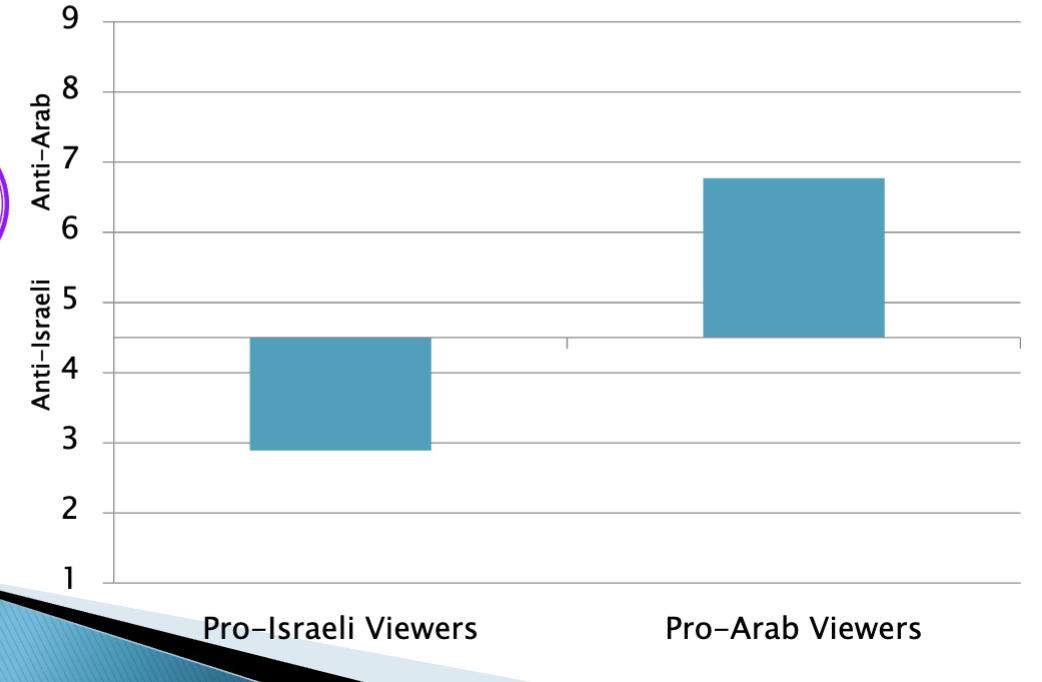
study by Vallone, Ross and Lepper (1985) on naïve realism: RESULTS #1
(a) both groups tended to think that the media was biased against their ideologies = very different subjective reactions
study by Vallone, Ross and Lepper (1985) on naïve realism: PROCEDURE #2
(1) then the researchers studies individuals who they thought were most informed on the news & had been following the news more
study by Vallone, Ross and Lepper (1985) on naïve realism: RESULTS #2
(a) the results did not significantly change
(b) may have displayed confirmation bias – bc they thought themselves that they were informed enough, whatever they believed holds more weight
what 4 phenomenon may contribute to naive realism?
confirmation bias
selective exposure
biased assimilation
constructive memory
what is confirmation bias?
(1) “wishful thinking”; the tendency to search for, interpret, favor, and recall information in a way that confirms or supports one's prior beliefs or values
what is selective exposure?
people choose to focus on information in their environment that is congruent with and confirms their current attitudes in order to avoid or reduce cognitive dissonance
what is biased assimilation?
(a) the tendency to interpret information in a way that supports a desired conclusion
what is constructive memory?
(a) memories may not be accurate reproductions of events but can be altered by new information related to beliefs, attitudes, and perceptions to fill in gaps in the memory
what is social cognition?
a) how we perceive, interpret, remember, and use social info to make judgments
b) not just conscious, effortful thoughts
what is the dual process model by Daniel Kahneman?
this model explains how social cognitions are driven in two different ways, or as a result of two different processes.
explains how a lot of our mind’s irrationalities form
system 1 automatic processing & system 2 ccontrolled processing
how does the system 1/automatic processing work according to the dual process model?
(1) “autopilot mode”; people LACK MOTIVATION and/or ABILITY TO THINK EFFORTFULLY
think is unconscious, unintentional, involuntary, effortless
ex: driving back home after a long day at work; blinking
(a) often, it’s our nonconscious minds that choose the goal for us, basing the decision in part on which goal has been recently activated or primed
how are creatig metaphors about the mind & body an example of system 1 automatic processing?
n addition to using schemas, ppl use metaphors about the mind & body: physical sensations (e.g. holding a clipboard) can prime a metaphor (e.g. that important thoughts “have weight”), which then influences people’s judgments (e.g. that student opinion should be goven more weight on a campus issue)
how does the system 2/automatic processing work according to the dual process model?
(1) for people to engage in this processing, people need to be MOTIVATED + possess ability to THINK EFFORTFULLY
thinking is conscious, intentional, voluntary, anf effortful
ex: learning how to drive at first
how do we off autopilot & engage in controlled thinking when we do counterfactual thinking?
(a) mentally changing some aspect of the past as a way of imagining what might have been
(b) ex: “if only I hadn’t erased my first answer to question 17 and circled the wrong one instead, I would have passed the test”
(c) the easier it is to mentally undo an outcome, the stronger the emotion reaction to it
we get angrier at failing a test by one point than by 20 points, bc we can more easily imagine it turning out differently
how does recognition of free will influence our behavior?
(1) there can be a disconnect between our conscious sense of how much we are causing our own actions and how much we really are causing them
(a) the more people believe in free will, the more willing they are to help other in need and the less likely they are to engage in immoral actions like cheating
what are the benefits of engaging in the dual process of social cognition?
(1) like initial learning to drive vs. driving back home after 3 yrs of driving = processing is ADAPTIVE
(2) we don’t have to spend tremendous energy on all types of activities
what are the cons of engaging in the dual process of social cognition?
(1) anything that requires a complex skill, it could be a waste of our time and not the most efficient to use system 1 processing
what is the STROOP test & what does it demonstrate about dual processing?
test extensively used to assess the ability to inhibit cognitive interference that occurs when the processing of a specific stimulus feature impedes the simultaneous processing of a second stimulus attribute
(1) we have to consciously separate the words from the actual colors we have to actively suppress automatic processing
(2) people slow down and make more errors when presented with words that don’t match the colors
(3) the STROOP test demonstrates how tough it can be to override automatic processing
what is planning fallacy and how is it a barrier to improvement of human thinking?
it’s the tendency for people to be overly opitmistic about how soon they’ll complete a project even when they have failed to get similar projects done on time in the past —→people are prone to making repetitive mistakes
what are schemas?
mental structures that organize our knowledge about the social world; extremely useful tool to reduce ambiguity about the social world
i) schemas are general, it encompasses our knowledge about many things—other ppl, ourselves, social roles, specific events
ex: jotting down any words that come up in association to specific words (chair – desk, table, classroom, sit, person, posture…)
ex: ordering at restaurants; we walk into the restaurant & based on our experience, we know how to behave in different ways; fast food -use kiosks; restaurant – wait to be seated by waiter
do we bring our expectations to schemas?
YES
i) there’s differences in people’s schemas
ex: how a 6 yr old vs. a 60 yr old think of the word “party”
ii) the content of our schemas is influenced by the culture in which we live
what do schemas influence?
the info we notice, think about, and remember
how we make judgments
what is accessibility and how does it influence schemas?
the extent to which schemas and concepts are at the forefront of people’s minds and are thus likely to be used when making judgments abt the social world.
schemas can become accessible for 3 reasons
what are the 3 reasons that schemas can become accessible?
(a) some schemas are chronically accessible bc of past experiences – these schemas are constantly active and ready to use to interpret ambiguous situations
(b) related to current goals:
ex: if I am studying about butterflies to write a report, i may try to interpret the specific butterfly type when i see one outside, at least until I’m done writing the report (which was the goal)
(c) related to recent experiences: our schemas can be primed by something we have been thinking or doing before encountering a certain event
e.g. if I was just talking to a friend about astrology signs and how geminis have bad personalities, we may hear that another person is a gemini right after that conversation and think badly of them)
what are the 3 benefits of using schemas?
i) higher efficiency (bc we’re in the realm of system 1/automatic processing)
“fast and frugal” navigation of complex social world
we can take in a lot of information quickly, with decent capability
ii) meaning-making device
it helps us make sense of the wold around us
predict results of our decisions & how we interact with people, situations
iii) semblance of order – feeling like there’s order and method to the madness around us can give us a sense of assurance
what are the 3 potential problems of using schemas?
i) distortion
ex: confirmation bias – seeing what I expect to see
bias toward people (can be caused by self-fulfilling prophecy)
ii) overreliance
use autopilot when we shouldn’t
generalize/oversimply info
iii) persistence (perseverance effect)
although we should change our schemas to new info, we tend to treat new info that we goes against our prior beliefs and treat them as flukes
ex: subtyping (we hold beliefs about how certain ppl are like, categorizing them into subtypes)
ex: librarians are supposed to be quiet, meets a man who’s rlly outgoing but a librarian —> “yeah librarians are usually quiet BUT this guy just is atypical”
what are self-fulfilling prophecies?
a) the case wherein people have an expectation about what another person is like, which influences how they act toward that person, which causes that person to behave consistently with people’s expectations, making the expectation
i) schemas become problematic when they cause self-fulfilling prophecies
ii) similarly, we apply these prophecies to ourselves too: making our schemas come true; expectation of one’s own behavior comes true, people tend to work toward their expectations
study on IQ ‘spurts’ in elementary school kids by Rosenthal & Jacobson (1968): PROCEDURE
i) researchers went into elementary school classes
ii) told teachers that certain kids were near intellectual growth spurts (however, these kids were actually picked at random)
teacher begins to have expectations toward kids of IQ spurts
study on IQ ‘spurts’ in elementary school kids by Rosenthal & Jacobson (1968): RESULTS
i) the kids who had been “stated” to have intellectual growth spurts actually showed growth after holiday break
(1) teacher challenged/encouraged students
students performances actually increased (not specifically bc of the researchers’ random guesses, but bc teachers actually provided with more support)
study on IQ ‘spurts’ in elementary school kids by Rosenthal & Jacobson (1968): CONCLUSIONS
i) teachers’ expectation = confirmed
ii) it takes INTERPERSONAL INTERACTION for self-fulfilling prophecies to occur
what is the bat & ball problem?
bat & ball problem:
a bat and ball cost $1.10 in total
the bat costs $1.00 more than the ball
how much does the ball cost?
people often think about answering $0.10 instead of the correct answer of $0.05
shows that our intuititions can be erroneous
how did Meye & Frederick (2023) explore the dual process model through the bat & ball problem?
they explored “stickiness” of erroneous intuition – how difficult it is to go against them; tested 60ish versions of bat & ball problem
ex: “consider that the answer may be $0.05
even though this hint was given, most people had difficulty letting go of what felt right ($0.10)
what did Meye & Frederick (2023) find about the dual process model through the bat & ball problem?
iii) system 1 processes often override or corrupt system 2 processes
override: believing in our intuition without letting our cognition carry out system 2 processing
corrupt: many choose to uphold their intuition, even when directly confronted with simple arithmetic that contradicts it; kind of like confirmation bias
what are heuristics?
a) mental shortcuts, rules of thumb for making judgments quickly & efficiently
although heuristics are most of the time highly functional and serve us well, heuristics don’t guarantee that people will make accurate inferences about the world. sometime they’re inadequate for the job at hand or are misapplied, leading to faulty judgments
b) NOT MOTIVATED or INCAPABLE to engage in more effortful processing = when we use heuristics, we are engaging in system 1 processing
what are the benefits & cons of using heuristics?
same benefits and cons as schemas: tradeoff between efficiency and accuracy
what is representativeness heuristic?
mental shortcut we use to classify things according to how similar they are to the typical case
ex: the way sally talks matches the concept of how valley girls talk, so she may be from california
tendency to ignore base rates
the naturally occurring frequency of a phenomenon in a population
e.g. “the percentage of students a at NY state universities who are from NY”
although we’re notified that the 80% of the sample were lawyers, our representativeness heuristic overrode the base rate of the sample & classified the individual as an engineer according to some other characteristic (although engineers only take up 20% of the sample)
what is availability heuristic?
a mental rule of thumb whereby people base a judgment on the ease with which they can bring something to mind - “if it’s easy to recall, then it must be correct”
ii) ex: “summer of the shark”
(1) more people are killed by coconuts than shark attacks HOWEVER, people are more likely to think of, and be scared of shark attacks than coconut attacks
(2) sometimes what it easiest to remember is not typical of the overall picture, leading to faulty conclusions
what is anchoring & adjustment heuristic?
heuristic where a person starts off with an initial idea and adjusts their beliefs based on this starting point.
judgment is influenced by salient value (anchor)
without sufficient adjustment, we end up incorrect judgments
ex: take your best guess study from class
(1) the students’ average estimated numbers as responses to the questions did not deviate much from the anchor heuristic
(2) ex: length of Mississippi river:
(a) ppl who were presented with “3000 miles” as a possible answer answered “2,376 miles” as estimate
(b) ppl who were presented with “70 miles” as a possible answer answered “375 miles” as estimate
what is priming and how does it relate to schemas?
the process by which recent experiences increase the accessibility of a schema, trait, or concept
ex: we see an advertisement of coca cola; we later go buy coca cola, we receive a nudge of an image that wasn’t in the front of our minds
we’re often not aware of the impact of priming
a) schemas made salient/accessible influences our ABCs
advantages of schemas: allows efficient action
disadvantage: hard to override schemas, may lead to bias
ex: we repeated the word “step” many time that sounded very similar to “stop,” when asked what people do when they’re at a green light right after repeating “step”, people answered “stop” although the answer should be “go
how is spreading activationa phenomemon of priming?
activation of one thought activates related thoughts
i) “ripple effect”
ii) I think about chair, then desks, then classrooms, then pencils, this chain of thoughts continue
what is mood induction (as an example of priming)?
a) strategies whose aim is to momentarily change the participant's mood in an artificial and controlled way; the moods then elicited are supposed to be equivalent to naturally occurring moods.
ex: watching a movie, receiving a gift, thinking of memory that made them frustrated
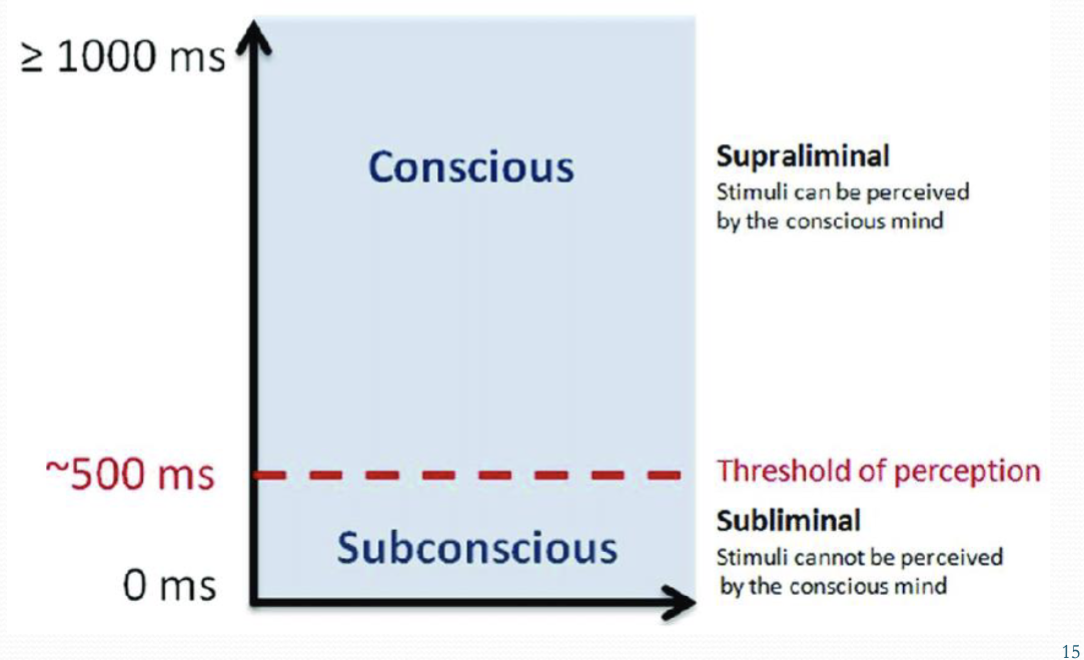
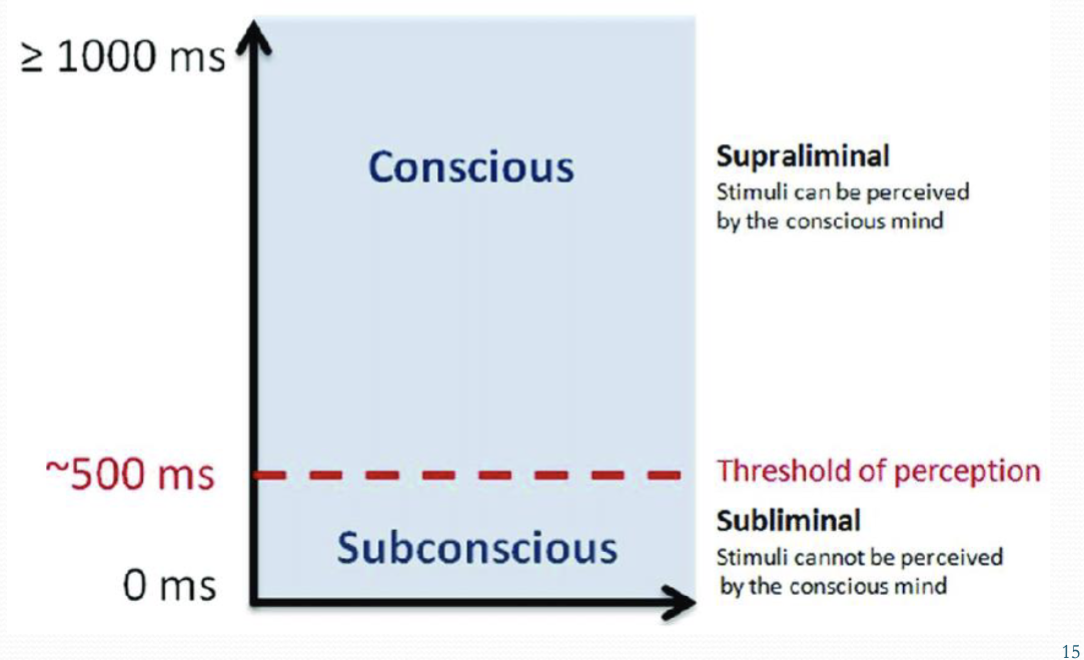
what is subliminal priming?
a) “below the threshold” of conscious perception
i) largely about the PRESENTATION of the stimulus
ex: an image is shown to people so quickly, within fractions of seconds, however this image still affects the people’s cognitions, in ways that they don’t realize
how did the “RATS” campaign ad by the bush campaign use subliminal priming?
(1) when the phrase “bureaucrats decide” was shown in the video in correlation to Al Gore, the word “rats” was very quickly shown
(2) the Bush administration presumably attempted to associate negative connotations to their opposing candidate
(a) elicits conditioned response of negativity
(b) goal would be to make the association not noticeable
what is supraliminal priming?
a) “above the threshold” of conscious perception
i) we can detect that we’re affected by the stimuli, BUT UNWARE of how they affect us
i) ex: odors: negative moods can be induced from people by putting them in a space of bad odor
ii) ex: images: when called to attention of an image of dogs, we detect that there’s a stimulus but not aware how this image would later influence us to bring up dogs in a convo with friends
how is the scrambled sentence task an examaple of supraliminal priming?
(1) when presented with the words: spend, shoe, together, should, time, families
(2) when asked to use ONE of the list of words to make a sentence, people tend to cross out “shoe” and make the sentence” families should spend time together”
(a) they were supraliminally primed to create a sentence with most of the words given
(b) people were aware that they were given a stimulus by the list of words, but don’t initially recognize how they would affect them
how is memory constructive?
a) when we recall info, we rebuild the memories
what did Elizabeth Loftus state about false memories?
i) false memory: remembering things differently/incorrectly than they actually occurred
influenced by spreading activation- leaves room for other associations/expectations that have previously built in to come out, even if they’re incorrect
loftus’s study on “rebuilding” memories – car crash experiment: PROCEDURE
(1) show participants of a crime scene video
(2) deliberately provide misinformation
although the video didn’t show a stop sign, ask participants whether they saw a stop sign
phrase the question to be “what happened when the cars crashed into each other” instead of “bumped into each other”
loftus’s study on “rebuilding” memories – car crash experiment: RESULTS
(1) participants came to recall a distorted detail although they didn’t actually see those details
(2) even when the reseatchers suggested that a certain event (that did not happen) occurred in the participants’ childhood, they came to believe it
loftus’s study on “rebuilding” memories – car crash experiment: CONCLUSIONS
wording is very influential
memory is malleable
we’re vulnerable to distortion
schemas can be very powerful
loftus’s study on “rebuilding” memories – car crash experiment: IMPLICATIONS
(1) explained the phenomena of false eye witness testimonies, although many people believed that their memory was solid, they unintentionally told of false details
(a) ex: a woman was raped, was convinced that she could identify who the culprit was, later finds out that the man she helped imprison was not the cuprit
what is ironic suppression according to Wegener (1994)?
thought suppression: avoiding thinking about something
ex: when told not to think about white bears for 30 sec, white bear was thought of a few times during that time even though I tried not to
how does ironic suppression work according to Wegener (1994)?
there’s 2 processes:
automatic process: monitors for unwanted thought
controlled process: creates a thought to distract us
requires motivation and effort
ex: “maybe I’ll think about a black bear”
b) at some point, the controlled process begins to break down… then the thought becomes more accessible ( since our automatic processing kicks in)
Masuda & Nisbett (2001) on cultural differences in cognition: analytic thinking
a) analytic & holistic thinking styles (thought to be the universal thinking methods)
i) analytic thinking:
logical reasoning approaches
focus on central character/individual/actor removed from context
more common in Western, independent cultures
Masuda & Nisbett (2001) on cultural differences in cognition: hollistic thinking
holistic thinking:
focus on the relationships between character/individual/actor with the context/backgrounds
dynamic view of scenery
more common in Eastern, interdependent, collectivistic cultures
Masuda & Nisbett (2001) on cultural differences in cognition: MAIN FINDINGS
i) Japanese participants were able to recall things more in relationship to other objects/background than the American sample = context seemed to matter significantly more for the Japanese sample
(1) context could facilitate memory; context could either inhibit/help memory processing
Masuda & Nisbett (2001) on cultural differences in cognition: IMPLICATIONS
i) we should not assume universality: context/details are thought of and processed across cultures differently
ii) shows how important diversity is in the research field, because different perspectives lead to different interpretations & can supplement more details
iii) the importance of blending the 2 thinking styles; asking what does the confluence of these styles do?
what is attribution and what is it useful for?
explanation for behavior
a) attribution is useful for:
understanding others’ behavior
predicting
what is nonverbal communication?
the way in which people communicate, intentionally or unintentionally, without words, including via facial expressions, tone of voice, gestures, touch, and gaze
i) helps us to express out emotions, our attitudes, and our personality (and to perceive those same characteristics in others
ex: emojis are popular bc they help fill in gaps created by the lack of nonverbal cues
what are examples of nonverbal communication?
facial expressions
body language/ gestures
tone of voice/ inflection
how are primary emotions conveyed by the face universal?
(a) all humans encode: to express or emit nonverbal behavior, like smiling or patting someone on the back
(b) all humans decode: to interpret the meaning of the nonverbal behavior other people express like deciding that a part on the back was an expression of condescension and not kindness
what ddo people often display, thata makes decoding of nonverbal communication (faciaal expressions) difficult?
1. affect blends: facial expressions in which one part of the face registers one emotion while another part of the face registers a different emotion
a. ex: if someone told me something that was both horrible and inappropriate—I might display disgust & anger
how does direction of gaze affect decoding of emotions?
(i) for approach-oriented emotion like anger decoding is quickest when a face stares right at you
(ii) for avoidance-oriented emotions like fear, decoding is easiest when a face displays an averted gaze—eyes looking to the side tells of the the exact location of the scary object
how do display rules affect nonverbal communicatiton?
a) display rules: culturally determined rules about which nonverbal behaviors are appropriate to display
ex: Japanese norms often lead ppl to cover up negative facial expressions with smiles and laughter and in general, to display fewer facial expressions than are displayed in the west
what are emblems?
a) nonverbal gestures that have well-understood definitions within a given culture, usually having direct verbal translations, such as the Ok sign
study on “what was that masked man saying?” (Hodges, 2020): CONCLUSIONS
(1) there is intentionality in expressiveness
we get fully brought into conversations when we can’t see their lips
(2) “motionese”
body language matters a lot
how does thin slicing affect first impressions?
a) drawing meaningful conclusions about another person’s personality or skills based on an extremely brief sample of behavior
i) snap judgments are not just quick; they also pick up on meaningful info and converge with the impressions formed by perceivers with even longer exposure to the target in question
how does the primacy effect affect first impressions?
a) when it comes to forming impressions, the first traits we perceive in other influence how we view info that we learn about them later
how does the belief perseverance affect first impressions?
a) the tendency to stick with an initial judgment even in the face of new information that should prompt us to reconsider
what is the attribution theory?
a) attribution theory: a description of the way in which people explain the causes of their own and other people’s behavior
what did Kurt Lewin state about the attribution theory?
i) father of social psyc”
ii) came to the US from Western Europe to flee WWII
iii) “there is nothing so practical as a good theory” – importance of rigorized standard empirical work
iv) B = f (P * S)
(1) psychological experience/behavior is some function of the mix of personality and situation
(2) Lewis was one of the first to recognize the importance of context in ppl’s behavior
what did Fritz Heider mean when he said that “we are all intuitive scientists?”
Heider aka “father of attribution theory”
it’s our natural instinct to try to make a sense of the world and people around us; we try to gather data to reach conclusions
(1) the way that we gather info is like a good scientist – based on evidence, not jumping to conclusions, reserve judgments until proven
(2) connects to watson’s idea of “flawed scientists” in that sometimes we do this imperfectly
according to Fritz Heider, what are the 2 types of attributions?
i) internal attribution (aka DISPOSITIONAL): the inference that a person is behaving in a certain way bc of something abt the person, like attitude, character, or personality
ex: if someone cut jack off, jack would attribute their behavior to the person being a terrible driver
ii) external attribution (aka SITUATIONAL): the inference that a person is behaving a certain way bc of something abt the situation they’re in, with the assumption that most ppl would respond the same way in that situation
ex: if someone cut jack off, jack would attribute their behavior to them being a new driver
what did Kelley’s covariation theory study?
i) studied: how things go together/covary to draw confident conclusions
ii) if people want to be good scientists, when should people make dispositional vs. situational attributions?
(1) people must consider multiple instances of behavior – if context shifts around, behavior might change/stay the same
(a) like aggregation in stats, we can be more confident about someone if their behavior holds up across contexts
what are the 3 constructs of behavior that must be considered accordidng to Kelley’s Covariation theory?
consensus information
consistency information
distinctiveness information
what is consensus information according to Kelley’s covariation theory?
consensus information: the extent to which other people behave the same way toward the same stimulus as the actor does
(a) “do other people behave like X in this situation?”
(b) yes, most people behave like this = high consensus
(c) no, not many people behave like this = low consensus
ex: a stranger raves about a film.
other peoeple do not rave about the film = low consensus
other people also rave about the film = high consensus
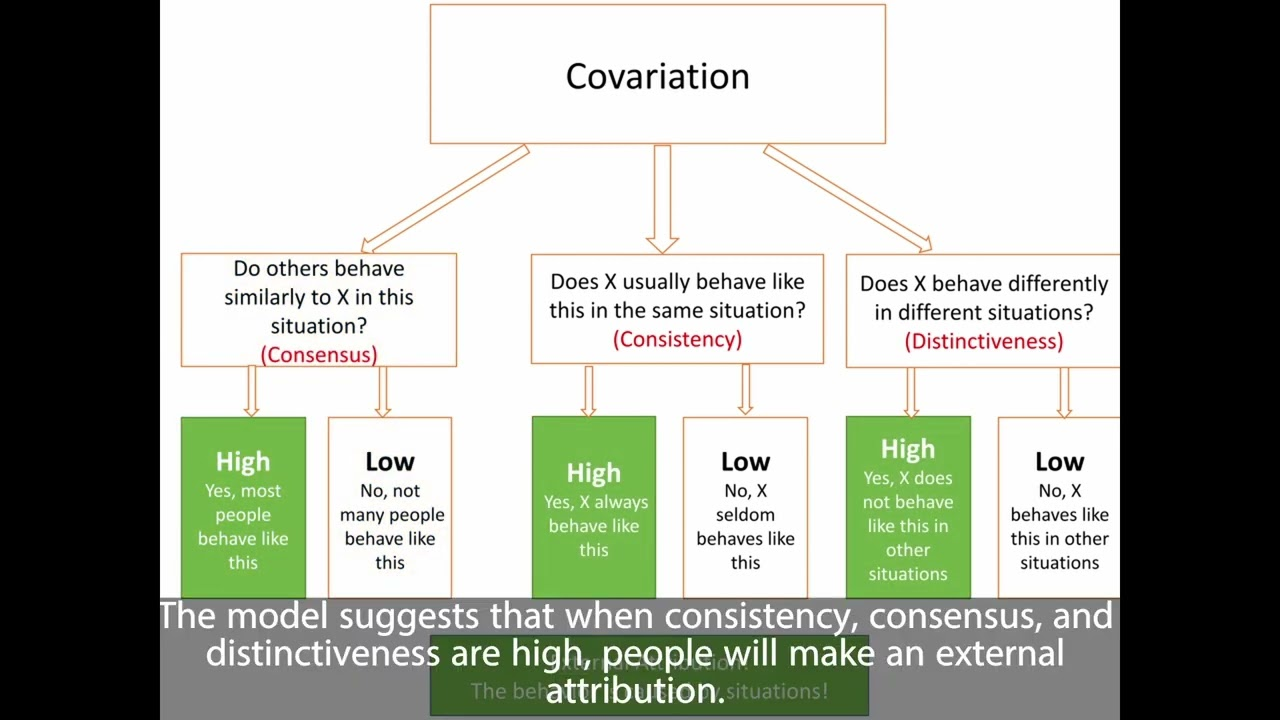
what is consistency information according to Kelley’s covariation theory?
(1) consistency information: the extent to which the behavior between one actor and one stimulus is the same across time and circumstances
(a) “does X usually behave this way in the same context?”
(b) yes, X always behave like this in this context= high consistency
(c) no,X seldom behaves like this in this context = low consistency
ex: a stranger raves about a film.
the stranger always raves about the film every week= high consistency
the stranger seldom raves about the film = low consistency
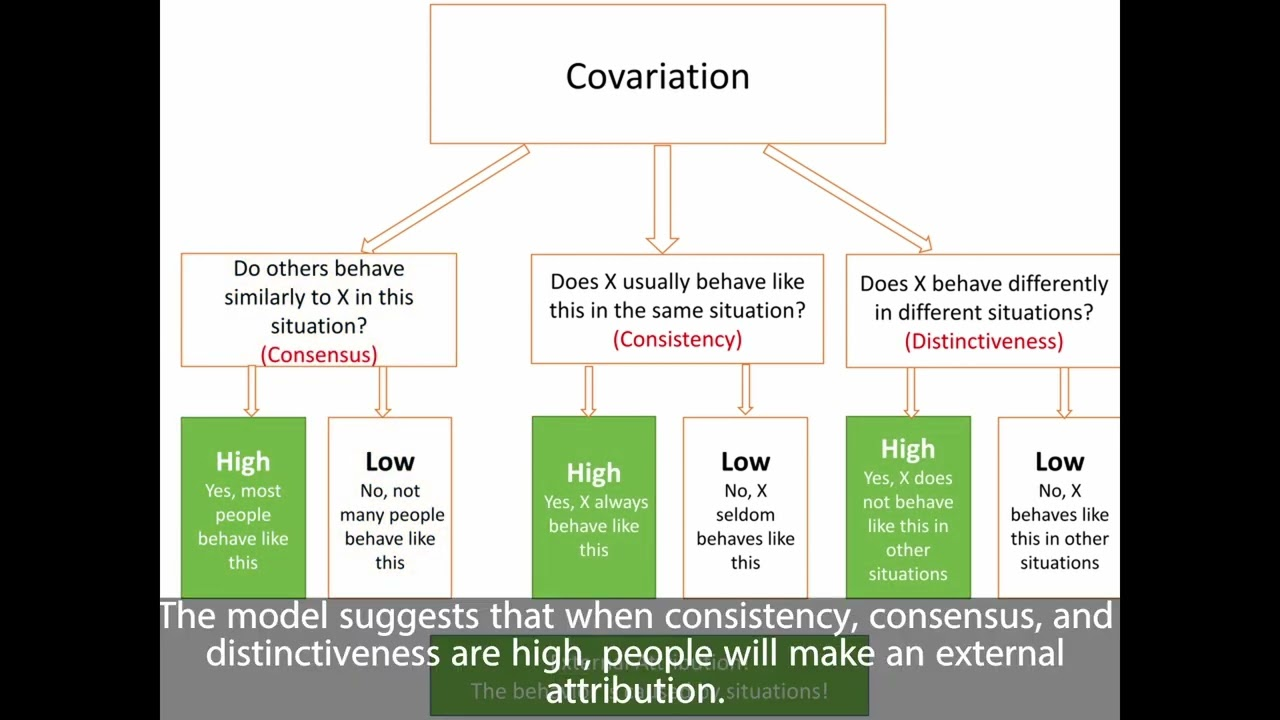
what is distinctiveness information according to Kelley’s covariation theory?
the extent to which a particular actor behaves in the same way toward different stimuli
(a) “does X behave this way to similar stimuli in different but related situations”
(b) yes, X behaves this way to similar stimuli = low distinctiveness (OPPOSITE SCORING TO CONSENSUS & CONSISTENCY!!)
(c) no, X does not behave like this to similar stimuli= high distinctiveness (OPPOSITE SCORING TO CONSENSUS & CONSISTENCY!!)
ex: a stranger raves about a film.
the stranger does not rave about many other films = low distinctiveness
the stranger raves about many other films = high distinctiveness
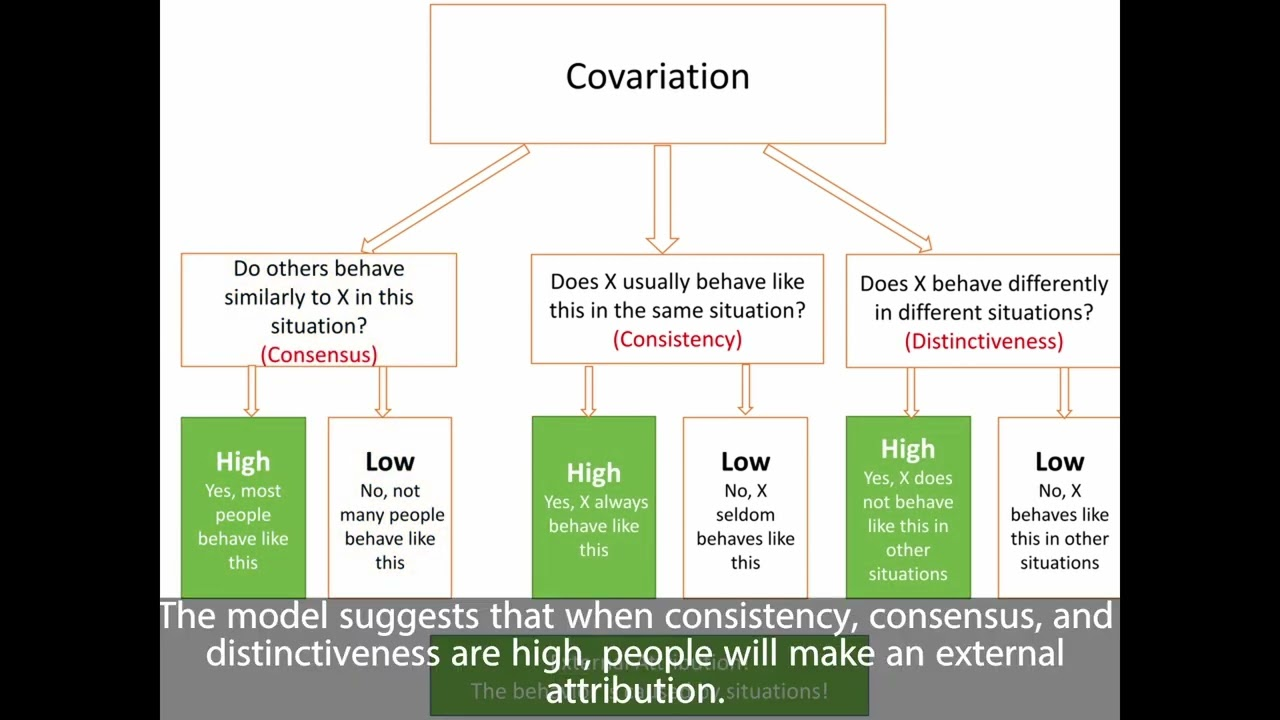
according to kelley’s covariation theory, what combinatiion of the 3 constructs can infer DISPOSITIONAL ATTRIBUTION?
(a) low consensus, high consistency, low distinctiveness
(i) ex: “other people do not really go screaming down the hallway, this person behaves like this around the same time every week, but they don’t behave like this in every building”
(ii) ex: “bob trips over kathy’s feet while they are dancing. no one else trips over kathy’s feet. when bob dances with beth and lynn, he also trips over their feet. bob tripped over kathy’s feet last Saturday, too.”
(i) ex: your boss keeps yelling at Hannah. is it something about who your boss is as a person (internal attribution) or something external to your boss (e.g. Hannah’s work ethic or attitude, etc)?
1. “no one except your boss yells at Hannah (low consensus) + your boss yells at everyone (low distinctiveness) + your boss always yells at Hannah (your boss always yells at Hannah.” = this is something about your boss’s personality = internal attribution
according to kelley’s covariation theory, what combinatiion of the 3 constructs can infer SITUATIONAL ATTRIBUTION?
high consensus, high consistency, high distinctiveness (all 3 needs to be high)
(i) ex: “other people go screaming down the hallway around the same time in every building on campus”
(ii) ex: “bob trips over kathy’s feet while they are dancing. everyone else trips over kathy’s feet. when bob dances with beth and lynn, he doesn’t trip over their feet. bob tripped over kathy’s feet last Saturday too”
(iii) ex: everyone yells at Hannah (high consensus) + your boss only yells at Hannah (high distinctiveness) + your boss always yells at Hannah (high consistency) = external attribution = this is not about your boss, but more likely abt Hannah’s work ethic or attitude.
according to kelley’s covariation theory, what combinatiion of the 3 constructs can infer AMBIGUITY?
(a) any other pattern is ambiguous – refrain from making attributions ( anything with low consistency!!)
(ii) ex: “bob trips over kathy’s feet while they’re dancing. no one else trips over kathy’s feet. when bob danced wit beth and lynn, he doesn’t trip over their feet. bob had danced with Kathy on ten prior occasions and he never tripped over her feet before”
1. low consensus, high distinctiveness, low consistency
what is the fundamental attribution error?
a.k.a correspondence bias (person behaves a certain way. therefore their behavior corresponds to their personality
b) tendency to OVERESTIMATE DISPOSITIONAL causes & UNDERESTIMATE SITUATIONAL causes
due to perceptual salience – the seeming importance of information that is the focus of ppl’s attention
ex: if you get into a car accident, the info that captures your attention, that’s the information you’re focusing on, you’re not focusing on other info like “oh I have a baby in the back”; focusing on info that’s readily available to us
due to information availability – we may not be privy to that kind of info
ex: didn’t see another driver cut into the lane 3 lanes to the left
quizmaster experiement by Ross et al. (1977) - example of funmental attribution error
i) people put in the role of “quizmaster” or “contestant”
ii) quizmaster generates Qs, contestant answers the questions
iii) asked the participants: who’s seen as more knowledgeable?
people answered the quizmaster
iv) this is an example of the FAE
people were informed of that people were assigned to the roles, but still underestimated the situational constraints
what does the Gilbert’s 3-stage model of attribution process explain?
attempts to explain robustness of FAE
ii) making attributions involves:
multiple stages
automatic & controlled processing
iii) we automatically opt for disposition attributions (default)
iiii) if nott motivated or able to correct for the situation, we never get to stage 3 of Gilbert’s model
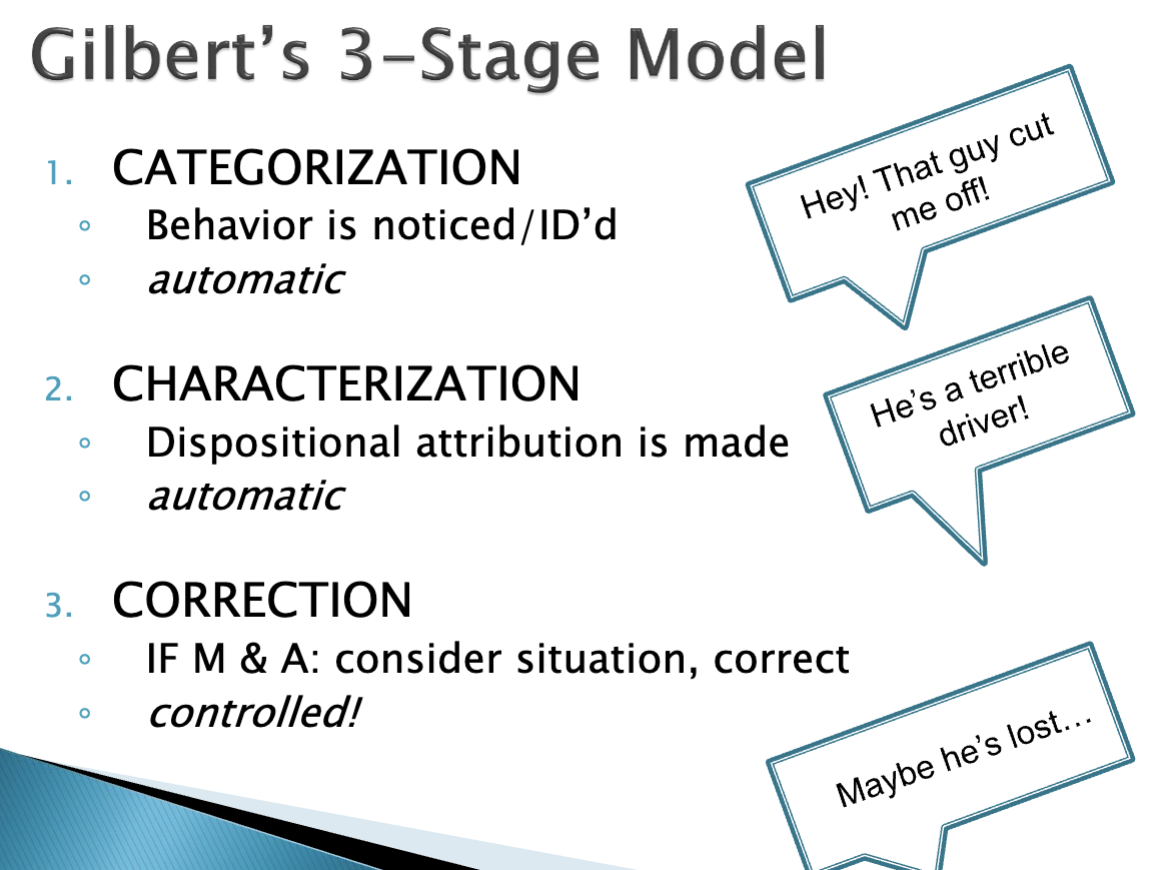
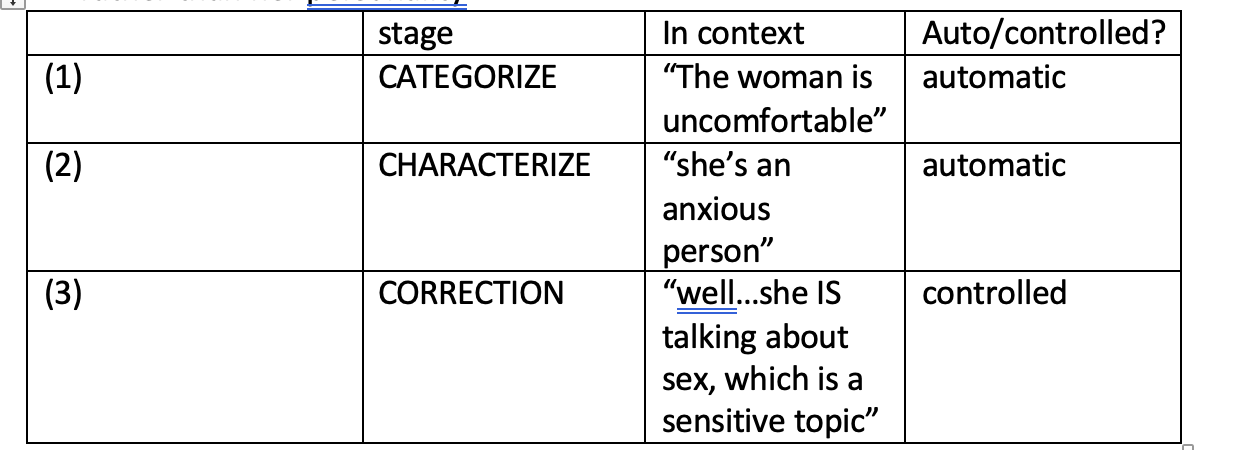
what stages does the Gilbert’s 3-stage model of attribution process include?
catgorization
characterization
correction
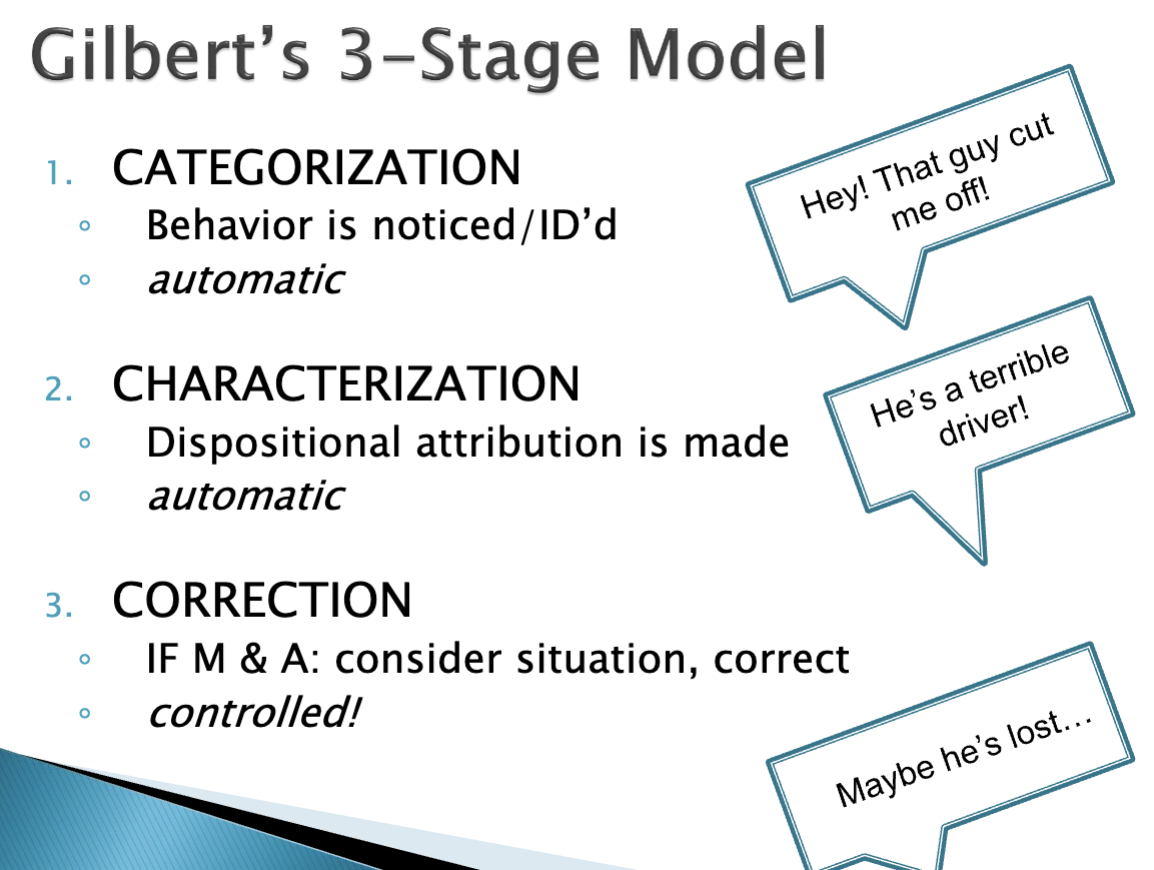
what does stage 1: categorization involve in Gilbert’s 3-stage model of attribution process?
behavior is noticed & identified/categorized
(a) ex: “hey! that guy just cut me off!”
(i) it is possible to not notice certain stuff
(b) this stage is automatic – involuntary noticing
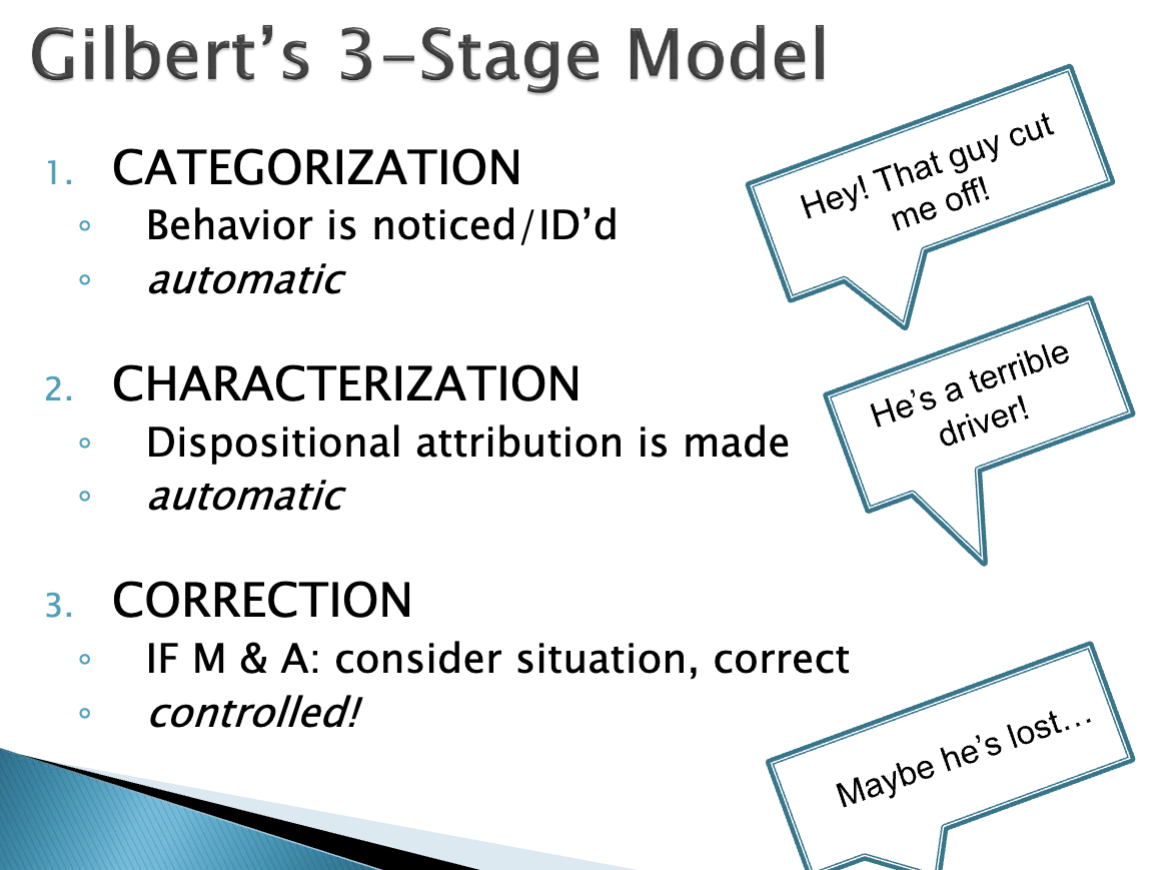
what does stage 2: characterization involve in Gilbert’s 3-stage model of attribution process?
dispositional attribution is made; dispositional default (our minds automatically attribute to dispositional factors)
(a) ex: “he’s a terrible driver!”
(b) this stage is automatic
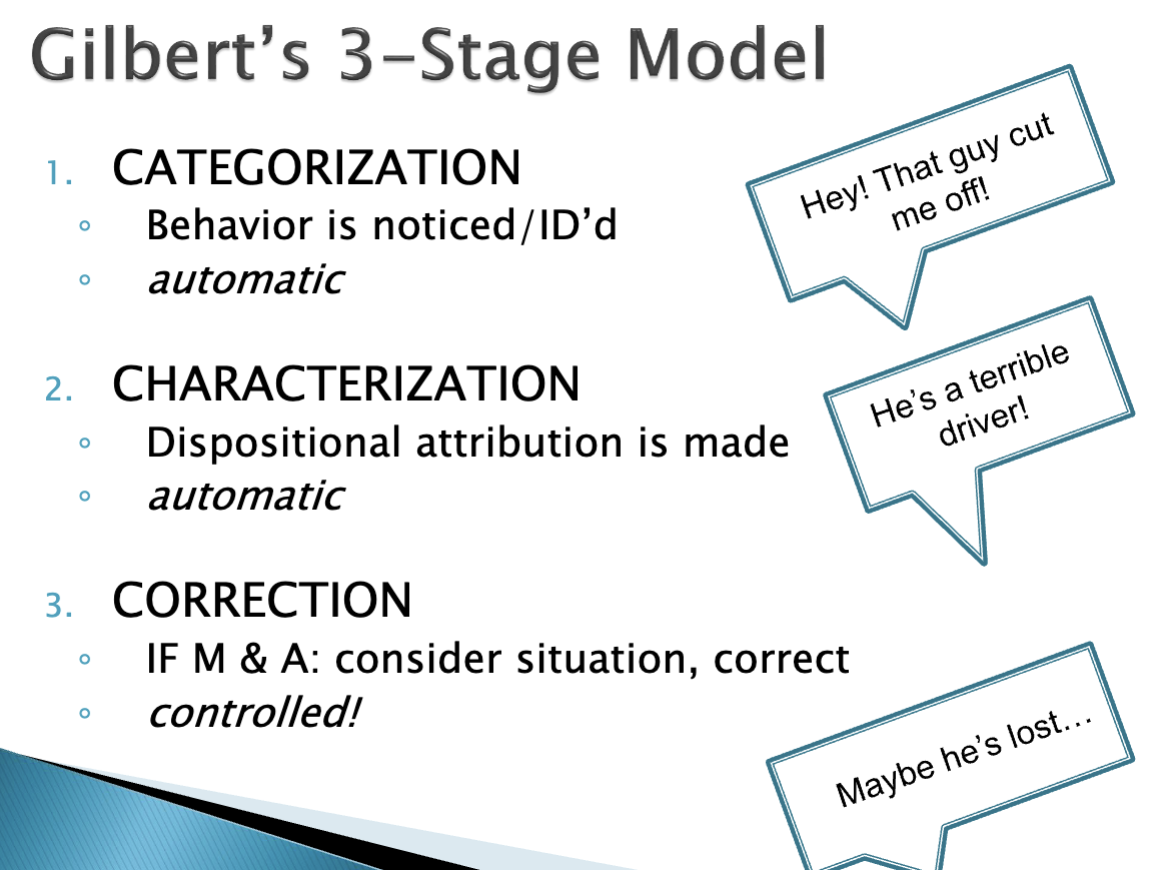
what does stage 3: correction involve in Gilbert’s 3-stage model of attribution process?
IF M & A (the person is motivated and have the ability), they will consider the situational context, correct their thinking
(a) ex: “maybe he’s lost..”
(b) this stage is controlled
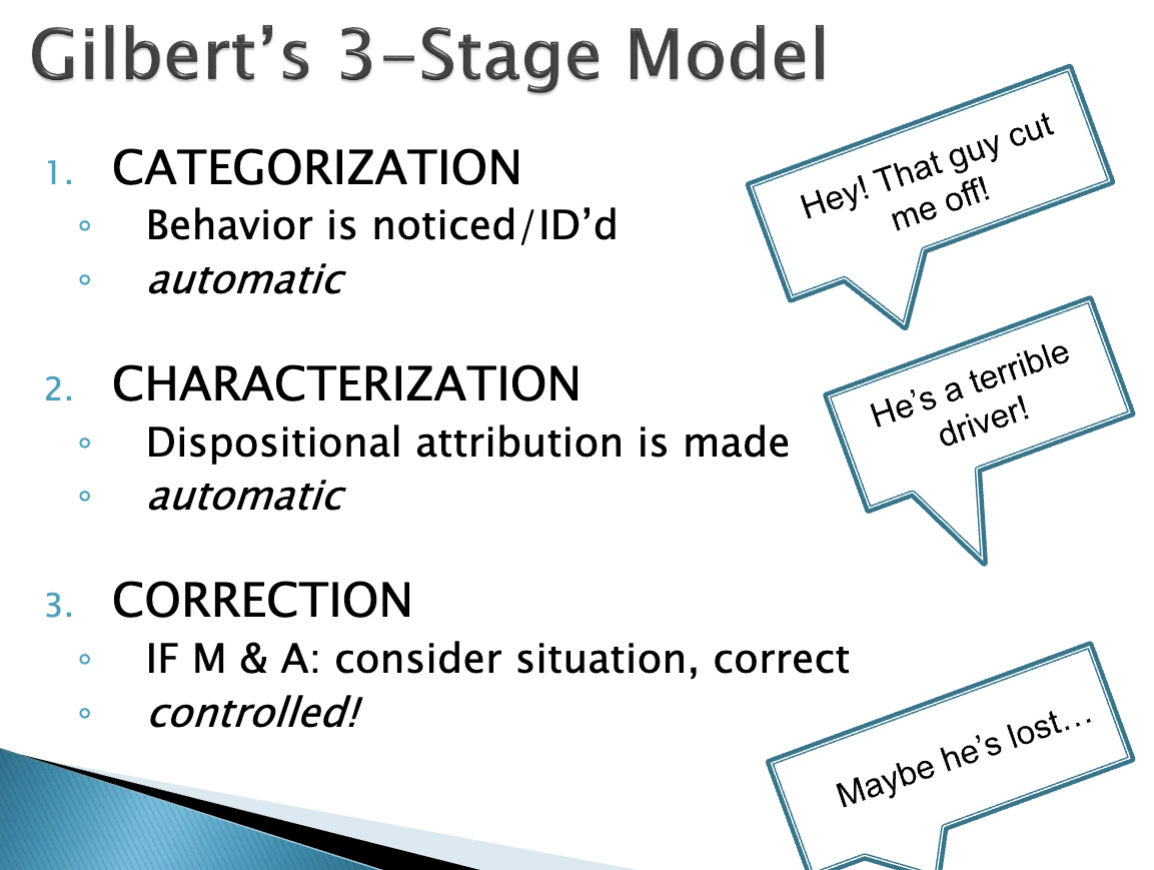
what does stage 3: correction involve in Gilbert’s 3-stage model of attribution process?
(1) if there’s a disruption to these stages, THEN people make a dispositional attribution error
(a) ex: you’re busy, tired, distracted, or just not motivated to think more about the person’s behavior. you stop at the first stage of characterization, your attribution remains an internal, dispositional one.
anxious woman experiment (Gilbert, Pelham & Krull 1988): PROCEDURE
participants watch muted video: woman talking to a stranger, but she seems very anxious
ii) IV 1: 2 topics (topic labeled at the bottom of the video that participants were watching)
anxiety provoking (sexual fantasies)
neutral (world travel)
iii) IV 2: cognitive load
busy
not busy
iv) DV: rate the woman’s (from the video) dispositional anxiety level on a scale of 1 to 10
anxious woman experiment (Gilbert, Pelham & Krull 1988): RESULTS
(1) participants under the not busy condition attributed the world travel video woman much higher to their dispositional traits and attributed the sexual fantasies video woman much lower to their dispositional trait
(1) participants in the busy condition did not display a significant difference between their attributions to dispositional traits for the 2 types of videos
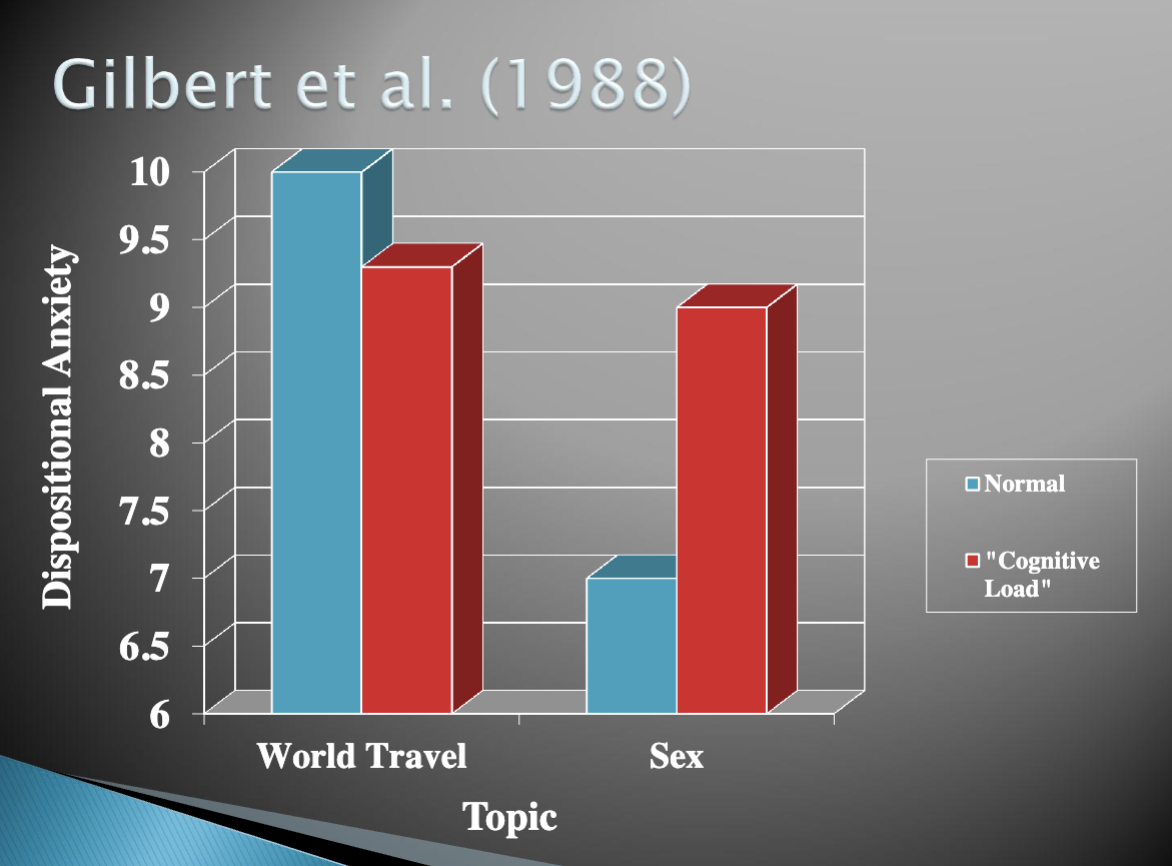
anxious woman experiment (Gilbert, Pelham & Krull 1988): CONCLUSIONS
without cognitive load, people were able to attribute the woman’s anxiety correctly to the situational factors rather than her personality = they were able to get to the correction stage without disruption
under cognitive load, people were not able to attribute the woman’s anxiety to the situational factors
the cognitive load prevented them from making a distinction between the dispositional factors and situational factors – they never made it the correction stage, they were just left at the dispositional default
what are the cultural differences in the fundemental attribution error?
a) stronger/more robust tendencies to make the FAE in independent cultures
i) westerns think like personality psychologists – focus on the actor
ii) easterners think like social psychologists – focus on the context
Mason & Morris, 2010: why are there cultural differences in the fundemental attribution error?
during stage 2: characterization…
(1) independent/individualistic cultures: “dispositional default”
(2) interdependent/collectivistic cultures: “hybrid default”
hybrid – holistic thinking style, combination of dispositional & situational thinking
ii) interdependent cultures more apt to make situation correction than western cultures because during stage 3: correction…
more automatized for ppl of interdependent culture to reach stage 3; gives them ABILITY (becomes easier to make correction)
stronger “weighting” of situational info – gives them MOTIVATION to consider the situational factors; even if it’s more work to do the correction
what are self-serving attributions?
i) explanations for one’s successes that credit internal, dispositional factors and explanations for one’s failures that blame external, situational factors
in sports, how do self-serving attributions play out?
(1) when explaining their victories, athletes and coaches both point overwhelmingly to aspects of their own teams
(2) losses were more likely to attributed to external causes, outside of the team’s control, such as bad luck or the superior play of the other team
(3) an athlete’s skill, experience & type of sport predicted attributional tendencies:
less experienced athletes were more likely to make self-serving attributions than experienced ones; experienced athletes realize that losses are sometimes their fault and that they can’t always take full credit for wins
athletes in solo sports made more self-serving attributions than those in team sports
 Note
Note  Flashcards (52)