Chap 17 - Oscillations
 Studied by 0 people
 Call with Kai
 Learn
Learn Practice Test
 Spaced Repetition
 Match
Match Flashcards
 Knowt Play
1/18

There's no tags or description
Looks like no tags are added yet.
Name | Mastery | Learn | Test | Matching | Spaced | Call with Kai |
|---|
No analytics yet
Send a link to your students to track their progress
19 Terms
Define displacement (x)
The distance from the oscillator to the equilibrium (measured in metres)
Define amplitude
Maximum displacement (measured in metres)
Define period
Time taken to complete 1 full oscillation (seconds)
Define frequency
Number of oscillations per unit time (hertz)
Define phase difference
The fraction of an oscillation between the position of two oscillating objects (radians)
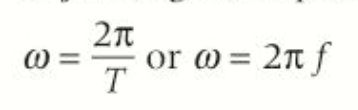
Define angular frequency
(ω) the rate of change of angular position/displacement
Equation for angular frequency
Define simple harmonic motion
type of oscillation where the acceleration of the oscillator is directly proportional to the displacement from equilibrium, but opposite in direction (towards equilibrium)
Defining equation of simple harmonic motion
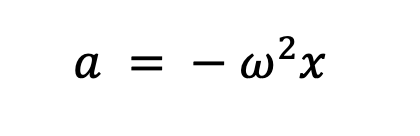
where ω is angular frequency
What is the relationship between acceleration and displacement?
acceleration is directly proportional to displacement
What does a graph of acceleration against displacement look like
a = -ω2 x
y = mx + c
Straight line through the origin. Grad -ω2
SHM is isochronous oscillation, what does that mean?
The time period is independent of the amplitude. If amplitude increases, so will speed so time period remains unaffected.
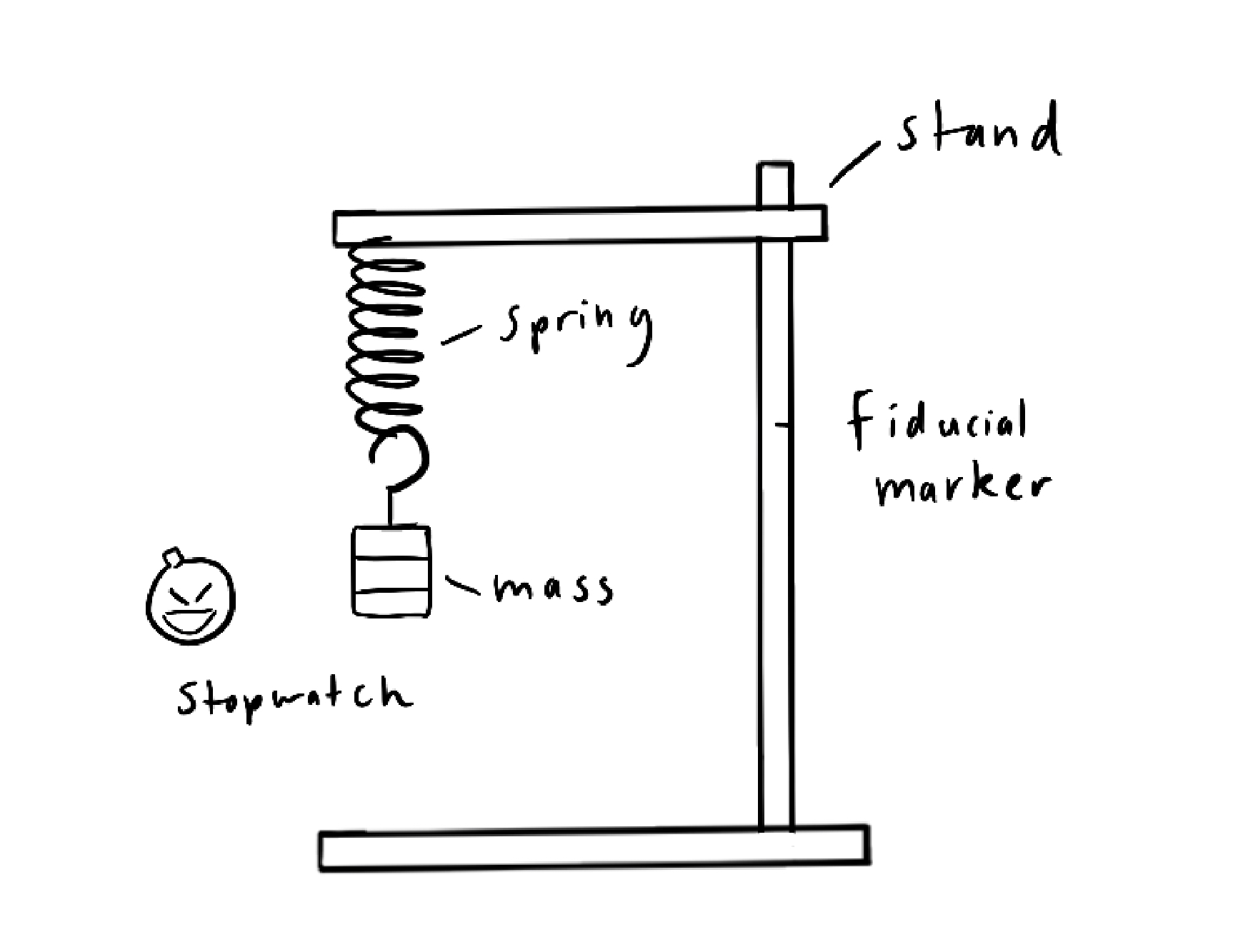
What set up do you need to carry out an investigation of SHM with a spring?
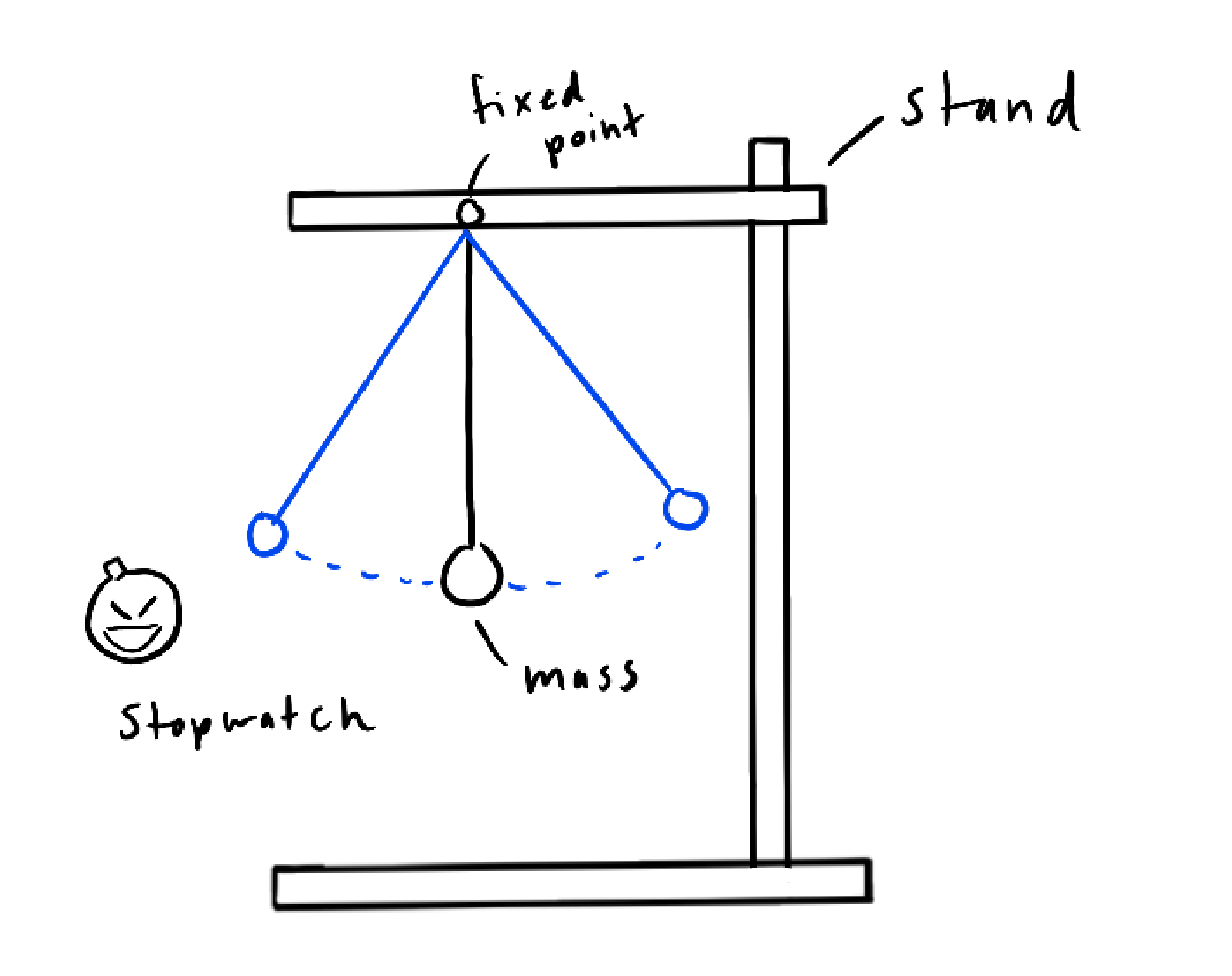
hat set up do you need to carry out an investigation of SHM with a penedulum?
Why should you mark a fiducial marker when investing SHM with a spring?
Reduces uncertainty in timing measurements, clearer equilibrium position to reduce error, even when oscillations are damped.
Why measure to take a reading for 10T rather than one T when investing SHM?
Reduce the effect of random errors, reduce the uncertainty in the timing measured due to human errors in the timings (reaction time, etc.)
what is angular frequency measured in?
rads-1
 Note
Note  Flashcards (20)