Topic 1: Introduction to American Foreign Policy, in the Constitution, and in the Washington Administration (1787-1797)
 Studied by 0 people
 Call with Kai
 Learn
Learn Practice Test
 Spaced Repetition
 Match
Match Flashcards
 Knowt Play
1/11

Earn XP
Description and Tags
Intro to American Foreign Policy
Name | Mastery | Learn | Test | Matching | Spaced | Call with Kai |
|---|
No study sessions yet.
12 Terms
American Foreign Policy
a gov’s strat in dealing with other nations (made up of framework, position, action)
frameworks → determine veiwpoints→ determine actions
American Foreign Policy Frameworks: 4 typologies
Hamiltonian
Jeffersonian
Jacksonian
Wilsonian
Hamiltonian
Hamiltonian (federalist, power to gov, wide interpret, Secretary of Treasury)
Economic Focus: The purpose of foreign policy should be to enhance and/or protect America’s economic position in the world
Jeffersonian
Jeffersonian (democratic-republican, power to states, narrow interpret, sec of state + 3rd prez, the purpose of US was to have living testament to democracy)
Democratic Focus: America’s priority should be cultivating and protecting democracy at home
America should get involved in foreign affairs when:
democracy at home is under threat
democracy at home can be enhanced by foreign involvement
Jacksonian
Jacksonian (federalist, for common man: spoils system, Indian Removal Act, veto Bank, prez should do whatever necessary)
Aim of foreign policy should be to promote America’s strategic interest (national security & overall well-being) in the world
Wilsonian
Wilsonian (democrat, WWI, progressive (gov should have experts to solve problems to create ideal society, Jesus-like figure (savior))
Democratic World Focus: Foreign policy should be motivated by democratic ideals
The world needs saving and through international cooperation, America can save it.
American foreign policy should work to usher in a more ideal and democratic world
Constitution created limited Foreign Policy Apparatus
Const reflects the Founders’ fear of an overly-militarized state/ authoritarianism
Const limits the war-making power of the gov in 3 ways
1. Distributes Foreign Policy Powers Across the Executive and Legislative Branch
2. Calls for a Small Standing Army
3. Gives the Right to Bear Arms to the American People
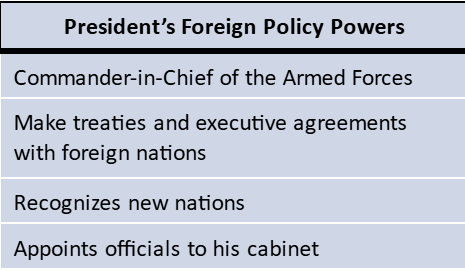
Presidents Foregin Policy Powers
(overall less power)
Commander-in-Chief of the Armed Forces
Make treaties and executive agreements w/ foreign nations
Recognizes new nations
Appoints officials to his cabinet
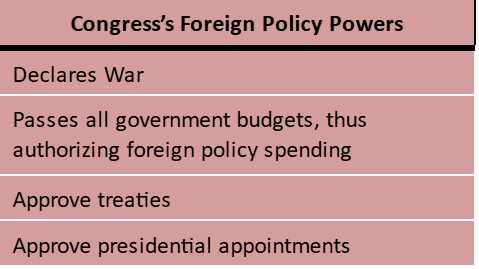
Congress’s Foreign Policy Powers
(overall more powers)
Declares war
Passes all government budgets, thus authorizing foreign policy spending
Approves treaties
Approves presidential appointments
Standing Army
small, on-call, ready to fight
Small: didn’t want over-militarized state bc it could be used against citizens (present in monarchies)
America was young, but not v likely to be attacked bc of geography -> so not too worried abt small army
Right to Bear arms: 2nd amendment, we think of as individual liberty, can also be interpreted as ppl can fight against gov + ppl have to show up voluntarily
How does this change:
Wilsonian = big military now + is influential in more recent years
Const stays the same but it's reinterpreted (don’t declare alot of war but engage in alot of conflicts)
Two conflicting foreign policy frameworks established in Washington Administration: The French Revolution
US was inspo for revolution but US debated getting involved
Hamilton: we shouldn’t get involved bc the costs are way higher than any benefit, young country, still in debt from was against British, signed a c;ontract w/ someones whos dead so its invalid (Pragmatist, looking thru lens of rationality, Bank)
Hamiltonian Framework: America should only enter into foreign affairs if it benefits America’s economic growth and development
Jefferson: we should get involved bc they signed a treaty saying they would help the French in a time of need, Willsonian/Jeffersonian bc this will prove that America's “experiment” is a role model (looking thru lens of morals/values, ideals)
Jeffersonian Framework: America must protect and promote democracy at home
Puritan Influence
The Puritans bring with them a “vision” of what they want their colony to be and to achieve.
This vision is best articulated in a sermon by John Winthrop in “A Model of Christian Charity,” a speech he gave on the Arabella while en route to the Massachusetts Bay Colony in 1630.
American Exceptionalism = chosen by God and therefore destined to accomplish greatness (city upon a hill)
“Farewell Address” - George Washington 1796
Calls for American isolationism bc Europe has ALOT problems/fightin' that don’t involve us, and wouldn’t benefit us to get involved -> if we got an alliance then we’d have to fight w/ them
Still, trade and be friends -> economic ties not political
 Note
Note  Flashcards (178)