Silk Road Quiz 2
 Call Kai
 Learn
Learn Practice Test
 Spaced Repetition
 Match
Match Flashcards
 Knowt Play
1/17

There's no tags or description
Looks like no tags are added yet.
Name | Mastery | Learn | Test | Matching | Spaced | Call with Kai |
|---|
No analytics yet
Send a link to your students to track their progress
18 Terms
Kushan Empire
Founded by the Yuezhi; prosperous as empire
controlling Silk Road trade from 1st to 3rd century CE
Did not have writing, but used scripts of conquered
people: Greek letters, Kharoshti script
Supported Buddhism, and contributed to spread of the
religion
Parthian Empire
One of the Empires in First Silk Road Era
A crucial cultural and economic bridge between Rome and East Asia via the Silk Road
Rivals to Rome and controlled trade routes in the Silk Road
Sasanian Empire
Restored Persian culture
Created a tightly organized bureaucracy, which improved military effectiveness and allowed for better taxation and infrastructure.
Served as a vital hub on the Silk Road, influencing art and culture in China, India, and medieval Europe.
Tang Empire
Golden age of Chinese civilization and Empire in the Second Silk Road Era
The capital, Chang'an, was likely the world's most populous and diverse city, attracting foreign merchants, artists, and diplomats from over 400 countries.
Expanded its influence over Central Asia, Korea, and Vietnam, securing the Silk Road to protect trade routes that reached as far as Rome.
Tilia Tepe (in Afghanistan)
Revealed six burial mounds (1st century BCE – 1st century CE) belonging to a nomadic royal family, yielding over 20,000 gold ornaments
The artifacts demonstrate a blend of cultures, including Roman coins, Chinese bronze mirrors, and, most prominently, Greek deities and Hellenistic styles
These findings fill a gap in the understanding of the early Kushan Empire
Parthian shot (an archer on horseback shooting backward)
A devastating military maneuver used by Parthian cavalry to defeat heavily armored foes like Roman legions
Uses of silk
Currency and Trade
Luxury Apparel
Artistic and Writing Surface
Gifts
Textile Art
Fishing lines
Bowstrings
Musical instrument strings
Mahayana Buddhism
the Great Vehicle
a major branch of Buddhism (influenced East and North
Asia)
advocates salvation to all, not just oneself
Yungang Cave-temples
The site showcases the integration of foreign Buddhist art with local Han culture
Masterpiece of Early Buddhist Art
Bodhisattva
a being destined to gain full enlightenment but postpones it in order to save suffering beings
has princely attire
Karma
signifies the universal law of moral cause and effect, where intentional actions of body, speech, and mind shape present experiences and future rebirths
Dunhuang Sealed Library
holds documents in over 20 languages and scripts, providing evidence of the cultural exchange along the Silk Road.
contains invaluable secular documents covering history, mathematics, medicine, and folklore, as well as official records of local life, taxation, and trade.
Zoroastrianism
serving as the state religion of Persian empires
focused on the struggle between good and evil, influenced other religions
Manichaeism
Founded by prophet Mani
influenced by Christianity, Zoroastrianism, and Buddhism
spread from Persia, through Central Asia, to China, and west to the Roman Empire
Constantinople
the vital western terminus of the Silk Road, acting as the primary bridge between Asian trade networks and European markets
Hagia Sophia
crucial landmark at the western terminus of the Silk Road
representing the immense wealth, power, and religious authority of the Byzantine Empire.
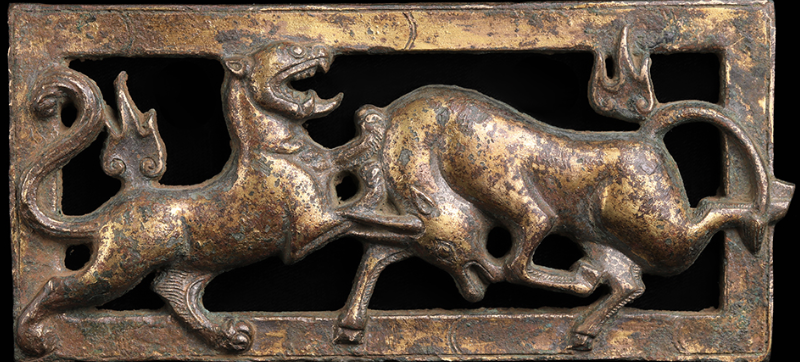
Name: Bronze belt plaque with human combat and animals
Country/Place: Han Dynasty
Period: 3rd century BCE – 3rd century CE
Medium: Bronze
Significance: cultural artifacts that represented the identity, status, and power of nomadic peoples in Northern China and the Eurasian steppes

