Social Cognition
 Studied by 0 people
 Call with Kai
 Learn
Learn Practice Test
 Spaced Repetition
 Match
Match Flashcards
 Knowt Play
1/12

There's no tags or description
Looks like no tags are added yet.
Name | Mastery | Learn | Test | Matching | Spaced | Call with Kai |
|---|
No study sessions yet.
13 Terms
System 1 and System 2 thinking
System 1 is fast, automatic, intuitive, and emotional, handling quick judgments and habits (like recognising faces)
System 2 is slow, effortful, analytical, and logical, managing complex computations and deliberate decisions (like solving math problems)
Priming
Activating particular associations in memory.
Experiments show that priming one thought, even without awareness, can influence another thought, or even an action
Embodied cognition
Embodied cognition: The mutual influence of bodily sensations on cognitive preferences and social judgments.
Overconfidence phenomenon
The tendency to be more confident than correct — to overestimate the accuracy of one’s beliefs.
Confirmation bias
A tendency to search for information that confirms one’s preconceptions. Confirmation bias appears to be a System 1 snap judgment, where our default reaction is to look for information consistent with our presupposition.
Heuristics
A thinking strategy that enables quick, efficient judgments. This is because humans are cognitive misers who want to spend the least amount of effort on thinking as possible, and it also saves time.
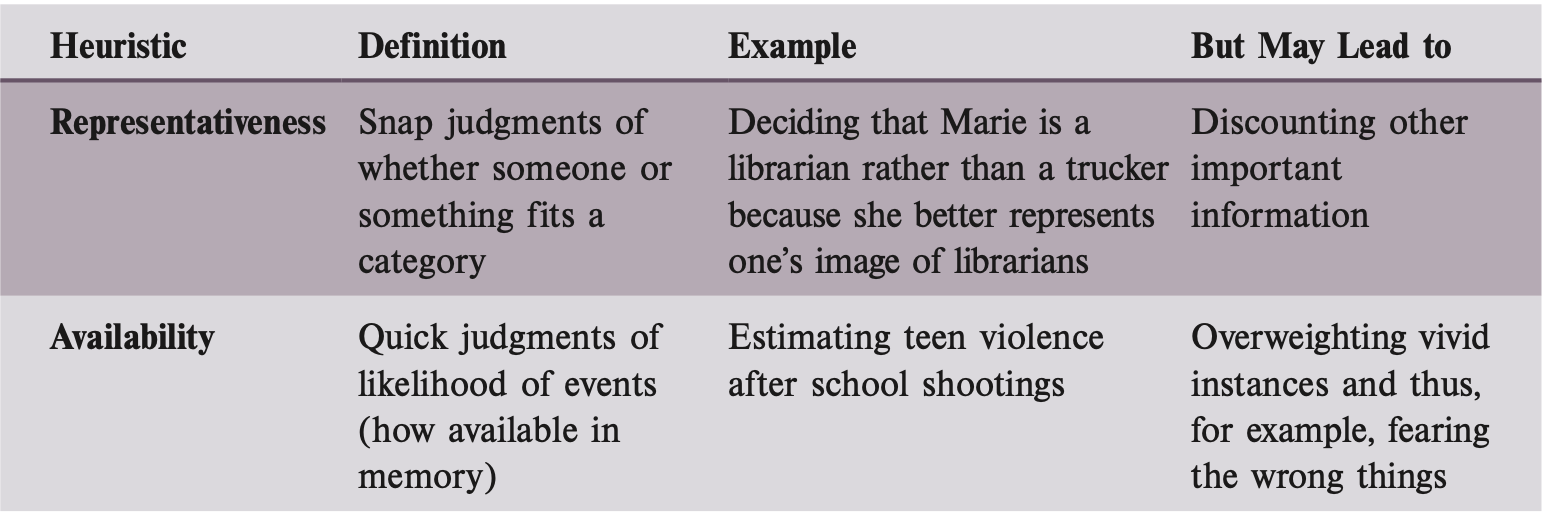
Representativeness heuristic
The tendency to presume, sometimes despite contrary odds, that someone or something belongs to a particular group if resembling (representing) a typical member.
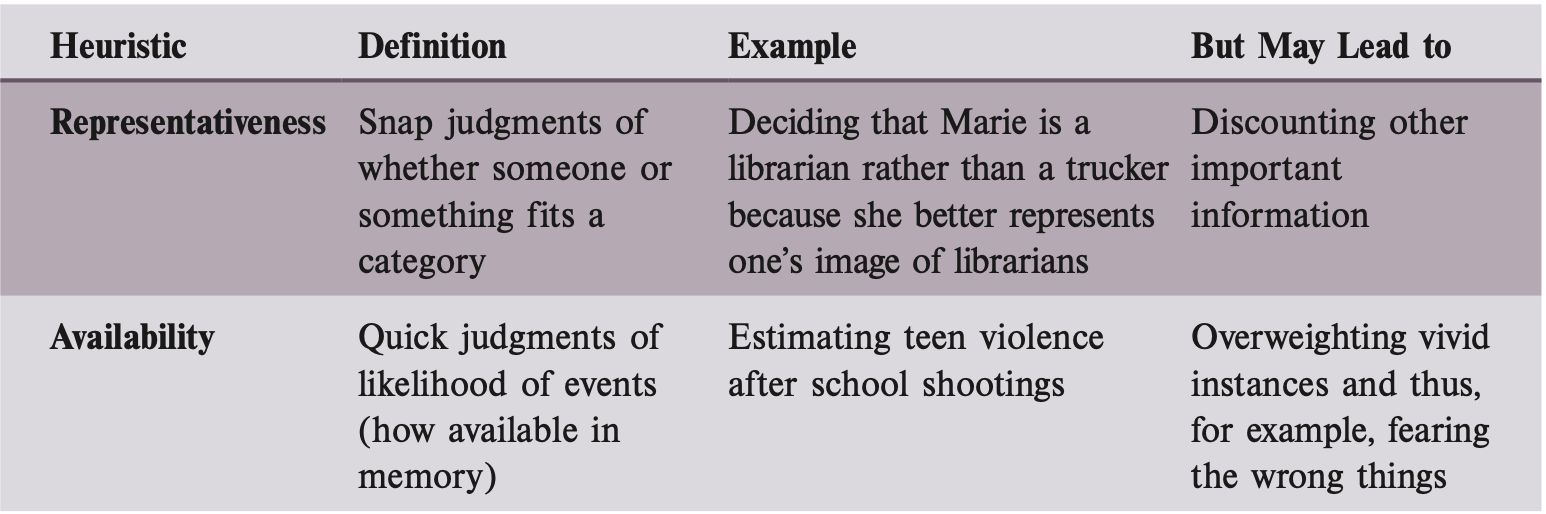
Availability heuristic
A cognitive rule that judges the likelihood of things in terms of their availability in memory. If instances of something come readily to mind, we presume it to be commonplace. (Fear of flying: After seeing news about a plane crash, people think flying is very dangerous—even though car accidents are far more common.)
counterfactual thinking
Imagining alternative scenarios and outcomes that might have happened, but didn’t.
Illusory correlation
Perception of a relationship where none exists, or perception of a stronger relationship than actually exists
Regression toward the average
The statistical tendency for extreme scores or extreme
behaviour to return toward their average (ex: a student who get’s a high mark on the first test is more likely to get a worse score on the following test than someone who received a bad score from the start)
Belief perseverance
Persistence of one’s initial conceptions, such as when the basis for one’s belief is discredited but an explanation of why the belief might be true survives.
Misinformation effect
Incorporating “misinformation” into one’s memory of the event after witnessing an event and receiving misleading information about it.
 Note
Note  Flashcards (87)