Cnidaria/Ctenophores
 Call Kai
 Learn
Learn Practice Test
 Spaced Repetition
 Match
Match Flashcards
 Knowt Play
1/33

There's no tags or description
Looks like no tags are added yet.
Name | Mastery | Learn | Test | Matching | Spaced | Call with Kai |
|---|
No analytics yet
Send a link to your students to track their progress
34 Terms
Organization
Tissue level, multicellular
Embryonic Development
Ectoderm → Epidermis
Endoderm → Gastradermis
(Diploblastic)
Symmetry
Radial
Skeleton
Hydrostatic Skeleton
Movement
Polyp (Mouth up): Sessile
Medusa (Mouth down): Motile
Sensory/Nervous
Nerve net, connecting ocelli
Digestion/Feeding
GVC
Cnidocytes to capture prey
Intracellular and Extracellular digestion
Excretory
Diffusion
Circulation
Diffusion
Respiration
Diffusion
Reproduction
Asexual
Sexual
Monoeicious or Dioecious
Classes of Cnidaria
Hydrozoa
Scyphozoa
Cubozoa
Anthozoa
Digestion/Feeding (Ctenophores)
Complete gut/colloblasts
Reproduction (Ctenophores)n
Sexual and Monoecious
Cnidocyte
Penetrate and may inject toxins
Stinger called nematocyst
Hydrozoa
Dominant Polyp Stage
Little mesoglea
Both sexual (Medusae) and Asexual (Polyps) reproduction
Hydra
Class Hydrozoa
Exists as an individual polyp
Mobile
Freshwater
Can reproduce asexually or sexually within the same individual
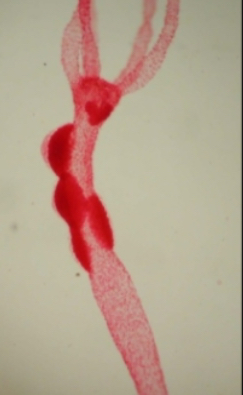
What organism is this?
Hydra
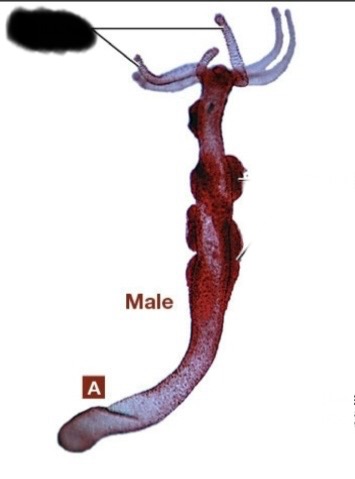
What class is this? What type of reproduction is this? What part is this?
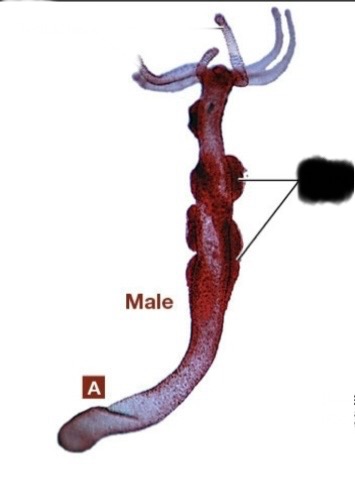
What class is this? What type of reproduction is this? What part is this?
Class: Hydrozoa
Sexual Reproduction (Male)
Testes
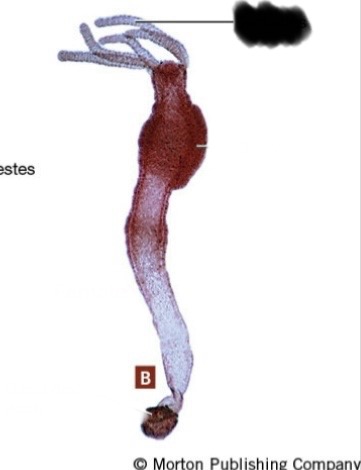
What class is this? What type of reproduction is this? What part is this?
Class: Hydrozoa
Sexual Reproduction (Female)
Tentacles
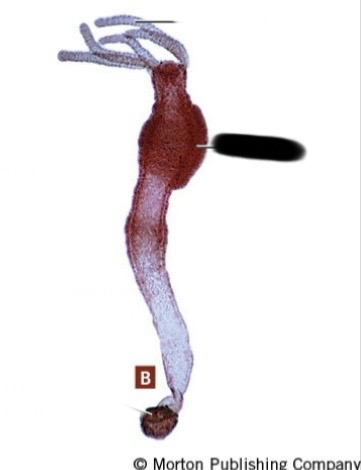
What class is this? What type of reproduction is this? What part is this?
Class: Hydrozoa
Sexual Reproduction (Female)
Ovary
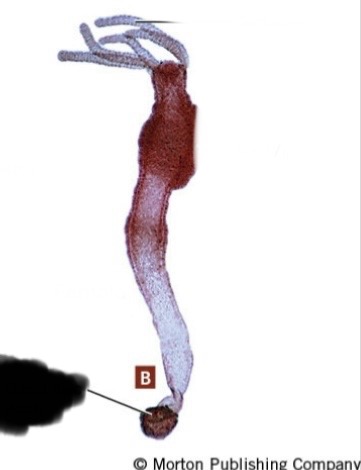
What class is this? What type of reproduction is this? What part is this?
Class: Hydrozoa
Sexual Reproduction (Female)
Basal Disc (Foot)
Obelia
Class Hydrozoa
Polymorphic colony
Have Specialized Polyps
Hydranths (gastrozooids) = feeding polyps
Gonangium (gonozooids) = asexually reproducting polyps
Both polyp and medusa
Medusa = Sexual Reproduction
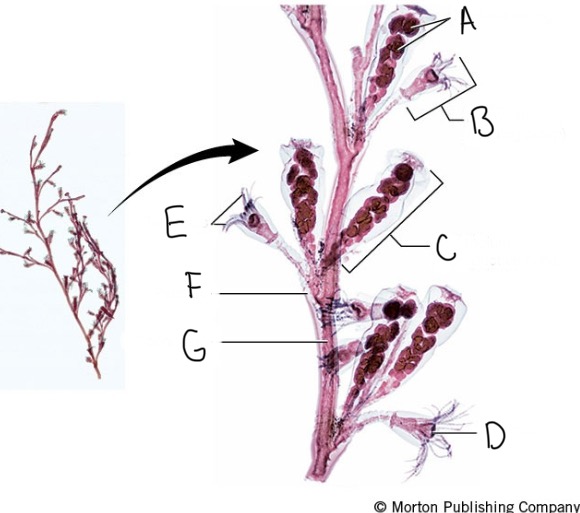
What organism is this? Phyla and class? Name the parts labelled below corresponding to each part.
Obelia
Phylum Cnidaria
Class Hydrozoa
A. Medusa buds
B. Hydranth (gastrozooids) (feeding polyp)
C. Gonangium (gonozooids) (Reproductive polyp)
D. Hypostome
E. Tentacles
F. Perisarc
G. Coenosarc
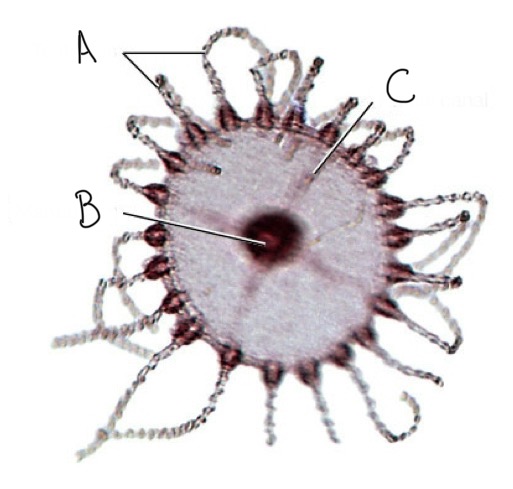
What organism is this? Phyla and class? Name the parts labelled below corresponding to each part.
Obelia (Medusa)
Phylum Cnidaria
Class Hydrozoa
A. Tentacles
B. Manubrium
C. Radial Canal
Fire Corals
Class Hydrozoa
Calcified Skeleton is smooth
Painful sting, polyps inside skeleton
Portuguese man o’ war (Physalia Physalis)
Class Hydrozoa
Polymorphic Colony
Highly specialized polyps
Venom-filled nematocysts that paralyze prey
Class Scyphozoa
True sea jelly
Thick layer of mesoglea
Medusa is dominant, reduced polyp
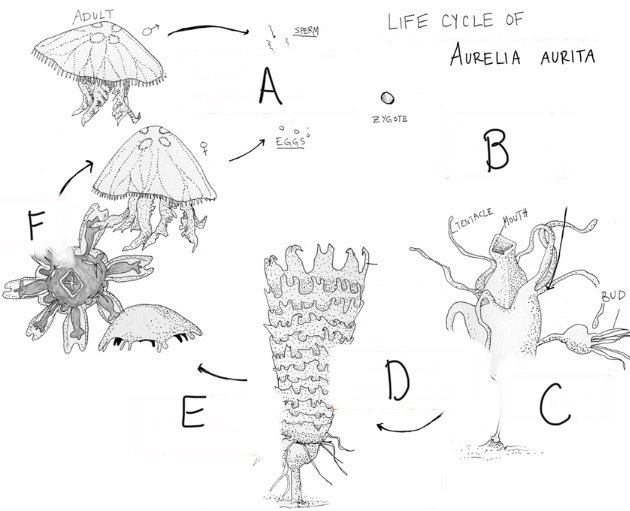
What phylum and class is this organism? Label the steps and types of reproduction.
Phyla Cnidaria
Class Scyphozoa
Organism: Aurelia Aurita
A. Sexual Reproduction
B. Planula Larvae (S)
C. Scyhphistoma (A)
D. Asexual Reproduction
E. Strobila (A)
F. Ephyra (S)
Class Cubozoa
Cube shaped dominant medusa stage
4 even tentacles
Fatal stings
Class Anthozoa
Sessile with only a polyp stage (no medusa stage)
Exists as solitary individuals(anemones) or as true colonies (corals)
Most specialized
All marine
Organisms in class Anthozoa
Sea fan (soft coral)
Sea pansy
Anemone
Hard Coral
Phylum Ctenophora
“Comb Jellies”
Collenchyme (like mesoglea except with muscle cells)
Colloblasts (cells that adhere to prey and bring to mouth)
Lack cnidocytes
HAVE A COMPLETE GUT
MOSTLY MONOECIOUS
SEXUAL REPRODUCTION

