Psych IV
 Call Kai
 Learn
Learn Practice Test
 Spaced Repetition
 Match
Match Flashcards
 Knowt Play
1/144

Earn XP
Description and Tags
Prof. Diehl at Notre Dame
Name | Mastery | Learn | Test | Matching | Spaced | Call with Kai |
|---|
No analytics yet
Send a link to your students to track their progress
145 Terms
Cognitive Psychology
Emerged from behavioralism; mediate the relationship between behavior and environment
Cognition
Mental process of thinking, learning, and understanding
Knowledge
Stored representations
Thinking
Manipulation of stored and experienced representations
Heuristics
Shortcuts used to reduce the amount of thinking that is needed to make decisions
thinking fast
instinctive and emotional
thinking slow
deliberative, logical, rational
Anchoring
Setting a reference point (usually first piece of information) to simplify a situation
Availability Heuristic
Decisions are influenced by how readily examples are recalled
Representativeness Heuristic
Making a judgment by comparing a person/object to a prototype
Conjuctive Fallacy
likelihood of multiple events happening together is more likely than any of those events happening individually
Stimulation Heuristic
people express more regret over outcomes that are easier to imagine, or “simulate”
Confirmation Bias
Tendency to search for information that confirms your expectation (and ignore information that refutes it)
Sunk Cost Fallacy
a person is reluctant to abandon a strategy if they are heavily invested in it (loss aversion)
Affective Forecasting
Predicting how we will feel with any given outcome (we’re horrible at this)
Binet Simon Scale
First IQ test- 1905. Eventually led to shift against intellectual disability and to eugenics.
Army Alpha/Beta Tests
Assessed cognitive abilities of recruits, ability to serve, and appropriate roles (WWI). Basis for famous Wechsler intelligence tests.
• Alpha tests for literate individuals
• Beta tests for illiterate recruits
Three theories of intelligence
One: overall (or general) intelligence - g
Two: Fluid and crystallized intelligence
Multifactor: Many
Fluid Intelligence
Natural abilities – reasoning, problem solving, in unfamiliar situations
Crystallized Intelligence
Knowledge gained from experience used to solve problems
Gardner’s 8 Intelligences
Word smart – Linguistic
Number smart – Logical-Mathematical
Picture smart – Visual-Spatial
Body smart – Bodily-Kinesthetic
Music smart – Musical
People smart – Interpersonal
Self smart – Intrapersonal
Nature smart – Naturalist
Intelligence Quotient (IQ)
Result of intelligence tests. Most intelligence tests will also include subtests that
can be grouped into what are called subscales
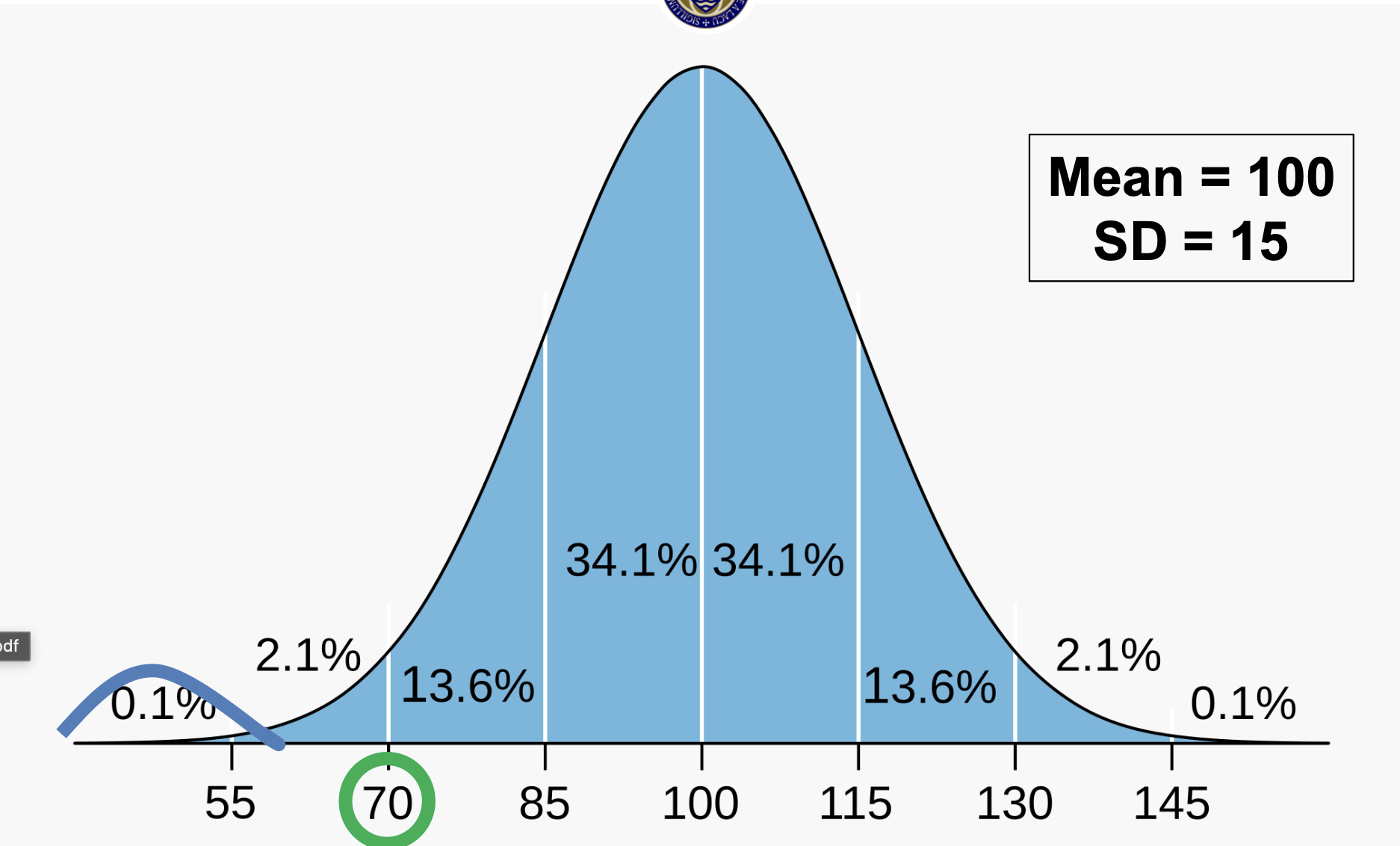
IQ Subscales
Verbal Comprehension, Perceptual Reasoning, Working Memory
strengths and weaknesses
Even if believing in g, it’s most helpful to know the patient’s ____________.
Cultural and Socio-economic status (SES) bias
Intelligence tests reflect the culture of the people who wrote, administer, and take it. Stereotype threat
Aptitude Tests
Purported to be a measure of general cognitive abilities and are predictive. Ex. SAT.
Achievement Tests
Measures of learned cognitive abilities. Ex. ACT.
Profiles of Functioning
critically useful to determine strengths and areas in need of support
Communication
The use of a language, gestures, facial expressions (and a lot of other stuff) to exchange information
Language
A system for exchanging information
Speech
The act of vocal communication
Bottom-up processing
Takes sound bits and turns them into words, and then phrases
Top-Down Processing
Takes previous knowledge of concepts and applies them to sound combinations
Communication Pathway
Sound travels in the ear, and the ear translates it into signals. Brain filters human speech from noise. The brain thinks about the information, and formulates a response. Massive coordination of face, hands, body posture, lungs, lips, tongue, jaw, throat, to give a response. Sound then travels to the other person’s ear
Language in Brain
A major debate is whether language is modular in the brain, or is distributed throughout. Research suggests systems/networks in the brain rather than areas (Chomsky/Pinter thought modular)
Phoneme
Smallest component of a language: in essence, a sound (b, k, t, o, th). Rarely carry meaning in isolation. We lose perception of some as we develop language.
Language Development
Vocal Exploration (9-12 Months)
Babbling (with Prosody) (1-1.5 Years)
Short Phrases; Articulation Improving (1.5-2 Years)
Full Conversations (2-3 Years)
Morphemes
Smallest meaningful unit of language. Typically root word and its affixes.
Overgeneralization
Kids learn rules and exceptions to the rule in steps
1. Kids pair a word with a meaning before learning the rule (broke means break in the past)
2. Then kids learn a rule (-ed means past tense, breaked, and overgeneralize rule to every circumstance)
3. Then kids learn the exception to the rule, and there are a lot in English (broke is an exception to the –ed rule)
Lexicon
Vocabulary; This is directly related to concepts. The total lexicon of a language is
always changing
Syntax
The structure of language. Chomsky argued for a universal (rules that
are present in all languages)
Semantics
The meaning of language. Operates at multiple levels (Lexical and Syntactic)
Prosody
Patterns of stress and intonation in a language. Can change the meaning of words. Can also add additional information to a word. Can structure a conversation.
Types of Gestures
Beats
Iconic gestures – gesture resembles object
Emblems – gesture represents a word
Metaphoric gestures – abstract ideas/concepts
Behaviorists
Language Acquisition Theory: Language is completely learned, taught (Skinner)
Nativists
Language Acquisition Theory: The ability to understand and communicate through language is innate. Language “module” or “organ” in the brain (Chomsky, Pinter)
Interactionists
Nature and nurture (Bruner)
Emotion
A temporary state that includes unique physiological activity, cognitive states, and subjective experiences. Leads to behavior. Are universal, communicative, and triggered by internal/external events
Purpose of Emotions
Adaptive, Cognitive, Relational/Communicative
Emotion vs Moods
Immediate vs Diffuse
Subjective vs General
Evaluative (valenced) vs Subtle
Temporary reactions to environmental events vs Long-Lasting
Components of Emotions
Physiological – biological response
Cognitive – Evaluative
Phenomenological - Subjective experience of emotion, or feeling
Behavioral – What your body expresses
Appraisal
Conscious or unconscious evaluations and interpretations of a stimulus
Limbic System
Slow vs Fast Path processing
James-Lange Theory
Emotion as a consequence - Stimuli activate ANS which produces emotion
Stimulus → Physiological → Phenomenological
Cannon-Bard theory
Simultaneous, independent pathways. Stimulus triggers both physiological (arousal) and
phenomenological (emotion) experience at the same time
Physiological ← Stimulus → Phenomenological
Schachter & Singer
Two-factor theory of emotion. Arousal triggers emotion BUT, physical sensations are so similar that some type of cognition is needed
Stimulus → arousal → cognitive interpretation → phenomenological experience
Duchenne Smile
A genuine, involuntary smile that signals true enjoyment by engaging both the mouth and eyes
Social Psychology
The study of how other peoples thoughts, emotion, and behavior are influenced by other people or social norms
Social Influence
How others affect our thoughts, opinions, and behavior (Obedience to authority, Conformity, Persuasion)
On a small scale, we are always unconsciously mimicking each other (Social Contagion)
Obedience to Authority
Milgram - “Effects of punishment on learning” (Experiment: You are the “teacher,” confederate is the “learner”. Teach by giving electric shocks. Start at 15 volts, or “slight shock.” Increase with incorrect answers). On an independent survey, most indicated that they would stop at the sight of pain (120 volts) → In the real study, 63% of all participants went all the way to 450 volts (men or women)
Decreased Obedience
Lower status of study administrator or affiliated university, Close proximity to “learner”, how close the participant was to “learner”, The presence of others who resist
Unimportant for Obedience
Personal characteristics of the learner, Reactions of the learner, Gender
Groupthink
The tendency of a group to make a bad decision as a result of preserving the
group and maintaining its cohesiveness (pg. 449)
Asch Study
3 lines presented in comparison to a reference line. Study has many confederates providing wrong answers, which changes correct response rate (74% of participants gave an incorrect response at least once).
Strengthening of Conformity
Feelings of insecurity, Larger group, degree of agreement in group, proximity to those in the group (are they watching you), Culture, Status of group members, similarity to those in a group.
Why Conform?
Benefits of social acceptance
Group behavior can be helpful when you don’t know what to do
Deindividuation
Become less aware of individual values/attitudes as part of a group
Diffusion of responsibility
Diminished responsibility when others around you are acting the same way
Bystander Intervention
Likelihood of person helping decreases with many factors, including: Size of the group, Ambiguity of situation, and Diffusion of responsibility. Case of Kitty Genovese
Social Identity Theory
People derive part of their self-esteem and identity from the groups they belong to (in-groups) Prefer your group over another group (Even when you are randomly assigned to a group. Given labels “Group X” and “Group Y”)
Motivation
Activates (energizes), directs (guides), and sustains (helps persist) behavior.
Needs
Internal physiological or psychological driving force that motivates people to act
Drives
Internal tension that arises from an unmet need
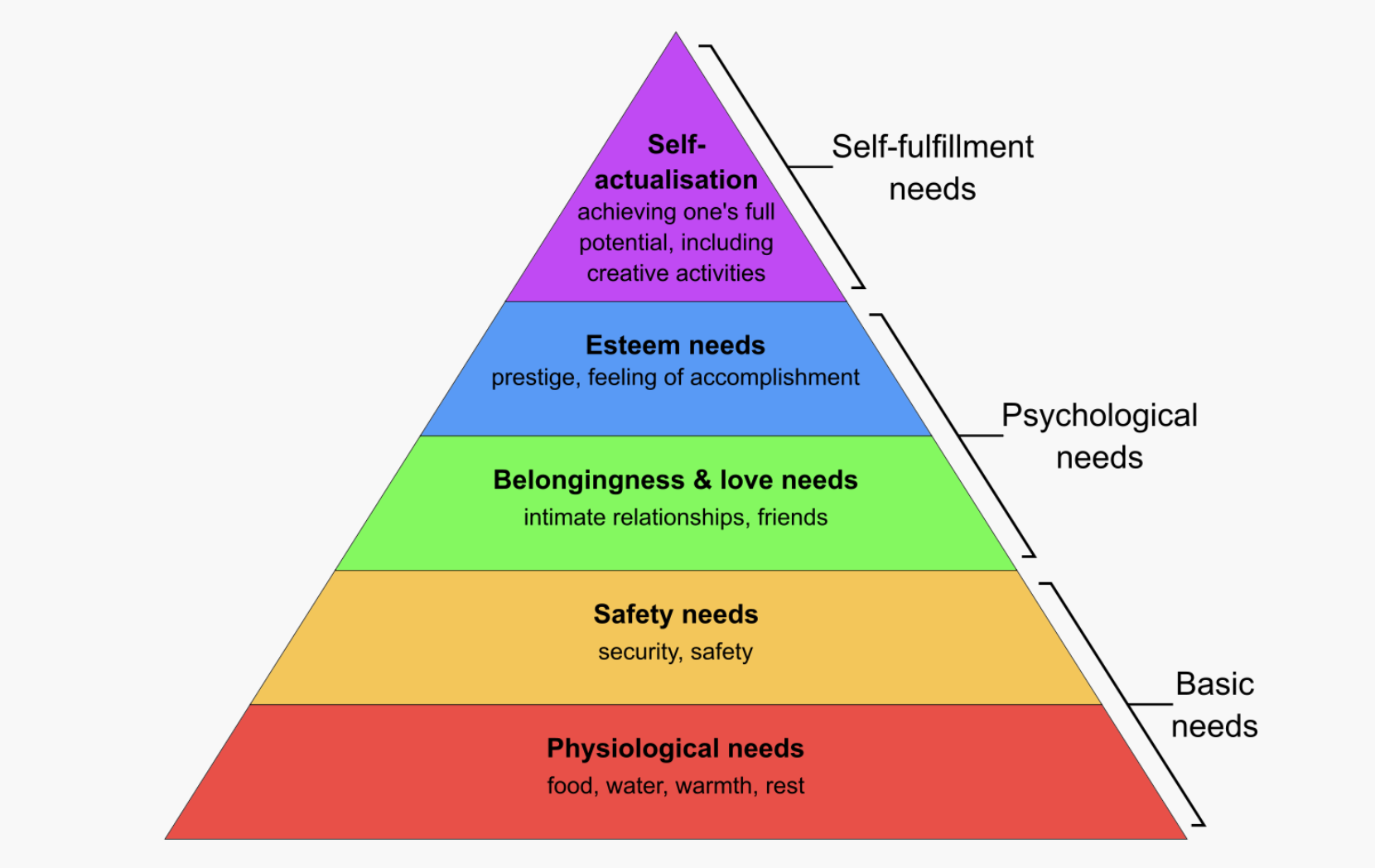
Maslow’s Hierarchy of Needs
Ranges from biological needs up to self actualization
Extrinsic Motivation
Motivated to act by the presence of reward/punishment. Rewards and
punishments can be used to shape, or control, behavior
Intrinsic Motivation
You are motivated to act because the action itself is rewarding
Self-Determination Theory
(theory of intrinsic motivation) posits that the introduction of extrinsic motivation undermines intrinsic motivation
Deci Study
1971 - Two groups had three sessions to complete puzzles. First, they simply built a puzzle with no rewards. Second time, one group offered money as an incentive while the other was control. Third was identical to the first. For the incentivized group, they were faster the second time, but slower the third, and lost the intrinsic motivation.
Self-Determination
Decisions based on choice and free will, without external influence
Needs from Self Determination Theory
Autonomy (Need to actively determine one’s own behavior), Relatedness (Need to care for and relate to others), and Competence (Need to control outcomes, predict environment)
Autonomy
Feeling that you are acting on your own volition
Facilitated by ability to make choices, Involvement in the task
Undermined by Peer pressure, Punishment, Surveillance, and Deadlines
Relatedness
Feeling cared for, feeling connected to, sense of belonging with others
Facilitated by unconditional empathy, warmth, secure attachments to others
Undermined by Cold interactions, Controlling Relationships Competence
Competence
Sense of effectiveness and competence in one’s context
Facilitated by Optimal challenge, Informational rewards, Positive Feedback
Undermined by Non-optimal challenge, Negative feedback
Informational feedback
If you are genuinely interested in learning, getting information is rewarding
Positive feedback
Promotes competence; If you do something, sometimes you don’t know if your
successful without some feedback
Undermine Intrinsic Motivation
Controlling or contingent rewards (“If you do X, then you will get Y.”)
Punishments, negative feedback (Punishments undermine all aspects of intrinsic motivation)
Behavioralists and Motivation
there is no such thing as intrinsic motivation, it’s all better explained through external motivators
Is there intrinsic motivation?
Theories of intrinsic motivation acknowledge that extrinsic motivation exists, but intrinsic motivation is better and is undermined by extrinsic rewards
Social Cognition
How we, as individuals, process social information. Origin of our social behaviors. Thinking fast and thinking slow (about ourselves, others)
The Self
The person, including mental processes, body, personality characteristics, and mental representation of experiences. Stable, continuous over time
Self-schema
Integrated set of memories, beliefs, and generalizations about the self that form your self-concept
Self-Concept
your experiences in relationships, and it develops expectations for:
-Your view of the world
-How you think you should be treated
Working Self-Concept
Changes based on the context; evolves and becomes more complex overtime.
Fundamental attribution error
Tendency to make situational attributions about yourself, but dispositional attributions about others
Attitudes
Feelings that predispose our reactions to a situation. Good predictors of behavior (most of the time). Biases and Stereotypes are examples.
Stereotypes
Characteristics attributed to people because they are members of a group. Attitude that is often overgeneralized, inaccurate, and inflexible. Save cognitive “energy” by simplifying a situation
Prejudice
“Prejudgment” or negative evaluation of a person based on existing stereotypes of (attitudes toward) a group of people
Discrimination
Differential treatment of people based on their group membership
Examples of Prejudice
Explicit prejudice: Conscious, planned evaluations, actions
Subtle prejudice: Evaluations of people based on things that are thought to be
related to a group, inferred but not explicit
Implicit prejudice: Automatic associations that are made without conscious
thought
Cognitive Dissonance Theory
When our actions and attitudes/beliefs don’t jive, we feel “tension”. Festinger: we change our attitudes/beliefs to match our actions, or to relieve the “tension”

