Problem identification and respiratory management
 Call Kai
 Learn
Learn Practice Test
 Spaced Repetition
 Match
Match Flashcards
 Knowt Play
1/3

There's no tags or description
Looks like no tags are added yet.
Name | Mastery | Learn | Test | Matching | Spaced | Call with Kai |
|---|
No analytics yet
Send a link to your students to track their progress
4 Terms
Dyspnoea
SOB
results from: psychological, physiological, social and environmental factors
Weakness/fatigue of respiratory muscles:
increased ventilatory requirements
low CO
gas asbnormalities
cardiovascular/ respiratory deconditioning
measures of breathlessness = VAS or modified borg scale
OBJ Ax
rate, depth, I:E ratio
altered breathing pattern
symmetry of thorax
exercise testing
Effects and causes of those effects of Dyspnoea
Resp muscle weakness/fatigue
brainstem lesions
neuromusc disorders
malnutrition
↑ WOB
↑ ventilatory demand
hypoxia
↑ metabolic demand (fever, exercise)
Low CO / ischaemia
↓ O₂ delivery to muscles
reflex → ↑ ventilation
Blood gas abnormalities
anaemia
COHb (carbon monoxide)
CO poisoning
CVS / resp deconditioning
dyspnoea esp. on exertion
↑ pulm capillary permeability
pulmonary oedema
Perfusion limitation
V/Q mismatch or shunt
pulm. embolus
pulm infarction
cyanotic heart-disease
Psychosocial
anxiety / depression
↑ perception of dyspnoea
Psychogenic
hyperventilation disorders
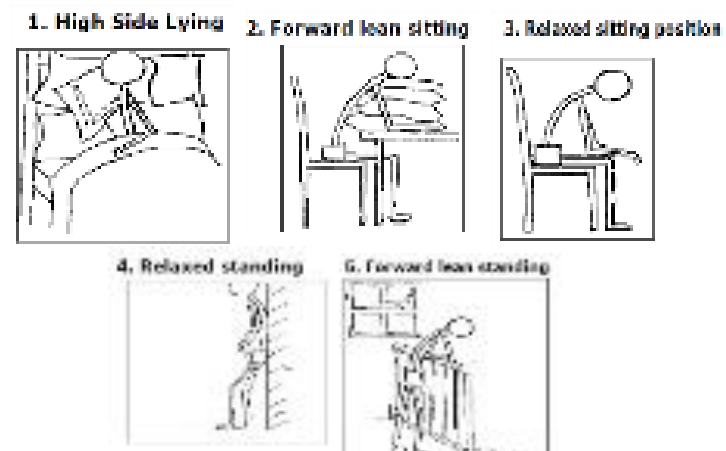
Breathless positions
positions that:
Optimise diaphragm length–tension → ↑ contraction → ↓ WOB
Promote relaxation of upper chest & accessory muscles
Avoid:
Gripping with hands → ↑ shoulder elevation → ↑ accessory muscle use → worsens breathing
breathless positions:
high side lying (lying in bed, on side w/ elbow pushing you up)
forward lean sitting (leaning on stack of pillows)
relaxed sitting position (elbows on knees)
relaxed standing (back on wall)
forward lean standing (hands on rail)
Breathing control
normal tide breathing
relaxation of upper chest + shoulders using lower chest
patient in well-supported + comfortable position (sitting/high side lying)
insp. = active, exp. = passive
pt. encouraged to relax upper chest, use lower chest
paced breathing
can be used with activities
if severely breathless, may use walking frame
can control paroxymal coughing (sudden, violent, uncontrollable coughing fit → ↓ breathing → gag/vomit/exhaustion)

