BS1040 TOPIC 8: INTRODUCTION TO VIROLOGY (LECTURE 1)
 Call Kai
 Learn
Learn Practice Test
 Spaced Repetition
 Match
Match Flashcards
 Knowt Play
1/30

There's no tags or description
Looks like no tags are added yet.
Name | Mastery | Learn | Test | Matching | Spaced | Call with Kai |
|---|
No analytics yet
Send a link to your students to track their progress
31 Terms
what is a virus
it is an obligate (must be) intracellular (inside a cell) parsite and so has to reproduce inside cells
"a chemical outside the cell, a living entity inside the cell"
what do viruses look like?
-rod shaped or spherical
-typically 20-40nM so theyre sub-microscopic
-they assemble from pre-formed componenets (think about tryingf to build an ikea wardrobe, the parts are the pre-formed componenets)
-virus paritcles dont grow or divide because they -lack geentic information and appartus for the generation of metabolic energy/ protein synthesis
what are the common viral components?
-protein shell (packaging which keeps everything inside)
-nucleic acids (type of nucleic acid is specific to the species of virus)
-sometimes lipids (envelope)
how many viruses are there?
About 4000 species of viruses have been classified but scientists believe there may be millions...
how do we classify viruses?
classification: hierarchical
it is based on the viral genomes sequence. families have suffix viridae. genus have suffix virus. species is important definition
order, family, genus, strain/type, RNA virus quasi species
explain viral replication
-attachement and penetration and uncoating
-replication of viral genome
-protein synthesis
-assembly and exit
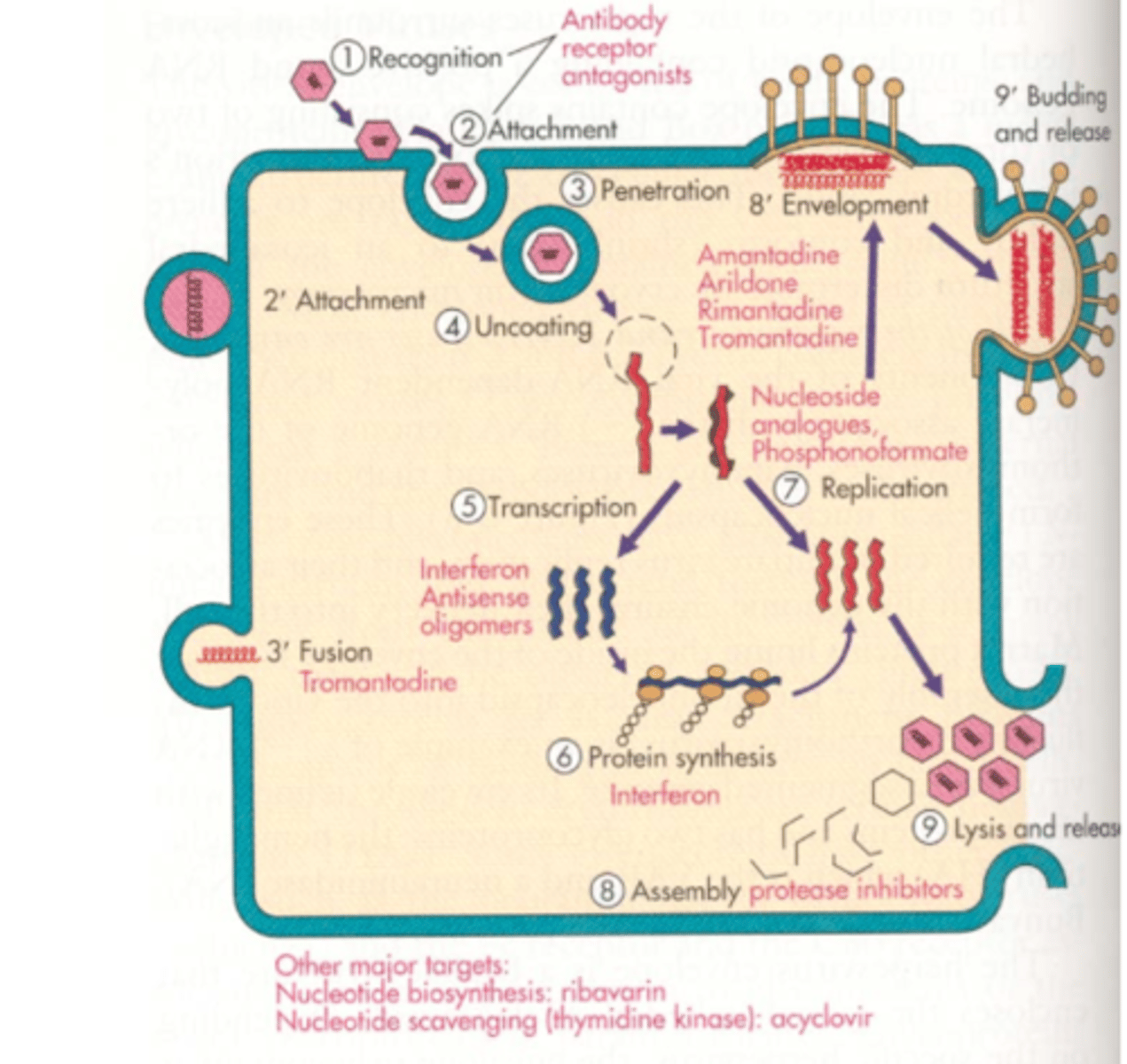
explain what nfection may be?
- productive: entry into permissive cells followed by virion formation
- abortive: entry into a non permissive cell which doesnt support virion formation and could be due to a variety of factors
- restrignent or restrictive: cell is transiently permissive and a few virus are produced
multiplicty of infection (MOI)
-key concept in virology
-number of virus particles divided by number of bacterial cells
-for a MOI of 1, then if you have 10^7 colony forming units
-however if particle to infectivity ratio is low, sya 1 in 100, you need 10^9 pfu for an effective MOI of 1
what is the eclipse phase?
Period from virus entry until new infectious virions released. low amounts of parental infectious material present. genome replication has been initiated
whats the maturation phase?
viral material accumulates in cell or surrounding medium
cells infected wit lytic viruses become metabolically disordered and die, viral production ceases. titres slowly drop
cells infected with non lytic viruses can continue to produce viral particles indefinelty
What is the reproductive cycle duration for many bacteriophage?
Less than an hour
How long is the reproductive cycle for picornaviridae?
6-8 hours
What is the reproductive cycle duration for herpesviridae?
More than 40 hours
How many copies of virus can cells infected with polio virus release?
More than 100,000 copies per infected cell
How many copies of virus can phage lambda and E. coli release?
~50 copies
What is the function of the virion attachment protein?
It binds to a cell surface receptor
What is the anti-receptor of the influenza virus?
Haemagglutinin (e.g. H5N1)
What is the anti-receptor of HIV?
gp120 envelope glycoprotein
What largely determines the tropism of most viruses?
The expression (or absence) of receptors on the surface of cells
Attachment
Energy independent.
Uptake
Endocytosis of the entire particle resulting in accumulation of virus particles inside a cytoplasmic vesicle, an endosome, e.g. influenza.
Fusion
Fusion of the cellular membrane with the virion envelope and direct release of the capsid into the cytoplasm e.g. HIV.
Uncoating
General term applied to events after penetration that allows the virus to express its genome.
Gene Expression
Dependent on the genome of the virus - will focus on in the next session.
Assembly of Filamentous Virus
Filamentous virus assembly e.g. Tobacco Mosaic Virus.
Icosahedral Assembly
Twelve pentamers form the particle e.g. polio.
What happens when some viruses cause cell lysis?
They lead to the destruction of the host cell.
How do some viruses acquire an envelope?
They bud through a cell membrane, such as the plasma membrane.
Which virus buds into the Golgi and retains its envelope?
Pox virus.
How do herpes viruses acquire their envelope?
They bud through the inner and outer nuclear membrane and then into the Golgi.
What type of envelope do herpes viruses retain after budding?
Golgi envelope.

