brainstem + somatosensory system
 Call Kai
 Learn
Learn Practice Test
 Spaced Repetition
 Match
Match Flashcards
 Knowt Play
1/75

There's no tags or description
Looks like no tags are added yet.
Name | Mastery | Learn | Test | Matching | Spaced | Call with Kai |
|---|
No analytics yet
Send a link to your students to track their progress
76 Terms
what does the brainstem connect
cerebrum - cerebellum - spinal cord
the brainstem contains what major components
cranial nerve nuclei + tracts + reticular formation
what is the reticular formation
complex network of nuclei throughout brainstem
what does the sulcus limitans separate
motor nuclei (medial) vs sensory nuclei (lateral)
are motor nuclei medial or lateral to sulcus limitans
medial to the sulcus limitans.
as the medial lemniscus ascends, does it move medial or lateral
moves more lateral
where is the spinothalamic tract located in the brainstem
lateral edge of reticular formation
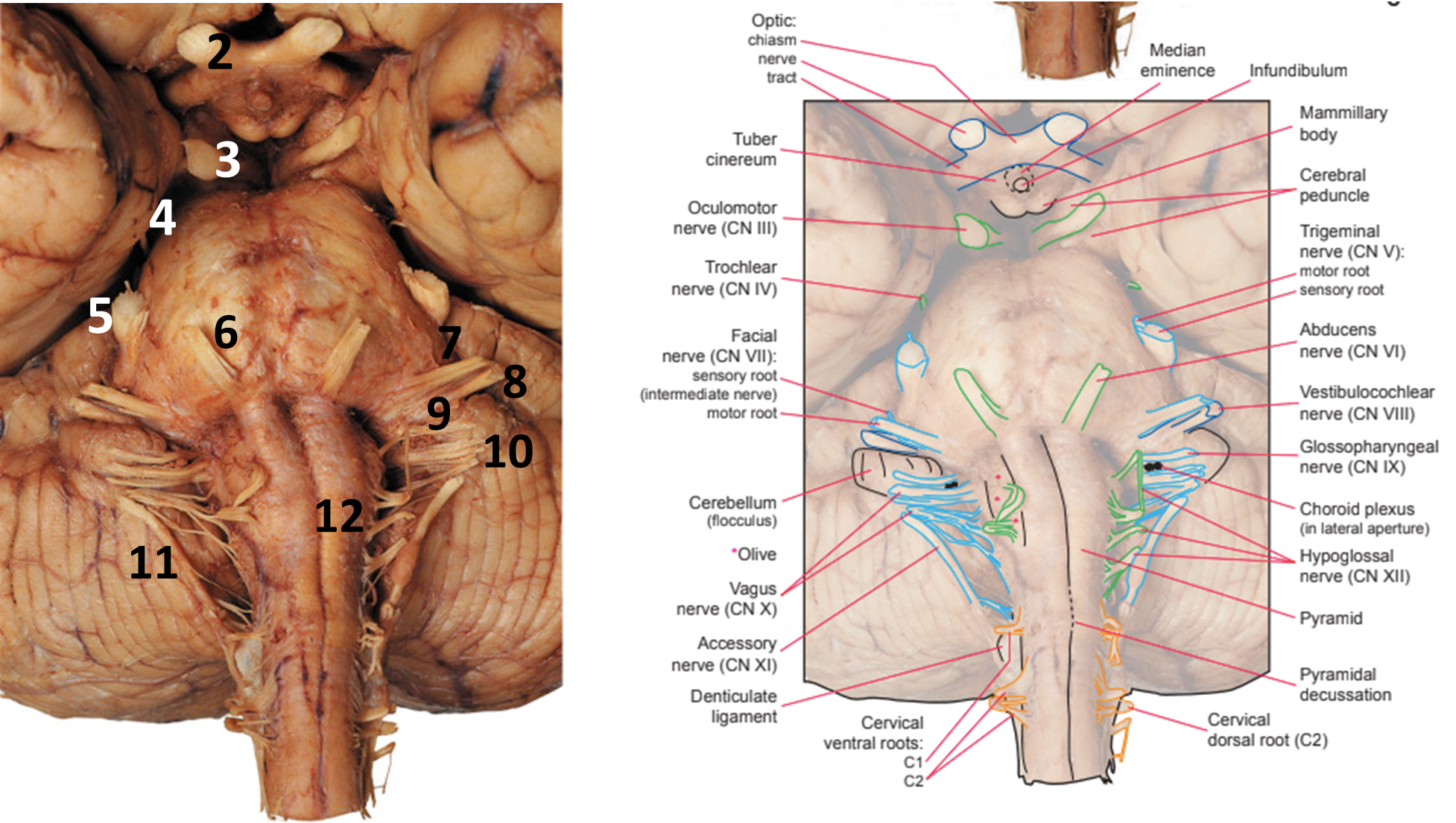
CN III, IV, and VI function together to do what
control eye movements
CN III innervates which muscles
all eye muscles EXCEPT superior oblique and lateral rectus
CN IV innervates what muscle
superior oblique
which cranial nerve is crossed
CN IV
CN VI innervates what
lateral rectus
what muscle opens the eyelid and what nerve controls it
levator palpebrae - CN III
what muscle closes the eyelid and what nerve controls it
orbicularis oculi - CN VII
CN XI innervates which muscles
sternocleidomastoid + trapezius
damage to CN XI causes inability to
rotate head (opposite side) + shrug shoulder
know
brainstem blood supply comes from what system
vertebrobasilar system
paramedian arteries supply which region
medial brainstem
circumferential arteries supply which region
lateral brainstem
what is the main function of the thalamus
relay sensory and motor signals to cortex
thalamus is composed mostly of what
gray matter
what structure connects the two thalami
interthalamic adhesion
dorsal horn function
sensory input
ventral horn function
motor output
dorsal columns carry what?
ascending sensory info (touch, proprioception)
afferent fibers carry information in which direction?
periphery → CNS
What type of neurons are in DRGs
pseudounipolar
where do afferent axons begin and end
begin in periphery → end in CNS
somatosensory system includes which 3 subsystems
touch, proprioception, pain
what is sensory transduction
stimulus → electric signal
what type of potential is first generate for sensory transduction
receptor (generator) potential
When are action potentials generated?
When threshold is reached
AP firing rate is proportional to what?
Stimulus intensity
What do mechanosensitive channels respond to?
mechanical distortion
piezo channels detect what?
membrane tensionw
what is a receptive field
are where stimulus changes firing rate
small receptive fields → what?
high spatial accuracy
where is somatic acuity highest
fingertips
slowly adapting afferents detects what
static features (size, shape)
rapidly adapting afferents detect what
changes (movement, vibration)
merkel cells are what type of adaptation
slowly adapting
merkel cells detect what
shape, texture, edges
merkel cells have what type of receptive field
small (high resolution)
Meissner afferents are what type?
rapidly adapting mechanoreceptors
Meissner detects what
Low-frequency vibration + grip
Meissner receptive field size:
Larger than Merkel
pacinian afferents detect what
High-frequency vibration and pressure
pacinian receptors are located where
deep in dermis
pacinian adaptation
rapidly adapting
why do pacinian respond only to rapid stimuli
lamellar capsule filters slow pressure
ruffini afferents detect what
skin stretch
ruffini adaption
slowly adapting
ruffini function relates to
finger / limb position
which receptor is MOST important for reading BRAILLE
merkel cells
why not pacinian for braille
detect vibration, not detail
proprioceptors detect what
body position and movement
Main proprioceptors:
muscle spindles and Golgi tendon organs
Muscle spindles detect what?
Muscle length
Group Ia fibers detect what?
dynamic movement
group II fibers detect what
static position
Golgi Tendon Organs (GTO) detect what
muscle tension and force.
GTOS are arranged how
in series with muscle
Proprioception from lower body synapses where first?
clarke’s nucleus
Pathway: Clarke’s nucleus → ___
Dorsal spinocerebellar tract
Final pathway to cortex:
Medial lemniscus → VPL → cortex
Which nerve carries somatosensory info from face?
trigeminal nerve (CN V)
pain / temp from face goes to
spinal trigeminal nucleus
touch from face goes to
principal nucleus
principal nucleus
VPM → cortex
What is somatotopy?
body mapped onto cortex
which areas process touch
3b and 1
Area 3a processes:
Proprioception
Area 2 processes:
Touch + proprioception
What happens after cortical injury?
Functional remapping
Example of plasticity:
Adjacent regions take over

