AP Economics
 Call Kai
 Learn
Learn Practice Test
 Spaced Repetition
 Match
Match Flashcards
 Knowt Play
1/48

There's no tags or description
Looks like no tags are added yet.
Name | Mastery | Learn | Test | Matching | Spaced | Call with Kai |
|---|
No analytics yet
Send a link to your students to track their progress
49 Terms
Why is money demand curve downward sloping?
opportunity costs of holding money rises as interest rate increases (opportunity of missing out on a higher interest rate)
What is crowding out and how does it impact the economy?
When the governments borrowing (i.e. deficit spending), SHIFTS Demand for loanable funds rightwards
-negative economic impact: interest rates rise, deterring private investment spending on physical capital
1/rr (money multiplier) * ALL reserves/funds =
MS addition (STATING THE BANKING SYSTEM DOESN’T WANT EXCESSIVE RESERVE, not prolonged)
M1
Currency in circulation, checkable bank deposits, traveler’s checks
MOST LIQUID
M2
ALL OF M1 + savings, certificates of deposits, money market funds, and other less liquid money (GIFTCARDS AS WELL)
Economists use _____ as a model to show how savers and borrowers come together to determine the equilibrium rate of interest
market for loanable funds
Bank Reserves
The currency kept in a bank’s vault + deposits with the FED
Interest Rate
The price, calculated as a percentage of an amount borrowed, charged by lenders to borrowers of the use of their savings for one year
Budget balance
The difference between tax revenue and government spending
Budget surplus
the difference between tax revenue and government spending when tax revenue exceeds government spending
Budget deficit
The difference between tax revenue and government spending when government spending exceeds tax revenue
National savings
private savings + budget balance
Investment spending identity =
national savings + capital inflow
Capital inflow =
Total inflow of foreign funds - total outflow of domestic funds to other countries
Financial markets
Households invest their current savings and their accumulated savings, or wealth, by purchasing financial assets
Financial asset
Paper claim that entitles the buyer to future income from the seller
Physical asset
claim on a tangible object that gives the owner the right to dispose of the object as he or she wishes
liability
A requirement to pay money in the future
TASKS OF THE FINANCIAL SYSTEM
1) Reducing transaction costs (expenses of negotiating and executing a deal)
2) Reducing risk
3) Financial risk (uncertainty about future outcomes that involve financial losses and gains)
Money
any asset that can easily be used to purchase goods and services
Medium of exchange
an asset that individuals acquire for the purpose of trading for goods and services rather than for their own goods and services rather than consumption
Store of value
holding purchasing power
EXAMPLE: Metal coins make a better store of value due to their durability, compared to grains and ice cream cones
Unit of account
A measure used to set prices and makes calculations
EXAMPLE: price comparisons among products
Commodity money
good used as a medium of exchange that has intrinsic value in other uses
Commodity-backed money
A medium of exchange with no intrinsic value whose ultimate value is guaranteed by a promise that can be converted into valuable goods
Fiat money
A medium of exchange whose value derives entirely from its official status as a means of payment
Bond prices and interest rates relationship
negative/inverse
Reserve ration
The fraction of bank deposits that a bank holds as reserves
REQUIRED-smallest FED requires bank to hold
Bank run
When many of a bank’s depositors try to withdraw their funds due to fears of a bank failure
FOUR FEATURES of bank regulation
-Deposit insurance (FDIC guarantees up to 250,00 per account if bank can’t meet obligations)
-Capital requirements (Making banks hold more capital means losses incurred when loans go bad accrue against the bank’s assets rather than government insurers)
-Reserve Requirements (Rules set by the FED that determine the require reserve ratio for banks)
-Discount Windows (Allows banks to quickly borrow money from the FED in an emergency)
Monetary base
sum of currency in circulation and bank reserves
Central bank
An institution that oversees and regulates the banking system and controls the monetary base
Commercial bank vs. investment bank
COMMERCIAL- accepts deposits and is covered by deposit insurance
INVESTMENT- trades in financial assets and is not covered by deposit insurance
Four basic function of the FED
1) Provide financial services to depository institutions
2) Regulate banks and other financial institutions
3) Maintain financial system stability
4) Conduct monetary policy
Federal funds rate
-set by supply and demand in the federal funds market
-greatly influenced by FED’s actions
-Banks borrow additional reserves from other banks
INCREASE MONEY SUPPLY (monetary policy)
decrease reserve req. - increase MS in banks, more loans, decreased interest rates, more money to consumers + increased investment spending
decrease discount rate -allows more banks to borrow from the FED, increased MS
buys treasury bills- money supply increase by allotting more money to the banks, decrease interest rates
DECREASE MONEY SUPPLY (monetary policy)
increase reserve req.- banks have less funds/decreased MS, increased interest rates, less money to consumers + decreased investment spending
increase discount rates- prevents banks from borrowing from FED (financial barrier), decreased MS
sells treasury bills- decreased money supply by taking away money from banks, increased interest rates
Discount rate
Banks borrow from the FED
Benefit + cost to holding money
BENEFIT: convenience, liquid → easily converted into goods and services)
OPPORTUNITY COSTS: earns no interests
Money demand (SPECIFICALLY PHYSICAL CASH)
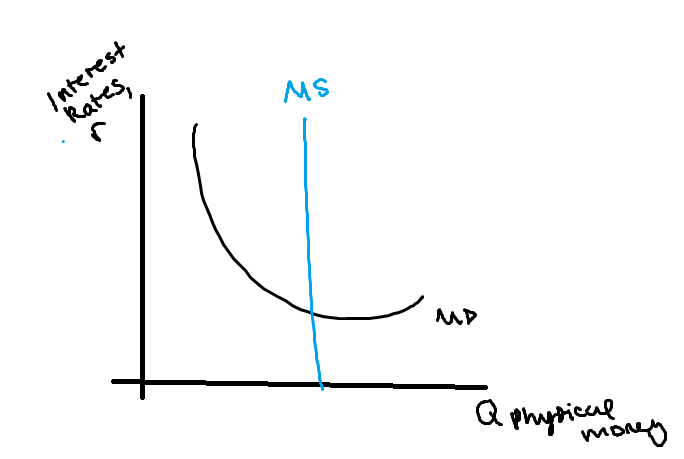
WHAT CHANGES MD? (for physical cash)
1) Changes in aggregate price level
HIGHER PRICES = INCREASED MD
LOWER PRICES = DECREASED MD
2) Changes in real GDP (consumer confidence)
INCREASE IN GDP = INCREASED MD
DECREASE IN GDP = DECREASED MD
3) Changes in banking tech.
MORE ACCESSIBILITY TO PHYSICAL CASH/PAYMENT= DECREASE
LESS ACCESSIBILITY TO PHYSICAL CASH/PAYMENT = INCREASE
4) Changes in banking institutions
AFTER interest checking was legal, MD shifted right
MS is set by
FED… (Specifically for money demand graph)
Reserves graph
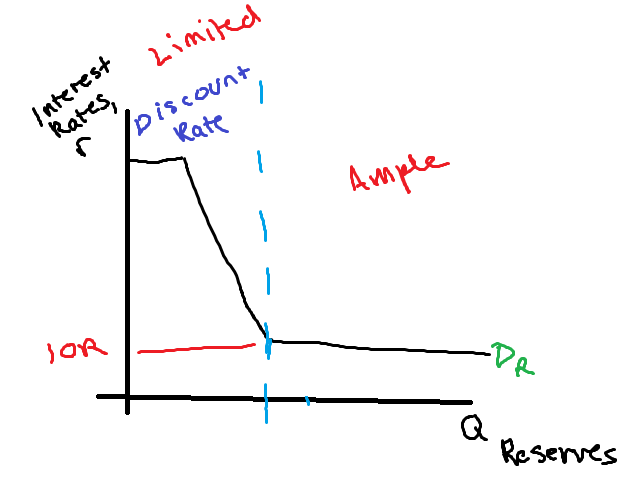
Changing the IOR
Lowering IOR- banks loan out more of their excessive reserves = INCREASED MS
Raising IOR- causes banks to hold more in reserves = DECREASED MS
Loanable funds market
brings together those who want to lend and those who want to borrow money
Rate of return
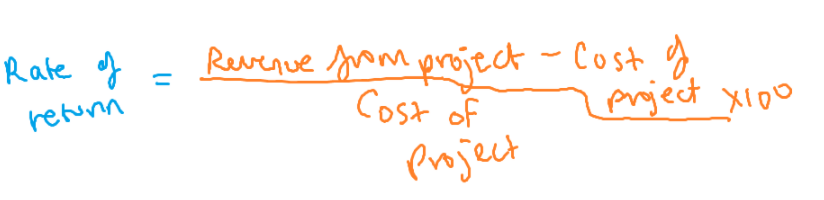
FACTORS THAT CAUSE DEMAND FOR LOANABLE FUNDS TO SHIFT
1) CHANGES IN PERCEIVED BUSINESS OPPORTUNITIES
increase in opportunities = borrow more
lessen in opportunities = borrow less
2) CHANGES IN GOVERNMENT BORROWING
increase in government borrowing = Dlf increase
decrease in government borrowing = Dlf decreases
Factors that cause the supply of loanable funds to shift
1) CHANGES IN PRIVATE SAVING
Household saves more = Slf increases
Households save less = Slf decreases
2)CHANGES IN CAPITAL INFLOWS
funds into country = right
funds out country = left
Fisher effect
An increase in expected inflation drives the nominal interest rate upward by the same percentage, leaving the expected real interest rate unchanged

