L10 - WOP
 Call Kai
 Learn
Learn Practice Test
 Spaced Repetition
 Match
Match Flashcards
 Knowt Play
1/20

There's no tags or description
Looks like no tags are added yet.
Name | Mastery | Learn | Test | Matching | Spaced | Call with Kai |
|---|
No analytics yet
Send a link to your students to track their progress
21 Terms
Authentic Leadership
The view that effective leaders need to be aware of, feel comfortable with, and act consistently with their values, personality, and self-concept.
Know Yourself → Be Yourself
Implicit Leadership Theory & The 2 Components
A theory stating that people evaluate a leader’s effectiveness in terms of how well that person fits preconceived beliefs about the features and behaviours of effective leaders (leadership prototypes) and that people tend to inflate the influence of leaders on organizational events.
Two Components:
Leader Prototypes → The employee’s beliefs about what makes a good leader.
Romance of Leadership → Employees feel better believing that leaders make a difference, so they actively look for evidence that this is so.
Leadership
Influencing, motivating, and enabling others to contribute toward the effectiveness and success of the organizations of which they are members.
Leadership Substitutes Theory
A theory identifying conditions that either limit a leader’s ability to influence subordinates or make a particular leadership style unnecessary.
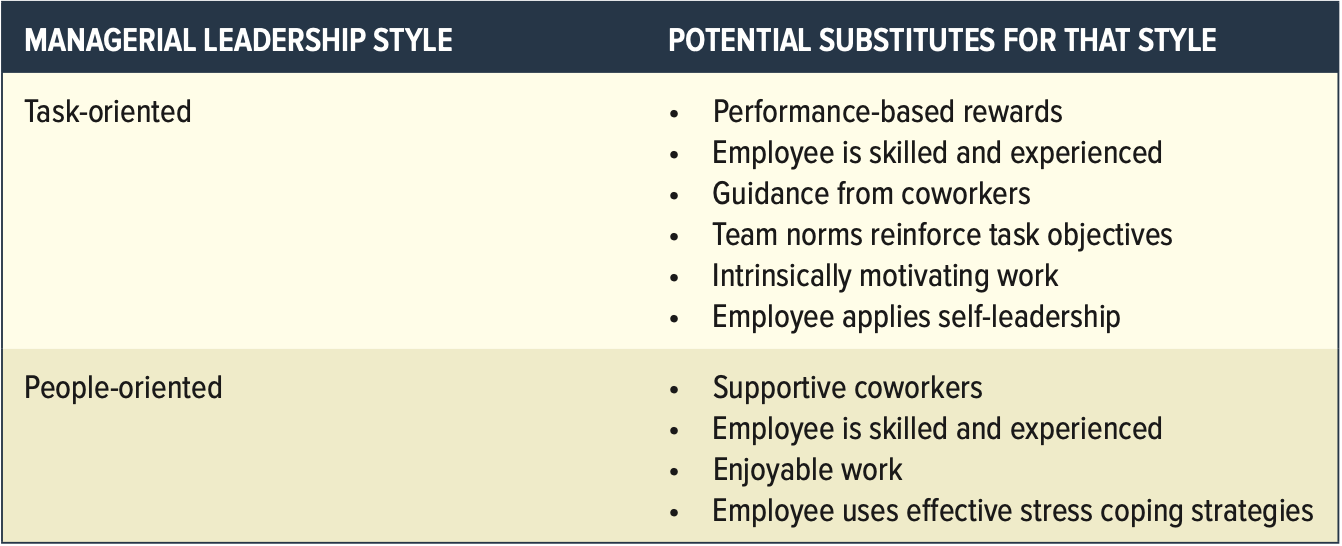
Learning Orientation
A set of beliefs and norms in which people are encouraged to question past practices, learn new ideas, experiment putting ideas into practice, and view mistakes as part of the learning process.
Managerial Leadership (Functional Leadership)
A leadership perspective stating that effective leaders help employees improve their performance and well-being toward current objectives and practices.
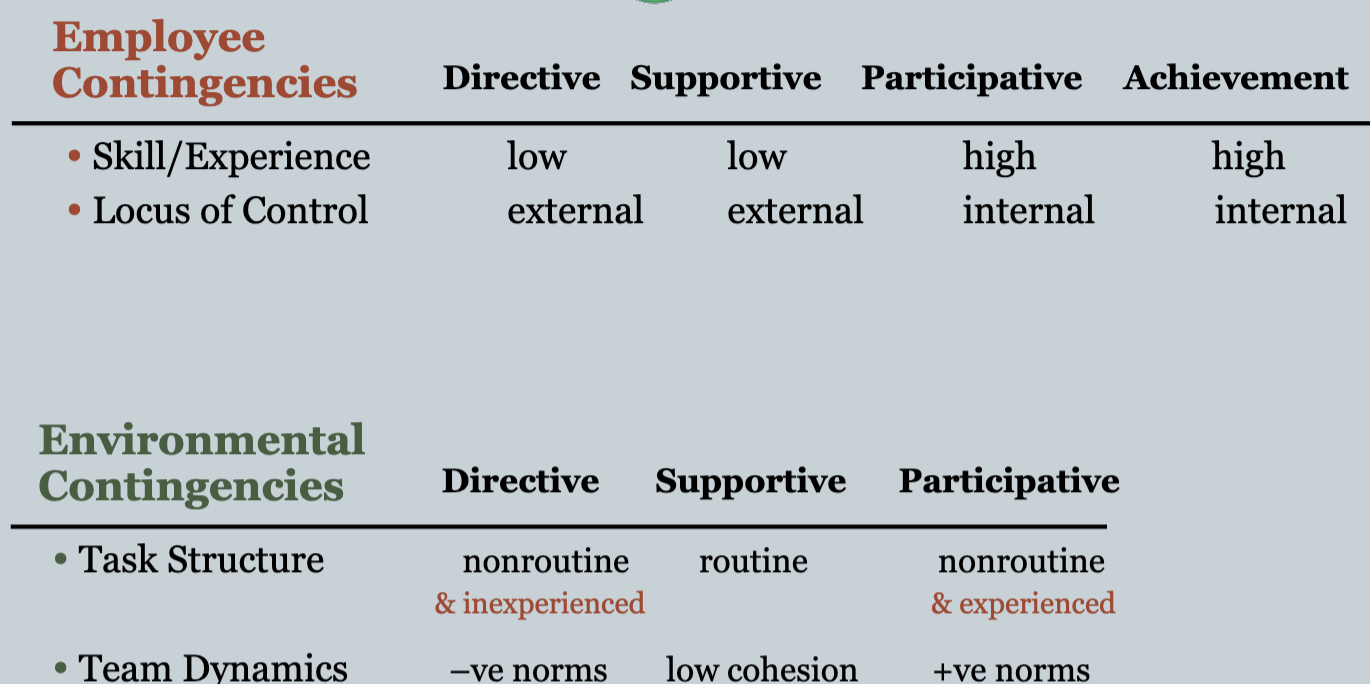
Path-Goal Leadership Theory & The Four Path-Goal Leadership Styles
A leadership theory stating that effective leaders choose the most appropriate leadership style(s), depending on the employee and situation, to influence employee expectations about desired results and their positive outcomes.
Four Leadership Styles
Directive (Task-Oriented)
Supportive (People-Oriented)
Participative (Encourages Employee Involvement)
Achievement-Oriented (Encourages Employee’s Peak Performance)
Servant Leadership
Servant leadership is an extension or variation of people-oriented leadership because it defines leadership as serving others. In particular, servant leaders selflessly assist others in their need fulfilment, personal development, and growth.
Shared Leadership
The view that leadership is a role, not a position assigned to one person.
The idea that leadership is broadly distributed across team members rather than assigned to one person.
Transformational Leadership & The Four Elements
Transformational leadership views leaders as change agents. They move the organization or work unit in a new direction that will provide better opportunities and alignment with the external environment.
Four Elements:
Build commitment to the vision
Model the vision
Develop/communicate a strategic vision
Encourage experimentation
Create a strategic vision
2 differences between managerial leadership and transformational leadership? (Assumptions vs Micro/Macro-Focused)
Difference #1:
Managerial leadership assumes the organization’s or department’s objectives are stable and aligned with the external environment.
Transformational leadership assumes the organization is misaligned with its environment and therefore needs to change its direction.
Difference #2:
Managerial leadership is more micro-focused and concrete, because it relates to the specific performance and well-being objectives of individual employees and the immediate work unit.
Transformational leadership is more macro-focused and abstract. It is directed toward an imprecise strategic vision for an entire organization, department, or team.
8 Leadership Attributes (SPEDLICK)
S → Self-Concept (Complex and Positive)
P → Personality (Extraversion & Conscientiousness)
E → Emotional Intelligence (Recognizing and Regulating Self and Others’ Emotions)
D → Drive (Inner Motivation to Pursue Goals)
L → Leadership Motivation (High Motivation for Social Power)
I → Integrity (Staying True to Actions)
C → Cognitive/Practical Intelligence (Above Average Cognitive Ability)
K → Knowledge of the Business (Understands External Environment)
Personal Attributes Perspective Limitation
Assumes all effective leaders have the same personality characteristics (it’s too complex).
Assumes leadership is the person (its about relation to followers).
Some characteristics only influence out perception of leadership.
Remember: Attitudes refer to leadership potential not necessarily performance!
Two Types of Oriented Behaviours in Leadership
Task-Oriented → Assigns specific tasks, clarifies work duties, sets goals and deadlines, establishes work procedures.
High → Boosted job performance.
People-Oriented → Concern for employees, listens to employees, makes workplace pleasant, recognize employee contributions.
High → Less stress, turnover, absenteeism, and job dissatisfaction.
Path-Goal Contingencies
The most appropriate style of leadership depends on the situation…
Employee → Skills/Experience, Locus of Control
Environment → Task Structure, Team Dynamics
Charismatic Leadership vs Transformational Leadership
Charismatic leadership motivates followers through referent power (i.e., capacity to influence followers due to admiration, respect and identification with leader) while transformational leadership motivates followers through behaviours that persuade and earn trust.
Charismatic Leaders Have..
Emotional expressiveness (attuned to the crowd)
Communication skills (e.g. energy)
An air of self-confidence
2 Sides of Charisma
Socialised charismatic leaders
Care about their followers’ collective interest
Empower followers
Personalised charismatic leaders
Care about their self-interest
Use others as a source of self-aggrandisement
Create dependence of their followers
Cultural Issues in Leadership
Societal cultural values and practices:
Shape leader’s values/norms
Influence leader’s decisions and actions
Shape follower prototype of effective leaders
Some leadership styles are universal, others differ across cultures:
“Charismatic visionary” seems to be universal
Participative leadership works better in some cultures (low power distance cultures)
Gender Effects of Leadership
Male and female leaders have similar task- and people-oriented leadership.
Participative leadership style is used more often by female leaders.
Glass Ceiling vs Glass Cliff (Gender Effects)
Glass Ceiling: Actual and/or perceived barrier in place within occupational or organizational settings that limits the upward mobility of women with respect to pay and promotions.
Glass Cliff: The tendency for women to be more likely than men to be appointed to leadership positions that are risky and precarious.

