Sed Strat Week 8 (cont)
 Call Kai
 Learn
Learn Practice Test
 Spaced Repetition
 Match
Match Flashcards
 Knowt Play
1/28

Earn XP
Name | Mastery | Learn | Test | Matching | Spaced | Call with Kai |
|---|
No analytics yet
Send a link to your students to track their progress
29 Terms
Solution
Dissolving of parent rock; addition of water and acids dissolves the rock into its original ions (limestone). Ions do not react with water
Common in polar solvents; most common reaction is carbonation, producing limestone pavement

Hydrolysis (decomposition reaction)
a molecule (primarily silicates) is cleaved into two parts by the addition of water. What results is H+ and OH- ions. Ions react with water instead of simply dissolving into solution, altering them
feldspar → kaolinite clay

Carbon dioxide in water (form of hydrolysis)
Carbon dioxide readily dissolves in water, producing a weak acid H+ donor (carbonic acid). This acid is consumed, producing alkaline solutions and consuming CO2
Pure water rarely acts as an
H+ donor, rarely resulting in full hydrolysis
Redox
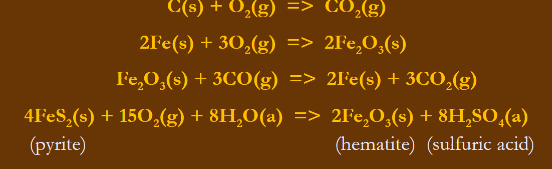
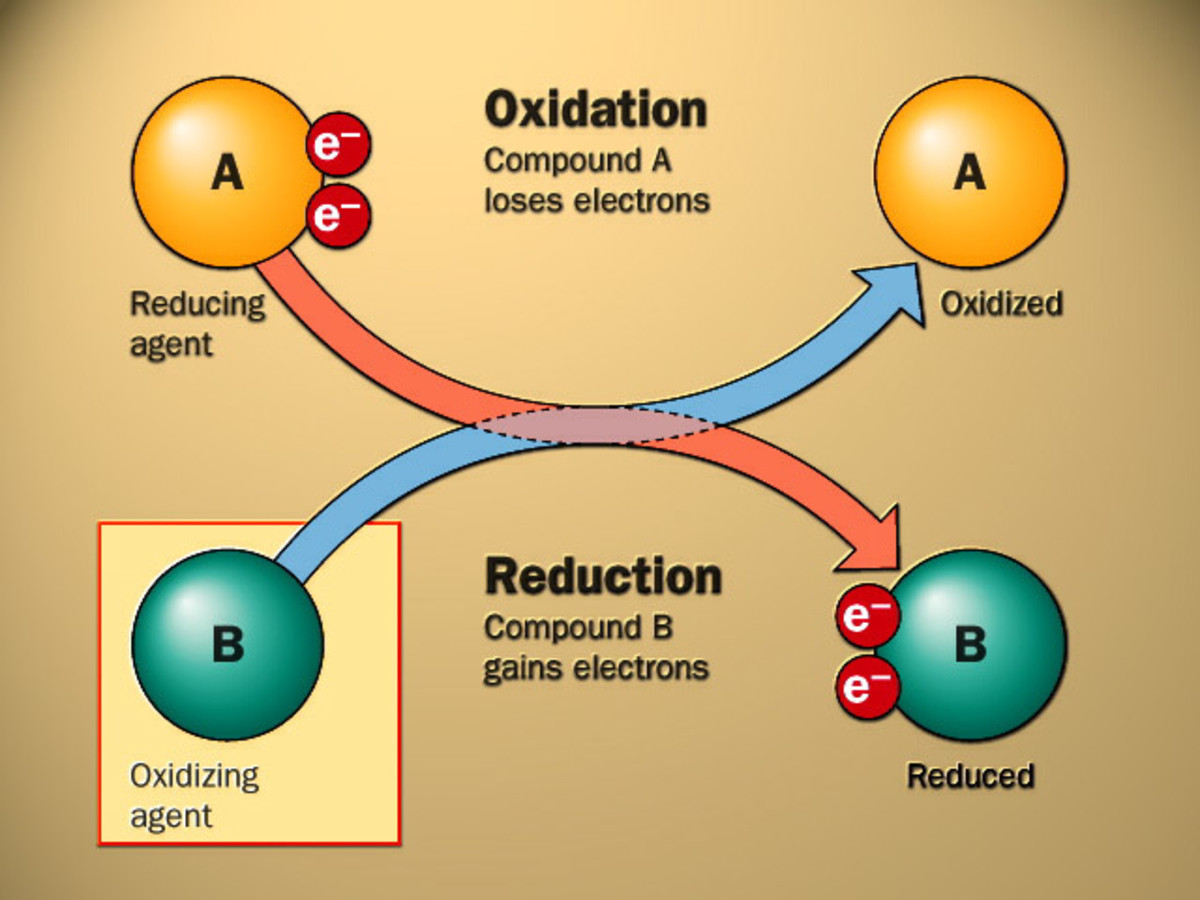
atmospheric oxygen (O2) gains electrons and is reduced as mineral constituents lose electrons and are oxidized, producing new minerals
Oxidation is gain of O2, reduction is loss of O2
Oxidizing agent
removes electrons from another substance, and is reduced because it gains electrons (-)
Oxygen is an example
Reducing agent
transfers electrons to another substance, and is oxidized because it loses electrons (+)
Iron is an example
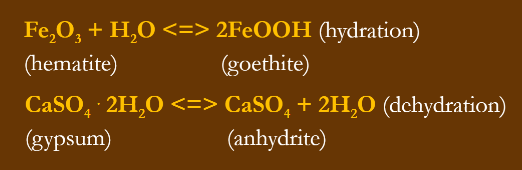
Hydration
process by which water molecules are added to a mineral to form a new mineral. Not hydrolysis. Accompanied by volume change
Plants enhance chemical weathering by
Retaining soil moisture, acidifying water by releasing CO2 and organic acids during decay
In weathering environments, minerals that are _____ are not stable, minerals _____ ARE
stable.
weathering, precipitating
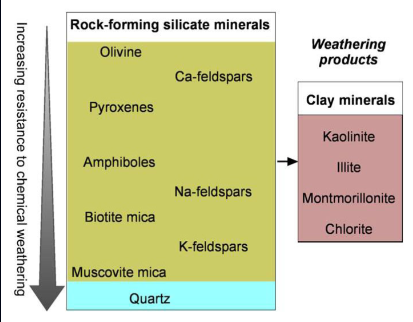
Goldich series
Way of predicting stability of minerals at the surface. Inversion of Bowen’s series
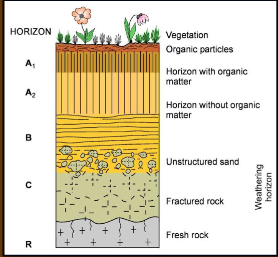
A horizon (topsoil)
uppermost level of soil profile. Dark colored zone or organic accumulation that is decaying and mixing with mineral soil. Prone to leaching
B horizon (zone of accumulation)
Secondary level of soil profile. Composed of minerals with minimal organic content; most rock structures have been destroyed by soil processes
Enriched with cations (iron) and clay
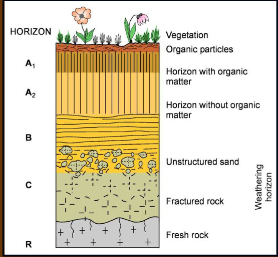
C horizon
Lowest level of soil profile. Lies above bedrock (R layer) and can be deeply weathered, but relatively unaffected by soil-forming processes. Oxygen-poor
Accumulation of calcium and magnesium carbonates
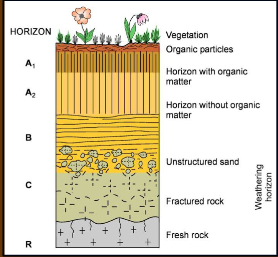
Translocation (illuviation)
downward movement of clay and cations from A → B horizon. No leaching
Elluviation
Leaching of cations from A horizon, and moving them downward to B
Humification
transformation of raw organic matter (OM) into soil humus and soluble organic acids
Gleization
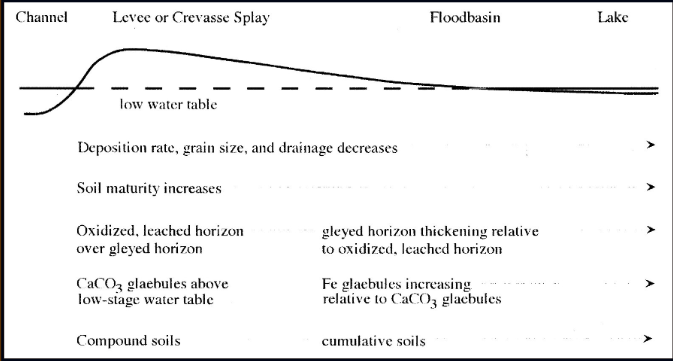
Reduction of iron under anoxic or anaerobic conditions to produce bluish to greenish gray waterlogged soil (gley). Seen in C horizon, preserves organic matter
Podzolization
downward chemical migration of Al, Fe, and/or organic matter within a soil profile
Lessivage
mechanical migration of clay-sized particles from the A to B horizon, producing a B horizon enriched in clay
Ferallitization
intense, deep weathering resulting in thick, uniform soil profiles depleted of exchangeable cations (tropics)
Calcification
accumulation of calcium (nodules) in the subsurface horizon near the depth of rainfall wetting in well drained soils of semiarid to subhumid regions
Salinization and desalinization
Accumulation or leaching of soluble salts (sulfates, chlorides) from salty horizons
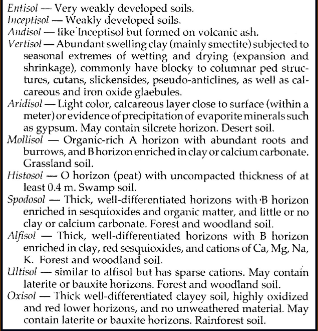
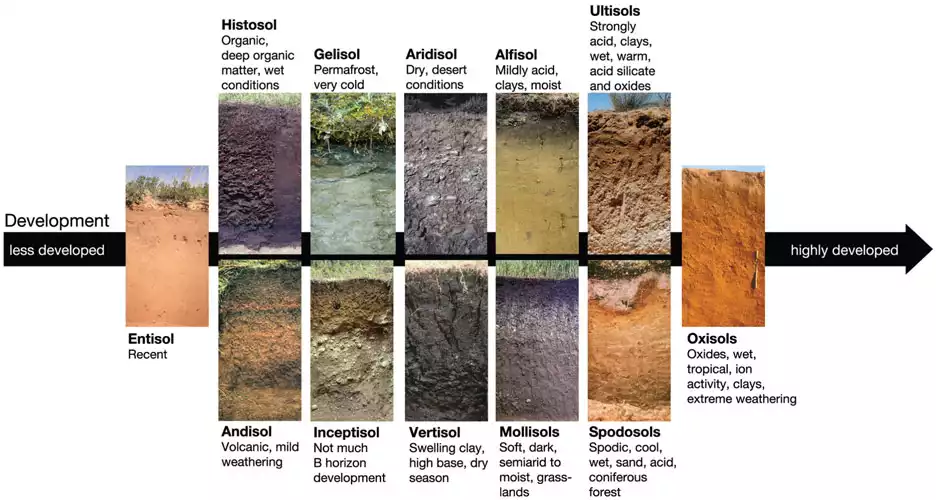
Soil types
12 kinds; modern soils
Paleosols
buried or exhumed soil horizons that formed in the geologic past and represent ancient landscapes. May represent unconformities
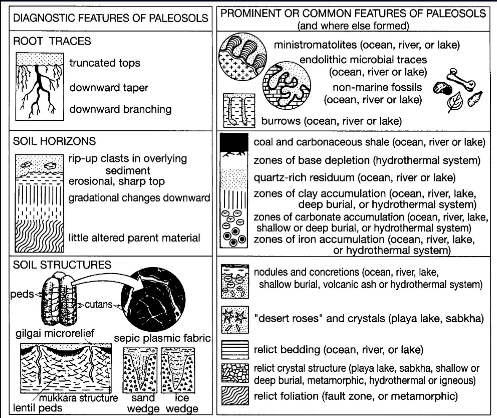
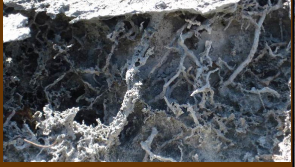
Root traces
Evidence of exposure and colonization of plants. Branch and taper downward in webs, distinguishing them from burrows.
Evidence of paleosol, along with bioturbation
Cutan
Network of irregular cracks surrounded by more stable peds (aggregates of soil). Gives soil a hackly appearance
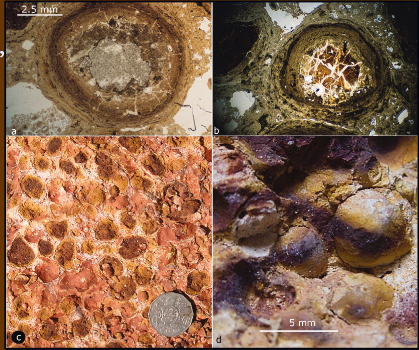
Glaebules (soil concretions)
Concentration of specific minerals to form hard, calcareous, ferruginous, or siderite nodules
Catena
Lateral variation in a paleosol or soil as a result of environmental change (rivers, elevation etc)