NPB 100 Chapter 8 Test Bank
 Studied by 0 people
 Call Kai
 Learn
Learn Practice Test
 Spaced Repetition
 Match
Match Flashcards
 Knowt Play
1/31

There's no tags or description
Looks like no tags are added yet.
Name | Mastery | Learn | Test | Matching | Spaced | Call with Kai |
|---|
No analytics yet
Send a link to your students to track their progress
32 Terms
After firing a short burst of action potentials in an axon, researchers observe a larger EPSP in the postsynaptic cell, and this effect seems to last a few tens of milliseconds. This is most likely due to the presynaptic terminal having
a. extra calcium.
b. lowered calcium.
c. extra sodium.
d. reduced sodium.
e. extra magnesium.
a. extra calcium.
An electrode is used to stimulate a presynaptic nerve that synapses in the dentate gyrus (DG) of the hippocampus. Postsynaptic recordings are measured in the DG neurons. First a weak stimulus (stimulus A) is applied, and then a strong stimulus (stimulus B). If a second weak stimulus (stimulus C) is applied after the strong stimulus, which result would you expect?
a. The postsynaptic response to the second weak stimulus (C) will be higher than the response to the strong stimulus (B).
b. The postsynaptic response to the second weak stimulus (C) will be lower than the response to the first weak stimulus (A).
c. The postsynaptic response to the second weak stimulus (C) will be equal to the response to the first weak stimulus (A).
d. The postsynaptic response to the second weak stimulus (C) will be equal to the response to the strong stimulus (B).
e. The postsynaptic response to the second weak stimulus (C) will be higher than the response to the first weak stimulus (A).
e. The postsynaptic response to the second weak stimulus (C) will be higher than the response to the first weak stimulus (A).
Compare cellular mechanisms involved in LTP versus LTD.
LTP is accompanied by an increase in the number of postsynaptic AMPA receptors, whereas LTD is accompanied by a decrease in the number of postsynaptic AMPA receptors
Define long-term potentiation (LTP). Draw a diagram that shows how LTP is obtained experimentally in CA1 of the hippocampus.
Long-term potentiation represents a long-lasting increase in synaptic strength.
Define the term "synaptic plasticity."
It is the ability of synapses to change in strength.
How do the short-term forms of synaptic plasticity contribute to learning and memory?
They cause the transmission at chemical synapses to change dynamically as a consequence of the recent history of synaptic activity, that is, experience.
How would an increase in external Ca2+ concentration affect synaptic depression?
a. It would increase the rate of depression.
b. It would reduce the rate of depression.
c. It would decrease the rate of neurotransmitter release and induce depression.
d. It would increase the rate of neurotransmitter release and delay depression.
e. It would have no effect on depression.
a. It would increase the rate of depression.
LTP represents a lasting increase in the size of EPSP
a. following a high-frequency train of stimuli.
b. following a low-frequency train of stimuli.
c. following a single stimulus.
d. that is restricted to the hippocampus.
e. that is restricted to the cortex.
a. following a high-frequency train of stimuli.
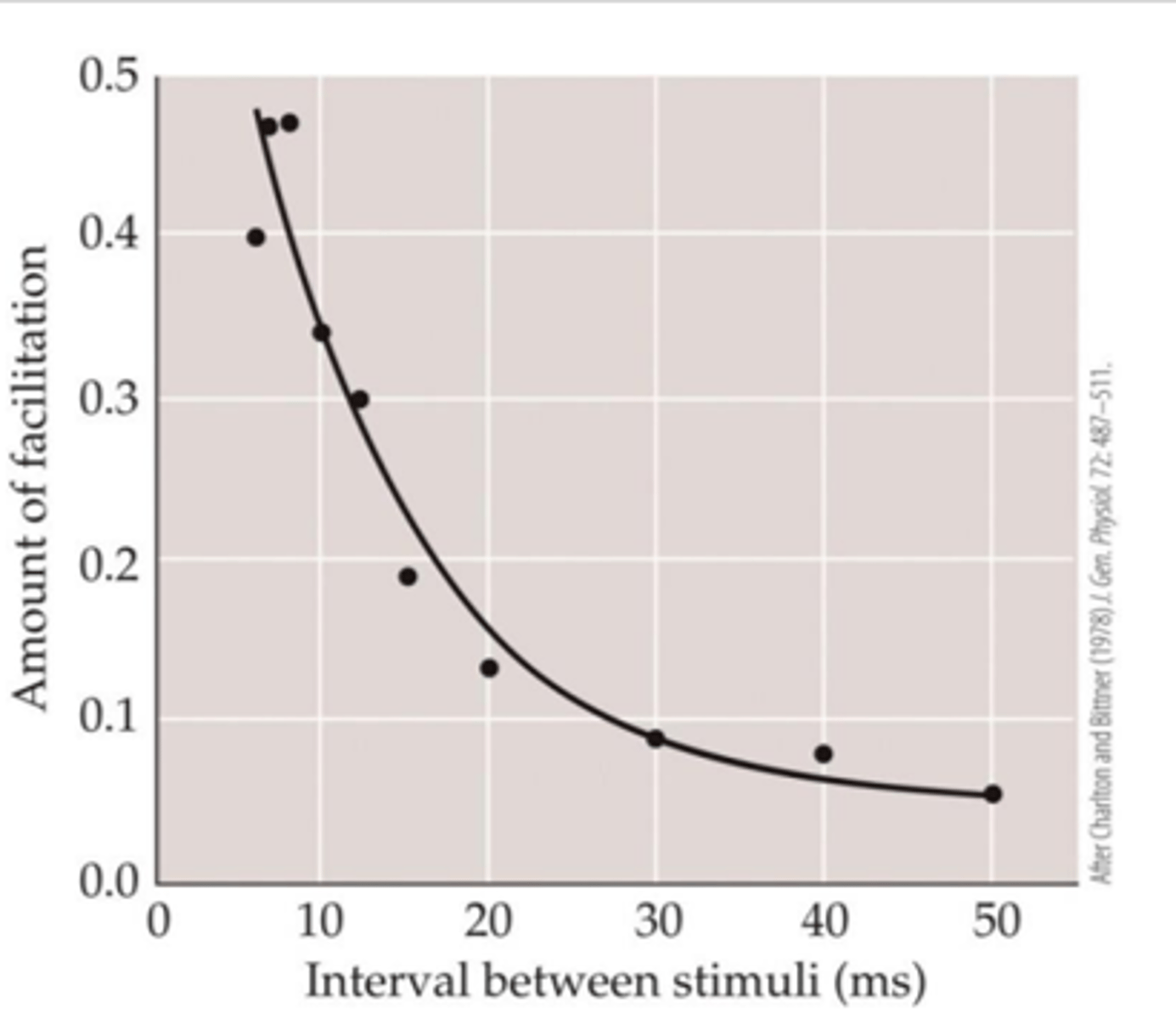
At which time interval would the postsynaptic membrane potential of the second stimulus be greatest?
a. 8 ms
b. 15 ms
c. 20 ms
d. 30 ms
e 50 ms
a. 8 ms
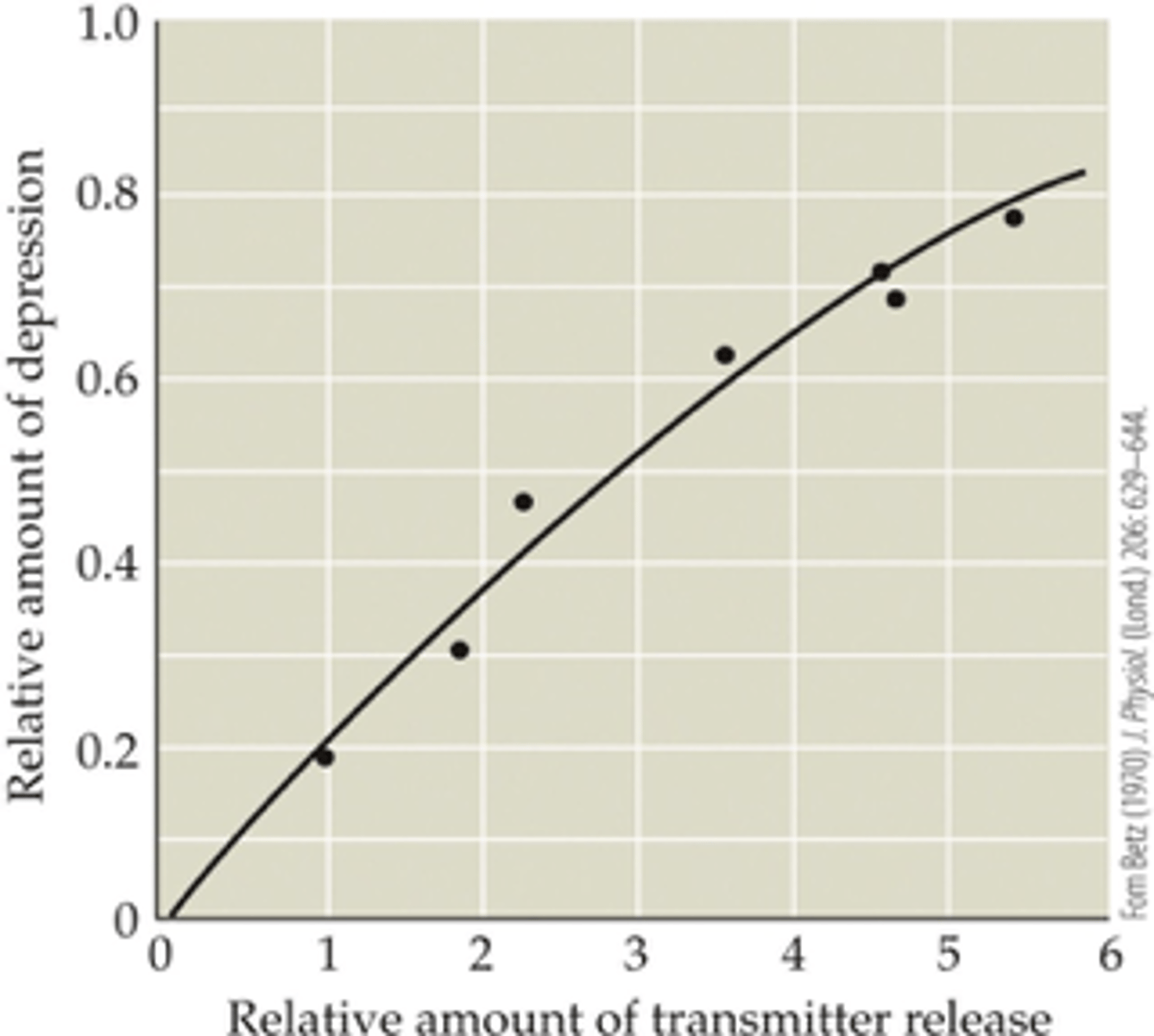
Which statement describes the depicted phenomenon most accurately?
a. Synaptic depression directly correlates with the concentration of extracellular Ca2+.
b. Synaptic depression directly correlates with the amount of neurotransmitter released.
c. Synaptic depression is inversely correlated with the amount of neurotransmitter released.
d. Synaptic depression depends on the rate of neurotransmitter release.
e. Synaptic depression depends on the concentration of neurotransmitter in synaptic vesicles.
b. Synaptic depression directly correlates with the amount of neurotransmitter released.
In which form of plasticity is this neural circuit involved, and which component of the circuit makes this form of plasticity possible?
a. Habituation; interneuron
b. Habituation; modulatory interneuron
c. Sensitization; interneuron
d. Sensitization; modulatory interneuron
e. Sensitization; motor neuron
d. Sensitization; modulatory interneuron
Repeated stimulation of the siphon results in habituation. Which synaptic change occurs during habituation?
a. The synapse between the sensory and motor neurons is depressed.
b. The synapse between the sensory and motor neurons is potentiated.
c. The synapse between the sensory neuron and the interneuron is depressed.
d. The synapse between the sensory neuron and the modulatory interneuron is depressed.
e. The synapse between the interneuron and the motor neuron is depressed.
a. The synapse between the sensory and motor neurons is depressed.
The function of which synapse is altered during sensitization?
a. The synapse between the sensory neuron of the siphon and the motor neuron
b. The synapse between the sensory neuron of the tail and the modulatory interneuron
c. The synapse between the sensory neuron of the siphon and the interneuron
d. The synapse between the interneuron and the motor neuron
e. The synapse between the modulatory interneuron and sensory neuron of the siphon
a. The synapse between the sensory neuron of the siphon and the motor neuron
Glutamate sensitivity (the amplitude of response to the application of glutamate) is color coded. The micrograph on the right was taken 120 minutes after the micrograph on the left. Which form of plasticity is shown in the figure?
a. Habituation
b. Sensitization
c. Synaptic facilitation
d. LTP
e. LTD
d. LTP
Silent synapses are "silent" because they
a. have no presynaptic terminal.
b. have AMPA receptors but no NMDA receptors.
c. have NMDA receptors but no AMPA receptors.
d. lack voltage-gated sodium channels.
e. are continuously inhibited and so cannot be activated.
c. have NMDA receptors but no AMPA receptors.
The key aspect of receptor-gating in the associative induction of hippocampal LTP is that
a. all glutamate receptors open automatically whenever glutamate is in the synaptic cleft.
b. the NMDA receptor acts as a molecular coincidence detector.
c. the AMPA receptor allows calcium into the cell only after the NMDA receptor is activated.
d. both the NMDA and AMPA channels must be open in order for the cell to depolarize.
e. The NMDA receptor allows the flow of magnesium into the cell.
b. the NMDA receptor acts as a molecular coincidence detector.
The targets of the phosphatases activated during hippocampal LTD are
a. voltage-gated ion channels.
b. ligand-gated ion channels.
c. synaptic vesicle regulatory proteins.
d. postsynaptic signaling pathways.
e. unknown.
e. unknown.
The type of receptor that is critical for the induction of hippocampal LTP, admitting calcium into a dendritic spine, is called a(n)
a. AMPA receptor.
b. NMDA receptor.
c. glycine receptor.
d. cholinergic GPCR.
e. noradrenergic GPCR.
b. NMDA receptor.
What causes synaptic facilitation?
a. Buildup of Ca2+ in the presynaptic terminal
b. Release of greater than usual number of synaptic vesicles
c. Release of synaptic vesicles loaded with extra neurotransmitter
d. Activation of synaptotagmin 7 by means of phosphorylation
e. Stronger binding of Ca2+ to synaptotagmin 7
a. Buildup of Ca2+ in the presynaptic terminal
What is the immediate consequence of Mg2+ blockade removal from the NMDA receptors?
a. Ca2+ influx into the presynaptic terminal
b. Ca2+ influx into the postsynaptic terminal
c. Na+ influx into the postsynaptic terminal
d. Postsynaptic EPSP
e. Glutamate binding to its receptors
b. Ca2+ influx into the postsynaptic terminal
What is the mechanism of LTP expression?
a. Increase in the number of postsynaptic NMDA receptors
b. Increase in the number of postsynaptic AMPA receptors
c. Increase in the number of presynaptic AMPA receptors
d. Increase in the intracellular level of synaptotagmins
e. Decrease in the level of glutamate released into the synaptic cleft
b. Increase in the number of postsynaptic AMPA receptors
What triggers LTD?
a. Ca2+ influx into the postsynaptic terminal
b. Internalization of AMPA receptors
c. High-frequency stimulation
d. Low-frequency stimulation followed by small or slow increase in Ca2+
e. Low-frequency stimulation followed by sharp and dramatic increase in Ca2+
d. Low-frequency stimulation followed by small or slow increase in Ca2+
What would happen if Mg2+ was not expelled from NMDA channels?
a. Glutamate would not bind to NMDA receptors.
b. Glutamate would not bind to AMPA receptors.
c. The postsynaptic membrane would not depolarize.
d. EPSP would not occur.
e. LTP would not occur.
e. LTP would not occur.
Which condition(s) must be met to induce LTP?
a. Glutamate must be released from the presynaptic terminal.
b. Glutamate must open the postsynaptic AMPA receptors.
c. The postsynaptic membrane must be depolarized for a period of time.
d. Mg2+ block must be expelled from NMDA receptors to allow Ca2+ influx.
e. All of the above
e. All of the above
Which mechanism contributes to the long-term enhancement of the gill withdrawal reflex in Aplysia but is not involved in the short-term enhancement of the reflex?
a. Activation of G-protein-coupled receptors by serotonin
b. Phosphorylation of CREB
c. Activation of adenylyl cyclase
d. Activation of protein kinase A
e. Decreased opening of potassium channels during presynaptic action potentials
b. Phosphorylation of CREB
Which mechanism used in hippocampal LTD is not part of the hippocampal LTP mechanism?
a. History-dependent modification of synaptic efficacy
b. NMDA receptor activation
c. Calcium influx
d. Calcium-dependent activation of protein phosphatases
e. Calcium-dependent activation of protein kinases.
d. Calcium-dependent activation of protein phosphatases
Which mechanism would be a plausible explanation for synaptic depression?
a. Inhibition of postsynaptic calcium channels
b. Activation of presynaptic potassium channels
c. Depletion of docked synaptic vesicles in the presynaptic terminal
d. Faster replenishment of vesicles to the reserve pool
e. Enhancement of presynaptic sodium currents
c. Depletion of docked synaptic vesicles in the presynaptic terminal
Which observation would demonstrate the spike timing-dependent plasticity of synapses?
a. Whether or not LTP occurs is dependent on the specific temporal pattern of action potentials.
b. LTP occurs whenever an action potential precedes an EPSP.
c. LTD occurs whenever an action potential follows an EPSP.
d. Switching the relative timing of action potential and EPSP by as little as 20 ms can switch the response from LTD to LTP, or vice-versa.
e. A rhythmic pattern of spike-EPSP-spike-EPSP, at 40 ms intervals, produces maximal LTP.
d. Switching the relative timing of action potential and EPSP by as little as 20 ms can switch the response from LTD to LTP, or vice-versa.
Which statement about LTP is false?
a. LTP involves an enhancement in synaptic efficacy that can last for hours, days, weeks or even longer.
b. If one synapse (A) is very strongly stimulated (sufficient to cause LTP), and another nearby synapse (B) on the same dendrite is weakly stimulated at the same time, then the second synapse (B) will also show LTP.
c. If one synapse (A) is very strongly stimulated (sufficient to cause LTP), and a nearby synapse (B) on the same cell is weakly stimulated a few seconds later, then the second synapse (B) will also show LTP.
d. The requirement for coincident pre- and postsynaptic activity was predicted by Donald Hebb in 1949.
e. Hippocampal LTP was first reported by Bliss and Lomo about 1970.
c. If one synapse (A) is very strongly stimulated (sufficient to cause LTP), and a nearby synapse (B) on the same cell is weakly stimulated a few seconds later, then the second synapse (B) will also show LTP.
Which statement about silent synapses is true?
a. They cannot be induced to transmit information.
b. They transmit information at a resting membrane potential.
c. They can produce postsynaptic responses as a result of LTP.
d. They contain both NMDA and AMPA receptors.
e. They represent mature glutamatergic synapses.
b. They transmit information at a resting membrane potential.
Which statement about the mechanisms underlying hippocampal LTP induction is false?
a. An influx of calcium triggers two or more intracellular processes in the postsynaptic dendritic spine.
b. Calcium may enhance transmitter release from the presynaptic terminal.
c. Calcium may activate Ca2+/calmodulin-dependent protein kinase type II (CaMKII), which then autophosphorylates, leading to a long-term "on" state.
d. Calcium may activate a signaling cascade that causes the insertion of glutamate receptors into the postsynaptic membrane.
e. Calcium decreases a resting leak current of sodium so that the postsynaptic cell is closer to threshold and therefore fires more easily.
e. Calcium decreases a resting leak current of sodium so that the postsynaptic cell is closer to threshold and therefore fires more easily.
Firing an action potential in an axon initially causes a 10-mV depolarization (EPSP) in a postsynaptic neuron, but after applying a certain stimulus to the axon, firing it causes an 8-mV depolarization after each action potential. This phenomenon is called synaptic
a. enhancement.
b. depression.
c. facilitation.
d. augmentation.
e. potentiation.
b. depression.
 Note
Note  Flashcards (71)