Unit C - Forces and movement

0.0(0)
Studied by 8 people
call kaiCall Kai
learnLearn
examPractice Test
spaced repetitionSpaced Repetition
heart puzzleMatch
flashcardsFlashcards
GameKnowt Play
Card Sorting

1/27

flashcard set

Earn XP

Description and Tags

1c (1.11-1.21)

Last updated 12:46 PM on 2/12/24
Name
Mastery
Learn
Test
Matching
Spaced
Call with Kai

No analytics yet

Send a link to your students to track their progress

28 Terms

1
New cards

Gravity

Gravity attracts all masses, but only noticeable when one of the masses is very big

This has three effects:

  • On surface of planet, makes things accelerate towards ground

  • Gives everything weight

  • Keeps planets, moons, satellites in orbit
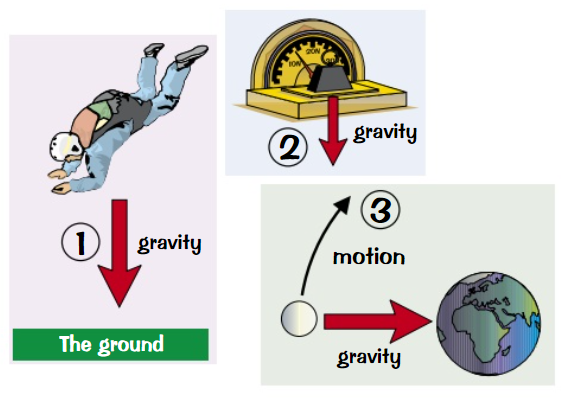
<p>Gravity attracts <strong>all </strong>masses, but only noticeable when one of the masses is <strong>very big</strong></p><p>This has <strong>three</strong> effects:</p><ul><li><p>On surface of planet, makes things <strong>accelerate</strong> towards<strong> ground</strong></p></li><li><p>Gives everything <strong>weight</strong></p></li><li><p>Keeps <strong>planets</strong>, <strong>moons</strong>, <strong>satellites</strong> in <strong>orbit</strong></p></li></ul>
2
New cards

Weight vs Mass

  • Mass is amount of ‘stuff’ in object - same value anywhere in universe

  • Weight is caused by pull of gravity

  • Object has same mass on Earth and Moon - but different weight

    1kg mass weighs less on Moon (1.6N) than Earth (10N) because force of gravity pulling on it is less

  • Weight is force measured in newtons
    Mass is not a force

3
New cards

Equation: Weight, Mass, Gravity

W = mg

Weight = Mass x Gravitational field strength

[N] = [kg] / [N/kg]

4
New cards

Force

A push or pull

Vector quantity with size + direction

5
New cards

Gravity/Weight

When close to a planet this acts straight downwards

6
New cards

Reaction force

Acts perpendicular to surface and away from it (if surface is horizontal, reaction force acts straight upwards)

7
New cards

Electrostatic force

Between two charged objects

Direction depends on type of charge (like charges repel, opposites attract)

8
New cards

Thrust

e.g. push or pull due to engine/rocket speeding something up

9
New cards

Drag/air resistance/friction

Slows the object down

10
New cards

Lift

e.g. due to aeroplane wing

11
New cards

Tension

in a rope or cable

12
New cards

Drawing the forces acting on a body

  • Many forces act on everything, but usually not noticed because they balance out

  • Any object with weight feels reaction force back from the surface it’s on
    Otherwise it would just keep falling

  • When an object moves in fluid (air, water etc.), it feels drag in opposite direction to motion
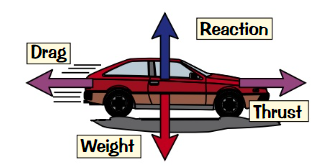
<ul><li><p><strong>Many forces</strong> act on everything, but usually not noticed because they <strong>balance out</strong></p></li><li><p>Any object with <strong>weight</strong> feels <strong>reaction force</strong> back from the surface it’s on<br>Otherwise it would just keep <strong>falling</strong></p></li><li><p>When an object <strong>moves </strong>in <strong>fluid</strong> (air, water etc.), it feels <strong>drag</strong> in <strong>opposite direction</strong> to motion  </p></li></ul>
13
New cards

Friction

If an object has no force propelling it, it always slows down and stops due to friction (force that opposes motion)

To travel at steady speed, objects need driving force to counteract friction

14
New cards

Static friction

Friction between solid surfaces which are gripping

Can be reduced by putting lubricant (oil/grease) between surfaces
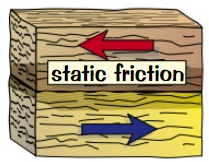
<p>Friction between <strong>solid surfaces</strong> which are <strong>gripping</strong></p><p>Can be reduced by putting <strong>lubricant</strong> (<strong>oil</strong>/<strong>grease</strong>) between surfaces</p>
15
New cards

Sliding friction

Can be reduced by putting lubricant (oil/grease) between surfaces

Friction between solids often causes wear of two surfaces in contact
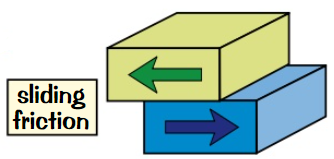
<p>Can be reduced by putting <strong>lubricant</strong> (<strong>oil</strong>/<strong>grease</strong>) between surfaces</p><p>Friction between <strong>solids</strong> often causes <strong>wear </strong>of two <strong>surfaces</strong> in contact</p>
16
New cards

Drag

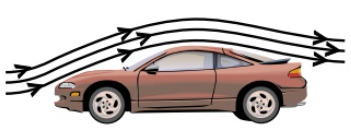
Keeping shape of object streamlined (sports car, boat hull) reduces drag in fluids
Lorries + caravans have ‘deflectors’ to make them more streamlines + reduce drag

Roof boxes on cars spoil their streamlined shape so slow them down
For a given thrust, higher drag = lower top speed of car

Opposite extreme is parachute (need as high drag as possible)

In fluid, friction always increases as speed increases
<p>Keeping shape of object <strong>streamlined </strong>(sports car, boat hull) reduces <strong>drag in fluids</strong><br>Lorries + caravans have ‘<strong>deflectors</strong>’ to make them more streamlines + reduce drag</p><p><strong>Roof boxes</strong> on cars spoil their streamlined shape so slow them down<br>For a given thrust, <strong>higher drag</strong> = <strong>lower top speed</strong> of car</p><p><strong>Opposite extreme</strong> is <strong>parachute</strong> (need as high drag as possible)</p><p>In <strong>fluid</strong>, <strong>friction always increases as speed increases</strong></p>
17
New cards

Newton’s First Law of Motion

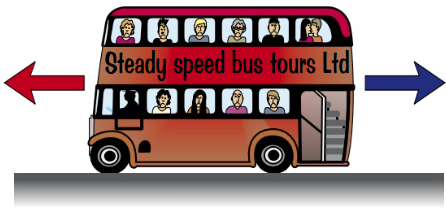
As long as forces on object are balanced, it will stay still, or if already moving, it carries on at same velocity
<p>As long as forces on object are <strong>balanced</strong>, it will <strong>stay still</strong>, or if already moving, it carries on at <strong>same velocity</strong></p>
18
New cards

Newton’s Second Law of Motion

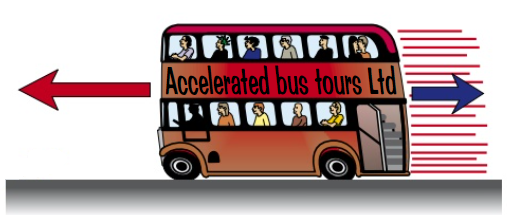
If there is unbalanced force, object accelerates in that direction
<p>If there is <strong>unbalanced force</strong>, object <strong>accelerates</strong> in that direction</p>
19
New cards

Equation: Force, Mass, Acceleration

F = ma

Force = Mass x Acceleration

[N] = [kg] x [m/s²]

<p>F = ma</p><p>Force = Mass x Acceleration</p><p>[N] = [kg] x [m/s<span>²]</span></p>
20
New cards

Newton’s Third Law of Motion

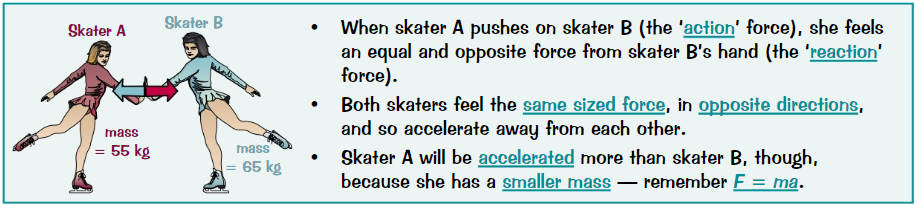
If object A exerts force on object B, then object B exerts an equal and opposite force on object A

e.g. swimming, push back against water with arms + legs, and water pushes you forwards with equal-sized force in opposite direction
<p>If object A <strong>exerts force</strong> on object B, then object B exerts an <strong>equal and opposite force</strong> on object A</p><p>e.g. <strong>swimming</strong>, <strong>push</strong> back against <strong>water </strong>with arms + legs, and water pushes you forwards with <strong>equal-sized force</strong> in <strong>opposite direction</strong></p>
21
New cards

Vector quantities

Have size and direction

e.g. force, velocity, acceleration, momentum

22
New cards

Scalar quantities

Only size, no direction

e.g. mass, temperature, time, length

23
New cards

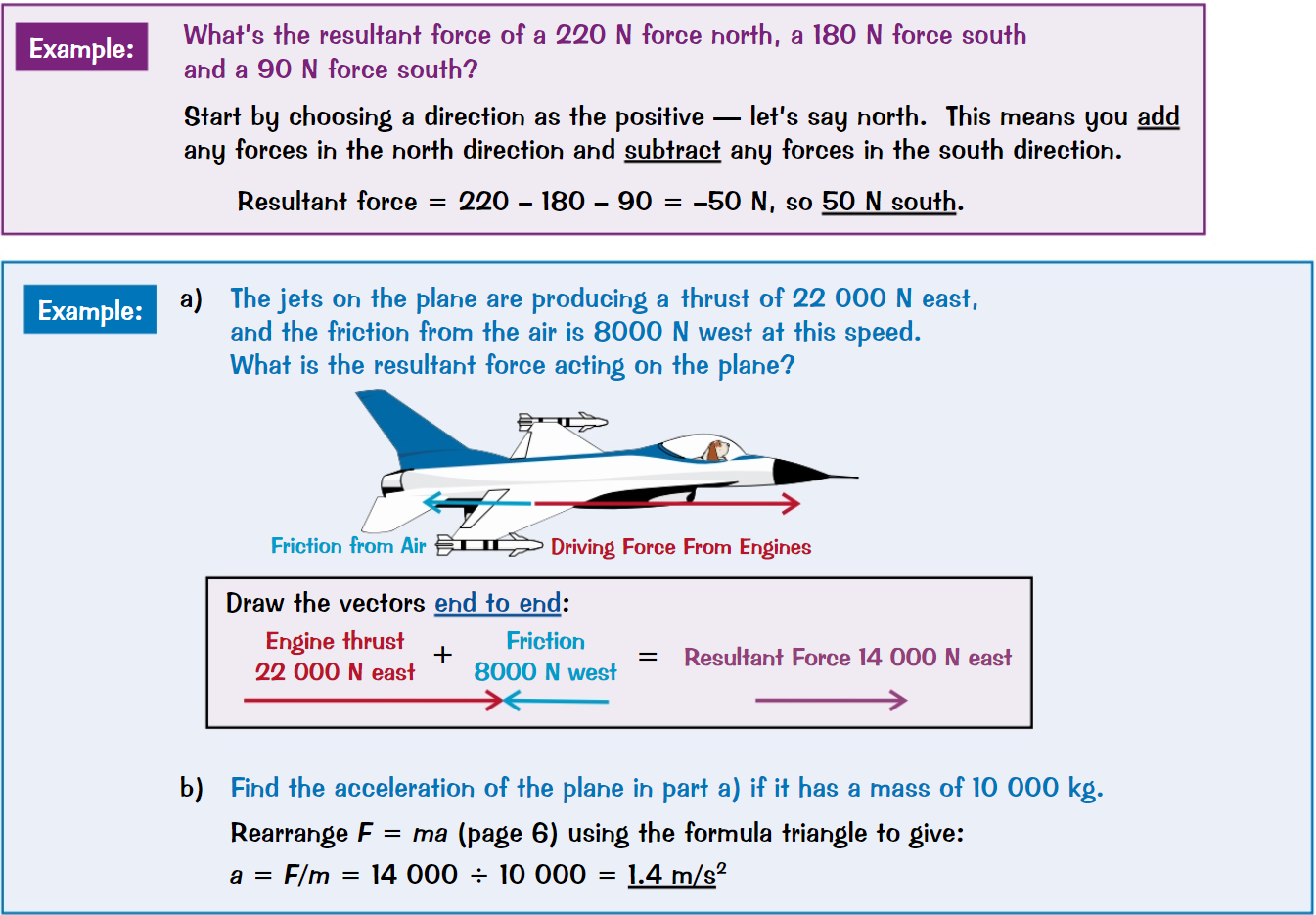
Resultant force

When multiple forces act on object, you can find resultant force acting on object by adding/subtracting - need to know size of all different forces acting on object and their direction
<p>When <strong>multiple forces</strong> act on object, you can find <strong>resultant force</strong> acting on object by <strong>adding</strong>/<strong>subtracting</strong> - need to know <strong>size </strong>of all <strong>different forces</strong> acting on object and their <strong>direction</strong></p>
24
New cards

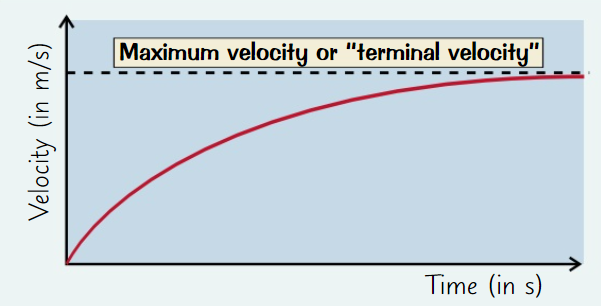
Terminal velocity

Frictional forces increase with speed - but only up to a certain point

  • When object first starts to fall, it has much more force accelerating it than resistance slowing it down

  • As velocity increases, resistance builds up

  • Resistance force gradually reduces acceleration until resistance force is equal to accelerating force
    At this point, object can’t accelerate any more, it has reached terminal velocity
<p>Frictional forces <strong>increase</strong> with <strong>speed</strong> - but only up to a <strong>certain point</strong></p><ul><li><p>When object first starts to fall, it has <strong>much more </strong>force <strong>accelerating </strong>it than <strong>resistance </strong>slowing it down</p></li><li><p>As <strong>velocity increases</strong>, resistance <strong>builds up</strong></p></li><li><p>Resistance force gradually <strong>reduces</strong> <strong>acceleration</strong> until <strong>resistance</strong> <strong>force</strong> is <strong>equal</strong> to <strong>accelerating force</strong><br>At this point, object can’t accelerate any more, it has reached <strong>terminal velocity</strong></p></li></ul>
25
New cards

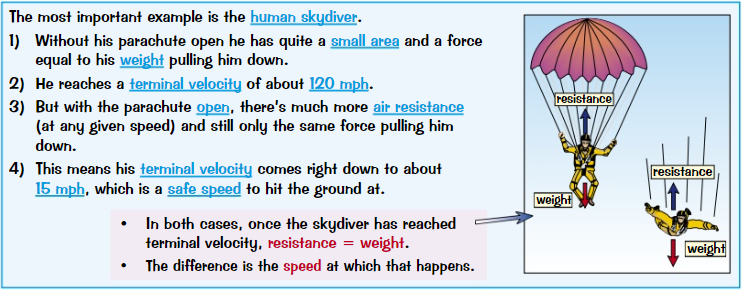
Factors affect terminal velocity

  • Accelerating force acting on all falling objects is gravity
    All objects would accelerate at the same rate without air resistance

  • Air resistance causes things to fall at diff speeds, and terminal velocity of object is determined by its drag compared to its weight
    Drag depends on shape and area
<ul><li><p><strong>Accelerating force</strong> acting on <strong>all falling objects</strong> is <strong>gravity</strong><br>All objects would accelerate at the same rate without <strong>air resistance</strong></p></li><li><p><strong>Air resistance</strong> causes things to fall at <strong>diff speeds</strong>, and <strong>terminal velocity</strong> of object is determined by its <strong>drag</strong> compared to its <strong>weight</strong><br>Drag depends on <strong>shape </strong>and <strong>area</strong></p></li></ul>
26
New cards

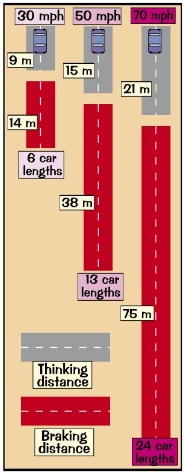
Stopping distance

Distance covered in the time between driver first spotting a hazard and the car coming to complete stop

Stopping Distance = Thinking Distance + Braking Distance
<p>Distance covered in the time between driver <strong>first spotting </strong>a hazard and the car coming to <strong>complete stop</strong></p><p>Stopping Distance = Thinking Distance + Braking Distance</p>
27
New cards

Factors affecting thinking distance

  • Reaction time - affected by tiredness, drugs, alcohol and old age

28
New cards

Factors affecting braking distance

  • Speed - faster speed = further distance before stopping

  • Mass of vehicle - larger mass = longer time to stop

  • Quality of brakes - worn/faulty brakes increase braking distance

  • Grip - depends on road surface, weather conditions (e.g. icy), tyres

Explore top notes

note
Aorta abdominal
Updated 1217d ago
0.0(0)
note
Biomolecules
Updated 1223d ago
0.0(0)
note
Brachioradialis Syndrome
Updated 1136d ago
0.0(0)
note
Chapter 5 flashcards
Updated 412d ago
0.0(0)
note
Chapter 4: Political Economy
Updated 1072d ago
0.0(0)
note
Othello Act 1
Updated 850d ago
0.0(0)
note
Chapter 9: Energy Sources
Updated 1035d ago
0.0(0)
note
5.2: French Revolution
Updated 291d ago
0.0(0)
note
Aorta abdominal
Updated 1217d ago
0.0(0)
note
Biomolecules
Updated 1223d ago
0.0(0)
note
Brachioradialis Syndrome
Updated 1136d ago
0.0(0)
note
Chapter 5 flashcards
Updated 412d ago
0.0(0)
note
Chapter 4: Political Economy
Updated 1072d ago
0.0(0)
note
Othello Act 1
Updated 850d ago
0.0(0)
note
Chapter 9: Energy Sources
Updated 1035d ago
0.0(0)
note
5.2: French Revolution
Updated 291d ago
0.0(0)

Explore top flashcards

flashcards
Insight Upper - Unit 4
50
Updated 609d ago
0.0(0)
flashcards
Vobabulary exam 22.12.22
118
Updated 1190d ago
0.0(0)
flashcards
Cuéntame de tus vacaciones
79
Updated 136d ago
0.0(0)
flashcards
Chapter 13 WHAP
50
Updated 530d ago
0.0(0)
flashcards
Insight Upper - Unit 4
50
Updated 609d ago
0.0(0)
flashcards
Vobabulary exam 22.12.22
118
Updated 1190d ago
0.0(0)
flashcards
Cuéntame de tus vacaciones
79
Updated 136d ago
0.0(0)
flashcards
Chapter 13 WHAP
50
Updated 530d ago
0.0(0)



