biochem exam2b
 Studied by 0 people
 Call with Kai
 Learn
Learn Practice Test
 Spaced Repetition
 Match
Match Flashcards
 Knowt Play
1/35

There's no tags or description
Looks like no tags are added yet.
Name | Mastery | Learn | Test | Matching | Spaced | Call with Kai |
|---|
No study sessions yet.
36 Terms
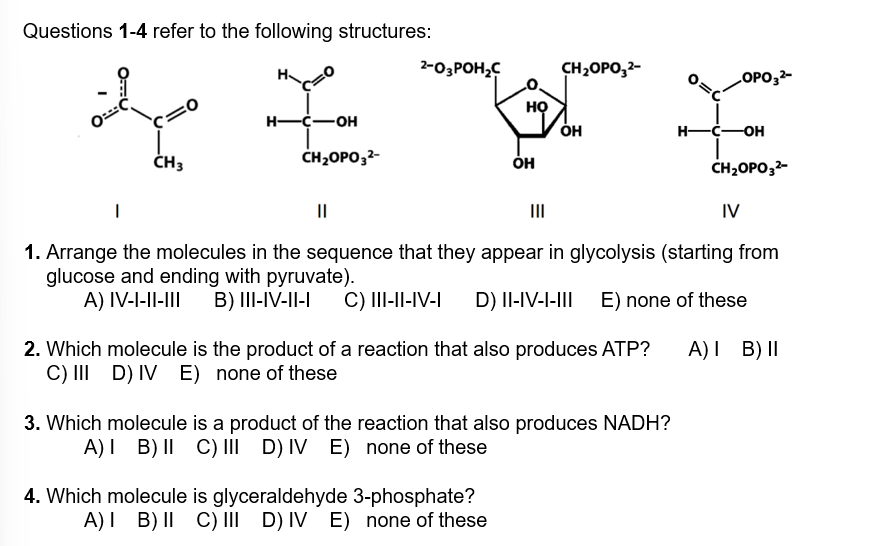
C, A, D, B
5. Which of the following molecules link catabolism and anabolism?
A) ATP/ADP+Pi B) NAD+/NADH C) both ATP/ADP+Pi and NAD+/NADH D) only ATP and NADH E) none of these
C
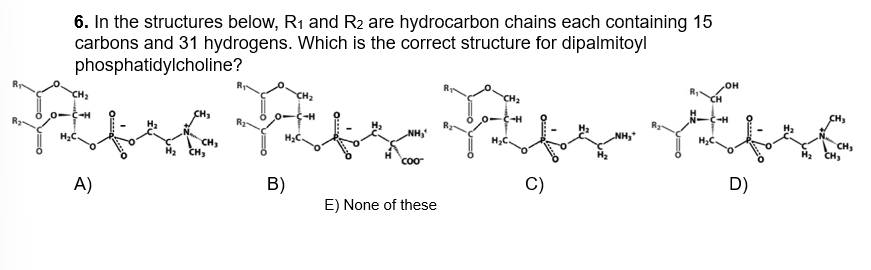
A
7. Which is the most oxidized molecule?
A) H2CO B) CH4 C) CH3OH D) CO2 E) all are equally oxidized
D
. Which molecule forms the backbone of sphingolipids?
A) glycerol B) sphingosine C) glucose D) choline E) none of these
B
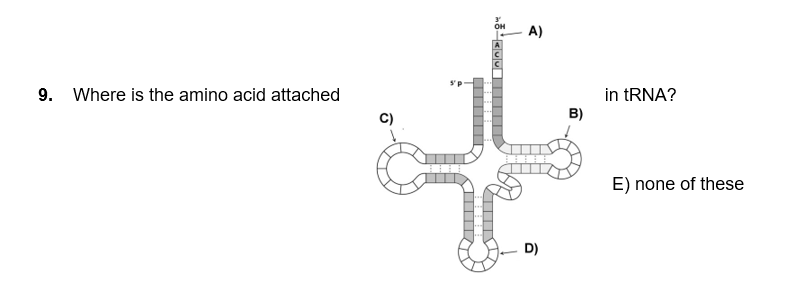
A
Which type of RNA is the one with the least amounts in most cells?
A) mRNA B) rRNA C) tRNA D) equal amounts of mRNA, rRNA and tRNA
E) none of the these
A
During replication, catalyzed by DNA polymerase III, which group on the elongating chain attacks the incoming deoxynucleotide triphosphate?
A) 3' OH on the leading strand and 5' OH on the lagging strand
B) 5' OH on the leading strand and 3' OH on the lagging strand
C) 5' OH on both strands D) 3' OH on both strands E) none of these
D
Identify an enzyme catalyzing a reaction on the lagging strand that is not needed on the leading strand?
A) CRISPR/Cas9 B) restriction endonuclease C) DNA ligase D) aminoacyl-tRNA synthetase E) none of these
B
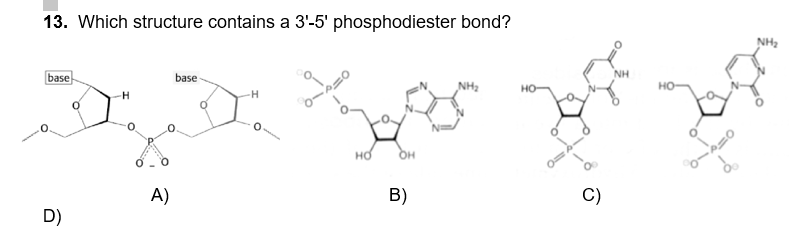
A
14. There are 64 different triplet codons, of which three are stop signals. Does that mean that there are 61 different tRNAs?
A) Yes, because each tRNA anticodon has a different sequence.
B) Yes, because all 61 codons are used in mRNA.
C) No, because the AUG start codon doesn't have a tRNA.
D) No, because the first anticodon position can "wobble" to form base pairs multiple codons for the same amino acid, so there are fewer tRNAs than codons. E) none of these
D
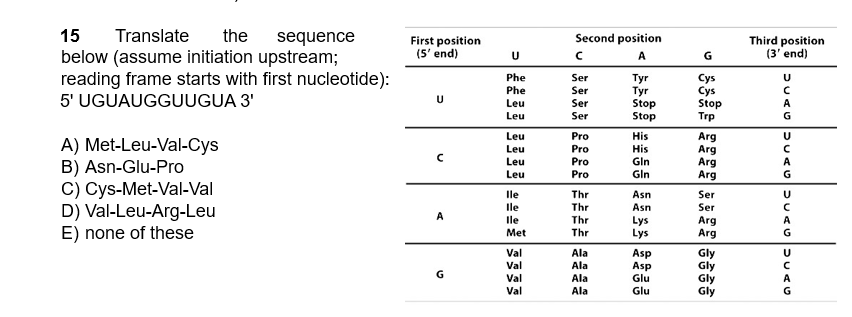
C
16. Which phospholipid motion occurs spontaneously in lipid bilayers?
A) Lipid moves across the bilayer from the cytoplasmic to the extracellular side.
B) Lipid moves laterally in the plane of the bilayer.
C) Lipid moves out of the bilayer into the cytosol.
D) Lipid moves in between carbohydrate and nucleic acid to form a trilayer. E) none of these
B
. Which of the following fatty acids has the most carbon atoms?
A) 22:1 B) 18:2 C) 20:4 D) 16:0 E) none of these
A
. Why are lipid bilayers relatively impermeable to potassium ions? A) K+ is repelled by negative charges on the lipid phosphates.
B) K+ is repelled by water surrounding lipid polar head groups.
C) K+ is strongly attracted to lipid hydrocarbon chains.
D) K+ is solvated by water but it interacts poorly with lipid hydrocarbon chains. E) none of these
D
. Which property is characteristic of DNA but not mRNA?
A) single-stranded B) double-stranded C) contains 2'-OH
D) contains uracil E) none of these
B
. Which biotechnology method is facilitated by the availability of restriction endonucleases?
A) recombinant DNA B) PCR C) dideoxy sequencing D) SDS gels E) none of these
A
21. What enzyme is essential for carrying out the polymerase chain reaction?
A) chymotrypsin B) restriction endonuclease C) thermophilic DNA polymerase D) aminoacyl tRNA synthetase E) none of these
C
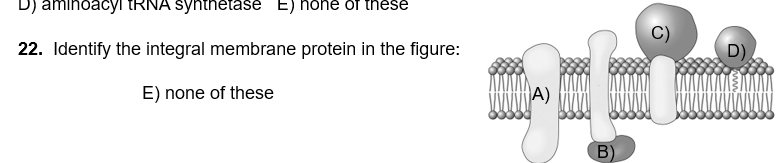
A
23. Comparing transcription and DNA replication, which of the following properties is NOT similar in the two processes?
A) Catalytic mechanism involves two metal ions
B) Polynucleotide product polymerizes in the 5' to 3' direction
C) Parental DNA strands have new complementary strands at the end of the process D) Nucleotide sequence of product is determined by base pairing interactions
E) none of these
C
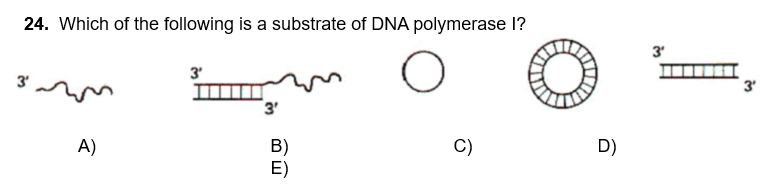
B
25. Of the following fatty acids, predict which one has the highest melting temperature: A) 18:3 B) 18:2 C) 18:1 D) 18:0 E) none of these
D
26 Identify the active transporter:
A) K+-channel B) Na+-K+ ATPase C) prostaglandin H2 synthase
D) porin E) none of these
B
Which can transfer a phosphate group?
A) palmitate B) coenzyme A C) NADH D) ATP E) none of these
D
28. After NADH reacts to form NAD+, what change has occurred?
A) NADH has lost an electron pair
B) NAD+ has gained an electron pair
C) NAD+ has gained a phosphate group
D) NADH has lost an acetyl group
none of these
A
Which metabolic intermediate is in a position where many catabolic pathways converge, and also in a position where many anabolic pathways diverge?
A) acetyl CoA B) glucose C) pyrophosphate D) NAD+ E) none of these
A
How does the lac repressor prevent transcription of lac operon genes?
A) It binds to RNA polymerase and inhibits its activity
B) It binds to the CAP protein
C) It binds to part of the lac operon promoter site
D) It binds to and cleaves the lac operon mRNA
E) none of these
C
31 Which is NOT a reason why hydrolysis of ATP is very thermodynamically favorable?
A) The g phosphate in ATP has better resonance structures than Pi
B) Pi has better resonance structures than the g phosphate in ATP
C) ATP has more charge repulsion than ADP + Pi
D) ATP has higher standard free energy than ADP + Pi
E) none of these
A
32. Which reaction in glycolysis combines oxidation and phosphorylation?
A) lactate → pyruvate
B) phosphoenolpyruvate → pyruvate
C) glucose → glucose 6-phosphate
D) glyceraldehyde 3-phosphate → 1,3-bisphosphoglycerate E) none of these
D
33 What is the cost, in terms of nucleotide triphosphates hydrolyzed, for each elongation step in protein synthesis?
A) 1 ATP B) 2 CTPs C) 2 GTPs D) 3 UTPs E) none of these
C
Questions 34-35 refer to the following:
A) glyceraldehyde 3-phosphate → 1,3-bisphosphoglycerate
B) 2-phosphoglycerate → phosphoenolpyruvate
C) fructose 6-phosphate → fructose 1,6-bisphosphate
D) 1,3-bisphosphoglycerate → 3-phosphoglycerate
E) none of the above
34. Which reaction produces ATP in glycolysis?
35. Which reaction produces NADH in glycolysis?
D, A
36. Which glycolytic reaction is essentially irreversible?
A) phosphoenolpyruvate + ADP → pyruvate + ATP
B) 3-phosphoglycerate → 2-phosphoglycerate
C) glucose 6-phosphate → fructose 6-phosphate
D) dihydroxyacetone phosphate → glyceraldehyde 3-phosphate E) none of these
A
37. The peptidyl transferase activity of ribosomes is catalyzed by:
A) ribosomal RNA B) messenger RNA C) EF-Tu D) ribosomal proteins E) none of these
A
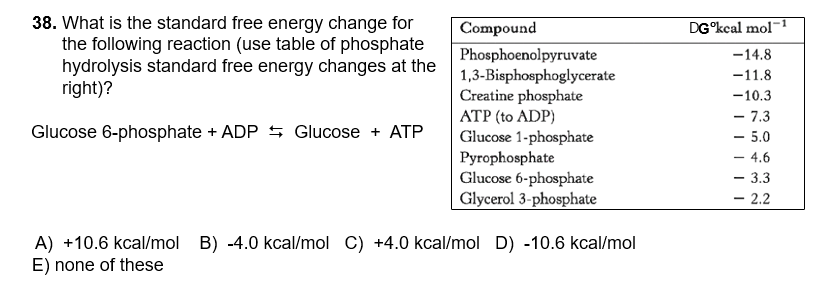
C
39. Which ribosomal subunit is involved in initiation of protein synthesis? A) 50S B) 30S C) 70S D) 23S E) none of these
B
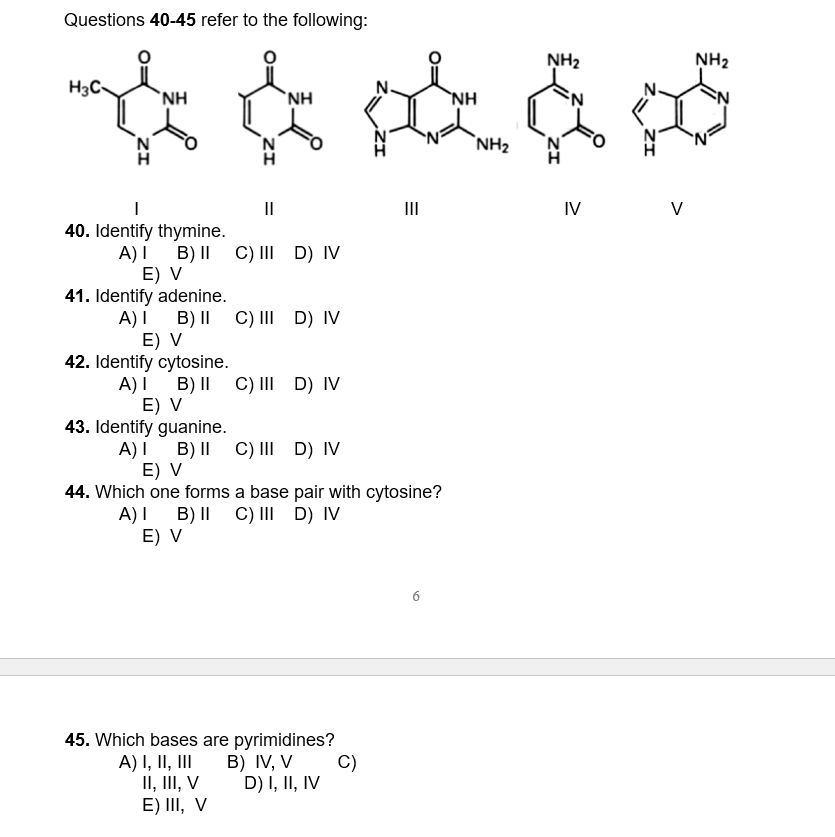
A, E, D, C, C, D
 Note
Note  Flashcards (44)