Week 2: social cognitions and attributions
 Studied by 0 people
 Call with Kai
 Learn
Learn Practice Test
 Spaced Repetition
 Match
Match Flashcards
 Knowt Play
1/75

There's no tags or description
Looks like no tags are added yet.
Name | Mastery | Learn | Test | Matching | Spaced | Call with Kai |
|---|
No study sessions yet.
76 Terms
What are the four stages of social encoding? (Penguins Forget Critical Evidence)
1. Pre-attentive analysis (automatic scanning),
2. Focal attention (conscious identification),
3. Comprehension (giving meaning),
4. Elaborative reasoning (linking to other knowledge).
What are the 5 different types of social cognitions?
Impression formation
Schemas
Stereotypes
Heuristics
Attributions
What is Asch's configuration model?
A model of impression formation that emphasises the role of central traits in shaping initial impressions, while peripheral traits are often ignored.
What are implicit personality theories?
Idiosyncratic and personal ways of characterising others, where certain traits are assumed to be associated with specific personality types.
What did Heilman and Stopeck (1985) find regarding attractiveness in executives? *
Attractive male executives were perceived as more capable than less attractive ones, while attractive female executives were perceived as less capable.
What did Van der Zanden (2022) discover?
Picture information not sufficient enough to form an impression about physical attraction
What did Kelley (1950) discover?
Impressions in a classroom (same person introduced as warm/cold): perceived as unsociable, ruthless and less likely to be asked questions when labelled as ‘cold’.
What is summation in relation to forming impressions?
Method of forming positive or negative impressions by combining the positive and negative traits of a person -> overall impression can be averaged or weighted averaging
What are the different types of schemas? Explain what these mean
Person schemas: about individuals - other people
Role schemas: about roles, e.g. pilot
Event schemas: scripts, e.g. going to a football match
Content-free schemas: limited rules for processing information, e.g. you should like someone if your friend also likes them
Self-schemas: sense of self and identity
What does social identity theory explain?
Group membership and intergroup relations through self-categorisation, social comparison, and creating a shared ingroup identity.
What are stereotypes?
Widely shared and simplified generalisations about a social group and its members, central to prejudice and discrimination.
What is the accentuation principle in categorisation?
Categorisation highlights similarities within groups and differences between groups based on traits people think are linked to those categories.
→ tendency to exaggerate differences between groups and minimise differences within groups when they are categorised
What is self-categorisation theory?
A theory by Turner and associates that describes how categorising oneself as a group member produces social identity and influences group behaviours.
What did Master et al (2021) discover about stereotypes?
–“Children as young as age six (…), across multiple racial/ethnic and gender intersections (Black, Latinx, Asian, and White; girls and boys) endorse steroetypes that girls are less interested than boys in computer science and engineering”
What did King et al (2021) discover about stereotypes?
“The social and cultural environment plays a large role in defining the cues by which young children classify on the basis of gender”.
→ found that young children at ages 3-5 are already aware and can apply stereotypes
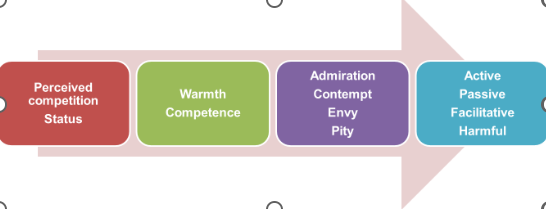
What is the stereotype content model (SCM) and what does it link?
Social psychology theory that posits that stereotypes are based on two fundamental dimensions: warmth and competence
High warmth, high competence → admiration
High warmth, low competence → pity
Low warmth, high competence → envy
Low warmth, low competence → contempt
It links perceived competition and status to emotions like admiration, contempt, envy, and pity, which influence behaviour.
What is the actor-observer effect?
The tendency to attribute one's own behaviour to external factors while attributing others' behaviour to internal factors.
What are the 2 reasons for the actor-observer effect?
Perceptual focus: Actor and observer have different perspectives on the behaviour, so interpret accordingly
Informational differences: Actor can draw on previous knowledge about their behaviour, observer cannot
What is external attribution?
Assigning the cause of behaviour to external or environmental factors.
What does Kelley's attribution theory focus on? (1967, 1973)
It focuses on how people identify the causes of behaviour using consistency, distinctiveness, and consensus.
Consistency – Does the person behave this way in similar situations over time?
Distinctiveness – Does the person react this way only to this stimulus or to many?
Consensus – Do others behave the same way in the same situation?
What occurs to attributions when consistency is low (Kelley’s covariation model)?
Where consistency is low, people discount the potential cause and search for an alternative
What occurs to attributions when consistency, distinctiveness and consensus is high?
Where consistency is high, and distinctiveness and consensus are also high, one can make an external attribution
What occurs to attributions when distinctiveness and consensus is low?
Where distinctiveness and consensus are low, one can make an internal attribution
Name some limitations of Kelley’s covariation model (1967, 1973).
Requires multiple observations
Requires observations from other people
Difficult to understand the cause of certain behaviour
Correlation not causation
Name some researchers and what they suggested about self-serving bias
To protect self-esteem (Berglas & Jones, 1978);
To preserve or enhance self-concept (Leary & Kowalski, 1990);
To convince oneself and others that the person is in control and is a good person (Higgins & Snyder, 1990).
What is the belief in a just world phenomenon?
The belief that the world is fair, leading people to think that individuals get what they deserve.
Belief that individuals have control over outcomes
Can regain control by taking some responsibility for an event
→ Cognitive consistency achieved
What is the illusion of control in relation to the just world phenomenon?
Belief of more control over our world than is true
What is the cognitive miser model?
A model of social cognition that suggests people use the least complex and demanding cognitions to produce adaptive behaviours.
What is the motivated tactician model? *
A model that characterises people as having multiple cognitive strategies that they choose based on personal goals and motives.
What is correspondence bias?
The tendency to overestimate the relationship between behaviour and personality, attributing behaviour to stable personality traits.
Name 4 causes of correspondence bias
–Lack of awareness
–Unrealistic expectations
–Inflated categorisations of behaviour
–Incomplete corrections of dispositional interferences
Lions Under Icy Igloos
What is intergroup attribution?
The process of assigning the cause of behaviour to group membership.
What are attributions in psychology?
How people explain their own and others' behaviour, involving social cognitions.
What are the 3 theories of attribution?
1. Theory of Naive Psychology – Heider (1958)
2. Covariation Model – Kelley (1967)
3. Attributional Theory – Weiner (1979, 1984, 1985)
What is the Theory of Naive Psychology?
Heider's theory that views people as 'naive scientists' interested in attributions, based on three principles: behaviour is motivated, stable properties help make sense of behaviour, and differentiation between personal and environmental causalities.
→ ordinary people try to seek causes for behaviour
Heider (1958)
What does the Covariation Model by Kelley propose?
People assess consistency, distinctiveness, and consensus to determine the cause of behaviour.
Kelley (1967)
What is consistency, distinctiveness and consensus in the Covariation Model?
Consistency = Whether a person behaves the same way in similar situations over time.
→ high/low consistency
Distinctiveness = Does the person react this way only to this stimulus or to many?
→ respond similarly to similar stimuli
Consensus = Whether others behave the same way in the same situation.
→ similar responses from others
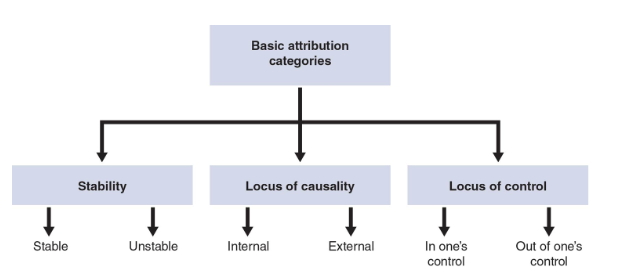
What is Attribution Theory according to Weiner?
A theory that explains attributions based on three performance dimensions: stability, locus of causality, and controllability.
Weiner (1979, 1984, 1985)
What did Napolitan and Goathals (1979) demonstrate about FAE?
Students attributed a friendly graduate's behaviour to her personality rather than the situational context.
What did Ross et al (1977) find in their study on FAE?
Pps assigned to 3 groups: questioners, pps and observers
Participants rated questioners as more knowledgeable despite knowing they had an advantage.
- Students talked with psych graduate who acted either warm and friendly, or cold and critical
- ½ of the students were told that the graduate's behaviour would either be spontaneous of instructed
-> when the graduate acted friendly, students believed she was friendly etc
•Students were randomly assigned to 3 groups: questioners, participants, and observers;
•Questioners were asked to come up with difficult questions which were then used to test the participants' knowledge;
•Even though everybody knew that the questioners had the advantage, they were rated as more knowledgeable than the contestants.
The application of FAE to group-level processes, explaining group behaviour.
•Prejudiced individuals explain:
-Negative outgroup behaviour as dispositional: internal factors
-Positive outgroup behaviour as situational
-Positive outgroup behaviour as anomalous
Attribution of causes of behavior depending on group membership, such as in-group vs. out-group differences.
→ refers to the way people explain the behaviour of members of their own group (ingroup) and other groups (outgroups) in biased ways that favour their own group.
What did Martin and Carron (2021) find about team-oriented attributions?
Meta-analysis of 21 studies
Athletes emphasised internal factors for wins and downplayed them for losses.
•Internal - external distinction has been questioned
•Concerns over empirical studies on attribution (unrealistic) confined to psych lab
•Research on FAE was found to be culturally specific rather than universal: focussed on Western cultures
•Questions raised about the way attributions are conceptualised as private mental events - shared aspects of attributions within a society or group?
 Note
Note  Flashcards (87)