EDUC 251 - EdPsych
 Call Kai
 Learn
Learn Practice Test
 Spaced Repetition
 Match
Match Flashcards
 Knowt Play
1/109

There's no tags or description
Looks like no tags are added yet.
Name | Mastery | Learn | Test | Matching | Spaced | Call with Kai |
|---|
No analytics yet
Send a link to your students to track their progress
110 Terms
Transfer
The ability to extend what has been learned in one context to new contexts
Low Road Transfer
Involves the spontaneous, automatic transfer of highly practiced skills, with little need for reflective thinking. Results from extensive practice of a skill in a variety of contexts until it becomes flexible and developed to automaticity
High Road Transfer
An individual purposely and consciously applies general knowledge, a strategy, or a principle learned in one situation to a different situation. Mindful abstraction is the defining feature
Positive Transfer
Previous learning benefits learning on new tasks
Negative Transfer
Previous learning hinders learning on new tasks
Zero Transfer
Previous learning has no effect on the performance of a new task
Near Transfer
involves applying prior knowledge to new situations that are very similar, but not identical to, the learning context
Far Transfer
applying prior knowledge to a context that is very different from the learning context
Vertical Transfer
Using what you previously know to understand a more complex topic (ex. using add., sub., and mult. principles to learn division)
Lateral Transfer
Using what you previously know to understand a topic of equal complexity (ex. using math to understand population on a map)
Specific Transfer
Edward Thorndike’s theory (1923, 1924) that transfer will occur between two learning tasks if the new skill or behavior contains elements that are identical to a skill or behavior from the original task
General Transfer
Proposes that broad-based cognitive faculties can “leap” across very different learning situations because these general abilities are the same in both contexts
Abstraction
The process of retrieving meaningful information (that has been consciously learned and actively memorized) and applying it to a new learning context.
Metacognition
Our awareness, monitoring, and regulation of our thinking
Problem-Solving Transfer
Type of high road transfer: A general strategy or principle that we have learned from solving one type of problem and apply it to solve another type of problem
Analogical Transfer
Type of high road transfer: involves creating or using an existing analogy to aid in understanding a new concept (ex. orbit of planet similar to orbit of electron)
Forward-Reaching Transfer
Type of high road transfer: involves learning a principle or strategy so well that an individual selects it quickly and easily when it is needed in future situations (ex. student with deep understanding of geometry easily using principles in other classes, future career, etc.)
Backward-Reaching Transfer
Type of high road transfer: occurs when an individual deliberately looks for strategies or principles learned in the past to solve a current problem or task
Recognition
Ability to detect a link between the new situation and prior knowledge
Mapping
Making appropriate connections between the original and the new problem
Convergent Thinking
Obtaining the right answer to a question
Learning Context
The situation in which the original knowledge is transferred from
Transfer Context
The situation in which the knowledge is transferred to
Framing
The meta-communicative act of characterizing what is happening in a given context and how different people are participating in it
Bounded
Type of framing that discourages students from later using what they learn
Expansive
Type of framing that encourages students from later using what they learn
Zone of Proximal Development
Activity is too hard to do independently, but is achievable with help. In between “too tough” and “easy peasy”. Developed by developmental psychologist Leo Vygotsky
Scaffold
Temporary structure that can come down once the building can stand on its own. Analogous to a method of supporting students in their learning.
Contiguity Learning
Learning by association
Generalization
Learning can be expanded beyond a specific stimulus to other, similar stimuli
Discrimination
Species can learn to differentiate between similar but different stimuli
Extinction
If the conditioned stimulus is presented repeatedly without the unconditioned stimulus, the previously learned behavior will disappear
Law of Effect
Behaviors associated with good consequences (satisfiers) are more likely to occur again in the future, whereas behaviors associated with bad consequences (annoyers) are less likely to occur again. Edward Thorndike (1874-1949)
Ratio Schedule
Type of intermittent reinforcement schedule: based on the number of times a behavior occurs
Interval Schedule
Type of intermittent reinforcement schedule: Based on the time elapsed after a behavior occurred
Fixed schedule
Type of intermittent reinforcement schedule: occurs exactly every third time or 5 minutes. Individuals know when to expect it
Variable Schedule
Type of intermittent reinforcement schedule: occurring every third time or 5 minutes on average but not always
Sensory
Type of memory that
Working
Type of memory that
Long-Term
Type of memory that
Information Processing Model
Helps us understand how various cognitive processes such as attention and memory can influence our ability to learn information
Bottom-Up
Type of processing that uses pieces of information (ex. lines and curves) to understand a more complicated concept (letter e)
Top-Down
Type of processing that uses prior knowledge (ex. women are smaller than skyscrapers) to perceive stimuli (picture of woman who appears larger than a skyscraper)
Fading
Removing scaffolding as student gradually masters concept or skill
Sociodramatic Play
Particular form of pretend play in which children jointly create and act out an imaginary context
Spontaneous Concepts
unsystematic, unconscious, and sometimes incorrect ideas generalized from children’s everyday concrete experiences
Semiotic Functions
Term by Piaget. Psychological and cultural tools to mediate the child’s thinking and shape the development of more complex thought
Intersubjectivity
Process in which two individuals who begin a task with different knowledge and perspectives comes to a shared understanding as each person adjusts to the perspective of the other. Also known as a co-construction of knowledge.
Sensorimotor
One of the four stages of Piaget’s theory: birth-2 years. Infants construct knowledge from sensory perceptions. They do not realize that they exist as separate entities apart from objects or that objects exist apart from them. Also included in this stage is the development of object permanence.
Preoperational
One of the four stages of Piaget’s theory: 2-7 years. Children develop the ability to represent an object or action with signs and symbols, such as language, imagery, drawing, symbolic games, and deferred imitation. Operations are limited to one-way thinking. Children cannot engage in reversibility of operations (ex. 5 coins together vs. spread out).
Concrete Operational
One of the four stages of Piaget’s theory: 7-11 years. Able to mentally reverse operations / engage in two way thinking.
Formal Operational
One of the four stages of Piaget’s theory: 11 years - adult. Children exhibit abstract reasoning, and can engage in a debate, write a critical analysis, or consider future career plans.
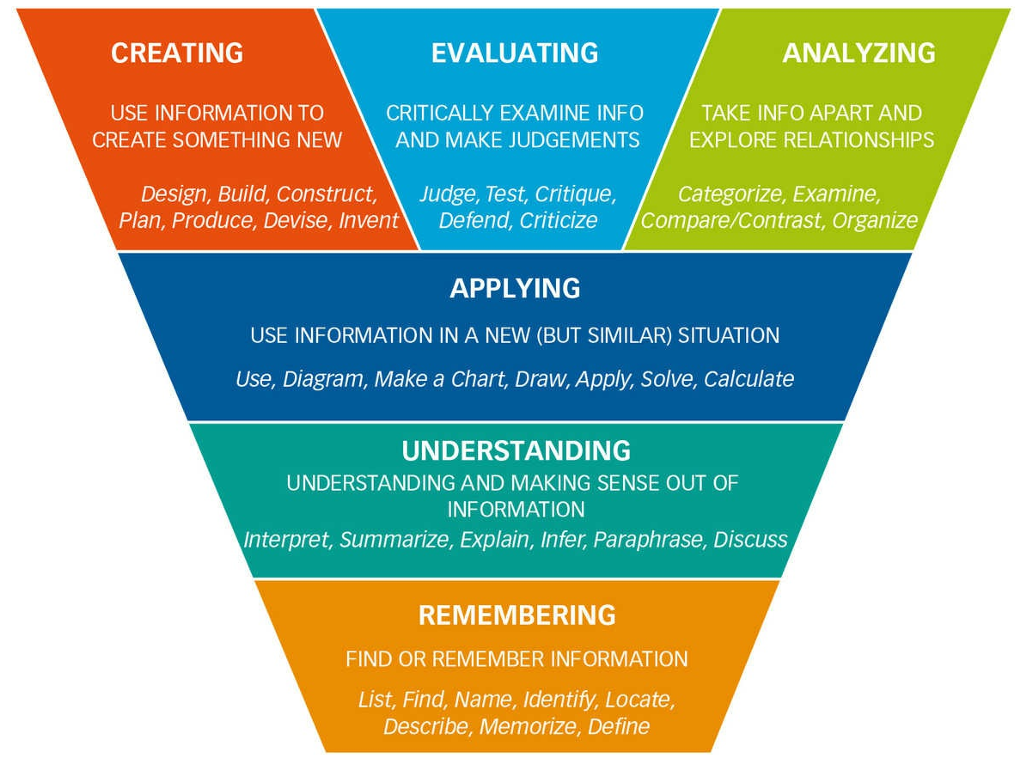
Remember
First of six levels of Bloom’s taxonomy: Memorizing facts or information learned earlier without necessarily understanding or being able to use that knowledge (e.g., list or define)
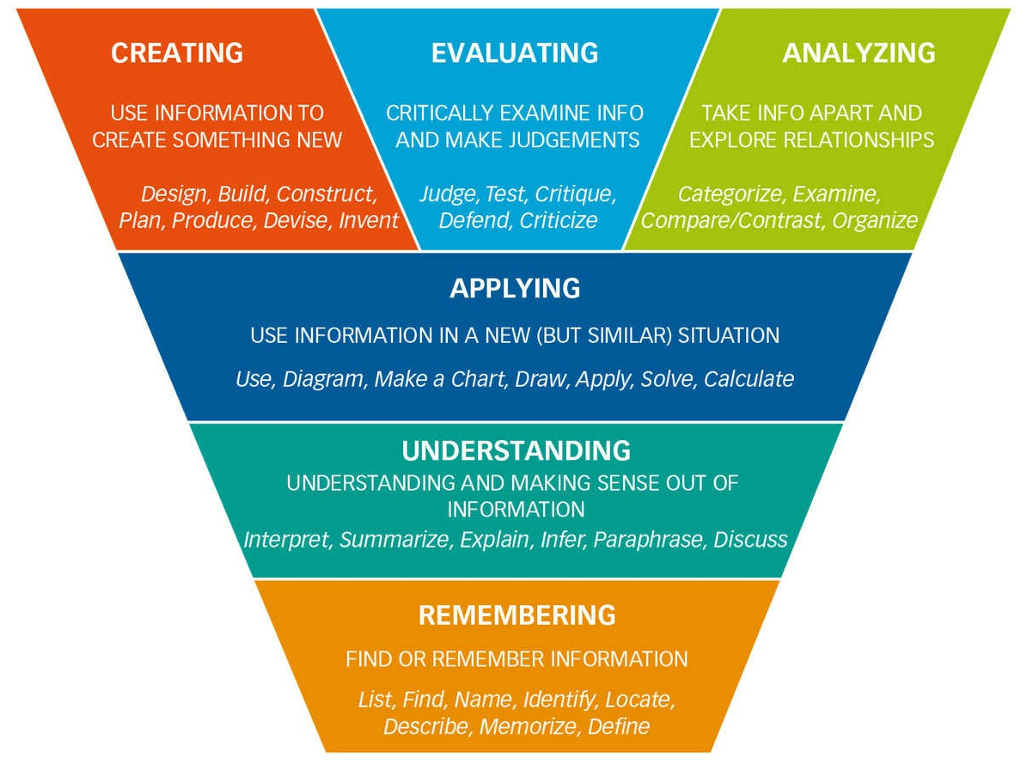
Understand
Second of six levels of Bloom’s taxonomy: Making sense of information without connecting the information to prior knowledge (e.g., explain or summarize)
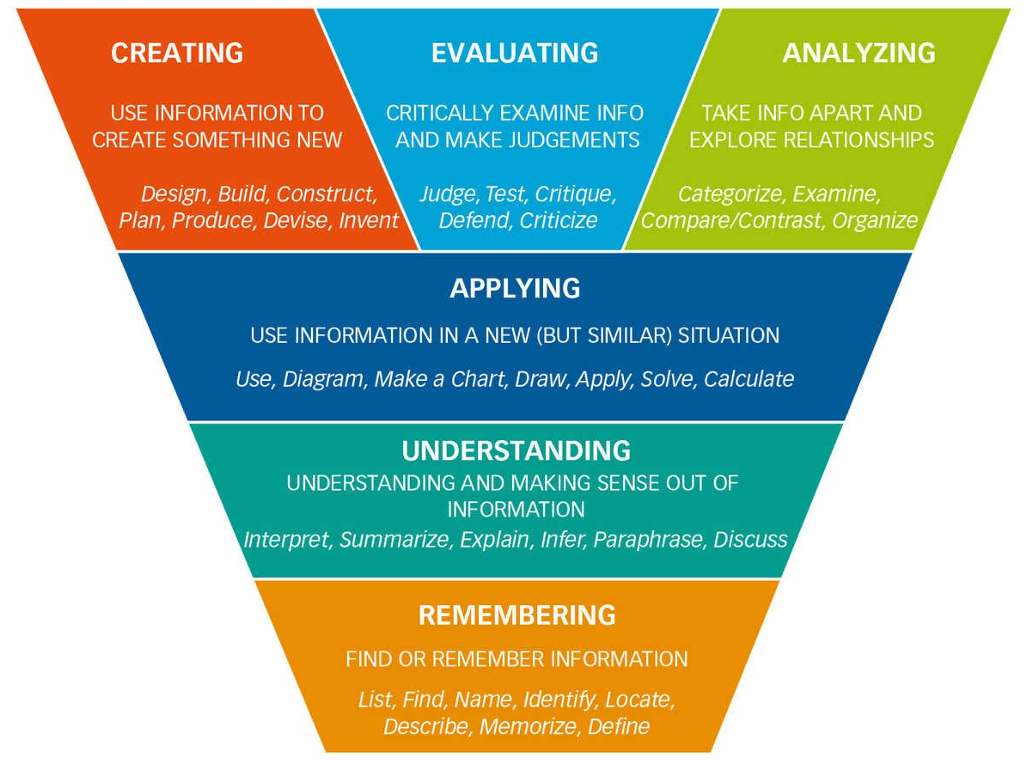
Apply
Third of six levels of Bloom’s taxonomy: Selecting and using information to solve a problem or specific task (e.g., demonstrate, compute)
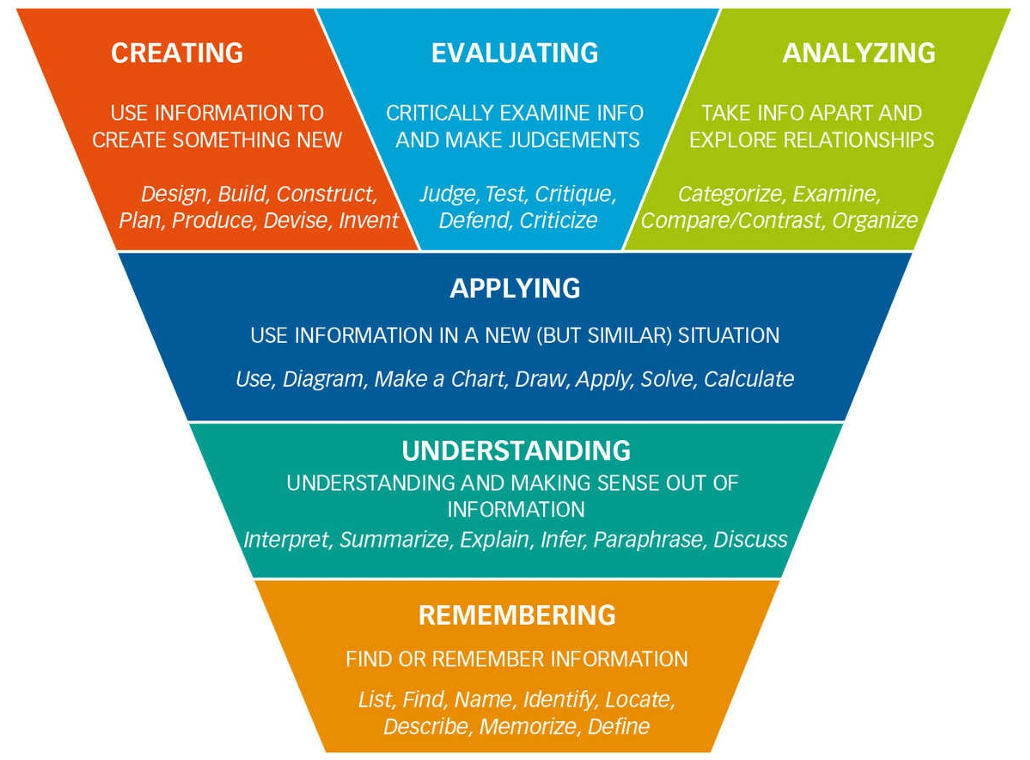
Analyze
Fourth of six levels of Bloom’s taxonomy: Breaking information or knowledge into parts and possibly making connections between those parts (e.g., compare, contrast)
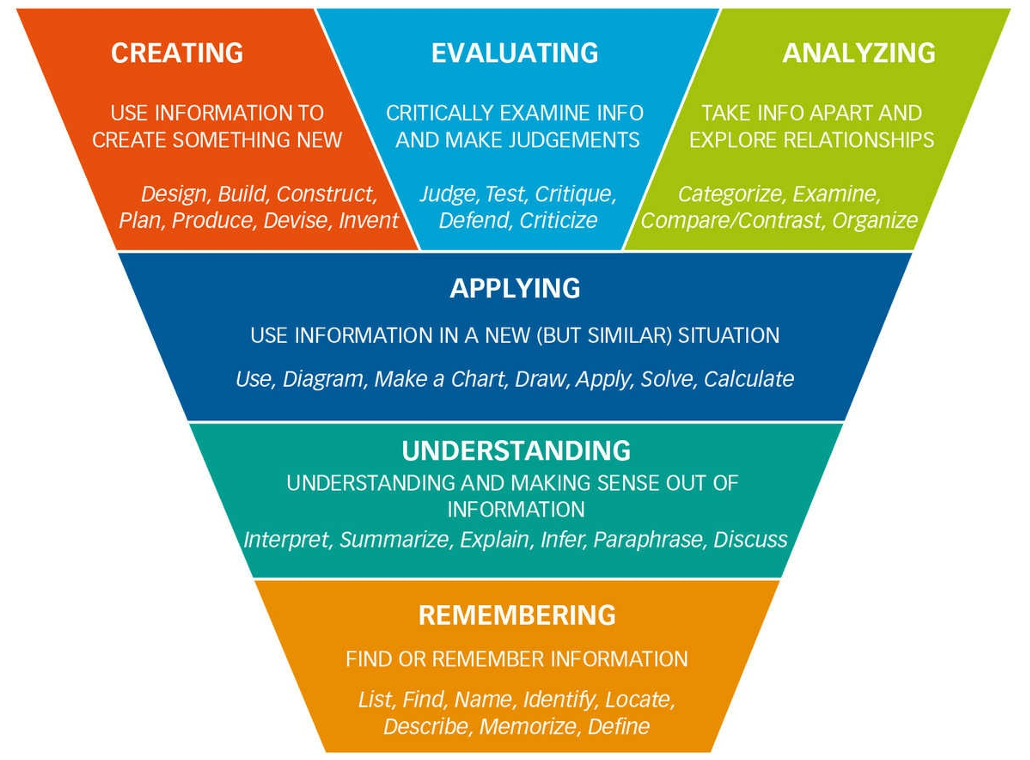
Evaluate
Fifth of six levels of Bloom’s taxonomy: Making judgments about the value of information for a particular situation (e.g., assess, critique)
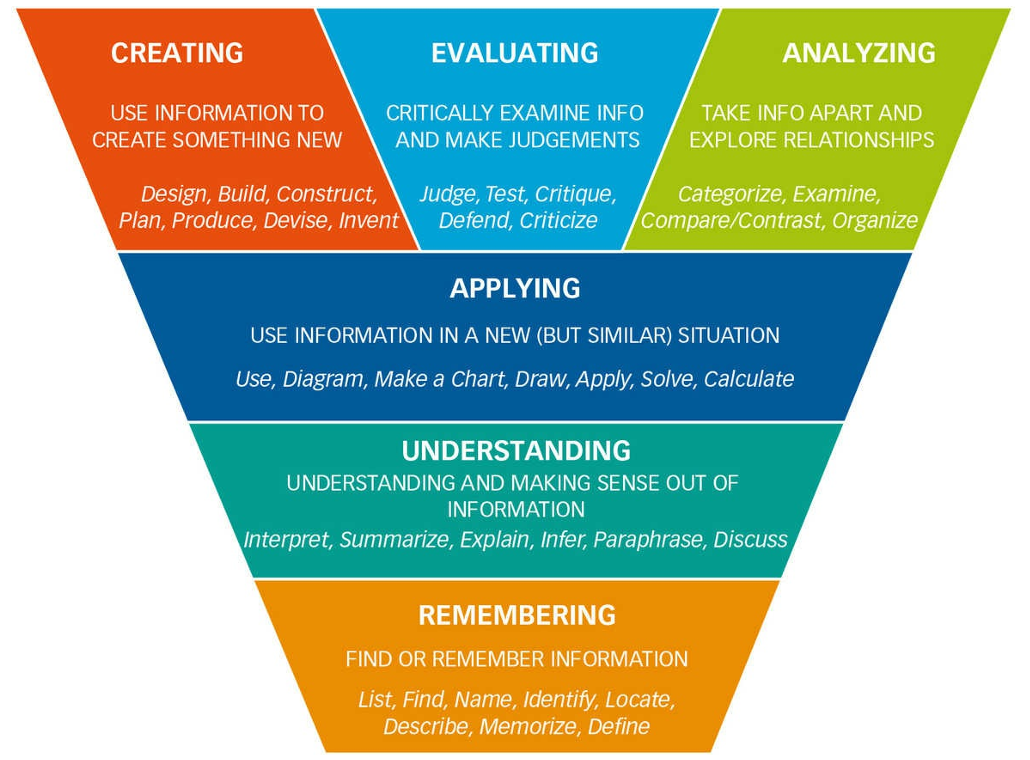
Create
Sixth of six levels of Bloom’s taxonomy: Creating or generating new ideas by combining information (e.g., produce, develop)
Identify
IDEAL problem solving method: i__ the problem. Initial state, goals, and constraints
Define
IDEAL problem solving method: D__ goals and represent the problem. Determine how best to ask the question or consider the problem
Explore
IDEAL problem solving method: E__ possible solutions. Identify possible options and strategies that might be used to solve the problem. Do not yet evaluate those strategies
Anticipate
IDEAL problem solving method: A__ outcomes and act. Consider consequences of possible strategies and choose a strategy
Look
IDEAL problem solving method: L__ back and learn. Determine how well that strategy worked and consider how to approach similar problems in the future
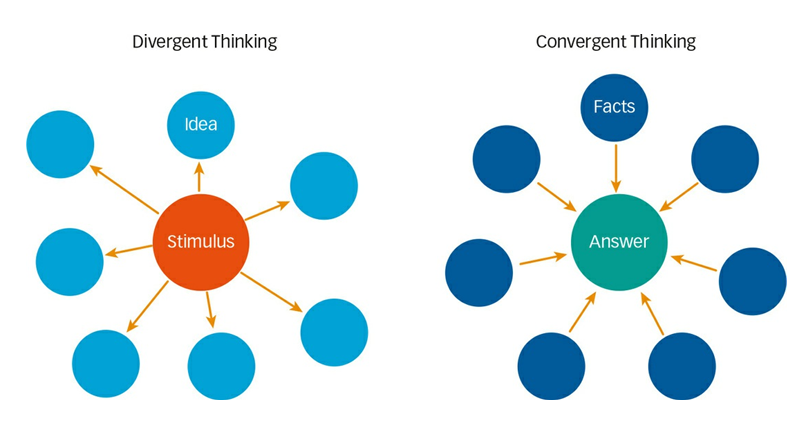
Convergent
Type of thinking that involves the ability to give one “correct” answer based on previous knowledge
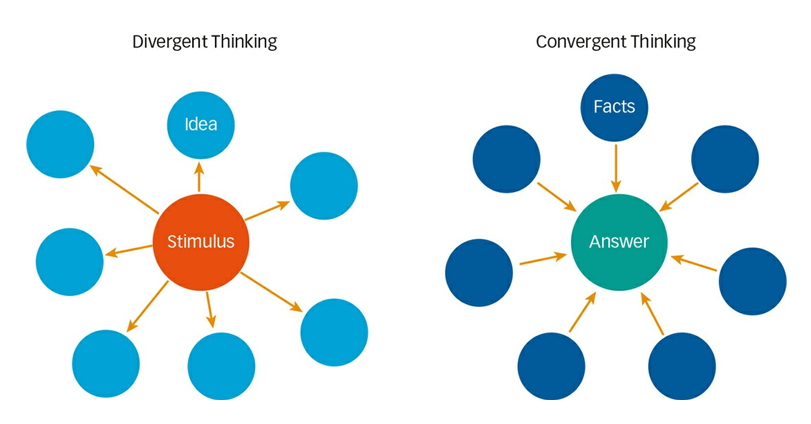
Divergent
Type of thinking that offers many solutions based on previous ideas
Interactive
Part of the ICAP framework:
Constructive
Part of the ICAP framework:
Active
Part of the ICAP framework:
Passive
Part of the ICAP framework:
ICAP Hypothesis
Interactive → Constructive → Active → Passive
Inductive
Type of reasoning in which a body of observations make up a general principle
Deductive
Type of reasoning where conclusions are drawn from general principles
ICAP Framework
Interactive → Constructive → Active → Passive
Interactive
Stage in ICAP framework in which information is discussed back and forth between more than one individual
Constructive
Stage in ICAP framework in which information is processed and recorded in one’s own words
Active
Stage in ICAP framework in which information is received and recorded word for word (ex. writing down teacher’s words in lecture)
Passive
Stage in ICAP framework in which information is received, but not used (ex. listening to teacher during lecture). Needs a cue to be recalled
Gap Filling
Process where the learner assimilates or integrates new information into activated schema, thereby making it more complete
Inferring
Process of elaborating, such as adding more details or qualifications
Revising
Process of changing what was initially stored but incorrect. Also known as repairing
Reorganizing
Changing hierarchical relations, or pattern of relationships
Reflecting
Student evaluates what he or she does or does not understand in order to carry out a constructive activity such as generating a question
co-inferring
Learners A and B (LA & LB) are both exposed to base information (Knowledge 1).
LA activates his/her own knowledge relevant to K1 (Schema A).
LA makes inference from SA (Inference 1)
LA shares i1 with LB
LB activates Schema B (SB) relevant to K1 + i1
LB makes Inference 2 (i2) based on Schema B
This is the process of __________
Bloom’s Taxonomy
Culturally Responsive Teaching
Using students’ customs, characteristics, experience, and perspectives as tools for better classroom instruction
Asset-Based Pedagogies
Teaching methods and strategies that focus on the strengths of all students and value diversity in culture, language, and other traits.
Community funds of knowledge
Also known as FoK
Trust Vs Mistrust
First of eight stages of Erikson’s development:
Occurs during infancy
Caregivers are dominant environmental an social influences
Positive outcome: Needs met. Infant learns to trust the world
Negative outcome: Needs not met. Infant develops a sense of mistrust
Autonomy Vs Shame
Second of eight stages of Erikson’s development:
Occurs during toddlerhood
Children continue to be influenced by caregivers’ responses
Individual attempts to do things on their own (walking, playing alone)
Positive outcome: Opportunities for freedom provided. Sense of autonomy instilled
Negative outcome: Parents are punitive / overprotective. Sense of doubt in individual’s own capability instilled
Initiative Vs Guilt
Third of eight stages of Erikson’s development:
Occurs during preschool age
Increased interaction among peers
Positive outcome: Child is rewarded for trying new things. Sense of initiative is developed
Negative outcome: Doing everything for the child / being overprotective / punitive. Guilt is instilled
Industry Vs Inferiority
Fourth of eight stages of Erikson’s development:
Occurs during school age
Child learns to master skills (reading, school subjects, sports, etc.)
Teachers and peers become increasingly influential
Positive: Influences (caretakers, peers) provide opportunities for child to complete tasks.
Negative: Influences don’t provide. Child does not feel competent
Identity Vs Identity Diffusion
Fifth of eight stages of Erikson’s development:
Occurs during adolescence
Individual’s own internal state and family / peers / school are influential
Goal is to develop a clear sense of self
Need for psychosocial moratorium (time with few responsibilities and opportunities to explore roles)
Familial / educational aspirations / career goals / morals and values considered
Intimacy Vs Isolation
Sixth of eight stages of Erikson’s development:
Occurs during young adulthood
Focused on developing close, personal relationship (not just romantic)
Positive: Close, long lasting relationships
Negative: Moving from one relationship to another. Fear of rejection
Generativity Vs Stagnation
Seventh of eight stages of Erikson’s development:
Occurs during middle adulthood
Focused on giving back to the next generation
Positive: Individual feels they have given to society
Negative: Individual feels they failed to contribute and are bored with life
Most teachers at this stage for most of their career
Integrity Vs Despair
Eighth of eight stages of Erikson’s development:
Occurs during late adulthood
Positive: Feeling that life was worth living. No fear of death
Negative: Dissatisfaction with one’s life. Desire for one more time
Emergent
Characteristic of a(n) ______ connection
Emergent
Characteristic of a(n) ______ connection
Transitional
Characteristic of a(n) ______ connection
Transitional
Characteristic of a(n) ______ connection
Meaningful
Characteristic of a(n) ______ connection