Ecology
 Call Kai
 Learn
Learn Practice Test
 Spaced Repetition
 Match
Match Flashcards
 Knowt Play
1/52

There's no tags or description
Looks like no tags are added yet.
Name | Mastery | Learn | Test | Matching | Spaced | Call with Kai |
|---|
No analytics yet
Send a link to your students to track their progress
53 Terms
Genetic Variation
Members of a population often vary in their inherited traits
overreproduction
All species can produce more offspring than the environment can support, and many of these offspring fail to survive and reproduce
Natural Selection summary
Individuals with certain heritable characteristics survive and reproduce at a higher rate than other individuals
Natural selection increases the adaptation of organisms to their environment over time
If an environment changes over time, natural selection may result in adaptation to these new conditions and may give rise to new species
Evolution
Describes the fact that genetic composition has changed over time
Is the explanation for life’s unity and diversity
Homology
A similarity resulting from common ancestry
Vestigial Structures
are remnants of features that served important functions in the organism’s ancestors
Vestigial Structures
are remnants of features that served important functions in the organism’s ancestors
Evolutionary Trees
hypotheses about the relationships among different groups
Divergent Evolution
branching from a common ancestor- Two or more species diverge from a common ancestor (ex. elephants and wooly mammoths)
Convergent Evolution
Two or more species share traits NOT due to a common ancestor (ex. birds, bats, butterflies)
Analogous Structures
Different structure, similar function
Not from a common ancestor
Ex. bird wing and insect wing
Population
a localized group of individuals belonging to the same species
Species
a group of populations who have the potential to interbreed and produce fertile offspring in future
Gene pool
total aggregate of genes in a population at any one time (all alleles at all loci)
Microevolution
is a change in allele frequencies in a population over generations
Three main causes of microevolution
natural selection, genetic drift, and gene flow
Genetic Drift
describes how allele frequencies fluctuate unpredictable from one generation to the next. chance events lead to changes in the gene pool of small areas.
Founder Effect
Occurs when a few individuals become isolated from a larger population allele frequencies in the small founder population can be different from those in larger populations
Bottleneck effect
is a sudden reduction in population size due to chance in the environment, if population stays small it may be further affected by gene drift
Gene flow
consists of movement of alleles among populations (migration) ex. pollen and reduces genetic variation
Natural selection is the only mechanism that
consistently causes adaptive evolution
Relative fitness
the contribution an individual makes to the gene pool of the next generation, relative to the contributions of others
Reproductive Success
generally more subtle and depends on many factors
Sexual Selection
natural selection for mating success, result in sexual dimorphism
Intrasexual selection
competition (male)
Intersexual selection
mate choice (female)
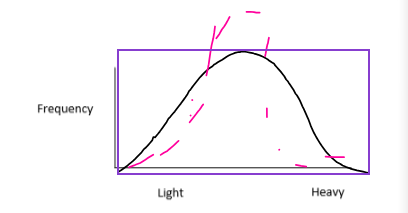
Stabilizing selection
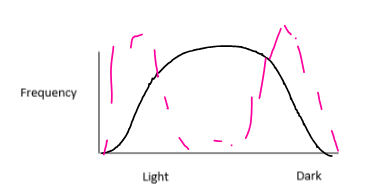
Disruptive selection
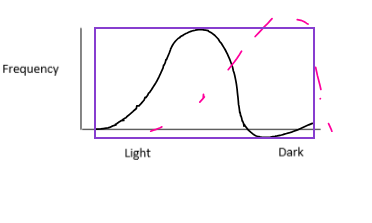
directional selection
P=
frequency of the dominant allele in the population
Q=
frequency of the recessive allele in the population
p²
frequency of homozygous dominant individuals
q²
frequency of homozygous recessive individuals
2pq
frequency of heterozygous individuals
Speciation
the origin of new species, is at the focal point of evolutionary theory
microevolution
consists of changes in allele frequency in a population over time
macroevolution
refers to broad patterns of evolutionary change above the species level
What do we actually mean when we talk about species
is a group of organisms that can produce viable fertile offspring
How are different species separated (what do we mean by reproductive isolation)
the existence of biological factors that impede two species from producing viable, fertile offspring.
Prezygotic
barriers that prevent fertilization from happening
Postzygotic
Reasons after fertilization happens that prevents
Habitat isolation
two species encounter each other rarely or not at all because they occupy different habitats even though not isolated by physical barriers
Behavioral isolation
courtship rituals and other behaviors unique to a species are effective barriers
Temporal Isolation
species that breed at different times of the day, seasons, and years cannot mix gamates.
Mechanical isolation
morphological differences can prevent successful mating
gametic isolation
sperm of one species may not be able to fertilize eggs of another
reduced hybrid viability
genes of the different parent species may interact and impair the hybrids development
reduced hybrid fertility
even if hybrids are vigorous they may be sterile
hybrid breakdown
some first gen hybrids are fertile but when they mate with another species offspring of next gen dies off
Allopatric speciation
a population forms a new species while geographically isolated from the parent
sympatric speciation
a subset of a population forms a new species without geographic isolation
punctuated equilibrium
to describe periods of apparent stasis punctuated by sudden change
Gradualism
changes occur slowly and steadily over long period of time

