Unit 1 Reading Section B
 Studied by 0 people
 Call Kai
 Learn
Learn Practice Test
 Spaced Repetition
 Match
Match Flashcards
 Knowt Play
1/43

There's no tags or description
Looks like no tags are added yet.
Name | Mastery | Learn | Test | Matching | Spaced | Call with Kai |
|---|
No analytics yet
Send a link to your students to track their progress
44 Terms
What dictates the use of different line types to fully illustrate a part or unit?
Drawing practices.
What do section lines indicate on a drawing?
Differences in types of materials and exposed surfaces.
What key information is found in the title block of an aircraft drawing?
Unit name, drawing number, scale, size, material, standards of manufacture (and other important details).
What does the revision block show, and what must you verify?
It shows the particular revision; always verify you’re using the latest revision.
What do fuselage station numbers identify, and from what reference are they measured?
They identify locations fore and aft along the fuselage; measured from station zero (the datum).
Define visible lines:
A line on an engineering drawing that represents a portion of an object that can be seen.
Define hidden lines:
Lines used in drawings to indicate invisible edges or contours.
Define center lines:
In aircraft drawings, the alternate long and short dashes indicating the center of an object or part of an object.
Define extension lines:
The lines on a technical drawing that extend from a view for the purpose of identifying a dimension.
Define dimension lines:
A light solid line broken at its midpoint for insertion of measurement indications. Dimension lines typically have outward-pointing arrowheads at each end to show origin and termination of a measurement.
Define cutting-plane lines:
A line used in aircraft drawings that consists of alternating medium or heavy dashes and two short dashes with an arrowhead at each end. This line indicates the plane in which a sectional view of an object is taken.
Define phantom lines:
Thin lines made of alternating long dashes and two short dashes. Used to show an alternate position or a missing part in a mechanical drawing.
Define break lines:
A line used in drawings to indicate that a portion of the object is not shown.
Define leader lines:
A light line with an arrowhead that extends from a note, number, or box in an illustration to a part.
Define section lines:
The crosshatching used in a cutaway section of an aircraft drawing to identify a type of material.
Define nominal dimensions:
A dimension on a drawing that represents the basic size of the part shown.
Define fuselage station numbers:
Distances measured along the longitudinal axis of an airplane; represent distances from the datum in inches.
Define datum:
An arbitrary reference line from which all measurements are made when determining the moments used for weight-and-balance computations. Also called the datum line.
Define water lines:
A vertical line used to locate a position on the fuselage of an aircraft; the zero reference is called water line zero.
Define buttock lines:
A measurement of width, left or right of, and parallel to, the longitudinal axis. Also referred to as BL or butt line.
Define wing stations:
Points measured from the centerline of an aircraft (buttock line zero) toward the wing tip; indicates the distance in inches from the centerline.
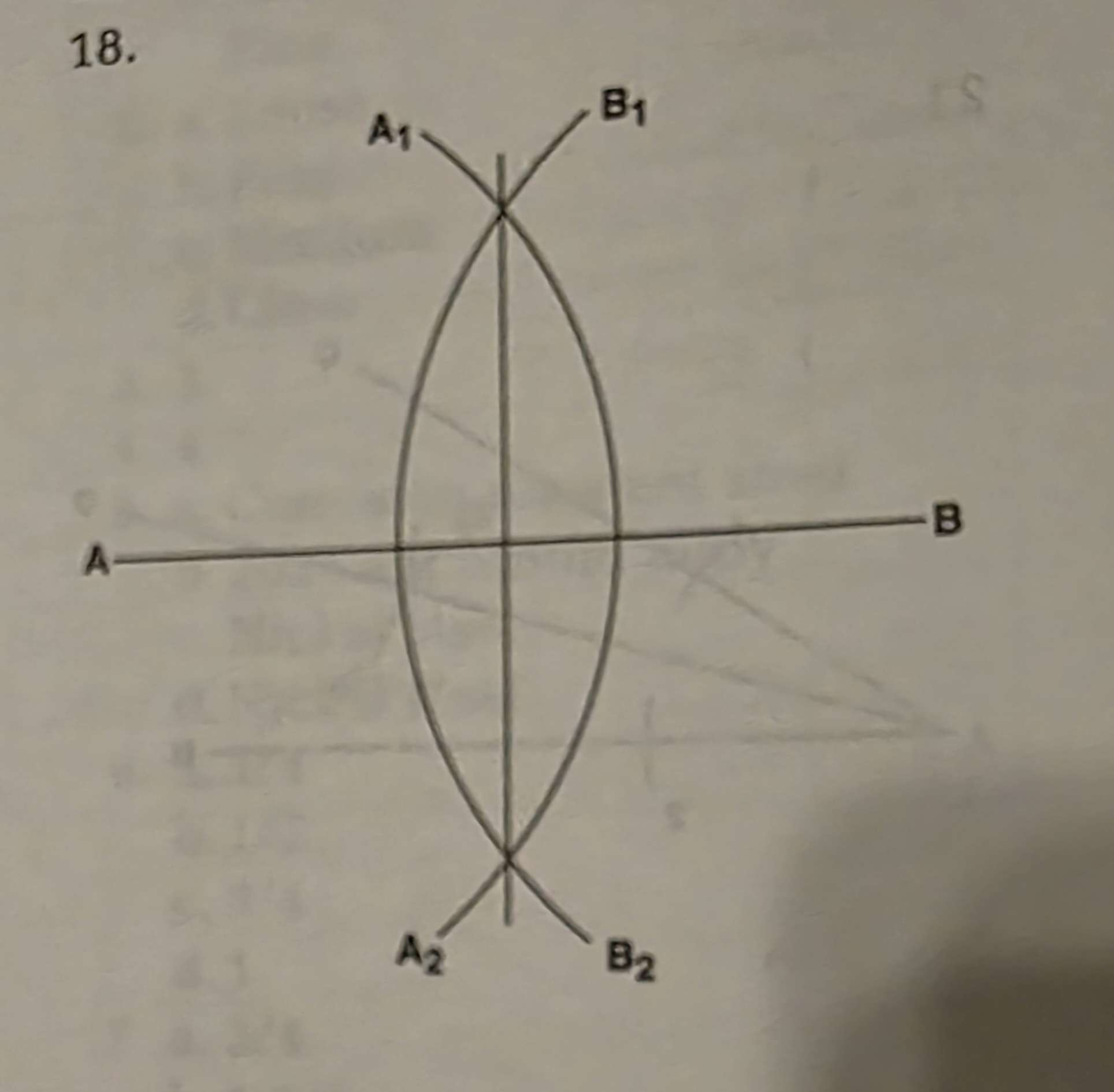
Define perpendicular bisector:
In applied geometry, a line that bisects another line at 90 degrees, dividing it into two halves.
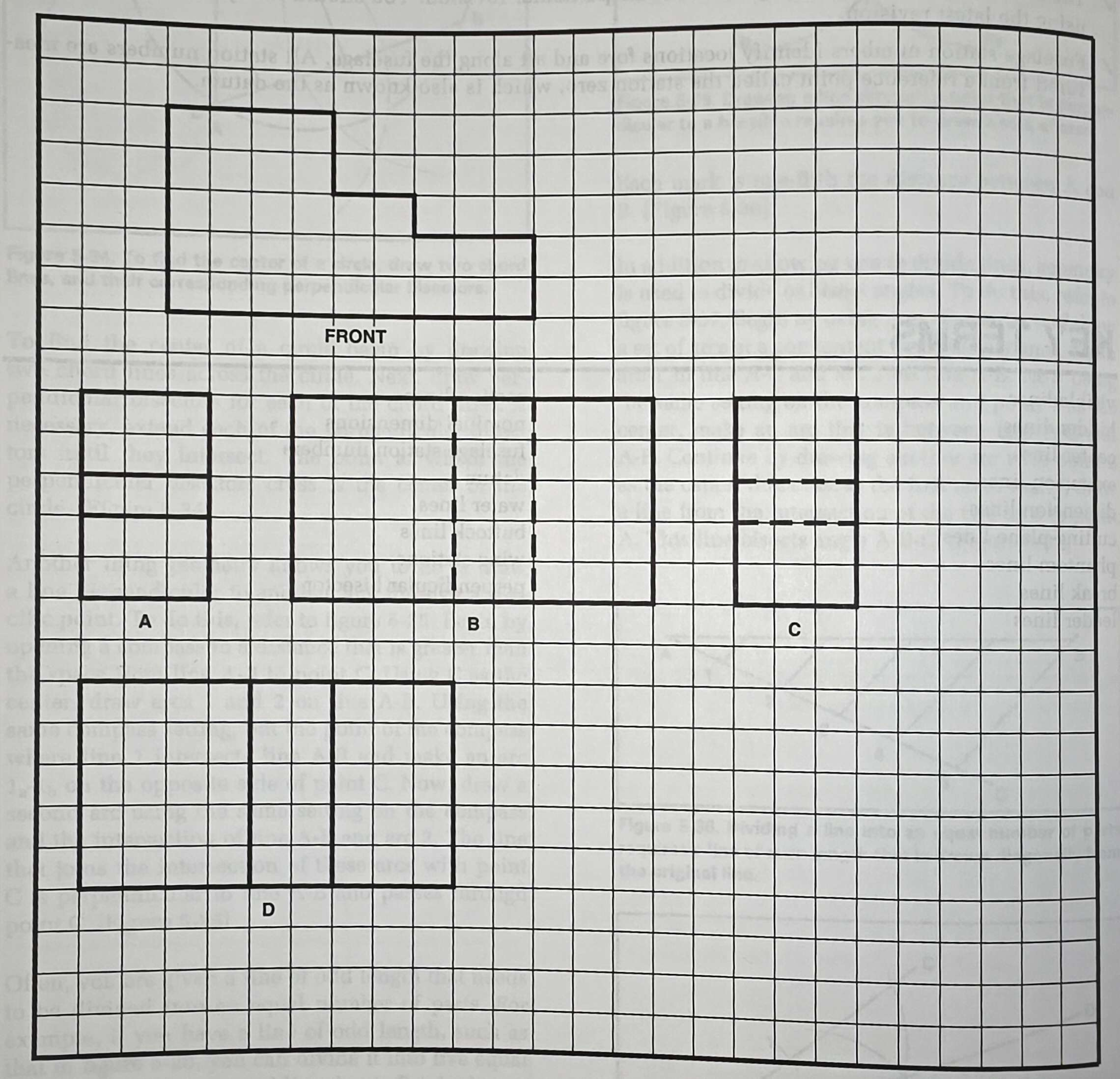
Identify each view in this orthographic projection:
Right = _______ Left = _______ Bottom = _______ Top = _______
Right = A Left = C Bottom = B Top = D
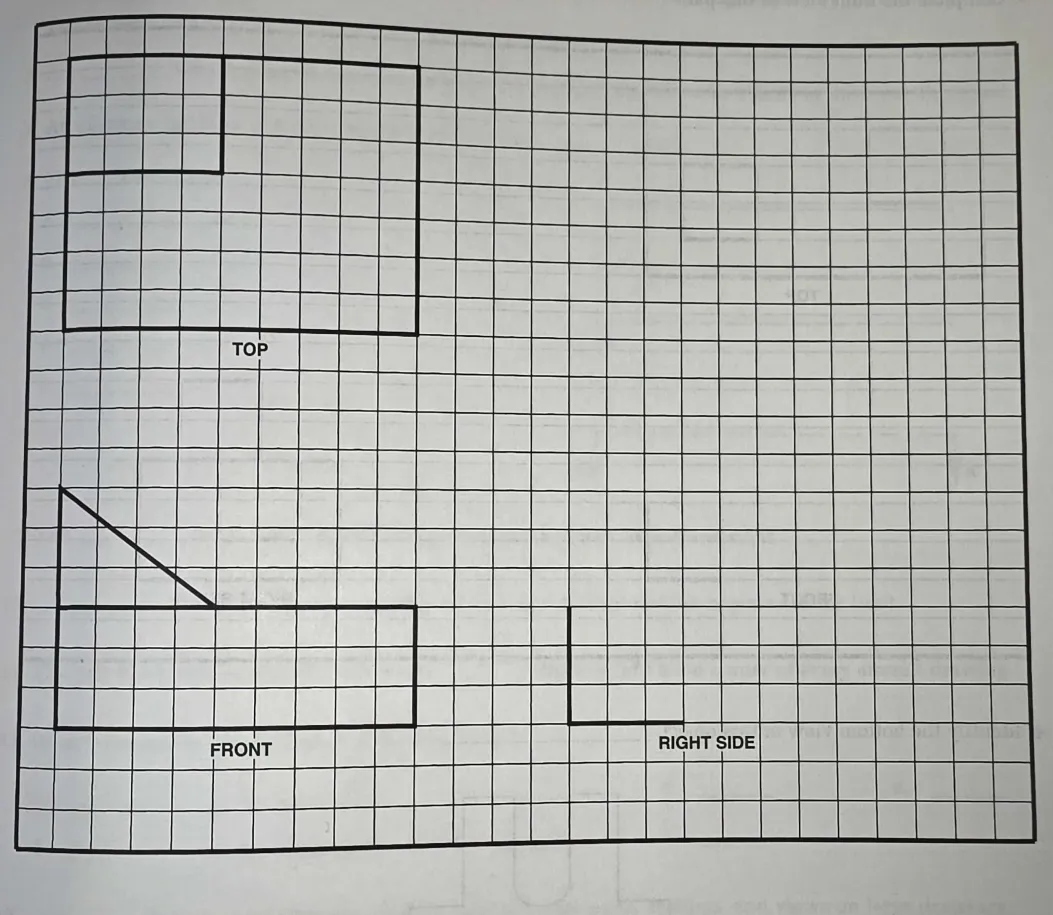
Complete the right side view of this part.
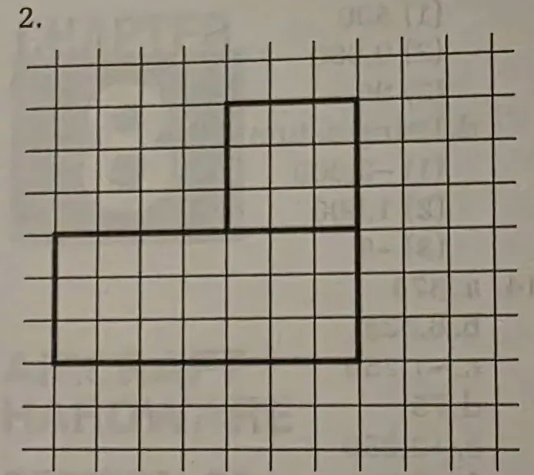
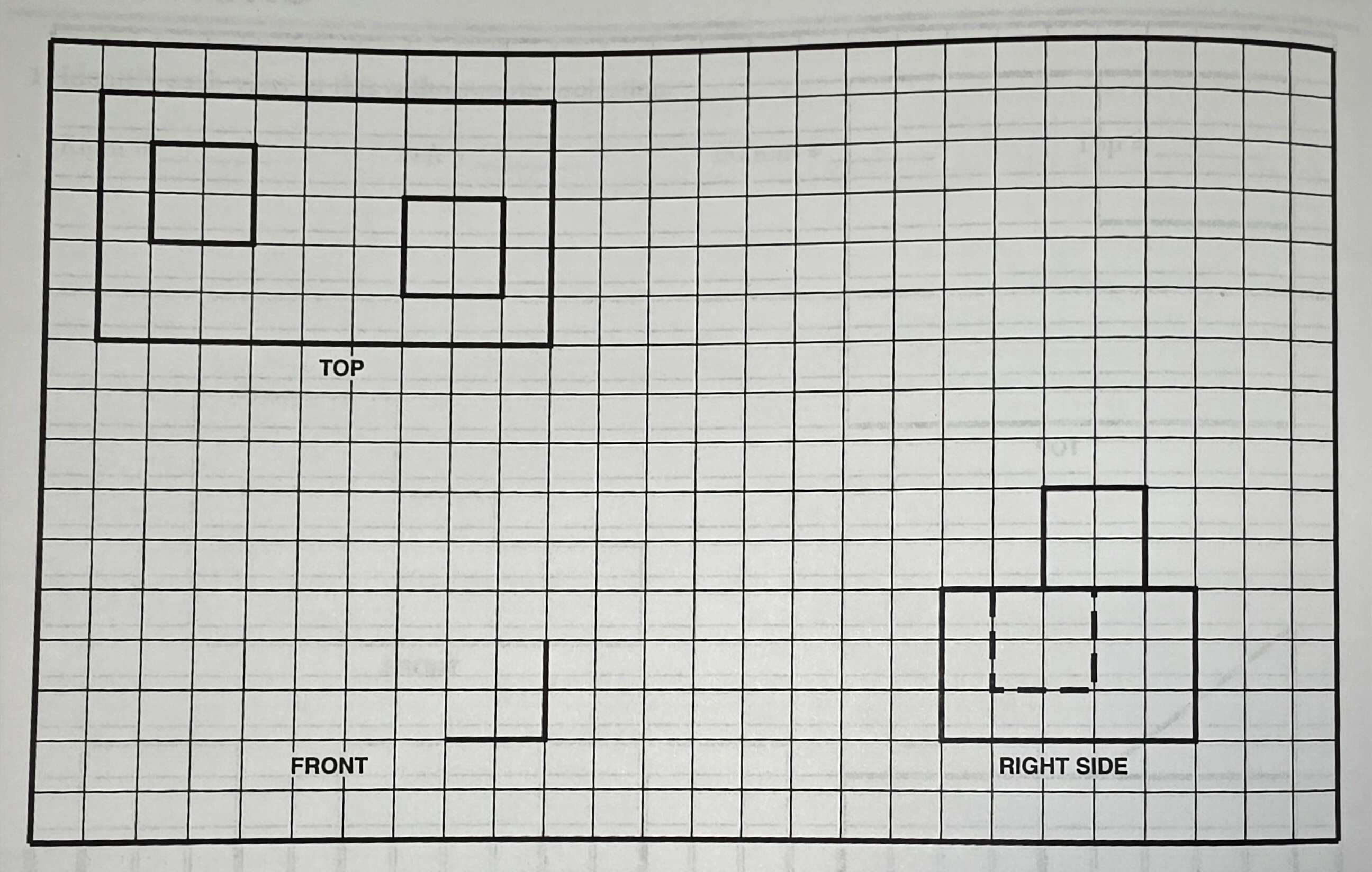
Complete the front view of this part.
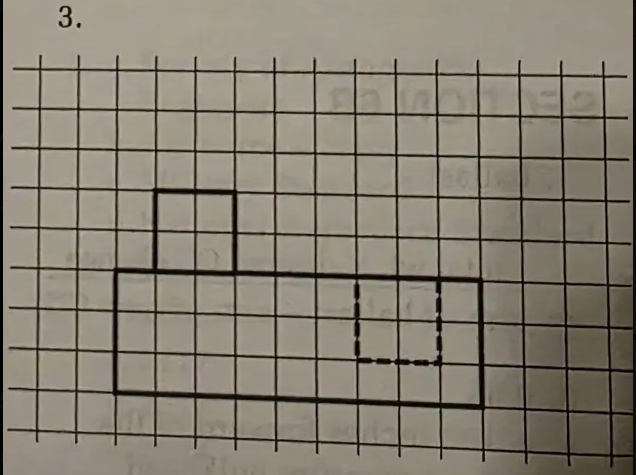
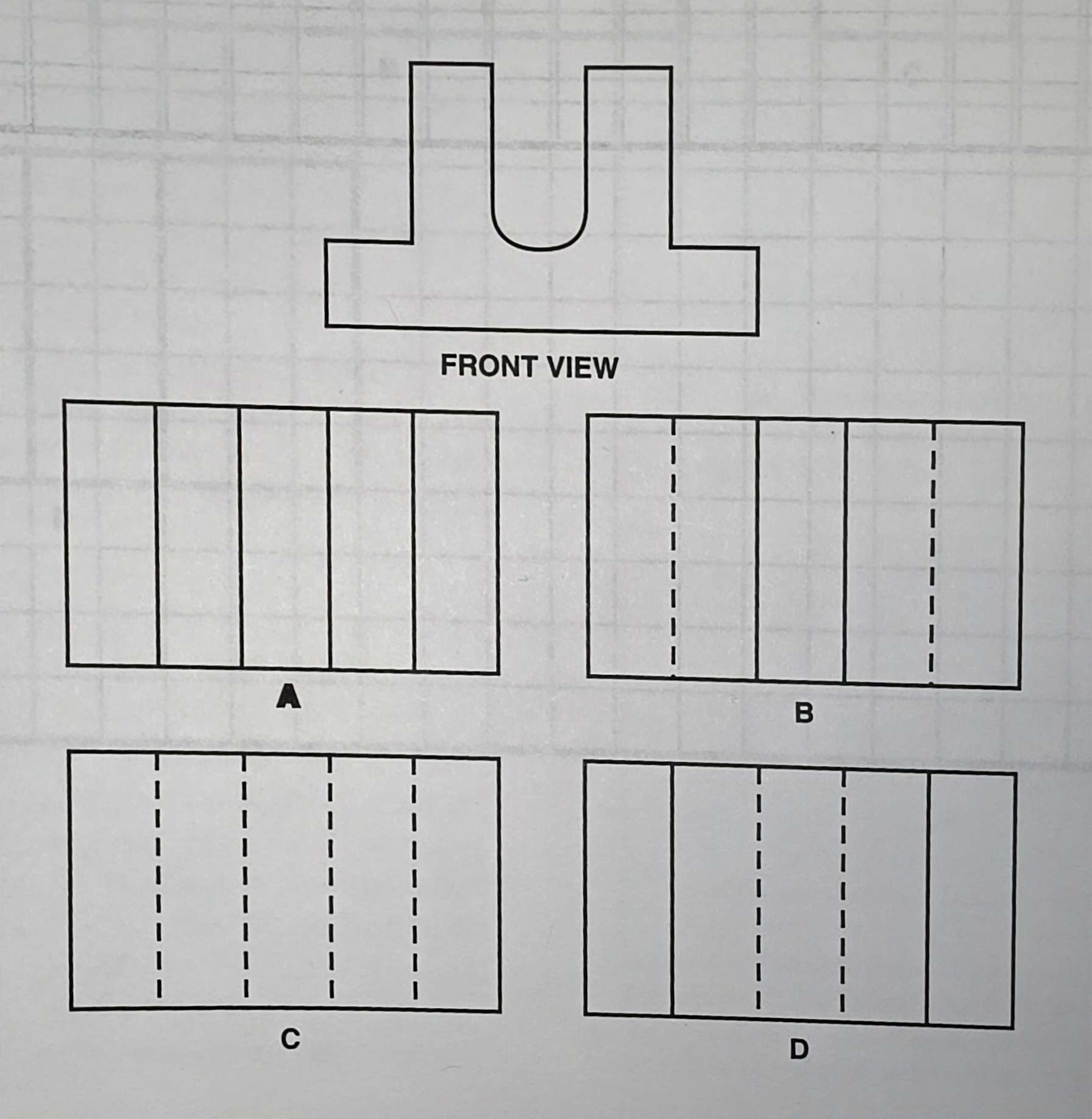
Identify the bottom view of this object.
C
What line is used to show any edge of a part that is visible in the view represented by the drawing? __________________
Visible
A __________________line is used to represent an edge of a part that would not be visible in the view illustrated.
Hidden
An alternate position of a part may be shown using __________________ lines.
Phantom
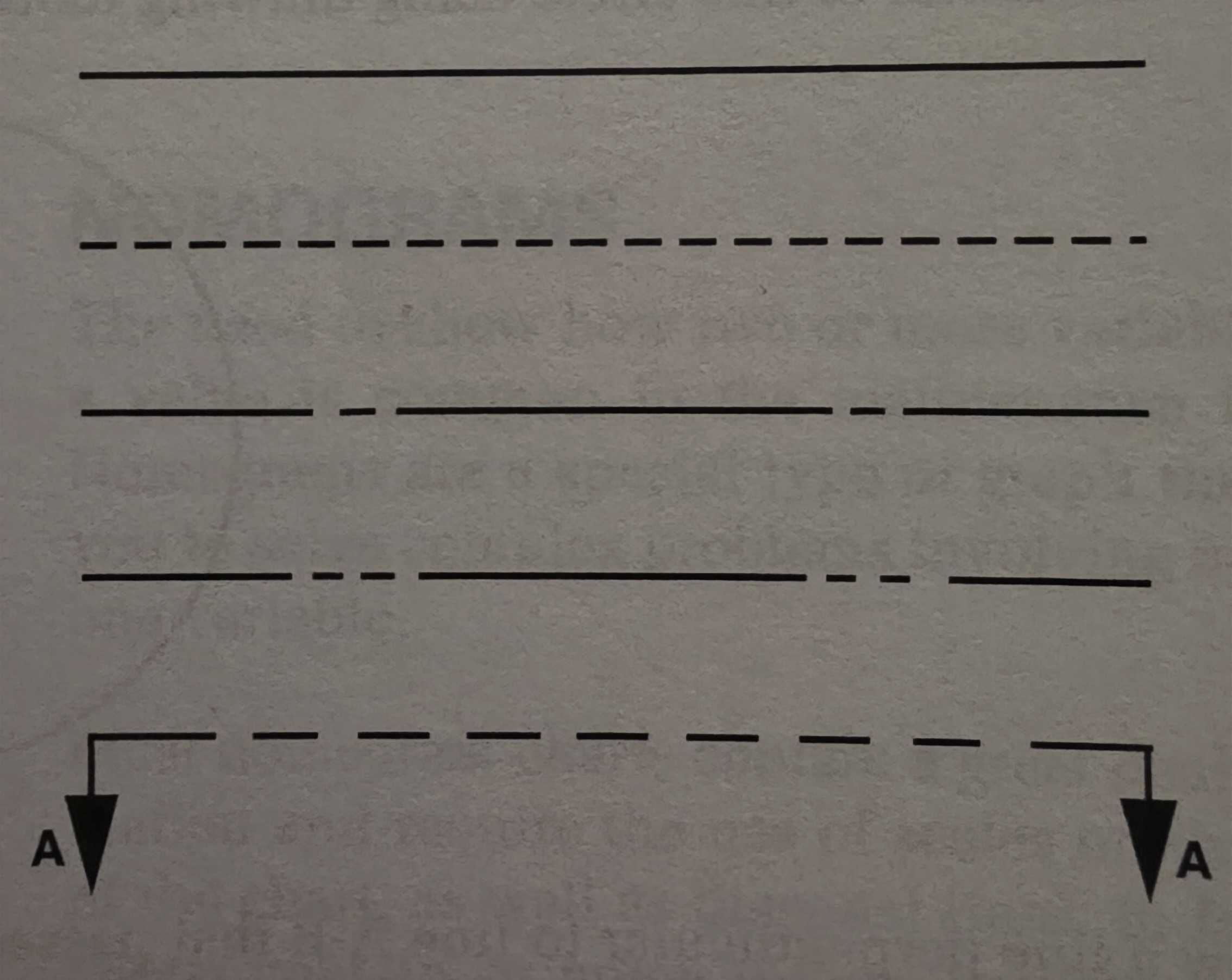
dentify these lines:
a. _______________________
b. _______________________
c. _______________________
d. _______________________
a. Visible
b. Hidden
c. Center
d. Phantom
e. Cutting Edge
The __________________ is the difference between the extreme permissible dimensions.
Tolerance
__________________is the difference between the nominal dimensions and the upper or lower limit.
Allowance
The title block will be found in the lower ________ (right or left) hand corner of every aircraft drawing.
Right
What information may be found in the title block?
a. __________________ b. __________________ c. __________________
d. __________________ e. __________________ f. __________________
g. __________________ h. __________________ i. __________________
a. Title
b. Size
c. Drawing #
d. Scale
e. Page
f. Responsibility
g. Standards
h. Bill of materials
i. Application
__________________ numbers on aircraft blueprints are used to locate parts, sections, and views on large drawings.
zone
Locations fore and aft along the fuselage, measured from a datum are called __________________.
station number
Vertical measurements on aircraft fuselages are made along __________________ lines.
water
Distances to the right or left of the center line of the fuselage are measured by __________________ lines.
buttock
__________________ stations are measured from the center line of the fuselage, and indicate the distance out along the wing toward the tip.
wing
Using a compass, a straightedge, and your knowledge of applied geometry, find the center of line A-B.
Find the center of this circle using drawing tools and applied geometry.
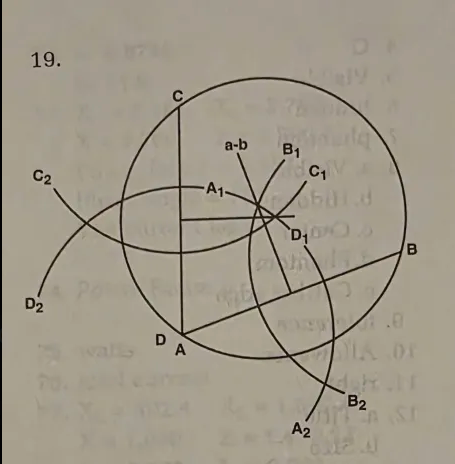
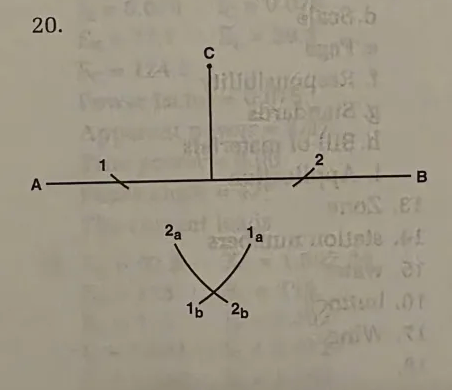
Draw a line perpendicular to line A-B that passes through point C.
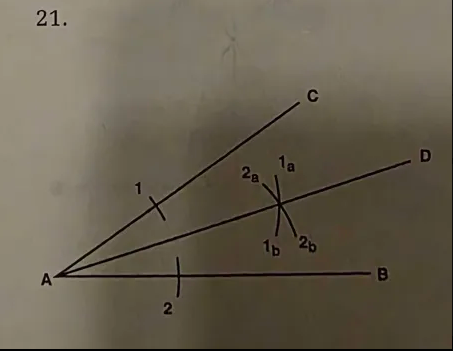
Using your compass and straightedge, bisect angle ABC.
What are the steps to be followed when making a sketch, such as those used on FAA Form 337?
a. __________________________________________________________________________________
b. __________________________________________________________________________________
c. __________________________________________________________________________________
d. __________________________________________________________________________________
e. __________________________________________________________________________________
a. Determine the necessary views
b. Block in the views
c. Complete the details
d. Darkened the object lines
e. Sketch extension and dimension lines
 Note
Note  Flashcards (69)