Week 5 Fitness Principles (Feb 2nd and 4th)
 Studied by 0 people
 Call Kai
 Learn
Learn Practice Test
 Spaced Repetition
 Match
Match Flashcards
 Knowt Play
1/39

There's no tags or description
Looks like no tags are added yet.
Name | Mastery | Learn | Test | Matching | Spaced | Call with Kai |
|---|
No analytics yet
Send a link to your students to track their progress
40 Terms
What is conducted in a needs analysis?
Evaluation of the activity
Physiological aspects
Biomechanical aspects
Common injury sites of the activity
Position specific attributes of the activity (if sport related)
What are the things analyzed in movement, physiology and injury analysis?
Movement: body and limb movement patterns and muscular movement
Physiological: Strength, power, hypertrophy, muscular endurance, speed, agility, flexibility, and metabolic capacities required of the activity
Injury: common sites for injury to joints and muscles and causative factors
What is the profile and training status in the assessment of the individual?
Profile: Needs and goals of the individual evaluating training history, injury status, conducting fitness testing, evaluating the results, determining the goal of training
Training status
Type of program previously participated in
Length participated in program
Level of intensity in program
Degree of exercise technique experience
What is the physical testing and evaluation of the assessment of the individual?
Comprehensive assessment of fitness capabilities of the individual
Compare results with normative data to assess strengths and weaknesses of the individual
Primary Training Goal
evaluating and determining the strategy to achieve the primary training goal
What is the design thinking cycle of a needs analysis?
Define the needs of the end user as accurately as possible
Ideate - challenge assumptions and generate multiple options
Prototype potential solutions
Evaluate the solution
What is involved in the metabolic aspects of the activity?
Vary considerably between activities
Might be completely oxidative (marathon) phosphagenic energy source (Weightlifting)
Most activities are usually a mixture of energy contribution from the 3 energy systems
Even in team sports, different positions will require a different mixture of contribution from the 3 energy systems
What is involved in the biomechanical aspects of the activity??
Movement patterns performed, muscles recruited and major joint actions, force requirements, movement velocity, acceleration, flexibility and agility
Other factors icluding the desired training adaptations and their order of priority (strength, power, muscular endurance) - considered physiological aspects of the activity
What is an injury risk in a needs analysis?
there is risk associated with any physical activity, sport participation carries a higher risk of injury than activities of daily living
Contact and non contact injuries
It is prudent for a fitness professional to identify any particular attributes that predispose an individual to injury
Designing well balanced, whole body training programs and focusing on rehabilitation will go a long way to reducing the risk of injury in sport or other activities
What is individuality?
Training responses to a given stimulus are different for varying individuals
Sex, maturation, conditioning experience, genetic predisposition, risk factors, diseases and constitution are all aspects of an individual to create an individualized progran
What is overload?
Stress placed on the body must exceed a certain threshold for the body to adapt to that given stress
Accomplished by changing the modifiable training parameters (FITT principle)
What is specificity?
The stimulus used to stress the body will result in specific adaptations to the imposed demand (SAID principle)
Training for muscle strength: muscle strength activities
Aerobic activities: cardiorespiratory activities
What is progression?
to see further adaptations, the system you are stressing must be gradually increased in intensity over time to see further adaptations
A good ‘rule of thumb’ is not to increase the frequency, duration or intensity more than 10% per week
Manipulate the FITT variables to progressively overload the system and prevent over reaching or over training
What is variation?
For the body to continually adapt to the stresses placed on it, there must also be a variety in the training variables to see constant adaptations
May also prevent ‘boredom’ from training and reduce the risk of over use injuries
What is recovery?
Often overlooked
certain amount of rest is needed before training again
Allows adaptations to occur and hopefully, improves performance / fitness gradually over time
What is reversibility?
Detraining - what was worked for must be maintained or there is the loss of fitness parameters
Important to continue exercise training throughout one’s life to ensure performance and health are optimized
How does the exercise potency, slope and maximal effect (efficacy) play a role in the dose response concept in exercise?
EP:
Ability of exercise to bring about a certain result
Slope:
degree of effect that comes from an increase in exercise
Maximal Effect (efficacy)
Vigorous activity likely to improve both risk factors moderate activity less impactful on VO2 max
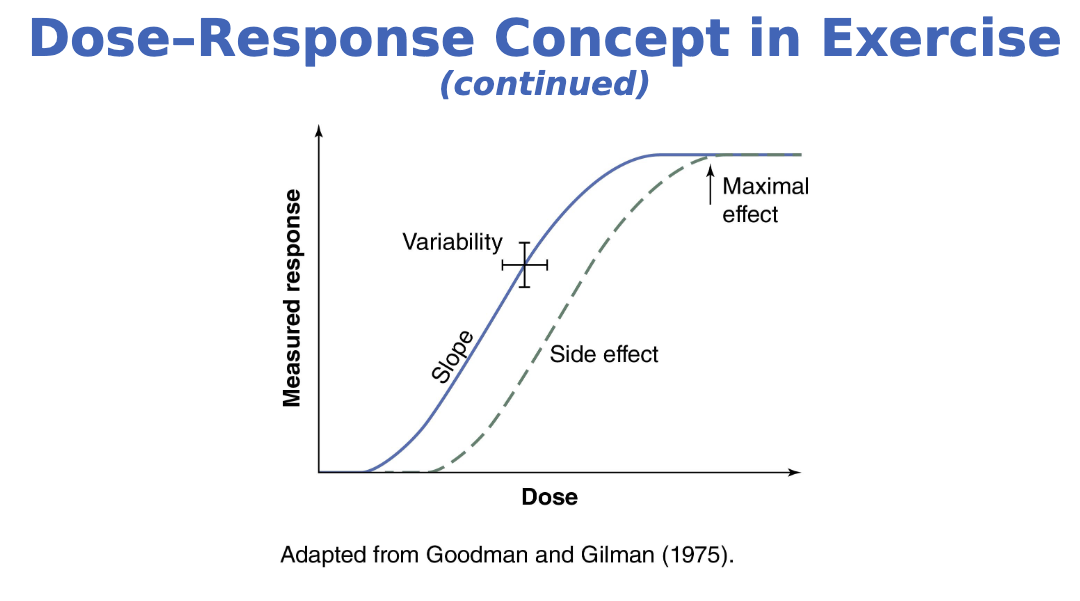
How does the variability and side effects play a role in the dose response concept in exercise?
V
Changes that occur in one person not necessarily equal to changes seen in other people
SE
increased risk of injury
Potential of exercise to interact with medications and affect physiological variables (glucose, BP)
What is FITT - VP?
The dose of PA/ exercise.
Frequency, Intensity, Time and Type
Volume: Frequency x Intensity x TIme
Progression: Transitioning from easier to harder exercise over time, or gradually increasing duration
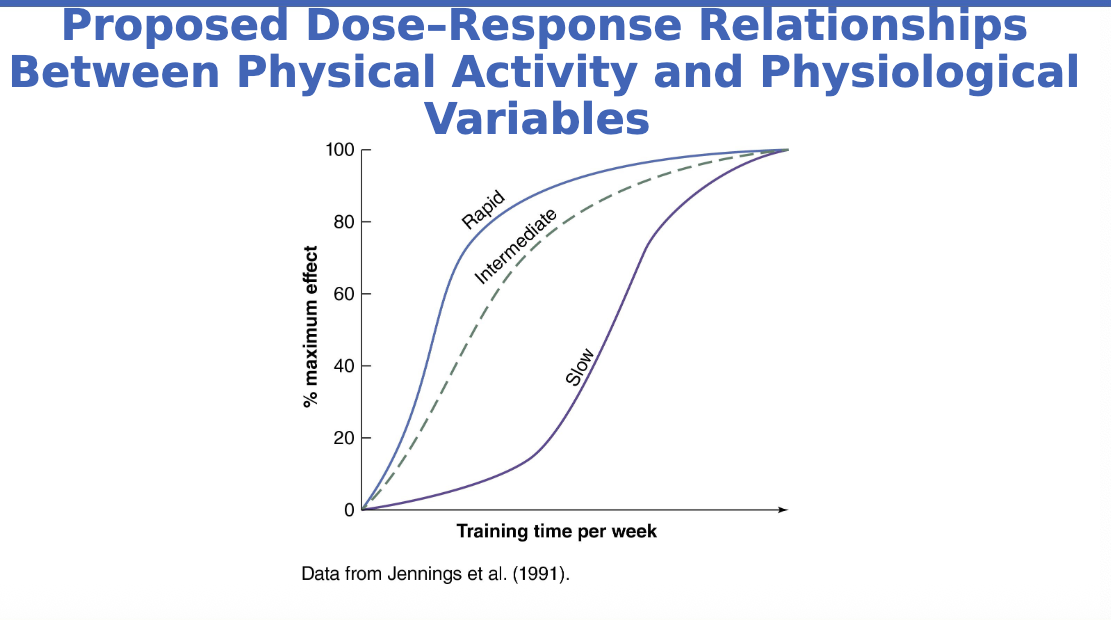
What are the short and long term responses to exercise?
Acute responses occur with one or several exercise bouts but do not improve further
Rapid responses occur early and then plateau
Linear responses are gains made continuously over time
Delayed responses occur only after weeks of training
What is the art of exercise prescription?
The proper does of activity is dependent on the desired effect or on the goals of the individual client
Dose of exercise needed for achieving better health differs from that needed to achieve peak performance
Exercise is Medicine focuses on the need for fitness professionals to communicate effectively with medical personnel to realize a client’s goals
How do we improve health status according to PA guidelines for americans?
150 to 300 min of moderate intensity PA, or 75 to 150 vigorous intensity PA per week, or a combination of the 2
additional health benefits of engaging in activity beyond the equivalent of 300 minutes of moderate intensity activity
Resistance training 2 days per week
Less sitting and more movement throughout the day
Health related gains associated with PA are realized when the volume of PA is between 500 and 1,000 MET min per wk
Bouts of any length of moderate to vigorous activity can provide health benefits
Spread activity throughout the week to reduce risk of injury and prevent excessive fatigue
What are the guidelines for increasing cardio respiratory fitness?
Encourage screening, regular participation and variety
Use a program focusing on progression
Increasing duration (10% per week) or frequency before increasing intensity
Use interval training to transition to continuous vigorous activity
Follow a formatted fitness workout
Include warm up and cool down ( 5 to 10min each)
Stretch (dynamic during warm up, static during cool down)
Conduct periodic CRF testing
A good general target is 10% improvement in 3 months
How do we formulate an exercise prescription dose?
500 to 1000 MET min per week or 1000 kcal per week
What should the frequency of exercise be?
Moderate intensity (>5 days per week)
Vigorous intensity (>3 days per week)
Gains can be made on < 3 days, but intensity would need to significantly increase, and weight loss goals may become difficult to reach
For previous sedentary individuals, > 4 days per week at vigorous intensity may increase dropout or injury rate
What is intensity generally prescribed as?
% VO2 max
%VO2 reserve
%HR reserve
% HR max, or RPE
What are the general guidelines for prescribing intensity?
For an apparently healthy sedentary person, begin with 40 to 60% HRR
Adults who are physically active and at the high end of the fitness scale may require intensities greater than 80% HRR
For most, progression over time to an intensity within the range of 60 to 80% HRR is a suitable target.
How do you prescribe time?
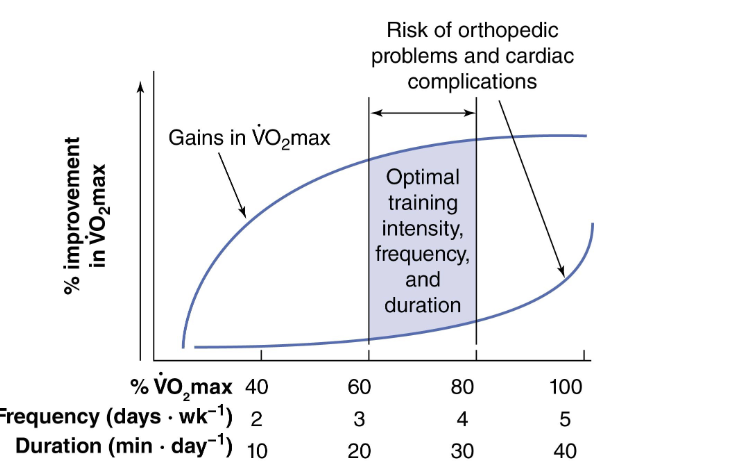
Based on improvements in VO2 max increased with extended duration
Optimal duration depends on intensity
Balance duration against intensity to achieve 500 to 1,000 MET minutes per week
Once the intensity threshold has been met, total work (kcal expended) determines CRF gains
There are many options: 30 min for 1 session, 2 15 min sessions, or 3 10 min sessions
How do you prescribe type?
A wide range of activities
Requiring minimal skill: walking, cycling, jogging, rowing and elliptical exercise
Requiring skill: Swimming, x country skiing, skating
Recreational sports provide variety for those who regularly engage in aerobic exercise and have a good CRF
What is metabolic load?
most direct way to determine target exercise intensity is to use a percentage of the measured maximal O2 consumption
A typical exercise intensity range associated with improved CRF in people who are ready to move from moderate intensity PA to a vigorous intensity exercise program is 60 to 80% VO2 max
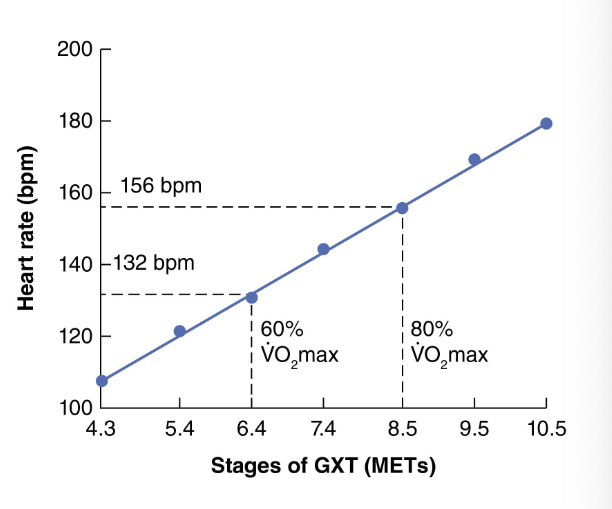
What is the direct way of determining target HR?
HR from a maximal graded exercise test (GXT) is plotted against VO2 of each stage
HR at 60 to 80% VO2 max represent THR range
What are the indirect methods of determining target HR?
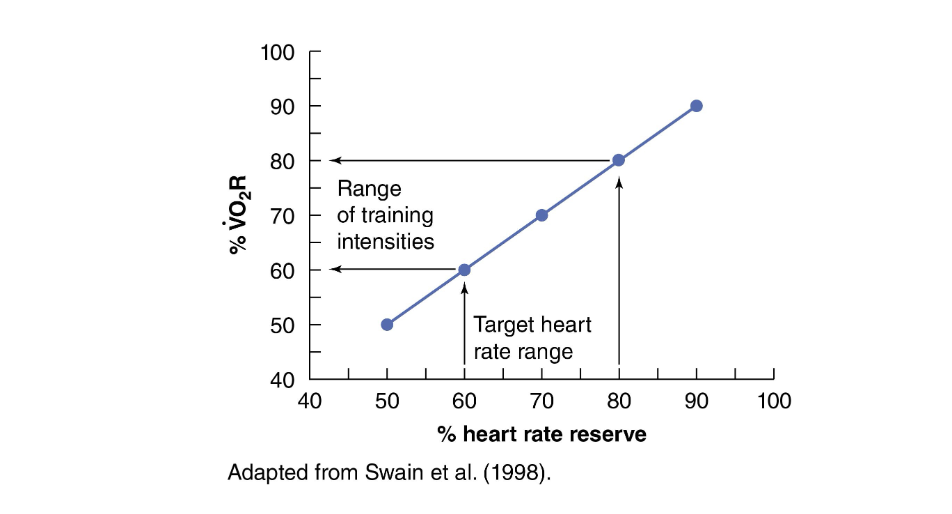
HRR
Maximal - Resting HR = HRR
% HRR approx. equal to VO2R
Subtracting resting HR from maximal HR to obtain HRR.
Calculate 60 and 80% HRR.
Add each value to the resting HR to obtain THR range.
What can be said about maximal HR?
Although a measured HR from a maximal GXT is most accurate, this isn’t typically available in health and fitness settings
If HRmax cannot be measured, any estimation must consider the effect of age
How do we estimate HRmax?
HRmax - 220 - Age
Overestimates HRmax for younger adults and underestimates for older adults
HRmax = 208 - (0.7 x age)
Better estimates on average, 6 beats low if < 20, 6 beats high if > 60 years
SD of 10 bpm for average estimated HRmax
HRmax = 207 - (0.7 x age)
SD of 5 to 8 bpm
What are the intensity ranges?
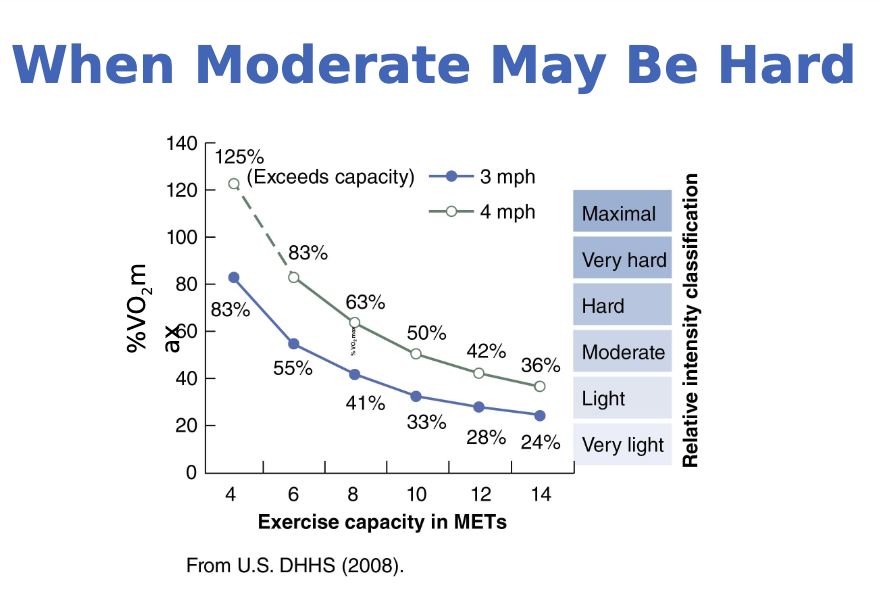
Moderate
40 to 59% HRR or VO2R
64 to 76% HRmax or 46 to 63% VO2 max
Vigorous
60 to 89% HRR or VO2 R
77 to 95% HRmax or 64 to 90% VO2 max
What should the exercise intensity be for improving CRF?
THreshold may be low for individuals with low levels of fitness
For most individuals, intensity thresholds are
60 ti 80% HRR or VO2max or 75 to 90% HRmax
What is HIIT?
High Intensity Interval Training
Intensities greater than VO2 max (Sprint Interval)
Near maximal interval training as shown by 90 to 100% of HRmax or VO2 max
Vigorous aerobic intensity as shown by 60 to 89 % VO2 R or 64 to 90% VO2 max
What does the work to rest ratio reflect?
The duration and intensity of work periods and rest perioods
Intensity is relative to an individual’s peak aerobic capacity and peak HR. Actual activities will differ based on a person’s fitness
There are potential benefits (e.g., CRF, time commitment), but further research is needed on feasibility, LT effects and safety aspects
What are supervised programs?
For high risk patients with diabetes, hypertension, asthma, coronary heart disease
May include low risk clients at fitness clubs
What are unsupervised programs?
due to supervised programs not always available due to:
Limited number, participant and physician interest level, financial resources required
Emphasis in the beginning of unsupervised program: low to moderate
Must clearly communciate how to begin and maintain the program
Individualization
When may you need to update an exercise program?
A simple sign of the need to progress is when a recommended exercise is nor longer sufficient to reach THR
More frequent testing should be performed for those who are just starting compared to established exercisers
Reevaluate if there is a change in medication that influences HR.
 Note
Note  Flashcards (23)