Power & Agency/ Giving Birth in the Early Modern Period
 Studied by 0 people
 Call Kai
 Learn
Learn Practice Test
 Spaced Repetition
 Match
Match Flashcards
 Knowt Play
1/25

There's no tags or description
Looks like no tags are added yet.
Name | Mastery | Learn | Test | Matching | Spaced | Call with Kai |
|---|
No analytics yet
Send a link to your students to track their progress
26 Terms
Historiography
Diff. conceptions Italian charlatans… m/more positive meaning then
Theatrical healer offer. theatrical displays on street
Uni-educated - beyond theatrics their trade, offic. sanction
(EM Italy) Protomedicato = offic. medical tribunal (comprised uni-educated medical professionals) respons. for regul. medical practice & public health.
Oversaw licensing physicians, surgeons & apothecaries, ensur. medical professionals met req. standards.
Auth. to inspect pharmacies, enforce health regulations & even prosecute malpractice cases.
Played crucial role in shap. medical governance - part broader efforts to standardise healthcare across diff. regions.
(C17-18) People assoc. theme healers w/poor medical practise & expertise
C17 Italy
Italian ‘charlatans’: Martino Grimaldi & his electuary
What can this tell us ab. influences on medical practice?
(1600s) Succ. defends himself in Protomedicato investig. by emphas. no. public/ private demonstrations given his electuary
Social cache/ status key to his respectability & succ. as practicioner
Entrusted secret formula to bro-in-law (uni-educ. physician)
Protect. fam. name more important than competition w/doctor
Mystery/ secrecy; ritualised aspect to healing
Passed through uni for 100+ yrs → Isabella Fontant (late 18th c.)
Applies to renew fam. license, claim. sole respons. prod. drug.
Each claim most import. part of it = fam. secrecy
Practitioners negotiated legitimacy through secrecy & trad.
Medical expertise + social auth. inherited. Fam. (even in prof. setting) structured medical practice
Being part fam. line → build. social & medical credit allows her to take control patent in way would normally be diffic. for woman to do.
Medicine = social event; trust built via negotiations w/state, community, fam.
Trust & auth. v/important in EM medical encounters.
Auth. somet. comes through fam. means
High stakes & often embroiled in legal action
Need to individuate ← other healers
(Ben Mutschler, 2007) C18 Massachusetts: Ebeniezer Parkman + John Jackman
(pre C18/19 → market econ.) Functioned on credit econ. (goods & services exchanged for goods & services, rather than money, in which people doing things based on credit & social rep. - everyone getting someth. out of this) → questions trust & rep. v/important
More interdependent than Europe: fam. sctructure, scarcity land & lab. → cooper. essential to survival
New England founded consciously as refuge ← perceived corruptions Old World; designed to be ‘well-ordered’ soc. driven by commitm. to Christian community: communal oblig. to care for others
Community credit balance could purchasing medical care/ medicines
Ebeniezer Parkman = minister keeps diary (1780s), in which writes extensively ab. his health
(1789) He & his wife ill → have to get watchers for fortnight
22 individuals help him; 10 his wife
As ministers parish, initially does this through connections & social relationships (respected; people happy to care for them for free) BUT event. ran out social credit & had to hire servants
John Jackman fell ill & died
Looked after by innkeeper Thomas Slack, who petitioned parish for recompensing money for care & work he did (since he had no social credit)
Drew up list expenses he occured: 4 days’ trouble (being out of busin.), extra washing, candles → amounts to £9.19 (check)
No social credit/ possessions → pay in money
Request upheld BUT because he had no money, took his clothes off dead body
1 person being ill in community can → social disorder (illn. takes you out of action → not performing normal function in soc., breed resentment & distrust)
illn. embedded in social politics
Trust & auth. v/important in EM medical encounters.
Access to medicine also reliant on status & rep.
How was medical & epistemic auth. constructed & maintained in EM?
Pregnancy bound up w/questions rep.
Status & econ. power determined everyth. ab. women’s experiences birth.
Focus more on women’s experiences - social & family as well as medical aspect
Cicely Linsgale - living Yorkshire 1664
Working as domestic servant alongside her her cousin Anne
Very poor → no portrait; elite practice
Suspects her cousin Anne; refuses to eat her normal food at lunchtime → ends up finding her giving birth to malformed child (accord. to court records) after midwife gives her something ← bottle
Anne buries baby; Cicely watches → told to never speak of it again, espec. to masters
After yr, falls out w/cousin Anne → snitches ab. this illegitimate birth
Secrets, exclusion, prevalence infanticide/ illegitimacy due to econ. circumstances in which women might see no way to keep a child
Stillborn… (check)
More ad hoc
This tale domestic servant keeping her pregnancy secret shows ability & knowl. community members in being able to induce birth & abortion/ quick lab.
Often in court…
Once these women suspected infantacide, suspected by juries of matron (appointed as experts to inspect their bodies → whether in their expert opinion, this woman had given birth - squeeze/ suckle woman’s breasts to determine if had recently been lactating)
Another ad hoc example: Elizabeth Barton; villagewomen insist must examine her naked women; rumours she’s been getting big/ given birth recently (black & purple nipple evidences this → such powerful gossip that she goes to diff. town for 2 months, claims when she returns that she miscarried before or after midwives’ visit)
Common for women servants
Masters might step in to interfere if child if was their child…
pay for wet nurse far away
rescind contract → mother on her own
Reputational damage
Scur illegit. pregnancy so great that women unable to call on their families to protect them
Tell doctors they were never pregnant/ had cholic/ wind then baby fell out… ambiguity pregnancy
People couldn’t know they were pregnant w/o test → draw on confusion around signs pregnancy to claim innoc. their sit.
Anne & Charles Gerard
Got pregnant twice ← affairs (separated ← husband for 2 decades)
He petitions parl. to divorce her; doesn’t want her babies to inherit his title & money
1 1st examples proper divorce - prev. annulled
Petitioning parl. for ability to marry again & have his own heirs again, sep. ← her
People called to give evid. in parl.
Relay how us. her money, Anne could hire room house in HOburn, paid priv. midwife & nurse, brought maid - all sworn to secrecy + wore mask dur. lab. but it fell off dur. heavy contraction → midwife & nurse recogn. her
So salacious, gave birth to lots pamphlets that expose some secrets elite classes to more prurient, middling sort readership
Husband angry at fact not living tog. & marriage dissolved (out of love) but fact she hasn’t taken en. care to conceal fact she was sleeping w/another man & impregnated by him
Servants recall hav. to entertain another man
Had to lace & re-lace her after each tryst (stiff clothing)
Sim. situations: both pregnant outside of wedlock
Show that status & econ. power determined everyth. ab. women’s experiences birthing in the period
Class/status or (not the same) access to money & race still condition women giv. birth
burgeoning middling class had access to money but not titles
UC had status but not money - not the same
Status & family v/important framework…
Anne’s exper. very mediated by claim to respectability she has hav. been married & hav. family around her
Importance to keep certain things secret, others public
Charles bothered by lengths she went to conceal father’s identity
Worrying prospect women keeping CBs secret
How was medical & epistemic auth. constructed & maintained in EM?
Big debates ab. CB
(pre-man midwives, 1970s WLM historians) Period female solidarity vs
conditional on legitimate pregnancy, status, community & fam. (Wales reading)
week on hospital birth shows pre-hospital births can be overly romantacised: reading stories women’s diffic. birth experiences should caution us that class more signif. than gender
Women as active agents in policing behaviour
before advent/ intrusion man midwives but often in ways policing/ insisted that women conducted themselves in certain ways to further cultural ideals/ ideas ab. family
CB takes women aw. ← families & nestled in women-only world
But all sorts ways families control & condition exper. bearing kids
Period when CB ‘wrestled’ aw. ← control of women & men ‘take over’ (var. chronologies)
CB took up so much people’s time & effort → much anxiety around it; stakes so high + work & money req. to have baby occupied people
How was medical & epistemic auth. constructed & maintained in EM?
getting pregnant & fertility x religion
Centrality CB to practice indiv. domestic & parishioners’ piety… fertility = being good Christian
Difficulties CB (struggling to conceive, sickly/short-lived/ deformed kids) could be divine punishm. for rebelliously transgressing God’s wishes
If one lived piously. would be rewarded by God w/quiver full of children - endless children = symbol piety & reward by God for good behaviour.
Hav. babies = form embodies devotion in which people rlly recon. & strengthen their rel. to God - cyclical proc. in which body mirrors soul
Fruitfulness begets fruitfulness: good behaviour gets lots babies
shaped by medical advice, relig. ideals & fam. pressures
How was medical & epistemic auth. constructed & maintained in EM?
getting pregnant & fertility x men: fam. correspondences
Fam. correspondences show high stakes to both sexes
Dudley Ryder (future Chief Justice) diary 1715 when he was 25: worried he wasn’t powerful in that way (impotence?), worried he’s going to be infertile → so worried his future spouse & fam. will have ‘reasons to complain’ → convinced perhaps shouldn’t bother getting married
Lord Orary told son ‘ashamed’ took him 2 yrs to get his wife pregnant 1690s
glad finally imitating his ancestors - also idea good fmailies/ dynasties are procreatively succ. & have lots healthy big kids
(1682) Earl Huntington hadn’t consummated his marriage/ conceived a child despite 6 months marriage → writes to uncle Arthur Stanhope for advice ab. how to consummate his marriage & how to conceive: insists letter burnt on receipt since so embarrassing
when have baby 2 yrs 6 months later, relative calls the baby a peacemaker; ‘← the first beginning in the womb did begin in better agreem. bet. the 2 of them’
hav. babies strengthens marial unit
normative social construct in which people encouraged to have babies for God & sake their marriage
shaped by medical advice, relig. ideals & fam. pressures
consid. work
men involved albeit in ways fitted w/cultural ideals
CB not haven female solidarity
How was medical & epistemic auth. constructed & maintained in EM?
getting pregnant & fertility x men: medical treatm. x male pride
Doctors case notes: women come, told fault their husbands not pregn.
even though man undertood respon., nevertheless woman who asks the question & who rec. treatm.
e.g. Dr Shepherd of London & Sarah his wife, visit astrologer Richard Napier & ask for medicine to cause Sarah to be fruitful - give her a pessary (pill that can be placed in vagina). Though we don’t know if this is for husband/ wife… treatments conceal male responsibility in conception to save ego?
recipies in domestic recipie books often contain remedies to counter infertility which include anointing vagina/ penis before hav. sex: sugg. commitm. to shielding male ego
when women get pregn., men very boastful
1729, George Leg ← aristocratic Staffordshire fam. wrties to father about this - been strutting about streets of London & everybody says he’s so happy, he’s like a prince
shaped by medical advice, relig. ideals & fam. pressures
consid. work
men involved albeit in ways fitted w/cultural ideals
CB not haven female solidarity
How was medical & epistemic auth. constructed & maintained in EM?
being pregnant: lots uncertainty + family
Aristotle’s masterpiece: women often fall out because dates don’t work out - suspect she slept w/someone else
1500s: Edward de Vere → estranged ← wife Countess of Oxford; he thinks it takes 12 months to gestate child & she gives birth after 9 - he was travelling she must have slept w/someone else
confusion ab. how long CB meant to last → people grappling w/multiplicity signs one’s pregnancy & lack certainty
2 sides same coin: women accused infantacide make use ambiguity & confusion around pregnancy
married middling/ upper sort women v/keen to assrrt knowl. & control over CB
MEDICAL AUTHORS PUSH IDEA women ought to (if not promiscuous), should know immed. pregnany as soon as had sex
but these medical practicioners hesitated to tell women certainly if they were pregnant & when they would give birth
Medical writer William Sermon (ladies companion 1671) cautions midwives & medical practicioners: you shouldn’t give into women when they ask for definitive answer on pregnancy; if you say yes & they’re not, they’ll lose all trust in you (which was so key to auth. EM medical practicioners: word of mouth). You’ve got yourself out of business.
(1658) Philosopher Anne Conway couldn’t be sure she was pregnant - her letters to medical experts & familiy tell her to keep it private until have reassurance; worried about it being town talk
if you don’t know when you got pregnant/ will give birth, possibility maybe you’ve got pregnant out of wedlock
Fact so many fam. members (includ. men) feel rlly entitled to give women v/intrusive advice in pregnancy & CB
E.g. draft letters to woman called Mrs Tullock by unknown correspondent: writer adamant she’s pregnant, ‘if she had taken any pains ab. her health, she would have been perfectly well’. Warned that is she neglects & disregards that which is so valuable to your acquaintances & that be to yourself, your disease may end in an incurable day.
Threatened with miscarriage if she eats wrong things
Anna Temple warns her pregnant daughter 1600s ought to be cheerful or likely to miscarry like she did with her last child
v/real threats fam. members us. to try condition behaviour pregnant women
shaped by medical advice, relig. ideals & fam. pressures
consid. work
men involved albeit in ways fitted w/cultural ideals
CB not haven female solidarity
How was medical & epistemic auth. constructed & maintained in EM?
being pregnant: material culture
Proc. gathering items & material culture in prep. birth = import. part CB proc… held up by historians as evid. female solidarity
CB chest given to women symbolism their fertility to keep bedding use for CB within them
(Sarah Fox) lower-status women sim. engaged in this material cultural gathering proc. w/cheaper items, partic. in regards to bedding (straw/pallette bed)
Elites/ middling sort women depicted in their portraits in parturient state
ays someth. ab. familiy: endlessly fertile
material, artistic depictions women beign pregnant also part material culture pregn. & kind fam. status & name more gen.
Material exchanges: men v/active in obtaining these items for women too
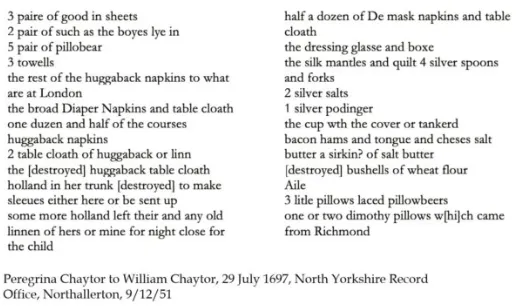
heavily pregnant wife wanted all these items sent up by her husband/ purchased in prep. for CB (lots linen & food)
extensive list someone of her status & mean would’ve been able to gather - though she thinks herself poor, seems unlikely in wake stories poor women who only had blanket to cover baby
enormous diff. in expert. women diff. status
men involved albeit in ways fitted w/cultural ideals
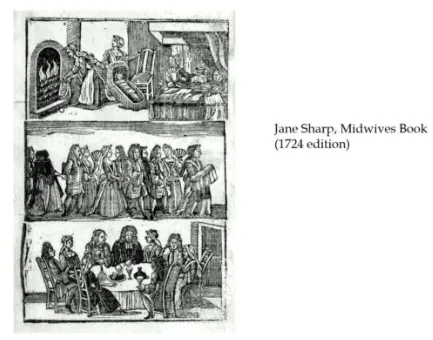
giving birth x men: Jane Sharp’s Midwives Book (1724 edition)
stages bearing kids
birth w/fire & midwife, baby swaddled stiffly in corner: christening & churching
celeb., eating drinking whilst women giving birth upstairs & long afterw.
not female-only world: men & women both important players
wet-nursing shaped by fam. pressures
women choose wet-nurses known to family
wet-nurse nursed prev. children or existing servants who’ve had childr ecently to breatfeed their children
importance keping exper. within fam. network & draw. on community ties in oper. medical auth
Bolstrode Whitlock’s wet-nurse = daughter man who nursed his father; both him and his father wrote ab. it in their diaries: keep bloodtie fam. & control practice & feed wet-nurse themselves
medical texts encourage families to surprise wet-nurse to check they’re doing right thing
C18 England: advent male midwives
Women had delivered babies
Often licensed by CofE & trained through formal/ informal apprenticeship
Male surgeons called in emergencies to manually extract child to save birthing mother
(1720s-) Increasing visibility man-midwives
Increasingly pop. choice for those could afford them
Start to be called in non-emergencies
Style themselves as gen. practitioners/ ‘doctor midwives’
Undo need for sep. midwife then male surgeon: offer both holistic & gen. care (both book-learning & experiential treatm.) given male surgeons often
deliver healthy live childWomen midwives alr. did this - also called in more gen. for diff. fam. ailments - however m/man midwives want to present them as just deliver. babies
Speaks to fundamental shift in ideas medical expertise… women no longer seen as experts CB (rooted in C17 medical texts increasingly seek to sep. male ← female medical knowl. - set groundwork for this change practice C18)
(Gervais Mackham) Women = approp. holders knowl. ab. preservation & care fam. but could never be physicians… can only deal w/ordin. illnesses → prevailing idea women = good medical practicioners
emergencybutwhen anyth. complicated happens
Framework women have experiential everyday knowl. vs men book-learning
Dichotomy women practicioners use in their texts to claim they’re better practitioners
(MW Jane Sharp 1671) nat. propriety women had as midwives, assisted by long & diligent practice/ everyday expertise
Men forced to borrow even name midwivfe rather than come up w/new term
Delivered 100,000s babies & been in room in all kinds diff. scenarios - m/more important for her than going to uni… import. haptic knowl
(1652 treatises) French midwife Louise Bourgeois emphas. intim. bodily knowl. came ← exper. delivering babies… key part of her medical auth. = her 1sthand knowl. ‘our pains’
cultiv. idea female body mysterious & could only be knowable by a woman - could have v/real political advantages
muscovite royal wives constructed idea they could miraculously conceive (shift attention ← child as desired product → their own bodies, where mystery CB & divine will revealed & enhanced their dynastic legitimacy & image)
assoc. bet. women as having control over secrets CB & being only expert practitioners in that
these female practitioners manip. learned discourses for their own gain, by arguing their skins innate & unknowable to physicians + attempting to attract & retain clients who might have been swayed by increasingly visible figure man midwife
istoriographical sketch and an indication of how your argument sits within the existing historiography: are you building on a path pioneered by someone? Are you pioneering a new path? Are you calling to question an existing interpretation?
n future essays, it might be useful to start by giving a brief precis of the subject: who were the man-midwives? When did they come to the picture? Any prominent figures among them? How have historians treated them in their work? Any number of these issues in combination should be necessary to set the stage for the analysis. In a nutshell, give basic facts before analysis - and this can be done in an extended introduction, depending on topic.
Man-midwives changed exper. CB c.18 by…
undermining auth. woman midwives in birth. room
(previously) Midwifery = women’s domain
BUT men w/medical training authored most manuals on subject - though little 1sthand expert.
(Sheena Sommer) (late C17) Advances in anatomy & obstetrics + Enlightenment ideals empiricism (‘detailed, objective & prof. learning’) → male practitioners could harness growing faith in reason & science → appear safest pair hands.
Promoted uni educ. in anatomy as essential to midwifery training; mind/machine figures: contradicted more emotionally attached, practical mnemonic approach assoc. w/(
trained∵ banned ← medical schools) women midwives.Leverage formal education to reinforce stereotypes women midwives as incompetent, consolid. their auth. in birthing room.
many man-midwivery manuals prioritised 1sthand exper. & observation body (style observational anatomy)
(c.18 surgeon & author Henry Bracken) Women midwives = ‘silly ignorant [p]retenders’, whose trad. approach lacked medical knowl. & skill.
⬆ man-midwives attending births x ⬆ literacy amongst UC women (⬆ly engaged w/Enlightenment culture & intellectual auth. man-midwives offered) (Adrian Wilson)
Lack evidence man-midwifery reduced maternal/ infant mortality sugg. women drawn more to image expertise & auth. man midwives cultivated, any clear improvement in outcomes. (Irvine Wilson)
BUT (Adrien Wilson) Skilled @ managing diff. labours… 2 in 1 (add ← lecture)
(1713) Isabelle Wentworth’s letter son Thomas Wentworth expresses her gratitude to man-midwife for ‘sav[ing] her [l]ife,’ → ‘she would not for never so much have a woman again’.
Man-midwives changed exper. CB c.18 by…
underminine autonomy labouring women trad. held in birthing room
Overlooked in scholarship (Monica Green): ‘we have perhaps focused too much attention on obstetrics as a site of combat between professional rivals (‘male control’ vs ‘female control’) and too little on obstetrics from the patient’s point of view.’
Mechanism: idea nature & human body operate accord. to mathematical & mechanical laws,
Shaped anatomical conceptions midwifery (Rebecca Whiteley) that undermined agency lab. women, whose voices carried less weight as male practitioners asserted their auth. (Rebecca Whiteley)
Interventionist forceps-first approach man midwives
(1754) William Smellie’s midwifery guide diagrams depicted these ‘artificial hands’ as able to slip seamlessly around baby’s head where a hand c
ould fit∴ more effective than midwife @ deliv. healthy baby.His advice on conceal. & discreet use forceps (→
alarm patients)
(Margaret Carlyle & Brian Callender) Increasingly mechanistic imagery & lang. in male-authored midwifery manuals, effectively reduc. pregnant body to womb & pelvis, whilst woman’s individuality faded into background.
Framed foetus as primary patient in pregnancy, undermin. labouring woman’s personhood & agency.
Women exercised their agency in selecting male-midwives for normal deliveries.
Man-midwives ultim. overpowered autonomy trad. associated w/woman-midwives. Male practitioners gen. positioned themselves as ultim. auth. in CB.
Remember that in tale how man-midwives changed exper. CB c.18 to emphas. agency women midwives
Scholarship tends to depict chang. midwifery practice as struggle: women vs encroaching male takeover
Undermines agency women midwives, reduc. them to passive victims of changing midwifery culture. (Margaret Carlyle)
Reductionist: change midwifery practices gradual, marked by controversy & resistance.
(even by end C18) Women still dominated prof., partic. when serving women lower orders, typically turning to male practitioners only in emergencies. (Angela Joy Muir)
Criticised man-midwives…
Caricatures - e.g. 1793 ‘Man-Mid-Wife’ reflect tenacity stereotypes man-midwives as ‘obstetric butchers,’ wielding instruments of masculine authority & aggression (
symbols medical prog.).
Midwifery knowl. & practice developed within broader medical marketplace
Had to be commercially viable (Margaret Carlyle)
Proc. reciprocal exchange: just as man-midwives influenced field, they absorbed elements of traditional female midwifery to appear more acceptable to their clients.
E.g. (by end C18) mechanistic visual lang. favoured by many man-midwives → commonplace in women’s midwifery manuals by the end of the century. (Richard J. Whitt)
Martha Mears (advoc. for trad. CB) referred to birthing women as ‘patients’ in her writings.
Man midwives sought to be 2-in-1: present themselves as embodying ‘feminine’ virtues assoc. w/trad. midwifery, alongside their ‘masc.’ medical expertise → avoid appearing threatening/
skilledto clients.The Female Physician, Containing All the Diseases Incident to That Sex, in Virgins, Wives and Widows (1724) Midwife John Maubray criticised forceps for danger they posed when used by hasty practitioners, instead advoc. for gentler, more patient approach attrib. to woman-midwives.
Whilst, therefore, man-midwives were increasingly perceived to be best-able to mitigate all risks, with the instruments and technical skill necessary if complications arose, women midwives also adapted their practices and asserted their agency.
training & roles
How were female midwives typically trained in the early modern period?
When were male surgeons historically involved in childbirth?
What role did male midwives start to take from the 1720s?
Where did many man-midwives build their reputations?
What did trained male physicians claim they could provide during childbirth?
Through licensing by the Church of England and formal/informal apprenticeships.
In emergencies where manual extraction was needed to save the birthing mother.
Increasing visibility; offered both emergency and general childbirth care, often for wealthier patients.
Lying-in hospitals serving both very poor and very rich women.
Holistic & gen. care, replacing both midwife & emergency surgeon roles.
shifting auth. & medical expertise
How did male midwives present their medical authority?
How did female midwives respond to male midwives’ claims of authority?
What did the rise of man-midwifery signal about ideas of expertise?
What historical texts laid groundwork for male takeover in childbirth?
How did midwives like Jane Sharp defend women’s medical authority?
As "doctor-midwives" blending book-learning with experiential treatment.
Argued they already provided general family care and had deeper practical expertise.
A shift in medical authority away from women, as men were increasingly seen as legitimate experts.
17th-century medical writings that began separating male and female knowledge.
Cited women’s natural propriety and long, diligent practice as midwives.
knowledge, gender & auth.
What dichotomy was drawn between male and female medical knowledge?
How did women use this dichotomy to defend their role?
Why did men use the term "midwife" rather than create a new title?
How did Louise Bourgeois defend female midwifery?
What was “haptic knowledge” and why was it important?
Women had everyday, experiential knowledge; men had academic, book-learned knowledge.
Claimed experiential knowledge made them better, more empathetic practitioners.
Acknowledged the role's deep association with female expertise.
Argued her intimate, bodily knowledge came from firsthand experience.
Knowledge through touch and repeated practice—crucial in childbirth.
Perception, Secrecy & Cultural Beliefs
What belief about the female body shaped early views on midwifery?
How did royal Muscovite women use this belief politically?
What genre contributed to the idea of secret female expertise?
Why might a woman avoid consulting a male physician?
What did early 18th-century advertisements suggest about women's expertise?
That it was mysterious and knowable only by other women.
Claimed miraculous conceptions to reinforce dynastic legitimacy.
“Secrets” literature and almanacs—e.g., remedies hidden from male physicians.
Embarrassment or modesty; belief women were more appropriate caregivers.
What did early 18th-century advertisements suggest about women's expertise?
A: That having children gave them superior knowledge of the female body.
Print Culture, Satire & Stereotypes
How was the man vs. woman midwife debate portrayed in print culture?
How were female midwives negatively portrayed?
What critiques were made of male midwives?
What did some believe about male practitioners seeing women's bodies?
What example shows resistance to male physical presence in birth rooms?
Through satire and pamphlets critiquing both sides.
As ignorant, drunken, or even murderous (e.g., Middle Row in Hoven, 1680).
Too quick to intervene with instruments; seen as profit-driven and impersonal.
It was improper; even visual contact could increase mortality or distress.
Percival Willoughby reportedly crawled on all fours to avoid direct sight.
Historiography & Theories of Change
What reason does Adrian Wilson give for the rise of man-midwifery?
What does Jean Donnason argue about institutional shifts?
How did middle classes respond to the rise of male midwives by the 1760s
How did some women practitioners adapt to competition from men?
What did the 1745 College of Physicians law signal?
Fashion and desire for medicalised birth—not strictly based on effectiveness.
Decline of ecclesiastical courts undermined women's official authority.
They adopted the trend, hiring male midwives like the upper classes.
Claimed their knowledge was innate, unknowable to men, and emphasis. secrecy & experience.
A push to restrict surgical roles to elite male professionals - exclud. midwives.
Conclusions
1970s WLM historians
(Muir) Bound by oath to extract name father so they could charge it to someone + policing illegitimacy & premarital sex - check for more
before advent/ intrusion man midwives but often in ways policing/ insisted that women conducted themselves in certain ways to further cultural ideals/ ideas ab. family
CB took up so much people’s time & effort → much anxiety around it; stakes so high + work & money req. to have babu occupied people
 Note
Note  Flashcards (42)