eclogie biology
 Call Kai
 Learn
Learn Practice Test
 Spaced Repetition
 Match
Match Flashcards
 Knowt Play
 Podcast
1/58

There's no tags or description
Looks like no tags are added yet.
Name | Mastery | Learn | Test | Matching | Spaced | Call with Kai |
|---|
No analytics yet
Send a link to your students to track their progress
59 Terms
Ecosystem
An ecosystem is a dynamic community of living organisms (biotic factors) interacting with each other and with non-living components (abiotic factors) such as water, soil, air, and climate in a defined area. These interactions can be complex, with organisms relying on each other for food, shelter, and reproduction. Ecosystems can vary widely in size and can include habitats like forests, deserts, wetlands, and coral reefs. They are crucial for maintaining biodiversity and ecological balance.
Abiotic factors
Non-living components of an ecosystem, like sunlight, rain, temperature, and pH.
Biotic factors
Living components of an ecosystem, such as producers, consumers, and decomposers.
Biotope
A defined area with specific abiotic and biotic factors.
Habitat
A specific part of a biotope where an organism lives and reproduces.
What is a niche, and what are fundamental and realised niches
A niche is the role and way of life of an organism, including how it interacts with others.
Fundamental niche: All the areas with suitable conditions where a species could live. This doesn’t mean it actually lives everywhere in this area.
Realised niche: The area where a species actually lives. It is limited by competition, predation, and other interactions.
Key point: Species cannot share identical niches because of resource competition, so interactions determine the realised niche.
Example: A bird species might be able to live in many parts of a forest (fundamental niche), but it only occupies areas where it can compete successfully with other birds (realised niche).
Fundamental Niche | Realized Niche | |
|---|---|---|
Definition | Potential area where a species can live | Actual area where a species lives |
Limiting Factors | None | Competition, predation, abiotic factors |
Size | Larger | Smaller |
Population
All individuals of the same species in a particular area.
Community
Different populations living together in the same area.
Symbiosis
A close relationship between species, including mutualism, parasitism, and commensalism.
Symbiosis Type | Benefits | Harm | Example |
|---|---|---|---|
Mutualism | Both species benefit | No harm | Bees pollinating flowers |
Commensalism | One species benefits; the other is unaffected | No harm | Birds nesting in trees |
Parasitism | One species benefits; the other is harmed | Harm | Ticks feeding on mammals |
Predation
An ecological interaction where one organism (the predator) hunts, kills, and consumes another organism (the prey) for food. This interaction plays a crucial role in regulating population sizes, driving natural selection, and influencing food web dynamics within an ecosystem.
Carrying capacity
The largest population size an environment can support.
Producers (autotrophs)
Organisms that make their own food, like plants and some bacteria. Photoautotrophs use sunlight for energy. Chemoautotrophs use chemical reactions for energy.
Consumers (heterotrophs)
organisms that get food from other organisms because they cannot make their own food. They include herbivores (eat plants), carnivores (eat animals), omnivores (eat both plants and animals), and detritivores (consume dead organic matter).
Decomposers (saprotrophs)
Organisms that break down dead plants and animals, recycle nutrients back into the soil or water, and make them available for producers. Examples include fungi, bacteria, and some types of worms.
What is cellular respiration and why is it important
Cellular respiration is the process by which cells break down glucose (or other organic molecules) to release energy in the form of ATP, which powers life processes.
Example: Plants, animals, and microbes perform cellular respiration to fuel activities like growth, repair, and movement.
Cause & Effect:
Glucose is broken down → ATP is produced → energy is available for cells → cells perform vital functions → organism survives.
Photosynthesis
Process where plants, algae, and some bacteria use sunlight, carbon dioxide, and water to make glucose and oxygen (6CO₂ + 6H₂O → C₆H₁₂O₆ + 6O₂).
Food chain
A simple path of energy flow showing who eats whom in an ecosystem; always starts with a producer and ends with a top consumer.
Top consumer
The highest predator in a food chain with no natural enemies (e.g., hawk, shark, wolf).
Food web
Many connected food chains that show the full feeding network of an ecosystem; consumers can occupy more than one trophic level.
Role of producers
Capture light energy and make chemical energy (glucose) that supports all other organisms.
Autotrophs vs heterotrophs
Autotrophs make their own food from inorganic sources (photoautotrophs use sunlight, chemoautotrophs use chemicals). Heterotrophs must eat other organisms for energy.
Primary vs secondary consumer
Primary consumers eat producers (herbivores). Secondary consumers eat primary consumers (carnivores or omnivores).
Trophic level
A feeding step in a food chain or web, such as producer, primary consumer, secondary consumer, or top consumer.
Typical top consumers
Large predators like hawks, wolves, or sharks.
Energy transfer
Only about 10% of energy moves from one trophic level to the next; the rest is lost.
Energy loss forms
Heat from metabolism and movement, excretion, faeces, and unconsumed material.
Why food chains are short
Less energy is available at higher levels, so only a few trophic levels can be supported.
Energy flow vs nutrient cycling
Energy enters as sunlight and leaves as heat (one-way). Nutrients are recycled by decomposers and reused by producers.
Ecological pyramids
Three ways to show energy and matter: pyramid of numbers, pyramid of biomass, and pyramid of energy.
What is a habitat?
The specific place or environment where an organism lives and finds everything it needs such as food, water, shelter, and space.
What does the term niche mean?
The role of a species in its ecosystem—how it survives, what it eats, how it gets resources, and how it interacts with other organisms and the environment.
Key Factors | Description |
|---|---|
Behavior | What the organism does (feeding, mating) |
Habitat | Where it lives (e.g., forest floor) |
Interactions | Relationships with other organisms (competition, predation) |
What resources do organisms compete for?
They compete for food, water, light, nutrients, living space, and territory, all of which are limited in nature.
What is an ecological community?
All the different populations of species living and interacting in the same area, including relationships like predator–prey, competition, and cooperation.
Why do species adapt to their niche?
They develop physical or behavioral traits that help them survive in specific conditions and reduce direct competition with other species. This process is called resource partitioning.
What is resource partitioning?
When different species share a habitat but divide resources—such as feeding at different times or using different parts of a tree—so they can coexist without driving each other out.
What is the competitive exclusion principle?
Two species cannot live forever in exactly the same niche. If their needs completely overlap, one will eventually outcompete and replace the other.
What is competition in ecology?
An interaction where individuals or species try to get the same limited resources. The species that gathers resources more efficiently survives and reproduces more successfully.
What is a fundamental niche?
The full range of environmental conditions and resources a species could use if there were no competitors, predators, or other limiting factors.
What is a realized niche?
The part of the fundamental niche that a species actually occupies in nature, limited by competition, predation, and other interactions.
What traits give a species a competitive advantage?
Traits such as high reproduction rates, larger size or aggression, more efficient foraging, or living in a place with few or no predators—common reasons why invasive species spread quickly.
What's the difference between a food chain and a food web?
A food chain shows a single path of who eats whom. A food web shows many connected food chains within an ecosystem.
Describe the different trophic levels within an ecosystem.
These are feeding levels in a food chain/web:
Producers (Autotrophs): Make their own food (e.g., plants, algae)
Primary Consumers (Herbivores): Eat producers (e.g., rabbits, deer)
Secondary Consumers: Eat primary consumers (e.g., foxes, small birds)
Tertiary Consumers: Eat secondary consumers (e.g., wolves, owls)
Top Consumers: Apex predators with no natural enemies (e.g., hawks, sharks)
Decomposers (Saprotrophs): Break down dead things (e.g., fungi, bacteria, worms)
Explain the transfer and loss of energy between trophic levels in an ecosystem.
Only about 10\% of energy moves to the next trophic level. Most energy is lost (as heat, for movement, or as waste), which limits food chain length and the number of organisms at higher levels.
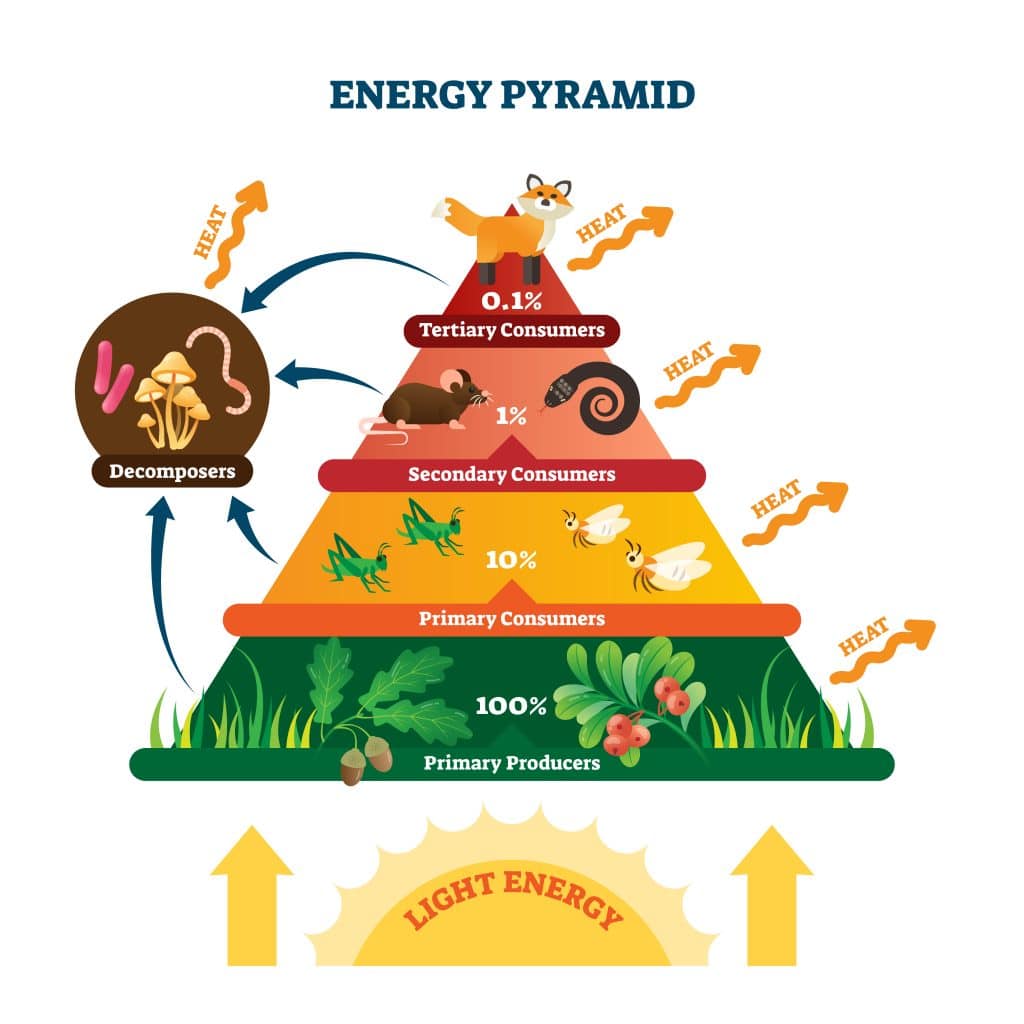
How do energy flow and nutrient cycling differ in an ecosystem?
Energy flows one-way through an ecosystem (from the sun, eventually leaving as heat). Nutrients, however, are constantly recycled by decomposers and reused by
What is a keystone species?
A keystone species has a large effect on the structure of an ecological community. It helps maintain and support balance in the ecosystem.
Example: In a classroom example, a predator like a top carnivore or an important pollinator can be a keystone species because removing it changes the whole ecosystem.
What is competition in an ecosystem
A: Competition happens when species need the same resources. The species that is better at gathering resources survives and may reduce the numbers of the other species.
Example: Lions and hyenas compete for prey. If lions are more effective hunters, hyenas may get less food, reducing their population.
Cause & Effect: Limited resources → stronger species survives → weaker species declines → population balance changes.
What is resource partitioning?
: Resource partitioning is when species divide resources to avoid direct competition.
Example: Birds eat insects at different heights in the same tree.
Cause & Effect: Species change resource use → less competition → more species can coexist → ecosystem stability increases.
What does ecosystem stability mean?
A: Stability is when an ecosystem can stay in a similar state over time. Mechanisms like (competition — when species fight for the same resources) and (partitioning — when species divide resources to avoid competition) help maintain it.
Example: A forest keeps similar numbers of trees and animals over years, even if some species fluctuate.
Cause & Effect: Mechanisms maintain balance → populations don’t crash → ecosystem persists over time.
What conditions are required for ecosystem stabilit
Steady energy supply – energy (like sunlight) is needed for photosynthesis, which supports all food chains.
Nutrient recycling – nutrients such as carbon, nitrogen, and water must be reused instead of being lost.
High genetic diversity – species, especially keystone species, need variety in their genes to adapt to changes and survive stress.
Cause & Effect:
Energy flow keeps organisms alive → recycled nutrients allow continuous growth → genetic diversity helps species adapt → ecosystem stays balanced and stable over time.
Why is genetic diversity important for stability?
More variation helps species survive selection pressures like disease or climate changes.
Example: Some plants survive drought because of genetic differences.
Cause & Effect: High variation → some individuals survive → population persists → ecosystem remains stable
What disruptions can affect ecosystems
Harvesting/removal (overfishing, logging)
Erosion (loss of nutrients)
Eutrophication (nutrient overload → algae blooms)
Selective species removal (hunting or epidemics)
Cause & Effect: Human or natural disturbances → resources or species decline → ecosystem balance is disrupted → stability decreases.
How do keystone species support ecosystem balance
Keystone species regulate the populations of other organisms and the use of resources. This prevents certain species from becoming too dominant and keeps the ecosystem functioning normally.
Example: Wolves in Yellowstone control the deer population. When wolves disappeared, deer numbers rose and they overgrazed plants. This caused soil erosion and reduced food for other animals. When wolves returned, plant life and animal diversity recovered.
Cause & Effect:
Keystone species removed → prey population increases → vegetation destroyed → habitat and food sources decline → ecosystem becomes unstable.
Keystone species present → populations stay balanced → habitats recover → biodiversity maintained.
Describe the process of photosynthesis and its importance to life on Earth.
Photosynthesis takes place in the chloroplasts of plant cells. With the help of sunlight, plants change carbon dioxide and water into glucose and oxygen. This process gives the plant energy and provides oxygen for other organisms, which is important for life.
Carbon dioxide + Water + Sunlight → Glucose + Oxygen
What are the carbon and nitrogen cycles
They are natural processes that recycle carbon and nitrogen through the environment, living things, and the atmosphere.
How does the carbon cycle work?
Plants take in carbon dioxide (CO₂) during photosynthesis.
Animals eat plants and release CO₂ through respiration.
When organisms die, decomposers release carbon back into the air or soil.
Burning fossil fuels also adds CO₂ to the atmosphere.
Q: How does the nitrogen cycle work?
How does the carbon cycle work?
Plants take in carbon dioxide (CO₂) during photosynthesis.
Animals eat plants and release CO₂ through respiration.
When organisms die, decomposers release carbon back into the air or soil.
Burning fossil fuels also adds CO₂ to the atmosphere.
How does the nitrogen cycle work?
Nitrogen gas (N₂) from the air is turned into useful forms by bacteria (nitrogen fixation).
Plants absorb these nitrogen compounds to grow.
Animals get nitrogen by eating plants.
When organisms die or release waste, decomposers return nitrogen to the soil.
Some bacteria release nitrogen back into the air (denitrification).
Why are these cycles important?
They make sure essential elements like carbon and nitrogen are reused and available for all living things to survive.

