techniques for measuring microbial growth
 Call Kai
 Learn
Learn Practice Test
 Spaced Repetition
 Match
Match Flashcards
 Knowt Play
1/15

There's no tags or description
Looks like no tags are added yet.
Name | Mastery | Learn | Test | Matching | Spaced | Call with Kai |
|---|
No analytics yet
Send a link to your students to track their progress
16 Terms
what are the 4 techniques for counting cells
Cell counting with a haemocytometer
Turbidometry with a colorimeter
Dilution plating
Dry mass for measuring fungal growth
describe cell counting
This counts the total cells in a broth culture by simply observing the individual cells under the microscope. This is reasonably easy for large cells like yeast, but is more difficult for bacterial cells, since they are so small. The cell counter (or haemocytometer) is a large microscope slide with a very accurate grid drawn in the centre. The grid marks out squares with 1 mm, 0.2 mm and 0.05 mm sides. There is an accurate gap of 0.1 mm between the grid and the thick coverslip, so the volume of liquid above the grid is known. The number of cells in a known small volume can thus be counted, and so scaled up. The units are cells mL-1.
One limitation is that this counts total cells not living cells what can be done to over come this
This counts total cells, since you can’t tell by looking if a cell is alive or dead. However, by using a vital stains (like trypan blue) that selectively stain only dead cells and not living ones, you can distinguish between living and dead cells under the microscope. This allows both total and viable cell counts to be made in a haemocytometer.
turbidometry
This technique measures the density of cells indirectly. A sample of the liquid culture is placed in a cuvette in a colorimeter, and the absorbance of light is measured. The greater the concentration of the cells, the more cloudy or turbid the liquid is, so the more light it scatters, so the less light is transmitted to the detector, so the higher the absorbance reading.
what’s an error which can occur in turbidometry
Since the cells are in suspension, they will settle over time, so it is important to shake the culture flask before collecting a sample
if your given an unknown concentration how do you calculate it
using a calibration curve to see what concentration would have that absorbance
does turbidometry count live or total cell
total cells
dilution plating
This technique counts viable cells. · A small sample is taken from a broth culture using aseptic technique and a sterile pipette. · This sample is then spread evenly onto an agar plate using a sterile glass or plastic spreader. · The agar plate is incubated at 30ºC for 24h. Each viable cell in the sample will multiply to form a colony. · The number of colonies on the agar plate is counted. Since each colony arose from a single living cell, this is the number of viable cells in the sample. For most cultures there will be too many colonies to count, so a serial dilution is used to get a range of cell concentrations, and a sample from each dilution is spread on an agar plate. For most of the agar plates there will be too many colonies to count, and in some agar plates there will be too few, so any count would be unreliable. But in one of the dilutions there will be a good number (20-200) of individual colonies. From this we can calculate the concentration of viable cells in the original culture.
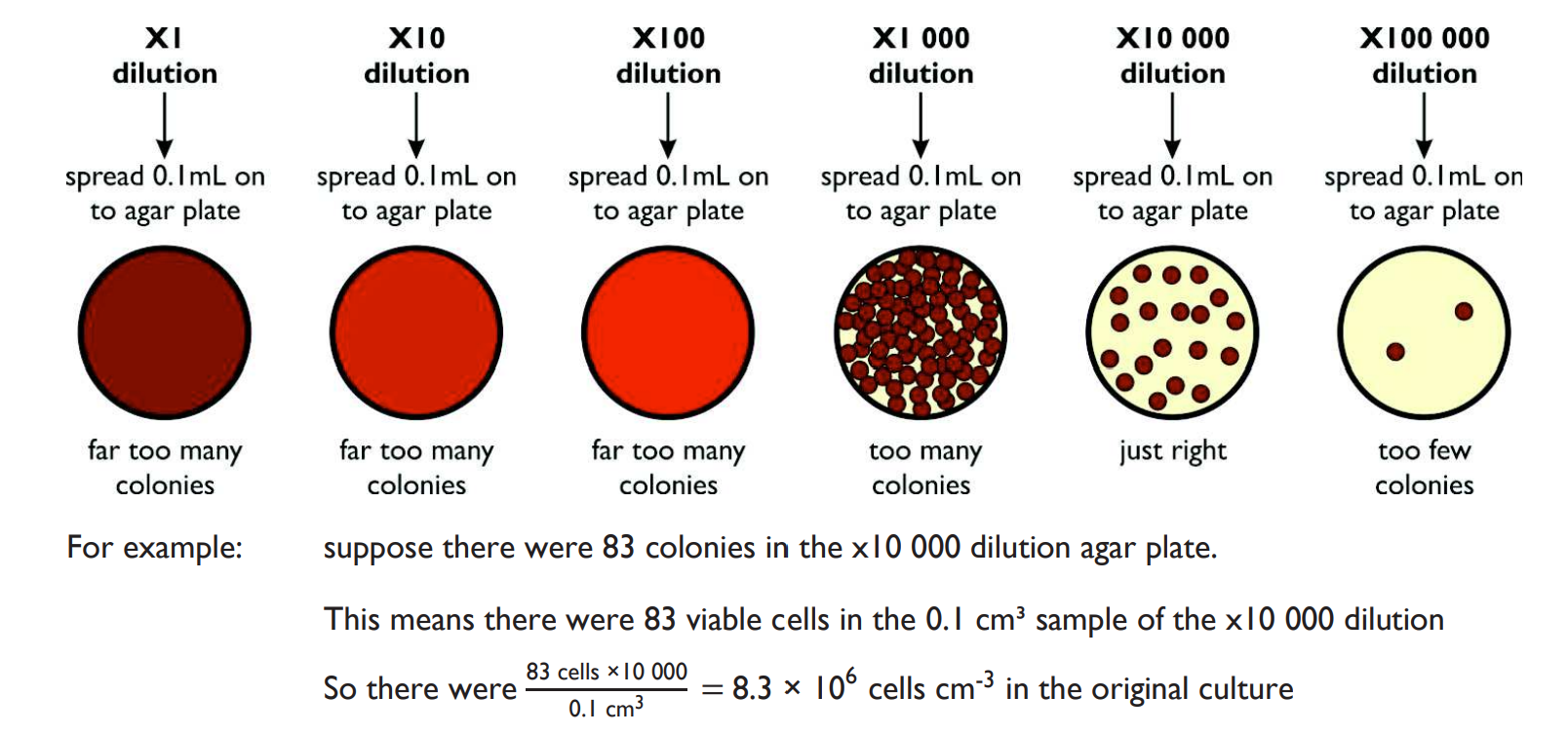
which one of these would be a suitable dilution plate.
This is the second to last one
For example: suppose there were 83 colonies in the x10 000 dilution agar plate. This means there were 83 viable cells in the 0.1 cm³ sample of the x10 000 dilution

does dilution plating count live or viable cells
viable
In what 2 conditions can fungi be grown in
solid cultures
liquid cultures
what are large masses of fungi called
mycelium
describe how to measure solid cultures
Moulds growing on a solid agar plate tend to form fairly flat circular mycelia, so the area of the mycelium is an easy measure of growth. If the mycelium is not circular it can be treated as an ellipse, and the area calculated using: area = p x r1 x r2, where r1 and r2 are the longest and shortest radii.
liquid cultures
For moulds growing in liquid cultures the best measure of growth is their dry mass. A sample of the culture is taken and filtered or centrifuged to separate the fungi from the solution. The mould is then dried fully by heating in an oven at 100ºC to evaporate the water and then weighed. The cycle of heating and weighing is repeated until the mass is constant, which means that all the water has been driven off. This gives the dry mass (i.e. fungal cell mass) in the original sample volume. The dry mass of bacterial cells growing in liquid culture can also be measured using this dry mass technique.
why do we keep reweighing and reheating the mass of cells until it remains constant.
to ensure that all the water is remove and isn’t effecting the mass

