`Introduction to Vector Calculus
 Studied by 1 person
 Call Kai
 Learn
Learn Practice Test
 Spaced Repetition
 Match
Match Flashcards
 Knowt Play
1/32

There's no tags or description
Looks like no tags are added yet.
Name | Mastery | Learn | Test | Matching | Spaced | Call with Kai |
|---|
No analytics yet
Send a link to your students to track their progress
33 Terms
What is a scalar quantity?
A scalar has only magnitude and sign, represented by a single number.
What is a vector quantity?
A vector has both magnitude and direction.
How is a vector represented in 2D Cartesian coordinates?
\mathbf{v} = \begin{pmatrix} \mathbf{v}_x \\ \mathbf{v}_y \end{pmatrix}
How is a vector represented in 3D Cartesian coordinates?
\mathbf{v} = \begin{pmatrix} \mathbf{v}_x \\ \mathbf{v}_y \\ \mathbf{v}_z \end{pmatrix}
What is the magnitude of a 3D vector \mathbf{v}?
|\mathbf{v}| = \sqrt{\mathbf{v}_x^2 + \mathbf{v}_y^2 + \mathbf{v}_z^2}
What is a unit vector?
A vector of magnitude 1: \hat{v} = \dfrac{\mathbf{v}}{|\mathbf{v}|}.
What does the unit vector represent?
The direction of the vector with a magnitude of 1
What is the zero vector?
A vector with zero magnitude and no defined direction, denoted \mathbf{0}.
What are the standard unit basis vectors in 3D?
\mathbf{i} = \begin{pmatrix} 1 \\ 0 \\ 0 \end{pmatrix},\;\mathbf{j} = \begin{pmatrix} 0 \\ 1 \\ 0 \end{pmatrix},\;\mathbf{k} = \begin{pmatrix} 0 \\ 0 \\ 1 \end{pmatrix}
How is vector addition defined for \mathbf{v}_1 = \begin{pmatrix} \alpha \\ \beta \\ \gamma \end{pmatrix}
and \mathbf{v}_2 = \begin{pmatrix} a \\ b \\ c \end{pmatrix}
?
\mathbf{v}_1 + \mathbf{v}_2 = (\alpha + a,\; \beta + b,\; \gamma + c)
How is scalar multiplication defined for a\in\mathbb{R} and \mathbf{v}=(\alpha,\beta,\gamma) ?
a\mathbf{v} = (a\alpha,\; a\beta,\; a\gamma)
List key vector algebra properties.
Commutative and associative addition, distributive laws, additive identity, additive inverse.
What is a 2\times2 matrix?
An array of 4 scalars
M = \begin{bmatrix} a & b \\ c & d \end{bmatrix}
Define a 2\times2 matrix–vector product.
\begin{bmatrix} a & b \\ c & d \end{bmatrix} \begin{pmatrix} \alpha \\ \beta \end{pmatrix} = \begin{pmatrix} a\alpha + b\beta \\ c\alpha + d\beta \end{pmatrix}
What is the 2D rotation matrix for angle \phi?
\begin{bmatrix} \cos\phi & -\sin\phi \\ \sin\phi & \cos\phi \end{bmatrix}
What is the determinant of a 2\times2 matrix?
\det(M) = ad - bc
Geometric meaning of \det(M) for 2\times2 ?
Area scaling factor; if \det(M)=0 the map is non-invertible.
Give a 3\times3 determinant formula (cofactor along first row).

Geometric meaning of a 3\times3 determinant?
Volume scaling factor; non-zero means invertible.
Define the scalar (dot) product.
\mathbf{v}_1 \cdot \mathbf{v}_2 = |\mathbf{v}_1|\,|\mathbf{v}_2|\cos\theta
Where \theta is the angle between the two vectors.
Also equivalent is v1=(a,b) v2=(x,y) then the cross product is (ax,by) and the same applies in 3d vectors
Dot product in components (3D).
\mathbf{v}_1 \cdot \mathbf{v}_2 = \alpha \mathbf{a} + \beta \mathbf{b} + \gamma \mathbf{c}
What does a zero dot product imply?
Vectors are orthogonal (perpendicular) and \theta=\frac{\pi}{2}
What are some other things to note about dot products?
If v1=v2 then the it product = \left\vert v_1\right\vert^2
Algebraic properties follow from the definition, such as
V1 . V2 = V2 . V1
V1 .(cV2)= (cV1).V2 for any scalar c
V1 . (V2+V3) = V1.V2 + V1.V3
Component of \mathbf{v}_1 in direction of \mathbf{v}_2
The component of a vector v1 in the direction of another vector v2 is the scalar quantity
|\mathbf{v}_1|\cos\theta = \frac{\mathbf{v}_1 \cdot \mathbf{v}_2}{|\mathbf{v}_2|}
Where \theta is the angle between the vectors.
Define the vector (cross) product.
\mathbf{v}_1 \times \mathbf{v}_2 = |\mathbf{v}_1|\,|\mathbf{v}_2|\sin\theta\,\hat{n}
Where \hat{n} is a unit vector perpendicular to both v1 and v2 such that {v1,v2,v3} form a right handed set, and \theta is the angle between the vectors.
Cross product in components for \vec{v}_1\times\vec{v}_2=|\vec{v}_1|\,|\vec{v}_2|\cos\theta
and the determinant form
\mathbf{v}_1\times\mathbf{v}_2=(\beta c-\gamma b,\;\gamma a-\alpha c,\;\alpha b-\beta a)
Think of it as the same way of calculating a determinant.
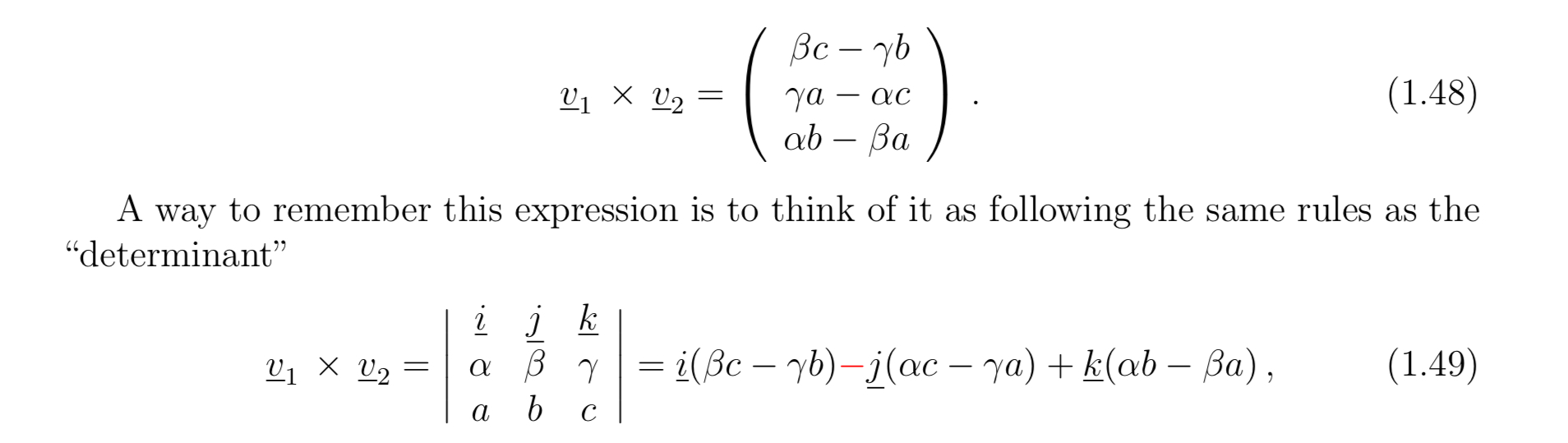
What is the cross product always perpendicular to?
The two ‘input vectors’
Does the cross product commute?
No
\vec{v}_1 \times \vec{v}_2 = -\,(\vec{v}_2 \times \vec{v}_1)
Is the cross product associative?
Not in general
(V1xV2)xV3 isn’t generally the same as V1x(V2xV3)
What are the algebraic properties of the vector cross product?
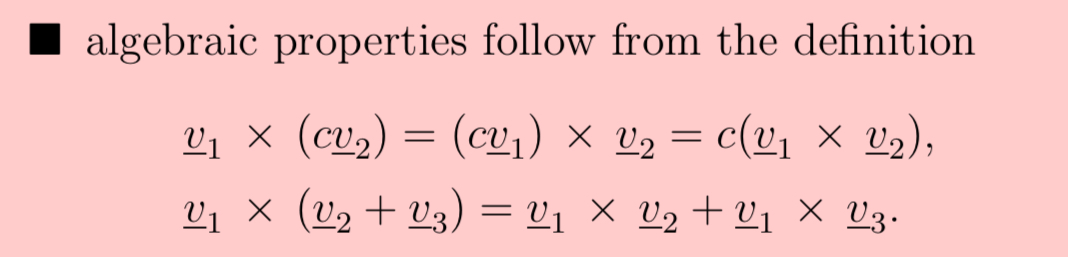
Basis-vector cross products.
\mathbf{i}\times\mathbf{j}=\mathbf{k},\; \mathbf{j}\times\mathbf{k}=\mathbf{i},\; \mathbf{k}\times\mathbf{i}=\mathbf{j}
Cross product when vectors are parallel.
\vec{v}_1 \times \vec{v}_2 = \vec{0}
Dot vs cross product roles.
Dot:
The dot product of two vectors represents their similarity or how much they point in the same direction.
Outputs a scalar
Cross:
a new vector that is perpendicular to both original vectors. The magnitude of this new vector represents the area of the parallelogram formed by the two original vectors.
vector output
 Note
Note  Flashcards (34)