Cell Growth & Division
 Call Kai
 Learn
Learn Practice Test
 Spaced Repetition
 Match
Match Flashcards
 Knowt Play
1/41

There's no tags or description
Looks like no tags are added yet.
Name | Mastery | Learn | Test | Matching | Spaced | Call with Kai |
|---|
No analytics yet
Send a link to your students to track their progress
42 Terms
Name each phase of the cell cycle
Interphase (G1, S, G2) Mitoitic [M] (Mitosis (Prophase, Metaphase, Anaphase, Telophase), Cytokinesis)
G1 phase
The longest phase (~1/2) where the cell grows, making proteins and lipids and starts synthesizing organelles, preparing for division. It has 1 set of DNA present at the end, and the DNA is chromatins with homologous chromosomes (one from egg, one from sperm).
S phase
DNA replication/Chromosome duplication, (1/3). It ends with 2 sets of DNA and slightly more organelles, with homologous pairs and sister chromatids in the form of chromatin.
G2 phase
Protein and organelle synthesis (1/6), checks mistakes in DNA replication, ends with 2 sets of DNA and more organelles, with homologous pairs and sister chromatids in the form of chromatin.
Mitosis (4 stages)
Overall this is the nuclear division, ends with 2 sets of DNA and nuclei
Prophase
Nuclear membrane breaks down
Chromatin condenses into chromosomes
Spindle fibers form and attach to chromosomes
Metaphase
Chromosomes line up in the middle of the cell (Metaphase plate)
Anaphase
Sister chromatids are split and move to opposite poles.
Telophase
2 nuclear membranes form
Chromosomes uncoil back into chromatin
Spindle fibers break down
Cytokinesis
Splitting of the cytoplasm. For animal cells, the cleavage furrow forms (contracting ring of microfilaments) like a balloon with a string tied around it to form 2 daughter cells. For plant cells vesicles filled with cellulose form a cell plate, eventually forming a new cell wall, and 2 daughter cells.
G0
Cells exit the cell cycle pausing division permanently or temporarily occurring after G1.
DNA replication location
In the S phase, in the nucleus.
Key enzymes for DNA replication
DNA helicase, DNA ligase, DNA polymerase (HeLP the cell with DNA replication).
DNA helicase
Breaks hydrogen bonds of parent molecule, unzipping the DNA strand.
DNA polymerase
Adds matching nucleotides to make the daughter strand. It goes from 5’ to 3’ of the daughter strand (3’ to 5’ of the parent strand for direction) so on one side it creates the leading strand which is continuous with the direction of DNA helicase, and on the other it creates okazaki fragments, constantly adding more DNA polymerase, creating the lagging strand.
DNA ligase
It connects fragments, as DNA replication occurs in bubbles that eventually meet where DNA ligase connects the fragments, including the Okazaki fragments.
Importance of cell division in organisms
To maintain a favorable SA:V ratio (stays small) to be able to manage nutrients and waste permanently.
With individual cells, the cells differentiate and specialize to perform different cell functions.
They can use this to repair as well as grow in size without compromising the SA: V ratio.
Unicellular organisms use it to reproduce. Multicellular mostly use it for repairs and growth and sexual (gametes) + asexual reproduction.
Prokaryotes cell division
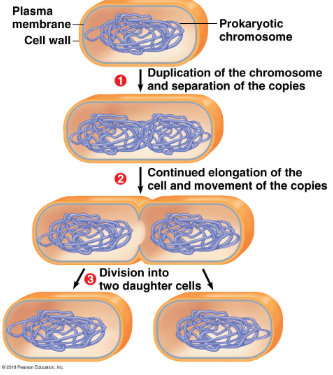
Binary fission, the cell duplicates the chromosome and seperates the copies, elongating the cell as the copies move to the ‘poles’ eventually dividing into two daughter cells. It is smaller, simpler and has one circular chromosome, and is faster taking only an hour or two to replicate.
Eukaryotes cell division
The cell cycle with its many phases, it is bigger, more complex, 46 chromosomes per cell, and it is slower taking at least 24 hours to replicate.
Chromatin
DNA strands wrapped loosely around histomes.
Sister chromatids
Two identical copies of a single replicated chromosome, which join together at the centromere.
Homologous chromosomes
Two chromosomes that resemble eachother in length, centromere position and staining pattern. Tightly coiled, and one comes from egg one comes from sperm.
How does a cell divide in general, how many chromosomes in the daughter cell versus the parent cell.
Prep, division. Same # of chromosomes in parent cell and daughter cell.
Cell cycle checkpoints/control system
G1 - Checks for nutrients, growth factors/if grown enough, and for DNA damage.
G2 - Checks for cell size and DNA replication
Metaphase: Chromosome spindle fibers attachments.
Regulators:
Proto-oncogenes (Gas pedal driving cell growth and division) - 1 mutated gene leads to go go go!
Tumor suppressor genes - 2 mutated genes, can’t stop/regulate cell growth (even w/ bad cells)
Apoptosis - Programmed cell death, eliminates uneccesary cells during development, removes unhealthy or damaged cells in the mature organism, occurs when the checkpoint fails.
Cancer “a disease of the cell cycle“
Cancer is essentially uncontrolled cell growth, which ends up forming tumors with too much cell division and too little cell death.
Possible sources: Aging (build up of mutations over time), regulators mutated, inherited mutations. Radiation, carcinogens, lifestyle factors.
Benign tumors: Abnormal cells remain at their original site, not cancerous, easily removable.
Malignant tumors: Abnormal reproducing cells spread into neighboring tissues and invade other body parts, they can displace normal tissue and interrupt organ function (METASTASIS) cancer spreads beyond their original site. cancerous.
Oncogene - A gene that can cause cancer when present in a single copy in the cell.
Forms: A single cell undergoes changes that convert a normal cell→ cancer cell and evades initial destruction.
Meiosis!
Similar but different from mitosis (and is for cell cycle to produce gametic cells).
Prophase 1
Chromatin condenses into chromosomes, nuclear membrane breaks down, spindle fibers form and attach to centromeres. Tetrads form, and crossing over occurs.
Metaphase 1
The tetrads line up in the middle of the cell (Metaphase plate).
Anaphase 1
The homologous pairs are pulled apart to opposite poles of the cell.
Telophase 1
2 nuclear membranes (re)form, spindle fibers detach and disappear, chromosomes expand into chromatin.
Cytokenisis 1
The cell breaks apart (same as cytokinesis) producing 2 diploid daughter cells NOT IDENTICAL.
Meiosis 2
Occurs in each cell
Prophase 2
Chromatin condenses into chromosomes, nuclear membrane breaks down, spindle fibers form and attach to centromeres.
Metaphase 2
Chromosomes line up in the middle of the cell vertically (metaphase plate).
Anaphase 2
The sister chromatids are separated, pulled apart to opposite poles of the cell.
Telophase 2
2 nuclear membranes (re)form, spindle fibers detach and disappear, and chromosomes expand into chromatin.
Cytokenesis 2
The same as cytokenesis, ends up with four haploid daughter cells that are genetically unique.
Mitosis vs Meiosis
Mitosis is 1 division, produces 2 diploid cells that are identical daughter cells, splits homologous chromosomes, and is for somatic cells and asexual reproduction and growth.
Meiosis is 2 divisions, and results in 4 haploid genetically unique daughter cells, splits sister chromatids (ends up with halved number of chromosomes) has tetrads formation and crossing over (NOT IN MITOSIS), and is for the production of gametes and sexual reproduction.
Why is meiosis essential to sexual reproduction and why must the chromosomes number be reduced during the process?
Meiosis results in haploid gametes, egg and sperm cells, which are key or fertilization. The sperm cell fertilizes the egg cell (Fertilization) creating a diploid zygote, which then can continue the cycle. Sperm and egg cells are produced through meiosis rather than MITOSIS since it produces haploid cells which come together to form diploid cells versus if they were diploid cells it would cause problems.
Variation in a species
Crossing over w/ tetrad formation: switches some info around, mix and match. Prophase 1.
Independent assortment: Chromosomes can line up in tetrads and w/ the metaphase plate w/ many different combinations, especially crossing over. Chromosomes are not identical like sister chromatids. This occurs during metaphase 1.
Random fertilization: The gametes (egg and sperm) are randomly ‘picked‘ when the egg is fertilized by the sperm, forming a unique zygote as the gametes themselves are also already unique due to independent assortment and crossing over (Fertilization).
Alterations
Non-disjunction can impact chromosome number, as the membranes of a chromosome pair/homologous chromosomes fail to seperate, this leads to down syndrome.
Deletion: A part of the chromosome is deleted.
Duplication: A part of the chromosome is duplicated.
Inversion: A segment breaks off, flips, and reattaches.
All three of these typically occur during crossing over, and impact the structure of a chromosome.
Mutations impacts
Gametes: Passed to offspring, affects every cell in the offspring’s ody, ie. cystic fibrosis and other hereditary conditions.
Somatic cells: Not passed to offspring, affects the individual ie. skin cancer from UV exposure, lung cancer.