Nutrition & Respiration
 Call Kai
 Learn
Learn Practice Test
 Spaced Repetition
 Match
Match Flashcards
 Knowt Play
1/57

There's no tags or description
Looks like no tags are added yet.
Name | Mastery | Learn | Test | Matching | Spaced | Call with Kai |
|---|
No analytics yet
Send a link to your students to track their progress
58 Terms
what does a balanced diet include?
appropriate proportions of carbohydrate, lipid, fibre, protein, vitamins, minerals, water
what is the function of carbohydrates?
the body's main source of energy (for respiration)
what is the function of protein?
growth (creating new cells) and the repair of damaged tissues and enzymes
what is the function of lipids?
long-term energy storage, insulation and protection of organs
what is the function of vitamin A?
maintaining good vision, supporting immune function, and maintaining healthy skin
what is the function of vitamin C?
maintaining healthy connective tissue, skin, gums, and blood vessels
what is the function of vitamin D?
absorption of calcium in the small intestine, which are necessary for developing and maintaining strong bones and teeth
what is the function of calcium?
building and maintaining strong bones and teeth, aiding in blood clotting
what is the function of iron?
production of haemoglobin, protein in red blood cells responsible for transporting oxygen around body.
what is the function of water?
acting as the primary medium for chemical reactions, transport, and waste removal
what is the function of fibre?
aiding digestion and maintaining bowel health
what are some sources of carbohydrates and what happens if you don’t have enough of it?
bread, pasta, potatoes and sugars- fruits, milk
can lead to fatigue, low blood sugar
what are some sources of protein and what happens if you don’t have enough of it?
meat, eggs, dairy and beans, lentils, soy
can lead to stunted growth, muscle loss
what are some sources of lipids and what happens if you don’t have enough of it?
butter, pork, salmon, olive oil
can lead to poor temperature regulation
what are some sources of vitamin A and what happens if you don’t have enough of it?
liver, egg yolks (fat soluble)
can lead to night blindness
what are some sources of vitamin C and what happens if you don’t have enough of it?
oranges, lemons, limes
can lead to scurvy or anaemia
what are some sources of vitamin D and what happens if you don’t have enough of it?
sunlight, salmon, beef liver
can lead to rickets
what are some sources of calcium and what happens if you don’t have enough of it?
milk, cheese and yoghurt
can lead to weak bones and teeth, rickets
what are some sources of iron and what happens if you don’t have enough of it?
beef, lamb, lentils, broccoli
can lead to iron deficiency (anaemia)
what are some sources of fibre and what happens if you don’t have enough of it?
whole-wheat bread, pasta, oats
can lead to constipation or piles
how do energy requirements vary with activity levels, age and pregnancy?
based on metabolic needs for activity, growth, and tissue maintenance
example, children and pregnant women need more energy
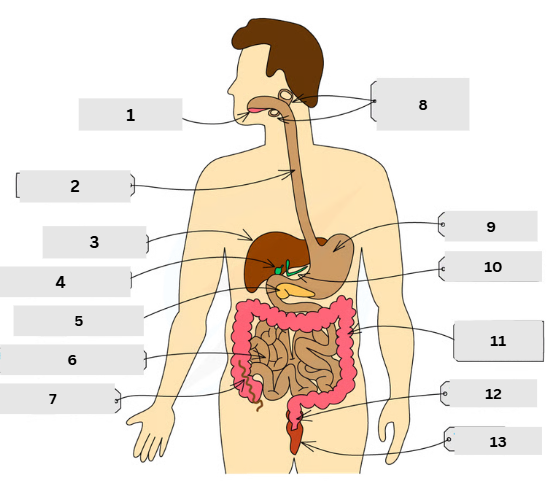
1-Mouth
2- oesophagus
3-Liver
4-Gallbladder
5-Pancreas
6-Small intestine
7- appendix
8-salivary glands
9-stomach
10- bile duct
11-large intestine
12-rectum
13-anus
what is the function of the mouth in digestion?
begin both mechanical and chemical digestion of food (ingestion)
teeth- grinds food
tongue- helps mix food with saliva
what is the function of the stomach in digestion?
mechanically churn food into a liquid called chyme and begin the chemical digestion of proteins
the HCl in the stomach kills bacteria
what is the function of the small intestine in digestion?
carbs digestion- pancreatic amalyse breaks down starch and maltase breaks down maltose into glucose
protein digestion- trypsin breaks down polypeptides into amino acids
lipid digestion- lipase breaks down fats into fatty acids and glycerol
bile action- bile produced in liver and stored in gallbladder is released to emulsify fats and neutralise stomach acid to provide optimum alkaline pH for enzymes
what is the function of the large intestine in digestion?
The colon absorbs water, mineral ions and vitamins
Egestion occurs- process of passing out food that hasn’t been digested/ absorbed (faeces) through anus
rectum stores faeces until ready to be expelled
what is the function of the pancreas in digestion?
produces and secretes pancreatic juice into the duodenum via the pancreatic duct
in pancreatic juice there’s amylase, trypsin, lipase and sodium hydrogencarbonate
what is the function of the gullet in digestion?
transports food from the mouth to the stomach using peristalsis
peristalsis are wave-like muscular contractions that push the food bolus downward
list all the enzymes and the substrates they break down
amylase- starch to maltose
maltase- maltose to glucose
proteases- proteins to amino acids
lipases- lipids to fatty acids and glycerol
where is bile produced and stored?
it is produced by the liver and stored in the gall bladder
what is the role of bile in digestion?
it emulsifies fats and neutralises stomach acid
how does bile emulsify fats?
Bile break down large fat droplets into many smaller droplets
makes much larger surface area for the enzyme lipase to work on- digestion of lipids happens faster
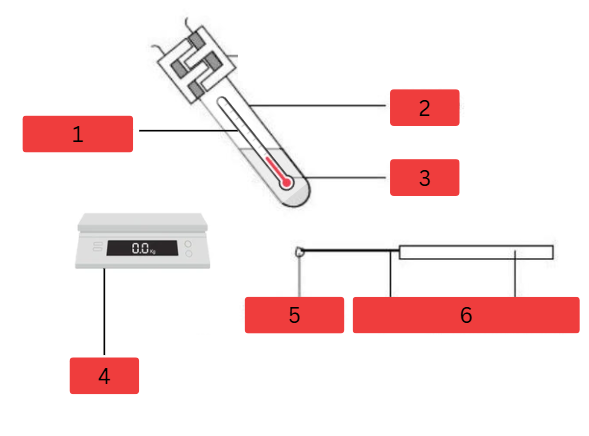
Explain the method to investigate the energy content in a food sample
1- Thermometer
2- Boiling-tube
3- Water
4- Scale
5- Burning food
6- Mounted needle
Measure fixed volume of water into boiling tube
Record initial temperature of water
Weigh food sample
Attach food to mounted needle
Burn food sample with flame
Hold burning food under boiling tube of water
Allow food to burn completely
Record final temperature of water
Reweigh food/ash to find mass burned
How do you calculate the energy transferred in the energy content of a food sample?
Energy = mass of water x 4.2 x temperature change
4.2 = specific heat capacity of water
how do you calculate energy per gram of food?
energy per gram = energy transferred / mass of food burned
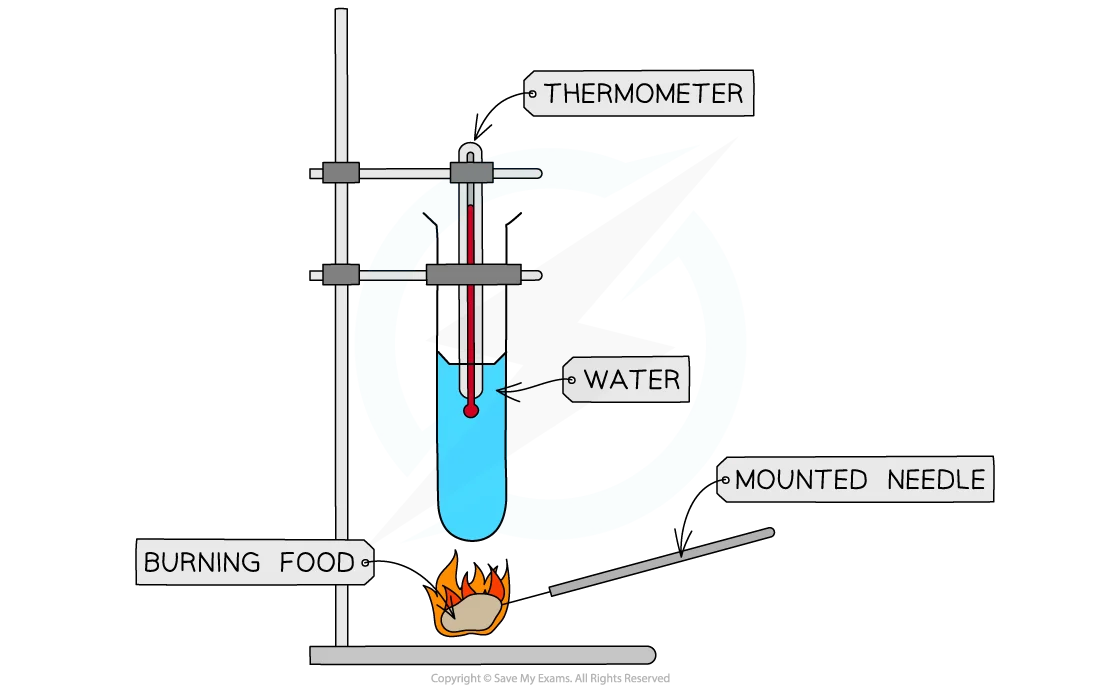
what are the control variables in the food energy content experiment?
Volume of water
Distance between food and tube
Starting temperature
Same apparatus
What are the sources of error in the food energy content experiment?
Heat lost to surroundings
Heat absorbed by apparatus
Food may not burn completely
How could you improve the accuracy of food energy content experiments?
Use a lid on the tube
Use a metal calorimeter
Insulate the apparatus
Stir the water
what is respiration?
the chemical reactions in cells that break down nutrient molecules (glucose) to release energy (ATP) for metabolism
what is the difference between aerobic and anaerobic respiration?
oxygen required: Yes, No
glucose breakdown: complete, incomplete
energy yield: high, low
location in cell: cytoplasm and mitochondria, cytoplasm
what is the word equation for aerobic respiration?
Glucose + Oxygen—> Carbon dioxide + Water (+ Energy)
what is the balanced symbol equation for aerobic respiration?
C6H12O6 + 6O2 —> 6CO2 + 6H2O
what is the word equation for anaerobic respiration in animals?
glucose—> lactic acid (+little ATP)
what is the word equation for anaerobic respiration in plants?
glucose —> ethanol + carbon dioxide (+little ATP)
what is the method for investigating carbon dioxide production in respiration in living organisms?
Place germinating seeds in a boiling tube.
Add cotton wool to keep them in place.
Connect the tube so the gas produced passes into limewater.
Leave for some time.
the limewater turns cloudy.
What could you use as a control experiment for investigating respiration in living organisms?
Dead seeds (boiled seeds)
they do not respire—> shows carbon dioxide came from respiration, not another source
what is the method for investigating heat production in respiration in living organisms?
Place germinating seeds in an insulated flask.
Insert a thermometer.
Leave for a period of time.
Record the temperature change
Temperature increases
how is the small intestine adapted for absorption?
Each villus has microvilli
One cell thick
Rich network of blood capillaries
central lymph vessel
large number of epithelial cells
Explain the adaptation of the small intestine- “large number of epithelial cells”
provide energy via respiration for active transport of certain nutrients
Explain the adaptation of the small intestine- “central lymph vessel”
specialised for absorbing and transporting lipids
Explain the adaptation of the small intestine- “Rich network of blood capillaries”
maintains steep concentration gradient for faster diffusion
Explain the adaptation of the small intestine- “each villus has microvilli”
increases surface area
Explain the adaptation of the small intestine- “one cell thick”
short diffusion distance
Why do the number of live yeast cells decrease toward the end of beef production?
There is less glucose so there is a decrease in ethanol
How can you modify apparatus to measure rate of oxygen production more accurately?
Use a measuring cylinder
Why is there an oil layer in the experiment investigating temperature on rate of carbon dioxide production?
It keeps out oxygen so the yeast is sure to respire anaerobically
Explain how a deficiency in Vitamin D can lead to anaemia, mentioning calcium absorption.
Vitamin D is needed for calcium absorption
Without vitamin D, calcium absorption is reduced
Low calcium leads to weak bones and may affect iron absorption or blood formation
Reduced red blood cells —> anaemia
what is synthesis?
small food molecules are used to build large molecules

