AqBot: Flagella and Intro to Reproduction
 Studied by 0 people
 Call Kai
 Learn
Learn Practice Test
 Spaced Repetition
 Match
Match Flashcards
 Knowt Play
1/29

There's no tags or description
Looks like no tags are added yet.
Name | Mastery | Learn | Test | Matching | Spaced | Call with Kai |
|---|
No analytics yet
Send a link to your students to track their progress
30 Terms
What are 3 flagellar external features?
scales, hairs, and spikes
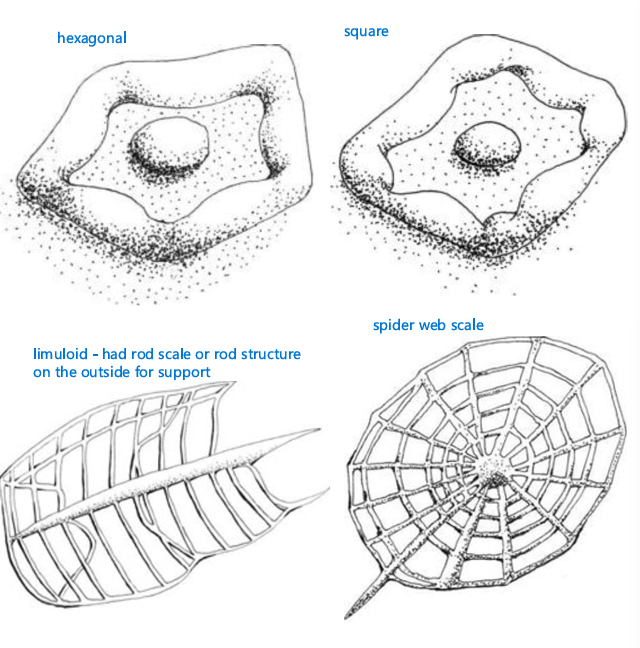
Describe flagellar scales
What organisms are they present in?
What are the 5 flagellar scale shapes
Normally a continuation of cell body scales
Present in Heterokontophyta, Haptophyta, and Chlorophyta
Hexagonal, square, limuloid (has rod scale or rod structure on the outside for support), spider web, rod
What are flagellar hairs known as?
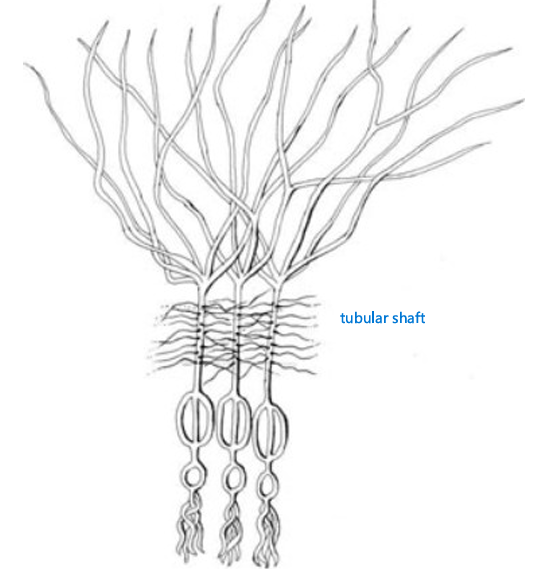
List and describe the 2 forms of flagellar hairs
aka Mastigonemes
2 types
Tubular - tripartite (base, tubular shaft, and terminal filaments)
Non-tubular - simple; slender and flexible
generally describe Euglena mastigonemes
Euglena has complex tubular flagella hairs, a tubular shaft is present
Describe flagellar spikes
What is there function?
What organisms are they present in?
described as a “peculiarity”
unknown function
only present on male gametes of a few brown algae
What are the 4 main types of flagellar internal features?
Why are flagellar internal features important?
Axoneme, paraxial rod, transition zone, and root system
Flagellar internal features are complex and are used to distinguish b/w similar looking plankton groups
What’s the purpose of axoneme?
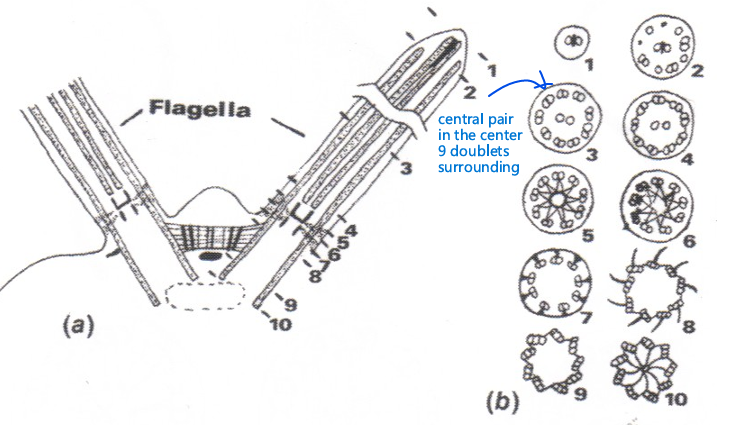
Describe its makeup.
USE = generates movement of flagella
9 + 2 pattern = contains central pair (where “2” comes from) and has 9 microtubule doublets linked by dynein arms (where “9” comes from)
How does the axoneme move?
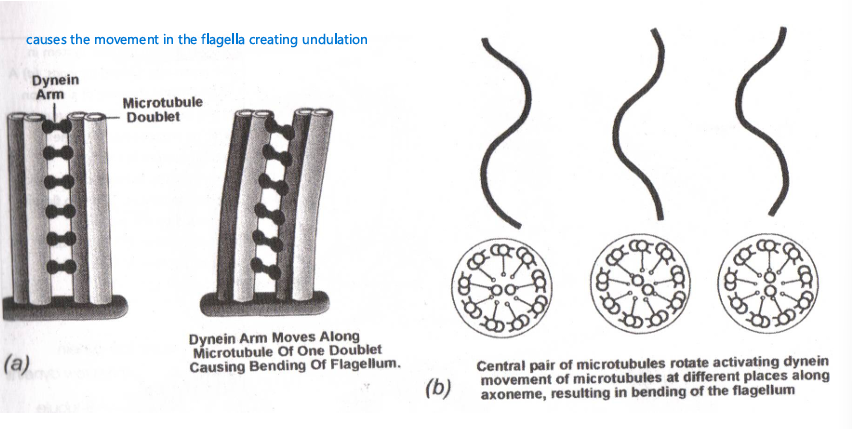
the dynein arm will move along the microtubule of one doublet causing the flagella to bend, then the other dynein follows creating undulation
What’s the purpose of the paraxial rod?
What is the paraxial rod known as?
What organisms are they present in?
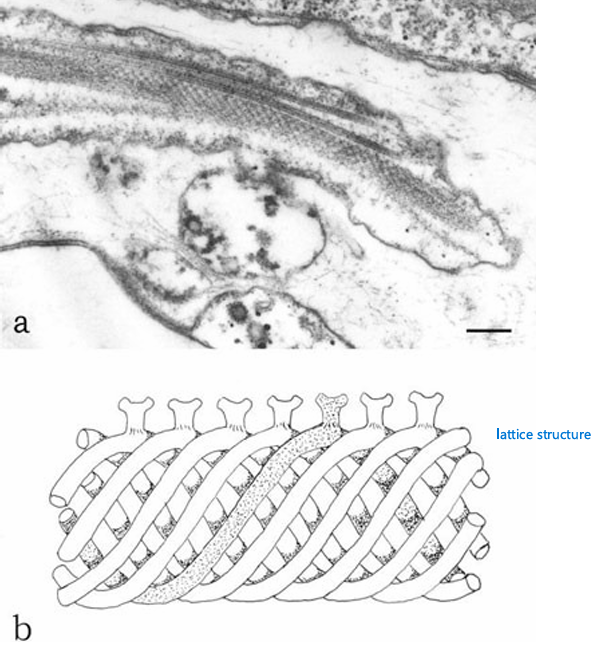
USE = provides support for the flagella; in the form of a complex lattice structure parallel to the axoneme/flagella
aka Paraflagellar Rod (PFR)
present in Heterokonts, Euglenophytes, and Dinophytes
Describe the transition zone
How many types of transition zones are there?
an axoneme constant b/w different algae; varies greatly, so it’s a useful indicator of phylogenetic relationships
5 transition zones types each having secondary variations
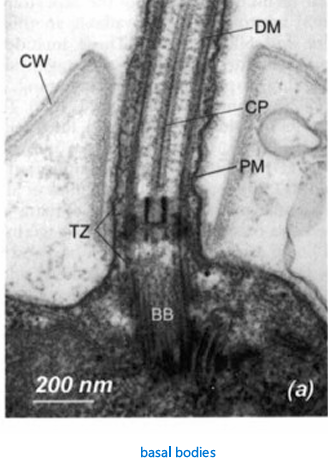
Describe the Type 1 transition zone
simplest
1 basal plate present
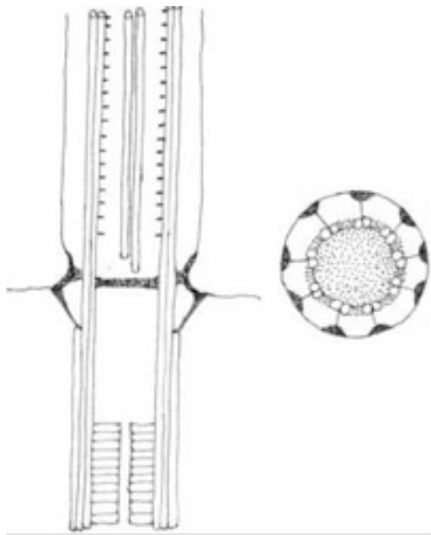
Describe the Type 2 transition zone
No basal plates
Has a plug
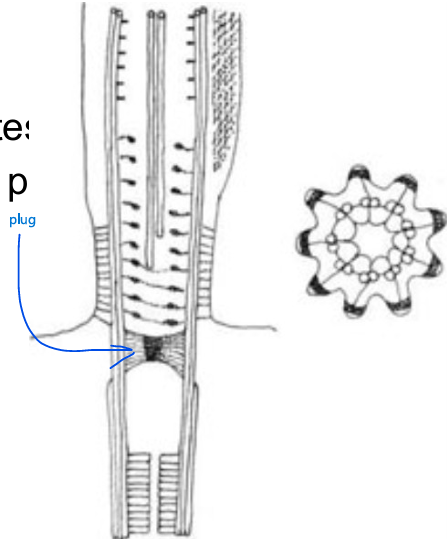
Describe the Type 3 transition zone
double plate system of complex plates which are stacked on each other
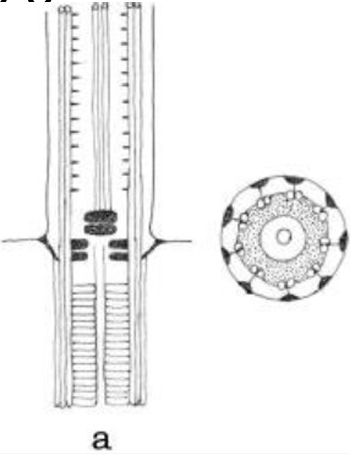
Describe the Type 4 transition zone
1 basal plate
contains transitional helix
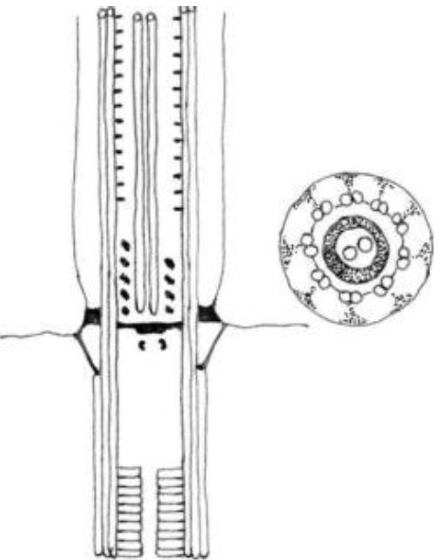
Describe the Type 5 transition zone
stellate pattern
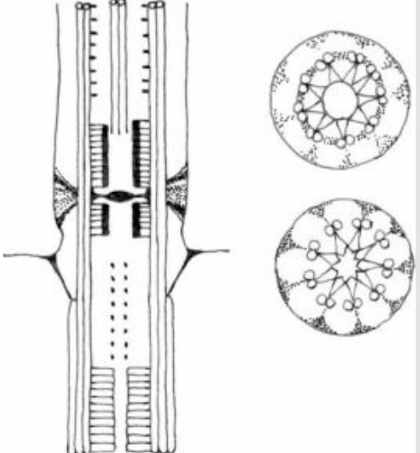
Define the root system
What are the 2 attachment forms?
Extends from basal bodies. Underlays plasma membrane or projects into cell contacting organelles
Cruciate and broad-band
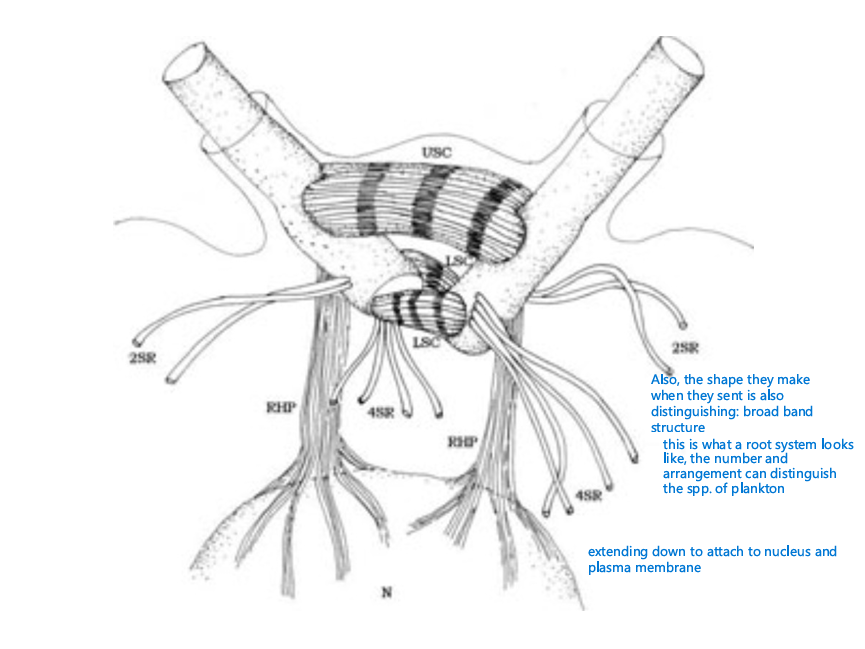
what is the flagella structure of Euglena?
canal is rigid
mastigonemes
contractile vacuoles can affect flagella
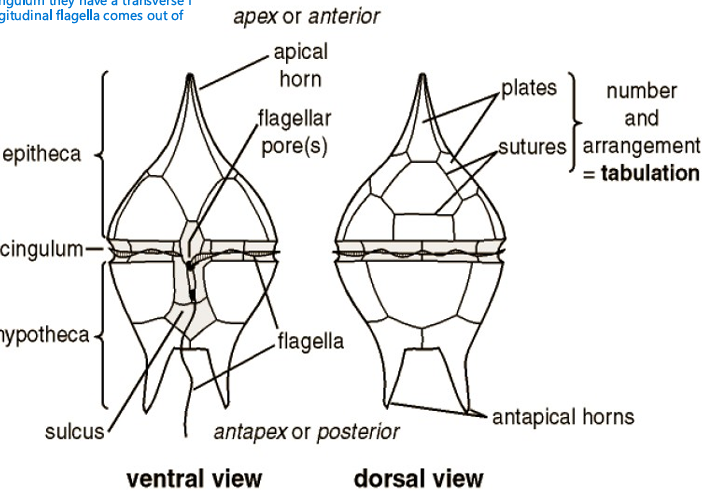
describe the flagella in dinoflagellates.
in their cingulum they have a transverse flagella and a longitudinal flagella comes out of posterior
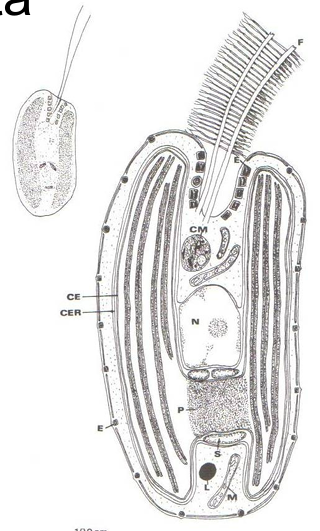
describe the flagella in Cryptophyta
USE of flagella
flagella are asymmetrical
creates unique movement that is spiral like due to the short and long flagella
Describe the flagella of stramenopiles which includes Heterokontophyta and brown algae.
Flagella comes in two forms which work together
whiplash - hairless so naked, pushes/propels the algae forward
tinsel - mastigonemes so has hairs, pulls or rows the algae using the increased surface area from the hairs
Why is physics important in algae movement?
its important to know how to move fluid as density increases from freshwater => saltwater => cytoplasm => diatom frustules or chrysophyceae scales => haptophyta coccoliths
what was the analogy of phytoplankton swimming through water?
what is the physics behind this analogy?
phytoplankton moving through water is like fish/humans swimming through molasses
Reynolds number (= inertial force/viscous force) is low for phytoplankton as inertia is low and viscosity is high for organisms the size of phytoplankton
what are the 6 adaptions for the movement of phytoplankton?
forward stroke of flagella entails slinging itself forward which is different than reverse
asymmetric cells advance by spinning along axis using its 2 unequal flagella
symmetric cells don’t spin or rotate
longitudinal flagella is propelling and steering flagellum
transverse flagella propulsion
flagellar hairs in Euglena increase thrust which creates helical waves, additionally Euglena secretes mucus and has inch worm motion for further propulsion
what is the general pattern of swimming/gliding speeds of the different phytoplankton?
the more complex the phytoplankton got, the faster they were able to move. Takes cyanobacteria 4 weeks to move 1 cm and takes dinoflagellates 20 seconds to move 1 cm
what are other adaptations present in phytoplankton that aid in swimming?
buoyancy control = internally hold water or air via contractile vacuole or gas vacuoles
reducing/increasing drag = hairs can slow down phytoplankton; the plankton can become more streamlines; mucus outer covering makes moving easier
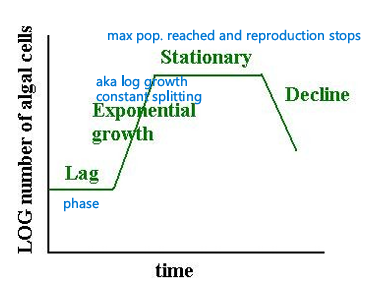
describe the pattern of population growth of unicells
lag phase => exponential growth (aka log growth) where constant splitting occurs => stationary phase where the maximum population is reached and reproduction stops => decline occurs possibly due to end of life cycle or decrease in nutrients
define binary fission
what are the 4 different forms and what organisms does it correlate to?
simplest form of asexual reproduction in which the parent divides into 2 equal and identical parts
Longitudinal = Euglena is classic example. Transverse = Paramecium. Irregular = amoeba. Oblique = Ceratium
What occurs during fragmentation?
What organisms does it occur in?
Why is it dangerous?
filaments (or noncoenobic colonies, like Volvox) which can break into two-several pieces, each capable of developing into new individuals
Occurs in cyanobacteria and macroalgae
Causes introduced spp. to become invasive bc very efficient in reproducing through fragmentation
what occurs during the resting stage, what is it influenced by?
what does it look like in Cyanobacteria, Diatoms, and other planktons?
this is a temporary stage in the intermediate part of the life cycle used for survival to stop reproducing until the environment is suitable again. Influenced by environmental triggers like desiccation, temperature, and nutrient limitations
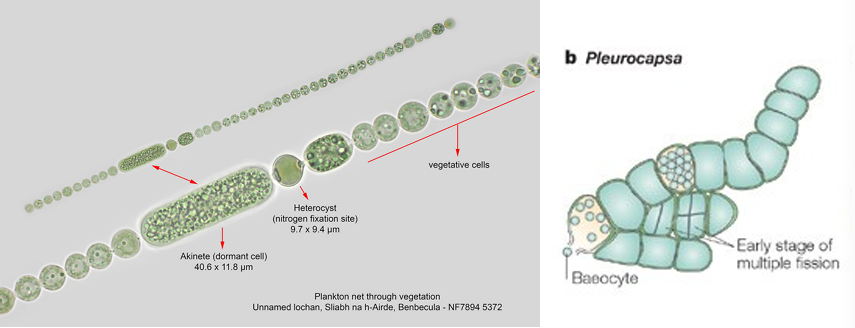
Cyanobacteria has akinetes. Diatoms have resting spores, resting cells, and auxospores. Hypnospores, hypnozygotes, and statospores
Describe the reproduction in Cyanobacteria
Define Hormongonia
Define Baeocytes
asexual reproduction ONLY
Akinetes (spores) develop thick cell walls, can survive months in harsh conditions like freezing and desiccation, in favorable conditions the akinetes with germinate into vegetative cells
Hormongonia are present in truly filamentous cyanobacteria in which they break off, glide away, and develop into a new filament
Baeocytes are similar to the endospores produced inside the cell, undergo multiple divisions w/in protoplasm, release via cell bursting open to mature
 Note
Note  Flashcards (47)