CH. 1 | The Microbial World and You
 Call Kai
 Learn
Learn Practice Test
 Spaced Repetition
 Match
Match Flashcards
 Knowt Play
1/29

There's no tags or description
Looks like no tags are added yet.
Name | Mastery | Learn | Test | Matching | Spaced | Call with Kai |
|---|
No analytics yet
Send a link to your students to track their progress
30 Terms
1 - 1 List several ways in which microbes affect our lives
Microbes (Microorganism) - Minute living things that cannot be seen with the naked eye + includes bacteria, fungi, protozoa, algae, and viruses
Microbes is important in both life itself and in the environment. For instance, it forms the basis of the food chain in oceans and lakes, it breaks down wastes, it can play a certain role in photosynthesis, and is involved in the food industry (due to enzyme manipulation).
It can also be used in the synthesis of chemical products containing vitamins, organic acids, enzymes, drugs, etc.
Describe some of the beneficial and destructive actions of microbes
Benefits
Environmental
→ Photosynthetic microbes → oxygen
→ Food webs
→ Nutrient cycling
→ Bioremediation
→ Important component in the food web of fresh water and marine environmentsFood
→ Bread , Wine , Cheese , Yogurt
Chemicals
→ Acetone
→ Production of vinegar & alcoholic beveragesHealth / Science
→ Antibiotics
→ Research Labs
Destructives
Cause disease
If there’s an overgrowth of microbes in spoiled food or liquid, it can cause a change in smell, taste, and texture.. Which can then lead to
→ Fermentative bacteria
1 - 2 Define microbiome, normal microbiota, and transient microbiota.
Microbiome - All the microorganisms in an environment / human body
→ lives stable - without typically causing disease
Normal microbiota - The microorganisms that colonize a host without causing disease
Prevents the growth of pathogenic microbes
Trains the immune system to distinguish pathogens
Good for nutrition
Produces useful substances such as Vitamin K & B
Transient microbiota - The microorganisms that are present in an animal for a short time without causing a disease
Pathogen
Disease causing microorganism
1 - 3 Recognize the system of scientific nomenclature that uses two names: a genus and a specific epithet.
Scientific nomenclature - Used for naming / Organism is referred to by both the genus & specific epithet + either underlined or italicized
Designed by Carl Linneaus
Genus - 1st name & first letter is always capitalized
Specific epithet - Species name, and is not capitalized
Distinguish a genus from a specific epithet.
In the name Escherichia coli,
Escherichia represents the genus
Coli represents the specific epithet
Difference between prokaryotes and eukaryotes
Prokaryotes
Prokaryotes are unicellular organisms that include bacteria and archaea. They are structurally simpler, smaller, lack a nucleus, and lack membrane-bound organelles
Eukaryotes
Eukaryotes are organisms whose cells have a true nucleus + other organelles, and are enclosed within membranes
1 - 4 Differentiate the major characteristics of each group of microorganisms
Bacteria
1 of the domains
Prokaryotes
Single-celled (unicellular) organisms (each bacterium contains one cell)
Types of shapes: Bacillus (rodlike) Coccus (spherical), and Spiral (curved), etc
Cell wall: Peptidoglycan
Reproduces by binary fission (dividing into 2 equal cells)
Motility is seen by flagella, etc
Absorbs organic or inorganic material (explains how they get energy)
Displays the greatest metabolic diversity
Archaea
1 of the domains
Prokaryotes
Single-celled (unicellular) organisms
Have cell walls, but lack/do not have peptidoglycan
Divided into 3 main groups: Methanogens, Extreme halophiles, & Extreme thermophiles
Not known to cause disease in humans
Fungi
Eukaryotes
May be unicellular or multicellular (yeasts/mushrooms)
→ Bimorphic fungi (^ both depending on the environment)Cell wall: Chitin
Cannot carry out photosynthesis
Most typical form of fungi is molds
Can reproduce sexually or asexually
Obtain nourishment by absorbing organic material from their environment
Mycelia/Mycelium (hyphae filaments) form the main body of a fungus
Protozoa
Eukaryotes
Single-celled (unicellular) organisms
Motility is seen by pseudopods, flagella, or cilia
→ Flagella are appendages that allow locomotion in bacteriaContains a variety of shapes
Live either as free entities or as parasites (that absorb organic compounds from their environment)
Usually chemoheterotrophic → light as a source of energy & carbon dioxide to produce sugars
Reproduce sexually or asexually
Algae
Photosynthetic eukaryotes
May be unicellular, filamentous, or multicellular but lacks the tissues found in plants
Cell walls: Cellulose (carbohydrate)
Motility is seen by flagellated swimming
Abundant in freshwater, saltwater, soil & in plants
Reproduces sexually or asexually
Photosynthesis benefits | uses sunlight to create their own food
Viruses
Acellular
Structurally, contains 1 type of nucleic acid; either DNA or RNA
→ surrounded by a protein coatReproduces only by using the cellular machinery of other organisms | Cannot reproduce outside a host cell
Considered to be living only when they multiply within host cells they infect
Considered not because they are inert outside living hosts
Multicelluar Animal Parasites
Animal parasites are eukaryotes
Multicellular
2 major groups: Flatworms & Roundworms / Helminths
Nutrition: ingest through a mouth
Reproduces sexually or asexually
Which groups of microbes are prokaryotes? Which are eukaryotes?
Prokaryotes
Bacteria
Archaea
Eukaryotes
Fungi
Protozoa
Algae
Multicellular Animal Parasites
Viruses - Neither because they are acellular
1 - 5 List the 3 domains.
Bacteria
Archaea
Eukarya
Viruses do NOT follow under any of these categories, (including prokaryotes & eukaryotes)
What are the 3 domains?
Bacteria (cell walls contain a protein–carbohydrate complex called peptidoglycan)
Archaea (cell walls, if present, lack peptidoglycan)
Eukarya, which includes the following:
Protists (slime molds, protozoa, and algae)
Fungi (unicellular yeasts, multicellular molds, and mushrooms)
Plants (mosses, ferns, conifers, and flowering plants)
Animals (sponges, worms, insects, and vertebrates)
Archaea & Eukarya are more closely related as opposed to Bacteria (because of their genetic and informational mechanisms)
1 - 6 Explain the importance of observations made by Robert Hooke & Van Leeuwenhoek.
Robert Hooke given his improved microscope was able to see individual cells. However, it lacked the resolution to see microbes clearly.
Led to the development of the cell theory
On the other hand, Van Leuuwenhoek was the first to observe live microorganisms through magnifying lenses
Between 1673 & 1723, he wrote about “animalcules”
Depicted drawings of organisms he found in different environments / atmospheres
What is the cell theory?
All living organisms are composed of cells and arise from preexisting cells
Viruses are NOT considered living because they are acellular and are distinct from other microbe groups
1 - 7 Compare spontaneous generation and biogenesis
Spontaneous generation
The idea that life could arise spontaneously from nonliving matter
Biogenesis
The theory that living cells arise only from preexisting cells
Life → Life
→ Issue was later resolved by Louie Pasteur in 1861
What evidence supported spontaneous generation?
The idea of:
Flies emerging from manure / Maggots arising from decaying corps
John Needham:
After boiling chicken & corn broth, the cooked solutions were apparent with microorganisms. Which garnered his reasoning that microbes developed spontaneously from the fluids (DEBUNKED)
1 - 8 Identify the contributions to microbiology made by Pasteur.
Argued that microbes in the air were the agents responsible for contaminating nonliving matter
Demonstrated that microbes are responsible for food spoilage, further encompassing the connection between microbes and disease
His experiments & observations provided the basis of aseptic techniques
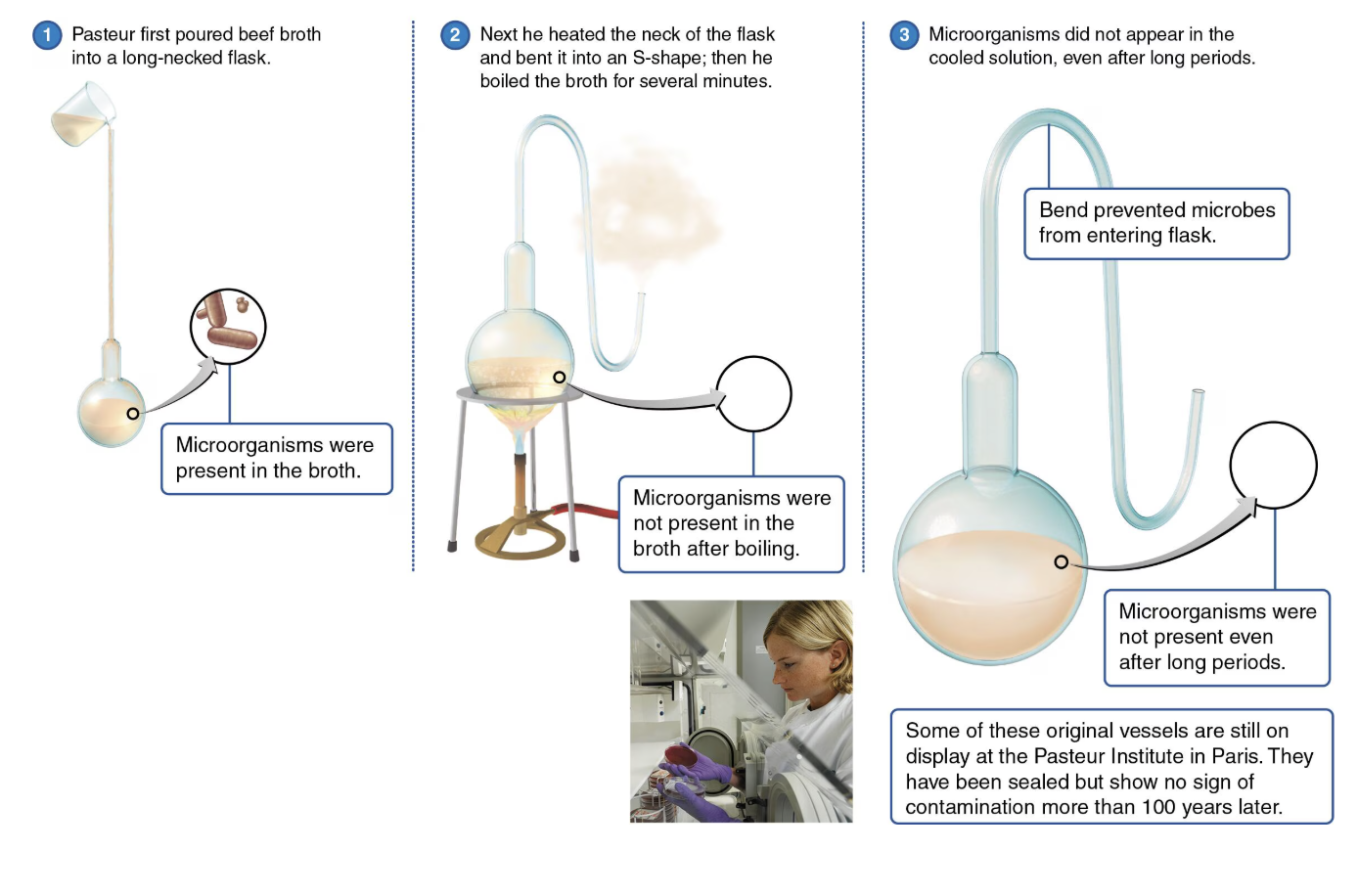
Pasteur created an experiment that permitted air to enter but the special shape of the flask’s opening prevented airborne bacteria from contaminating the broth.
How was spontaneous generation disproved?
According to Pasteurs’ swan-neck chicken broth experiment, he demonstrated that microbes were present in nonliving matter (air , liquids , solids). Which further invalidated the hypothesis of spontaneous generation.
NO GROWTH because all the microbes got trapped, the broth ended up remaining sterile → Further convincing people that microorganisms had to have come from pre-existing organisms → Further debunking spontaneous generation and supporting biogenesis
1 - 9 Explain how Pasteur’s work influenced Lister and Koch.
Louis Pasteur showed that tiny microorganisms cause disease.
- Started the idea of microbial growth
His idea led Joseph Lister to use phenol (carbolic acid) in surgery to kill germs and keep wounds clean, which greatly reduced infections.
→ Used as the first disinfectantRobert Koch later expanded on this by developing Koch’s postulates, a set of criteria/steps for proving that a specific germ causes a specific disease, further strengthening the germ theory.
A given pathogen can cause disease
Summarize in your own words the germ theory of disease.
The principle that microorganisms infect hosts and cause disease.
1 - 10 Identify the importance of Koch’s postulates.
Koch’s postulates were criteria used to determine the causative agent of infectious diseases.
To provide a scientific framework that a specific microorganism causes a specific infectious disease
He created very specific steps that link a particular pathogen to a specific disease as the causative, or etiologic, agent
1 - 11 Identify the importance of Jenner’s work.
Edward Jenner’s observations led to the concept of immunity / protection from infection through previous exposure to a pathogen.
First vaccine to be developed (1796)
This was due to individuals being previously sickened with cowpox and did not develop smallpox infections even after being injected with it (cowpox immunity against smallpox)
Trusted that the body produced agents that effectively overcame a disease-causing microbe
1 - 12 Identify the contributions to microbiology made by Ehrlich and Fleming.
Paul Ehrlich introduced an arsenic-containing chemical called salvarsan (his magic bullet) to treat syphilis (1910).
→ His magic bullet: selective toxicity, should harm a pathogen, and not harm the host
Alexander Fleming observed that the Penicillium fungus inhibited (prevented) the growth of a bacterial culture. He named the active ingredient penicillin (1928).
First true antibiotic to be developed (1928)
Penicillin has been used clinically as an antibiotic since the 1940s.
antimicrobials
However, the usefulness of an antibiotic can be hampered due to the emergence of antibiotic-resistant bacteria
Present; more ABX (antibiotics) were discovered and being used
1 - 13 Define bacteriology, mycology, parasitology, immunology, and virology.
Bacteriology
The scientific study of prokaryotes, including bacteria and archaea
Mycology
The study of fungi
Parasitology
The study of protozoa and worms
Virology
The study of viruses (structure , life cycle , evolution , classification , etc)
1 - 15 List at least 4 beneficial activities of microorganisms
Recycling vital elements
Sewage treatment: Using microbes to recycle water
Bioremediation: Using Microbes to clean up pollutants
Insect Pest Control by Microogranisms
Name 2 beneficial uses of bacteria
Food production through fermentation
Medicine through the use of antibiotics
1 - 17 Define resistance
The ability to ward off diseases through innate and adaptive immunity.
Vaccines
Antibiotics (Helps the body be more resistant)
Prevent microbes from getting in; immune system
Differentiate normal microbiota and infectious disease.
Normal microbiota
The microorganisms that colonize a host without causing disease
Infectious disease
A change in the state of health when a pathogen grows in a host
1 - 18 Define biofilm.
A microbial community that usually forms as a slimy layer on a surface.
Complex aggregation of microbes
Why are biofilms important?
They can protect your mucous membranes from harmful microbes and are an important food source to aquatic animals.
However, it can also be harmful and cause infections. If it formed/grew on environmental surfaces, or on implants, it would be difficult to remove them
1 - 19 Define emerging infectious disease.
A new or changing disease that is increasing or has the potential to increase in incidence in the near future
EX; Measles
What factors contribute to the emergence of an infectious disease?
Evolutionary changes in existing organisms, or the spread of known diseases to new geographic areas