BIO Lecture Exam 1 Cram
 Call Kai
 Learn
Learn Practice Test
 Spaced Repetition
 Match
Match Flashcards
 Knowt Play
1/73

There's no tags or description
Looks like no tags are added yet.
Name | Mastery | Learn | Test | Matching | Spaced | Call with Kai |
|---|
No analytics yet
Send a link to your students to track their progress
74 Terms
Many prokaryotic species can reproduce quickly by [blank], leading to the formation of extremely large populations.
Binary Fission
Describe the process (starting and end results) of binary fission.
Binary fission refers to the type of asexual reproduction that prokaryotes undergo. One cell will grow to about double its size and duplicate all contents then divide to form two identical cells.
Describe features of prokaryotes that enable them to thrive in a wide range of different environments.
Flagella, fimbriae, pili, cell walls, capsules, etc…
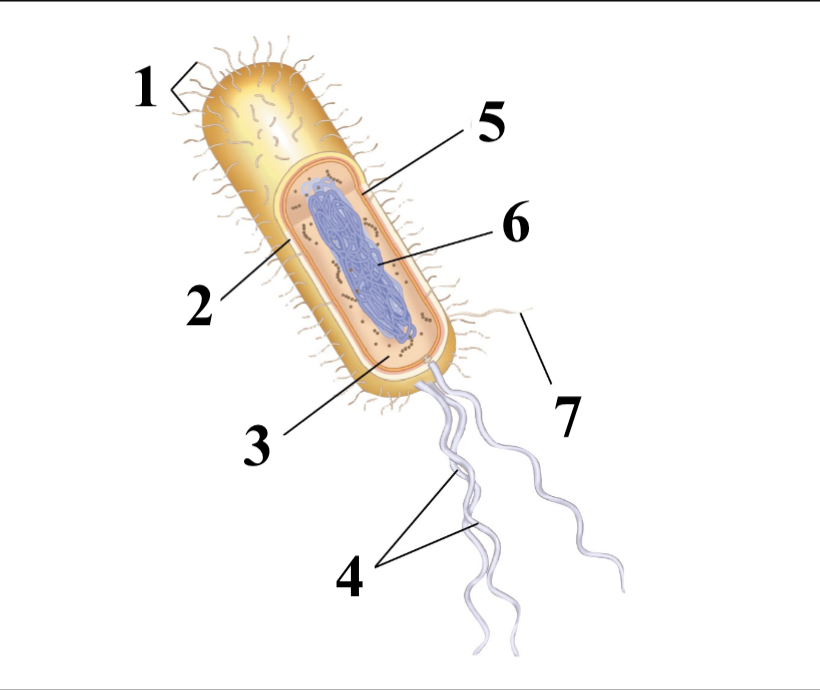
What does 1 represent and its function?
Fimbriae- hairlike appendages that help cells adhere to other cells or to a substrate
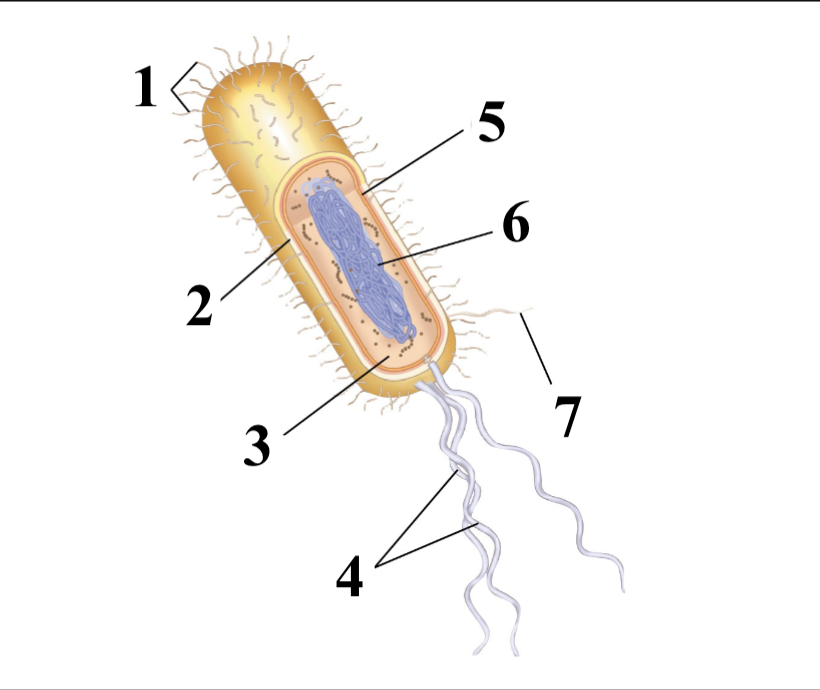
What does 2 represent and its function?
Capsule (slime layer)- sticky layer of polysaccharide or protein that can help cell adherence and/or evasion of a host’s immune system
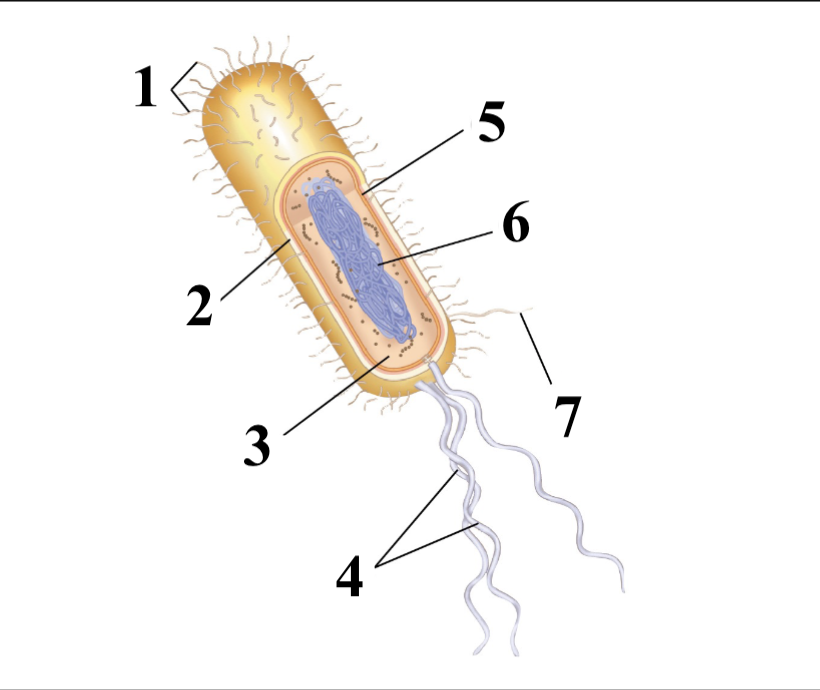
What does 3 represent and its function?
Internal Organization- no nucleus or other membrane-enclosed organelles; usually no complex compartmentalization
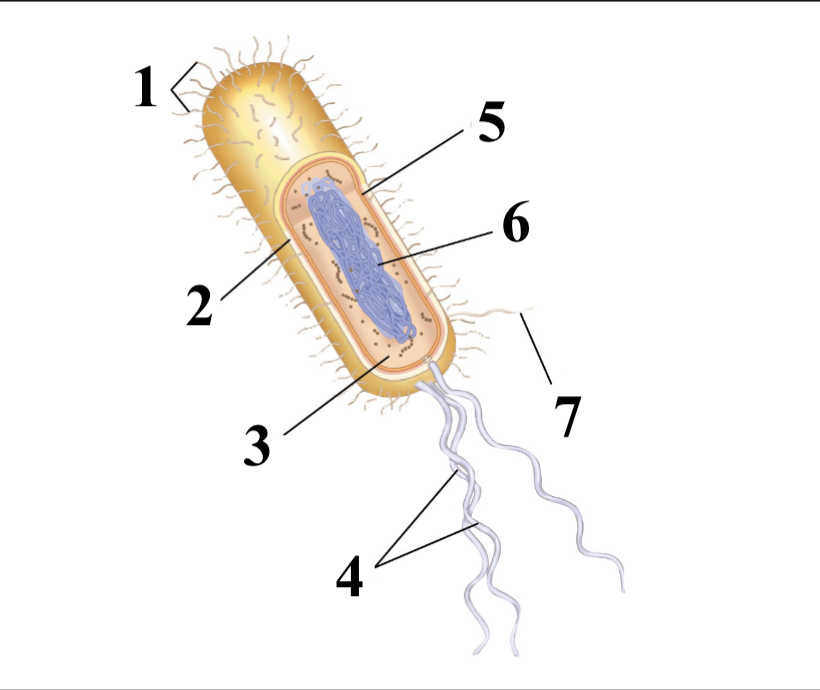
What does 4 represent and its function?
Flagella- structures used by most motile bacteria for propulsion; many species can more toward or away from certain stimuli (taxis)
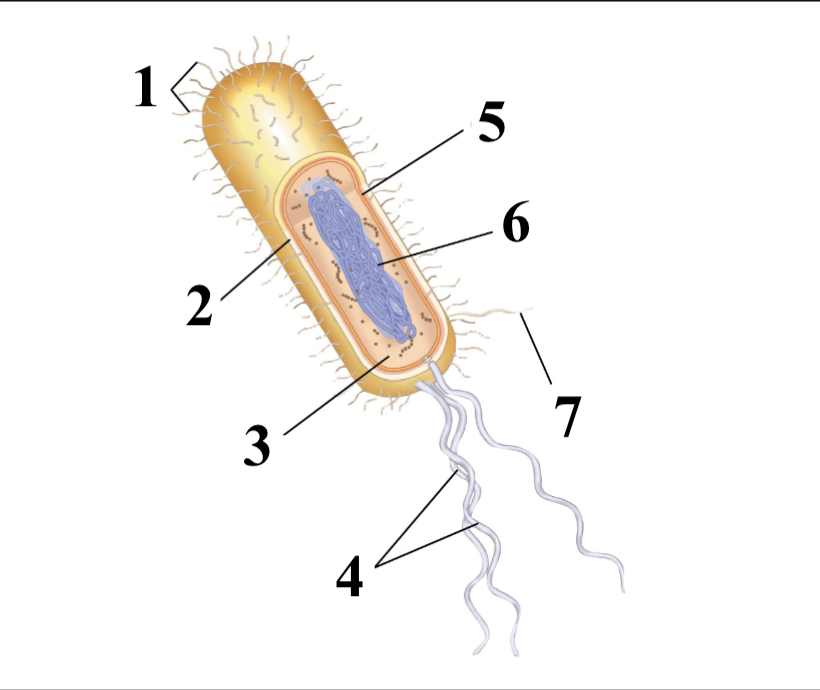
What does 5 represent and its function?
Cell Wall- found in nearly all prokaryotes; structure differs in gram-positive and gram-negative bacteria
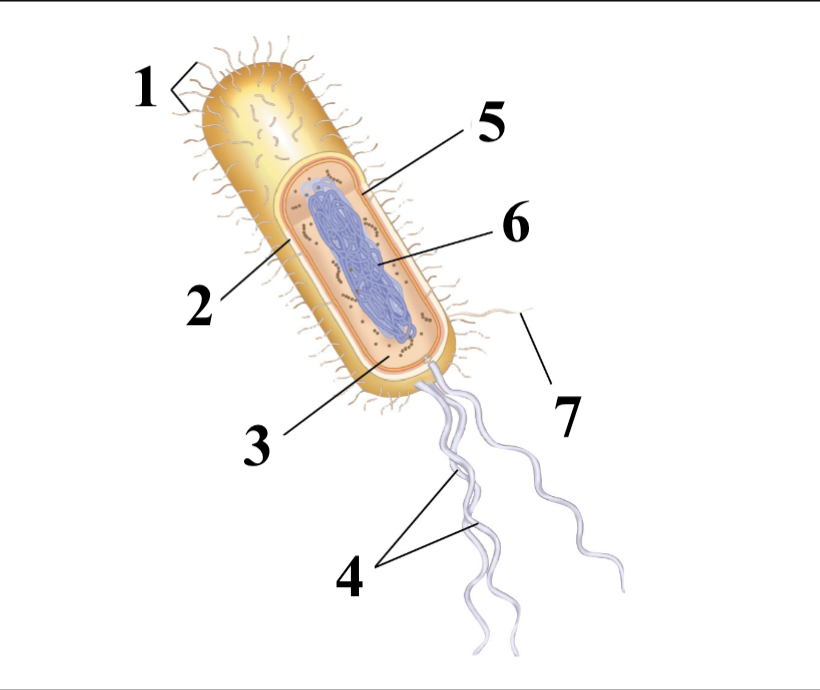
What does 6 represent and its function?
Circular Chromosome- often accompanied by smaller rings of DNA called plasmids (extracellular DNA)
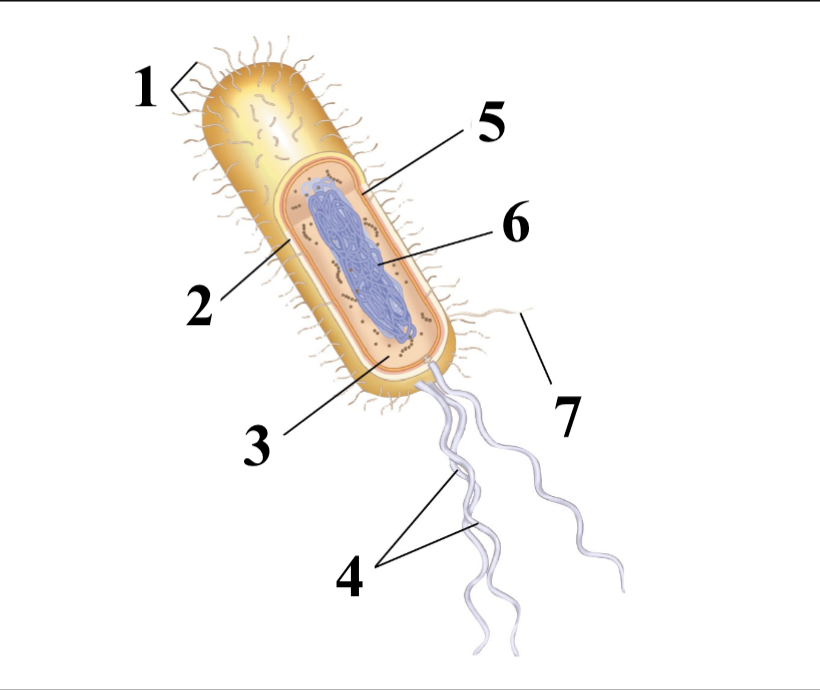
What does 7 represent and its function?
Pilus- appendage that pulls two cells together prior to conjugation (DNA transfer)
Outline the Gram Stain.
Primary Stain- Crystal Violet
Mordant- Gram’s Iodine
Decolorization- Ethanol
Counterstain- Safranin
Scientists use [BLANK] to classify bacteria by cell wall composition.
Gram Stain
[BLANK] bacteria have simpler walls with a large amount of [BLANK].
Gram Positive; peptidoglycan
The walls of [BLANK] bacteria have less [BLANK] and are more complex with an outer membrane that contains lipopolysaccharides.
Gram Negative; peptidoglycan
Which type of bacteria tend to be more resistant to antibiotics?
Gram Negative
What do antibiotics target?
Many targets such as: Cell wall (mainly peptidoglycan) & bacterial ribosomes (smaller than eukaryotic)
Why do antibiotics leave human cells intact? In other words, what do human cells lack?
Antibiotics leave human cells intact because they target bacteria specific structures, such as the peptidoglycan or bacterial ribosomes, which differ from human cells. This means the antibiotics can not act on human cells.
Prokaryotes have a sticky layer of [BLANK] or protein surrounding the cell wall. This is known as a [BLANK] if it is dense and well-defined, or a [BLANK] if it is not well organized.
Polysaccharide; Capsule; Slime Layer
Name three things the Capsule/Slime Layer allow a prokaryote to do.
Enable adherence to the substrate or other individuals
Prevent Dehydration
Protect cell from host’s immune system
What is the purpose of the endospore?
To withstand extreme conditions (lack of nutrients/water) and remain viable for centuries
How are endospores formed?
Original cell makes copy of its chromosome and surrounds that copy with a multilayered structure, water is removed, metabolism halts, original cell lyses leaving behind the endospore
Some prokaryotes have hairlike appendages called [BLANK] that allow them to stick to their substrate or other individuals in a colony.
Fimbriae
[BLANK] are longer than fimbriae and function to pull cells together enabling the exchange of DNA.
Pili (sex pili)
Prokaryotes have [BLANK] chromosome, eukaryotes have multiple [BLANK] chromosomes.
one circular; linear
Prokaryotes lack a nucleus, the chromosome is in the [BLANK], a region with no membrane
Nucleoid
Prokaryotes may also have smaller rings of independently replicating DNA called [BLANK].
Plasmids
Do Bacteria, Archaea, and Eukarya have nuclear envelopes?
Bacteria: Absent
Archaea: Absent
Eukarya: Present
Do Bacteria, Archaea, and Eukarya have membrane-enclosed organelles?
Bacteria: Absent
Archaea: Absent
Eukarya: Present
Do Bacteria, Archaea, and Eukarya have peptidoglycan in their cell walls?
Bacteria: Present
Archaea: Absent
Eukarya: Absent
Describe the membrane lipids of Bacteria, Archaea, and Eukarya.
Bacteria: Unbranched Hydrocarbons
Archaea: Some Branched Hydrocarbons
Eukarya: Unbranched Hydrocarbons
How many types of RNA polymerase do Bacteria, Archaea, and Eukarya have?
Bacteria: One
Archaea: Several
Eukarya: Several
What is transformation?
prokaryotic cells incorporate foreign DNA taken up from their surroundings (think pGLO)
What is a non-pathogenic bacteria taking up a DNA fragment replacing own allele with the “pathogenic allele fragment” and examples of?
Transformation
What is transduction?
phages (viruses that infect bacteria) carry prokaryotic genes from one host cell to another
What is a recombinant cell? How can bacteria become recombinant cells?
Genetically modified cells that have incorporated DNA from other sources into their genome. Bacteria can become recombinant cells via transformation, transduction, or conjugation.
What is conjugation?
Process through which DNA is transferred between two prokaryotic cells that are temporarily joined
What is the F factor? Why is it important?
The F factor is a piece of DNA that codes for the production of pili (structure that brings the two cells together for conjugation). Once the cells are close to eachother, a mating bridge is formed to allow for DNA transfer.
What is a High Frequency Recombination (HFr) Cell?
A cell that has the F factor incorporated into its chromosome rather than a standalone plasmid. It can undergo conjugation, but it more likely to produce a recombinant F- cell as the F factor does not always get incorporated into the new cells chromosome.
What is endosymbiosis?
a relationship between two species in which one organism lives inside the cell or cells of another organism (the host)
What gave rise to the great diversity of protists and how have their lineages diverged over time?
Likely from the host cell engulfing a bacterium that would later become an organelle found in all eukaryotes- the mitochondrion
What do protist and eukaryotes have in common?
Organelles, well-defined cytoskeleton, both part of domain Eukarya
Is there anything found only in protist that are not present in eukaryotes?
Very rare- contractile vacuoles and ocelloids
List the 3 general types of protists and state how they obtain energy.
Photoautotrophs- through chloroplasts (type of plastid)
Heterotrophs- absorbing/ingesting organic molecules or larger food particles
Mixotrophs- combine photosynthesis & heterotrophic nutrition
How do protists reproduce?
Asexually and sexually
[BLANK] is an informal term used to refer to all eukaryotes that are not plants, animals, or fungi.
Protists
What protists are responsible for “red tides”? They also have a specialized “eye-like” organelle. What are they called and what is the organelle?
Dinoflagellates and Ocelloid
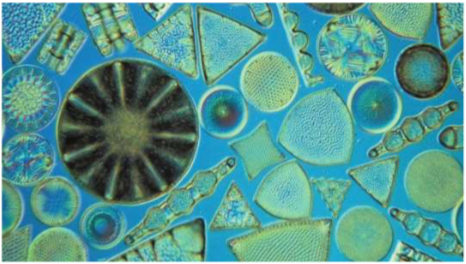
What are these organisms? Place them in a group.
Diatoms- part of SAR (specifically Stramenopiles)
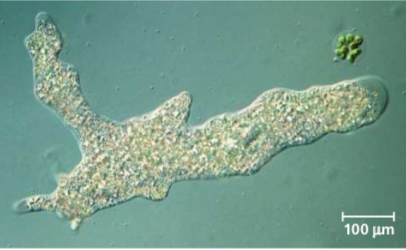
What is this organism? Place in a group.
Amoeba- part of unikonta
How are fungi and arthropods structurally similar?
Fungi use chitin, a strong but flexible polysaccharide, in their cell walls for strength and arthropods use chitin in their exoskeleton for strength
Explain the purpose and function of mycorrhizae.
Mycorrhizae refers to the mutually beneficial relationship between fungi and plant roots. Fungi will improve the delivery of phosphate ions and other minerals to plants and the plants supply the fungi with organic nutrients (like carbohydrates).
Differentiate arbuscular mycorrhizal and ectomycorrhizal fungi.
Arbuscular- have specialized branching hyphae that physically penetrate the root cell wall
Ectomycorrhizal- form sheaths of hyphae over the surface of a root and grow into the extracellular spaces of the root cortex
What are the closest living relatives of fungi?
The closest living relatives of fungi are nucleariids followed by animals
What are parasitic fungi?
Fungi that absorb nutrients from living hosts
What are mutualistic fungi?
Fungi that absorb nutrients from hosts and reciprocate with actions that benefit the host
Define a commensal relationship.
A +/0 ecological interaction that benefits the individuals of one species, but neither harms nor helps the individuals of another species.
What are the closest living relatives to plants?
Charophytes
What evidence supports algae as the common ancestor to plants?
Shared similarities between plants and brown, red, and certain green algae all being multicellular, eukaryotic, photosynthetic autotrophs. Cellulose cell walls, chloroplasts a and b
What characteristics do plants and their closest living relatives share?
Cellulose-synthesizing membrane proteins are arranged in rings, rather than linear sets
Structure of flagellated sperm
Sequence similarities in nuclear, chloroplast, and mitochondrial DNA
Key traits appear in nearly all plants, but are absent in the [BLANK]. These are: alternation of generations, walled spores produced in sporangia, and apical meristems.
Charophytes
Describe the alternation of generations undergone by plants.
About 450 million years ago, the terrestrial landscape on Earth would most likely have had which features in terms of plants?
What are the differences between the structures of spores and seeds?
For plants, what is a benefit of retaining the zygote on the living gametophyte?
What molecule contributes to the structural integrity of plant spores?
Where are apical meristems found in plants?
What are the characteristics of bryophytes?
This plant has flagellated sperm, xylem with tracheids, separate gametophyte, sporophyte generations with the sporophyte dominant, and no seeds. Which group does this plant most likely belong?
Correct this statement: The sporophyte generation is smaller in size than the gametophyte generation.
Correct this statement: Sporangia are found on the gametophyte.
Correct this statement: Ferns contain no vascular tissue.
Which characteristics are functionally important in gametophyte cells of both angiosperms and gymnosperms?
Name the characteristics that are unique to seed-producing plants.
Which plant structures most directly produces the pollen tube of angiosperms?
How is the fruit of angiosperms produced?

