Eukaryotic cell structure
 Call Kai
 Learn
Learn Practice Test
 Spaced Repetition
 Match
Match Flashcards
 Knowt Play
1/65

There's no tags or description
Looks like no tags are added yet.
Name | Mastery | Learn | Test | Matching | Spaced | Call with Kai |
|---|
No analytics yet
Send a link to your students to track their progress
66 Terms
Fill in the blank
Answer
Cell
the basic unit of all living things.
Prokaryotic
single-celled organisms with a simple structure of just a single undivided internal area - cytoplasm (composed of cytosol -> made from water, salts and organic molecules).
Eukaryotic organisms
multicellular
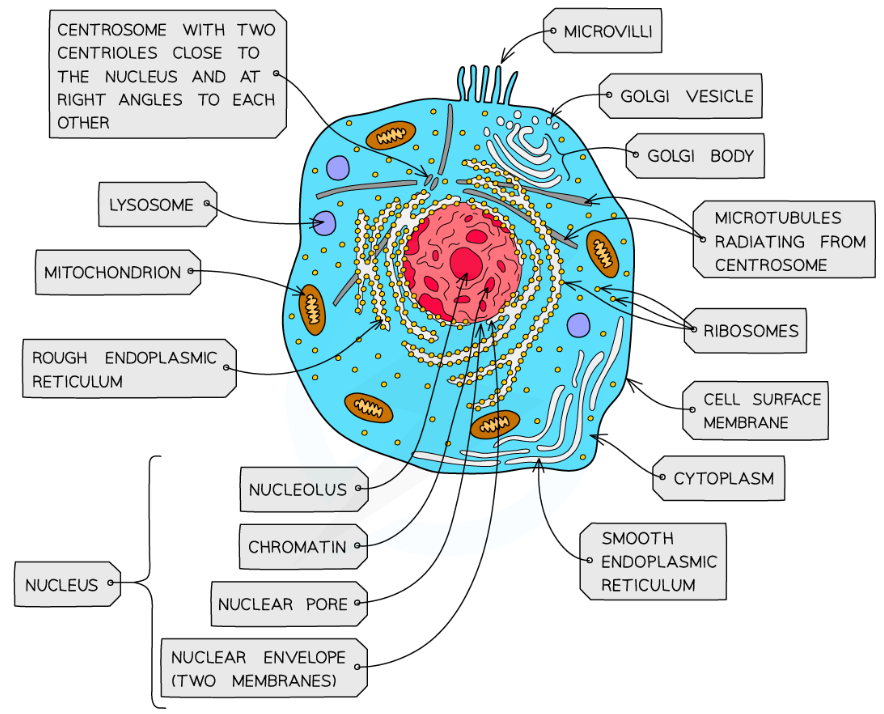
Eukaryotic cells
more complicated internal structure, with membrane-bound cellular components.
Metabolism involves both the [...] and the [...] of molecules.
Metabolism involves both the synthesis and the breaking down of molecules.
Chemical reactions takes place in the
cytoplasm
The cytoplasm is separated from the external environment by what
a cell-surface membrane.
In eukaryotic cells the cytoplasm is divided into...
many different membrane-bound compartments, known as organelles.
Organelles provides...
distinct environments and therefore conditions for the different cellular reaction
Membranes are [...] and control the movement of substances into and out of the cell.
Membranes are selectively permeable and control the movement of substances into and out of the cell.
what does the nucleus (nuclei) contain
coded genetic information in the form of DNA molecules.
DNA directs the [...] required by the cell.
DNA directs the synthesis of all proteins required by the cell.
why does DNA controls the metabolic activities of the cell
DNA controls the metabolic activities of the cell, as many of the proteins, which DNA directs the synthesis, are the enzyme necessary for metabolism to take place.
Where is the dna contained
DNA is contained within a double membrane called a nuclear envelope to protect the nucleus from damage.
What does the nuclear envelope contain
The nuclear envelope contains nuclear pores that allow molecules to move into and out of the nucleus.
DNA itself is [...] to leave the nucleus to the site of protein synthesis in the cell cytoplasm. Instead it is [...]
DNA itself is too large to leave the nucleus to the site of protein synthesis in the cell cytoplasm. Instead it is transcribed into smaller RNA molecules
DNA associates with proteins called [...] to form a complex called [...].
DNA associates with proteins called histones to form a complex called chromatin.
Chromatin [...] and [...] to form structures known as [...]
These only become visible when cells are preparing to [...].
Chromatin coils and condense to form structures known as chromosomes
These only become visible when cells are preparing to divide.
The nucleolus is an area within the nucleus and is responsible for [...].
The nucleolus is an area within the nucleus and is responsible for producing ribosomes.
What does the nucleolus composed of
It is composed of proteins and RNA
RNA is used to produce [...] necessary for protein synthesis.
RNA is used to produce ribosomes necessary for protein synthesis.
Mitochondria (singular mitochondrion)
They are the site of the final stages of cellular respiration.
This where energy stored In the bonds of complex, organic molecules is made available for the cell to use by the production of the molecule ATP.
The number mitochondria in a cell tells the [...].
The number mitochondria in a cell tells the amount of energy the cell uses.
Mitochondria have a [...].
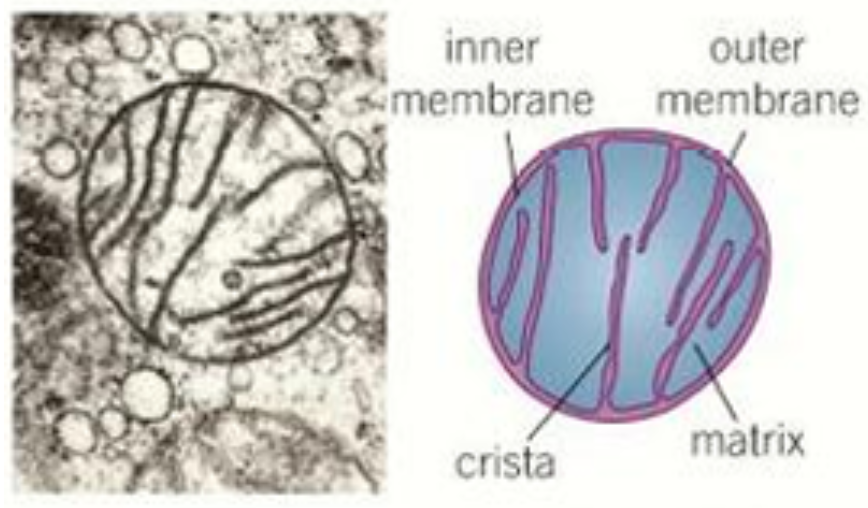
Mitochondria have a double membrane.
The inner membrane is [...] to form structures called [...] and the fluid interior = [...].
The inner membrane is highly folded to form structures called cristae and the fluid interior = matrix.
The membrane forming the cristae contains the [...] used in aerobic respiration.
The membrane forming the cristae contains the enzyme used in aerobic respiration.
Mitochondria also contain a small amount of DNA -> [...].
Mitochondria also contain a small amount of DNA -> mitochondrial (mt)DNA.
Fill in the blank
Answer
Vesicles
membrane sacs that have storage and transport roles.
What is the role of vesicles
Vesicles are used to transport materials inside the cell.
what is a structural feature of vesicles
They consist simply of a single membrane fluid inside.
Lysosomes
Lysosomes are specialised forms of vesicles that contain hydrolytic enzymes.
Roles of lysosomes
They are responsible for breaking down waste material in cells.
They play an important role in the immune system as they are responsible for breaking down pathogens ingested by phagocytic cells.
They also play an important role in programmed apoptosis (programmed cell death).
Roles of cytoskeleton
It is a network of fibres necessary for the shape and stability of the cell.
Organelles are held in place by the cytoskeleton and it controls cell movement and the movement of organelles within cells.
what are the three components of the cytoskeleton
Microfilaments, Microtubules, intermediate fibres
Microfilaments
Contractile (tending to contract) fibre formed from the protein, actin
Roles Microfilaments
These are responsible for cell movement
Responsible for cell contraction during cytokinesis
Microtubules
Globular tubulin proteins polymerise to form tubes
Microtubules Roles
Used to form a scaffold-like structure that determines the shape of the cell.
Act as tracks for the movement of organelles, including vesicles, around the cell.
Makes up spindle fibres which have a role in the physical segregation of chromosomes in cell division
Intermediate fibres role
These fibres give mechanical strength to cells and help maintain their integrity.
Centrioles are a component of the [...] present in most eukaryotic cells.
Centrioles are a component of the cytoskeleton present in most eukaryotic cells.
Structural features of centrioles
Composed of microtubules.
Two associated centrioles -> centrosome
Roles of centrioles
Centrosome is involved in the assembly and organisation of the spindle fibres during cell division.
In organisms with flagella and cilia, centrioles play a role in the positioning of these structures.
Both flagella and cilia are [...] that protrude from some cell types. Flagella are [...] than cilia and cilia are usually present in [...].
Both flagella and cilia are extension that protrude from some cell types. Flagella are longer than cilia and cilia are usually present in much greater numbers.
Role - flagella
Flagella are used primarily to enable cell mobility.
In some cells the flagella are used as sensory organelle detecting chemical changes in the cell's environment.
Role - cilia
Cilia can be mobile or stationary.
Stationary cilia are present on the surface of many cells and have important function in sensory organs - like nose.
Mobile cilia beat in a rhythmic manner, creating a current and cause fluids or objects adjacent to the cell to move.
Structural features of cilia
Each cilium contains two central microtubules surrounded by nine pairs of microtubules arranged like a "wheel".
This is know as the 9+2 arrangement.
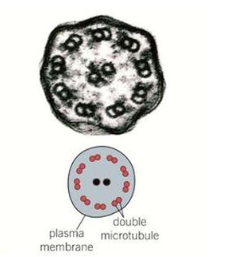
Pairs of [...] microtubules [...] each other causing the cilia to move in a [...].
Pairs of parallel microtubules slide over each other causing the cilia to move in a beating motion.
A key function of a cell is to synthesis proteins for [...] use and for [...] (transport out of the cell).
A key function of a cell is to synthesis proteins for internal use and for secretion (transport out of the cell).
The endoplasmic reticulum (ER)
A network of membranes enclosing flattened sac -> cisternae.
Connected to the outer membrane of the nucleus.
How many types of ER are there?
2
What are the two types of ER
Smooth ER
Rough ER
Role of Smooth ER
Responsible for lipid and carbohydrate synthesis and storage.
Role of Rough ER
Has ribosomes bound to the surface and is responsible for the synthesis and transport of proteins.
Ribosomes can be free-floating in the cytoplasm or attached to the [...], forming the [...].
Ribosomes can be free-floating in the cytoplasm or attached to the endoplasmic reticulum, forming the rough endoplasmic reticulum.
True or false Ribosomes are surrounded by a membrane
False
How are Ribosomes constructed
They are constructed of RNA molecules made in the nucleolus of the cell.
What are Ribosomes?
Ribosomes are the site of protein synthesis
Which two cell component also contain ribosomes accept from the ER
Mitochondria and chloroplasts also contain ribosomes, as do prokaryotic cells.
True or false. The Golgi apparatus has a similar structure to the smooth endoplasmic reticulum.
True
Golgi apparatus structural features
It is a compact structure formed of cisternae and does not contain ribosomes.
Golgi apparatus Role
It modifies proteins and 'packaging' them into vesicles.
These may be secretory vesicles (if the proteins are destined to leave the cell or lysosomes) which stay in the cell.
Protein production (steps)
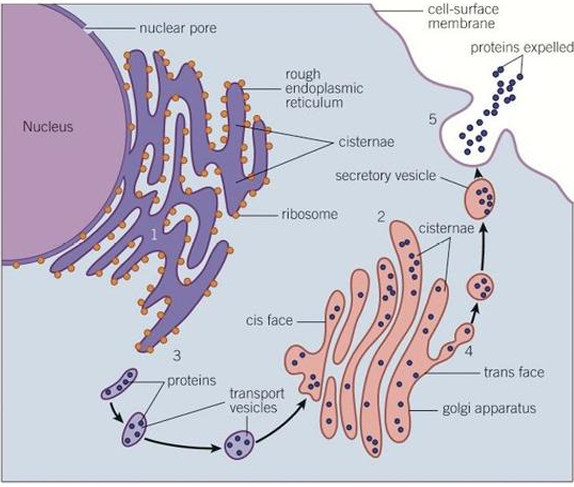
Proteins are synthesised on the ribosomes bound to the endoplasmic reticulum (1)
They then passed into its cisternae and are packaged into transport vesicles (2).
Vesicles containing the newly synthesised proteins move towards the Golgi apparatus via the transport function of the cytoskeleton (3).
The vesicles fuse with the cis face of the Golgi apparatus and the proteins enter.
The proteins are structurally modified before leaving the Golgi apparatus in vesicles from its trans face (4).
Secretory vesicles carry proteins that are to be released from the cell.
The vesicles move towards and fuse with the cell-surface membrane, releasing their contents by exocytosis.
Some vesicles form lysosomes - these contain enzyme for use in cell (5).
Explore top notes

Explore top flashcards
