Chem Unit 3: Atomic Structures- AS.1
 Studied by 0 people
 Call Kai
 Learn
Learn Practice Test
 Spaced Repetition
 Match
Match Flashcards
 Knowt Play
1/13

There's no tags or description
Looks like no tags are added yet.
Name | Mastery | Learn | Test | Matching | Spaced | Call with Kai |
|---|
No analytics yet
Send a link to your students to track their progress
14 Terms
The 2 ancient Greek philosophers and their ideas
Aristotle- Matter is continuous and not made of smaller particles
Democritus- World was made of 2 things: Empty space and atoms
(Neither had evidence so they were not given credit)
1st foundational law, found by Antoine Lavoiser (French) in 1782
Law of conservation of matter-matter is neither created or destroyed, just rearranged
2nd foundational law, found by Charled Coulomb in 1785
Law of electrical charges-opposite charges attract and like charges repel
3rd and 4th foundational law, found by Joseph Proust (French) in 1799
Law of definate proportions-Atoms must combine in whole number ratios
Law of multiple proportions-Atoms can combine in different whole number ratios
John Dalton (1839)
father of modern atomic theory
Daltons Atomic Theory
All matter is made up of atoms. Atoms are the smallest fundamental units of matter (True today)
All elements consist of atoms which are indivisible and indistructable (False-nuclear reactions)
All atoms of the same element are identical in size, shape, and mass (false-isotopes)
Atoms of different elements are different in size, shape, and mass (true)
In a chemical reaction, atoms are rearranged, never created nor destroyed and they combine in whole number ratios (true)
Daltons atomic model:
Lacks subatomic particles
solid sphere
everything else is empty space
JJ Thomsom
Cathode Ray Experiment

Thomson’s Plum-Pudding Model
-Concluded all atoms contained electrons. Since all atoms were neutral, there must be some positive change spread throughout the atom to balance the negative and keep the atom neutral.
-PROBLEM: No nucleus
Ernest Rutherford ( Thomson’s Student)
Gold foil model
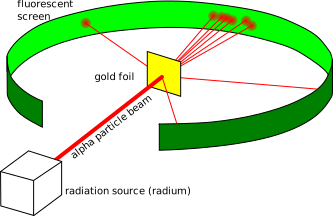
results of gold foil experiment:
Most of the positive charges passed through because the atom is mostly empty space
Some of the positive charges deflected because the atom contains some possible charge
Some of the positive charges deflected straight back because there is a concentrated area of positive charge (Nucleus)
 Note
Note  Flashcards (40)