2C - Carbon Dioxide Absorbents
 Studied by 0 people
 Call Kai
 Learn
Learn Practice Test
 Spaced Repetition
 Match
Match Flashcards
 Knowt Play
1/11

There's no tags or description
Looks like no tags are added yet.
Name | Mastery | Learn | Test | Matching | Spaced | Call with Kai |
|---|
No analytics yet
Send a link to your students to track their progress
12 Terms
CO2 Absorbent
Elminates CO2 by chemical neutralization
makes rebreathing possble
conserve anesthetic gases
decrease OR pollution
Used by semi close and closed breathing circuits
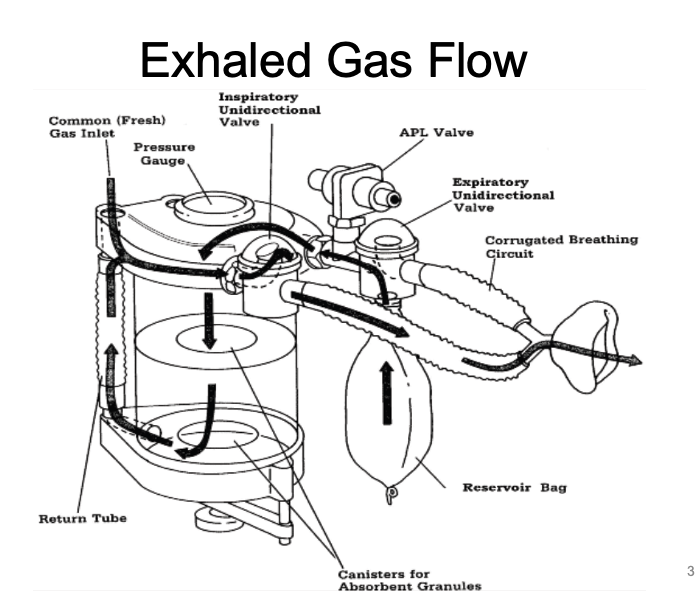
Exhaled Gas Flow
CO2 Absorbents - Before and After
pH sensitive indicator dye
colour changes
colour change
From white to purple
when Co2 absorbent granules are exhausted
due to accumulation of carbonic acid
Chemical neutralization
CO2 reacts with water to produce carbonic acid (H2CO3)
Carbonic acid reacts with hydroxides (-OH) forming carbonates (-CO3), water, and heat
Water leaches out of granules carrying NaOH or KOH to the bottom of the canister and these strong bases are corrosive to skin
By- products of neutralization
water and heat
useful for humidifying inhaled gases
excess water is drained into a water trap
Soda Lime - fragment easily
produce alkaline dust (may lead to bronchospasm)
silica is added to harden granules and decrease dust formation
degrade inhaled vapors to CO and compounds A
may revert from purple back to while over time with no recovery of absorptive capacity
Amsorb Plus
calcium sulfate and polyvinylpyrrolidine added as harder
do not degrade inhaled vapors
do no revert to white
Efficiency of CO2 Neutralization
absorbent granule size
balance between absorptive efficiency and airflow resistance
↓ granule size (↑ surface area) – ↑ absorptive efficiency
↓ granule size (↓ space) – ↑ airflow resistance
Mesh Size
# openings/linear inch in a sieve
Ex. 4 mesh = 4 quarter-inch openings/linear inch
Mesh size ranges from 4 – 8 (maximal absorptive efficiency with minimal airflow resistance)
Channeling points
Exhaled gases only go through a preferred passage (low resistance)
Bypass the bulk of absorbent granules
Result from loose packing
Prevent by gently shaking canister after filling
Absorptive Capacity
Maximum amount of CO2 absorbed by 100 g of absorbent
Influenced by channeling and canister design

