Topic 2 - Cells and Control(check)
 Studied by 1 person
 Call with Kai
 Learn
Learn Practice Test
 Spaced Repetition
 Match
Match Flashcards
 Knowt Play
1/132

There's no tags or description
Looks like no tags are added yet.
Name | Mastery | Learn | Test | Matching | Spaced | Call with Kai |
|---|
No study sessions yet.
133 Terms
cell cycle
series of events in which a cell grows, prepares for division, and divides to form two daughter cells
cell cycle checkpoints
G1, G2, M, S
What is colour blindness caused by?
faulty or absence of cone cells
What is short-sightedness(myopia)?
The ability to see close objects clearly; distant objects appear blurry
Mitosis
cell division in which the nucleus divides into nuclei containing the same number of chromosomes
Interphase (Mitosis)
G1, S, and G2 phase of cell cycle
DNA is replicated in S phase(1 chromosome to 2 sister chromatids)
Stages of Mitosis
Prophase, Metaphase, Anaphase, Telophase (PMAT)
Prophase (mitosis)
Chromosomes become visible and form an x,centrosomes move to opposite sides of the cell nuclear membrane begins to fade, spindle fibres start to form
Metaphase (mitosis)
Chromosomes line up in the middle of the cell, nuclear membrane breaks apart, spindle fibres attach to the centromere of each chromosome
Anaphase (Mitosis)
cell elongates and sister chromatids are pulled apart toward the poles by the spindle fibres, each of the 2 sister chromatids that are a chromosome which have been pulled away from each other are now counted as an individual chromosome
Telophase and Cytokinesis
spindle apparatus disappears
chromosomes uncoil
cytoplasm and organelles separate so that each daughter cell has supplies to survive on its own (cytokinesis)
results in 2 identical daughter cells after the membranes come into contact(cytokinesis)
a protein wraps around the cell and begins to split the cell into two.Membranes(nuclei) form around the cytoplasm
Why is mitosis necessary?
for new cells, for growth and repair of body cells; duplicates of their parents (growth repair asexual reproduction)
Growth in animals
an increase in cell size and number
Differentiation
process in which stem cells become specialised in structure and function
What does differentiation allow?
the growth of mulyiple vital organs in an organism
The centromere is a region in which
sister chromatids are attached to one another in prophase
Centrosomes and Centrioles
form mitotic spindle; needed to form cilia and flagella, a centrosome contains 2 centrioles, centrosomes found at teh nucear envelope
Importance of mitosis
growth, repair, asexual reproduction
Asexual Reproduction
Production of genetically identical offspring without mating, ensuring survival in stable environments
Genetically Identical Cells
Result of mitosis where duplicated chromosomes ensure new cells are identical to the original
Cancer Growth
Uncontrolled cell division forming tumors that can spread, impacting overall health
Growth in Animals
Increase in cell number and size
What is the main function of muscle cells?
Shorten to cause movement of the body
How do muscle cells move the skeleton, heart, and internal organs?
By contracting and relaxing antagonistically in pairs
Structure-Function Relationship
Specific cell structures suited for functions, e.g., muscle cells' fibers for contraction
Cell Differentiation Importance
Critical for specialized cell development, ensuring efficient body functions
How to interpret percentile growth curves
1.Look at the percentile of height. It will depict an xth percentile etc
2.This means that the person is the same height or taller than x% of people in the data
3.This means that (100 - x)% of people are taller than said person
Example:A person in the 75th percentile will be taller than or the same height as 75% of people however 25% of people will be taller than said person.
Plant Growth Stages
Cell division, elongation, and differentiation stages in plant growth
storage cell(parenchyma)
cells filled with starch grains - they store it until it is needed for growth
Meristem
an area of cells(of a plant) that rapidly divide by mitosis.These cells are embryonic as long as the plant lives
zone of elongation
The zone of primary growth in plant roots where new cells elongate, sometimes up to ten times their original length.
zone of cell differentiation
the three tissues systems produced by primary growth complete their differentiation
Why is cell differentiation important?
Allows production of different tissues and organs that perform various vital functions in the human body.In plants, to be able to differentiate into cells such as palisade cells
Stem Cells
unspecialised cells that can differentiate into different cell types
Where are pluripotent stem cells found?
embryos
Pluripotent
Cells that are capable of developing into most, but not all, of the body's cell types
totipotent
Stem cells with the potential to differentiate into any type of cell.
Multipotent
cell with limited potential to develop into many types of differentiated cells
Where are totipotent stem cells found?
early embryo, usually the first 8-16 cells made
Where are multipotent stem cells found?
adult stem cells, they form as the organs form
Embryonic vs. Adult Stem Cells
Embryonic pluripotent cells vs. adult multipotent cells, differing in differentiation potential
Medical Applications of Stem Cells
Utilized in bone marrow transplants, regenerative medicine, and potential treatments for diseases
Benefits and Risks of Stem Cells
Potential for tissue repair with risks like tumor formation and ethical considerations
What is one ethical issue of stem cells?
As pluripotent stem cells are embryonic, some would argue that using stem cells prevents a new life
What are risks of using foreign stem cells?
Risk of rejection
Identify the brain parts corresponding to their colour and the arrow.
Orange - Front of brain
turquoise - cerebral cortex
pink - cerebellum, back of brain
beige - upper half, above the concave bit = medulla oblongata
arrow - spinal cord
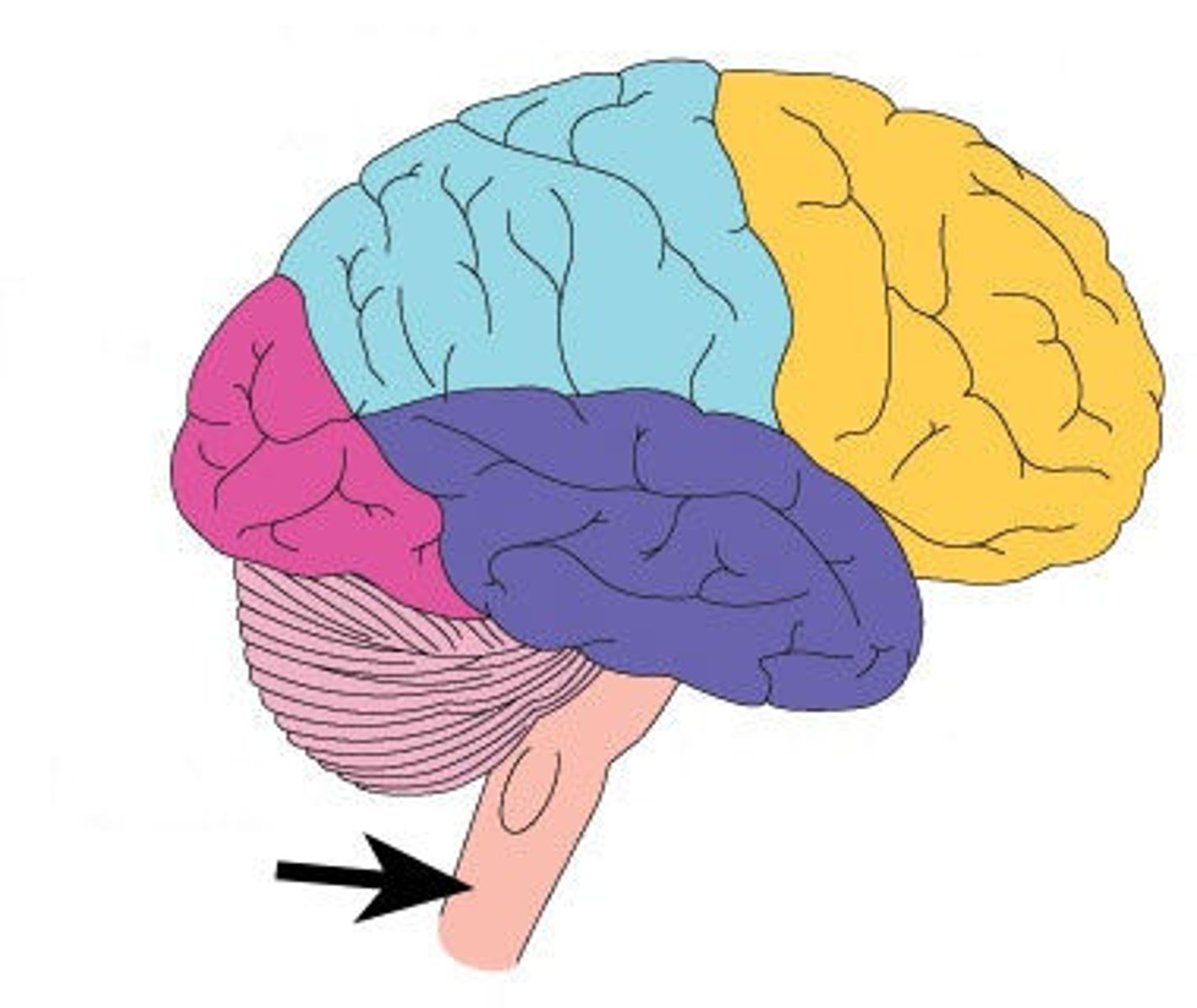
What are the functions of the cerebral cortex?
most of the function and senses of the brain (taste, sight, personality etc.)
What is the main function of the cerebellum?
Movement and position and balance and coordination
medulla oblongata function
regulating vital function (breathing, digestion, heart rate)
connects brain to spinal cord
controls unconscious activities of the brain
spinal cord
carries electrical impulses from medulla oblongata to the rest of the body, part of the CNS
CNS (central nervous system)
brain and spinal cord
PNS (peripheral nervous system)
the sensory and motor neurons that connect the CNS to the rest of the body
What is the cerebral cortex split into?
2 hemispheres
What are the functions of the left cerebral hemisphere?
Verbal and other cognitive processes
What are the functions of the right cerebral hemisphere?
Perceiving world around us and creating images
How many separate areas or lobes does each cerebral hemisphere consist of?
Four
CT scanning
A computerized imaging technique that uses X-ray slices passed through the brain at various angles and then combined into an image
What is a tracer?
A radioactive molecule
Which form of brain scanning employs radioactive tracers?
PET scanning
How is a tracer made?
By using a cyclotron
What are the most commonly used tracers?
Radioactive glucose
Why do PET scans use tracers?
The tracer will decay to form a positron in the brain
When a positron meets an electron, gamma rays are emitted.
A computer can detect and locate these gamma rays.
What is the function of a PET scan?
To locate active brain areas, this is because more active brain areas take in more of the tracer.
What are spinal cord injuries?
Severe injuries to the spinal cord, such as vertebral fractures and dislocations
What is the result of spinal cord injuries?
Impairment of spinal cord function below the level of the injury
What are benefits of using CT and PET scanning together?
You can combine them to get an image of the brain with the active brain structures.
cerebellum damage causes
uncoordinated, jerky movements, loss of balance
medulla oblongata damage results in
respiratory failure, paralysis, heartbeat failure
cerebral cortex damage results in
loss of taste, smell, vision
Why is a brain tumour especially bad?
the cancer cells can spread throughout the body via the blood stream, furthermore parts of the brain can be affected from the tumour
Why is the brain risky to operate on?
Risk of infection
relatively hard to access
may be hard to obtain consent(the patient has brain issues), therefore potentially unethical
risks damaging healthy tissue
side effects
How can we study different functions of the brain?
By electrically stimulating different parts of the brain.
Explain why some types of spinal cord
damage cannot be fully repaired.
The CNS has limited regenerative ability.
Central Nervous System
Includes the brain and spinal cord, vital for processing sensory information.
Peripheral Nervous System
Comprises nerves outside the CNS, facilitating communication with the body.
How does the nervous system detect stimuli?
1.Stimulus
2.Sensory Neurone
3.Coordinator(Brain and Spinal Cord)
4.Motor Neurone
5.Response
How are sensory neurones structured?
Cell body in the middle of the cell, dendrites and axon terminals
Myelin Sheath
insulates dendrons + axons and speeds up electrical impulses
What is the pathway of an impulse in a sensory neuron?
Dendrites -> Dendrons -> Axons -> Axon terminal
What is the pathway of an impulse in a motor neuron?
Dendrites -> Axons -> Axon terminal
How are sensory neurones adapted?
myelin sheath for speed
long axon for faster transmission
label all parts of the eye
What is the cornea?
The clear tissue that covers the front of the eye
What are the functions of the cornea?
It is a protective and a refractive layer
What is an iris?
A ring of muscle tissue that forms the colored portion of the eye around the pupil
What is the function of the iris?
Controls the size of the pupil opening, thus the amount of light that enters the eye
pupil
opening in the centre of the iris through which light enters the eye
lens
Focuses light on the retina, muscles change the lens shape to cause fine focusing
What are cone cells?
Shorter retinal cells that operate best in bright light
What is the function of cone cells?
Enable high-acuity, color vision as they respond to different wavelengths
How many cone cells are there per human eye?
About 6 million
Where is the highest concentration of cone cells found in the eye?
At the centre of the retina (fovea)
How many types of cone cells are there?
3
What are rod cells?
Longer retinal cells that work best in dim light and enable you to see black, white, and shades of grey.
Where are rod cells located in the retina?
At the periphery/edges of the retina.
What is the visual acuity of rod cells?
Low visual acuity
How many rod cells are there?
about 120 million per human eye
What is the function of optic nerves?
Carries electrical neural impulses from the cones and rods to the brain
What is the composition of optic nerves?
Made of neurones
What is the Retina?
the light-sensitive inner surface of the eye
 Note
Note  Flashcards (92)