MCB4203 Module 11 SG
 Studied by 0 people
 Call Kai
 Learn
Learn Practice Test
 Spaced Repetition
 Match
Match Flashcards
 Knowt Play
1/5

There's no tags or description
Looks like no tags are added yet.
Name | Mastery | Learn | Test | Matching | Spaced | Call with Kai |
|---|
No analytics yet
Send a link to your students to track their progress
6 Terms
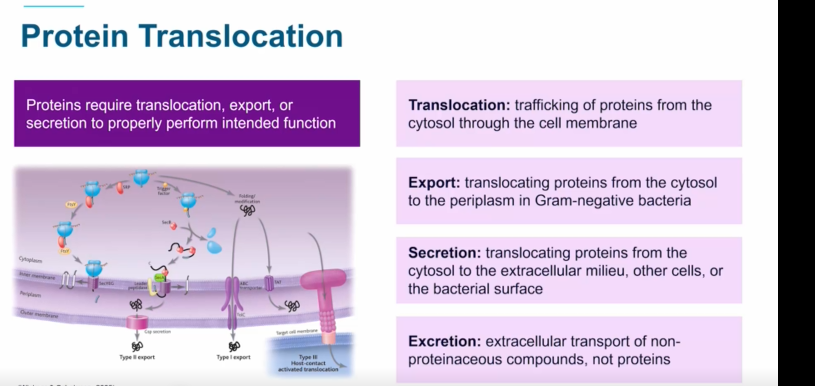
Understand the difference between translocation, export, secretion, and excretion, including their mechanisms and functions in bacterial cells.
Translocation: Trafficking of proteins from the cytosol through the cell membrane.
Export: translocating proteins from cytosol to the periplasm in Gram neg bact
Secretion: Translocating proteins from the cytosol to extracellular milieu, other cells, or the bacterial surface
Excretion: Extracellular transport of non-protein compounds.
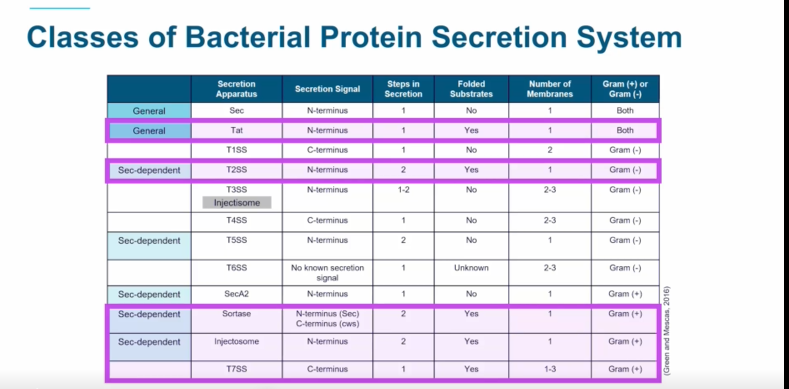
Identify the different secretion systems present in Gram-positive and Gram-negative bacteria, including which systems are appropriate for the secretion of folded substrates, with a focus on the Tat system.
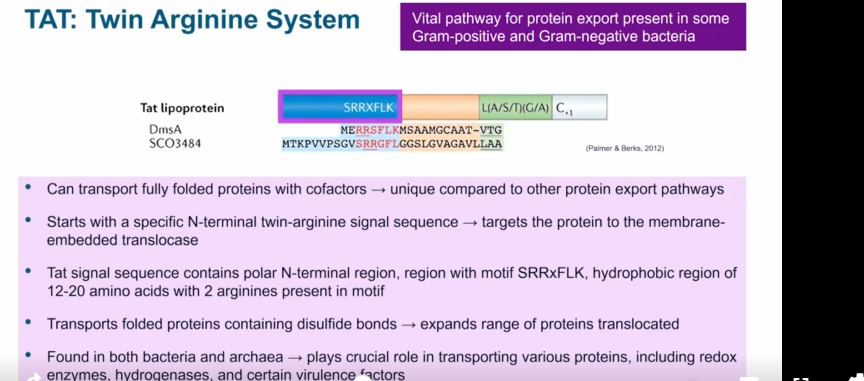
Compare and contrast the Sec and Tat secretion systems, including their major differences and characteristics, and the importance of the signal peptide.
Sec system: translocation of unfolded/partially folded proteins. NEEDS to recognize N-terminal signal peptide
Tat System: translocation of folded proteins. NEEDS to recognize N-terminal signal with twin arginine.
Precursor protein binds to TatBC bia tat signal sequence.
TatA is recruited to form a ring/large pore.
protein gets moved throughout the membrane via electrochemical gradient proteins.
Signal sequence is clefted by surface peptidase and signal is left behind in membrane while mature protein is released.
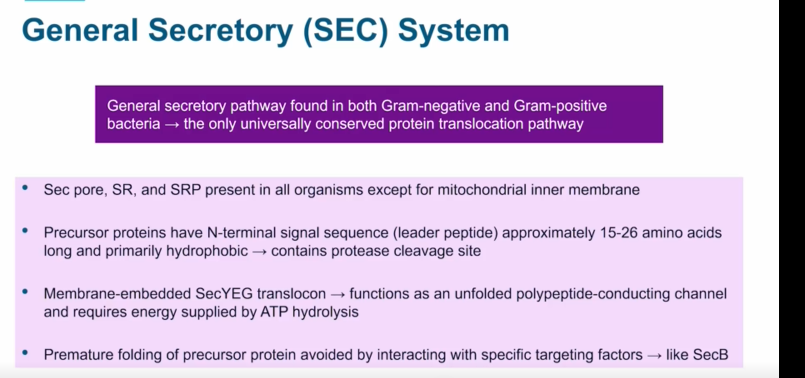
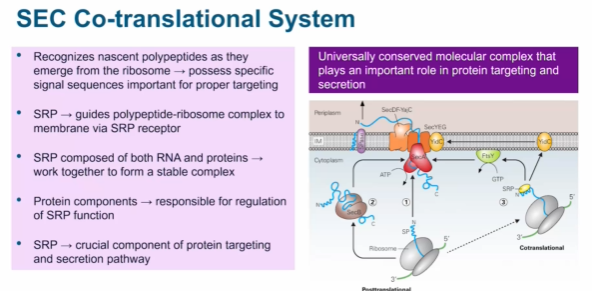
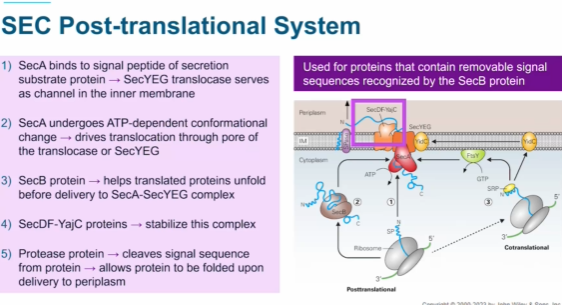
Understand the post-translational and co-translational mechanisms of the Sec system, and how they differ between different bacteria, including the components that distinguish one from another, such as the signal recognition particle (SRP).
Gram pos bact: Mature protein folds as it emerges through SecYEG channel —> released to surface of bact or directly into medium.
Gram neg bact: Protein folds in periplasmic space and remains there or transported across outer membrane via additional mechanisms.
Two main Routes: post trans and cotrans
Post Translation: SecB-mediated in E.coli and most common mech in bact. These pores or lower in prokaryotes vs eukaryotes = slow translocation rates.
Co Translation: SRP mediates the translocation. Common in eukaryotes and haloarchaea but not so common in bacteria.
Identify which secretion systems require Sec and which are Sec-independent.
Identify which secretion systems inject proteins/molecules directly inside the host cell.
 Note
Note  Flashcards (58)