Cognitive Psychology Chapter 4: Goldstein 4th Edition
 Studied by 0 people
 Call with Kai
 Learn
Learn Practice Test
 Spaced Repetition
 Match
Match Flashcards
 Knowt Play
1/81

There's no tags or description
Looks like no tags are added yet.
Name | Mastery | Learn | Test | Matching | Spaced | Call with Kai |
|---|
No study sessions yet.
82 Terms
Attention
Focusing on specific features, objects, or locations or on certain thoughts or activities. Glue that holds the whole cognitive system together. For example: problem solving suffers if attention is not there. Stimuli can be internal or external. Internal thoughts example: what's for lunch later…
Attentional capture
a rapid shifting of attention, usually caused by a stimulus such as a loud noise, bright light, or sudden movement. (could caused by stimulus salience)
Attenuation model of attention
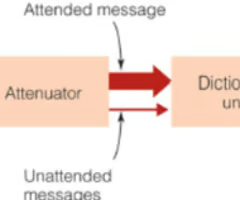
Anne Treisman's model of selective attention. Leaky Filter model, also early filter model, that proposes that selection occurs in two stages. In the first stage, an attenuator analyzes the incoming message and lets through the attended message—and also the unattended message, but at a lower (attenuated) strength. (a modification of Broadbent's model)(top-down). Then Dictionary unit
Attenuator
In Treisman's model of selective attention, the attenuator analyzes the incoming message in terms of physical characteristics, language (how the message groups into syllables or words), and meaning. Attended messages pass through the attenuator at full strength, and unattended messages pass through with reduced strength.(attenuator represents a process and is not identified with a specific brain structure.)
Automatic processing
(1)without intention (happens automatically) (2) at a cost of only some of a person's cognitive resources. Automatic processing is associated with easy or well-practiced tasks. (driving, but while task becoming harder (lots of blocks), automatic can't work (focus/crash))
Balint's syndrome
A condition caused by brain damage in which a person has difficulty focusing attention on individual objects. (hard to combine feathers in feature intergration aspect)
Binding
process by which features such as color, form, motion, and location are combined to create our perception of a coherent object.
Binding problem
problem of explaining how an object's individual features become bound together. Addressed by Anne Treisman's feature integration theory.
Bottleneck model
Broadbents Model of attention that proposes that incoming information is restricted at some point in processing, so only a portion of the information gets through to consciousness. Broadbent's model of attention could be considered as an example of a bottleneck model. (however, Broadbent's filter doesn't restrict the speed of the flow of information, and selecting data based on specific physical characteristics (such as the rate of speaking or the pitch of the speaker's voice))
Change blindness
Difficulty in detecting changes in similar, but slightly different, scenes that are presented one after another. The changes are often easy to see once attention is directed to them, but are usually undetected in the absence of appropriate attention.
Conjunctive search
Called serial search because have to search item by item. Target shares features with the detractors. Searching among distractors for a target that involves two or more features, such as "horizontal" and "green". (feature search for two features). Usually a little less accurate but noticeably slower because have to go item by item and longer reaction time as the distractors increase.
Cocktail party effect
The ability to focus on one stimulus while filtering out other stimuli, especially at a party where there are a lot of simultaneous conversations. Selective Attention
Covert attention
Occurs when attention is shifted without moving the eyes, commonly referred to as seeing something "out of the corner of one's eye." Contrasts with overt attention. (sport)
Dichotic listening
The procedure of presenting one message to the left ear and a different message to the right ear. (Broadbent). First introductd in 1959.
Dictionary unit
A component of Treisman's attenuation theory of attention. This processing unit contains stored words and thresholds for activating the words. The dictionary unit helps explain why we can sometimes hear a familiar word (threshold), such as our name, in an unattended message. See also Attenuation model of attention. Low threshold means means you need little activation to become aware (your name)
Distraction
Occurs when one stimulus interferes with attention to or the processing of another stimulus.
Divided attention
The ability to pay attention to, or carry out, two or more different tasks simultaneously.
Early selection model
Model of attentions that explains selective attention by filtering out information early in the process. Broadbent and Triesen's models are early selection models
Feature integration theory
An approach to object perception developed by Anne Treisman that proposes that object perception occurs in a sequence of stages in which features are first analyzed and then combined to result in perception of an object.
Feature search
Also called parallel search. searching among distractors for a target item that involves detecting one feature, such as "horizontal" red line among greens. (kind of visual search). Usually fast and accurate. Search whole display at once & it pops out. Fast because detractors don't share key features with the target so easy to see no matter how many distractors
Filter model of attention
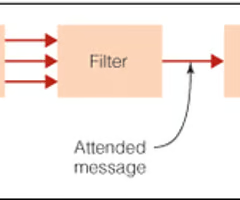
Model of attention that proposes a filter that lets attended stimuli through ad blocks some or all of the unattended stimuli. (Broadbent) Messages, Sensory memory, Filter (select attended message), Detector, To memory
Fixation
In perception and attention, a pausing of the eyes on places of interest while observing a scene.
Focused attention stage
The second stage of Treisman's feature integration theory. According to the theory, attention causes the combination of features into perception of an object.
High-load task
A task that uses most or all of a person's resources and so leaves little capacity to handle other tasks.
Illusory conjunctions
A situation, demonstrated in experiments by Anne Treisman, in which features from different objects are inappropriately combined. (Treisman) (prove feature integration)
Inattentional blindness
Not noticing something even though it is in clear view, usually caused by failure to pay attention to the object or the place where the object is located. Also see change blindness.
Late selection model of attention
A model of selective attention that proposes that selection of stimuli for final processing does not occur until after the information in the message has been analyzed for meaning. (meaning-select-final)(MacKay)
Load theory of attention
Proposal that the ability to ignore task-irrelevant stimuli depends on the load of the task the person is carrying out. High-load tasks result in less distraction.
Low-load task
A task that uses few resources, leaving some capacity to handle other tasks.
Overt attention
Shifting of attention from one place to another by moving the eyes. Contrasts with covert attention. Studying eye movements
Perceptual load
related to the difficulty of a task. Low-load tasks use only a small amount of a person's processing capacity. High-load tasks use more of the processing capacity.
Preattentive stage
The first stage of Treisman's feature integration theory, in which an object is analyzed into its separate features. (shape, color… depend on different location in brain)
Precueing
A procedure in which participants are given a cue that will usually help them carry out a subsequent task. This procedure has been used in visual attention experiments in which participants are presented with a cue that tells them where to direct their attention.
Processing Capacity
the amount of information input that a person can handle. This sets a limit on the person's ability to process information.
Saccadic eye movements
rapid and jerky eye movements from one fixation point to another. See also Fixation.
Saliency map
map of a scene that indicates the stimulus salience of areas and objects in the scene. (high saliency: lighter color)
Same-object advantage
Occurs when the enhancing effect of attention spreads throughout an object, so that attention to one place on an object results in a facilitation of processing at other places on the object.
Selective attention
The ability to focus on one message and ignore all others. Simplest form of attention. Important to understanding information processing.
Shadowed Ear
The procedure of repeating a message out loud as it is heard. Shadowing is commonly used in conjunction with studies of selective attention that use the dichotic listening procedure. (Broadbent) Person shadows the Attended ear.
Stimulus salience
Bottom-up factors that determine attention to elements of a scene. Examples are color, contrast, and orientation. (highly salient: pop-up from others) The meaningfulness of the images, which is a top-down factor, does not contribute to stimulus salience. See also Saliency map.
Stroop effect
Congruent: color and word match, In-congruent word and color don't match. J. R. Stroop, given word "blue" with red color, ask people to identify the ink of the word (red) and ignore the color expressed by the word (blue). This effect occurs because the names of the words cause a competing response and therefore slow responding to the target—the color of the ink. Controlled (processing color over reading )vs Automatic (reading)
Topographic map
Each point on a visual stimulus causes activity at a specific location on a brain structure, such as the visual cortex, and points next to each other on the stimulus cause activity at points next to each other on the structure.
Visual scanning
movements of the eyes from one location or object to another.
Visual search
Occurs when a person is looking for one stimulus or object among a number of other stimuli or objects. Goal is to know if a target is present or not. Look for accuracy and reaction time. People usually accurate but take more or less time to id.
attended ear
one ear in which you focus your attention on the words (Broadbent). The shadowed ear
Sensory memory
The first part of the filter model of attention: holds all of the incoming information for a fraction of a second and then transfers all of it to the filter.
filter
The sencond step in the model which identifies the message that is being attended to based on its physical characteristics—things like the speaker's tone of voice, pitch, speed of talking, and accent—and lets only this attended message pass through to the detector in the next stage.
detector
The third step of the model which processes the information from the attended message to determine higher-level characteristics of the message, such as its meaning. process all information entered
Final step of the filter model of attention
The output of the detector is sent to short-term memory, which holds information for 10-15 seconds and also transfers information into long-term memory, which can hold information indefinitely.
Treisman's attenuation model of attention
The analysis of the message proceeds only as far as is necessary to identify the attended message. if there are two messages, one in a male voice and one in a female voice, then analysis at the physical level (which Broadbent emphasized) is adequate to separate the low-pitched male voice from the higher-pitched female voice. If, however, the voices are similar, then it might be necessary to use meaning to separate the two messages.(Treisman's)
Leaky filter model
Because at least some of the unattended message gets through the attenuator (although weaker than the attended message), Treisman's model has been called
threshold
the smallest signal strength that can barely be detected. Thus, a word with a low threshold might be detected even when it is presented softly or is obscured by other words.
biasing word
"money/boat" in unattended ear when hear ambiguous "bank", listener are unaware of that but that could influence listener's decision on the meaning of bank. (Mackay)
Central vision/Peripheral vision
the area you are looking at (detailed because it falls on fovea)/everything off to the side.
bottom-up (physical characteristics)/top-down (cognitive factors: knowledge about scenes and past experiences)
two factors that determine how people shift their attention by moving their eyes
attentional capture
When attention due to stimulus salience causes an involuntary shift of attention (sudden noise/flash light)
step of scanning image
First: saliency map /then: top-down (associate with scene schema)
Just in time" strategy
top-down processing/task-oriented/eye movements occur just before we need the information they will provide.
valid trail/invalid trail
information processing is more effective at the place where attention is directed (Posner)
same object advantage
when attention is directed to one place on an object, the enhancing effect of that attention spreads to other places on the object.
continuity errors
Change blindness in movie (changed clothes)
William James Attention
Everyone knows what attention is. It is the taking possession of the ind, in clear and vivid form, of one out off what seem several simultaneously possible objects or trains of thought. Focalization, concentration of consciousness are at it's essence. It implies withdrawal from some things in order to deal effectively with others.
Moray
Dichotic listening experiments
found little recognition of unattended channel even if repeated up to 35 times discovered that subjects detected their own name in the unattended channel
Cherry
1953 Dichotic listening experiments. Can tell if voice in the unattended/unshadowed ear is male or female. Can not tell if unattended message changes languages'
Broadbents model of attention
First model of attention 1958. Refered to a Bottleneck Method (flow is restricted) Filter happens early in the processing. Filter blocks out many pieces of information, such that you are only aware of somethings going on. More Data caused problems in this model, for example the cocktail party effect.
Corteen & Wood (1972)
Dichotic listening experiments pairing a shock with city names. Later in the unattended ear (biological response) they reacted as though being shocked. Brain heard even though no attention. Everything getting through
MacKay (1973)
Dichotic Listening experiments. Ambiguous words in the attended ear were made more sense by what was heard in the undattended ear. (meaning must be getting through.
Deutsch & deutsch 1963
Late selection models of attention. Filter picks out after everything gets through but before memory. That's why don't remember it. This is for hearing only. doesn't work for visual, smell, etc.
Filter Model Problems
Filter models don't always capture what's going on. They are not correct just specific to what's the observer task or type of stimuli
Filter Model Positives
Provides a hypothesis, study beginning to jump off for testing. Crucial to demonstrating the information processing approach to Cognitive Psychology. Nice demonstration of how the field of Cognitive Psychology works
Michael Posner (1980)
National Medal of Science winner. Yes attention can be moving around even whtn the senses eyes) are not moving around. 3 systems of attention: Alertness, Orieting, Executive 1)Alertness: be aware of, high state of sensitivity Clock dot study 2) align attention resources to sensory signal from the environment visual search - snowman in penquins & visual cueing - arrows. Noted attention diverted by cues where inaccurate cues made attention engagement take longer
Visual Search 2 types
Feature or Parallel search and Conjunctive or Serial Search. Real life use is related to the easy of using technology. Airport security, getting in a cockpit of a plane
Visual Cuing
In visual search there are certain things that can draw our attention away or toward our target
Posner's Covert shift of Attention
idea that cues can direct attention preparing for the shift in attention making it fast. All without using the eyes: covert shift. Uses different parts of the brain so makes his work so great.
Posner's Orienting the Brain
Cues use top down processing Dorsel visiospatial processing while righting the attention after noted a incorrect cue kicks in the Ventral system to id the object bottom up reorienting approach.
Cognitive Resources
Cognitive… idea that we have a limited # of resources to use in processing and performing actions. Decreases self control, perform task more difficult, harder to make good decisions
Attentional Resources assumptions
less resources worse tasking, more resources better decisions, better performance, getting more done, multi-tasking uses up more resources than single tasking
Attention Resources Function of
Individual differences and Genetics result in Executive attention is applied differently also automatic (low-load) and Controlled processes (High-load)
Controlled Attention
Perceptual load, High load task, Effort, initiated by you, learning studying, awareness that your in charge, what were you thinking about, taking on something new, not robust to stressors (tired, anxiety don't do as well), requires resources.
Automatic Attention
Perceptual load, Low load tasks, easy path, Robust to stressors, occurs because of repeated practice, no introspection or thought, out of your control, reading, talking, doesn't require resources, well practiced, can't turn off.
In-congruent Trials
During the Stroop effect the color and the word don't match. requires a controlled attention. Takes longer, resource consuming. Have to stop the automatic processing of reading
Congruent Trials
In the Stroop effect the word and the color match thus allowing for easy, automatic processing, uses automatic resources, so few resources
 Note
Note  Flashcards (54)