Biochemistry Chapter Four
0.0(0)
 Studied by 1 person
 Call Kai
 Learn
Learn Practice Test
 Spaced Repetition
 Match
Match Flashcards
 Knowt Play
Card Sorting
1/149

Earn XP
Description and Tags
Last updated 10:55 PM on 2/12/23
Name | Mastery | Learn | Test | Matching | Spaced | Call with Kai |
|---|
No analytics yet
Send a link to your students to track their progress
150 Terms
1
New cards
What is the general flow of genetic information
DNA to RNA to proteins
2
New cards
What is the information content of a nucleic acid
The sequence of the bases
3
New cards
What is each monomer of a nucleic acid made up of
A sugar, a phosphate, and a base
4
New cards
What is the linkage of sugars in the backbones of DNA and RNA
Sugars are linked by phosphodiester bridges between the 3’-hydroxyl of one sugar and the 5’-hydroxyl of an adjacent sugar
5
New cards
What carbon are the bases of a nucleotide attached to
Carbon atom 1’ in the sugar
6
New cards
What charge does the backbone of DNA and RNA have and what does this for the nucleic acid
The backbone has a negative charge due to the phosphate group being negatively charged. This negative charge repels nucleophilic species such as hydroxide ions that can hydrolytically cleave the phosphodiester linkages
7
New cards
Ester
The compound obtained when the hydrogen atom in at least one hydroxy group is an oxoacid or a hydroxoacid is replaced by an alkyl group (alkyl ester) or an aryl group (aryl ester).
8
New cards
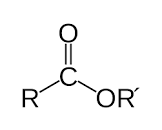
Ester bond
Also called ester linkage and is the bond connecting the atom doubly bonded to oxygen and the oxygen atom bearing the alkyl or aryl group
9
New cards
How does the absence of a 2’-hydroxyl group in DNA increase its resistance to nucleophilic species and hydrolysis
Free hydroxide ions in solution can easily deprotonate the 2’ OH of the ribose enabling the deprotonated 2’ hydroxyl’s nucleophilic attack on the adjacent phosphorus. Phosphodiester bond is broken, cleaving the RNA backbone
10
New cards
Nucleoside
A base bound to a sugar
11
New cards
Nucleosides of DNA
deoxyadenosine, deoxyguanosine, deoxycytidine, and deoxythymidine. By convention, since deoxythymidine rarely occurs in RNA, it is simply called thymidine in reference to DNA
12
New cards
The nucleosides of RNA are
Adenosine, guanosine, cytidine, and uridine
13
New cards
How are sugars and purine attached
The C-1’ of the sugar is attached to the N-9 of the purine by a B-glycosidic bond
14
New cards
How are sugars and pyrimidines attached
The C-1’ of the sugar is attached to to the N-1 of the pyrimidine by a B-glycosidic bond
15
New cards
What is a nucleotide in terms of a nucleoside
A nucleotide is a nucleoside with one or more phosphoryl groups attached
16
New cards
What are the building blocks of DNA and RNA
Nucleotide triphosphates
17
New cards
Mnemonic to remember the attachment of purine to sugar
PurNINE (the C-1’ of a sugar attaches to the N-9 of the purine)
18
New cards
Glycosidic bond
Also known as a glycosidic linkage is a type of covalent bond that joins a carbohydrate (sugar) molecule to another group, which may or may not be another carbohydrate
19
New cards
Beta position (glycosidic bond)
When the -OH is on the same side of the ring. IN the ring structure this results in an upward projection
20
New cards
Alpha position (glycosidic bond)
The -OH is on the opposite side of the ring. The ring structure this results in a downward projection
21
New cards
Nucleic acid directionality
One end has a phosphoryl group attached to the 5’ carbon of the sugar and one end has a free hydroxyl attached to the 3’ carbon of the sugar
22
New cards
What direction are nucleic acid sequences written in
They are written in the 5’ to 3’ direction
23
New cards
How long can a DNA molecule be
Pretty long, consisting of more than 1 billion nucleotides
24
New cards
How many nucleotides does the human genome comprise of
3 billion nucleotides per DNA strand (so 6 billion total)
25
New cards
How is the human genome divided
Among 23 pairs of chromosomes
26
New cards
What is the double helix of DNA stabilized by
Hydrogen bonds and van der Waals interactions
27
New cards
Hydrophobic interactions
Also called stacking forces. Interactions that help to stabilize the double helix
28
New cards
Semiconservative replication
Because of the base pairing rules, the sequence of one strand determines the sequence of the partner strand. The two strands can be separated and complementary sequences can be synthesized to generate two identical daughter strands. The two daughter helices have one parent strand one newly synthesized strand
29
New cards
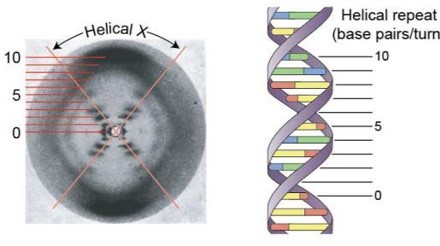
Photo 51
Taken in 1951. The photo revealed that B-form DNA was a double helix with 10 nucleotide base pairs within a complete turn of the helix. The “X” in the picture indicates a helix. The dark patches indicate the bases
30
New cards
What distance are adjacent bases separated by and what does this mean for the structure of DNA
3\.4 angstroms at intervals of 34 angstroms which corresponds to approximately 10 nucleotides on each chain
31
New cards
What is the angle of rotation for each base and what does this mean for the structure of DNA
36 degrees which shows that the bases are stacked on top of one another
32
New cards
Base pairing rules
Account for the observation, originally made by Erwin Chargaff, in 1950, that the ratios of adenine to thymine and of guanine to cytosine are nearly the same in all species studied, whereas the adenine-to-guanine ratio varies considerably
33
New cards
van der Waals interactions between stacked bases
Are called stacking forces, help to stabilize the double helix
34
New cards
What are the different ways of depicting molecular structures
Lewis structures, condensed formulas, skeletal formula, and stereochemistry (3D arrangement), space-filling, ball-and-stick
35
New cards

Lewis structure
\
36
New cards

Skeletal formula
37
New cards
Condensed formula
Example: ethanol (CH3CH2OH)
38
New cards

Stereochemistry
39
New cards
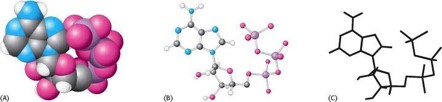
Space filling molecules
A
40
New cards
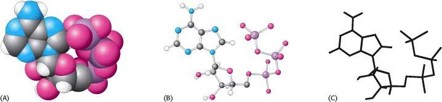
Ball-and-stick model
B
41
New cards
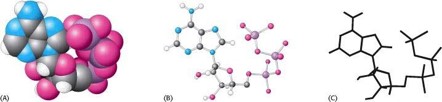
Skeletal model
C
42
New cards
A form of DNA
Shorter and wider than the B form with bases at an angle rather than perpendicular to the helix axis. The sugar is in the C-3’-endo conformation
43
New cards
B form
The most commonly seen form of the DNA double helix. Its sugar is in the C-2’-endo configuration
44
New cards
Where is the A form of the DNA double helix found in
In the RNA double helices and in RNA-DNA hybrid helices, structures observed in transcription and RNA processing
45
New cards
What form does DNA take when it isn’t hydrated
A-DNA
46
New cards
Where does the C-3’ carbon atom lie in the A-form of DNA
It lies above the approximate plane defined by the four other sugar nonhydrogen atoms (called C-3’ endo)
47
New cards
Where does the C-2’ lie in the B-form of DNA
In the endo conformation which means that it lies out of the plane
48
New cards
What does C-3’-endo puckering in A-DNA lead to
A 19-degree tilting of the base pairs away from the perpendicular to the helix
49
New cards
Why are RNA helices induced to take the A-DNA form
Because of steric hindrance from the 2’-hydroxyl group: the 2’-oxygen atom would be too close to three atoms of the adjoining phosphoryl group and to one atom in the next base
50
New cards
Z-DNA
A left-handed, zigzagged form of DNA.
51
New cards
What is the degree of the tilt of base pairs from perpendicular to helix axis for B DNA
1 degree
\
\
52
New cards
What is the screw sense of B DNA
Right-handed
53
New cards
How does bacteria fit DNA into the cell without a nucleus
In order to fit inside a cell, the DNA molecule must be compacted. In E.coli the DNA double helix is a circular molecule (in terms of continuity of the DNA strands and not in reference to their geometric form) that is twisted into a superhelix by the process of supercoiling. Without coiling, E. coli chromosome, fully extended, would be about 1000 times as long as the greatest diameter of the bacterium
54
New cards
Stem-loop
A motif of single stranded nucleic acid which occurs when complementary sequences in the same strand form a double helix. In many cases, these double helices are made up entirely of Watson-Crick base pairs. In other cases, however, the structures include mismatched base pairs or unmatched bases that bulge out from the helix
55
New cards
Where do non-Watson-Crick base pairs occur frequently in terms of type of nucleic acid
They occur frequently in RNA
56
New cards
What do mismatched bases do in stem-loop structures of single stranded nucleic acid molecules
These mismatched bases destabilize the local structure but introduce deviations from the standard double helical structure which can be important for higher-order folding and for function
57
New cards
Aside form forming a stem-loop, what else can single-stranded RNA molecules do
A single-stranded RNA molecule can fold back on itself to form a complex structure. Often three or more bases interact to stabilize these structures. In such cases, hydrogen-bond donors and acceptors that do not participate in Watson-Crick base pairs participate in hydrogen bonds to form nonstandard pairings.
58
New cards
What can stabilize stem-loop and single stranded RNA folding
Metal ions such as magnesium ion (Mg 2+) often assist in the stabilization of these more elaborate structures
59
New cards
What do different, complex structures of RNA allow these molecules to do
To perform a host of functions that the double-stranded DNA molecule cannot. Indeed, the complexity of some RNA molecules rivals that of proteins, and these RNA molecules perform a number of functions that had formerly been thought to be exclusively done by proteins
60
New cards
Relative size of globular proteins and the mRNA that codes for it
Myoglobin mRNA is 1078 bases long but the protein (myoglobin) it codes for is only 153 amino acids long
61
New cards
Meselson and Stahl Semi-conservative replication experiment
Demonstrated (in 1958) that replication is semiconservative by growing bacteria in growth media supplemented with 15N. The bacteria were then shifted to growth media with 14N as the nitrogen source. Density gradient centrifugation established that upon the shift to 14N medium, newly synthesized DNA consisted of DNA with equal parts 15N-DNA and 14N-DNA, a result consistent with semiconservative replication
62
New cards
N14 vs N15
N15 is a heavier isotope of N14
63
New cards
At the start of the experiment, what would the sample of bacterial DNA look like during the Meselson and Stahl experiment?
There would be a band towards the bottom (a heavy band) indicating that the bacterial DNA was still the parent DNA with the N15 incorporated
64
New cards
After two generations, what would the sample of bacterial DNA look like during the Meselson and Stahl experiment
There would be some of the sample in the middle, indicating that the DNA was now in the “intermediate” expression. The DNA would have both N14 and N15 incorporated in one of the two strands each of the DNA double helix
65
New cards
After two generations, what would the DNA of the Meselson and Stahl experiment look like
There would be a band closer to the top which indicates that the DNA of that band consisted of two strands of the lighter N14. There would be another band in the middle indicating that there was still some DNA with the intermediate expression of the DNA with one strand with N15 and one strand with N14
66
New cards
How can DNA’s double helix be separated
In the laboratory, DNA strands can be separated by heating a solution of DNA, a process called denaturation or melting
67
New cards
Melting temperature (Tm)
The temperature at which half of the DNA molecules are denatured
68
New cards
How can the melting and denaturation of a DNA double helix be observed
Bases stacked in a double helix absorb less ultraviolet light than bases in a single-stranded molecule
69
New cards
Hypochromism
Bases stacked in a double helix absorb less ultraviolet light than bases in a single-stranded molecule which can be used to observe the denaturation of the double helix
70
New cards
Reannealing
After denatured DNA strands have cooled, the two strands can bind to one another to reform the double helix
71
New cards
Hypochromism and single-stranded DNA
Single-stranded DNA absorbs light more effectively than does double-helical DNA
72
New cards
Absorbance of a DNA solution at a wavelength of 260 nm
Increases when the double helix is melted into single strands
73
New cards
How many hydrogen bonds form a guanine and cytosine base pair
Three
74
New cards
How many hydrogen bonds form a adenine and thymine base pair
Two
75
New cards
How many proteins does DNA replication in E. coli require
More than 20, five of them being DNA polymerases
76
New cards
DNA polymerase
Catalyzes phosphodiester-bridge formation
77
New cards
Reaction of phosphodiester-bridge formation
Catalyzed by DNA polymerase:

78
New cards
What is required for DNA synthesis/replication
Four deoxynucleoside tripshosphates (ATP, GTP, CTP, and CTP) and Mg2+ are required, a template strand, primers, and DNA polymerase with intrinsic nuclease activity
79
New cards
DNA primers
From here the new DNA strand grows
80
New cards
What does the intrinsic nuclease activity DNA polymerases have allow them to do
Allows them to remove mismatched bases
81
New cards
What primes the synthesis of DNA
RNA, specifically an RNA polymerase called RNA primase
82
New cards
RNA primase
A RNA polymerase that synthesizes a short stretch of RNA- about five nucleotides- that is complementary to one of the template DNA strands
83
New cards
Why are primers needed for DNA synthesis/replication
Primer strands have a free 3’OH group which can attack the innermost phosphorus atom of the deoxyribose nucleoside triphosphate
84
New cards
As the phosphodiester bridge is being formed, what is being released
A pyrophosphate is released after a nucleophilic attack by the 3’OH end of the growing strand on the innermost phosphorus atom of the deoxynucleoside triphosphate. There is subsequent hydrolysis of pyrophosphate to yield two ions of orthophosphate (Pi) by pyrophosphatase which drives the polymerization forward
85
New cards
Retroviruses have one kind of DNA
DNA that had been transcribed from single-stranded RNA genomes by the action of reverse transcriptase
86
New cards
Examples of retroviruses
HIV-I
87
New cards
What are the genes of some viruses made of
Some viruses, such as the tobacco mosaic virus, have RNA genomes that are replicated by RNA-directed RNA polymerases
88
New cards
Reverse Transcriptase
Possesses several activities such as catalyzing the synthesis of a complementary DNA strand, the digestion of the RNA strand, and the subsequent synthesis of the DNA strand
89
New cards
Kilobase
A unit of length equal to 1000 base pairs of a double-stranded nucleic acid molecule (or 1000 bases of a single-stranded molecule).
90
New cards
Messenger RNA
Is the template for protein synthesis of translation
91
New cards
How many mRNA molecules do prokaryotes for their genes compared to eukaryotes
One mRNA molecule for a group of genes vs eukaryotes for each gene
92
New cards
Transfer RNA (tRNA)
Carries amino acids in an activated form to the ribosome for peptide-bond formation, in a sequence dictated by the mRNA template.Consists of about 75 nucleotides. Known as the “adaptor molecule” for protein synthesis
93
New cards
Ribosomal RNA (rRNA)
The major component of ribosomes. IN prokaryotes three kinds of rRNA called 23S, 16s, and 5s RNA because of their sedimentation behavior,. One molecule of each of these species of rRNA is present in each ribosome. rRNA is the actual catalyst for protein synthesis
94
New cards
Svedberg unit
The units for sedimentation. Bigger particles have higher S values
95
New cards
What is transcription catalyzed by
RNA polumerase
96
New cards
What does RNA polymerase have for transcription to happen
A template, activated precursors, and divalent metal ions
97
New cards
RNA polymerase template
The sequence of the newly-synthesized RNA is complementary to the DNA template. The DNA strand that has the same sequence as the RNA product (with T instead of U) is called the coding strand
98
New cards
Activated precursors
Four ribonucleoside triphosphate
99
New cards

Transcription reaction
100
New cards
DNA polymerase vs RNA poly,erase
RNA polymerase does not need primers. RNA primes the synthesis of DNA
 Note
Note  Flashcards (169)