reaction rates and equilibrium
 Call Kai
 Learn
Learn Practice Test
 Spaced Repetition
 Match
Match Flashcards
 Knowt Play
1/50

There's no tags or description
Looks like no tags are added yet.
Name | Mastery | Learn | Test | Matching | Spaced | Call with Kai |
|---|
No analytics yet
Send a link to your students to track their progress
51 Terms
how do rates of reaction differ?
some happen very fast, while other reactions take ages
what does the rate of a reaction do?
measures how fast a reactant is being used up/ how fast a product is being formed
what is the rate of a reaction?
the change in concentration of a reactant or product in a given time
rate =?
change in concentration/ time
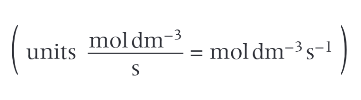
units of rate?
when and why is rate of a reaction fastest?
at the start of the reaction, as each reactant is at its highest concentration
when and why does the rate of a reaction slow down?
as the reaction proceeds, as the reactants are being used up and their concentrations decrease
when is the rate of a reaction zero?
once one of the reactants have been completely used up so the concentrations stop changing
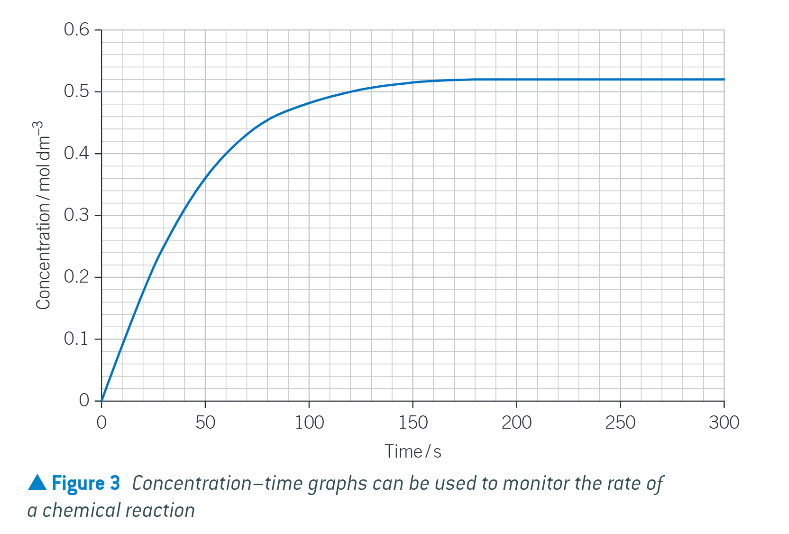
concentration time graph example:
shows the formation of a product over the course of a chemical reaction
what are the factors that can change the rate of a chemical reaction?
concentration (or pressure when reactants are gases)
temperature
use of a catalyst
surface area of solid reactants
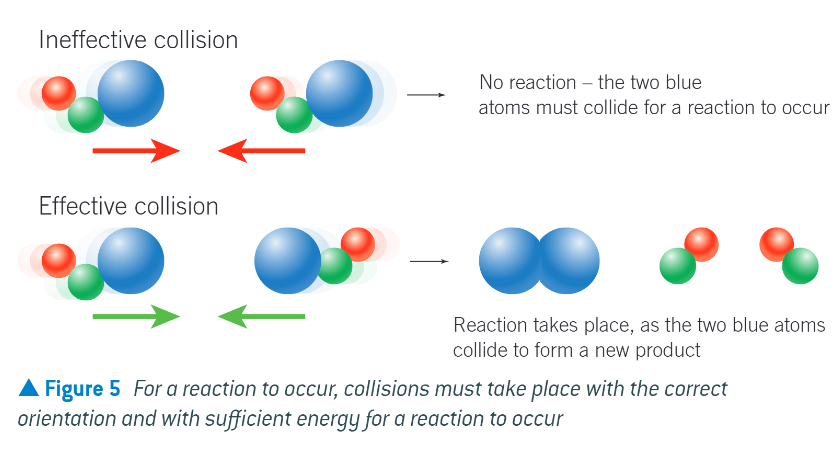
what is collision theory?
states that 2 reacting particles must collide for a reaction to occur. usually only a small number of collisions start a chemical reaction
what happens in most collisions?
the molecules collide but then bounce off each other and remain chemically unchanged
what are the 2 conditions that need to be met for a collision to be effective?
the particles collide with the correct orientation
the particles have sufficient energy to overcome the activation energy barrier of the reaction
how does increasing the concentration affect the rate of reaction?
an increase in conc increases the number of particles in the same volume
the particles are then closer together and collide more frequently
there will therefore be more effective collisions in a given period of time and an increased rate
how does increasing the pressure of a gas affect the rate of reaction?
the conc of the gas molecules increases as the same number of gas molecules occupy a smaller volume
the gas molecules are closer together and collide more frequently, leading to more effective collisions in the same time
how can the progress of a chemical reaction be followed?
monitoring the removal (decrease in conc) of a reactant
following the formation (increase in conc) of a product
what will the method chosen depend on?
the properties and physical states of the reactants and products in the reaction
what are other measurable properties that can be used to measure rate?
gas volume, mass of reactants/ products, colour
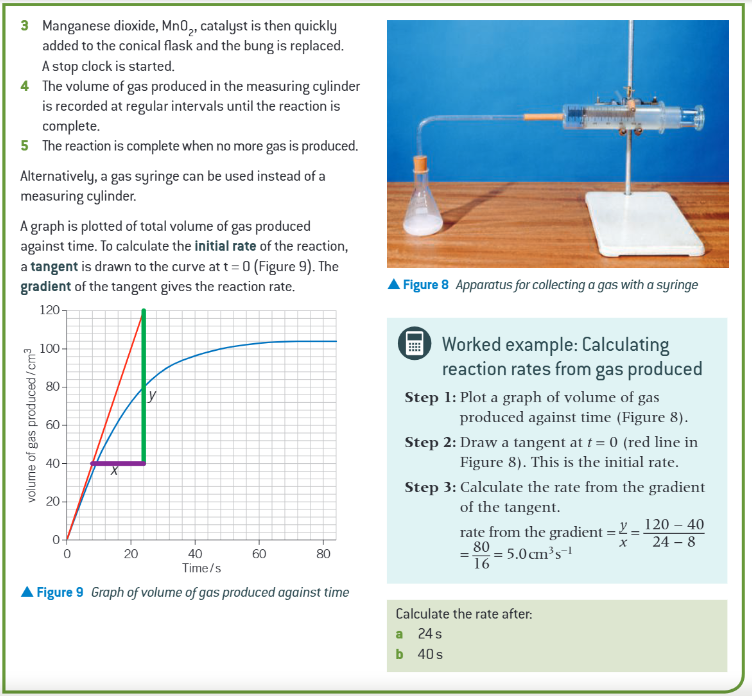
how can you determine the rate of a reaction if the reaction produces a gas?
monitor the volume of gas produced at regular time intervals using gas collection
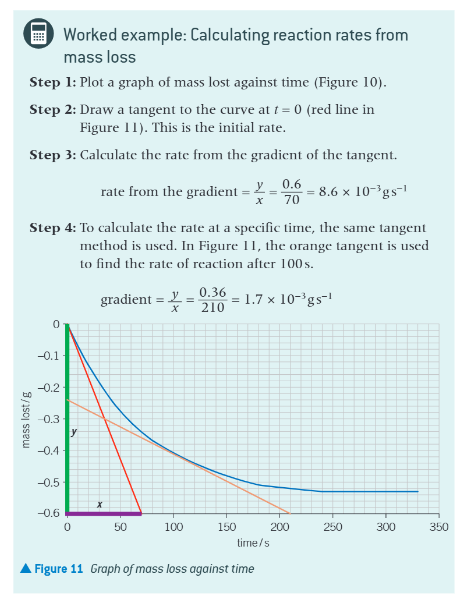
monitor the loss of mass of reactants using a balance
what are volume of gas produced and mass loss both proportional to?
the change in concentration of a reactant/ a product. this means that the change in volume with time/ mass loss with time both give a measure of the rate of a reaction
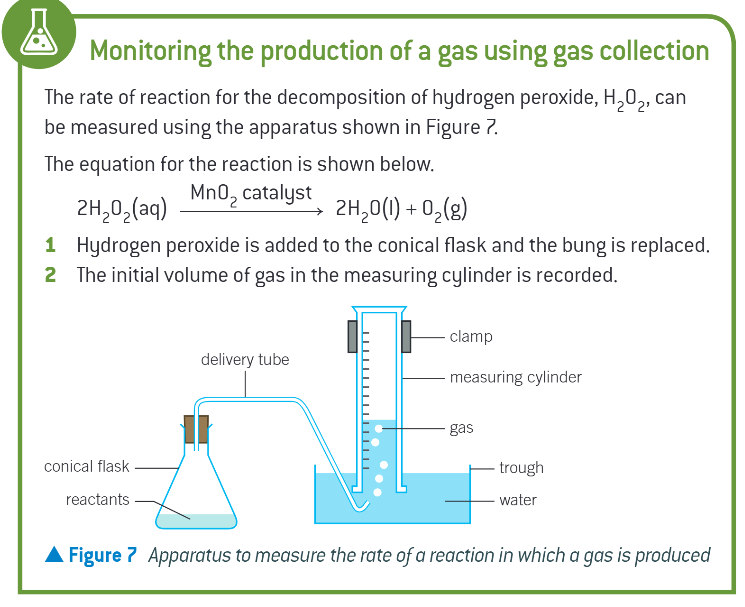
monitoring the production of gas
eg. how can the rate of reaction between calcium carbonate and hydrochloric acid also be determined?
by monitoring the loss in mass of the reactants over time
equation for the reaction:

how does this work?
add carbonate and acid to conical flask on a balance
mass of flask and content recorded initially and at regular time intervals
the reaction is complete when no more gas is produced so no more mass is then lost
you can then plot a graph of mass lost against time
worked example:
what is a catalyst?
a substance that changes the rate of a chemical reaction without undergoing an permanent change itself
features of catalysts:
the catalyst isnt used up in the reaction
the catalyst may react with a reactant to form an intermediate or may provide a surface on which the reaction can take place
at the end of the reaction the catalyst is regenerated
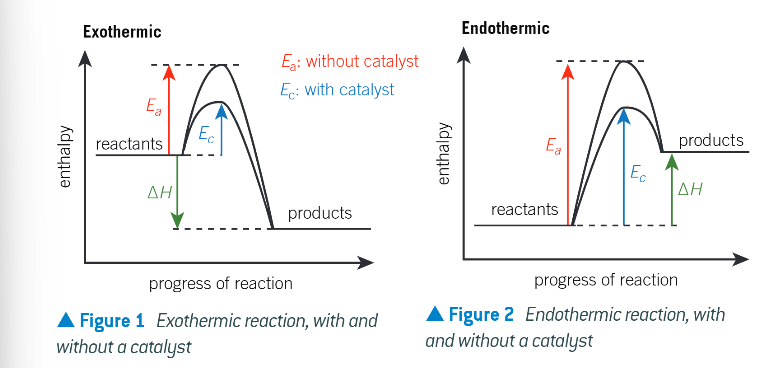
how does a catalyst increase the rate of a chemical reaction?
it provides an alternative reaction pathway with a lower activation energy
enthalpy profile diagrams for catalysts in endothermic and exothermic reactions:
what is a homogeneous catalyst?
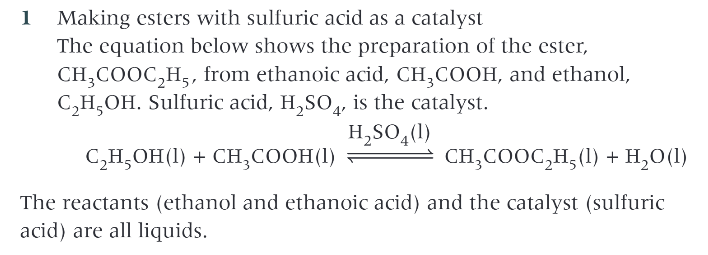
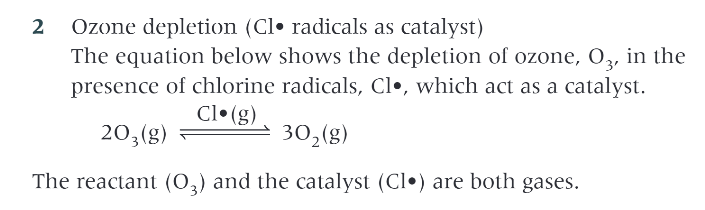
a catalyst with the same physical state as the reactants to form an intermediate. the intermediate then breaks down to give the product and regenerates the catalyst
one example of the many reactions of gases and liquids that use homogeneous catalysts:
another example of the many reactions of gases and liquids that use homogeneous catalysts:
what is a heterogeneous catalyst?
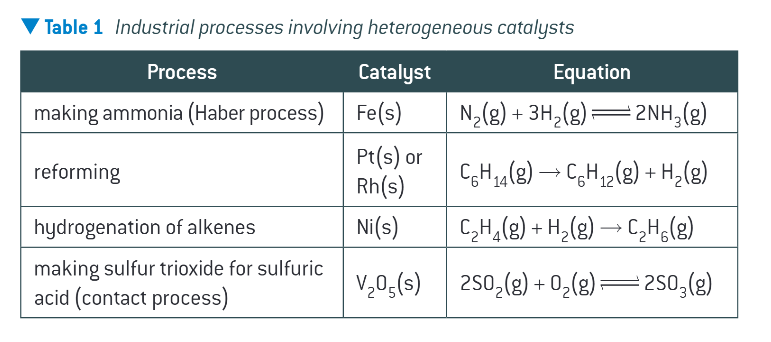
a catalyst that has a different physical state from the reactants. they are usually solids in contact with gaseous reactants/ reactants in solution
what happens to the reactant molecules?
they are absorbed (weakly bonded) onto the surface of the catalyst where the reaction takes place. after reaction, the product molecules leave the surface of the catalyst by desorption
some of the common industrial processes that use heterogeneous catalysts:
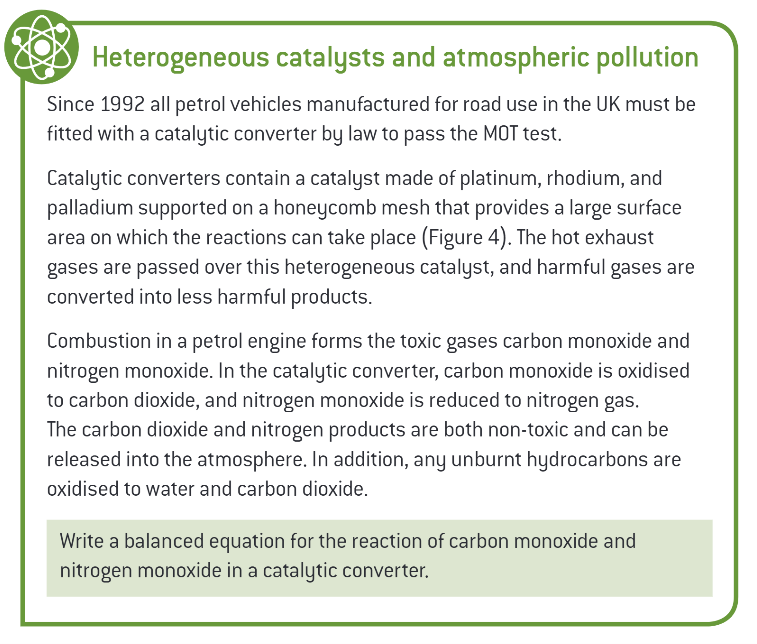
extra info: heterogeneous catalysts and atmospheric pollution:
what is estimated?
90% of all chemical materials are produced using a catalysts, which increase the rate of many industrial chemical reactions by lowering the activation energy. this then reduces the temp needed for the process and energy requirements
whats the case if a chemical process requires less energy?
then less electricity or fossil fuels are used
what does making the product faster and using less energy do do?
cut costs and increase profitability. therefore the economic advantages of using a catalyst outweigh any costs associated with developing a catalytic process
what does the modern focus on sustainability require?
industry to operate processes with high atom economies and fewer pollutants. using less fossil fuel will cut emissions of CO2, a gas linked to global warming
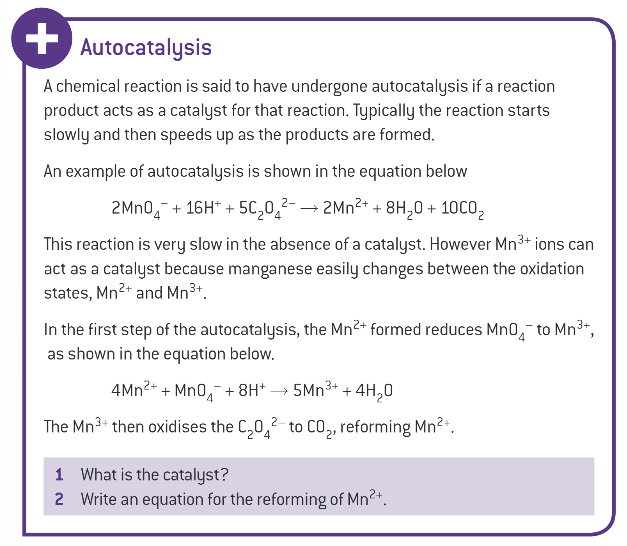
extra info: autocatalysis:
What did we learn about molecules in a gas and collisions at GCSE?
molecules in a gas move at a high speed, colliding with each other and with the walls of the container they are held in
The collisions are said to be elastic - the molecules dont slow down as a result of a collision and no energy is lost
what is the case with different molecules in the different states?
some molecules move slowly with low energy and some molecules move fast with a high energy
what do most molecules do?
move close to the average speed and have close to the average energy
What is the spread of molecular energies in gases known as?
the Boltzmann distribution
diagram to show Boltzmann distribution of molecular energies:
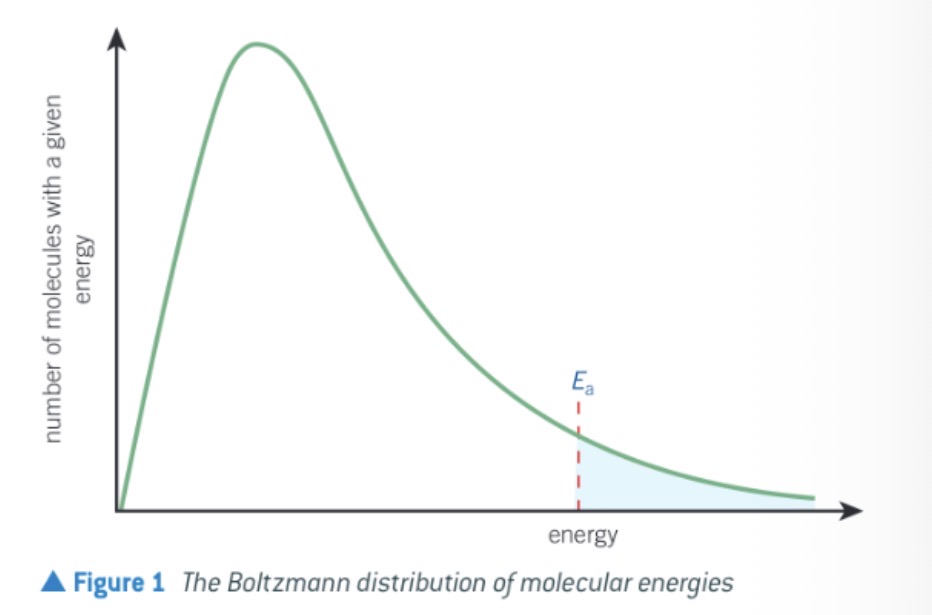
What does Ea stand for?
Activation energy - you can see from the diagram that only a small proportion of the molecules have more energy than Ea, that is enough energy to react
feature of the Boltzmann distribution:
no molecules have zero energy - the curve starts at the origin
The area under the curve is equal to the total number of molecules
There is no maximum energy for a molecule - the curve doesn’t meet the x axis at high energy. The curve would need to reach infinite energy to meet the x axis
the effect of temperature on a Boltzmann distribution curve:
as temp increases, the average energy of the molecules also increases
A small proportion of the molecules will still have low energy, but more molecules have higher energy
The graph is therefore stretched over a greater range of energy values
The peak of the graph is lower on the y axis and further along the x axis - the peak is at a higher energy
The number of molecules is the same, so the area under the curve remains the same
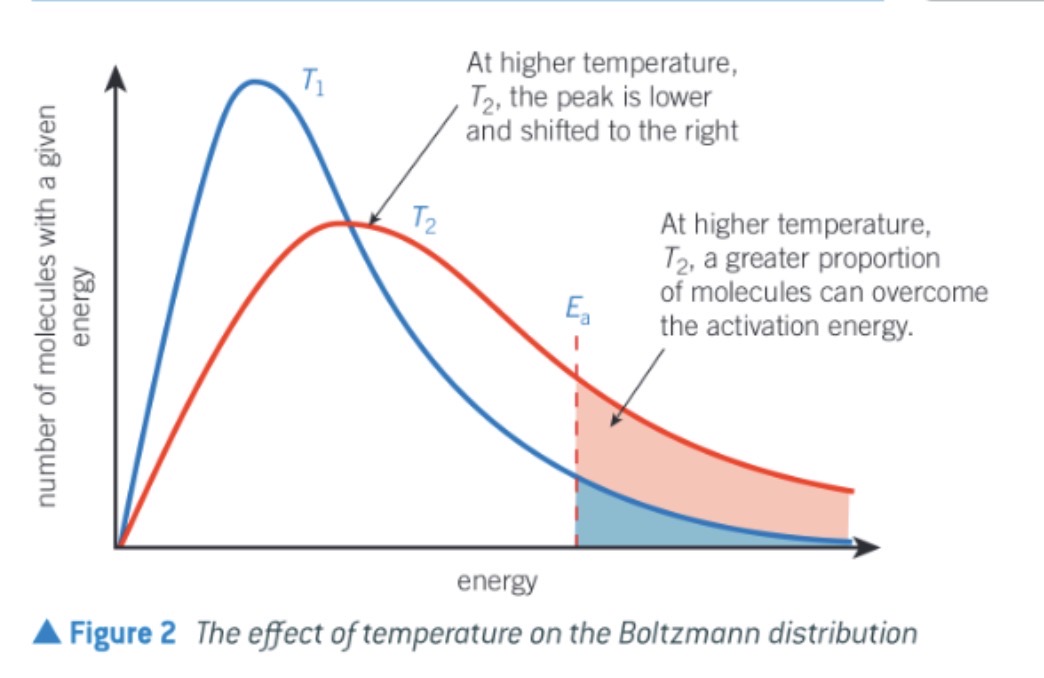
At a higher temperature:
more molecules have an energy greater than or equal to the activation energy
Therefore a greater proportion of collisions will lead to a reaction, increasing the rate of reaction
Collisions will also be more frequent as the molecules are moving faster, but the increased energy of the molecules is much more important than the increased frequency of collisions
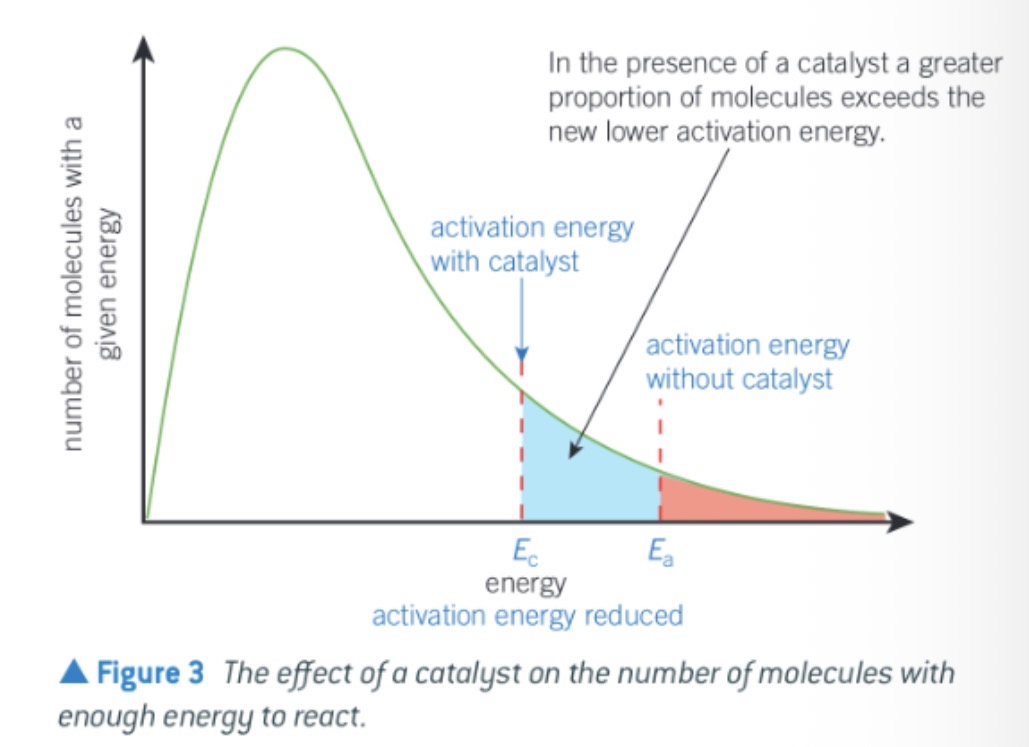
the effect of a catalyst on activation energy:
a catalyst provides an alternative reaction route with a lower activation energy
Compared to activation energy, a greater proportion of molecules now have an energy equal to or greater than the lower activation energy
In collision, more molecules will react to form products. The result is an increase in the rate of reaction